Liquid lightning: The Clear energy of XingYi Quan

Liquid lightning: The Clear energy of XingYi Quan

fists

My friend Scott at the Tabby Cat blog has written a new article on XingYi. Unlike most articles which are concerned with the miniature of detail about how you move the arms and legs, this one is more about what you’re supposed to feel going on inside.

Read it and give it a go!

It’s not the fashion these days to talk about what you should feel in martial arts – as a people we seem more concerned with breaking down which muscle is doing what, or what force vector is going where. So, it’s refreshing to throw that all out and get back to the way Chinese Martial Arts were always taught in the past, which is to get the feel of something, not work it out intellectually.

Enjoy!


Winter training

As Winter draws to a close here’s a little clip I recorded as the UK was getting battered by storms – some branches had come down in the garden so I used them as improv training tools! Clip is a mix of Choy Lee Fut, Tai Chi and a splash of XingYi.

Hope you enjoy – let me know in the comments!

Two sides to the movement coin

There are two sides to the movement coin in Chinese Martial Arts – particularly the so-called internal martial arts. A Yin and a Yang, if you like.
 

Image

On side a) of the movement coin you’ve got a kind of basic postural advice. Directions we’re all familiar with like – ‘suspend the head from above’, ’round the shoulders’, ‘droop the elbows’, etc. The goal of these directions is to achieve a level of relaxation (‘Sung’) through working with the least level of resistance to gravity. If we can align with gravity it becomes our friend, instead of our enemy in movement. We can discover a sense of lightness and ease in our movements.

On the other side b) of the movement coin there are more subtle instructions to do with things like ‘moving from the dantien’, ‘intent’, ‘wrapping and coiling’, ‘silk reeling force’, ‘open and close’, etc… While these terms are generally unknown to people outside of the Chinese Martial Arts, they are usually familiar to people within them, even if we all understand them in slightly different things, and are willing to go to war over the small details!

Obviously (like Yin and Yang) the two sides form a whole, after progressing beyond a basic beginner level most people assume that they’re ok with a) and spend most of their time working out what the heck b) is supposed to be anyway.

I tend to think that there’s more to a) than we tend to think there is. I’d like to suggest that we put the focus on a) as much as on b), since it’s a) that really has the most impact on how we live our day to day life.

Here’s an article that can help. It’s to do with something called The Alexander Technique, but don’t let that put you off. It’s just great advice for how we ‘use the self’ in everyday life, and it relates directly to part a) of the coin I talked about earlier.

Have a read and see what you think.

http://alexanderviolist.wordpress.com/2014/03/20/understanding-the-primary-directions-which-way-is-up/

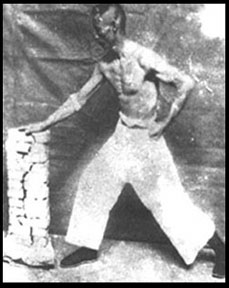
Gu Ru Zhang’s book – Taiji Boxing

Finally, a translation of the Gu Ruzhang (Ku Yu Chang) Tai Chi book, Taiji Boxing, by Brennan Translation. This is the style (a version of it, in the same lineage) of Tai Chi that I personally practice. The form in the book is the long form that he learned from Yang Jian Hou, and you should recognise the postures from other Yang forms. It’s not just a book on form movements, there’s a lot of theory here, much of it from the Tai Chi classics, so it’s worth a read for practitioners of any style.

Master Gu Ru Zhang was also known as “King of Iron Palm”, mainly for doing things like this:

guruzhang3B

His approach to martial arts was to take both Internet and External as a whole. He was most known for his Northern Shaolin, but as his Tai Chi book demonstrates, he practiced soft style martial arts as well, including XingYi and Tai Chi. He was an early proponent of the idea of cross training (mixing martial arts). He obviously saw this as beneficial, and trained in many arts, and enjoyed exchanges with different masters.

Find out more about Master Gu.

The (martial) use of Peng Jin in Tai Chi Chuan

Peng Jin gets talked about all the time in relation to Tai Chi, yet you rarely see anything shown or discussed about its usage and relationship to actual fighting. I wanted to make a video that did that, so here it is!

Tai Chi Chuan, after all, is a martial art, and not just a collection of interesting ways of manipulating ‘force’ in the body for purely health purposes. It’s a martial art that uses Sung Jin, or ‘relaxed force’ in preference to hard strength. One of the reasons why it prefers relaxation over hard strength is that it enables the use of Peng Jin. You simply can’t do Peng Jin unless you are sufficiently relaxed. In terms of martial arts it’s a very useful skill that can be used as shown in the video.

There’s much more to Peng Jin than what I’m showing here – but it would require a much longer video to go into all the intricacies. I don’t, for example, talk about how I’m doing what I’m doing, I just show what the effects are.

Another factor to consider is that Peng Jin should also be a quality that’s always present in the Tai Chi practitioner, rather than something you turn on or off for technique purposes. However it’s the subtle, but powerful, effect of the Peng ‘bounce’ on an opponent that I wanted to demonstrate, so that’s what’s shown here.

The classic “Song of the eight postures” describe Peng Jin as:

“What is the
meaning of
Peng energy?

It is like water
supporting a
moving boat.”

Imagine the way a boat bobs on the water, and that will give you a good insight into Peng.

Walking the circle

Another of the Internal Arts of China is Bagua, the core practice of which is walking a circle with various different palm positions. While I don’t really practice Bagua I do have a great circle walking training tool at my local park. Check it out:

As you can see, it’s important to fit your training into your life, and the local park provides many different training opportunities.

As it says in the Tai Chi Classic,

“In motion the whole body should be light and agile, 
with all parts of the body linked 
as if threaded together.”

Obviously you need to be light and agile to keep your balance while stepping on this childrens’ ride. Lightness and agility are important qualities that need to be trained in Tai Chi, and always practicing on a perfectly flat wooden floor of a dojo, or the flat concrete of a patio won’t help you. I strongly advocate training the form on a variety of surfaces, both even and uneven, sloping, staggered and even moving, as shown here! Also, it never hurts to have a little fun time with your kids 🙂

The problem with push hands

Credit: Image courtesy of http://www.marriedtothesea.com

This blog post is written after reading Scott Phillips’ excellent account of his encounter of pushing hands with another notable Tai Chi blogger… Tabby Cat here.

Interesting post. It reminds me a lot of all the (sometimes depressing) Tai Chi push hands encounters I’ve had with other practitioners. I think the problem is that everybody has a different view of Push hands than everybody else, and these encounters always end up in ‘passive aggressive smiling through gritted teeth’ ideological stand-offs.

My push hands seems to be a lot freer than other people’s. I’m not a fan of this idea that ‘you lose if you move your foot’. As the author says, if your training this as a martial art that’s an absurd conclusion to come to, also moving a foot is yielding, should we not yield now in the art of yielding to force and overcoming it?

But I can also see the value of attribute training.

It comes down to push hands being a useful vehicle for a teacher to use to get across their teaching to a student, but an essentially useless vehicle to test a stranger’s skills out. Sadly it seems to be used for the later all the time!

I don’t know what the solution is. I’m trying to come up with something called GPF Push hands, which is a rule set that will allow for an actual test of skill. (Humorously known as Ground Path Free Push Hands). It’s still a work in progress and the main issue to overcome is ‘what makes this different to wrestling?’

Anyway, you can see a few of my videos of GPF Approved Basic Techniques at:

http://www.YouTube.com/macmus98

The Song of Peng

This week in class we were working on Peng Jin (Ward off energy), the fundamental Yang energy (Jin) of Tai Chi Chuan.

A lot as been written and debated about Peng Jin in Tai Chi circles, but I think the following quote sums it up pretty well, for me at least.

From the classics:

“The Song of Peng

What is the meaning of Peng energy?
It is like the water supporting a moving boat.
First sink the ch’i to the tan-t’ien,
then hold the head as if suspended from above.
The entire body is filled with springlike energy,
opening and closing in a very quick moment.
Even if the opponent uses a thousand pounds of force,
he can be uprooted and made to float without difficulty.

I like the imagry of water and a boat floating on water. I also like to use the imagery of a rubber ball when teaching Peng to people. If you imagined that you were punching a large rubber ball then the bounce-back you’d experience is Peng. The hard part is turning yourself into that rubber ball!

To manifest Peng you need to be relaxed (sung) – excess physical tension really spoils the technique. There are various exercises you can do to help you develop the feeling of Peng, one of which I present here: Hold out your arms and get a partner to press down on your arms, then try to compress their force into your centre and bounce them out. The big mistake you’ll make first is to use your arms too much to try to push them off you – that’s not it. In this video you can see that my arms are nice and relaxed. You’re looking for that springy force coming back up from the ground.

This exercises also requires that your partner hold their arms somewhat rigidly. If they let their arms go all soft and floppy as you bounce them then nothing happens. This is just a training exercise after all, and not a martial technique, so it require some co-operation, so give your training partner a hand and don’t be too difficult to work with!

they pretend to know it by pretending not to know it.

Great blog post.

“Our ancestors are very great, the principle of Taichi is very mysterious and beyond every word,” I heard this all the time.

I am not denying the greatness of that circle composed with two fishes, although according to some experts, the two-fish circle can only be called yin-yang diagram, the real taichi diagram is just a plain circle. Besides, it really looks cool when a person practices taichi in that circle or builds a house by drawing that circle at the center of the house or puts that circle on the clothes. It is so popular that as long as Chinese culture is mentioned, it mostly probably comes out covered with a mysterious face with the introducers’ blinky words. If you have some questions, they would say, “it is normal that you don’t understand, it is very deep and our ancestors are too smart.”

I think just this can best show the attitude of modern Chinese to traditional Chinese culture— they pretend to know it by pretending not to know it.