We talk a lot about alignment in Tai Chi, but often this is done by looking at a static posture. The hip is aligned with the shoulder here, the elbow aligns with the knee here, etc… We do this because it’s easier to do it this way, but we should never forget that alignment is something that happens as you move.
Biomechanist Katy Bowman discusses this often ignored movement aspect of alignment in the first episode of the Katy Says podcast.
Give it a listen. I particularly like the analogy that ergonomics is the best way to stay on a sinking ship.
A lot of people are attracted to Tai Chi because of the associated Taoist philosophy. It turns out that there’s perhaps less historical proof of a link between Tai Chi and Taoism than some people would like. You can think of Taoism more as an intellectual ‘bolt on’ addition to an existing martial art, or perhaps as a reimagining of Taoism In Action in the 1900s, a bit like when somebody remixes the classic Beatles albums with a modern house groove. But anyway, for whatever valid (or invalid), historical reasons, Taoism and Tai Chi are now part and parcel of the same package.
I think a lot of Westerners are attracted to Taoism (and Buddhism) because it represents something that has been lost in our culture. (Ironically it’s probably even harder to find in modern, face-obsessed, materialistic 20th Century Chinese culture, but that’s another story). But it wasn’t always like this. Ancient Greece and Rome had some of the same ideas represented in their various schools of philosophy. Philosophy to them wasn’t the dead, academic, historical subject that we know today. It was a living breathing thing that hadn’t been pummelled to death by religion yet.
Stoicism is one of the philosophical schools of ancient Greece and Rome that appeals to me – it tends towards the practical, the ‘how to live your life well’, of Taoism, with probably a bit more real-world applicability and more obvious steps to get somewhere. It was followed by slaves and emperors, so it must have been useful for all walks of life. Thanks to the Stoicism Today page you can become a Stoic for a week – give the philosophy a spin, and let it marinate in your brain for a while.
Go on, it’s free – try the one week course – your slaves will thank you for it:
“When the opponent is hard and I am soft,
it is called tsou [yielding].”
The idea of yielding to overcome is the main combat strategy of Tai Chi Chuan, but there are various ways of thinking about this idea. It’s another way of saying to use your opponent’s strength against them. Recently I found another way of thinking about this that you might find useful.
“In the martial arts, there is often talk of taking the opponent’s strength and using it against him, but normally this is illustrated in books and films with a woman performing a judo throw on a male aggressor. But I contend that there is no better example of using and opponent’s strength against him than drawing him onto your blows and having him double the force for you.”
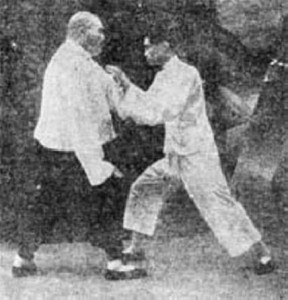
One of the things that get belittled about Tai Chi Chuan so much is the amount of pushing that goes on. From the point of view of other martial arts it’s impossible to look at people struggling for years to effectively push somebody away in the most relaxed way possible and not wonder if they’ve missed the point of martial arts entirely.
Tai Chi push
Of course, the standard answers to this type of criticism are that “if you can push, you can hit!”, “it’s just a training tool”, “it’s so nobody gets hurt”. This may all be true, but there never seems to be any hitting going on, long after the ability to push has been acquired.
Perhaps another way to look at it is that pushing, far from being an ineffectual tool in the fighters arsenal, is actually a very valuable skill to acquire. Read this article about the famous kick-boxer, Giorgio Petrosyan. The summary is, he uses the push technique effectively to counter pretty much all offense that’s thrown his way.
Pushing the opponent away.
Perhaps Tai Chi needs to reclaim its “push” as just what it says on the tin – a push – and stop trying to pretend it’s for something else. Because, frankly, it’s pretty damn useful.
It’s interesting that a lot of Tai Chi people have Push “An” as a downward push – almost like a takedown done from a push, but without the leg trip. I’m dubious about this – I don’t think it works well beyond the Master’s doe-eyed students. Looking at the motion of any Tai Chi form, you can see that the motion of An is up, up, up and away. I’d suggest that’s how it’s meant to be used. I think some of the ‘push down’ is to crowbar Tai Chi into a philosophy.
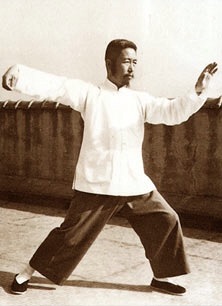
This is the ‘end point’ of the Single Whip posture. Like many, if not all, the postures in a Taichi form, it doesn’t look much like something you’d see in a fight. Why is this?
Even when demonstrated by the practical, hardcore, or no-nonsense tribe of Tai Chi practitioners, it’s a pretty absurd fighting application. That’s just my opinion, so feel free to reject it, but to be honest, a lot of Chinese martial art is pretty absurd, when it comes to fighting applications (“Monkey steals the peach!”, anyone?) Even the ruthlessly practical styles have a few applications that are aways on the edge, but anyway…
I was picking up on this old post from internal strength adept Mike Sigman:
“Silk-Reeling and the Taiji of Yin-Yang
There are two basic martial-arts postures in Asian martial-arts: Open and Close. In “Close” there is stress inward along the front of the body and the inward parts of the limbs; the knees and elbows and the joints bend and are generally under contractile forces of the front. Wing Chun’s basic stance, Uechi Ryu karate’s basic stance, “Play PiPa” (in Taiji), the closed aspect of “Squatting Monkey” (in Dai Family Xinyi), and in many other martial arts can be found variations of the Closed position of stances.
In “Open” the expansive forces from the back of the body and the outsides of the limbs pull the knees and elbows outward and the body lengthens, joints opening. Postures like “Single Whip” exemplify Open. In classically correct postures there is always a balance of the forces of Close and Open or Yin and Yang.”
So, if the point of practicing a Tai Chi form is to get used to going from open to closed in a sequence of postures, perhaps it becomes less relevant what those postures are. Of course, this implies that the form isn’t really for fighting, and that it’s for teaching a body method, which you then use in fighting… which means that the “fighting” probably doesn’t look any different to regular “fighting”, whatever that may be….
If you want to go from close to open then why not create a nice series of postures rather than simply repeat the same movement over and over. That way you get used to doing it in a good variety of positions.
This is about the fine differences between Tai Chi and Xingyi. Watch this video (some wisdom from the pear tree) first, then carry on reading:
Generally, and as written in the classics, the power comes from the ground up in Tai Chi. I’m not saying you don’t want to start striking until your front foot has hit the floor – that would obviously be ridiculous – but in Tai Chi you do generally move your weight onto the foot in a kind for rolling motion. Just look at any Tai Chi form:
Yang, for example,:
But it’s the same for all of them generally speaking. Moving into a forward posture your weight moves into the technique, which could be a punch, for example, or something else. If it’s not meant to be like this, then all the forms must be wrong and for reasons that are unclear we’re all training to do it wrong so we can do it differently in application? I don’t think so. It’s effective, it works, it’s just different to Xingyi.
Xingyi example showing how stepping is different:
It ties into the strategy of tai chi as well – you train push hands to be good at the ‘in contact’ range, where you can generate power from weight shifts forward and back, without the need to step -e.g. Person punches you, you contact their arm, shift your weight back and turn the waist, deflecting them into emptiness, so you can strike back with ease with a forward weight shift. No stepping even necessary. It’s a good range to work grappling techniques as well.
Generally speaking, and ignoring the animals that like to grapple, Xingyi does not want to be in the ‘in contact’ range as much – you want to be out or in. It’s origin lies in sharp weapons – think about that.
As the classics say, it is rooted in the feet, issued by the legs, controlled by the waist, and expressed in the fingers – some, people might call that ‘all together’ but to me that’s more like a sequence. It can all happen in a microsecond, but it happens from the ground up. Xingyi is different, which is why the footwork is so different. Which is my point in the video. Watch again as I demonstrate it physically – when you use words it’s very open to misinterpretation. Right at the end I do both methods side by side for comparison – they both work, they are just different. Like the way Hyenas and Dogs are different.
This is one of the reasons I’m writing it – although I’d actually written it before I read that blog post. But I love the point he makes about seeing differences between things that are very similar. Worth pondering.
Guy trains hard with lions, becomes a lion! Becomes so good he can do it by being soft and using minimum effort. Teaches this soft lamb way to all his students because its obviously superior. None of the new lamb students really get it. The founder dies. The lamb students soon realise that nobody has it and go back to find what the founder did originally to get that good.
It turns out it was to train hard like a lion, with other lions!
A very interesting post on Fightland about the modern Chinese fighter. I like the point about the increased appetite for realism under a regime where most things are fake. Read it here:





 The Tai Chi Notebook
