Friend of the Notebook, Byron Jacobs, who lives in Beijing, recently posted a video giving a glimpse into the martial arts culture found in Beijing parks. You can see people doing all sorts of martial practices, like calisthenics, chi kung, Tai Chi, sword and push hands.
Byron comments:
“Beijing’s public spaces and parks have been gathering places for people from all walks of life for generations. This includes martial artists, who would meet regularly at such places to practice as part of their general lifestyle. Throughout the many parks of the capital, you can find practitioners of various styles and standards getting together to train regularly. This is a glimpse of some of these special places. The first episode features the Temple of Heaven.”
I wrote a blog post a while ago about standing in a deep horse stance when brushing your teeth as a life hack for building leg strength. It was a bit of a throw-away post, but surprisingly it consistently turns up in my blog statistics as one of my most popular stories.
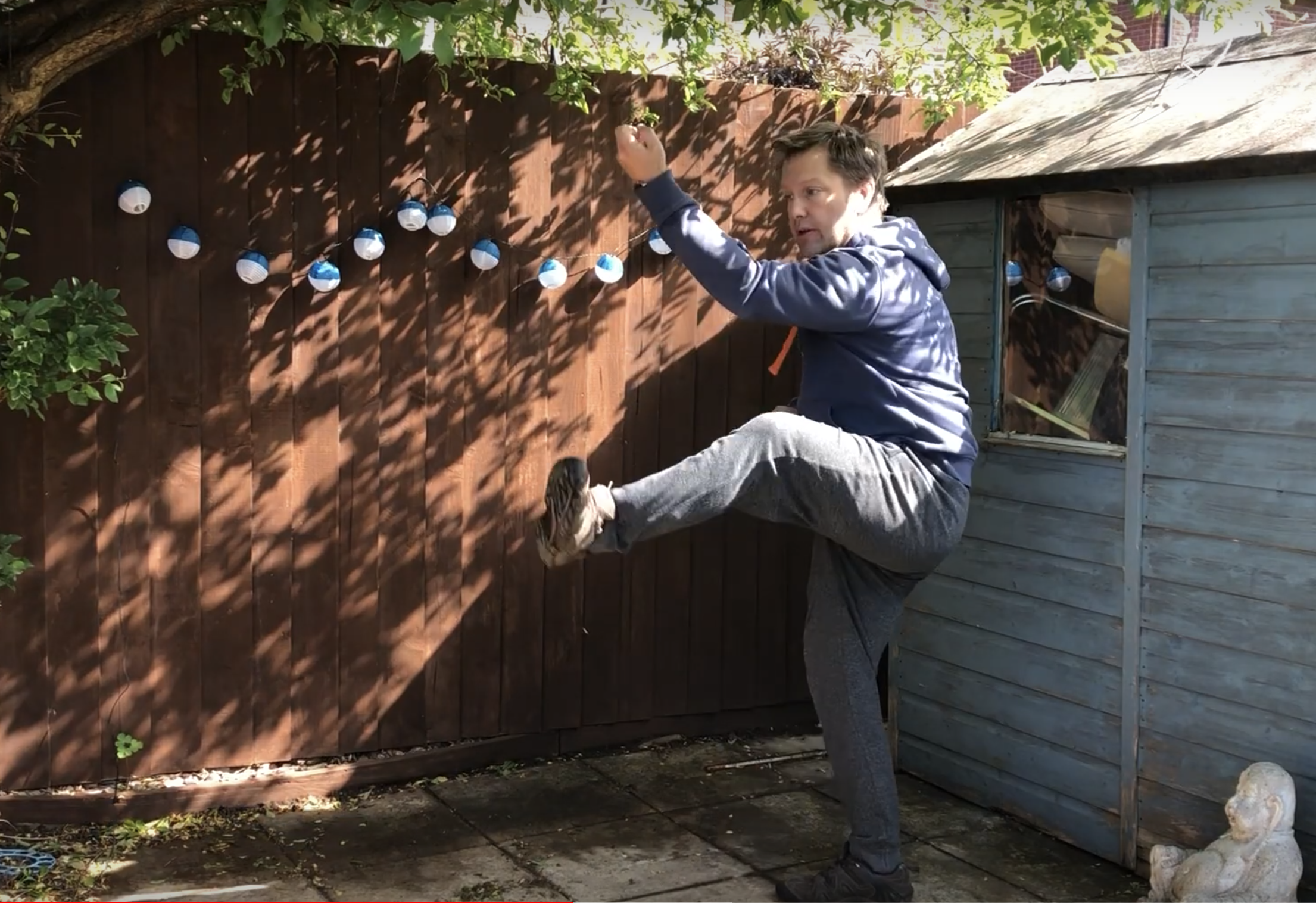
Michael does something similar while brushing his teeth, but he stands on one leg instead.
It turns out that your ability to stand on one leg for an extended period of time is a good indicator of how long you’re going to live, and it decreases significantly after age 35. It’s something to do with the brain slowing down as we age and the fact that balance requires the integration of so many body systems, but the good news is that we can improve our balance with practice.
You can give yourself a little test of your balance right now, if you like. Try and stand on one leg for 30 seconds each side, and for 10 seconds with your eyes shut. Be careful though, standing on one leg with your eyes shut is very tricky!
So, what’s the best way to improve you balance? Professor Dawn Skelton from Glasgow Caledonian University was interviewed in the programme about all things relating to balance, and at 10 minutes 59 seconds she recommends Tai Chi as one of the best activities to improve your balance and prevent your first serious fall – especially for old people. It is 3 dimensional movement, so your head moves at different times to the rest of your body, and because it’s slow and controlled you get great feedback from joints.
So, there you go – yet more evidence that Tai Chi is good for you and will help you live longer!
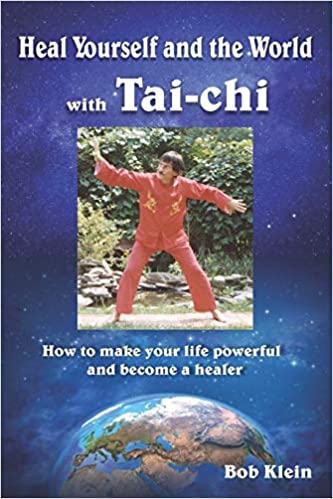
Bob Klein first studied Tai Chi Chuan fifty years ago with Grandmaster William C. C. Chen, and also owned an animal importing business, which gave him a ready supply of exotic animals to test his martial skills against. In a method that sounds similar to the legendary founding tales of many Chinese martial arts, Bob observed the wild animals, and learned their fighting ticks. Bob describes the process as learning the “pattern of attention” of each species, which he then tried to adopt in himself in sparring and Chi Kung, creating his own system, Zookinesis, along the way.
“The imported animals were often not in a good mood as they emerged from their shipping containers and I was attacked frequently.”, explains Bob. “Many of the animals were stronger and faster than I so I had to use my skill in controlling their attention. There were many close calls and I had many scars”, he observes.
Klein also traveled to the jungles of Central America several times to study animals in the wild. “I would buy a dugout canoe and spend a few months paddling along rivers, meeting the wildlife and people.”
The result of this study is the system of chi kung he calls “Zookinesis” (“animal exercises”) and the fighting system called “Phantom Kung-fu”, which is the result of his Tai Chi Chuan influenced by Zookinesis. Zookinesis seems to evolve into the wider world of healing and being in harmony with nature.
The book, Heal yourself and the world with Tai Chi is as much about Zookinesis as it is about Tai Chi. It’s not a “teach yourself Tai Chi” type of guide, or a deep dive into history. Instead, I’d describe it as a kind of stream of consciousness on the subject of animism, Tai Chi, energy flow and spirituality. There are headings and there are chapters, but I don’t really feel like they matter much. You could dip in at any point and just start reading. Stop, flick on 20 pages and read a bit more. Go back 40 pages. And so on. That’s not to say it’s not a well written book, but a reader looking for a more organised, practical or logical system to unpick will be disappointed.
Here are some examples of paragraph I’ve picked at random to give you an example of the sort of text it contains:
“Small children in our society usually draw people as big heads with tiny arms and legs sticking out of the heads. I wonder if they are just seeing the distribution of attention in a person, and drawing their pictures accurately from that perspective.”
In fact, Klein’s work makes a nice contrast to the often fractious world of online Tai Chi discussion. His musings are marvelously inofensive and do a good job of framing his points of reference. He has no interest in denigrating other styles of Tai Chi or teachers, exposing fake histories or arguing with anybody else about what ‘real’ Tai Chi is.
No egos were harmed in the making of this book. If you’re looking for a philosophical meander through many of spirituality’s greatest hits then you’ve come to the right place. Step inside, pour yourself a cup of green tea and let the zookinesis flow.
I remember when I started Tai Chi in the 90s, one of the things that was talked about a lot was that you should never let your knees go beyond the line of your toes in a forward stance.
YCF: Knees not extending past the line of the toes.
Letting this happen was always seen as unequivocally bad. Not only was knees beyond toes seen as structurally unsound (your weight is too far forward making you easy to pull off balance), but this was seen as the primary cause of the epidemic of so many Tai Chi people having bad knees.
The Snake Creeps Down posture in particular was quite often used as an example of a badly done posture by Western dilettantes.
But it always struck me as a bit odd that it was seen as being such a dangerous thing to do. If you were training the martial side of Tai Chi then you were being punched, thrown and armlocked on the regular. Worrying about your knees going over the line of your toes seemed a minor danger in comparrison.
Fast forward to 2021 and today I found out that a lot of BJJ people (an art that specialises in slowly destroying your body over time) were raving about the benefits of the method espoused by the Knees Over Toes Guy on YouTube, who had achieved great results reparing people’s knees using a traning methods that empahsises, yes, you guessed it, putting your knees beyond the line of your toes as much as possible.
Interesting. Here’s what he says:
A year went by with no results. In fact, I was certain I needed another surgery when a spark of truth finally presented itself…
“The athlete whose knees can go farthest and strongest over his or her toes is the most protected.”
Everything I had been taught up to this point by dozens of trainers and physical therapists was very clear: NO KNEES OVER TOES — but when I read this statement, I immediately knew it was true.
Knees Over Toes Guy
The write up of his method is here. And here’s a video of his basic method is here:
The logic seems sound to me, so if you’ve got knee trouble, you might want to give it a try.
It makes me think – is the epidemic of Tai Chi people with bad knees (if it really exists) caused by the knees going over the toes? Or is it more likely because that group self-selects for other unhealthy behviours?
True or not, he makes a good case for the move not being the backfist or punch it is usually shown as, and being a throw instead. In a way, there’s no right answer – the move is whatever you use it for.
But it made me think a lot about how Kung Fu postures are repurposed and reused through the years.
If we go back to one of the earliest written descriptions of Kung Fu by General Qi Jinguang in his “Boxing Classic” of 1560 we can see that all he’s showing are a series of still postures with written verse about the move in question.
You can see that the first posture shown, “Lazily pulling back the robe” shares some similarties with the posture discussed above.
Lazily pulling back the robe, Qi Jinguang, 1560
A Confucian cuture of respect for tradition and elders would naturally lead to respect for older kung fu postures, and you can see how they would get reused and repurposed to fit new needs over the generations.
I bet the current Yang style Single Whip posture is not chosen because it’s the optimal way of pushing forward with a single palm. Instead, it’s more likely a posture that has been passed down from older generations. Maybe it’s original meaning (if it had one) has been lost, over the years. Maybe it was once a Suai Jiao throw? Maybe it was once a posture from Chinese theatre or religious ritual? Who knows.
The important thing is, as always, what can you do with it now?
One admonition from Yang Cheng Fu’s 10 important points, that has become something of a law in Tai Chi Chuan, is to ‘keep the head suspended, as if from above’. In the Tai Chi Classics it also states “Stand like a perfectly balanced scale and move like a turning wheel”, whilst also saying, “Don’t lean in any direction; suddenly appear, suddenly disappear.”
These quotes have produced all sorts of controversies in the Yang style side of the Tai Chi universe. If you look at ChengFu’s student Cheng ManChing, who did so much to popularise Tai Chi in the West, you can see that he changed his form to truly embody this principle of suspending the head and standing like a perfectly balanced scale. In a forward posture, Cheng ManChing kept his head, neck and back vertical in relation to the ground at all times. He allowed no forward incline at all. To stay vertical he softened his back knee a bit, which removed the straight line from the heel to the head, producing a much softer posture than his teacher, Yang Cheng-Fu, exhibited.
Whereas, if you look at pictures of Yang Cheng-Fu in a similar forward posture you can clearly see that he holds his head in the same vertical alignment, but holds his back with a slight forward incline. He keeps his back leg straighter, forming a straight line from his back heel to his head, meaning that his posture is slightly harder than Cheng ManChings, and he exerts more of a forward pressure.
Both of these approaches can be seen as interpreting the advice to not “lean in any direction” differently. The situation becomes even more confusing when you look at the Wu style of Tai Chi Chuan, derived from the version of the form practiced by ChengFu’s peer Wu Jianquan. Wu holds an even more inclined position, which keeps the head vertical, but often seems to break the line at the hip, so that the back heel is no longer in a straight line all the way to the head. Being of Manchu heritage, Wu Jianquan had a shuai-jiao background. He was taught martial arts by his father who was a student of Yang LuChan and also a cavalry officer and imperial palace guard, as he was, so a change in his preference for grappling techniques could very well account for the changes in his version of the form.
I used to ponder these discrepancies a lot, but these days I have become more interested in the relation of the back (including the neck) to the hands and arms, regardless of its orientation in the vertical plane. When we lift and use our arms our tendency is to bend the top of our spine and drop the head forwards, a fact that can be proved each and every time you type on a laptop. The next time you’re sitting at a laptop observe what happens when you start to type. Notice that your head wants to move towards your focus of attention, the object you are interacting with.
Recently I was watching an excellent performance by a child doing Bak Sing Choy Li Fut, filmed in the 1960s. Young children doing martial arts can be great teachers because they effortlessly keep their posture as they move. It is only as we become adults that we seem to lose this ability.
Search for the video “Old Kung Fu Footage in Hong Kong in the 1960’s” on YouTube and you’ll see what I mean. Watch the good posture he keeps throughout – his back remains still in relation to the movement of his arms allowing his neck to stay extended and space and awareness to be present.
This is what I think is being asked for in Yang Cheng-Fu’s writings and the Tai Chi Classics, not mere fussing about how vertical a posture is. What is required is the freedom to move our arms, but to keep our back still, and maintain our head and neck relationship without falling into the trap of bending towards the object of our attention.
But how do we train this? Here’s something simple you can try. Get a 4-pint carton of milk out of the fridge and swing it in a figure of 8 in front of you. Now do it again and notice how you head wants to be pulled forward. Resist the pull and feel the work done by the neck and back muscles to prevent it from happening. It shouldn’t feel like they’re straining, but they should feel active.
You can do the same thing with a heavy sword, of course, if you want to look more like a traditional martial artist, and less like a deranged milk man. And once you get a feeling for it you can try it without a heavy object, in which case it becomes more like a silk reeling exercise, or you can try and keep the same feeling when you do the Tai Chi form. In which case it doesn’t look like anything.
Obviously, when you are standing still, or sitting, in meditation you can achieve the same relationship of the torso, neck, head and arms but with even less use of muscle to maintain the position. Initially at least. If you try standing in a Zhan Zhuang posture with your arms extended for a few minutes you’ll start to feel your neck and shoulder muscles tighten. This is where you need to work on relaxing them, yet maintaining your posture. You need to let the weight of the upper body rest on the lower body, and flow down into the ground through the centre of the foot, or through the sitting bones if you are seated.
A human head is quite heavy, at around 5KG, which is a lot more than a typical bowling ball weighs. If the head moves forward of the hips too far then we have to start using a lot of muscle to hold it up. In a way, the neck being tense, or feeling tired, after we’ve been doing an activity is a warning sign that we’re not using our body to the best of our ability. If we can maintain the relaxed, neutral, position of the neck through movement, then the weight of the head is transfered down to the ground through our frame instead. Our breathing will be better, and we won’t lose that sense of lightness and ease that the kid in the Choy Li Fut video from the 1960s so effortlessly demonstrates.
Finally, his idea of keeping an open relationship between the head, neck, back and arms raises a few good questions when applied to martial arts. What springs first to my mind is, should you have your head in that position to fight? I’d say probably not – you want to tuck your chin in a bit more when you fight, for obvious reasons, but the real question is how you tuck your chin. The idea of the extended neck that you’re training by working on your posture can be transferred into the way you tuck your chin. Dropping the head towards the opponent has all the same disadvantages we’ve outlined above when applied to martial arts, and will inhibit the free movement of your arms, so critical to fluid punching, not to mention making you more hittable.
So, keep your head up, as people say to you when you’re looking down. Walk lightly, smile brightly!
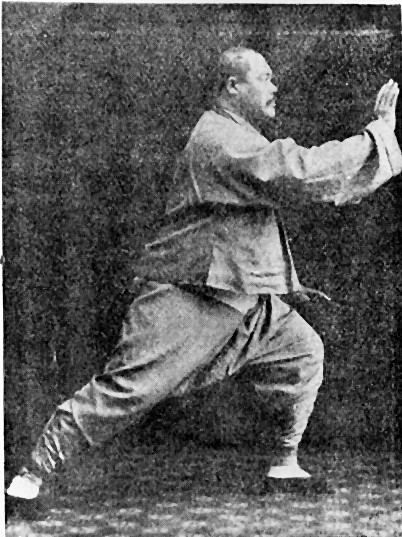
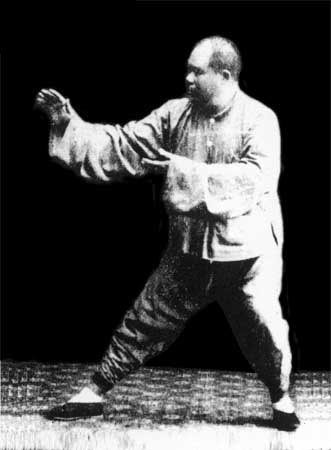
I thought I’d start a series of posts commenting on what I like about photos of famous masters of the past. I thought I’d start with this photo of Yang Cheng-Fu doing rollback from the Yang long form.
Yang Chengfu, Rollback.
Yang Cheng-Fu comes in for a lot of criticism, mainly I think because of his weight. He was a big man, but I’ve always been impressed with how precise and delicate his postures seem to be. What I like most about this picture is that you can almost feel the heaviness and sinking in what he’s doing, yet at the same time there is the precise placing of his hands and feet.
Tai Chi is a paradox in that you are supposed to feel light yet also heavy. According to the Tai Chi Classics your head needs to feel like it is being pulled up “as if suspended from above”, and yet your body needs to also have the feeling of sinking, “Make the chi sink calmly” and “The abdomen relaxes, then the chi sinks into the bones.”
You can see both these qualities in Yang Cheng-Fu performing Rollback, head upright, light and nimble, yet also firm and heavy. With the placement of his hands you also get a sense of the yin and yang being distributed throughout his body. The back hand has the intent of pulling and the front hand has the intent of pushing. He is not “double weighted” – each hand is expressing a different energy. The weight on his feet is on the back leg – again, not in no man’s land in the middle, but clearly distinguished.
You also get a sense of calm. This is not a frantic and hurried performance. It’s slow and deliberate, like a great river rolling.
“When the opponent expands, I contract. When he contracts, I expand. And, when there is an opportunity, I do not hit – it hits all by itself.” ― Bruce Lee
Practicing both Xing Yi and Tai Chi together helps you gain insights into both arts. Here’s what occured to me this morning: If you were to strip down Tai Chi and Xing Yi forms to their essentials then Tai Chi is a series of deflecting moves interspersed with occasional punches or kicks, and Xing Yi is a series of punches or kicks interspersed with occasional deflecting moves.
That’s a gross simplification, but I think it’s true to some extent. It’s what makes the two arts good companions for each other.
I’ve written before about not putting power in the form, but in a related note I think the idea of not using your arm to punch is another way of looking at it from a more Xing Yi perspective. It’s the same nut, just another way to crack it.
The famous Tai Chi practitioner, Cheng Man Ching, is said to have had a dream in which he had no arms, and it was only after that that he grasped the secret of pushing hands. The secret was that pushing hands had nothing to do with hands at all, and he credited this dream with in his ability to push people.
But I find it a lot easier to understand the ‘not using your hands’ thing when you are constantly pushing and deflecting. It’s a lot harder to do it when you are striking.
Xing Yi is obsessed with striking. Most of the forms are a series of strikes linked together (called “links” – Lian Huan). I’ve come to appreciate however that the key to it is to not use your arm to strike. I mean, yes, your arm is doing the striking, of course, but it’s like it’s not involved in the process. I’m thinking about what Bruce Lee said when he said “it hits all by itself”. But while I believe Lee was talking about a more spiritual process (the top line of the hexagram), I’m thinking about a more mid-line process that’s rooted in the body. The hand moves into the position you want, but what moves it there has nothing to do with the arm at all, it’s all from the body. I find that when Xing Yi becomes “too much in the arm” it ceases to be the art it’s supposed to be.
Paradoxically by trying to hit hard, you ruin it. You’ve got to ease back a little bit – take your foot slightly off he gas and let the body do the work, almost as if you are a craftsman using a tool skillfully (your body) rather than making a great effort to get things done and just making a mess in the process.
I had an interesting conversation with a reader recently about Tai Chi and butts, which I thought I’d share as it’s a good topic. A lot of Tai Chi people, me included, tend to stick out their bottom slightly during form and push hands. Maybe more so in push hands… either way, it’s a fault that inhibits relaxation.
I think in push hands it happens because people try to “brace” against the incoming force to stop themselves being pushed backwards, but by going for a short term solution they are inhibiting their progress in the long term.
Q: Do you have any experience of Chen style TCC? I’ve been to a few lessons. Seems like, in order to soften the kua sufficiently, you need to stick your backside out more than in Yang….?! Having spent a whole lifetime trying not to do this, it feels weird…..!
A: I’ve never really done Chen style, but I’ve looked into their silk reeling exercises quite a bit – just the simple one hand “wave” – I really like that and do it quite often.
I’ve seen some Chen stylists that stick their butt out a lot, but to be fair I’ve also seen a lot of Yang styists do the same. I think as part of an opening and closing movement it’s ok (like in Yoga, for example), but leaving it “stuck out” all the time can’t be right. Tai Chi requires you to move from the waist (or the dantien, if you like) and that encompasses both the front (belly), sides and back of the body around the waist line – the lower back is part of that. If you put your hands on your lower back then stick your butt out you can feel your muscles contract and tighten – having a tight lower back as your default means you can’t effectively “move from the dantien” so everything else you do, no matter how clever or artful looking, has to be wrong because the foundation is wrong.
When doing silk reeling exercises I try to keep my lower back relaxed and “hanging down” – that’s the right feel – so the movement can originate there. The form should be no different. I feel like the people who stick out their butt have simply missed an obvious problem with their Tai Chi.
We all have blind spots. If you went outside and did your Tai Chi form right now I can guarantee you there’s a bit of it that you’ve never really paid attention to. I don’t mean something big, like a whole movement, but there will be lots of little spots which you’re glossing over your form without full awareness.
Try this as an exercise: Go through your Tai Chi form right now, but as you do each posture pay attention only to the way the joints of the body open and close. But here’s the thing – I’m not saying, make them open and close.
This is a crucial difference. If you try and make them open and close you just end up ruining your form, or being “too physical” as my teacher likes to say. Just use your awareness to be the silent observer of yourself as you do the form. And try and focus that awareness on the way your joints are opening and closing. Pick the easy ones to start with – the shoulder/hip, elbow/knee and ankle/wrist relationships. Try and see if you can maintain awareness of all 3 pairs and how they open and close as you move through the postures. The postures, done correctly, are designed to allow them to open and close – there’s nothing extra you need to add. If that’s too much too mentally juggle at once then just pick one pair to be aware of for the entire length of the form. Shoulders and hips is a good one. There are many more ‘joints’ to be aware of, of course, but that will do for now.
I don’t want to spoil the experience for you, so if you’d like to discover what this training method can do for yourself, then stop reading here and come back when you’ve done it.
Remember that joke – ‘Don’t think of an elephant’? This picture reminds me of that. 🙂 Photo by Pixabay on Pexels.com
Still with me? Ok, let’s go on…
What I find when I do this is that the simple act of being aware of something changes it, without me having to do anything. For me, this exercise highlights the areas of the form that I’ve been glossing over, and from that awareness, a new form begins, one that is more complete and better.
As the great Taoist sage Lao Tse wrote:
10
Can you coax your mind from its wandering
and keep to the original oneness?
Can you let your body become
supple as a newborn child’s?
Can you cleanse your inner vision
until you see nothing but the light?
Can you love people and lead them
without imposing your will?
Can you deal with the most vital matters
by letting events take their course?
Can you step back from you own mind
and thus understand all things? Giving birth and nourishing,
having without possessing,
acting with no expectations,
leading and not trying to control:
this is the supreme virtue.
In fact, that’s just one example, the whole Tao Te Ching is full of the benefits of this sort of Wu-Wei “non-action”.
These blind spots in your Tai Chi are usually found in the transitions between what we think of as “postures”. The in-between bits. The space between the notes, as the great French composer Claude Debussy famously said, was where the music is found.
This discovery poses an interesting question not only for your Tai Chi, but for your life too. Where are your blind spots? What are you not really paying attention to? I think you know what to do now.




 The Tai Chi Notebook