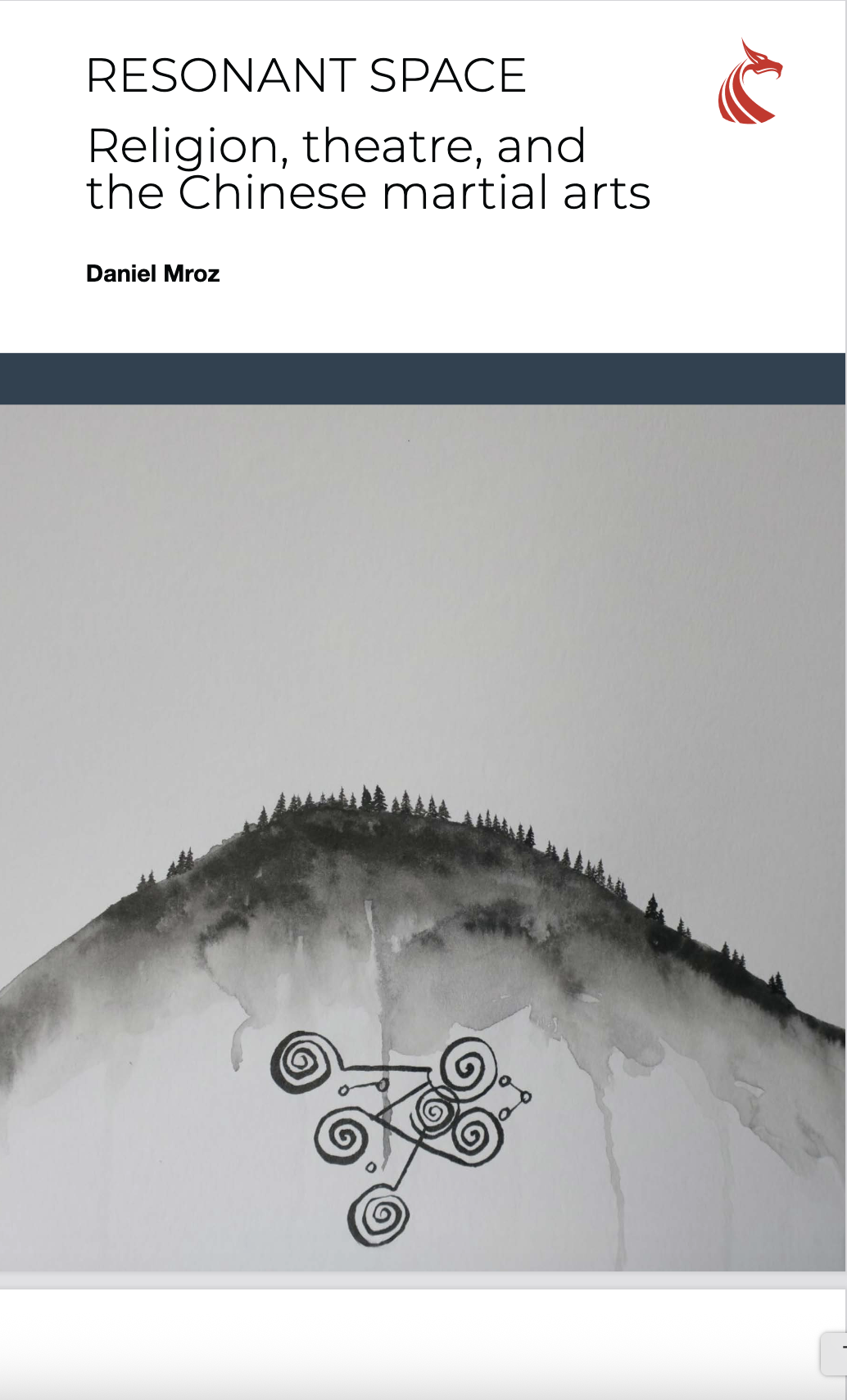
Religion, Theatre, and the Chinese Martial Arts, by Daniel Mroz
My good friend Daniel Mroz’s new book Resonant Space is out now! Daniel was the first guest on my podcast — back when I had no idea what I was doing with recording and editing audio, so it sounds pretty bad compared to my more recent efforts. However, what he talked about remains as insightful and up to date now as it did then. This book takes his ideas even further.
Here’s the blurb:
“Resonant Space constellates the martial, ritual, and theatrical elements of the Chinese martial arts with the practice of contemporary theatre and dance. This interdisciplinary approach blends the embodied experiences of the author, a lifelong student of the Chinese martial arts and a theatre director and dance dramaturg, with the study of Chinese cultural history. This is a work for scholars and practitioners of the Chinese martial arts, of contemporary dance and theatre, and for scholars of Chinese religion and cultural history.”
If you are at all interested in the intersection of Chinese martial arts, magic, theatre, military methods, violence, dance, self defence and religion, then you can’t miss this. I have read bits of this book already (it’s excellent), but I haven’t read it all yet, so I’m yet to appreciate it as a whole, and to see how he makes all the pieces fit together. I’m very excited to finally get to read the complete thing.
If you’re a practitioner of Chinese marital arts, then I can guarantee that this book will make you think. In good ways. There’s almost an embarrassment of riches packed into every page. So, rather than attempt to describe it, I thought I’d just throw three random quotes at you from the first chapter of the book, without context. Hopefully they’ll make you want to find out more.
“In the Chinese martial arts and in military strategy more generally, excellence in fighting is secondary to trickery and wisdom.”
“Perhaps the most famous failure of war magic was experienced by the Yìhéquán 義和拳 fighters of the Boxer Rebellion of 1899, who discovered they were not impervious to the bullets of Western colonial powers.”
“Given its spectacular nature and emphasis on dramatic fights, it comes as no surprise that Chinese theatre, or xìqǔ 戲曲, employs many training methods that are virtually identical to those used in martial arts.”
Again, you can read the whole book for FREE from Cardiff University Press as a PDF, or you can buy a printed copy for a reasonable price. Don’t miss this!
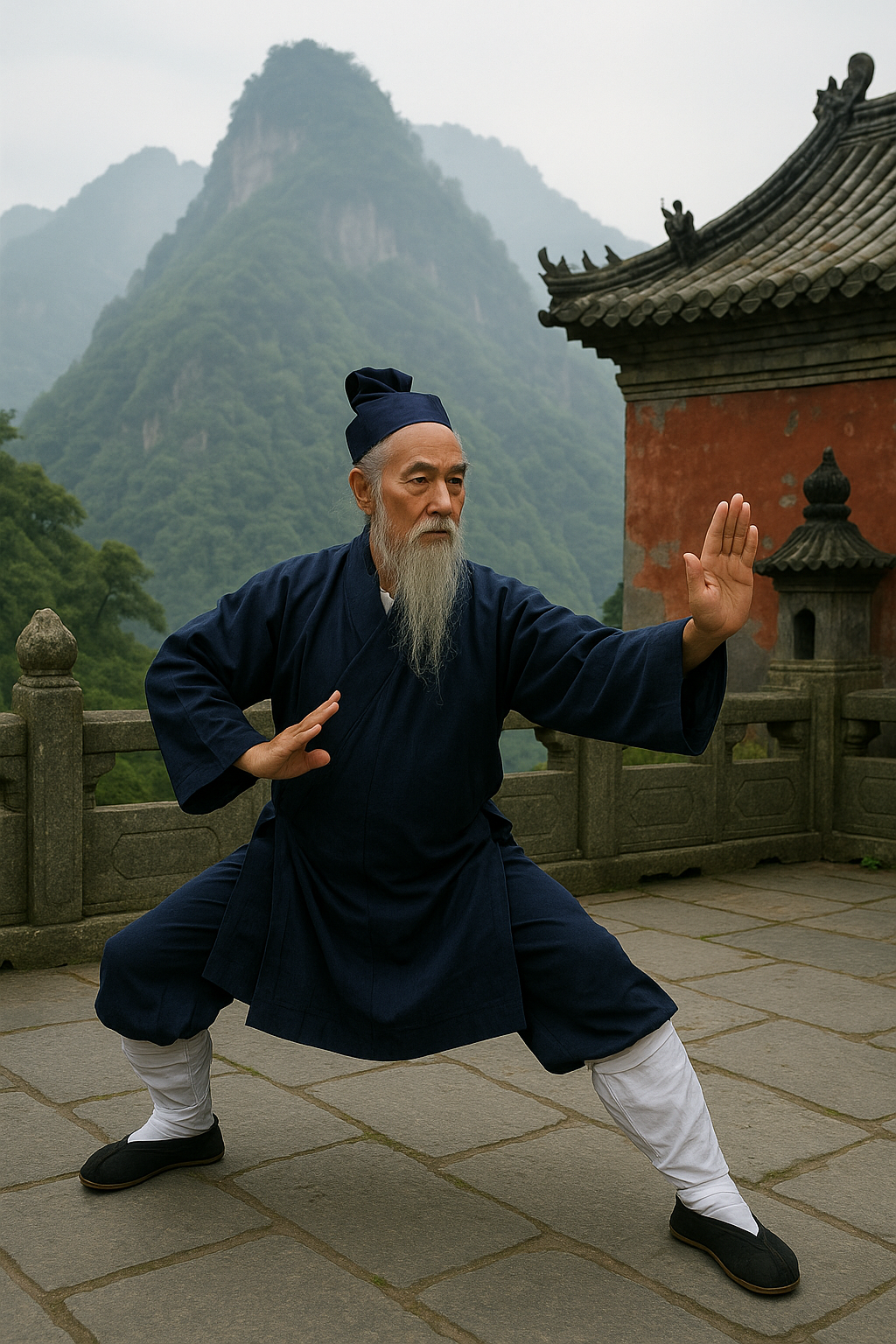
(FYI AI-generated image of a monk practicing martial arts at Wudang).
This is an excellent article called The Sacred Cash Cow: Wudang Mountain’s Martial Arts Tourism Empire by The_Neidan_Master on the massive amount of commercialisation of the martial arts in Wudang, which has really leaned into its claims as the birthplace of tai chi.
I don’t think it’s worth debating the authenticity of these claims again, I’ve done a couple of podcasts with people who have lived at Wudang and trained there, one with Simon Cox, and the other with George Thompson – both very different experiences, which reflects the diversity over such a wide area, since Wudang is a vast collection of mountains and temples/schools, rather than a single place – and I don’t know what more is gained by going over that ground, but I think it’s better to simply accept that there is a growing cultural force that is pushing Wudang, a traditional home of Taoist studies, as one of the centers of modern tai chi training.
If your goal is to train tai chi at Wudang then its worth reading the article to get a balanced view of the place before going there.
Here’s a great quote:
“For travelers seeking authentic martial arts experiences at Wudang, awareness of these commercial realities provides crucial context. Understanding that most schools are modern businesses rather than ancient temples allows for more informed decisions about where and how to invest time and money.”
I think we have to accept that for ancient traditions to exist and continue in the modern age there needs to be some soft of commercial aspect, but that means that you need to approach these traditions with eyes wide open.
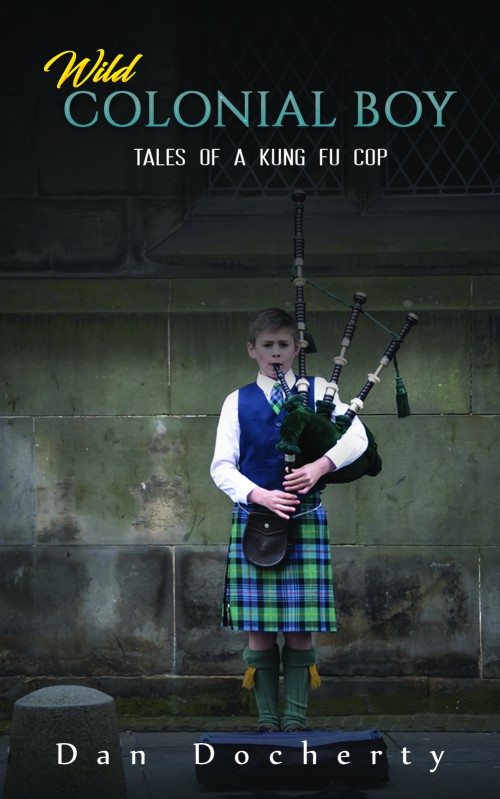
My latest podcast with Alan Wychereley, who was as student of the late UK tai chi legend Dan Docherty inspired my listener/reader Steffan Stringer to track down Dan’s autobiography “Wild Colonial Boy” (I have to admit, I’d heard of this book before, but never read it, and in my mind it was always called “Wild Caledonia Boy”, which, I think, given the Scottish-centric design of the cover would have been a far better title!)
“In 1975, Dan Docherty, a young Scots law graduate and karate black belt, left Glasgow to spend nine years as a Hong Kong police inspector.
As well as serving as a detective and vice squad commander, he also took up Tai Chi and won the 5th Southeast Asian Chinese Full Contact Championships in Malaysia in 1980.
In 1985, he was awarded a postgraduate diploma in Chinese from Ealing College.
He travels extensively teaching Tai Chi and has written four books on the subject.”
When I started Tai Chi in the early 90s everybody had heard of Dan Docherty, and he was something of a big name, not only because of his competition success, but also because of his reputation for unmasking frauds. I remember him gaining a lot of notoriety for pouring a bottle of water over the head of an ethnically Chinese Qigong teacher who was doing seminars on Ling Kong Jin or “Empty force”. Dan’s reasoning was that if he could move people without touching them then he should be able to deflect the bottle without the need for physical contact. It didn’t work. He was also famous for “getting into it” with one of the Yang family representatives in the UK, who ended up leaving the UK after their encounter.
Sadly Dan Docherty died of complications from Parkinson’s disease in 2021. I never met Dan in real life, but his impact on the UK tai chi community continues to be felt long after his death. That’s probably the best legacy a tai chi teacher could hope for.
I had a chat with Alan Wycherley from the In Defence of the Traditional Martial Arts YouTube channel for my podcast and the episode is now live. We talk about how Tai Chi can be used as a realistic self-defence system and Alan’s encounters with traditional martial artists from different kung fu systems.
Do you want to find out what traditional martial arts are practiced in Vietnam? Do you want to know what Tai Chi is like in Vietnam? And what Ho Chi Minh had to do with the development of the 24-step Tai Chi form? You do? Well, you’re in luck!
This episode of the Tai Chi Notebook Podcast features martial artist and author Augustus John Roe who lives and works in Vietnam. Enjoy!
What’s in a name? When it comes to tai chi chuan (taijiquan), then the answer is… quite a lot.
Firstly, there’s the issue of how you write it. Occasionally, you will see an attempt to guess at the spelling of the name that makes the mind boggle, such as an email asking if somebody can come to your “thai chee” class, but usually it’s some variation of “tai chi” or “taiji”.
Tai chi was first romaised into English using the Wade–Giles system as “tʻai chi chʻüan”. But English speakers soon abbreviated it to “tʻai chi” and dropped the mark of aspiration. Nowadays, in the UK at least, we tend to use “tai chi” and forget about the “chuan”. Perhaps a better translation would be “tai chi boxing”, but this goes against the image of the art, which is usually practiced as a health exercise, so that’s never going to catch on. There really isn’t much “boxing” going on in most tai chi classes.
Then there’s he newer pinyin romanisation system, which has replaced Wade–Giles as the most popular system for romanizing Chinese. In pinyin, tai chi is written taijiquan. It’s popular to use taiji or taijiquan in English now to also remove any colonialist connotations of the term from a bygone era.
I get that, but I think the written phrase tai chi has slipped so far into the general populations consciousness that a lot of people have no idea what you’re talking about if you write taijiquan. I use tai chi myself.
Step back into the Qing dynasty
Then there’s the issue of when the art was given the name tai chi boxing. Tai chi emerged into public life in the royal court during the Qing dynasty, yet it wasn’t freely called tai chi until after the dynasty ended. If you try and find a written occurrence of the name published before 1912 you’ll draw a blank. There are certainly written documents that claim to be from years earlier that contain the name “tai chi boxing” yet not a single one of them was made public or published before 1912. What happened in 1912? The Qing dynasty collapsed and the new Republican era began.
My best guess as for the reason that this is the case is that Hong Taiji (1592 – 1643), the founding emperor of the Qing dynasty had adopted the name “Taiji”. It’s unclear if this was his personal name or a title, but there was certainly a taboo around using that name because it belonged to an emperor. It therefore became impossible for a marital art to be called “tai chi boxing” without breaking that taboo and suffering the (presumably harsh) consequences. However, once the Qing dynasty fell, the name was back on the market. (Credit to my friend Daniel Mroz for bringing this to my attention).
The taiji symbol
Then there’s the meaning of the name. The name taiji has obvious connections to the philosophical concept of the taiji symbol – the circle with the two fishes representing yin and yang and their constant interchangeable position. One state increase till it exhausts itself leading to the other in an infinite loop.
In Yang style tai chi lineages, the art has long been associated with Taoist ideas, which the taiji symbol is representative of. Chen style seems less Taoist in origin, however, the concept of taiji is a universal symbol, and used throughout all of Chinese thought.
The name taiji can be translated as “supreme ultimate”, which has lead many to conclude that tai chi boxing must have got the name because it was the boxing system par excellence of the Chinese martial arts scene. It is literally, the best! If only!
I wish that was true, but I think it’s just a common misunderstanding, which is perhaps played on as a marketing device in modern times. I mean, who wouldn’t want to be learning the supreme ultimate boxing system, right?
The concept of being a supreme ultimate is more to do with supremely different positions being harmonised. Extreme yang and extreme yin. Polar opposites that work together and find harmony. That’s the real meaning.
In Tai Chi your body moves through position after position – we call these ‘postures’ usually – in the transition between them the body will open and close in a repetitious cycle. Once yang (open) is exhausted the body will move to yin (close) once you’ve reached the extreme position of yin, you move back to yang again, and so on.
The opening and closing is a whole body action. So, you are literally enacting the taiji diagram with your body.
That’s the general idea. Of course, you can break down your body into sections and look at how each one of those opens and closes, there is seemingly no end to the level of detail you can drill down to, but on a basic level your body is always moving from yin to yang and back again, which is the reason for the name of the art – tai chi chuan.
Nabil Ranné is a Chen style teacher living in Berlin who offers classes and online training at CTN Academy Nabil is a student of Chen Yu, who is the only son of Chen ZhaoKui and grandson of the famous Chen Fake. Listen here.
Here’s what we talk about:
Timestamps:
1.00: Nabil’s background in martial arts and what attracted him to Chen style Tai Chi
3.40: What is Jin in Tai Chi?
7.30: What makes Tai Chi different to other marital arts?
11.15: What is the strategy for Tai Chi?
16.00: What is the function of Tai Chi push hands?
17.55: Competition push hands vs Tai Chi push hands
22.20: The Xin Yi podcast and how do you train applications in Tai Chi
This post is going to start somewhere you don’t expect – over 1,000 years ago in Song Dynasty China during which we find the legendary founder of Xing Yi, Yue Fei, a general in the Song Dynasty army, mulling over the advancing (heavily armoured) Jin cavalry, and wondering how his foot soldiers are going to fair against the crushing advance of an army that had destroyed the Liao Dynasty troops, scattering them to the Western regions.
The Jin/Song wars would last a century, starting in 1125, when the Jin attacked the Song after a series of negotiations between the previous allies failed. During this period North and Southern China was effectively separated between Jin and Song, with the Song retreating into the south of China. The Jin advance into southern China in 1130 was stymied by Song generals like Yue Fei and Han Shzhong. Eventually the Song allied with the Mongols in 1233 to defeat the Jin, but the Mongols then went on to defeat their previous allies, the Song, and thus the Yuan Dynasty was born.
But why this history lesson? Well, one weapon that was popular during the Song/Jin wars was the ‘sword breaker’ called a bian, which translates as ‘whip’. But it was a very solid short stick made of iron, not a flexible whip. It was often used on horseback because it was effective against heavily armoured warriors, and the Jin cavalry was very heavily armoured.
The Tai Chi move “Single Whip” (Dan Bian), has the same character for whip as the one used for the ‘sword breaker’. It’s also similar to the characters for ‘shoulder pole’, which I’d previously speculated was a possible origin for the name. But people who are better at Chinese than me have cast doubt on this theory. It seems much more likely that it’s the ‘sword breaker’ weapon that is being referred to, not a shoulder pole.
“Recently I’ve been made aware of some theories about the meaning behind “Single Whip” 單鞭 (dān biān)
Basically the claim is that the posture resembles a farmer carrying something on a pole or yoke and that the name refers to this yoke.
This yoke or shoulder pole is called 扁擔 (biǎndan)
So right away, simply linguistically, this claim is a little bit problematic.
English Character Pinyin Romanization. Single Whip 單 鞭 dān biān Shoulder Pole 扁 擔 biǎndan
We’re dealing with four completely different characters with completely different meanings. The dan in biandan is POLE not single.
To a native Chinese speaker this is like comparing apples to tennis balls. It’s just a ridiculous claim.”
The post goes on to look at the historical record, which is fairly interesting, and makes the case for the bian being the ‘sword breaker’.
Fair enough, the shoulder pole idea was just a theory of mine based on the similar name, and the way it looks. As with all good theories, it can be disproved with evidence. But as I also said in that original post of mine:
“The ‘whip’ could also be used as a weapon in Chinese Marital Arts. Again, it was usually referring to a short stick, not a flexible whip. In the excellent “Chinese Martial Arts Training Manuals” by Brian Kennedy and Elizabeth Guo you’ll find a description of a book called “Tiger Tail Whip” by Jiang Rong Qiao published in 1930. It features a “long routine for the metal tiger tail ‘whip’, which is rigid and actually amounts to a type of cane.””
“Chinese Martial Arts Training Manuals”, by Brian Kennedy and Elizabeth Guo
The ‘sword breaker’ or ‘bar mace’ was certainly more substantial than a cane. As the name implies, it could break swords, but it was also good for attacking heavily armoured soldiers as it could impact the person under the armour. Check out what it could do in this excellent video:
What’s in a name?
But it’s still hard to work out why the Single Whip posture would be named after the ‘sword breaker’ in the first place. I mean, the posture doesn’t resemble the weapon at all… But then I saw something very interesting recently:
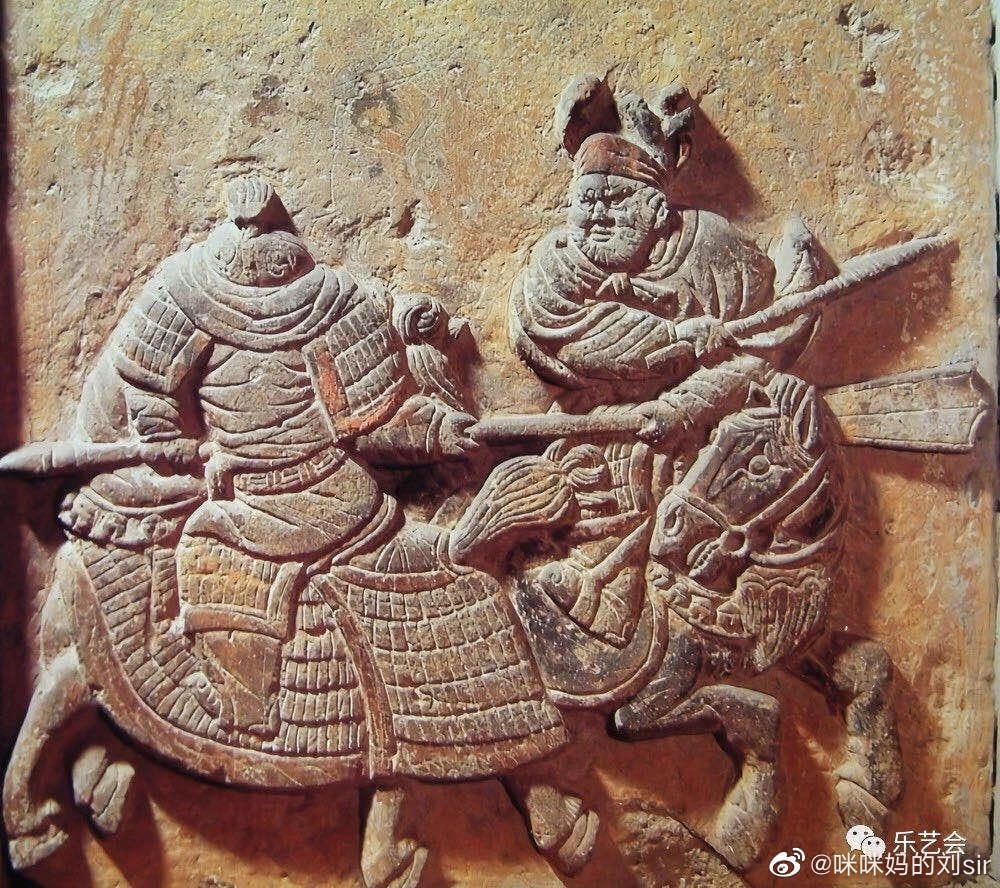
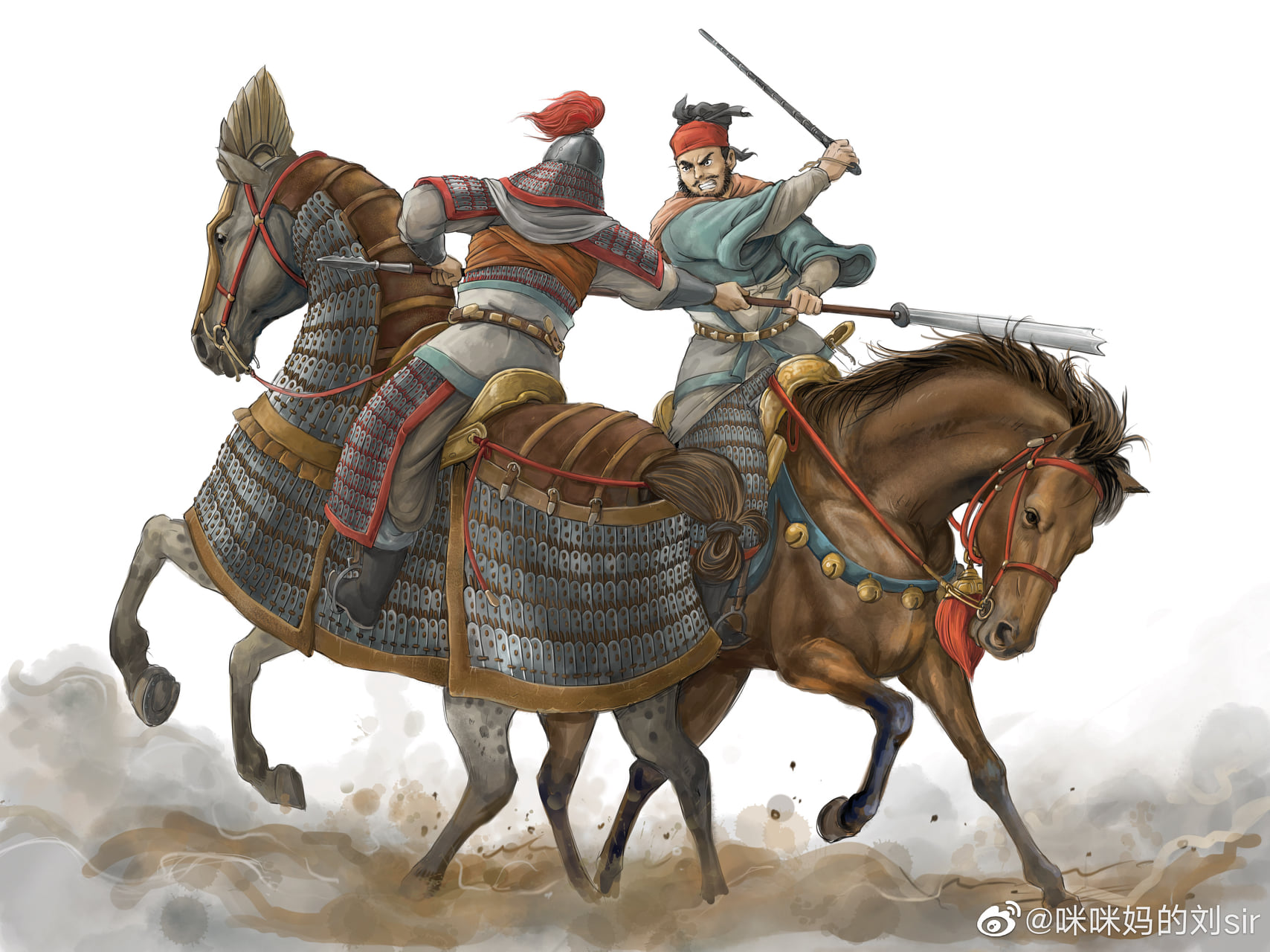
“This brick carving is from a tomb of Jurchen Jin (1125–1234), describing a battle between Song and Jin cavalries. The one who faced to us with a sword breaker 锏 might be Jin cavalry, who snatched the pole weapon (三尖两刃刀, lit. ‘Three points double edged blade’ fig. 3) away from Song cavalry and swung his sword breaker 锏 to attack his head from right to left. Song cavalry’s head and helmet were totally whacked. Well, pole weapon user should always keep distance with enemy and, such blunt weapons like mace, sword breaker etc. are really excellent weapon against heavy armor. Picture 2 was drawn by 咪咪妈的刘sir.”
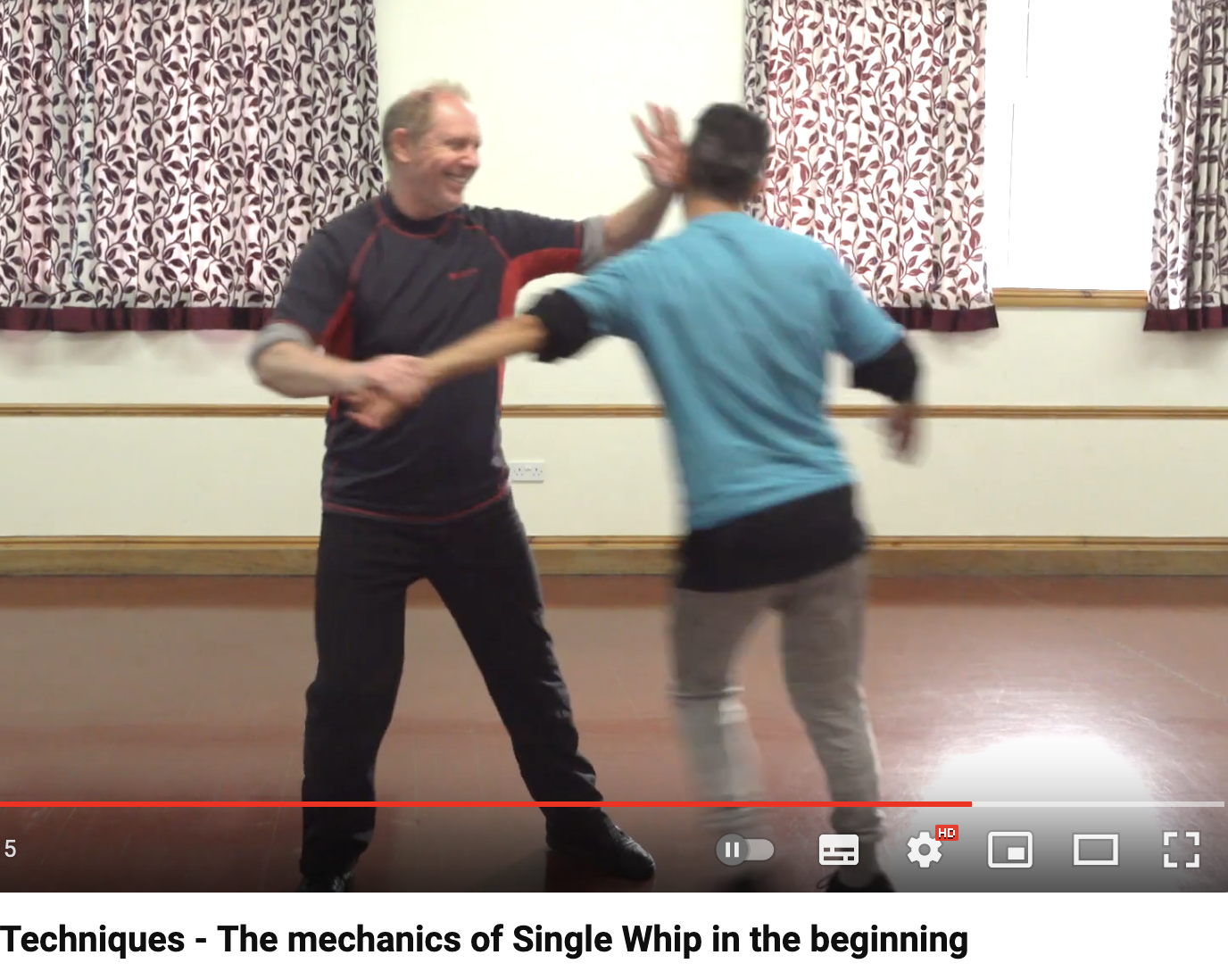
Now, what I notice about this carving, and the painting, is that it isn’t a million miles away from the application of single whip that we practice in our Tai Chi. Check it out:
Maybe that’s where the name “Single Whip” comes from? The application of the move is certainly similar to the way you’d use a ‘sword breaker’ way back in the Jin/Song wars to grab the opponent’s long pole weapon and bash them on the head with your ‘whip’.
But why “single”? Well, it turns out that the ‘sword breaker’ was often a two handed weapon. You had one in each hand, as this carving of the Jin cavalry shows:
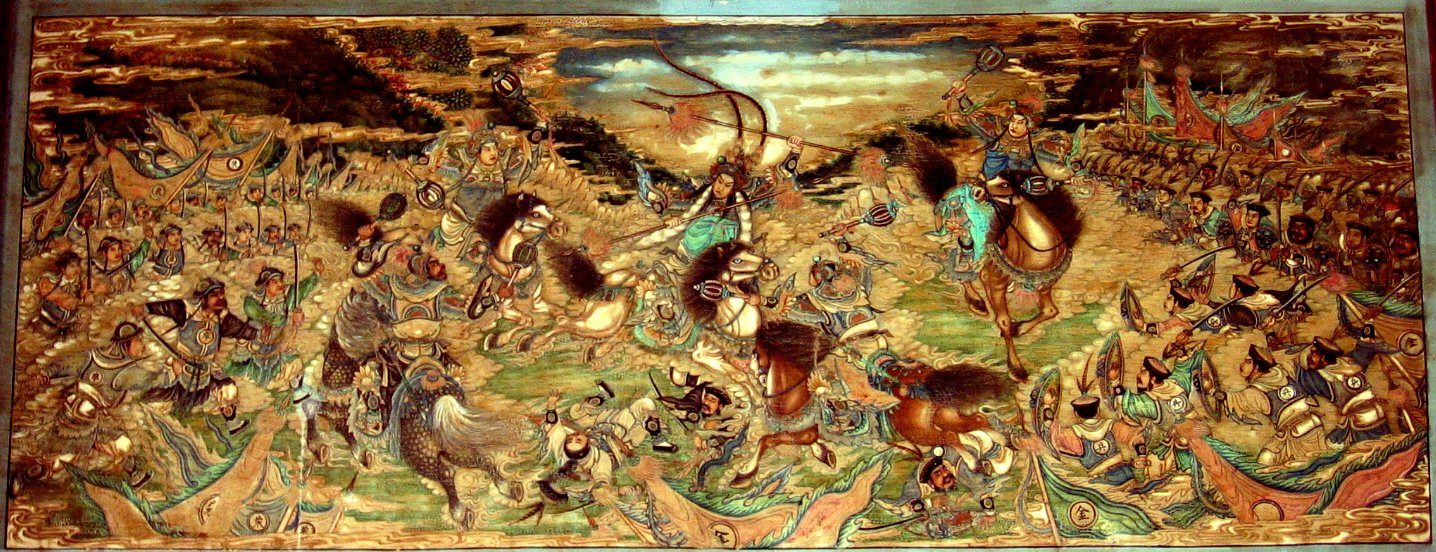
You can also see double maces being used by cavalry in the painting that opens this article.
It’s as good an explanation for “single whip” as I’ve read anywhere else. And at least this reasoning makes some sense. At the end of the day, it’s just another theory, ready for some eager beaver to disprove.
One observation I have on ‘internal’ martial arts is that there there is often very little focus on the ‘internal’ qualities to a human being. Or if they do address them then it is, not directly and often in passing.
I’m not talking about things to do with forces, or the body, like Qi, Xin and Jin. Yes, the Yi (intent or mind) is mentioned all the time in the Tai Chi Classics, but it’s always in relation to fighting, or releasing and accepting forces on the body. “Quelle surprise”, you might say, since Tai Chi is a marital art, but if I contrast ‘internal’ martial arts with ‘external’ martial arts for a moment, the discussion there is often on the internal qualities of a human that internal martial arts, ironically, neglect.
I’m talking about things like self-control (temperance), endurance and patience.
The goal of improving these internal qualities has been the goal of practical philosophers since man first decided to ponder his/her existence. I could quote from LaoTzu here, but I find it more explicitly written by the Greek philosophers, particularity the Stoics.
In Chapter 10 of the Greek classic of Stoicism, The Enchiridion, we find:
“On the occasion of every accident (event) that befalls you, remember to turn to yourself and inquire what power you have for turning it to use. If you see a fair man or a fair woman, you will find that the power to resist is temperance (continence). If labour (pain) be presented to you, you will find that it is endurance. If it be abusive words, you will find it to be patience. And if you have been thus formed to the (proper) habit, the appearances will not carry you along with them.”
Epictetus, The Enchiridion
Sure, these internal qualities can certainly be learnt from any martial art, however I find it is the external martial arts that really emphasise them. Many Taekwondo schools use the goal of improving your inner qualities as the main sell in their marketing approach. For example, I just did a Google search for Taekwondo clubs in the local area, clicked on Tiger martial arts, and what do I find written on their website, in all caps, so you can’t miss it?
“WE BELIEVE MARTIAL ARTS IS ABOUT MORE THAN JUST KICKING AND PUNCHING”.
This is followed up with “We give students the focus and confidence to achieve in all areas of their lives. Yes, you can learn to take care of yourself in dangerous situations, but really it’s about learning to use your mind and body like a martial artist – learn how to control your body and your mind, and you will be set up for life.”
It’s the same with Karate. I did another random search on Karate clubs and found Bristol Karate Academy whose motto is “virtue in industry” from “Virtute et industria” — or by virtue and industry — from the city of Bristol, which dates back to at least 1569. They explain how that relates to the values of their club on their About us page:
“So what does that mean for us?
Virtue (美徳): We have integrity, in our commitment to traditional, effective Karate and integrity in the way that we treat others. We are respectful, fair and aim for high moral standards. We build character, strive for excellence and show courage in the face of challenges.
Industry (勉励): We work hard to reach our goals. We’re diligent and determined to get better at every single training session. We are rigorous in our approach to improvement and dedicated to our own and each other’s development.
Through hard, honest training we become our best possible selves”
Again, while I’m sure they can kick-ass with their karate, the emphasis in their motto is on the internal qualities of a human being. It’s about becoming your best possible self.
I know what you’re thinking – “perhaps it’s about teaching children?” Things like Karate and Taekwondo can be very orientated towards teaching children, and you obviously don’t want to be raising a hoard of little ninjas who have no idea about the moral implications of using their marital arts. However, it’s not just non-Chinese marital arts that have a heavy emphasis on building moral character. Similar ‘external’ Chinese martial arts do too, and those tend to have as much emphasis on adults as children. Also the moral aspects were there right from the beginning in the Southern arts.
For the history of Southern Chinese martial arts I’d recommend Ben Judkin’s excellent book “The Creation of Wing Chun”. Its tag line is “A social history of the Southern Chinese Martial Arts” because it covers all of them, not just Wing Chun, and particularly Choy Li Fut. When the first professional Choy Li Fut school opened in 1836 a moral education was seen as part of the ethos of the school. The school had 10 rules that had to be followed at all times:
Ten Points 1 Seek the approval of your master in all things relative to the school. 2 Practice hard daily. 3 Fight to win (but do not fight by choice). 4 Be moderate in sexual behavior. 5 Eat healthily. 6 Develop strength through endurance (to build a foundation and the ability to jump). 7 Never back down from an enemy. 8 Practice breathing exercises. 9 Make the sounds (“Yik” for punches, “Wah” for tiger claws, “Tik” for kicks). 10 Through practice you cannot be bullied.
While some of the rules are to do with body use, like making sounds on punches, others are more moral, like being moderate in sexual behaviour. And also eating healthy is a rule! Can you imagine going to a Tai Chi class or a Xing Yi class today and being told that healthy eating is now a rule, and if you don’t follow it, you’re out? In fact, I’d go as far to say that many internal martial arts teachers were renowned for hard drinking and over eating!
(It should be noted that Bak Mei tended to not have this moral emphasis. Reasons for this are explored in the book.)
Moving forward in time and changing locations to Brazil… Carlos Gracie also created a set of rules called the 12 Commandments when he started Brazilian Jiujitsu as an offshoot of Judo.
1 Be so strong that nothing can disturb the peace of your mind. 2 Talk to all people about happiness, health, and prosperity. 3 Give to all your friends the feeling of being valued. 4 Look at things by the enlightened point of view and update your optimism on reality. 5 Think only about the best, work only for the best, and always expect the best. 6 Be as just and enthusiastic about others victories as you are with yours. 7 Forget about past mistakes and focus your energy on the victories of tomorrow. 8 Always make those around you happy and keep a smile to all people who talk to you. 9 Apply the largest amount of your time on self-improvement and no time in criticizing others. 10 Be big enough so you can feel unsatisfied, be noble enough so you can feel anger, be strong enough so you can feel fear, and be happy enough so you can feel frustrations. 11 Hold a good opinion about your self and communicate that to the world, but not through dissonant words but through good works. 12 Believe strongly that the world is in your side, as long as you stay loyal to the best of yourself.
Carlos Gracie
These are mainly forgotten about these days and I’ve noted before that a lot of them were borrowed from somewhere else but they are almost exclusively about internal qualities of a human being.
If you contrast these sorts of rules to what you find in “internal” marital arts schools, well first of all, there are usually no set rules like this at all! Secondly, we tend to look to the classics for our ancient sayings, and finding moral instruction in them is like finding a needle in a haystack. Instead you find simile – for example, “be still like a mountain and move like a great river” from the Tai Chi classics, or philosophy from the Xing Yi classics like The 10 Theses of Yue Fei:
“From the beginning, that which is discrete must have its unification. The divided must be combined. Therefore, between heaven and earth, all that is disordered hasits abode, all the thousand branches and the confusion of then thousand endings, all have their origin. This is because one root divides into ten thousand branches, and ten thousand branches all belong to one root. These events are natural“.
– The Thesis of Integrity
Or you find descriptions of body use and strategy.
The jin should be rooted in the feet, generated from the legs, controlled by the waist, and expressed through the fingers.
What you don’t find a lot of is moral instruction or a reflection on the internal qualities of a martial artist that you find emphasised right up front in external schools.
So, why is this? Good question. One possible answer could be that ‘external’ arts historically coming from the Shaolin Temple (in the usual origin myth, at least) always had a Buddhist religious and therefore moral aspect to them. The internal arts in contrast tended to evolve out of the (violent and bloody) countryside, or they evolved from a Taoist approach to life, which was less prescriptive.
I don’t know – what do you think? What explains the internal/external difference? Let me know in the comments.
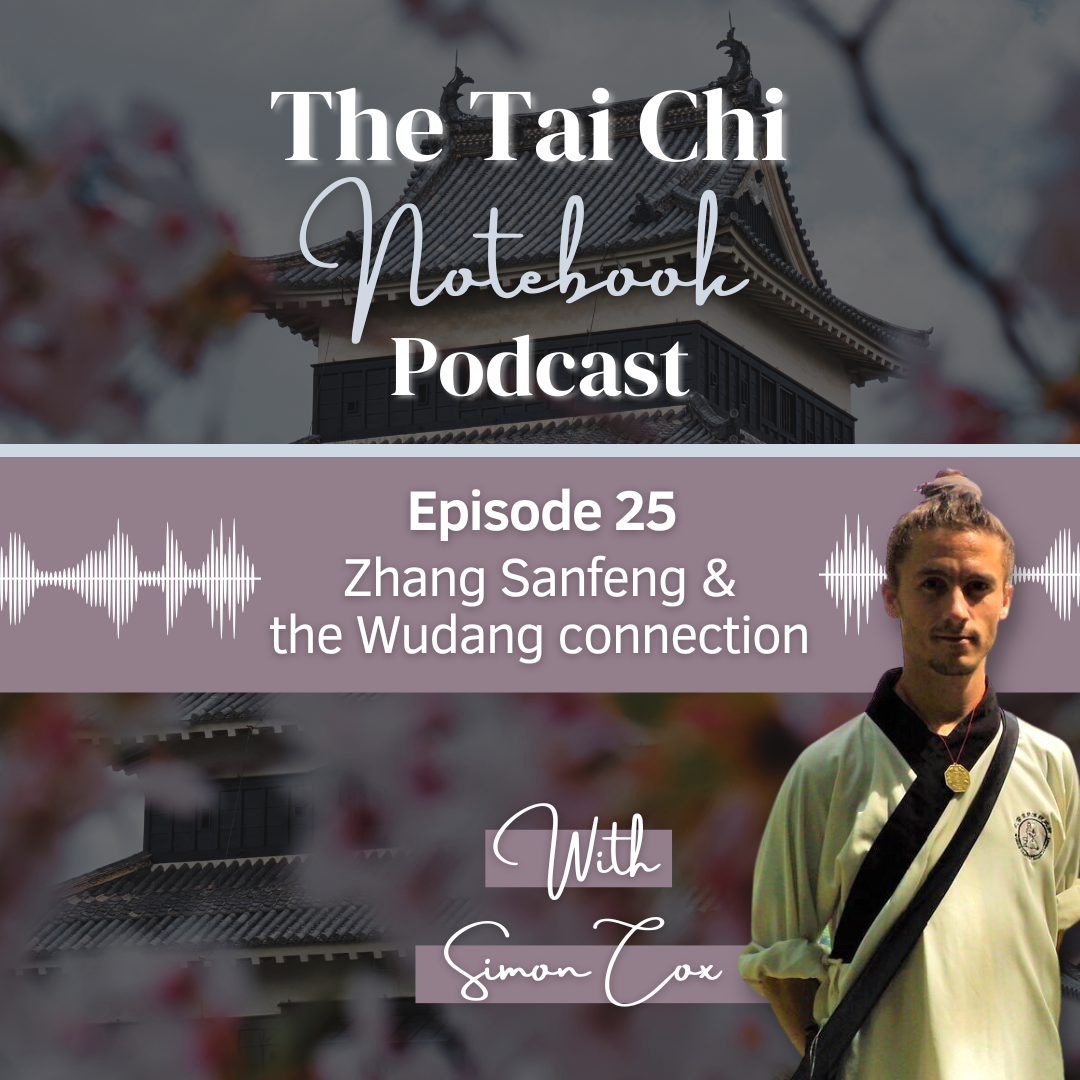
Simon and Brandi spent six years living and training in China under master Yuan Xiu Gang at the Wudang Daoist Traditional Kung Fu Academy. While there they studied Kung Fu, Tai Chi, Qi Gong, meditation, herbal medicine, Daoist music, and ancient and modern Chinese language.
After returning to the West, they started a Kung Fu school and community group in Houston Texas, where Simon was working on his PhD in Chinese and Tibetan mysticism at Rice University. At the end of 2019, they moved up to the Okanagan Valley and began sharing Wudang teachings with the local community.
What I really wanted to get at with Simon was an elucidation on his article about Zhang Sanfeng – exactly who was this mysterious Taoist immortal who is often credited as the founder of Tai Chi Chuan? I also wanted to find out more about Wudang mountain, and where its martial arts really come from. I hope you enjoy are conversation!






 The Tai Chi Notebook