Episode 31: Mantis boxing, BJJ, self defence and heresy in martial arts

Here’s my latest podcast! Mantis boxing, BJJ, Self Defence and heresy in martial arts with Randy Brown.

Randy Brown is a Mantis Boxing and BJJ black belt coach teaching in the USA. In this podcast we explore how Randy has reworked his Mantis Boxing to explore the grappling potential hidden in its forms and how they can interact with his Brazilian Jiujitsu. We talk about a range of subjects including self defence vs sport, weapons vs barehand and how to turn dead systems into living arts again.

Links:
https://randybrownmantisboxing.com/

Tai Chi Notebook Podcast Episode 30: Nabil Ranné on Chen style Tai Chi training

Nabil Ranné is a Chen style teacher living in Berlin who offers classes and online training at CTN Academy Nabil is a student of Chen Yu, who is the only son of Chen ZhaoKui and grandson of the famous Chen Fake. Listen here.

Here’s what we talk about:

Timestamps:

1.00: Nabil’s background in martial arts and what attracted him to Chen style Tai Chi

3.40: What is Jin in Tai Chi?

7.30: What makes Tai Chi different to other marital arts?

11.15: What is the strategy for Tai Chi?

16.00: What is the function of Tai Chi push hands?

17.55: Competition push hands vs Tai Chi push hands

22.20: The Xin Yi podcast and how do you train applications in Tai Chi

28.00: Real life self defence situations

36.00: Martial arts vs marital sports

44.02: Zhan Zhuang: Standing pillar practice

46.55: Chen style FaJin methods and their purpose

55.00: Nabil’s book and getting in touch

Links:

Nabil’s training history

Nabil’s Instagram

Retreat to Ride Tiger

There are lots of tigers in Yang style Tai Chi. There’s ‘Bend Bow to shoot Tiger’, which is a pretty obvious punch, and each section of the forms ends with the classic ‘Carry Tiger to Mountain’. Today we want to look at ‘Retreat to Ride Tiger’.

Photo by Pixabay on Pexels.com

In Yang Cheng-Fu-like forms it looks like this:

It looks a lot like ‘White Crane spreads wings’ on the surface, but the hands are at a slightly different angle. Also you are always stepping back when doing this move and the intention of what you’re doing is slightly different to White Crane, too.

One aspect of the move I really like to emphasis is the Kou or ‘Shoulder Stroke’ that it contains. Rather than striking forward with your shoulder you are striking behind you as you step. I happened to be near a hanging heavy bag the other day so took the opportunity to show where the power goes in the move, like this:

Rather than thinking of it as striking with just the shoulder itself, it’s more like the whole of your back is the striking surface. In fact, the literal translation of Kao is not “shoulder stroke” as it’s normally written, it’s “lean”, so that gives some more insight this member of Tai Chi’s 8 energies.

Obviously, ‘Retreat to Ride Tiger’ isn’t just about striking behind you, the hands and legs can be doing applications facing forwards at the same time. Here are some ideas:

“I tried Tai Chi and it’s not what I expected”

This is a nicely made video about Tai Chi Push Hands:

Some quick observations:

1) I quite like the emphasis on feeling where the opponent is during push hands instruction – I think this is bang on.

2) “Sensei Seth” correctly identifies very quickly that push hands competitions are very, very, similar to Sumo. And if you’re good at Sumo then you should be good at this, and indeed, he is.

3) There are some fascinating insight into the teaching process here. Seth seems to do a few things that are “wrong” according to the laws of Tai Chi, but are working (i.e. sticking his butt out and leaning forward), however, he gets corrected by the instructor to stop doing it. I just find that interesting. The “Stop cheating, it makes you win!” mentality is rife all over the Tai Chi world. It’s one of the reasons I avoid push hands with people unless the conditions are right (i.e they are the right sort of person). I much prefer the “Hey, if it works, then it works! It’s up to you to figure out what I’m doing and stop me” mentality of BJJ.

4) In the end, with competitive push hands, the better wrestler always wins the exchange (for example, when they are doing the ‘foot outside the square’ push hands). So, if you want to be good at competitive push hands then why not just learn some wrestling? You can even keep things Chinese by learning Shuai Jiao.

5) I like this coach – he’s clearly skilled, but competitive push hands is the problem here. Even this coach gets super tense when under pressure because of the need to win. I just think that Push Hands is better used as a training exercise for learning TCC skills – when it gets competitive, all the principles go out the window (unless you are very, very, very very good).

Possible origins of the Tai Chi Single Whip (Dan Bian) posture name

This post is going to start somewhere you don’t expect – over 1,000 years ago in Song Dynasty China during which we find the legendary founder of Xing Yi, Yue Fei, a general in the Song Dynasty army, mulling over the advancing (heavily armoured) Jin cavalry, and wondering how his foot soldiers are going to fair against the crushing advance of an army that had destroyed the Liao Dynasty troops, scattering them to the Western regions.

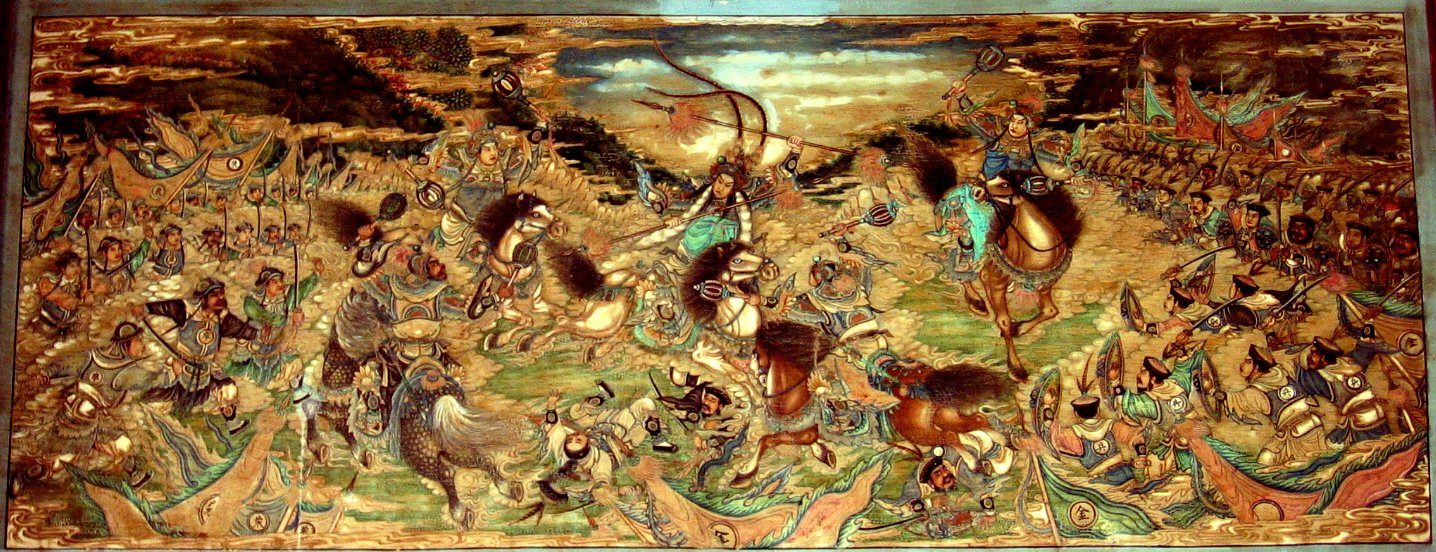
Photograph of the painting “The Battle of Zhuxian County” inside the Long Corridor on the grounds of the Summer Palace, constructed during the Qing Dynasty, in Beijing, China. Photograph taken on April 17, 2005 by Rolf Müller.

The Jin/Song wars would last a century, starting in 1125, when the Jin attacked the Song after a series of negotiations between the previous allies failed. During this period North and Southern China was effectively separated between Jin and Song, with the Song retreating into the south of China. The Jin advance into southern China in 1130 was stymied by Song generals like Yue Fei and Han Shzhong. Eventually the Song allied with the Mongols in 1233 to defeat the Jin, but the Mongols then went on to defeat their previous allies, the Song, and thus the Yuan Dynasty was born.

But why this history lesson? Well, one weapon that was popular during the Song/Jin wars was the ‘sword breaker’ called a bian, which translates as ‘whip’. But it was a very solid short stick made of iron, not a flexible whip. It was often used on horseback because it was effective against heavily armoured warriors, and the Jin cavalry was very heavily armoured.

The Tai Chi move “Single Whip” (Dan Bian), has the same character for whip as the one used for the ‘sword breaker’. It’s also similar to the characters for ‘shoulder pole’, which I’d previously speculated was a possible origin for the name. But people who are better at Chinese than me have cast doubt on this theory. It seems much more likely that it’s the ‘sword breaker’ weapon that is being referred to, not a shoulder pole.

To quote Atomic Tai Chi:

“Recently I’ve been made aware of some theories about the meaning behind “Single Whip” 單鞭 (dān biān)

Basically the claim is that the posture resembles a farmer carrying something on a pole or yoke and that the name refers to this yoke.

This yoke or shoulder pole is called 扁擔 (biǎndan)

So right away, simply linguistically, this claim is a little bit problematic.

English Character Pinyin Romanization.
Single Whip 單 鞭 dān biān
Shoulder Pole 扁 擔 biǎndan

We’re dealing with four completely different characters with completely different meanings. The dan in biandan is POLE not single.

To a native Chinese speaker this is like comparing apples to tennis balls. It’s just a ridiculous claim.”

The post goes on to look at the historical record, which is fairly interesting, and makes the case for the bian being the ‘sword breaker’.

Fair enough, the shoulder pole idea was just a theory of mine based on the similar name, and the way it looks. As with all good theories, it can be disproved with evidence. But as I also said in that original post of mine:

“The ‘whip’ could also be used as a weapon in Chinese Marital Arts. Again, it was usually referring to a short stick, not a flexible whip. In the excellent “Chinese Martial Arts Training Manuals”  by Brian Kennedy and Elizabeth Guo you’ll find a description of a book called “Tiger Tail Whip” by Jiang Rong Qiao published in 1930. It features a “long routine for the metal tiger tail ‘whip’, which is rigid and actually amounts to a type of cane.””

“Chinese Martial Arts Training Manuals”, by Brian Kennedy and Elizabeth Guo

The ‘sword breaker’ or ‘bar mace’ was certainly more substantial than a cane. As the name implies, it could break swords, but it was also good for attacking heavily armoured soldiers as it could impact the person under the armour. Check out what it could do in this excellent video:

What’s in a name?

But it’s still hard to work out why the Single Whip posture would be named after the ‘sword breaker’ in the first place. I mean, the posture doesn’t resemble the weapon at all… But then I saw something very interesting recently:

A post on the Facebook page “Collecting Chinese armor&Art” has the following (I’ve corrected the spelling):

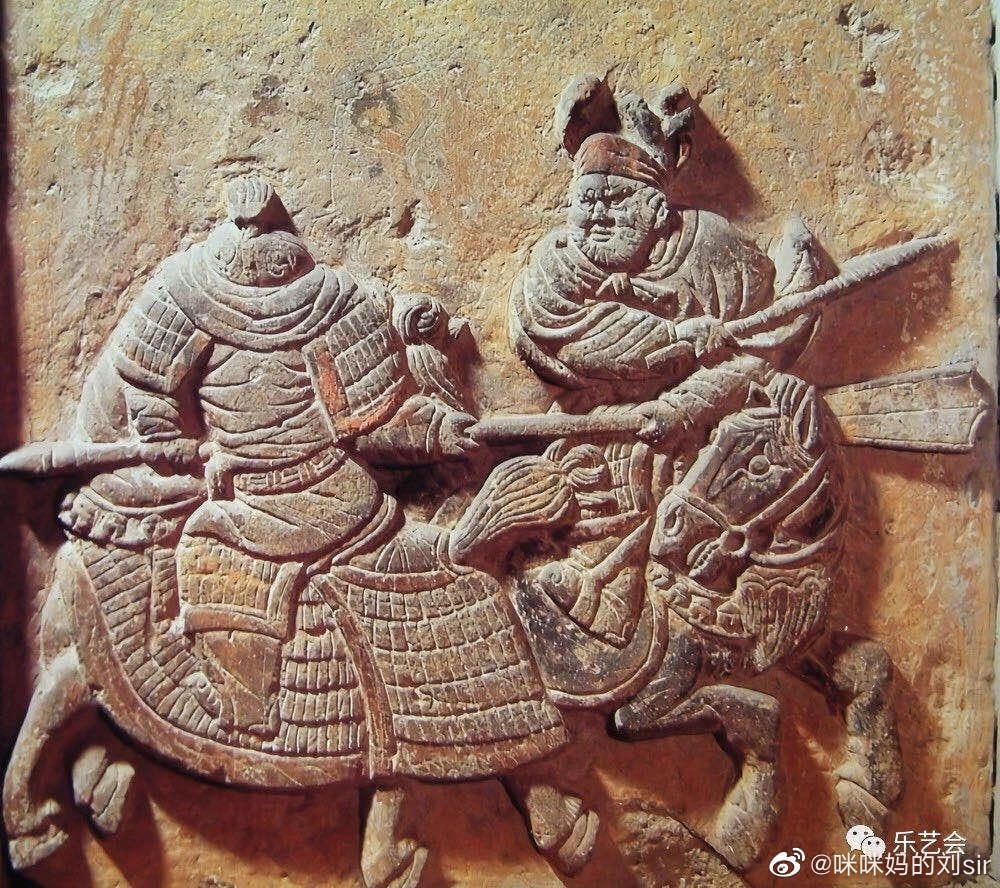
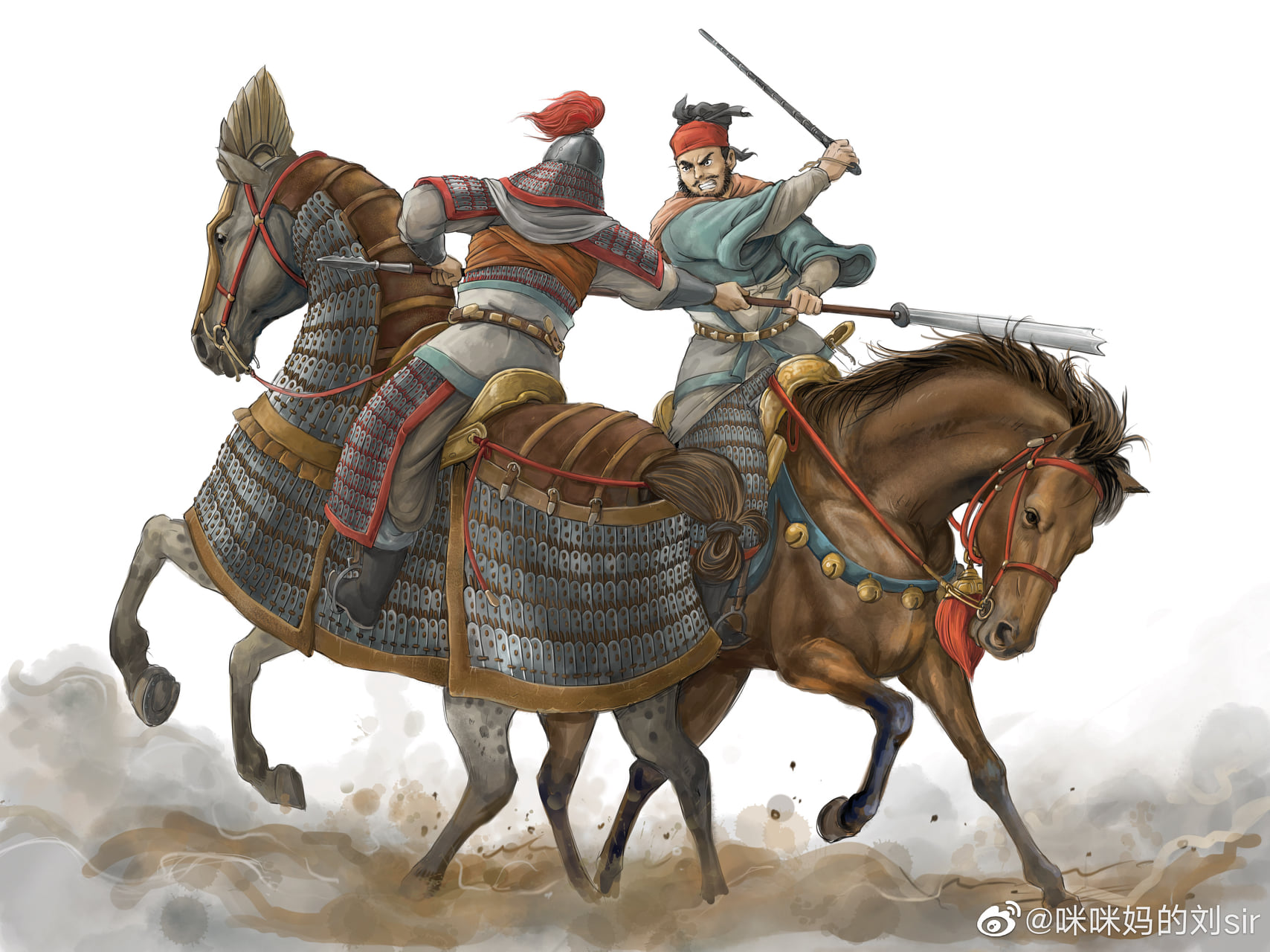
“This brick carving is from a tomb of Jurchen Jin (1125–1234), describing a battle between Song and Jin cavalries. The one who faced to us with a sword breaker 锏 might be Jin cavalry, who snatched the pole weapon (三尖两刃刀, lit. ‘Three points double edged blade’ fig. 3) away from Song cavalry and swung his sword breaker 锏 to attack his head from right to left. Song cavalry’s head and helmet were totally whacked. Well, pole weapon user should always keep distance with enemy and, such blunt weapons like mace, sword breaker etc. are really excellent weapon against heavy armor.
Picture 2 was drawn by 咪咪妈的刘sir.”

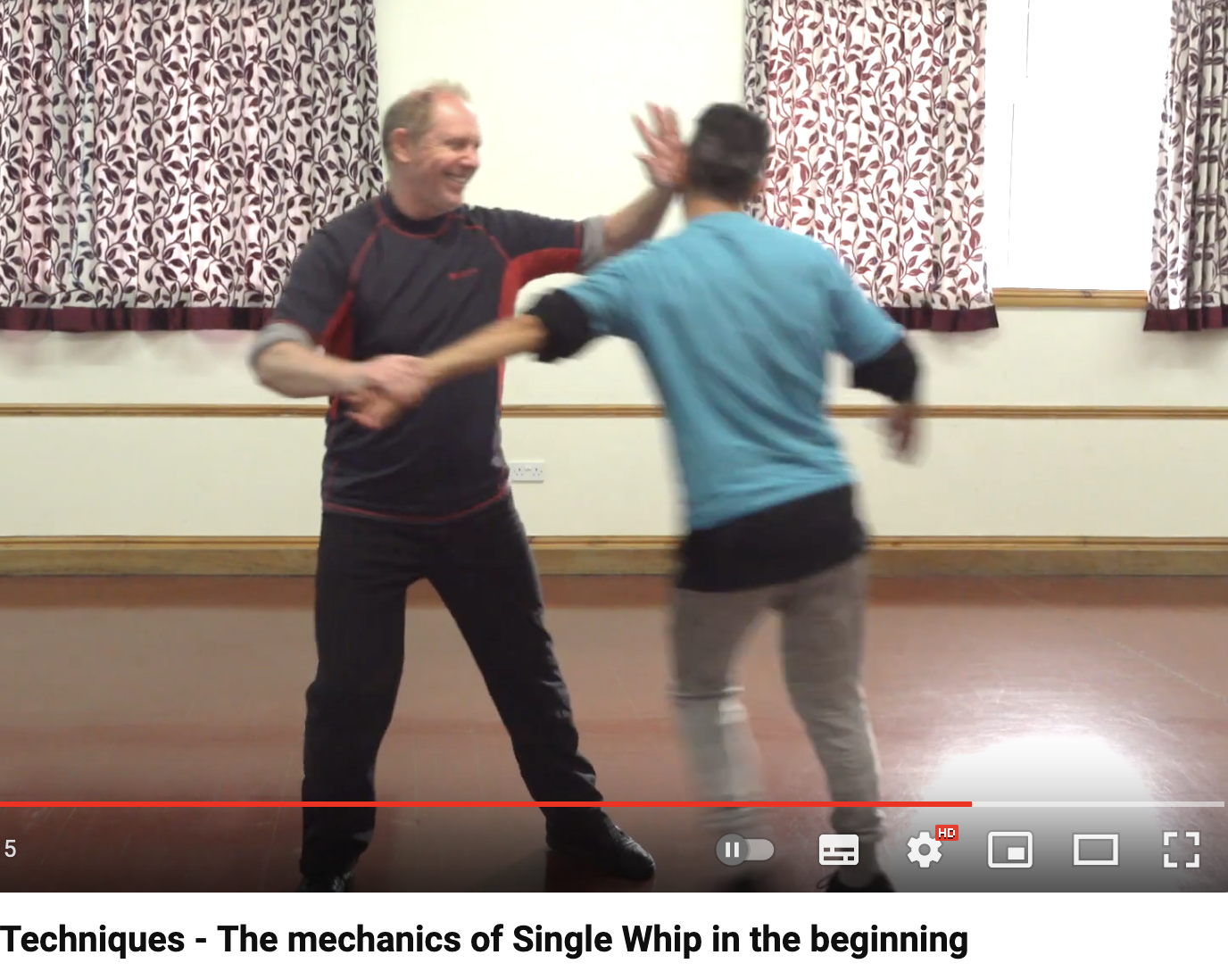
Now, what I notice about this carving, and the painting, is that it isn’t a million miles away from the application of single whip that we practice in our Tai Chi. Check it out:

Spinning Dragon Tao performing Single Whip.

That’s a still taken from the video:

Maybe that’s where the name “Single Whip” comes from? The application of the move is certainly similar to the way you’d use a ‘sword breaker’ way back in the Jin/Song wars to grab the opponent’s long pole weapon and bash them on the head with your ‘whip’.

But why “single”? Well, it turns out that the ‘sword breaker’ was often a two handed weapon. You had one in each hand, as this carving of the Jin cavalry shows:

You can also see double maces being used by cavalry in the painting that opens this article.

It’s as good an explanation for “single whip” as I’ve read anywhere else. And at least this reasoning makes some sense. At the end of the day, it’s just another theory, ready for some eager beaver to disprove.

Perhaps this is the true application? 😉

Tai Chi Applications: Needle at Sea Bottom, Fan through back, White Snake Spits out Tongue + Torso-Flung punch

My friend Sifu Donald Kerr of Spinning Dragon Tao has been producing some great videos recently featuring my teacher, Sifu Rand, demonstrating Tai Chi applications from our version of the Yang form. If you’re interested, I’ve written an article about the full lineage of that form before, but a quick summary is that it’s the Yang form from before Yang Cheng-Fu’s modifications, but with some input from Sun Lu Tang, so it’s a bit of a hybrid.

Needle at Bottom of the Sea, Shoulder through the arm and White Snake Spits Out Tongue.

I thought I’d do some posts as new videos become available comparing the videos to the historical books on the style that contain photographs.

There are a couple of historical books available that catalogue the long form in quite some detail. The first is the 1938 book by Gu Ru Zhang, then there’s the 1952 book by his student Long Zi Xiang, both of which have been kindly translated by Paul Brennan.

I’m using the 1952 book by Long Zi Xiang here, as the photos are of a higher quality. The English versions of the move names will always be slightly different, depending on the translator. Brennan translates these moves I’m looking at today, in order, as Needle under the sea (海底針), Shoulder through the arm (肩通臂) and White Snake shoots out its tongue (白蛇吐信).

In our school we use the names Needle at Sea Bottom, Fan through back and we don’t have a name for what Long is calling White Snake… it’s just part of Fan through back.

The application Long describes for Needle at Sea Bottom is, “If the opponent punches to my chest, I grab his wrist and press down, making his power drop downward.” It’s a pretty short explanation, but it does seem to match the modern day demonstration quite well:

For Shoulder through the arm, Long says, “If an opponent strikes from in front of me, I use my right hand to prop up his fist so that he cannot lower it, at the same time using my left hand to obstruct his waist and send him outward, causing him to topple over.”

Again, that’s a pretty good explanation of what happens in that video.

Long has one more application for the part of the form we don’t name - White Snake… – which is a simple block and strike to a different opponent, “If an opponent punches to my waist, I then press down with my right hand while my body moves back so that his punch lands on nothing, and then I use my right [left] fist to strike to his face.

We seem more interested in the next move, which is “Torso-Flung Punch” (撇身捶) according to Brennan’s translation. We call this move “Chop opponent with fist“, and it’s the natural conclusion to the previous moves, so I’ll add it on here:

The explanation for the application is: “If an opponent attacks me with a [left] punch and [right] kick at the same time, I then withdraw my right leg, causing his kick to land on nothing, my right hand pressing down his fist. Then my left palm pushes down on his arm, and my right hand turns over from inside with a strike to his face.” Which ties in very well with the video showing the application by Sifu Rand:

New podcast! Richard Johnson on Chen Style Practical Method

This month’s podcast guest is Richard Johnson a long-time student of Joseph Chen of Chen Style Practical Method.

As well as a Tai Chi practitioner and teacher, Richard is a full time movement coach working with athletes, so he brings an appreciation of athletic movement to his views on Tai Chi.

In our discussion Richard delves deeply into the internal workings of the Chen Style Practical Method and we talk a lot some interesting movement principles based around rotation. We also talk about how the Practical Method is different to the Chen Village style of Tai Chi.

Enjoy the podcast. You can get in touch with Richard using his email address ⁠trukinetix at gmail.com⁠

The number 1 mistake people make in Tai Chi push hands and how to fix it

I got to meet up with a local Tai Chi instructor recently, and it was a good chance for me to do some hands-on work in push hands. One of the things working with somebody else at Tai Chi, as opposed to the endless solo practice that mainly makes up the art, brings up is the question of range.

Range is an interesting one in Tai Chi. You actually need to be in really close for Tai Chi to work. I think this is one of the things that has been forgotten along with the martial aspects of the art. I very rarely find another Tai Chi person who is comfortable working at the correct range.

How to fix your range

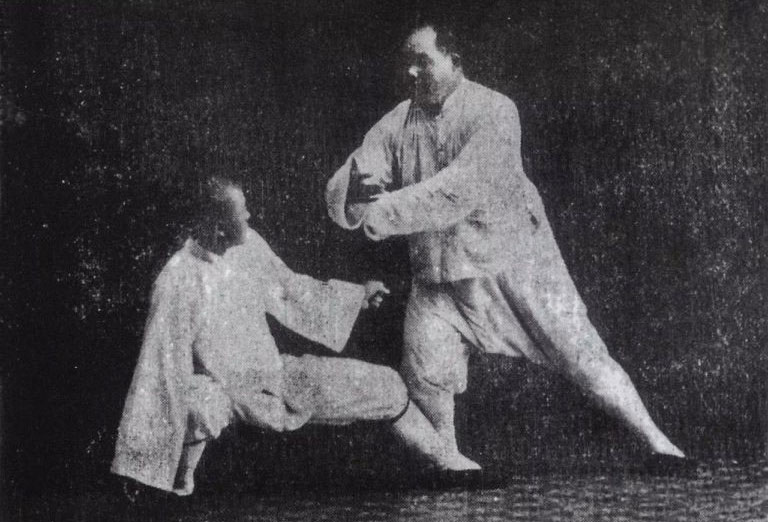
To get the correct range your front foot should be one fists-width apart from your opponents foot on the horizontal axis and your front toes should be roughly matching the back of heel. His front toes are then roughly matching your heel. (Look at the foot position in the photo).

This distance feels uncomfortably close to do any sort of combat actions to most people, however, this is where Tai Chi lives. At this range you will need to use subtle movements of the kua and rotation of the body to neutralise your opponent’s force, and it takes some practice. You also need to make use of Ting – or “listening” because you are definitely within punching range here, but from here you can go even closer (body to body) and turn it into wrestling if so desired, which will protect you from punches.

At the correct distance the Tai Chi techniques will work. When you are further out, they won’t work so well at all. So, this is where you should be when practicing push hands.

When it comes to actually fighting, I’m not suggesting you should “hand around” in this range, because that will just get you clipped. However, you do need to move into this range to do all the good stuff that the Tai Chi Classics talk about – controlling your opponent, knowing him before he knows you, etc. I think a lot of the time that Tai Chi fighting is described as “bad kick boxing” it’s because of the range being used. People stay too far out and pot shots at each other. Kick boxing is perfect for this range.

More of my writing on push hands:

The crucial detail of using the kua and hips in Needle at Sea Bottom

There’s a lot of talk in the internal arts about the “kua”, and how using the kua (as opposed to the hip joints) is central to getting the idea of internal movement in Tai Chi.

So, what is the kua?

A definition from Crane Tiger Tai Chi reads:

Kua refers to the area that extends from the inguinal folds (front of the hip where the leg and body meet) to the crest of the pelvis. It includes the hip joints, the iliopsoas, and adductor muscles as well as the sacrum and the perineum.

I’ve written about the kua several times myself, but I think Ken Gullette’s book (my review is here) does a great job of describing it. To me, moving the kua is about opening and closing the body in the space inside the hip joints. Integrating the opening and closing of the kua into your movement facilitates power moving smoothly from the legs and feet up through the body, or receiving force in the opposite direction and directing it down towards the ground.

Moving “inside” the hip joints allows for very detailed movement and enables you to create and remove space when interacting with an opponent, which has martial application.

However, I think that the focus on the kua in internal arts often risks people ignoring the pivotal (ha!) role of the hip joints. I think the hip joints are actually more important to get right – if you focus on the kua but never think about your hip joints it’s a bit like building the walls of your house without a firm foundation.

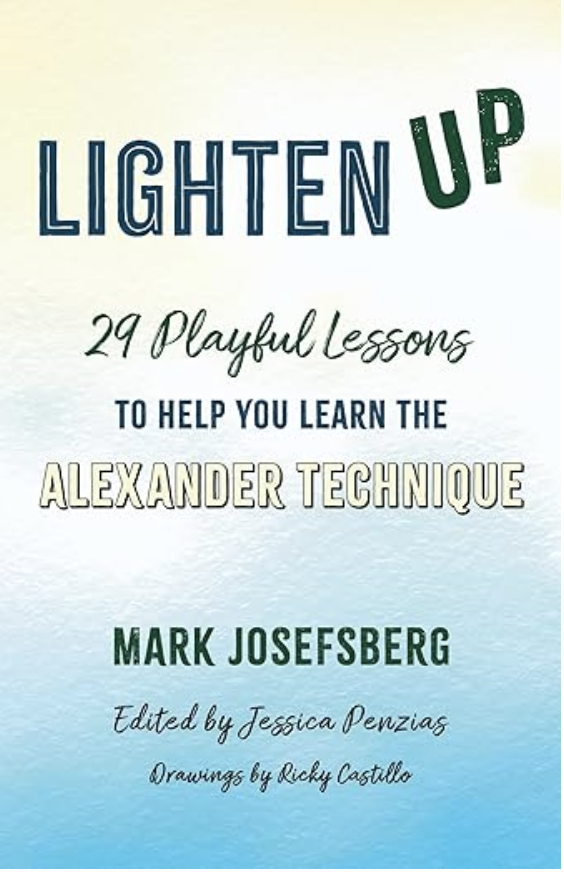
I’ve been reading a great little book called Lighten Up by Mark Josefsberg, which is a humorous description of the Alexander Technique, and only costs £2.50 for the Kindle edition.

It starts off making the great point about the pivotal (ha!) role the hip joint play in actions like sitting, standing, running, walking, bending, etc.. A good point it makes about your hip joints is that they probably aren’t where you think they are. People tend to think that you put your ‘hands on your hips’ that’s where you bend from, when in fact, your hips attach to your legs via a ball and socket joint that is much lower down.

This has real consequences for Tai Chi postures such as “Needle at Sea Bottom”, where you bend forward. If you bend from too high up then you are compromising your spine, and bending from your hip joints is always a bit lower down than you think it is.

Wu Jianquan, Needle at sea bottom

The way I do Need at Sea Bottom is to try and keep my head going “up” away from the spine and bend from the hip joints (where the legs attach to the body) keeping my spine in a straight line. In theory, at least.

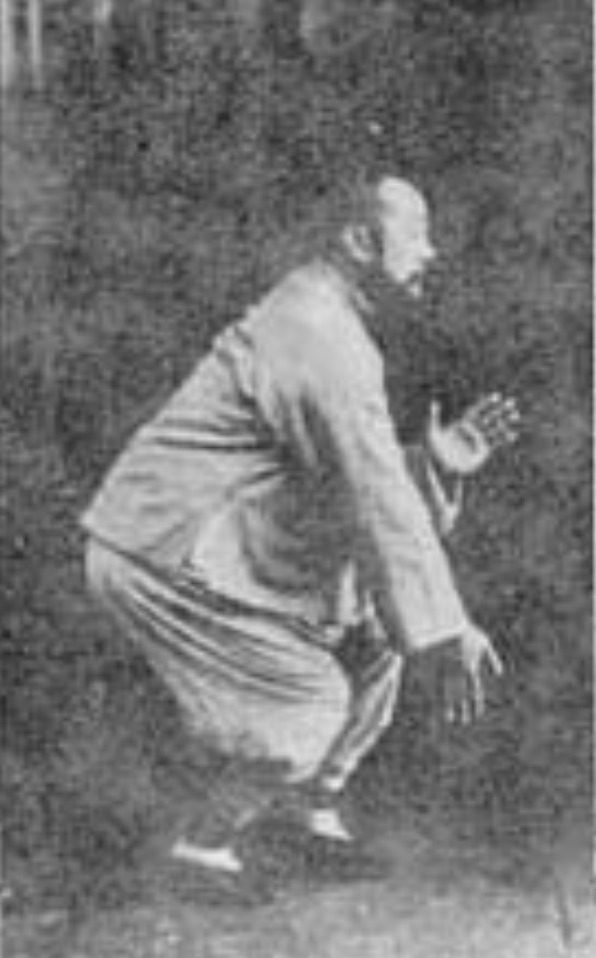
I don’t know who this is, but look at this guy doing it:

To me there are all sorts of problems here – he’s rounding his spine, and the head is kinked at an unnatural angle that isn’t an extension of the spine, in an effort to go too low. I’d rather not go as low as he is, and not compromise my spine like that.

The other point that Mark continually makes in the Lighten Up book I mentioned is to be aware of the AO joint – the atlanto-occipital joint. This is where the head meets the neck, and again, it’s not exactly where you think it will be. Put your fingers in your ears and imagine they are touching. Rotate the head up and down from something on a level with that point – that’s roughly where it is. What you’ll find is that you can look up and down without your fingers moving up or down because you are rotating the head around this point. Now apply that principle to Needle at Sea Bottom and you can see how your head position is meant to be.

Here’s a video of my Sifu Raymond Rand doing the movement correctly, with martial application:

Is Tai Chi really about relaxation (fangsong)?

I noticed a person on Facebook recently who was trying to make the point that the term Fangsong (放松 relax, unwind, loosen, ease, release, slacken) doesn’t appear in writings about Tai Chi until about 1930, and is therefore a modern idea that we are retrofitting to suit our modern ideas of Tai Chi being all about relaxing. That’s not his argument word for word, but that was the gist of it, anyway.

I’ve heard similar things from other people about how ‘back in the day’ Tai Chi was practiced hard, like a real marital art, until you were exhausted, and that modern training has gone soft in comparison. To those people I would point out that intensity and duration of practice have nothing to do with how you practice. Ask anybody who has practiced ‘standing still and relaxing’ for half a hour in a Zhan Zhuang posture and you’ll find out that practicing relaxing for half an hour in a stressful position is an exhausting, sweaty, business.

But to return to the original point, I would point out that even if you look at one of the oldest writings we have on Tai Chi – the handwritten manuscript of Li Yiyu from 1881 (which is available to read on Brennan Translation) you’ll find the word “relax” appears in the English translation 9 times. That’s not an insignificant amount. (I’ll leave it to the Chinese language experts to search the original Chinese).

You find it in phrases like:

I relax my power, but I do not allow it to collapse. (This has to do with “calm”.)

and

Every movement is a technique of first putting forth strength and then immediately relaxing, yet always there must be continuity from one to other, and there is never to be a departure from the four stages of “begin, develop, transmit, and finish”.

However, if you check out the even earlier 1875 text Explaining Tai Chi Principles, written by Yang BanHou, son of the famous Yang LuChan, you’ll find that he’s right – the phrase “relax” doesn’t appear, even once!

However, just look at one of the things written in the text:

“Power comes from the sinews. Strength comes from the bones. Looking at it purely physically, one who has great strength is able to carry many hundreds of pounds, but this is an externally showy action of bones and joints, a stiff strength. If on the other hand the power of your whole body is used, it may appear you are unable to lift hardly any weight at all, yet there is an internal robustness of essence and energy, and once you have achieved skill, you will seem to have something more wonderful than one who has the stiff sort of strength. Thus runs the method of physical training for self-cultivation.”

It seems pretty clear that he’s talking about relaxation being required for whole body strength.

But getting away from the nitpicking about facts (sorry!) I do think he has a point – there has been a modern re-framing of everything to do with Taoist arts as a kind of therapy for stress and dealing with the pressures of modern living that wasn’t necessarily there in the original arts – especially with Tai Chi.

Tai Chi was created in pretty stressful times, when wars were being fought, the concepts of law and order and justice were malleable depending on how important you were and life could be brutal and short. Taoism emerged at a time that was probably even more dangerous to be alive in! Frankly, I don’t think you expected to live long enough to have to worry about getting stressed! You were probably too busy trying to stay alive and earn a living. Being stressed is something of a modern disease because we live lives of relative comfort and we’ve got nothing truly life threatening to worry about on a daily basis.

The same thing has already happened to yoga.

But, I think we’ll have to live with it, because the hippies who have taken over Tai Chi Chuan do have a very good point – the first step in Tai Chi is to relax, whether you like it or not! You cannot move your body as a unit if parts of it are tense.

In Tai Chi Chuan the body is required to move as a whole unit, connected by fascia, tendons, muscles, etc, with all the joints allowed to move freely during exercise. All the joints are involved to some degree in all movement, so need to be relaxed. The ball-and-socket joints of the shoulders and hips are allowed to move freely. The gliding joints of the ankles and wrists move freely, and the hinge joints at elbows and knees are all allowed to move freely. Finally, the dantian moves freely and controls everything. Tensing the muscles around a joint separates it off from the rest of the organism, meaning that whole body movement is not possible.

And being mentally ‘tense’ is just as much of a problem as being physically tense, since the mind and the body are intimately connected.

Perhaps the emphasis in the original writings on Tai Chi was focused on more lofty philosophical principles, yes, but you will find plenty of admonitions to relax in there, and for good reason. That’s just how Tai Chi works.