It’s pretty good! I particularity enjoyed the ‘Wu chi’ standing at the start where he emphasises relaxing and releasing tension. Later on he gets into Feng’s HunYuan Qigong, but he’s using it more as a framework to teach his Ancestral Movement concepts. Fascinating stuff.
And why you shouldn’t train with weights when developing your qi
Mike Sigman has sent me an article to publish on this blog. I don’t normally publish other people’s work, or agree to their requests, but I’ll make an exception because it will hopefully generate some discussion. Regardless of how you feel about him, there’s is always a real depth to Mike’s writings and ideas that you can get a lot from, that you don’t really find anywhere else.
The article is primarily about one of the trickiest subjects in Chinese martial arts – qi (or chi).
I have a few thoughts about it:
1) The article starts by trying to “separate the skin-related qi, which includes the subconscious mind’s involvement, from the theoretical qi of traditional Chinese medicine”.
To some, particularly those people who relish Chinese history and the evolution of the concept of qi as it appears in Taoist thought, or medicine, that just won’t be acceptable, but I think this works for me. It moves the discussion into the realm of the physical and practical. It becomes a feeling and a doing thing.
2) It appears to be written partly as a reaction to a recent trend of mixing, or doing, Chinese martial arts conditioning through the medium of kettle bell or weights training. The question is, is that a waste of time if you want to get to the root of the subject, which is what the Chinese martial artists call qi?
Look, I don’t think there’s anything wrong with making yourself physically stronger at all. In fact, it’s obviously advantageous if you’re learning martial arts… But the article states that to master the internal movement, “the body must be completely retrained to learn to move with the qi, jin, and dantian”, and using weights will not help you in that respect. If you have retrained the body, then you could probably add them.
3) As I’ve said, nobody else really talks about this stuff, or if they do it’s watered down with a lot of other guff. If the article is correct on qi then what exactly are all the big names in modern tai chi seminar circuit and online courses out there actually teaching? Because they talk about qi a lot… but they don’t approach it in the same way as this article does, at least as far as I can see.
4) The article describes internal movement, quite simply and quite succinctly: “Ultimately, you develop a form of movement that uses the solidity of the ground as the focus of all forces to and from the body, while the qi covering of the body is manipulated by the lower-body and the middle to bring power to the arms and upper body.”
I find it hard to disagree with that definition, probably because it’s pretty broad. Sure, we can argue over what the “middle” is, or what the “lower-body” means,etc.. but as a succinct definition, it’s not half bad.
Now, let’s move on to how you do it…
The article talks about breathing exercises as a starting point: “Breathing techniques that stretch the surface of the skin and the involuntary muscle layers are the usual start of the progression.”
Now, I have personally trained in some of the methods that Mr Sigman uses (there’s a link to a video at the end of the article), and experienced what he’s talking about, and I’d agree that I can feel what he’s talking about. But I wouldn’t count myself as an expert in it, or knowledgeable about anything to do with it beyond the initial foot in the door stages, however, I have found that alone to be incredibly valuable and shone a light on some of the other things I was already doing. Even getting a foot in the door took a lot of work and a lot of time.
Anyway, I’ll leave you to read the article now and feel free to comment with your thoughts below.
Graham
Practical Development of Qi
And why you shouldn’t train with weights when developing your qi
by Mike Sigman, March 2025
Discussing qi is difficult because the definition of qi has become a bird’s nest of related topics. Let’s try to narrow the discussion and then describe an approach to practical development.
Most of the skills related to qi, in the physical body, have to do with an area near the skin of the body that is referred to as the “protective qi” or “wei qi”. While the protective qi is often referred to as an “energy”, it is actually a physical set of tissues that is controlled via the autonomic nervous system … but when you learn to control it via the subconscious mind, it does indeed feel sort of like an “energy” because it is apart from the topical sensations of the somatic nervous system, and the qi indeed feels odd, like an energy.
So, let’s separate the skin-related qi, which includes the subconscious mind’s involvement, from the theoretical qi of traditional Chinese medicine: that’s where most of the confusion lies. The skin-related qi and the subconscious mind are the artifacts which give us heightened toughness of the skin, odd sensations of qi, added strength by supplemental our muscle-bone strength, and dantian control of the body as whole connected by skin-related qi, among other things. Jin forces, the manipulation of the solidity of the ground and/or downward forces of gravity, are also the product of the skin-related qi: jin is defined as “the physical manifestation of qi” in many Chinese sources.
The qi of traditional medicine theory is/was an effort to explain the workings of strength, including the strength of our involuntary systems. We don’t need to know all the theories about meridians, putative different types of qi, etc., in order to develop the qi. Breathing exercises and focused physical and mental exercises are more important than complex qi-paradigm explanations.
The skin-area wei qi is initially controlled by respiration and “breathing exercises” are our initial approach to control and development of the qi tissues. During inspiration, if we are slightly extended or stretched out, we can feel a slight inward pulling of the tissues of the fingers and hand. Other areas of the body, upon being slightly stretched taut, can also be felt during the inhale, but many tissues in other areas of the body can’t be felt. They must be developed over time by breathing exercises before we can feel them respond to our breathing and before we can develop them further.
Some Chinese texts mention the fact that this superficial qi is something that animals still use (think of a horse quivering its flanks, for example), but which has atrophied in humans over the course of evolution. In order to regain our qi, we must use deliberate exercises of breathing, mental imagery, and posture manipulation.
Training the Qi in General Movement
Jin force-manipulation is a product of the qi tissues applying stressors within the body’s frame. That’s why jin is defined as “the physical manifestation of the qi”, among other things. We use jin unconsciously in our everyday movements, so another common definition of jin is as an “intrinsic strength”. The full-blown traditional movement methodology that permeates the Chinese (and related) martial arts involves both qi and qi’s subset, jin. Qi and jin. Jin forces are the mind-directed forces from the ground and gravity; qi can be thought of, in a simplified sense, as a superficial muscular layer that connects the whole body.
The basic idea of movement with qi and jin is that the power from the ground and lower body is used as the power source for the upper body. The qi and the jin work from the lower body (including the middle/dantian), so what we have with “internal” movement is a system where the arms and hands are controlled and powered by the lower body and the middle.
The general admonition is that muscle and power are used in the lower body, as needed, while the upper body is moved without the use of local muscle. I.e., a person has to learn to control his/her upper body via manipulation of the lower body and the middle. The person who thinks the internal arts would be best supplemented with typical weight workouts at the gym has lost the plot and is giving away a total lack of understanding about how the “internal” martial arts work.
Developing the Qi
Jin skills are actually fairly easy to learn, although it generally takes a few knowledgeable pointers and some personal, hands-on demonstrations to get someone started. There are a number of written attempts at jin explanations on the internet, particularly through the 6H forum.
Qi is difficult to develop because it takes time and the feelings we need to focus our attention are tenuous at first. Breathing techniques that stretch the surface of the skin and the involuntary muscle layers are the usual start of the progression. Many traditional Chinese martial arts talk about “100 Days” of breathing exercises to develop the qi to a usable status.
Movement of the involves directing all forces upward from the solidity of the ground (so you must “sink your qi”) or use the weight of the body as a basis for downward movement.
Ultimately, you develop a form of movement that uses the solidity of the ground as the focus of all forces to and from the body, while the qi covering of the body is manipulated by the lower-body and the middle to bring power to the arms and upper body.
All Asian martial arts that are labelled as “internal” martial arts, formal calligraphy, qigongs, traditional dance, etc., use this combination of qi and jin for movements. Learning the external choreography and appearance of a martial art, a qigong, etc., no matter how much it resembles the movements of an expert, will not be correct until the system of movement is changed over to the qi, jin, and dantian type of movement.
Almost all of the movements we so often see in western semblances of “Tai Chi”, Aikido, Xingyiquan, Baguazhang, etc., are based from normal movement parameters, rather than qi and jin mechanics and it will take effort to re-learn these arts with the correct movement basis. There is an old saying to that effect: “Taijiquan is easy to learn, but difficult to correct”. So, if your goal is to learn Taijiquan, Aikido, or related arts, remember that all the talk about “relaxation”, “don’t use weights”, etc., is because the body must be completely retrained to learn to move with the qi, jin, and dantian.
Here’s a video of Chen Zhaosen, with translation by John Prince, teaching basic movement drills for the Chen-style Taijiquan. Notice his comment about no strength in the upper body, but whatever strength you need in the lower body. https://vimeo.com/141009942
I’ve returned to teaching beginners recently and that’s left me with a problem: I need a simpler Tai Chi form to teach.
The main problem with beginners learning Tai Chi is remembering the movements. While this is all a distant memory for me, lost behind 30 years of practice, I can see that the struggle is real for them – where does this arm go? Where are my feet? What move is next?
Also, the complexity of movements is an issue. Moves involving kicks where you have to stand are a lot harder for people without any background in a sport or a martial art to do.
I also need a Tai Chi form that’s short enough that the end of it isn’t so far away as to be unattainable to beginners, but has enough content in it that there’s something of a work out going on.
So I came up with doing some modifications to the first section of our long form and running with that. Here it is:
I think this form has a good balance of everything – it’s long enough that there’s enough to learn and practice, plus the movements are relatively simple for beginners, with no complicated kicking or turning manoevers. But it’s not so long that it’s going to take months to get to the end of.
Once the form has been learned and the first 6 posture principles of Tai Chi adhered to:
…and a reasonable level of relaxation achieved, then they can work on principles, like arms following the body, not moving independently. A good way to work on this is through silk reeling exercise.
Of course, after beginners have reached a reasonable standard in this form, they can move on to the full Lam short form, which is more of a challenge. But I suspect that for a lot of people, this little form will be enough.
I also updated my Tai Chi teaching website with a new name Slouching Tiger. Check it out.
So, Mike Sigman raised an interesting point in his comments on my last post on silk reeling – “Silkreeling is about developing the elastic connections of the body.”
I agree with him. That’s probably not all silk reeling is about, but that’s the fundamental idea. But I wonder how many people who teach silk reeling or Tai Chi actually agree? I mean, there are so many style and different ways of doing Tai Chi these days that’s it’s almost like it’s become a terms for a grab bag of different skills all meshed together.
But perhaps we just need to establish a baseline. I’m interested to hear what you would call the point of silk reeling? How does that statement sit with you?
I read something interesting in this interview with Chen Xiaowang, originally published in the October 1996 (vol 20 no. 5) issue of T’ai Chi Magazine.
He’s talking about silk reeling and he says:
Chen commented that many people practice the Chen style in an overly exaggerated fashion making very big movements. He said these kinds of excessively large movements lead to a separation of one part of the body from other parts of the body and is incorrect. A common mistake, he said, especially among those who do the Xin-jia or new frame is to do movements in an exaggerated manner and make a lot of small circles and loops. “That shows that they don’t understand the principles of chan si jing.”
Tai Chi Magazine
I’m not sure what to think about that. It’s pretty well understood in Chinese martial arts that you often practice big and use small. The best way to practice a movement is to start with it in a large, exaggerated way, but then over time you do it in a more refined way and it becomes smaller.
A quote from my teacher I’ve always remembered is:
“In the beginning my circles encompass the whole universe but at the end I roll them up and put them in my sleeves.”
However I think perhaps Chen is not talking about this. I’ve seen a lot of people who do Tai Chi (and particularly Chen style) in a very bendy, rubbery, gyrating way. I think he’s saying that too much of that can often lead people onto the wrong track. And more specifically, he’s saying that if they’re doing this then it’s because they don’t understand the basics of silk reeling.
Now silk reeling is quite a Chen style-specific practice. I don’t think you even need to do it to practice Yang or Wu style, but if you are doing it, I bet it’s very easy to get sidetracked into doing lots of small loops and circles. But really the process should be about being minimalist. Cutting out the inessentials until the movement is pure and simple, while still being effective.
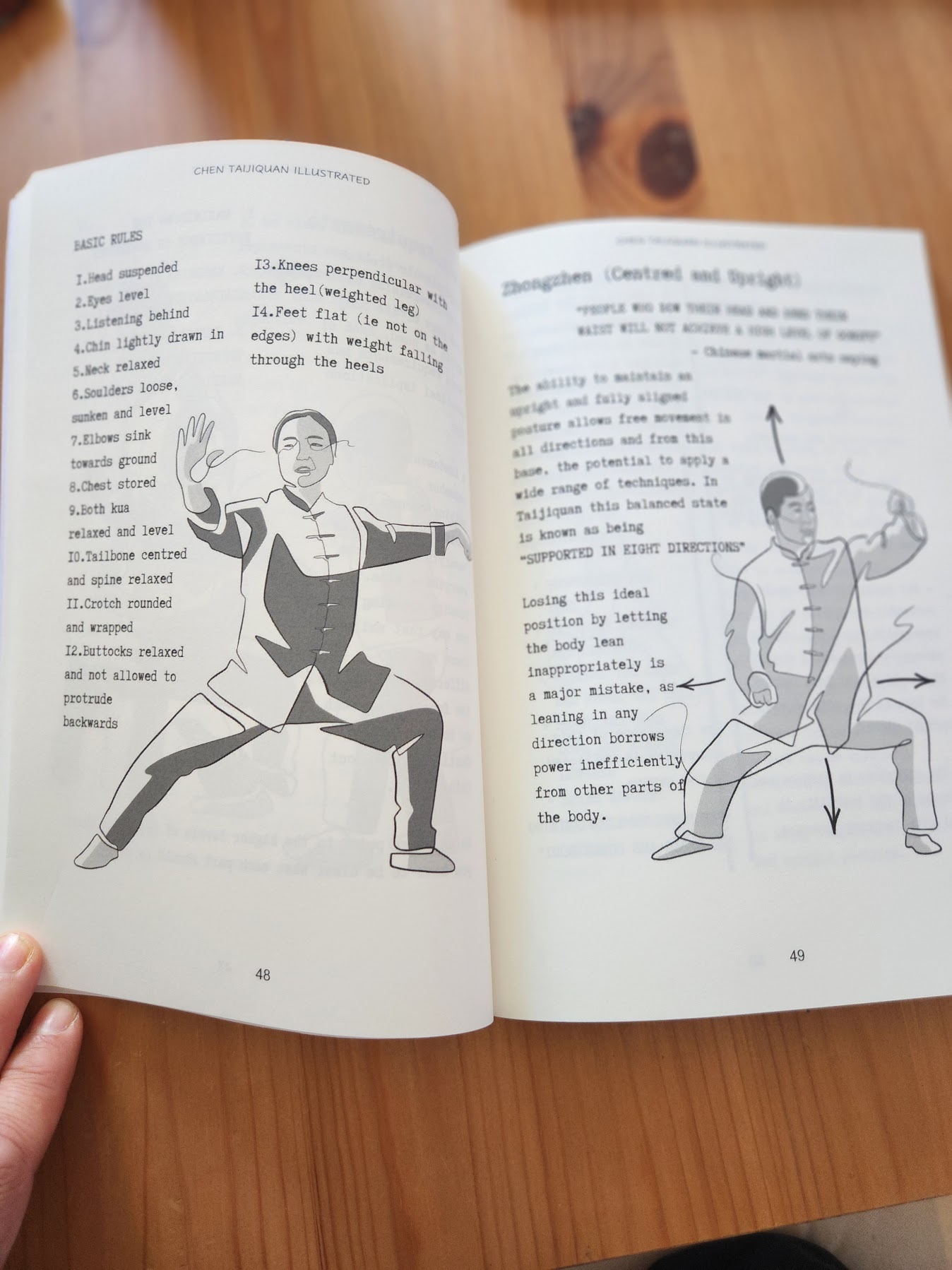
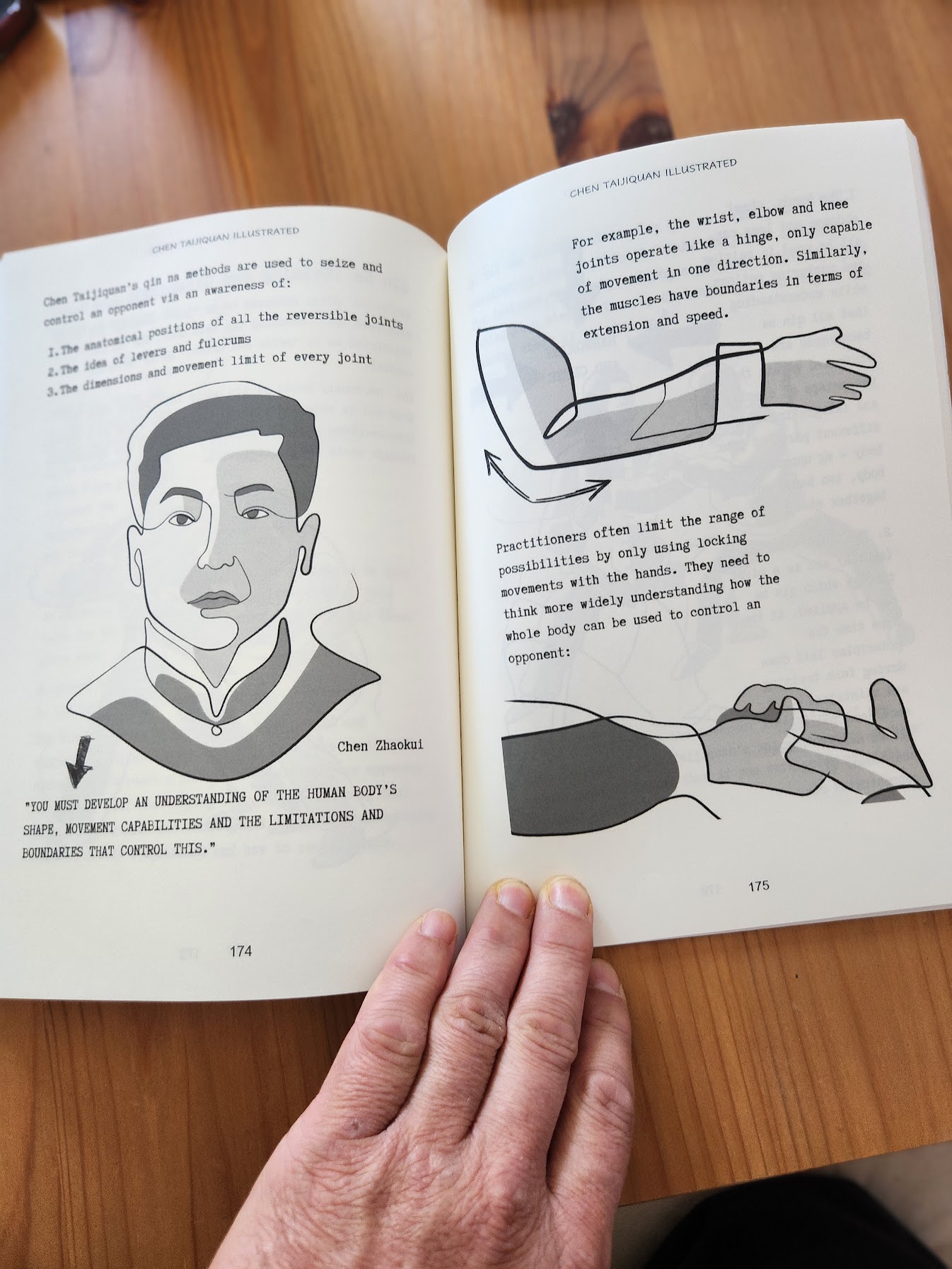
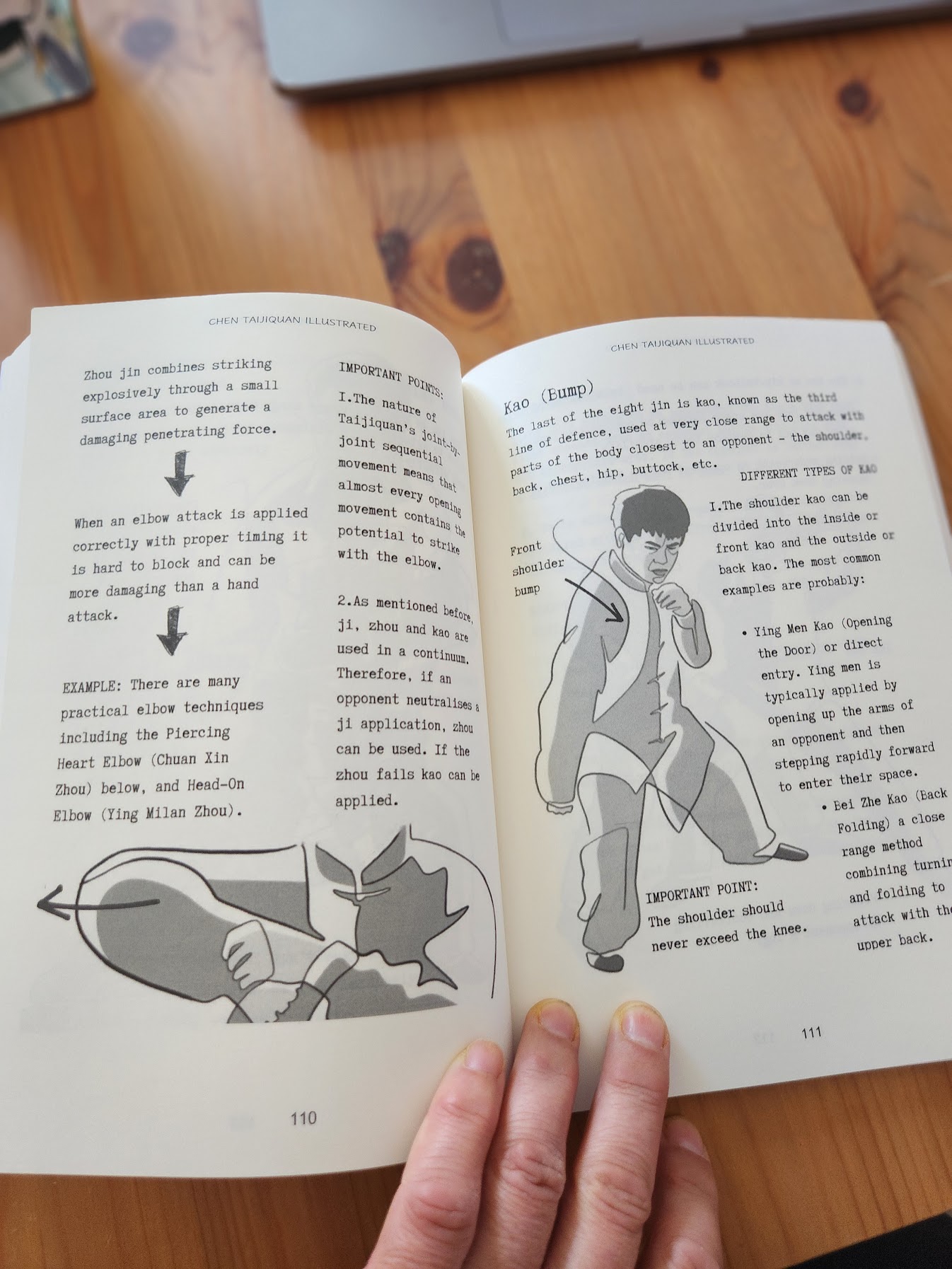
Chen Taijiquan Illustrated is an exploration of pretty much everything that makes up Chen Taijiquan, from principles, and body methods to practical usage and philosophy. But the most notable thing about this Taijiquan book, and the place where we should probably start, are the illustrations, because they are what really separates this book from others of its ilk.
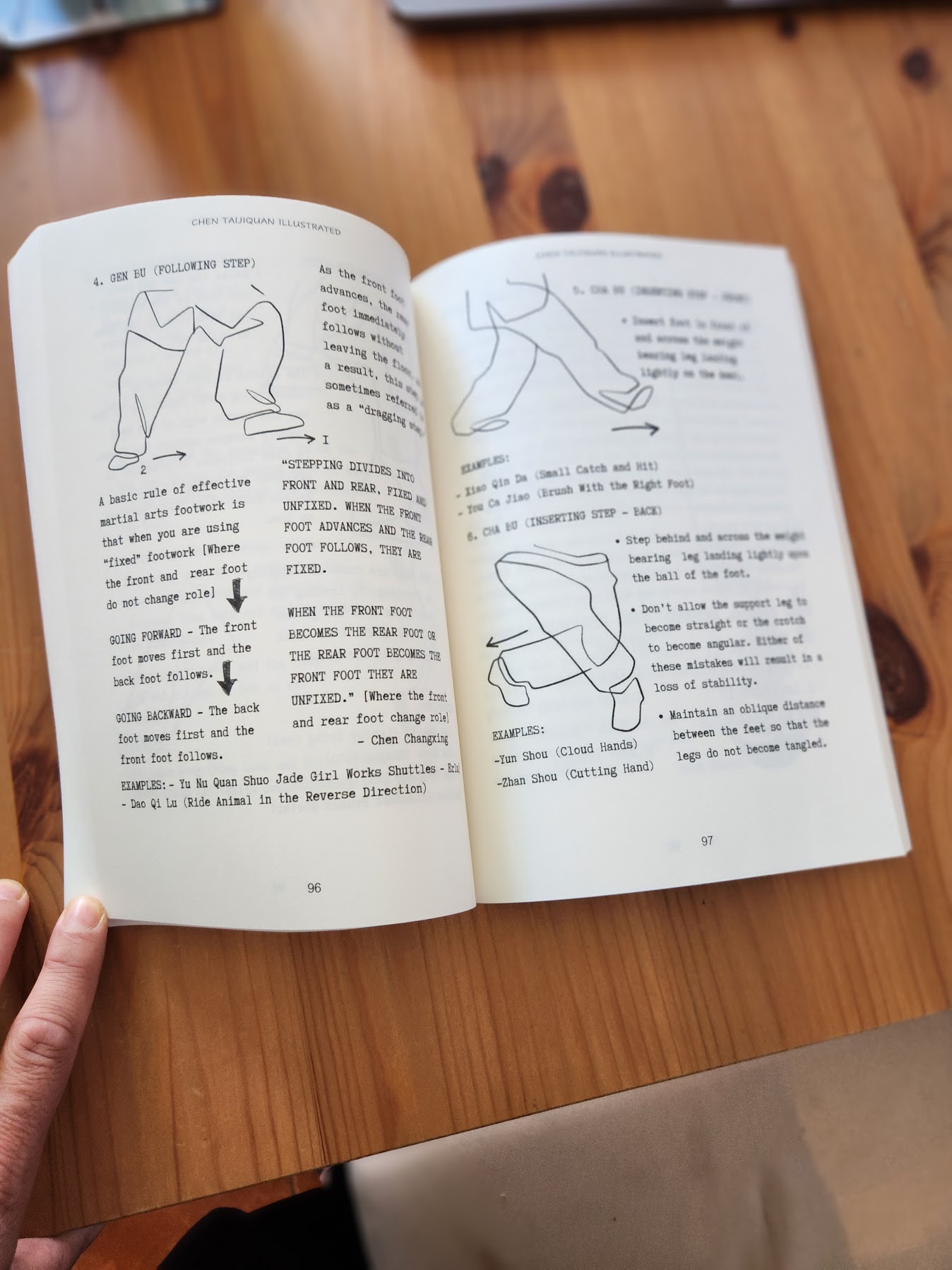
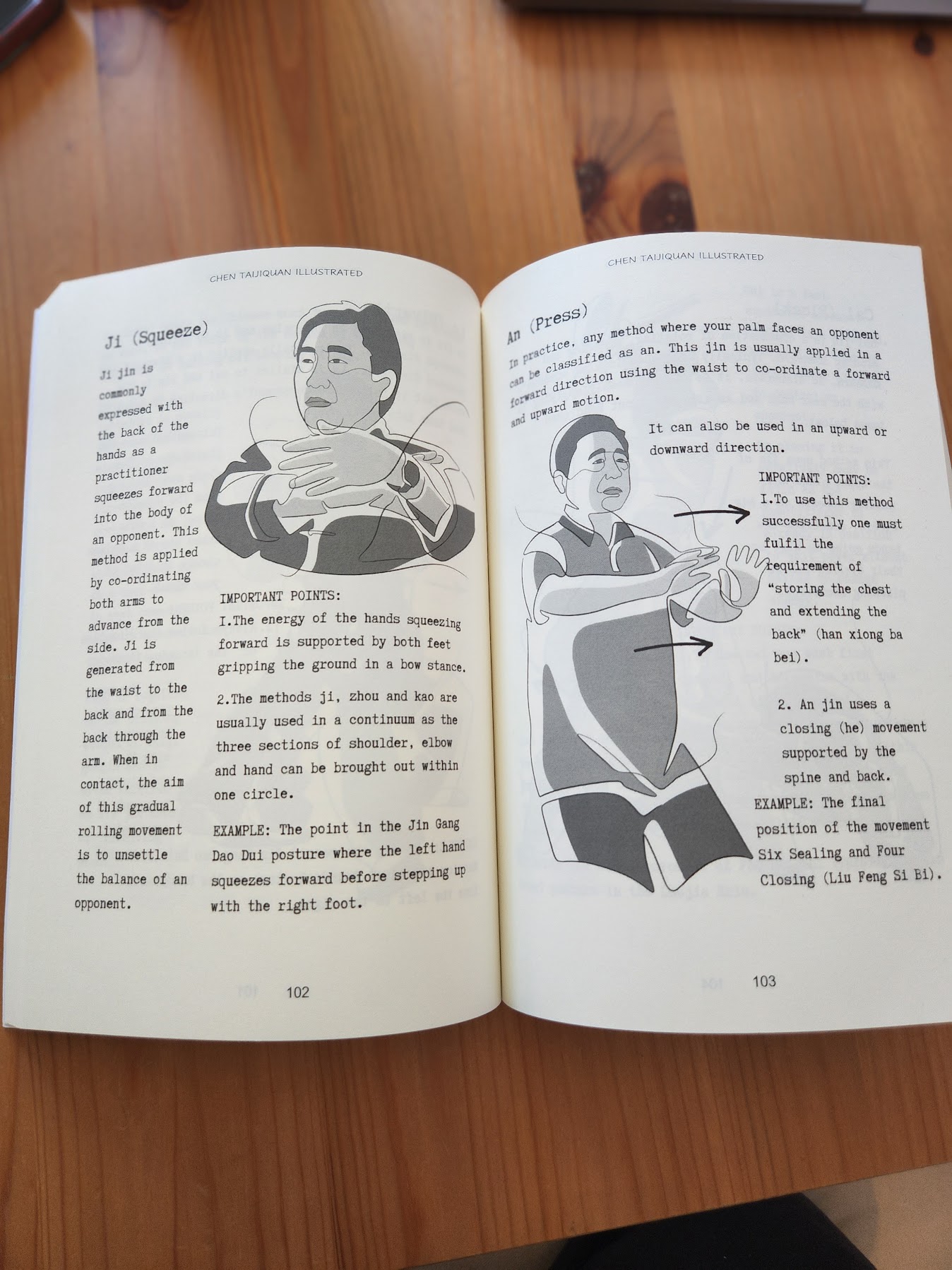
Almost every page here (and there are over 200) has some sort of detailed drawing on it that adds context to the text surrounding it. In fact, the whole book takes the form of a visual notebook, as if you are discovering a secret copy of the best-looking training notes you’ve ever seen. Surrounding the drawings are quotes from the most iconic practitioners in the Chen lineage, past and present, as well as explanations of principles, concepts and requirements of Taijiquan. Take a look and you’ll get the idea:
As you can see, the drawings are mainly done in a stylised cartoon way, which is actually very effective, and it’s pretty clear that these are photographs that have been traced over digitally, to produce the illustration, rather than drawn from scratch. The overall effect is really nice, and refreshingly modern and accessible.
Because a Taiji master’s posture takes years to develop and is a reflection of their skill, you can learn quite a lot from just looking at it. So, having a drawing based on a real photo gives you the best of both worlds – you get to see the genuine skill of the practitioner on show mixed with the accessibility and visual appeal of an illustration.
In fact, in a lot of cases you can guess the famous master that the drawing is based on. For example, the book cover shows, I believe, a digital tracing of a photo of Chen Xiaoxing, brother of Chen Xiaowang.
It should be pointed out that not all the illustrations in the book are done to the same high standard, but there are only a few where the quality dips significantly.
Chen Taijiquan Illustrated is split into three sections – Section 1, Body Rules (Shape and energy), Section 2, Practical use/Application and Section 3, Philosophical Roots. Section 3 on philosophy is tiny compared to the massive section two, which consists of a catalogue of pretty much all the practical methods found in Taijiquan – peng, lu, ji, an, listening, sticking, neutralising, push hands, hand methods, leg methods, stepping, chin na, etc. Pretty much everything to do with the Chen style is here!
The initial section on body requirements is very good, and something you can keep coming back to and the book goes into much more detail than you’d expect to find in a basic beginner’s book, which makes me happy. The explanations of the concepts and techniques in the second section can sometimes err towards being more of a catalogue of techniques than an in-depth ‘how to’ of each one, but there is always going to be a limit on how much can be achieved in print, and the illustration of various masters doing the method being discussed speaks volumes in itself, and adds a lot of depth. It’s also nice to see the martial methods of Taijiquan being discussed in detail, something that is also rare to find in a Taijiquan book.
Let’s talk for a moment about what the book doesn‘t include. For a start, there is no attempt to teach a form in this book, which is probably a good thing, as Chen style in particular would be hard to teach in a printed book due to its intricate nature and complex, spiraling movements. Also, there is no history section – personally I’m glad about that, as it’s a massive subject and would require too much space to do it justice, and frankly, it’s been done to death elsewhere, and matters not a jot to your actual practice of the art. If you want to discover the key to “internal movement” then you’ll find good pointers here, but if you really want to delve deeply into subjects like peng, groundpath and internal body mechanics then I’d say you should check out Ken Gullette’s book on the subject. Finally, there’s no mention of weapons here, which are obviously a huge part of the Chen art. The emphasis here is on body methods and bare hand methods only.
Taijiquan is a practical, doing art, not the sort of practice that benefits from too much intellectualism, and the visual nature of the book is great at reminding you of that fact, grounding the concepts and principles in practical reality.
Overall, I think this has to be one of my favourite books on Taijiquan ever produced. This is really one of the most comprehensive collection of training notes you’ll ever come across. And because everything is fitted around pictures, there are no long, boring, passages of text, meaning you can dip in and out at any point. In fact, just picking it up, flicking to a random page and starting to read for a few minutes can easily give you inspiration for your practice that day.
Highly recommended, and while obviously best suited to Chen style practitioners (there’s a lot of discussion of silk reeling), I think a Taijiquan practitioner of any style would get a lot out of it. I certainly did.
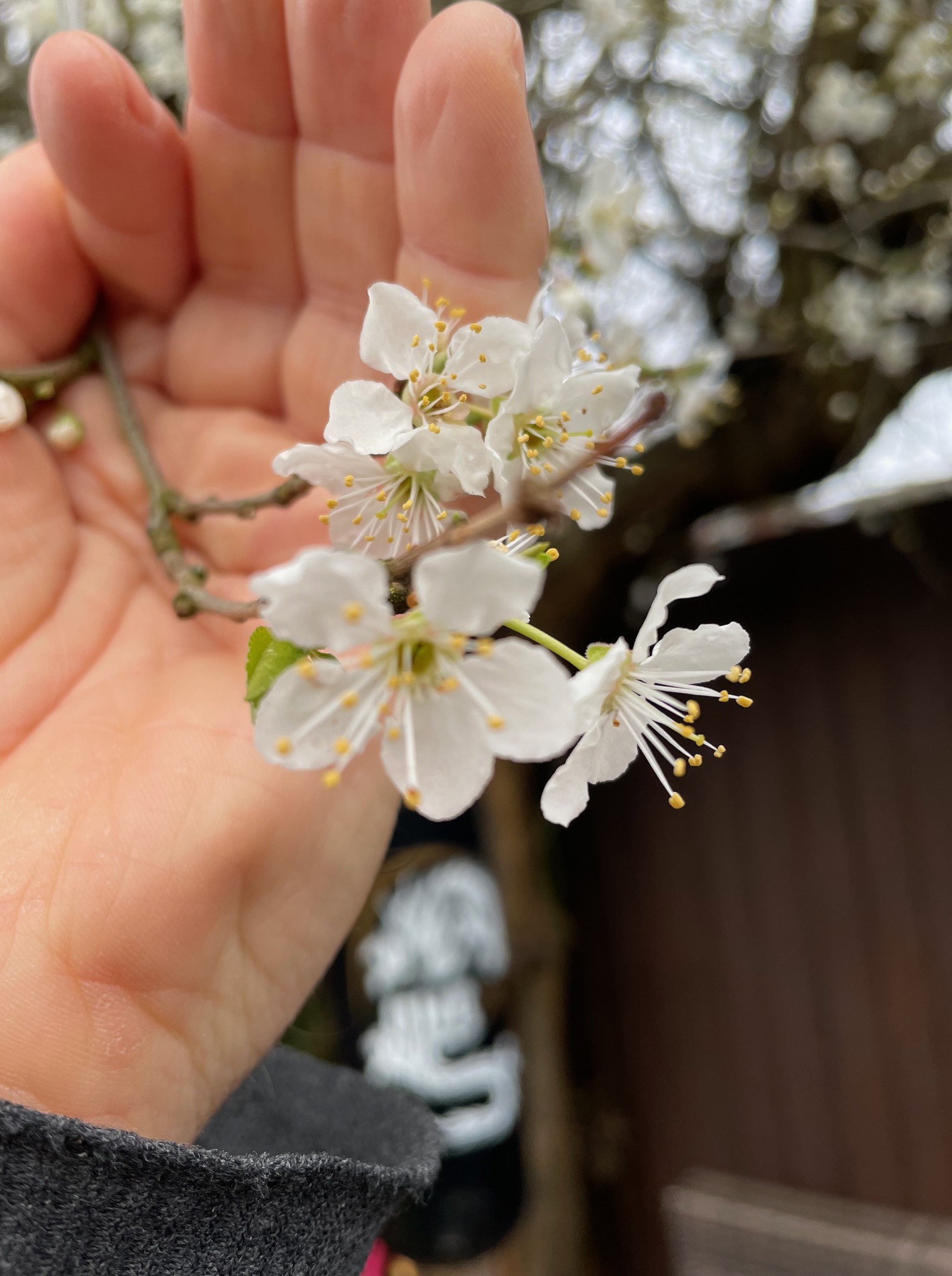
The plum tree in my garden is blossoming, and that can mean only one thing: Spring is here!
Without getting too poetic about it, the potential energy trapped within the tree over Winter is releasing and opening out to the world. So, in keeping with the cycle of the seasons, let’s return our Tai Chi practice to a similar aspect – opening and closing.
All Chinese martial arts contain movements that open and close the body, but I’d go as far as to say that a repeated pattern of opening and closing your body in movement is the fundamental action of Tai Chi Chuan. It’s perhaps the one thing that makes Tai Chi Chuan (Taijiquan) different to other Chinese martial arts.
Then there are also Chinese martial arts that use ‘open’ postures a lot, and produce power from the big turning actions of the waist and shoulders – Choy Li Fut is a good example of this.
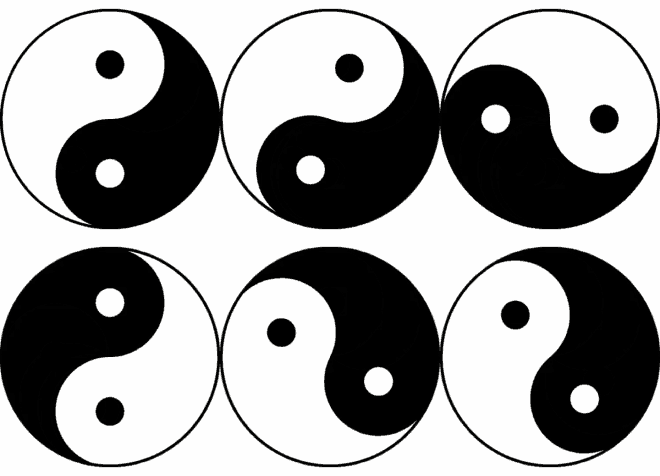
Of course, both these arts make use of both opening and closing movements in application, but what makes Taijiquan different is that it seems to have a rule that the body must constantly cycle through a series of opening and closing postures. You can see this when you look at Tai Chi forms – it shouldn’t matter which style you’re looking at, the opening and closing movements should follow each other in a cycle, very much like the Yin Yang symbol. If you imagine the Yin Yang symbol turning in a clockwise direction then the white fish becomes the black fish, which becomes the white fish, and on and on.
Silk Reeling exercises are a great way to focus on understanding open and close movements, as you just keep repeating the same pattern over and over, so your brain doesn’t get occupied thinking about the movement you are doing next (as it would in a Tai Chi form) and you can focus on the opening and closing actions.
So, what are the opening and closing actions? Well, I went over it in a video series a while ago. You can watch it here:
But it takes a while to watch all that series, so long story short, here’s a written explanation: an opening movement generally stretches out the front of the body (the Yin side – the soft parts, like the inside of the arms, and thigh, calves, and belly) and a closing movement generally stretches out the back of the body (the Yang side – the harder parts, like back of the arms, back and outside of the thighs and shins).
You can see these actions everywhere in nature: Cats tend to stretch along the front and back (yin and yang) of the body when stretching. (And it’s the same with the Yoga “Cat stretch” posture). But you see them in humans too – when you do one of those involuntary yawning/stretching movements in the morning, it tends to be opening the chest (yin stretch), occasionally followed up by a Yang side stretch.
It’s been noted that animals running are opening and closing the Yin and Yang sides of their bodies in sequence. So, this opening and closing action is fundamental to human and animal movement and the more we can utilise it, the more we are returning to our own natural systems of movement. Now, I don’t want to get sidetracked into a debate on what exactly “natural” movement is, but simply put, this opening and closing movement done in the human body feels good, it seems to put you in a good mood and you feel like your body and mind are returning to the way they are supposed to work. It requires less effort to perform tasks using it because it’s very efficient and it feels natural. If you watch skilled workmen and women then you’ll notice that they tend to gravitate towards easy body movements that have this natural opening and closing quality. Many of the people in ancient China who practised kung fu systems would have been agricultural village works who were familiar with natural movement patterns through necessity.
4 Directions Breathing exercise
Silk reeling exercises belong to the Chen style of Taijiquan, and while I (a Yang stylist) have no problem borrowing what works from other styles, a lot of Tai Chi practitioners might not want to do something from another style. However, almost all Qi Gong/Tao Yin type breathing exercises follow the same idea of opening along the Yin side of the body and closing along the Yang side that you find in Silk Reeling exercises.
You probably have some sort of exercise already that’s in your system to try this with, but let’s try one simple exercise to get our heads around the idea of open and close.
Stand in a Horse stance,
Breathe in as you bring your hands up facing you and then move them around a large imaginary ball that’s in front of your chest, so that your hands are facing away from you.
Push the imaginary ball forward away from you as you breathe out.
Turn the hands over and bring them back in towards you as you breathe in, going around the outside of the ball.
Push to the sides as you breathe out.
Bring the hands back in, circling the ball, getting underneath it as you breathe in.
Push upwards as you breathe out.
Bring the hands back in, circling the ball, getting on top of it as you breathe in.
Push downwards as you breathe out.
Bring the hands back in, going around the ball as you breathe in.
Let the palms face down and hands return to your sides as you breathe out.
Adding the opening and closing:
As you bring your arms up and towards you and go around a big ball that’s the opening movement. You can feel the slight stretch opening around the chest area, and you use that slight tension to help push your hands forward. As you do you’ll feel a slight stretch developing along your back. That’s the closing movement. You then use that slight tension to help bring your arms back. This is opening. Then as the arms push to the side, this is closing, and so on.
You often hear Tai Chi teachers say things like “don’t use muscle”. Normally this drives me mad, as you can’t physically make a movement without using muscles! However, what they’re really talking about is using that slight stretch you can feel to power the movement instead of just moving as you normally would, which results in making it “too physical” for Tai Chi. Finding the right words here is a delicate balance, but what we’re looking for is more of a whole body movement.
Final words
It helps to work on this in a stationary exercise, as described, but when you try your Tai Chi form, try and focus on keeping that feeling of opening and closing going throughout the whole form. The opening and closing movements are already there in the form, it’s up to you to reveal them. It’s a way of approaching the form from the inside, rather than the outside. So, if you’ve been struggling to get a movement to feel right in your form, it could be that the method described here will solve the problem for you. For it to work you have to be “sung” (relaxed) and focused on what you’re doing and the feelings inside the body. If your mind wanders off then inevitably so will your form. This is the start of what we call in the Tai Chi Classics “internal and external combine”.
So often we have to practice Tai Chi in our front rooms, back gardens or patios because of time pressures. Or maybe we only get to practice at a class in a village hall, gym or community centre. Either way, our surroundings are often far from natural.
Being able to practice Tai Chi in an environment where there were no other people, no human sounds and no interruptions was a blessing. It was possible to really sink into the environment for once, and not just my legs!
It’s a process one of my teachers calls “being a teabag in the ocean”. If you want to take in the good stuff from the natural world around you then you need to adopt the attitude of being like a teabag in the ocean – i.e. let nature move through you as well as around you, so that you don’t feel like something separate to it. Absorb it, soak it in. I’d say most people practice Tai Chi as if they are a teabag that’s sealed inside a plastic bag then dropped in the ocean. They can be doing great Tai Chi, but they are perfectly contained within themselves and not interacting with the environment. Often there’s not much environment to interact with, as mentioned previously, but if you get the chance to practice Tai Chi out in the woods, you should take it and take the opportunity to get out of that plastic bag.
Before you practice the form, stand for a few moments and try to let the barriers between you and your surroundings break down. Your mind should be focused on the moment and on your breathing, after all, that is as much a part of nature as anything else. Stand like that for a while before doing the form and just experience it, don’t think about experiencing it.
Then as you go through the movements of the form, you’ll start to feel like you are moving with the natural patterns around you. Don’t worry if your form takes on a subtly different quality than normal. It’s all part of the process.
I find that I don’t have as much free time for this in my normal life as I do when I’m on holiday, but I’m going to try and make an effort to get out to a secluded place now and again and practice my Tai Chi out there because the effort is well worth it.
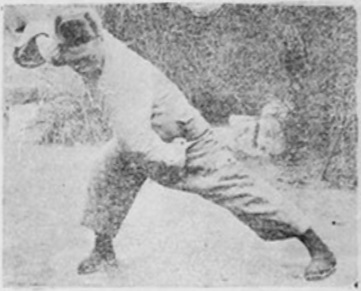
Chen Ziming demonstrating whole body coordination.
What makes Tai Chi, Tai Chi? One of the things you often hear said is that whole body movement, or whole-body coordination, is what makes Tai Chi different to other kung fu styles. How this is interpreted in Tai Chi Chuan, however, seems to vary slightly, moderately or even hugely depending on the style of Tai Chi you’re watching or doing.
I was scrolling through the excellent 1932 book by Chen Ziming (I’ve discussed this book before) on Chen style small frame called “The inherited Chen family boxing art”. I did a search of the text for “whole-body coordination” and it appeared 34 times! That gives a good sort of indication on how important he thought it was to his Tai Chi Chuan. In fact, the phrase “The entire movement must have whole-body coordination.”, appears in almost every single description of a move in his form.
Earlier in the book he lists the key points of Tai Chi boxing and says:
[8] WHOLE-BODY COORDINATION
四肢百骸協同動作此之謂周身相隨故太極拳一動無有不動一靜無有不靜 Your four limbs and hundreds of bones are to be moving cooperatively. This is called “whole-body coordination”. Hence in Taiji Boxing: “When one part moves, every part moves, and when one part is still, every part is still.”
Chen Ziming
He’s quoting “When one part moves…” from the Tai Chi Classics there. But what does he mean?
In some styles of Tai Chi the footwork is lively and continually moving. Wu (Hou) style springs to mind as a good example. In others, there are moments where the practitioner seems to almost stop in a semi-static posture for a moment or two – Chen style springs to mind. It’s therefore no surprise then that people’s definition of what “whole body movement” actually is can vary considerable.
It clearly doesn’t mean that the feet have to be moving all the time. My belief is that it’s more to do with engaging the whole body in a movement – think of the difference of lifting a heavy weight with just your arms, or getting your whole posterior muscle chain involved with the movement, all the way down to the feet. A Judo hip throw is a good martial example. When picking up a heavy object (like a spear) it’s more obvious when you are engaging the whole body and when you’re not. With a solo bare-hand form it requires an extra level of awareness to discern if you are engaging your whole body, or not, in a movement. You can essentially cheat because with no weight to carry, there are no consequences to using local movement. This is one of the advantages of practicing archaic weapons forms, even in the modern age – they give you direct feedback on your whole-body coordination.
On a more subtle (esoteric?) level, whole-body movement can refer to dantien controlled movement, as often exhibited in silk reeling exercises. This is where you’re controlling the extremities (the limbs) by subtle movements from your dantien. This is a step beyond simply activating the posterior muscle chain in a movement, it’s a different way of moving altogether, and well worth investigating. Find out how to do it here.
Whether you subscribe to the belief that a dantien exists, and can be used to control the limbs, or not, you’ll notice that Chen Ziming only listed whole body coordination as one of the key points of Tai Chi boxing. There are others – 10 others in fact. All of which are worth noting too:
Key Points for Taiji Boxing 性質 [1] The Nature of the Art 方法 [2] Methods 程序 [3] Sequence of Training 姿勢 [4] Postures 動作 [5] Movement 呼吸 [6] Breathing 精神 [7] Spirit 變著轉勢 [8] Whole-Body Coordination 周身相隨 [9] Switching Techniques & Transitional Movements 身作心維 [10] The Body Performs & the Mind Ponders 無貪無妄 [11] Do Not Be Greedy or Rash 十三勢術名及其演練法
In this episode Tai Chi Notebook podcast my guest is Ken Gullette, a native of Illinois, USA, where he trains in all three of the main internal arts – Tai Chi, Bagua and Xing Yi. Ken also runs a website called internalfightingarts.com where he trains students from around the world in the three internal arts using a combination of recorded and live classes.
Ken is quite famous for his focus on body mechanics, internal power and getting to the root of these arts in a non-mystical and no-nonsense way. In fact, he’s written an excellent book that’s available on Amazon – it’s called ‘Internal body mechanics for Tai Chi, Bagua and Xing Yi’, and I’d recommend you get a copy.
In this episode we discuss the internal body mechanics of Tai Chi, training with disciples in the Chen family linage and there’s also a few stories of the times Ken has had to use his arts in real situations.



 The Tai Chi Notebook