Rollback – the unfinished technique

Here’s the best thing to do after you’ve applied Tai Chi’s rollback.
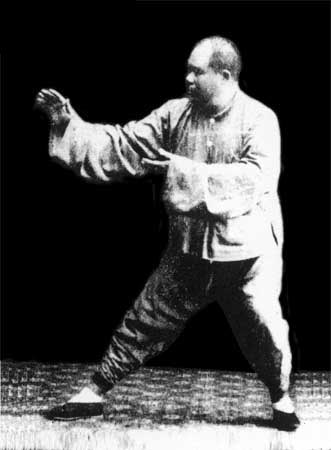
ycf_roll_back

One of the things that comes up a lot in Tai Chi push hands training that’s geared towards the martial side of Tai Chi is what to do with the opponent after you’ve done Rollback. Rollback uses Lu energy to lead the opponent in and control them, with their arm kind of locked, but not to the point where they’d tap. In the Yang form there’s no ‘finish’ from this position – after controlling them you strike with Press (Ji). This is ok, but to me it seems like you’re giving up the advantage you have over them because of the control that rollback affords in exchange for a quick strike. It looks like this:

lnbetw

There are several alternative things you can do – turn it into a push away (into a wall?), turn it into a takedown where you keep the pressure on the arm and shoulder, forcing them into the ground, or you can go for my preferred answer, which is to turn it into a standing arm bar as shown in this video:

Key things to note:

1. He puts his elbow over the top of their arm and makes sure the locked arm is snug in his armpit.

2. On the locked arm the little finger edge is pointing to the sky.

3. In the finish position he rotates his wrists around the opponent’s wrist so that both his thumbs point upwards – this gives you maximum leverage on the arm.

4. Once the opponent is controlled you can look around and watch out for further danger from somebody else.

I like this solution because it’s a really powerful arm lock and you can move into it from the end of the Tai Chi rollback posture fairly easily. You can feel it would be easy to break the arm from here, and the opponent is pretty much helpless. Obviously, in a self defence situation the level of force you exert needs to match the severity of the threat you feel you are under, so don’t go breaking the arm of people who have innocently patted you on the back, and also take care of your training partners. Don’t break your toys!


The Tai Chi magician

Woo! Everywhere is Woo!

Tai Chi, like all other traditional martial arts, contains some aspect of performance, show or magic trick. See my previous post about meeting Scott Phillips for more on this idea, but in short, public demonstrations for entertainment have always been a part of the traditional Chinese martial arts. Martial arts street ‘buskers’ doing gymnastic performances, kung fu schools doing en masse demonstrations of their skills, the Shaolin Monks touring the world with their concrete-breaking, skull-cracking performances, etc… The list goes on.

In Tai Chi the publicly-expected demonstration of skill has turned into something more subtle and suitably ‘Taoist’ than merely breaking concrete blocks, or wooden boards. It seems to come down to a ‘master’ figure demonstrating how far he can push a student back with a very light touch, and while it may not be explicitly stated, the assumption is that the master is demonstrating his Chi Power. Sometimes touch is not even necessary and it is done through thin air by the master merely waving his hands at the student. The bigger the reaction of the student then the better the master, or so the unspoken rule seems to go.

Yes, there can be some functional use to this sort of pushing demonstration as a teaching aid. From the students point of view they get to feel what it’s like when somebody with skill puts hands on them and pushes them backwards. Ideally, from a Tai Chi perspective, it should feel different to a muscular, forceful push. It’s not much use as a self-defence technique, but it’s good for demonstrating the type of force you want to be developing in Tai Chi – using the force of the ground via the legs, controlled by the waist and channeled into the hands. It’s a smooth type of effortless power, rather than using the shoulders or back to do a muscular ‘stiff’ sort of push. The difference is subtle and getting hands-on with your teacher is essential if you’re ever going to learn what it is, because you need to feel what it is not, too.

The problem arrises when when the student’s reactions become hyped up in public. In an effort to not let their teacher lose face they can start to over-react to the push. They start to stiffen their arms, and straighten their legs, resulting in a curious type of ‘hop’. It’s not like an agreement was explicitly made before the demonstration that the student should have a big reaction, it’s more that he starts to subconsciously over-egg his response so he doesn’t make his teacher look bad. Anybody who has taught a group of people Tai Chi will be familiar with this phenomenon. Whenever my students tried to ‘fall over’ for me in a demonstration I always reprimanded them and tried to get them to stop ‘helping’ me do the demonstration, and just act like a normal attacker.

On the other side of the coin, you could decide to view these kind of demonstrations as a simple magic trick. A magician (the teacher) is showing a magic trick, and you all know it’s not real, so just enjoy it for the spectacle it is.

At The Fajin Project Facebook group a chap called Stuart Shaw, seems to have no patience for the Tai Chi magician. He’s done some brilliant breakdowns of how various ‘masters’ of Tai Chi do their tricks (he calles them “Woo Woo”). You might have to join the group to view the videos, but I’ll try and link to them below. Why watch it? Well, if your Tai Chi teacher does this stuff to you, then it’s worth being aware of what’s really going on:

>> Woo Fajin Analysis — Adam Mizner Jalapeños <<

>> Analysis of Woo-Fajin << Michael Phillips

>> Analysis of Woo-Fajin – Seated Push Trick << Chee Soo

>> Woo Fajin Analysis – Huang Shyan vs. Liao Kuangcheng <<