In this episode I talk to two Wudang Tai Chi teachers from Brighton, UK: Nick Walser and Ian Kendall. Both students of the late Dan Docherty, they have continued to practice the tai chi that Dan taught them and developed a new training system called 5 Snake.
5 Snake is a unique and powerful method for finding flow, resilience, and calm through partnered close- quarter practice, and they’re here to tell you all about it.
Paying attention to your inner thighs can bring better structure and a feeling of power to your tai chi form
If you’ve read my last post about keeping the knees bent during tai chi practice, and most importantly can do your whole tai chi form without violating this principle, then the kwa (inner thigh) is a good thing to focus on next.
Quite often in Zhan Zhuang chi kungstanding practice we use the imagery of balloons supporting various parts of the body. You can imagine balloons supporting your arms, under your armpits and that you’re sitting on an imaginary beach ball. Balloons are soft but strong when pressured, so they’re a good image to help with the idea of staying relaxed and that feeling of springy peng (‘bounce’) energy that needs to be in the body during tai chi.
We don’t tend to use the supportive balloons imagery when explaining tai chi because it’s a moving practice, so the imaginary balloons would inevitably float off at some point! But you can still use the imagery in a couple of places – imaging balloons under the armpits and one held between your thighs that is gently pressing the knees outwards is a good place to start.
The kwa needs to be kept open at all times in tai chi practice.
One of the things beginners often fail at in Tai Chi is sufficiently rounding the kwa. By kwa I mean the area of the inner thigh and groin. I’ve been told that this area is more correctly called the dang in Chinese, but kwa/dang/whatever, I mean the arch formed by the inside of the thighs and containing the pelvic floor. As I’ve discussed before, beginners tend to want to straighten their legs, rising everything up in their stance, which has the effect of collapsing this kwa area, so that it effectively closes as the thighs move together.
In tai chi we always want to maintain the feeling that we’re holding a small balloon between the thighs so that this area is always rounded. Of course, there is opening and closing going on in tai chi all the time. As you progress through a move, one side of the kwa is opening and the other is closing, but regardless of any opening and closing movement that is going on, you need to keep a general feeling of openness in the whole area throughout the form. Even in postures where the feet are together. If you stand with your legs together, then that is considered a closed kwa, but in tai chi that area always has the feeling of being open – even when the legs are together.
You might find that last statement confusing, but it’s helpful to remember that in tai chi we are not performing an exact science, but we are dealing with feelings. The feeling of being open is what I’m talking about.
The last thing to mention is the why. Why do you need to do this? That’s where you need a teacher to give a demonstration of the application of tai chi against a simple push. With the kwa rounded you create a good base from which you can receive and launch attacks. When pushed, you can use that base the rounded kwa gives you to receive and then bounce away an attacker. If your kwa collapses when your upper body is pressured then you can’t do this without using a lot of effort and strength in the upper body. In tai chi this is wrong. Using your legs is always a better way.
Thank you for supporting The Tai Chi Notebook. If you are reading this on a website that isn’t thetaichinotebook.com, then it’s highly likely it’s been stolen. Please let me know so I can issue their webhost a DMCA takedown notice for copyright breach. Thanks.And if you have the great idea of starting a tai chi website by stealing other people’s work to fill it with content for clicks then take a good hard look at yourself, and do better.
This is a nicely made video about Tai Chi Push Hands:
Some quick observations:
1) I quite like the emphasis on feeling where the opponent is during push hands instruction – I think this is bang on.
2) “Sensei Seth” correctly identifies very quickly that push hands competitions are very, very, similar to Sumo. And if you’re good at Sumo then you should be good at this, and indeed, he is.
3) There are some fascinating insight into the teaching process here. Seth seems to do a few things that are “wrong” according to the laws of Tai Chi, but are working (i.e. sticking his butt out and leaning forward), however, he gets corrected by the instructor to stop doing it. I just find that interesting. The “Stop cheating, it makes you win!” mentality is rife all over the Tai Chi world. It’s one of the reasons I avoid push hands with people unless the conditions are right (i.e they are the right sort of person). I much prefer the “Hey, if it works, then it works! It’s up to you to figure out what I’m doing and stop me” mentality of BJJ.
4) In the end, with competitive push hands, the better wrestler always wins the exchange (for example, when they are doing the ‘foot outside the square’ push hands). So, if you want to be good at competitive push hands then why not just learn some wrestling? You can even keep things Chinese by learning Shuai Jiao.
5) I like this coach – he’s clearly skilled, but competitive push hands is the problem here. Even this coach gets super tense when under pressure because of the need to win. I just think that Push Hands is better used as a training exercise for learning TCC skills – when it gets competitive, all the principles go out the window (unless you are very, very, very very good).
I got to meet up with a local Tai Chi instructor recently, and it was a good chance for me to do some hands-on work in push hands. One of the things working with somebody else at Tai Chi, as opposed to the endless solo practice that mainly makes up the art, brings up is the question of range.
Range is an interesting one in Tai Chi. You actually need to be in really close for Tai Chi to work. I think this is one of the things that has been forgotten along with the martial aspects of the art. I very rarely find another Tai Chi person who is comfortable working at the correct range.
How to fix your range
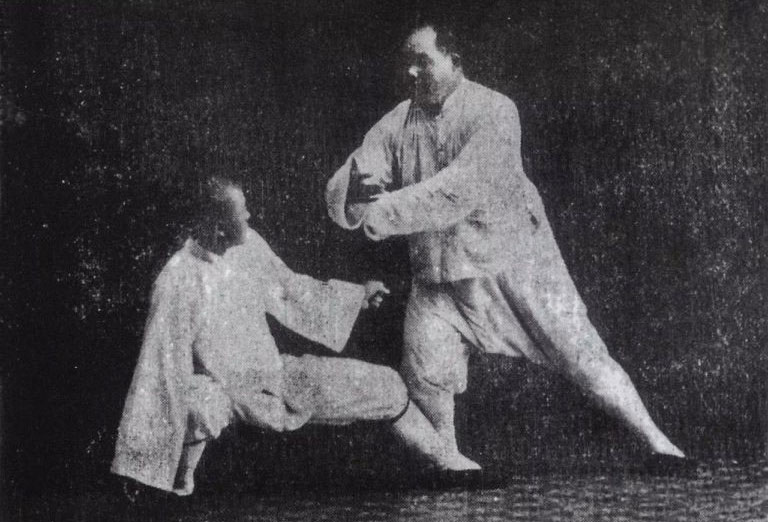
To get the correct range your front foot should be one fists-width apart from your opponents foot on the horizontal axis and your front toes should be roughly matching the back of heel. His front toes are then roughly matching your heel. (Look at the foot position in the photo).
This distance feels uncomfortably close to do any sort of combat actions to most people, however, this is where Tai Chi lives. At this range you will need to use subtle movements of the kua and rotation of the body to neutralise your opponent’s force, and it takes some practice. You also need to make use of Ting – or “listening” because you are definitely within punching range here, but from here you can go even closer (body to body) and turn it into wrestling if so desired, which will protect you from punches.
At the correct distance the Tai Chi techniques will work. When you are further out, they won’t work so well at all. So, this is where you should be when practicing push hands.
When it comes to actually fighting, I’m not suggesting you should “hand around” in this range, because that will just get you clipped. However, you do need to move into this range to do all the good stuff that the Tai Chi Classics talk about – controlling your opponent, knowing him before he knows you, etc. I think a lot of the time that Tai Chi fighting is described as “bad kick boxing” it’s because of the range being used. People stay too far out and pot shots at each other. Kick boxing is perfect for this range.
I’m writing this as a kind of follow up to my previous article on 3 views of qi in Tai Chi. That article contained the 3 different things I think people really meant when they talk about qi in Tai Chi. This article aims to do the same thing with yi. I don’t consider myself an authority on either matter, but I have had some skin in the Tai Chi game for a while now, and I’ve read enough of other people’s writings to come to some conclusions about what I think they’re talking about. Hopefully you’ll find these definitions helpful, and I’d be interested to hear your thoughts in the comments section.
Yi gets a few mentions in the Tai Chi Classics, and is usually translated into English as “intent”, or “mind-intent”, a translation which I think can be problematic because there are at least 3 different things that people mean when they say “intent” in Tai Chi, and while the three are obviously related, they’re also quite distinct from each other.
Before we get into the definitions, let’s have a look at what the Tai Chi Classics have to say about yi:
The most quoted line regarding Yi is in the Tai Chi Classic: “All movements are motivated by yi, not external form”, which can also be translated as “use the mind, not force”. In no.6 of Yang Cheng-Fu’s 10 important points he says:
“6.) Use the mind instead of force. The T’ai Chi Ch’uan Classics say, “all of this means use I [mind-intent] and not li.” In practicing T’ai Chi Ch’uan the whole body relaxes. Don’t let one ounce of force remain in the blood vessels, bones, and ligaments to tie yourself up. Then you can be agile and able to change. You will be able to turn freely and easily. Doubting this, how can you increase your power?”
So, here the emphasis is on relaxing and not using “force”, but why? And What does that mean? I will explain later.
Interestingly, right after that line, the Tai Chi Classic then goes on to say:
“If there is up, there is down; when advancing, have regard for withdrawing; when striking left, pay attention to the right.
If the yi wants to move upward, it must simultaneously have intent downward. “
Definition 1: Martial intent
Given the lines quoted in the Tai Chi classics above I find it strange that the most common interpretation of yi in Tai Chi is as a kind of martial intent. Here intent is “your intent to do something”, and in Tai Chi people generally mean a martial intention that needs to be contained within every particular posture or movement. So, for example, when you do the ward off movement, you need to have the intention of deflecting a blow away. If you movement lacks that intention, it is said to be empty.
Now this may all be true, and not knowing the martial applications of a movement inevitably leads to it becoming too abstract and unfocused, but this understanding of ‘intent’ is clearly not what is being talked about in the Tai Chi Classics when it admonishes us to “use the mind, not force”. If all it meant was to have a martial intention behind the movements, then it’s impossible to see how that can match up with lines from the classics like:
“If the yi wants to move upward, it must simultaneously have intent downward.”
What has that got to do with martial intent?
Clearly this is talking about something else. Yes, a martial spirit is obviously important for Tai Chi, and some Chinese teachers refer to an “eye spirit” which his making sure you are focused and looking in the right place in form performance, and you look like your actions are martially proficient, but I don’t really think this is what is specifically meant by yi in the Tai Chi classics.
Definition 2: A line of intent from the ground up
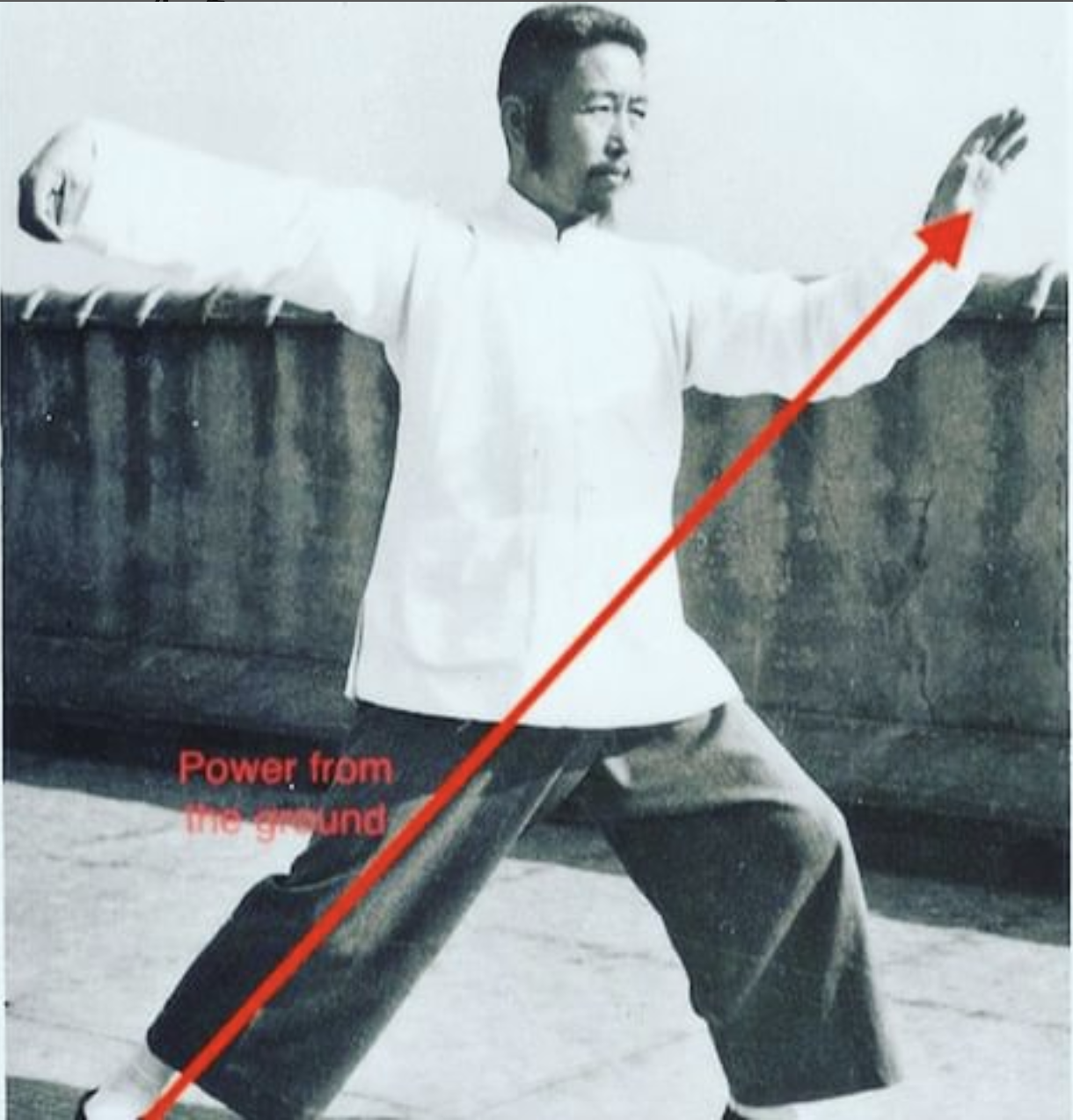
The second way that people refer to intent in Tai Chi is as a line of force, usually from the ground to the point of contact with the opponent. The idea in Tai Chi is to bring the solidity of the ground to your point of contact with the opponent. How do you do this? Well, firstly by relaxing, so that your body can function as a whole, connected, unit, and then by feeling a line of connection from the point where you contact your opponent (in push hands that would be your palm or wrist) directly to your foot (the part of you that is closest to the ground). By imagining the force of your opponent going straight down to the ground in a straight line from your palm to your foot then you can make use of jin – which is a force obtained from bringing the solidity of the ground to the point of contact with your opponent. This jin force stands in contrast to the normal force of the body produced by exerting your muscles, which the Chinese call li. Of course, muscles are involved in generating jin (otherwise you’d collapse not he ground), but they kept as neutral and relaxed as possible, so that excess force is avoided.
If you send force from the ground to your point of contact with your opponent, using jin, you can bounce them back off you.
Of course, you cannot be thinking of the ground if you want to project somebody away from you. Your work in creating the path to the ground is already done – in the bow analogy this is the drawing of the bow. All that remains now is to fix a direction and release the arrow:
As it says in the classics:
“Release the chin like releasing the arrow.
To fajin [discharge energy], sink, relax completely, and aim in one direction!”
This use of Jin fits in better with the lines in the classic that say
“If the yi wants to move upward (i.e. bounce your opponent back) it must simultaneously have intent downward. (i.e. you imagine a line of force to the ground).
(N.B. this straight line of force obviously goes through empty space, so it’s not the actual line any force from the ground will take, but it’s a case of your mind having the overall goal in mind, and your body filling in the details on a kind of subconscious level.)
Definition 3: A part of the mind
This definition is about yi being a part of your mind and the hardest to put into words. Obviously, definitions 1 and 2 also involve using the mind, so you can see how all 3 definitions are kind of wrapped up in each other.
In everyday life when you want to do something, like say pick up a pen or bring a cup of tea to your lips, the idea to do it appears in your head before the physical action takes place.
In internal arts the 6 harmonies get a lot of press. Of these 3 relate to the physical body, and 3 relate to the internal make up of the person. In the West we tend to have one word “mind” to relate to all the different and distinct parts that the Chinese have words for, like xin, shen and yi, but the three internal harmonies (san nei he) are:
1) The heart (Xin) harmonises with the intention (yi).
2) The intention (yi) harmonises with the chi.
3) The chi harmonises with the movement (li).
The heart mind (Xin) is related to our desire to do something, the yi (intent-mind) is the part of our mind that makes things happen on a subconscious level. When you pick up the cup to bring it to your lips you don’t think “hand move to cup, fingers wrap around handle”, etc.. It just happens because your intent-mind is taking over, based on what you desired to happen. The intent-mind is therefore a kind of subconscious process.
Now, going along with the idea that there are these different parts of our mind that exist as separate entities comes the idea that we can train these separate entities in isolation to gain a deeper ability with them. So, for example, by repeated practice of a Tai Chi form (or Zhan Zhuang standing practice), in which we are trying to access the subconscious intent-mind, rather than brute force, to perform action we might, in fact, get better at it and develop some ability that ‘normal’ people who lack this cultivation don’t have. It’s an interesting idea!
A good starting point for developing this intent-mind is Zhan Zhuang standing practice. One common practice is to stand in the ‘hugging a tree’ posture and try and get the mental sense that your hands are expanding outwards, yet without physically moving them. You are cultivating your intent-mind when you do this. This is starting with just one direction, but in standing practice people often talk about training 6 directions at once.
When performing a Tai Chi form it’s obvious that you are dealing with moving energy (in a physical sense) in different directions. If you can utilise your mind to “think” in these directions then you can start to train your yi, and it can start to feel like your movements are generated by yi and not by physical force.
Conclusions
It’s not easy to talk about what is meant by yi in Tai Chi, but hopefully I’ve provided you with some good starting points and ideas. I’ll repeat again my assertion that the three definitions I’ve given are all important parts of the practice that makes up Tai Chi Chuan and all inter-related. And while yi may be tricky to describe, it is of utmost importance to all the internal arts. There is a line from the Xing Yi classics that goes:
“There is nothing but structures and nothing by qi”
On hearing this line I remember my Tai Chi teacher saying “Oh, that’s good, I like that, but I’d change it to:
There is nothing but structures and nothing by yi”.
Structure and intent. When it comes right down to it, that’s all the internal arts are made up of. That’s how important yi is.
One of my poetic/literary heroes, Charles Bukowski had “Don’t try” written as an epitaph on his tombstone. To many people he was simply an alcoholic, womanising, bum who pissed way his talent, but I bet Charles Bukowski did more honest days work in his life than a lot go his critics ever did. Writing was his way out of a life of oppressive blue collar jobs that had ground him down, and he only succeeded as a writer late in life, and that gave him a unique perspective.
There’s a video that explains his seemingly paradoxical philosophy of “Don’t try”.
But if you don’t have time to watch it then Bukowski explained it himself in one of his letters:
“Somebody asked me: “What do you do? How do you write, create?” You don’t, I told them. You don’t try. That’s very important: not to try, either for Cadillacs, creation or immortality. You wait, and if nothing happens, you wait some more. It’s like a bug high on the wall. You wait for it to come to you. When it gets close enough you reach out, slap out and kill it. Or if you like its looks, you make a pet out of it.”
– Charles Bukowski
I think anybody versed in the philosophy of Tai Chi can see an instant parallel here to the Taoist ideal of Wu Wei – “not doing”. Quite often if you can wait for the mud the settle the water becomes clear all by itself, and the right action becomes obvious.
There are a number of quotes you can find in the Tao Te Ching that elucidate on this idea, right from the start of the book, where in chapter 2 Lao Tzu states: “The sage acts by doing noting”, then later in chapter 22 he says “Because he (the Sage) opposes no one, no one in the world can oppose him.” And in Chapter 48, “When nothing is done, nothing is left undone.”
Now I wouldn’t say that Lao Tzu and Bukowski have exactly the same take on this idea, but they’re not a million miles apart.
There are obvious applications of “Don’t try” in all areas of your life – from creativity, as Bukowski found, to business and your home life, but one of the most obvious I find is in martial arts.
If I find I’m engaged in too much of a struggle during sparring, rather than go harder, I have slowly learned to back off. Rather than fight through something it’s much easier to change track and go around it.
In Tai Chi push hands you can encounter this idea whenever you feel resistance from your opponent. How do you react? Do you push harder, knowing if you do, you can impose your will on them? Maybe you can, but you’re just engraining a bad habit that’s not going to lead to success when you try it on somebody bigger than you.
In Jiujitsu I often find guard passing is the best example of this idea of Don’t Try. If you try and force a guard pass, like a knee slide for example, when your partner is defending well then quite often you can make it work, but it’s a lot of effort and ultimately you’ve depleted your energy reserves more than you had to. And again, it won’t work on somebody bigger and stronger. That’s when the words “don’t try” tend to appear in my mind. If the knee slide pass is defended then change the angle, work something else, see if you can switch to a bull fighter pass instead. Or change to a back step. There are always ways around the problem instead of having to power straight through it.
Friend of the Notebook, Byron Jacobs, who lives in Beijing, recently posted a video giving a glimpse into the martial arts culture found in Beijing parks. You can see people doing all sorts of martial practices, like calisthenics, chi kung, Tai Chi, sword and push hands.
Byron comments:
“Beijing’s public spaces and parks have been gathering places for people from all walks of life for generations. This includes martial artists, who would meet regularly at such places to practice as part of their general lifestyle. Throughout the many parks of the capital, you can find practitioners of various styles and standards getting together to train regularly. This is a glimpse of some of these special places. The first episode features the Temple of Heaven.”
I think push hands is completely flawed as a competitive sport, which is why it ends up as a shoving match, but somebody (Jet Li?) is trying to change the rules to make it work better as an Olympic sport…. So here it is! It’s essentially more like wrestling, which is probably a good thing as it means you can move your foot.
And it’s got takedowns, but I think the question is then always … why not just compete at Shuai Jiao?
I don’t really enjoy push hands. I used to, I used to enjoy it much more when I saw it as a medium for exploring arm locks, takedowns, wrist locks, throws. In short, when I saw it as a way to practice techniques. I used to love it.
In more recent years I’ve reframed my view of what push hands is. Partly this is because I took up BJJ, and found I got more than enough scrapping in my diet to satisfy my craving to try out locks, throws and sweeps. That’s essentially what we do in BJJ, we practice locks, throws and sweeps over and over until we get very good at them and can do them under full resistance.
Inevitably the BJJ player ends up going one of two ways over the years. Either he (or she) gets softer and more flowing. So, when the other person is pushing you should be pulling, and when they’re pulling you should be pushing. By learning to flow with the dynamic movement between two people you learn to blend, yield and overcome. Or they end up getting very good at smashing people. Whatever is in front of them they can just smash through it using precise, accurate bursts of speed and power.
Inevitably all BJJ players tend towards the first approach as they age, if they want to keep training, that is. Or they give up either through injury or changing life circumstances.
But back to push hands. Once I had found a way to get my regular fix of fighty, I found I could step back and view push hands as something else. Perhaps what it was originally intended for.
Now when somebody pushes on my arm I don’t immediately think “how can I lock this arm?”, I am thinking, “where is his force going?”. Is it going to my feet? If not, I try and send it there, turn and yield. When it’s my turn to push back I ask myself where I’m pushing from. Is it the ground? If not, why not? What am I doing that’s stopping that? Where am I tense?
Pushing hands like this might not be as much fun, but I think overall, it’s more satisfying.
Proper push hands lacks the thrills of the fighty approach, but it instils qualities in you that make your fighty better.
That’s a difficult concept to really understand, and even harder to do when the other person just wants to fight. If the other person wants to fight then I sometimes just fight back. Inevitably I slip into BJJ mode and we end up in some armlock on the ground, and it’s fun…


 The Tai Chi Notebook