Mike Sigman on the Practical Development of Qi

And why you shouldn’t train with weights when developing your qi
Mike Sigman has sent me an article to publish on this blog. I don’t normally publish other people’s work, or agree to their requests, but I’ll make an exception because it will hopefully generate some discussion. Regardless of how you feel about him, there’s is always a real depth to Mike’s writings and ideas that you can get a lot from, that you don’t really find anywhere else.

The article is primarily about one of the trickiest subjects in Chinese martial arts – qi (or chi).

I have a few thoughts about it:

1) The article starts by trying to “separate the skin-related qi, which includes the subconscious mind’s involvement, from the theoretical qi of traditional Chinese medicine”.

To some, particularly those people who relish Chinese history and the evolution of the concept of qi as it appears in Taoist thought, or medicine, that just won’t be acceptable, but I think this works for me. It moves the discussion into the realm of the physical and practical. It becomes a feeling and a doing thing.


2) It appears to be written partly as a reaction to a recent trend of mixing, or doing, Chinese martial arts conditioning through the medium of kettle bell or weights training. The question is, is that a waste of time if you want to get to the root of the subject, which is what the Chinese martial artists call qi?

Look, I don’t think there’s anything wrong with making yourself physically stronger at all. In fact, it’s obviously advantageous if you’re learning martial arts… But the article states that to master the internal movement, “the body must be completely retrained to learn to move with the qi, jin, and dantian”, and using weights will not help you in that respect. If you have retrained the body, then you could probably add them.

3) As I’ve said, nobody else really talks about this stuff, or if they do it’s watered down with a lot of other guff. If the article is correct on qi then what exactly are all the big names in modern tai chi seminar circuit and online courses out there actually teaching? Because they talk about qi a lot… but they don’t approach it in the same way as this article does, at least as far as I can see.

4) The article describes internal movement, quite simply and quite succinctly: “Ultimately, you develop a form of movement that uses the solidity of the ground as the focus of all forces to and from the body, while the qi covering of the body is manipulated by the lower-body and the middle to bring power to the arms and upper body.”

I find it hard to disagree with that definition, probably because it’s pretty broad. Sure, we can argue over what the “middle” is, or what the “lower-body” means,etc.. but as a succinct definition, it’s not half bad.

Now, let’s move on to how you do it…

The article talks about breathing exercises as a starting point: “Breathing techniques that stretch the surface of the skin and the involuntary muscle layers are the usual start of the progression.”

Now, I have personally trained in some of the methods that Mr Sigman uses (there’s a link to a video at the end of the article), and experienced what he’s talking about, and I’d agree that I can feel what he’s talking about. But I wouldn’t count myself as an expert in it, or knowledgeable about anything to do with it beyond the initial foot in the door stages, however, I have found that alone to be incredibly valuable and shone a light on some of the other things I was already doing. Even getting a foot in the door took a lot of work and a lot of time.

Anyway, I’ll leave you to read the article now and feel free to comment with your thoughts below.

Graham

Practical Development of Qi

And why you shouldn’t train with weights when developing your qi

by Mike Sigman, March 2025

Discussing qi is difficult because the definition of qi has become a bird’s nest of related topics. Let’s try to narrow the discussion and then describe an approach to practical development.

Most of the skills related to qi, in the physical body, have to do with an area near the skin of the body that is referred to as the “protective qi” or “wei qi”. While the protective qi is often referred to as an “energy”, it is actually a physical set of tissues that is controlled via the autonomic nervous system … but when you learn to control it via the subconscious mind, it does indeed feel sort of like an “energy” because it is apart from the topical sensations of the somatic nervous system, and the qi indeed feels odd, like an energy.

So, let’s separate the skin-related qi, which includes the subconscious mind’s involvement, from the theoretical qi of traditional Chinese medicine: that’s where most of the confusion lies. The skin-related qi and the subconscious mind are the artifacts which give us heightened toughness of the skin, odd sensations of qi, added strength by supplemental our muscle-bone strength, and dantian control of the body as whole connected by skin-related qi, among other things. Jin forces, the manipulation of the solidity of the ground and/or downward forces of gravity, are also the product of the skin-related qi: jin is defined as “the physical manifestation of qi” in many Chinese sources.

The qi of traditional medicine theory is/was an effort to explain the workings of strength, including the strength of our involuntary systems. We don’t need to know all the theories about meridians, putative different types of qi, etc., in order to develop the qi. Breathing exercises and focused physical and mental exercises are more important than complex qi-paradigm explanations.

The skin-area wei qi is initially controlled by respiration and “breathing exercises” are our initial approach to control and development of the qi tissues. During inspiration, if we are slightly extended or stretched out, we can feel a slight inward pulling of the tissues of the fingers and hand. Other areas of the body, upon being slightly stretched taut, can also be felt during the inhale, but many tissues in other areas of the body can’t be felt. They must be developed over time by breathing exercises before we can feel them respond to our breathing and before we can develop them further.


Some Chinese texts mention the fact that this superficial qi is something that animals still use (think of a horse quivering its flanks, for example), but which has atrophied in humans over the course of evolution. In order to regain our qi, we must use deliberate exercises of breathing, mental imagery, and posture manipulation.

Training the Qi in General Movement

Jin force-manipulation is a product of the qi tissues applying stressors within the body’s frame. That’s why jin is defined as “the physical manifestation of the qi”, among other things. We use jin unconsciously in our everyday movements, so another common definition of jin is as an “intrinsic strength”. The full-blown traditional movement methodology that permeates the Chinese (and related) martial arts involves both qi and qi’s subset, jin. Qi and jin. Jin forces are the mind-directed forces from the ground and gravity; qi can be thought of, in a simplified sense, as a superficial muscular layer that connects the whole body.

The basic idea of movement with qi and jin is that the power from the ground and lower body is used as the power source for the upper body. The qi and the jin work from the lower body (including the middle/dantian), so what we have with “internal” movement is a system where the arms and hands are controlled and powered by the lower body and the middle.

The general admonition is that muscle and power are used in the lower body, as needed, while the upper body is moved without the use of local muscle. I.e., a person has to learn to control his/her upper body via manipulation of the lower body and the middle. The person who thinks the internal arts would be best supplemented with typical weight workouts at the gym has lost the plot and is giving away a total lack of understanding about how the “internal” martial arts work.

Developing the Qi

Jin skills are actually fairly easy to learn, although it generally takes a few knowledgeable pointers and some personal, hands-on demonstrations to get someone started. There are a number of written attempts at jin explanations on the internet, particularly through the 6H forum.

Qi is difficult to develop because it takes time and the feelings we need to focus our attention are tenuous at first. Breathing techniques that stretch the surface of the skin and the involuntary muscle layers are the usual start of the progression. Many traditional Chinese martial arts talk about “100 Days” of breathing exercises to develop the qi to a usable status.

Movement of the involves directing all forces upward from the solidity of the ground (so you must “sink your qi”) or use the weight of the body as a basis for downward movement.

Ultimately, you develop a form of movement that uses the solidity of the ground as the focus of all forces to and from the body, while the qi covering of the body is manipulated by the lower-body and the middle to bring power to the arms and upper body.

All Asian martial arts that are labelled as “internal” martial arts, formal calligraphy, qigongs, traditional dance, etc., use this combination of qi and jin for movements. Learning the external choreography and appearance of a martial art, a qigong, etc., no matter how much it resembles the movements of an expert, will not be correct until the system of movement is changed over to the qi, jin, and dantian type of movement.

Almost all of the movements we so often see in western semblances of “Tai Chi”, Aikido, Xingyiquan, Baguazhang, etc., are based from normal movement parameters, rather than qi and jin mechanics and it will take effort to re-learn these arts with the correct movement basis. There is an old saying to that effect: “Taijiquan is easy to learn, but difficult to correct”. So, if your goal is to learn Taijiquan, Aikido, or related arts, remember that all the talk about “relaxation”, “don’t use weights”, etc., is because the body must be completely retrained to learn to move with the qi, jin, and dantian.

Here’s a video of Chen Zhaosen, with translation by John Prince, teaching basic movement drills for the Chen-style Taijiquan. Notice his comment about no strength in the upper body, but whatever strength you need in the lower body.
https://vimeo.com/141009942
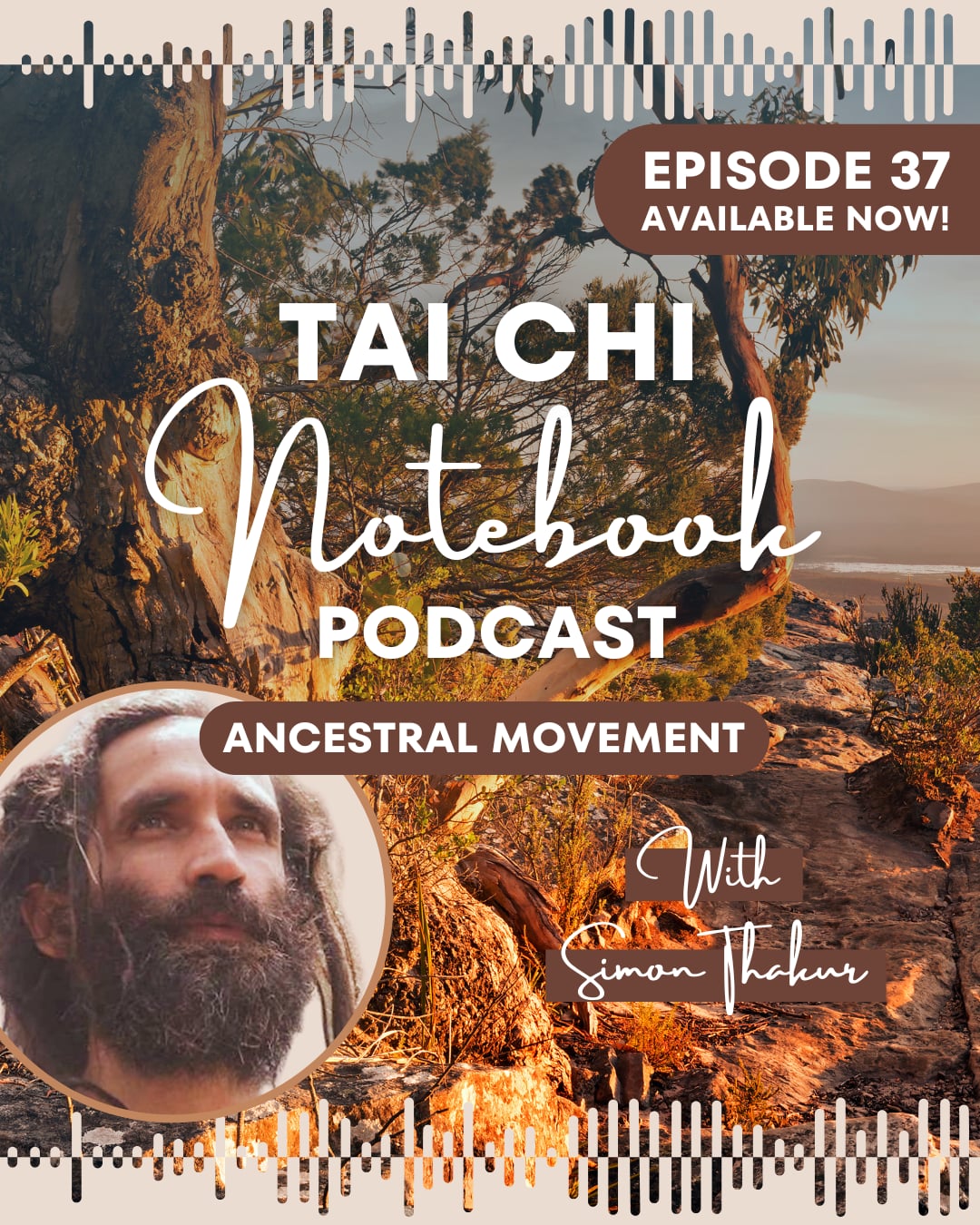
New podcast! Ancestral Movement, with Simon Thakur

Simon Thakur is the founder of Ancestral Movement, “An ecological approach to movement and mind-body practice, exploring ancient ancestral patterns of movement and awareness built into our bodies, rediscovering the power, grace and ease of natural movement and our bodies’ innate connection to the rest of the living world.”

In this episode we talk about many subjects including Yoga, Chinese Martial Arts, Brazilian Jiu-Jitsu, Tai Chi, Shamanism and more!

Simon’s website

Simon’s new online practice group

Happy Year of the Snake

What to do when your Snake Creeps Down

Hello! Happy Year of the Snake, dear reader. On an occasion such as this is would normally be customary for a tai chi blog like mine to do a little post about the influence of the snake on tai chi, kung fu and Chinese culture in general.

Snake is, after all, one of the five main Shaolin kung fu animals, one of the 12 main xing yi animals and frequently appears as a menu item in Chinese restaurants, er no, sorry, I mean, appeared in Kung Fu Panda!

But, no! I’m not going to do that; partly because it’s such an obvious thing to do that I’ve done it before, and I hate being predictable, or at least repeating being predictable, but also because I’ve just recorded an excellent conversation for my next podcast with Australian national treasure and sometimes-Chinese-martial-arts-practitioner, Simon Thakur of Ancestral movement about finding your inner, ancestral animal, including, of course, the snake, and I just need to find the time to get on with editing it so I can get it out to you lovely people.

I think that what Simon says about our human connection to snake-style movement is probably more valuable than whatever I’ve got to say on the subject of our slithering cousin. So, I’ll leave the snake talk until the podcast comes out!

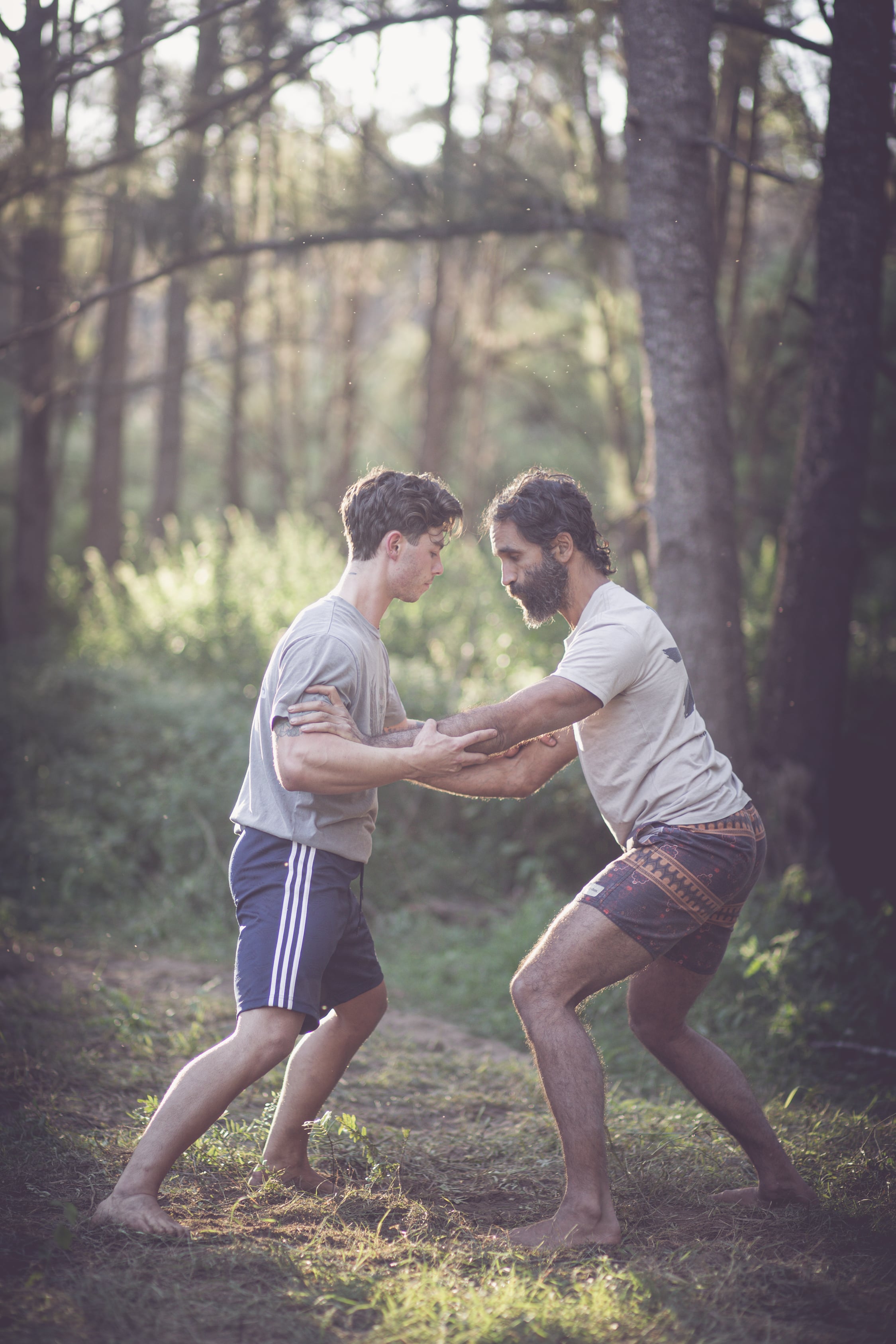
Simon Thakur, trying to locate his inner snake while doing an impromptu bit of Fox Trot in The Bush.

In the meantime, while you wait for that podcast to properly percolate (all the best things take time) I’ll leave you with a thought. “Tai Chi is more than the techniques, it’s the jins that make it interesting”.

If you listened to my last podcast with the esteemed Alan Wycherley of ‘In Defence of the Traditional Arts’, you might be forgiven for thinking that I’m all about training tai chi techniques. Now, while I’ve no objection to practicing a Repulse Monkey or a Part Wild Horse’s Mane (or two), or even a Snake Creeps Down, I definitely agree with the statement that tai chi is more than the moves. In fact, I think we can probably agree that tai chi applications aren’t that great as martial techniques. There are (shock!) other martial arts that have more effective techniques. Hello, Brazilian Jiu-Jitsu, I’m looking at you. Hello, Choy Li Fut. Hello, Western Boxing. Hello, Muay Thai, stop hiding at the back! Yes, all these martial arts have techniques that I would probably put ahead of anything found in a tai chi form, regardless of style. They’re practical and effective. And yet, I practice tai chi. So, why is that?

What tai chi has, and emphasises over techniques, are the eight energies – the jins: Peng, lu, ji, an, etc.. What you are doing when you practice a tai chi form is emphasising energy changes using these eight over technique. Flowing from one to the other a bit like a river flowing along smoothly. Sometimes there are fast bits, sometimes there are slow bits, sometime the river turns one way or another, but its energy flow keeps going.

When I practice other martial arts, my emphasis is more on technique. When I practice tai chi I can relax and get more inside the movement and concentrate on the energy flow.

And of course, in tai chi push hands you get to interact your energy flow with the energy flow of another person in a live situation, and that’s extremely valuable for developing martial ability. Techniques are another thing.

Now, if the analogy of a river doesn’t work for you then think of something else… perhaps, a snake? Snakes can flow along smoothly, they can change direction sharply and they can be incredibly powerful or incredibly quick, as well as slow and suffocating. They’re a great example of energy changes.

Homework

In preparation for my next podcast allow me to recommend a documentary by professional paleontologist and evolutionary biologist Neil Shubin called Your Inner Fish. (He’s written a book of the same name, if you prefer to read about him). Snakes come out to play in episode two. Here you go:


Simple alignments for Tai Chi

One of the first things I talk about when it comes to alignment is:

Head over shoulders
Shoulders over hips
Hips over ankles

These three are the basic alignments for standing upright at the beginning of almost all Tai Chi forms and looks something like this (ignore the arm positions):

Image taken from a free Zhan Zhuang course by Water Dragon Arts:

If one of these things is out of alignment then you are leaning forward or backwards, or your posture is out of whack.

It’s easy enough to keep these three alignments in a standing stance, but things can get more complicated in movement, and when you introduce forward and back-weighted stances. At that point I try and keep the following two alignments:

Head over shoulders
Shoulders over hips

The ankles can now be in different places, as reacquired by the stance.

It depends on the style of Tai Chi you do, but if you do a style that advocates a forward lean then you need to make sure that there’s a straight-ish line between your back foot and your head. If you do a style that doesn’t advocate a lean, then your back knee must be bent and you want to keep your body upright with your shoulders vertically over the top of your hips.

But the real answer is that no one style of Tai Chi only does things one way. Most styles contain some moves that lean and some that don’t. Wu style, for example: 

If you compare late Yang Cheng Fu to early Chen Man Ching postures, you can see that they are very similar, and are both trying to keep the head over the shoulders, over the hips:

While doing the tai chi form, take a moment to think: ‘where is my head in relation to my hips?’ You don’t want to be sticking your bottom out and destroying your alignment, which often happens in transition movements between postures:

A picture paints a thousand words, especially in Tai Chi. I recently found an incredible source of Tai Chi images drawn (I think) by Anthony of Brisbane Tai Chi.

Just scroll down the main page and look at the images – they’re great! Full of tips on alignment and posture for Tai Chi and Zhan Zhuang (standing practice).

One of Anthony’s best images for thinking about how alignment relates to the tai chi form is this one:

Anthony/Brisbane Tai Chi

I think that image very clearly shows head over shoulder over hip over ankle, and how easy it is to mess that alignment up once you start moving in Tai Chi. You basically want to keep the blocks aligned over each other.

Why?

As it says in the picture, if you align yourself correctly with gravity then your legs become the primary weight holders in the body. That means you can be more relaxed (Sung) in the upper body, so that you can use it to transfer force, instead of tensing up to hold weight that is misaligned. Plus, it just feels better.

Open up your hips with these Bagua mobility exercises

As you age your hips definitely get less flexible. If you do BJJ as well, like I do, then the wear and tear seems to add up exponentially, which is why I’m always interested in mobility routines for the lower back and hips, and I think I’ve found one I really like.

This is Carsten Stausberg – Martial Arts, Movement & Nutrition Coaching and this is the mobility routine he recommends for students of his Bagua course.

In Carsten’s own words:

“The main goal here is to get comfortable with “uncomfortable” positions by re-searching them on a daily basis. Ideally first thing in the morning, or as a warm up to your practice. Note: A mobility sequence will not necessarily improve your mobility permanently, but is mostly useful for opening up your normal range of motion by releasing unnecessary tension. For more specific mobility issues, you need more specific and targeted practice”.

A lot of these movements remind me of Yoga for BJJ by Sebastian Brioche, which is no bad thing. I like the way the set it put together, and it makes my hips feel great afterwards. It seems to target all the right areas for me. I could see myself running through this each morning.

Have a go (N.B. consult your doctor first, you do so at your own risk, etc) and let me know how you get on!


Thank you for supporting The Tai Chi Notebook. If you are reading this on a website that isn’t thetaichinotebook.com, then it’s highly likely it’s been stolen. Please let me know so I can issue their webhost a DMCA takedown notice for copyright breach. Thanks.

One simple change you can make to your Tai Chi that will make it immediately better (N.B. practice required).

Change from being ‘stuck’ in your form to smooth, effortless movements.

People often say that Tai Chi is a moving meditation. But what does that really mean?

I can think of two distinctively different ways of mediating (there are others, too). One is to focus on an object exclusively. This is a type of concentration-based meditation. Your goal is to keep that object in your mind so that other thoughts can’t intrude. The other is an awareness-based meditation. Instead of focusing on one object, you have an overview of everything going on: you, what you are doing, and the space you are in, and you try and maintain that open awareness without getting distracted. If something comes up you notice it and let it go, returning to the awareness.

An awareness mind, reflected in nature. Photo by Noelle Otto on Pexels.com

In Tai Chi we want the second type of practice. When you’re are a beginner, learning the movements, you are akin to somebody learning to drive – it feels like there’s too much to do at once. Your mind is completely occupied by what you are doing and there’s no room for anything else. The more experienced Tai Chi player knows the choreography of the form, they know what’s coming next, and they don’t need to be in the movement so much. They can afford to step back and take a more general view of the activity.

If you’re in the more experienced camp on your Tai Chi journey, then try this the next time you do your form: imagine that ‘you’ are in your head, watching yourself do the form. You can be aware of yourself, your movements, your breathing and the space around you simultaneously, without getting ‘stuck’ in any one of those things. You’re just watching them happen.

I went to see an Alexander Technique teacher for lessons once and she told me to imagine a stage, with every element that’s happening to you and around you is on that stage. In normal every day life we have a spotlight on the one thing we are doing. In Alexander Technique, she said, we allow everything to be in the light. For me that made immediate sense. Maybe it will for you? It’s the same with Tai Chi. When doing the form, we need to expand our awareness to include everything that’s going on with us right now, and not get stuck in the one thing we are doing. It’s a bigger, more expansive feeling that leads to smoother, effortless movements.

In my training my Tai Chi teacher described something very similar to this as ‘man’ in Chinese, which translates as “slowness”, which is misleading since it wasn’t about moving slowly, it was about hanging in the moment without rushing. Rushing is often the thing that takes us out of the moment.

So, slow down, stop rushing, and when you’re doing the form allow yourself to mentally step back a little so you can be aware of everything that’s happening on your stage. For me the results of doing this are profound and immediate. It’s like a light bulb going on. It also feels like the release of a lot of mental tension you didn’t even know you were carrying. And it doesn’t need to be limited to the times you are doing the Tai Chi form. You can do it when you’re sitting down and having a cup of tea, watching TV, playing with the kids, or even ‘meditating’.

Some comments from Lao Tzu, in the Tao Te Ching come to mind:

“Do you have the patience to wait
Till your mud settles and the water is clear?
Can you remain unmoving
Till the right action arises by itself?”

― Lao tzu


Thank you for supporting The Tai Chi Notebook. If you are reading this on a website that isn’t thetaichinotebook.com, then it’s highly likely it’s been stolen. Please let me know so I can issue their webhost a DMCA takedown notice for copyright breach. Thanks.

UFC 295 – Alex Pereira vs Jiri Prochazka: Chicken vs Swallow fight analysis

One of the things I like to do when watching UFC fights is to try and analyse what the fighters are doing in terms of Xing Yi’s 12 animals. Now, I’ve got at least one friend who hates when I do this because he believes it makes people think that by practicing a few Xing Yi moves twice a week in your back yard you can somehow be on the level of professional MMA fighters. Yeah, I get that. Comparing martial arts can easily lead to delusion… however, my No. 1 one rule for The Tai Chi Notebook is this: this is my blog and I can write what I want! So, I’m going to do it anyway. But also, I genuinely think that if you’re a Xing Yi practitioner yourself, then trying to analyse MMA fighters in terms of the 12 animals is a really valuable hobby to get into. It will increase your understanding of not only the animals, but also of fighting itself.

Viewed through the modern Xing Yi lens (by modern, I mean, post Boxer Rebellion, from the early 20th century onward) it’s popular to understand the 12 Animals of Xing Yi as merely variations on the 5 Elements. This approach is indicative of the reductive, simplistic, winds of change that blew through Chinese martial arts over that century. It’s not a wrong view technically (the 5 elements are the basics, so of course they are inside the 12 animals), but it’s also a huge misunderstanding. The 12 Animals are more than just variations of the 5 Element fists, they are older and contain the essence of the art. They’re a continuation of a tradition that started back in the Song Dynasty. If you really want to understand that point of view then I’d point you towards the History of Xing Yi series we’ve been doing on the Heretics Podcast for a few years now – and is currently up to part 15, about to start the Ming Dynasty section.

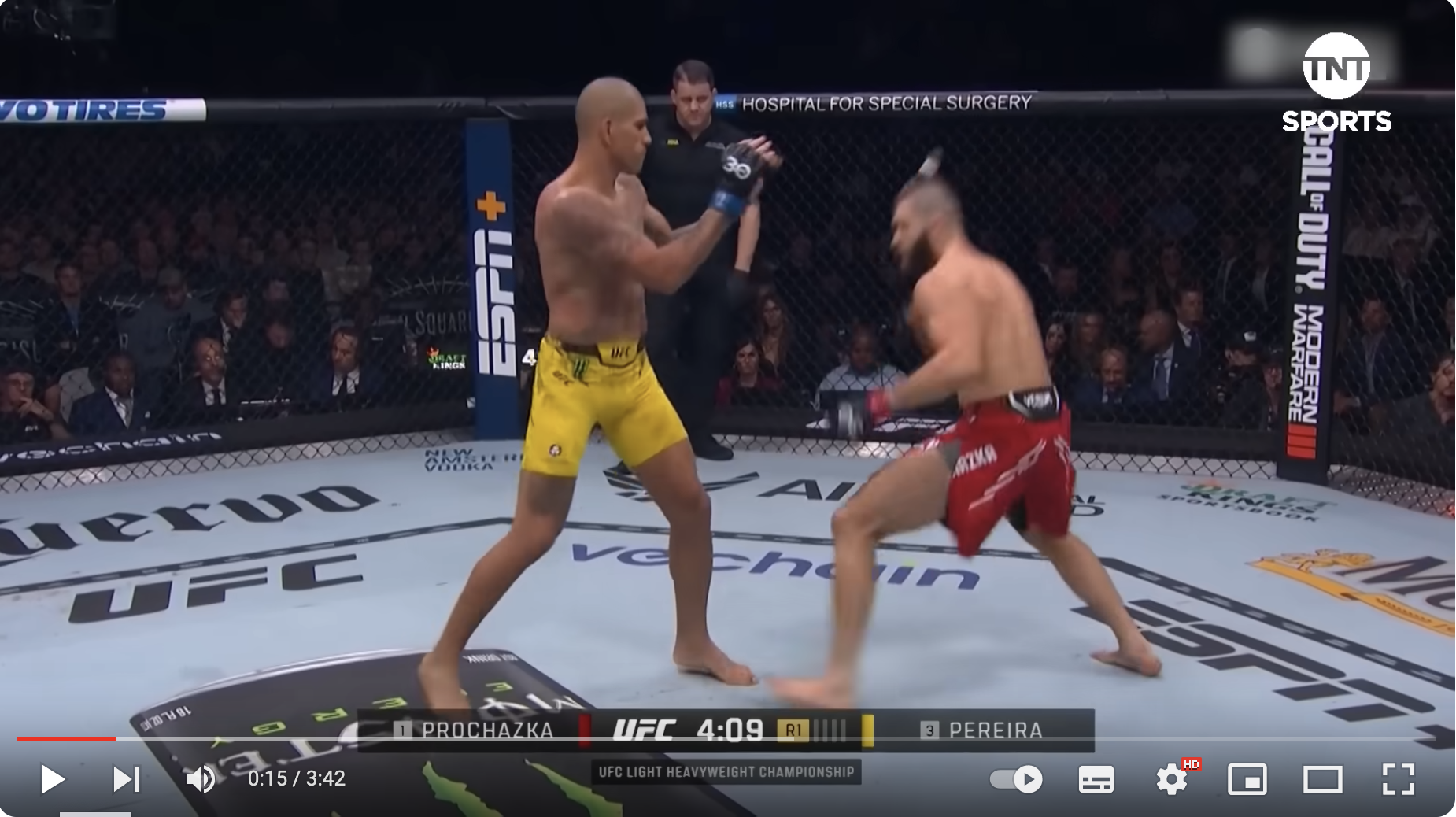
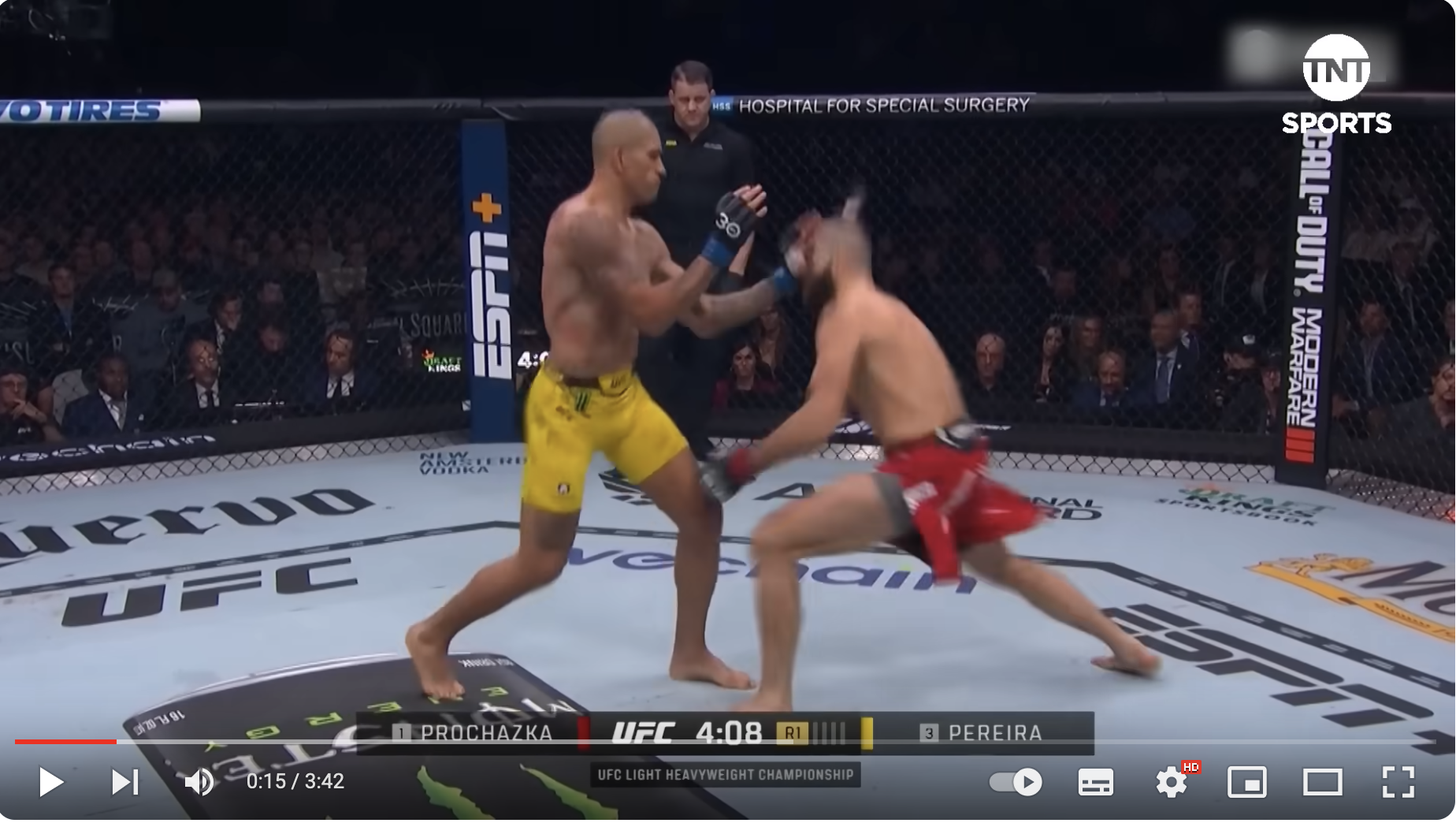
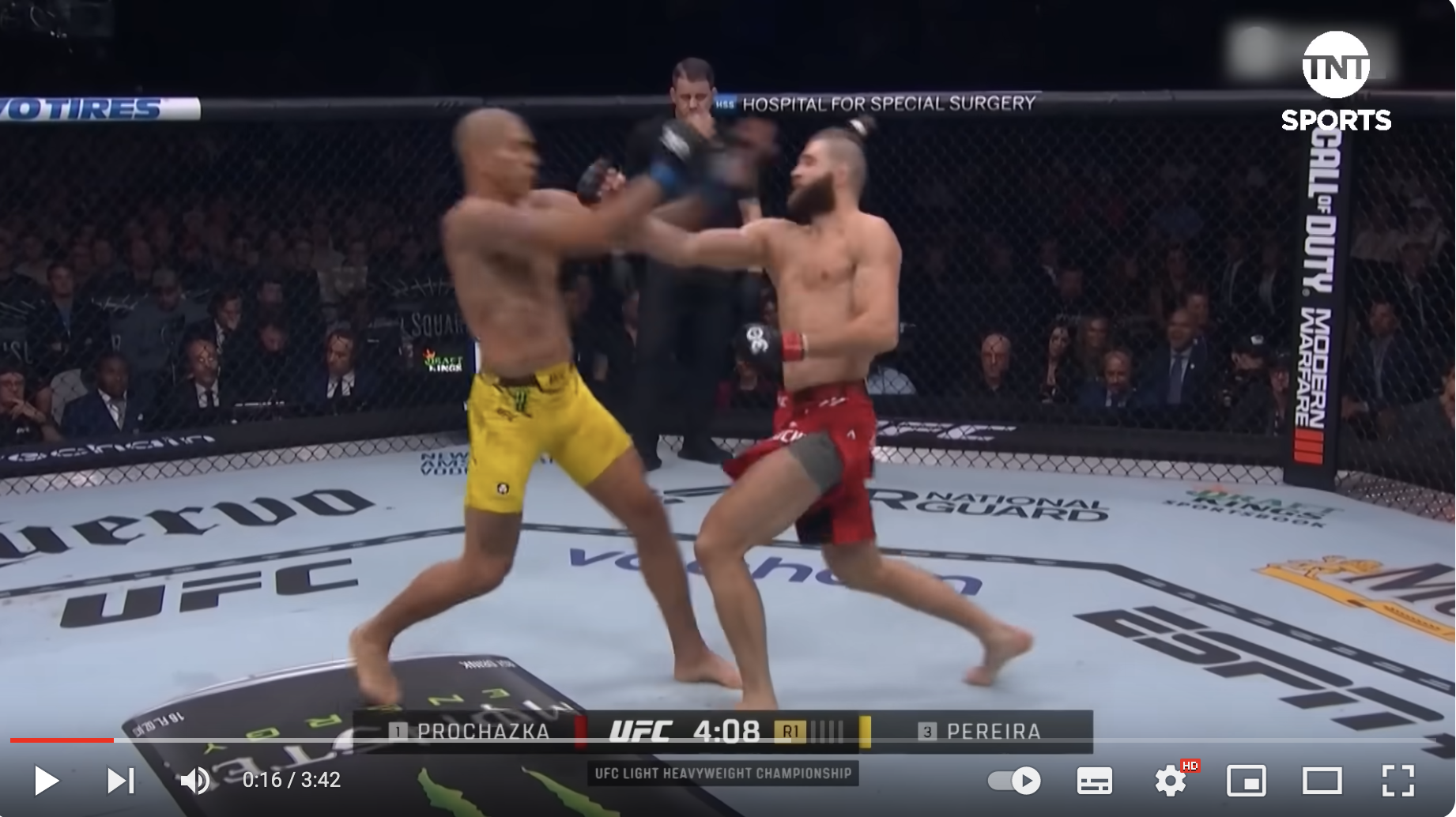
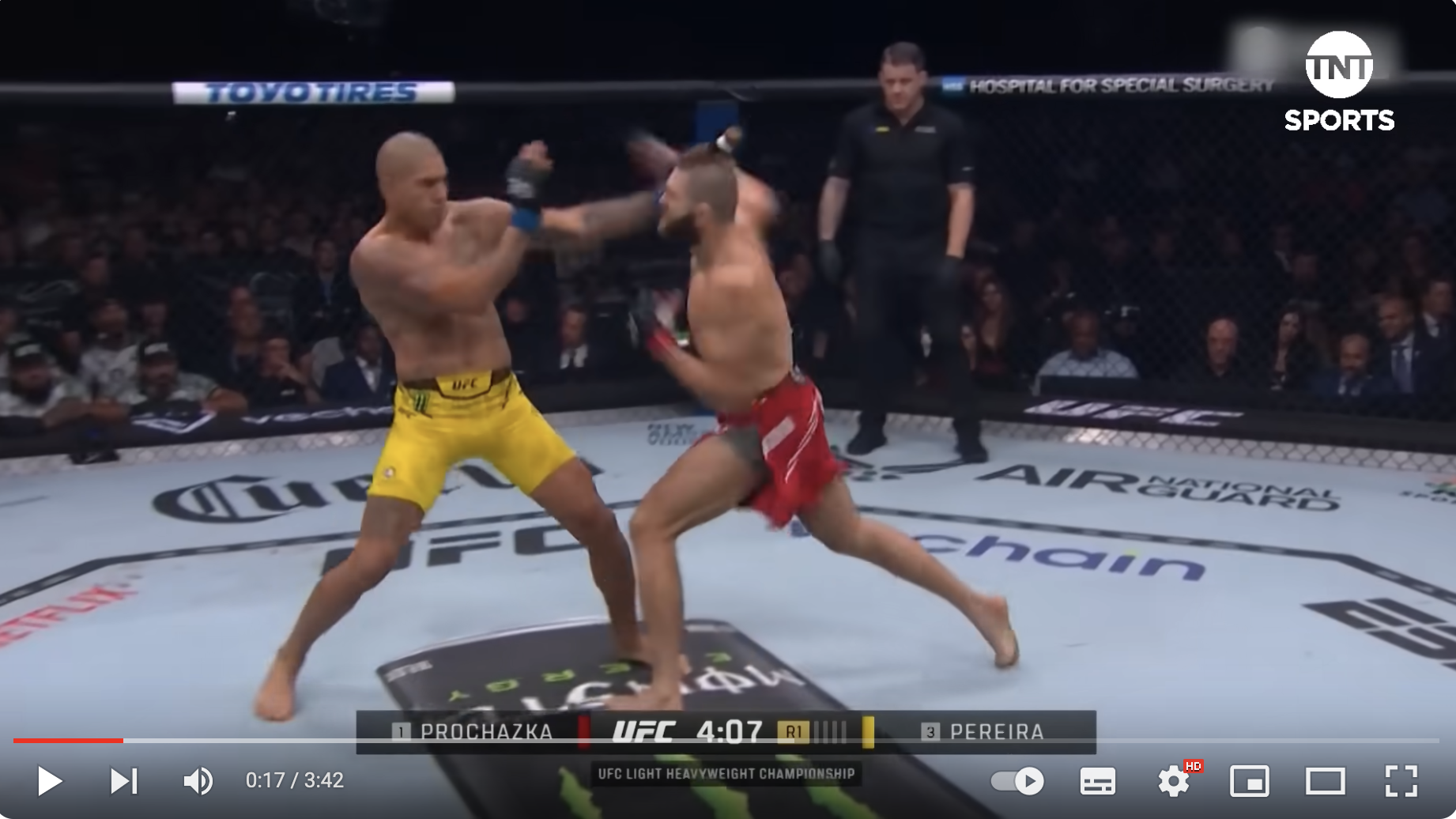
But coming back to the present day, last week saw Alex Pereira vs Jiri Prochazka for the UFC Light Heavyweight belt at UFC 295. It was a great fight resulting in a knockout for Pereira, but honestly it could have gone either way. There was some debate about the finish being an early call from the ref, but Jiri himself said he was out cold, so it was fair. Highlights here:

Looking through my Xing Yi lens at what the fighters were doing, UFC 295 was a good one because it was very clear what animal strategy each of them was using. (Obviously, neither gentleman has probably ever heard of Xing Yi, however, like I said earlier, I’m simply using the 12 animals to analyse fighting styles.)

Swallow (yan xing)

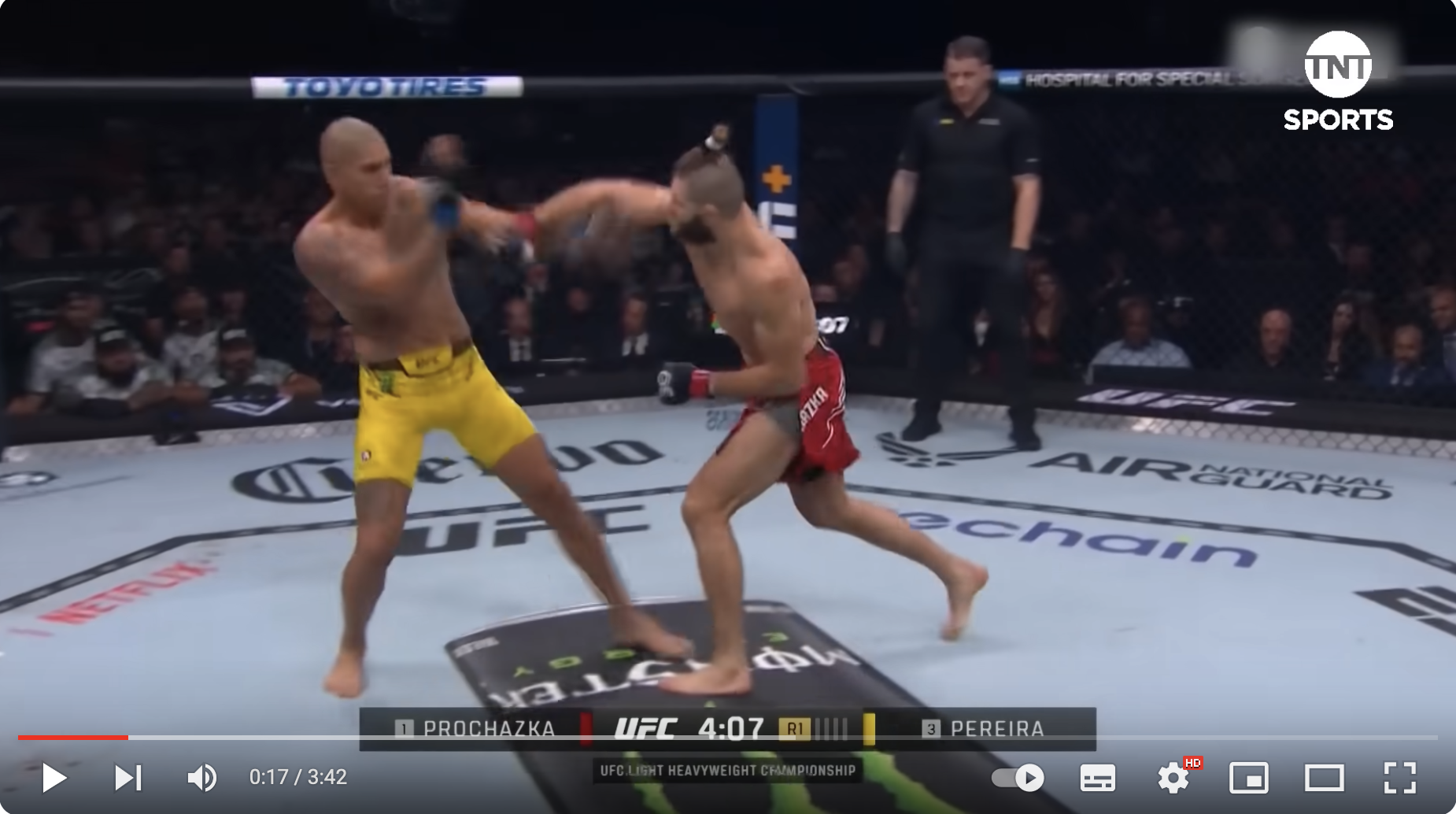
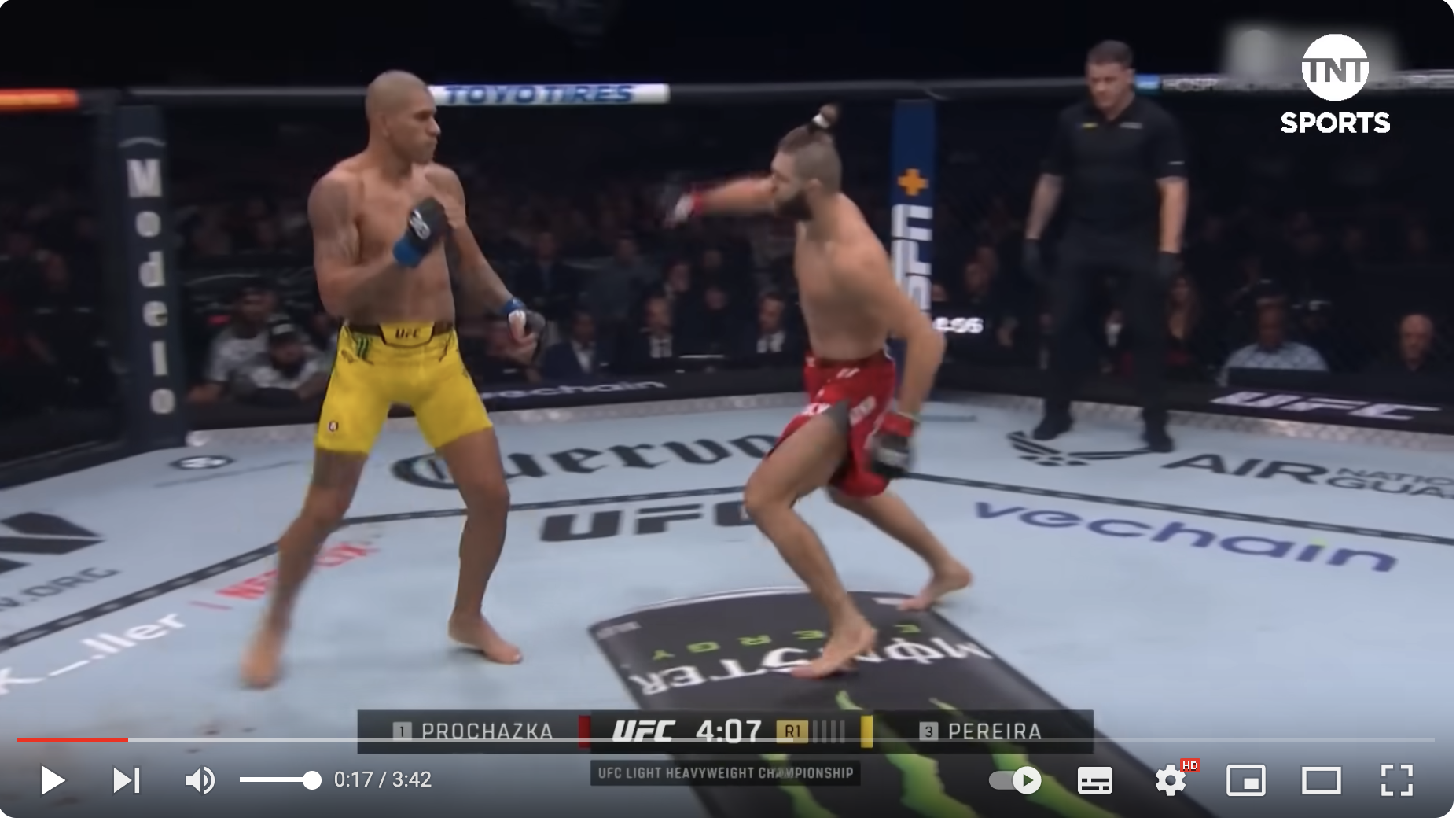
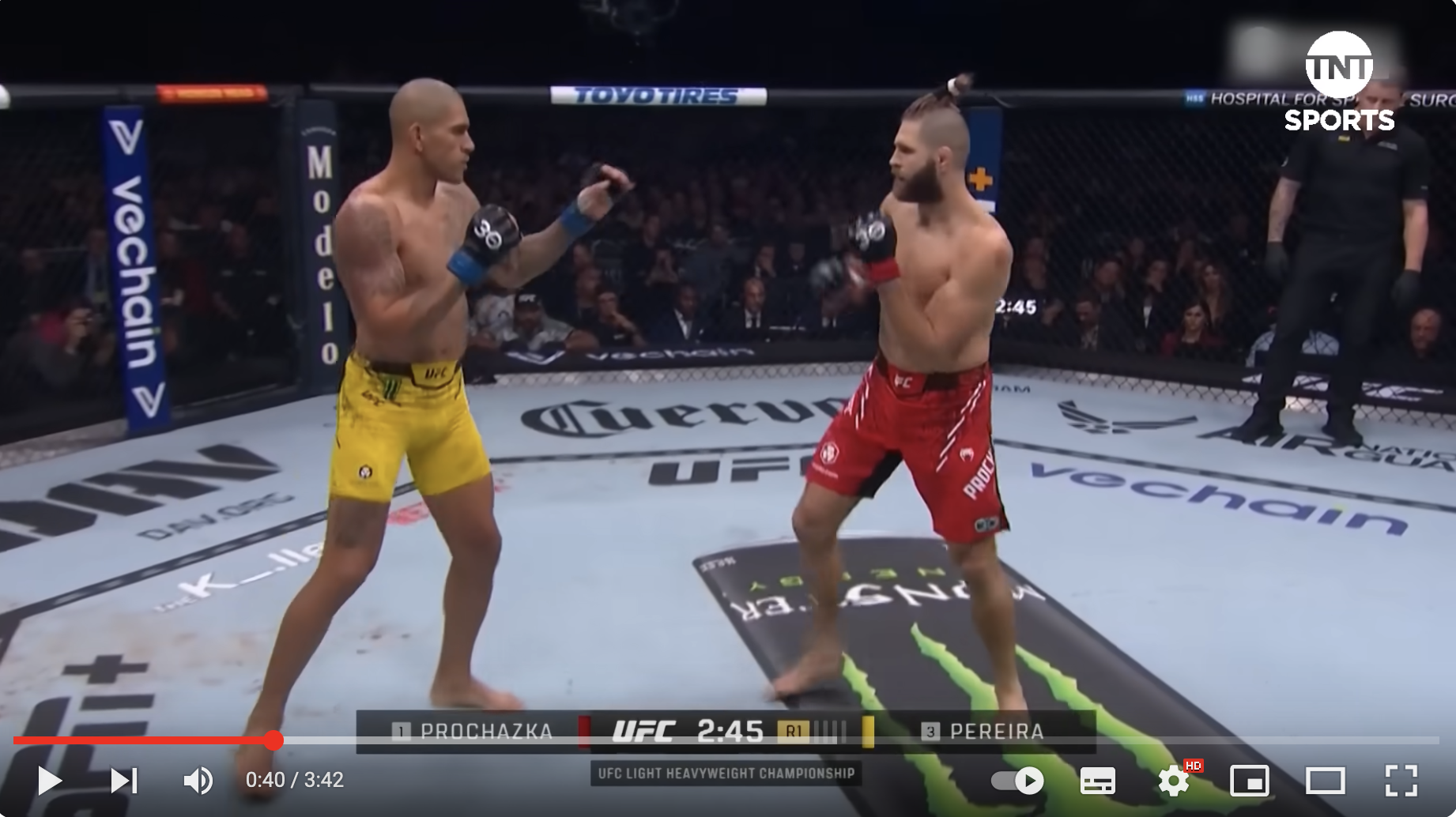
So, on one hand we have Jiri Prochazka (red shorts) whose attacks frequently go from high to low:

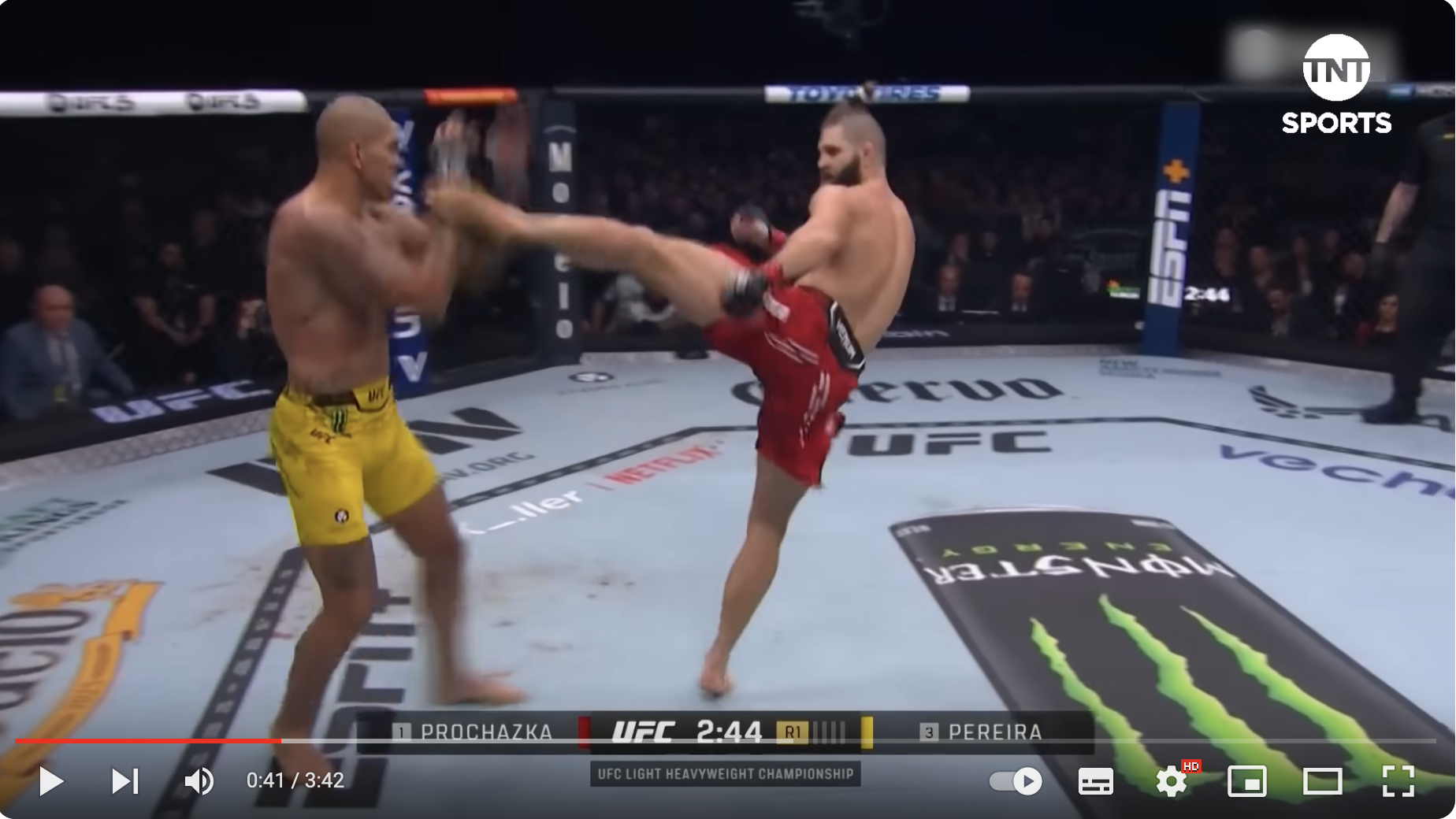
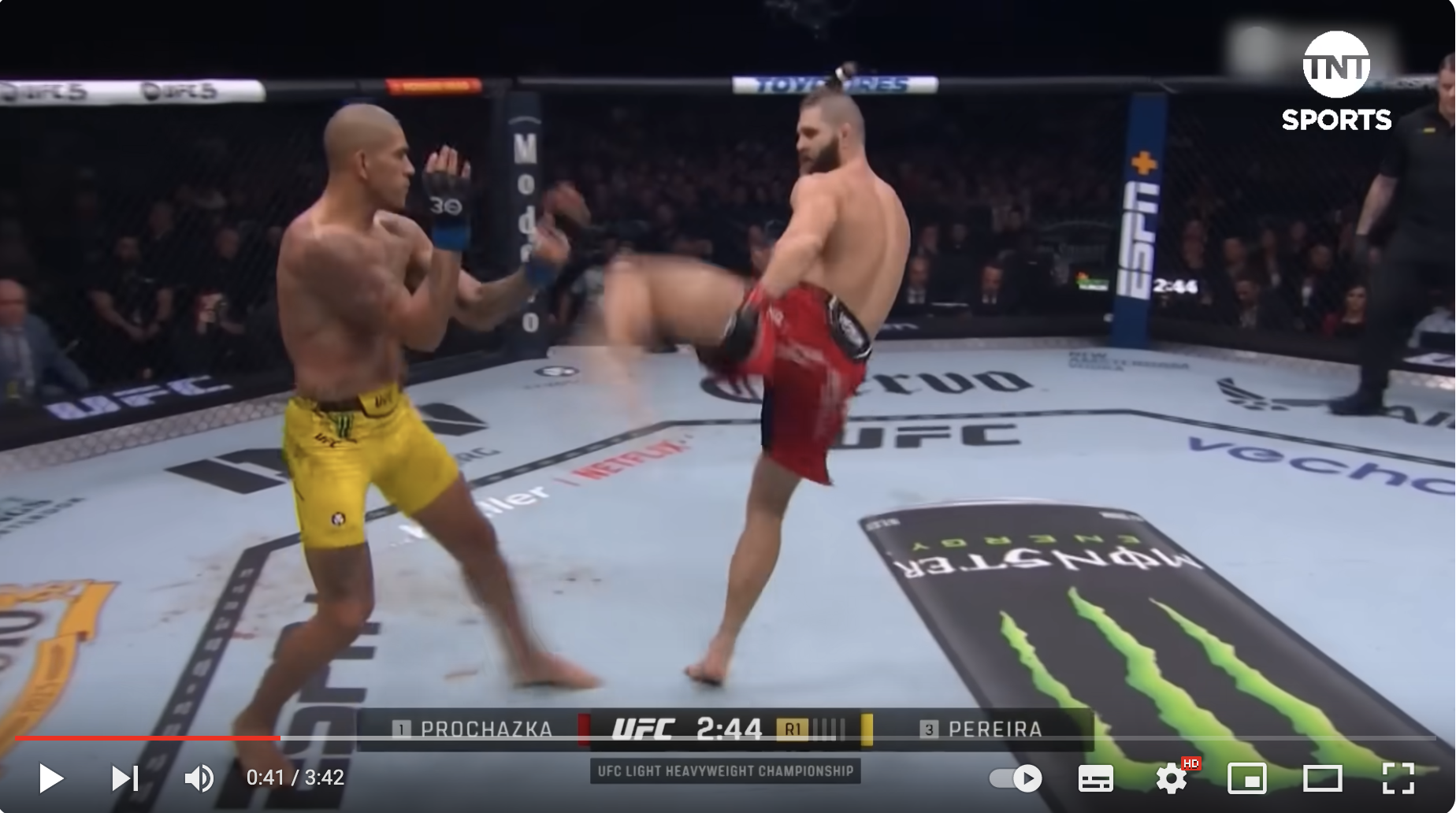
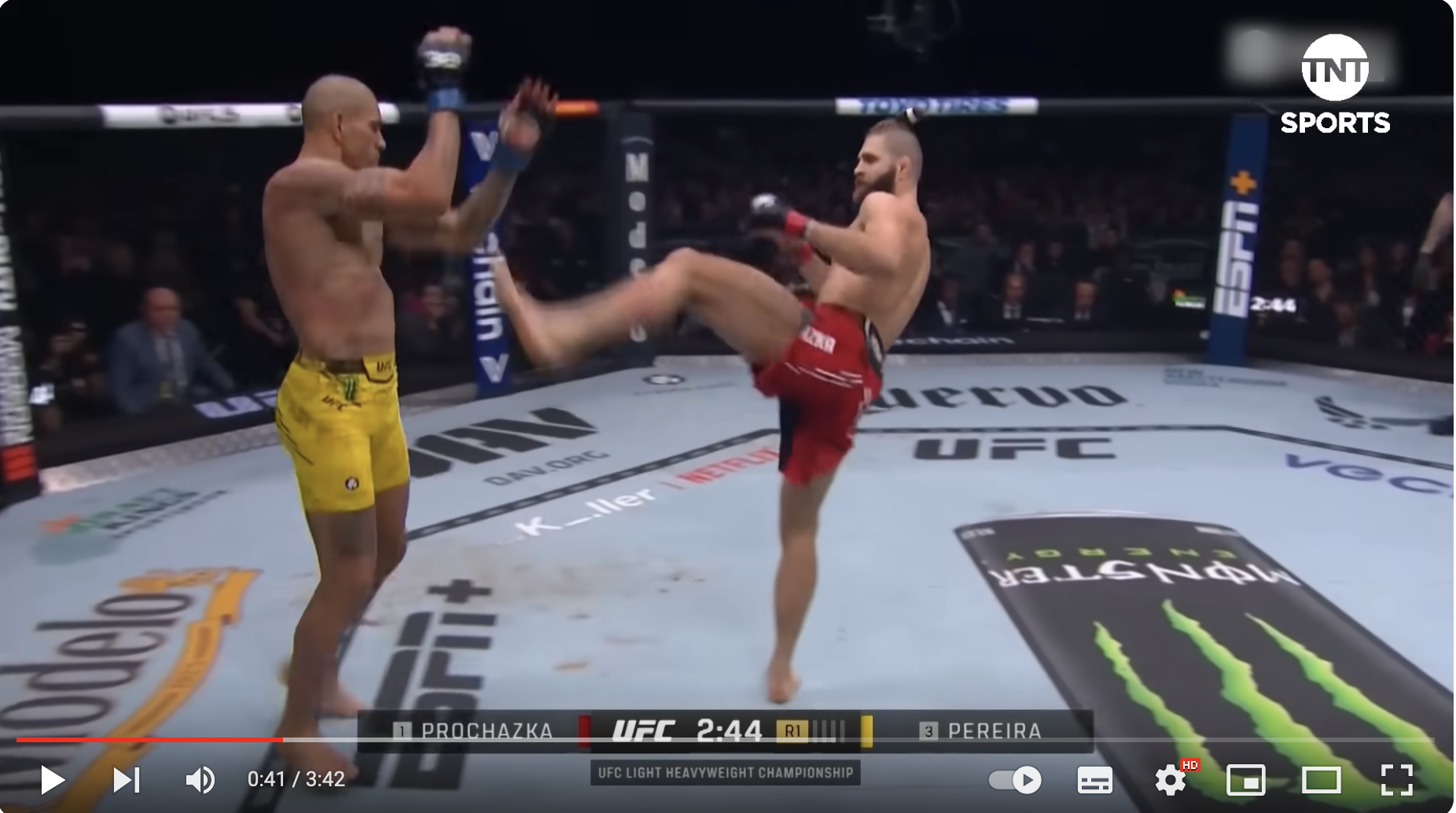
He kicks high to the head, then kicks low to the ankle:


(Obviously a lot, but not all, MMA fighters kick to both heights, but it’s the alternating way he does it, as a strategy, that I’m interested in. It’s not the techniques that make something an animal style, it’s the intent and strategy behind them, but also certain styles lend themselves naturally to certain techniques – which is a subtle point)

He dummys a wrestling shot low but then comes up with an upper cut.

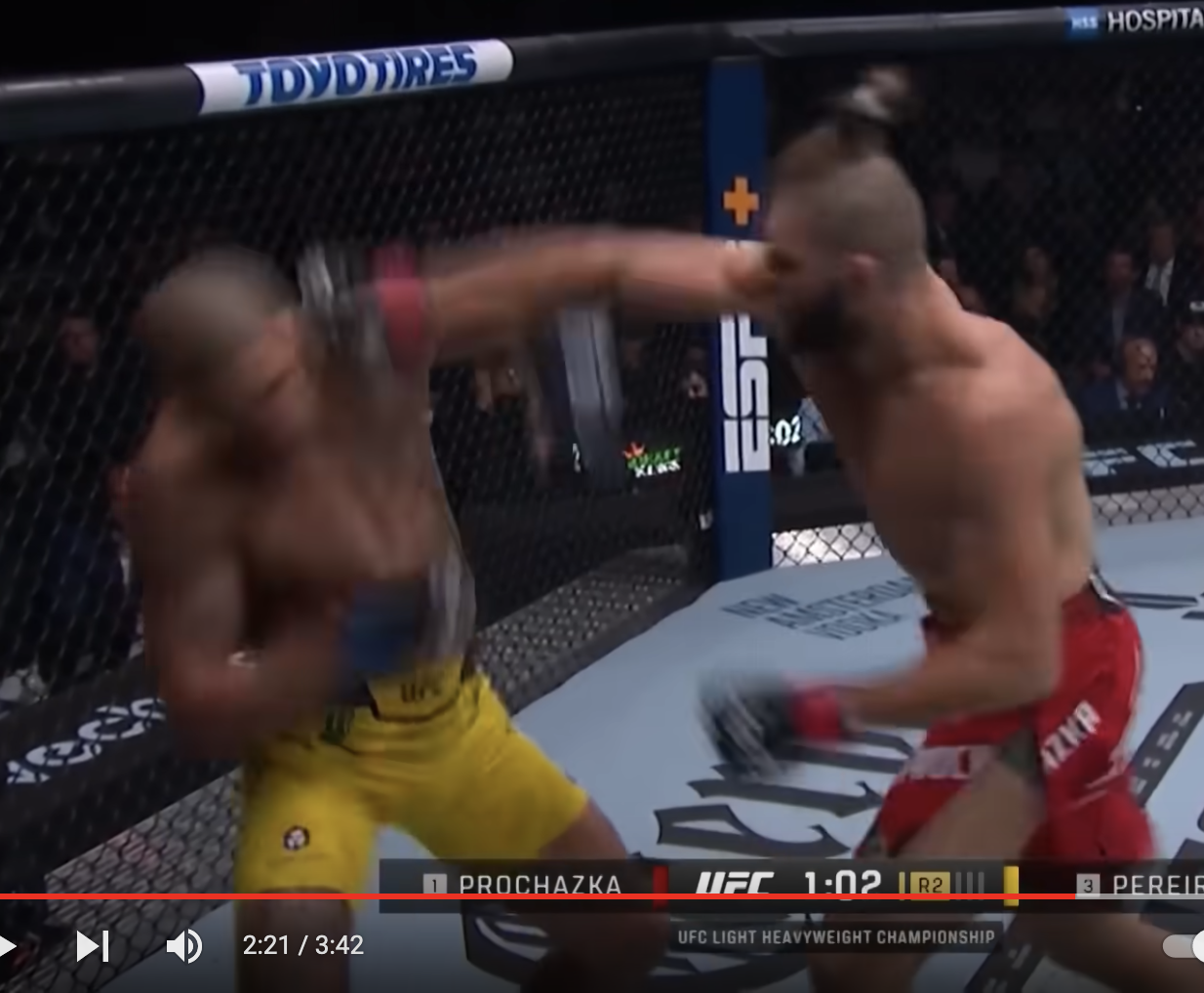
His preferred range is long, and when he punches he throws arcing punches that start low, go high and finish low:

To me this is clearly a Swallow strategy. Swallow is a bird you wouldn’t normally associate with fighting, but it aggressively hunts insects on the wing, and defends its nesting location by dive bombing potential intruders, including humans! Its characteristics are swooping low then going high, particularly over water and “swallow skims the water” is a name often given to a popular swallow movement in forms in Xing Yi, Bagua and Qigong. But the swallow is also famous for its absolutely beautiful aerial acrobatics that are always elegant and graceful.

A swallow defending its nest – I like this clip because you can see the speed that the swallow attacks with, and how unafraid it is of something as big as a human.
The classic “swallow skims water” in action, by the true masters of the art – the swallows themselves.

A typical “swallow skims water” movement found in Chinese martial arts. This one from Cheng style Bagua.

Chicken (ji xing)

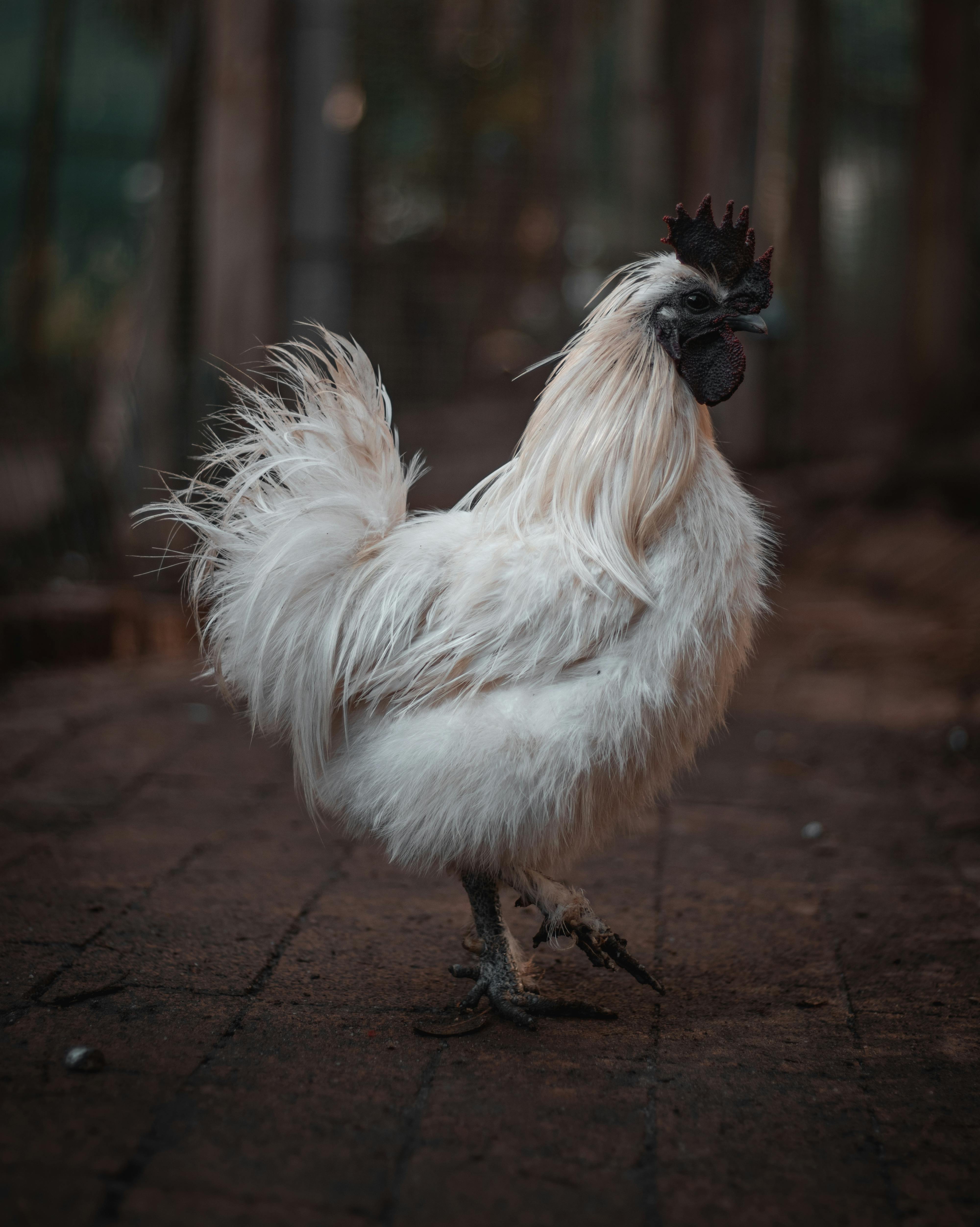
But let’s get back to UFC 295. In contrast his opponent, Alex Pereira is famous for his minimal movement and crushing low calf kicks. There’s a great clip of him playing about with UFC commentator Daniel Cormier taking his low kick:

A native of Brazil, Pereira is also famous for his indigenous face paint he wears to the weigh in events:

(For people that like to argue that Shamanistic things have no part in MMA, I always like to point them to double UFC champion, Alex Pereira!)

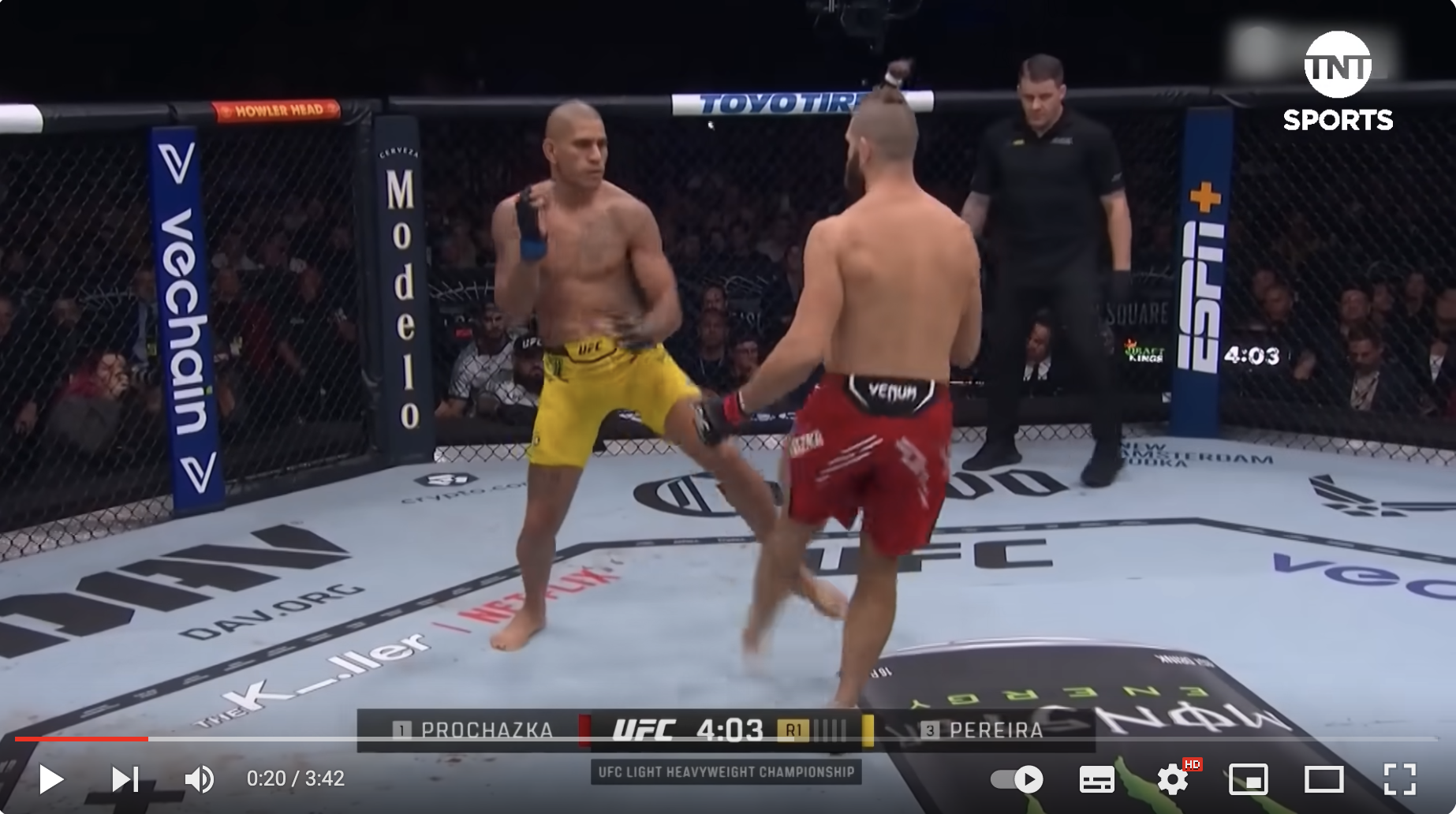
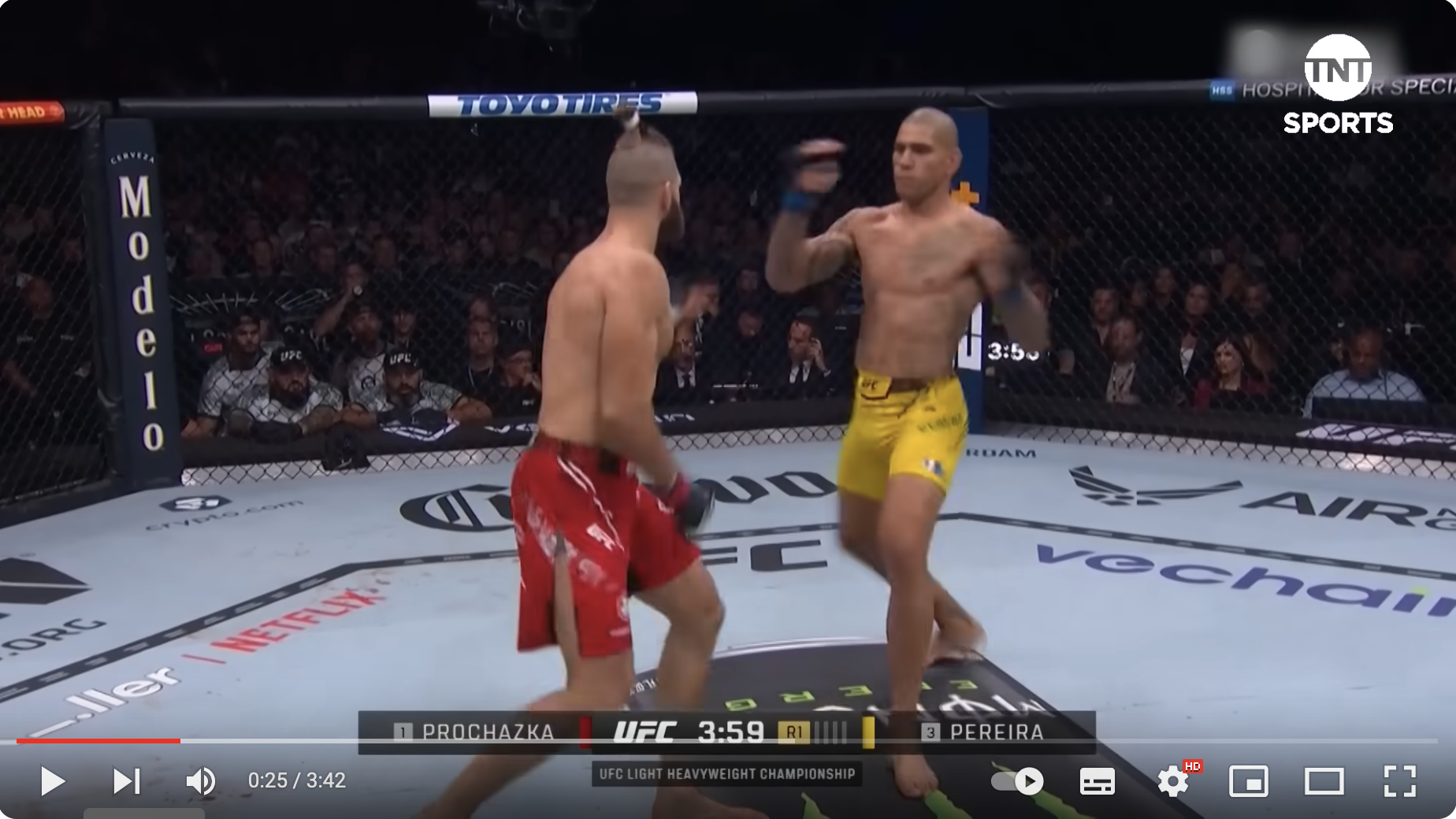
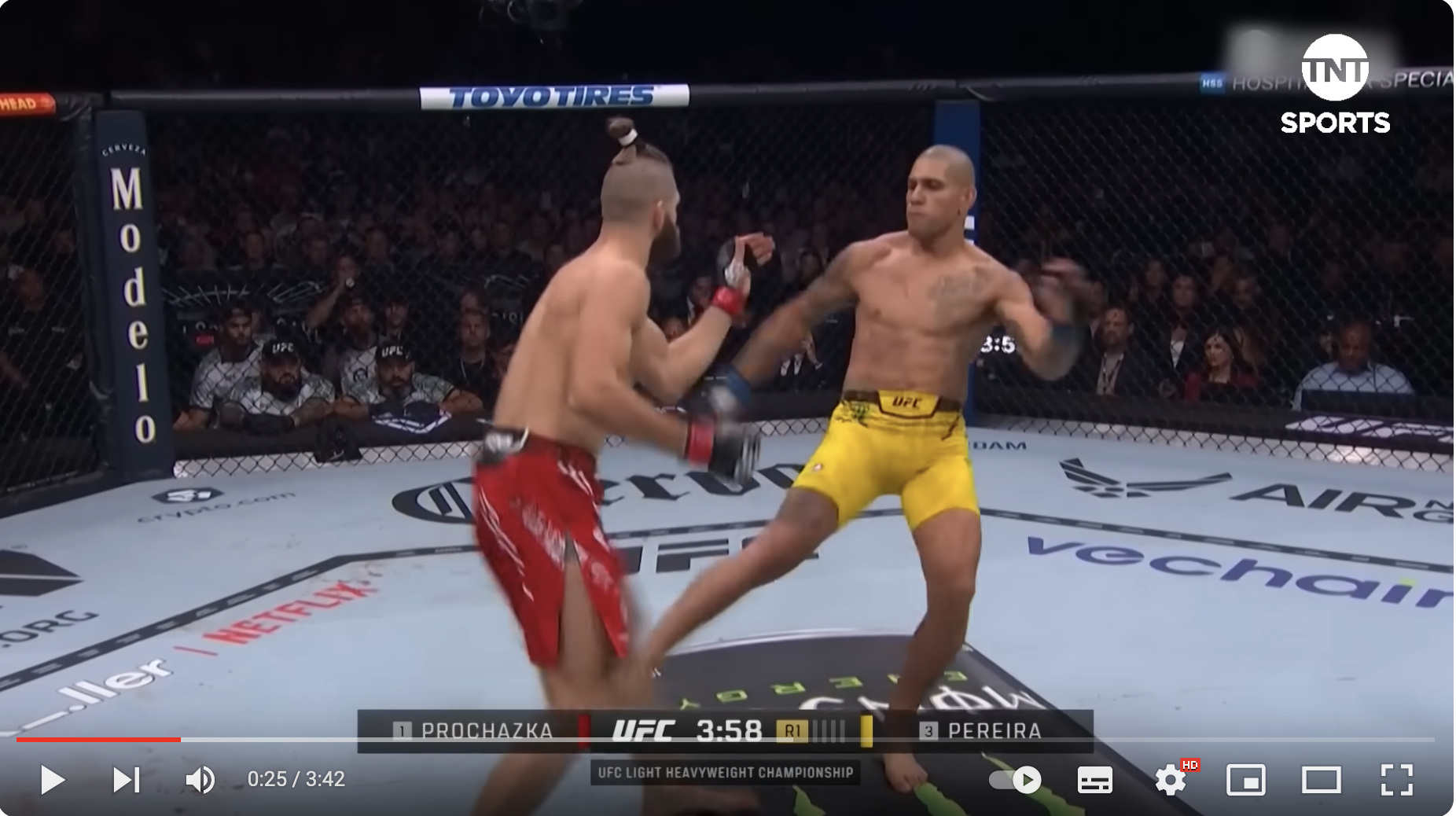
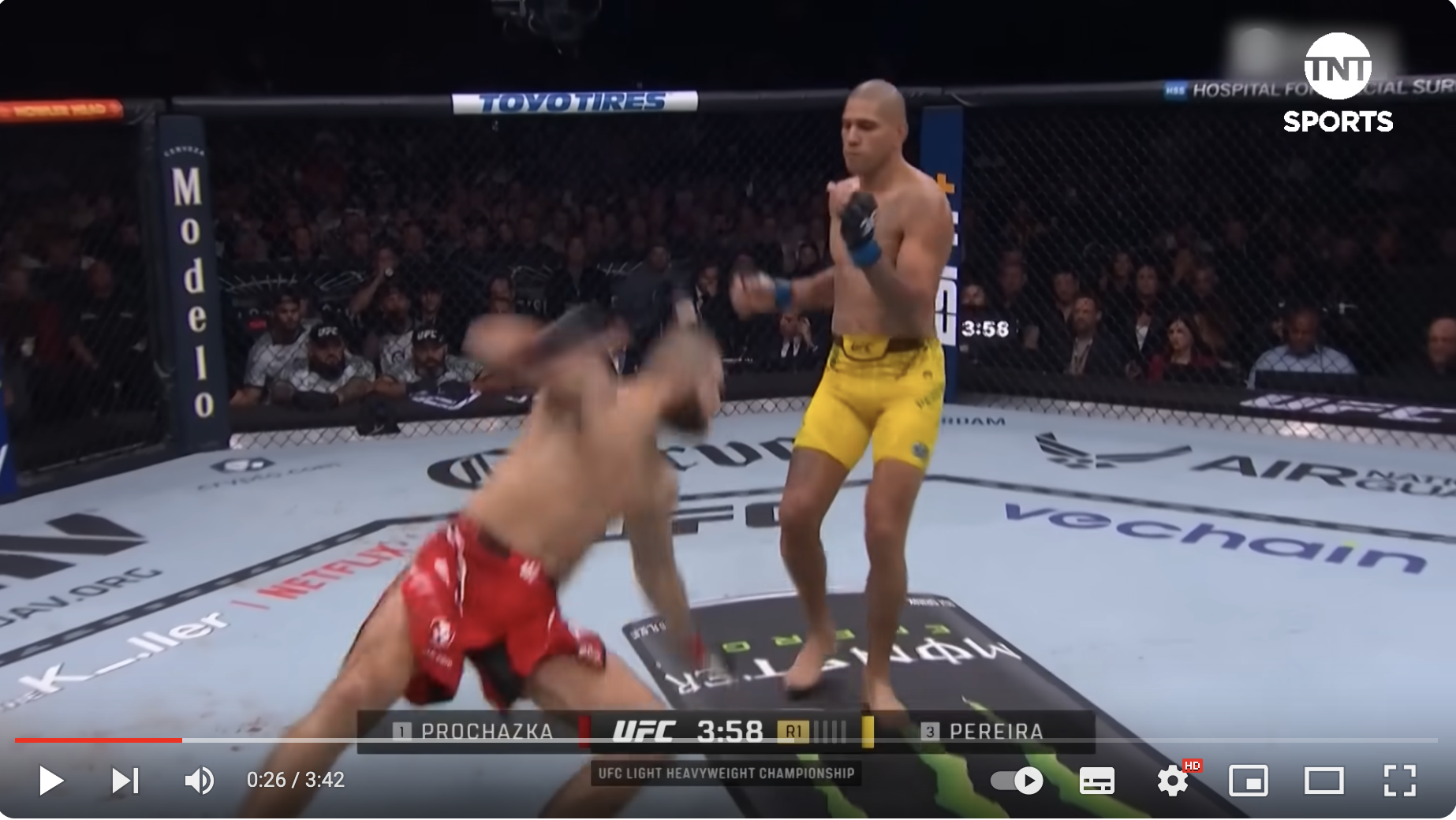
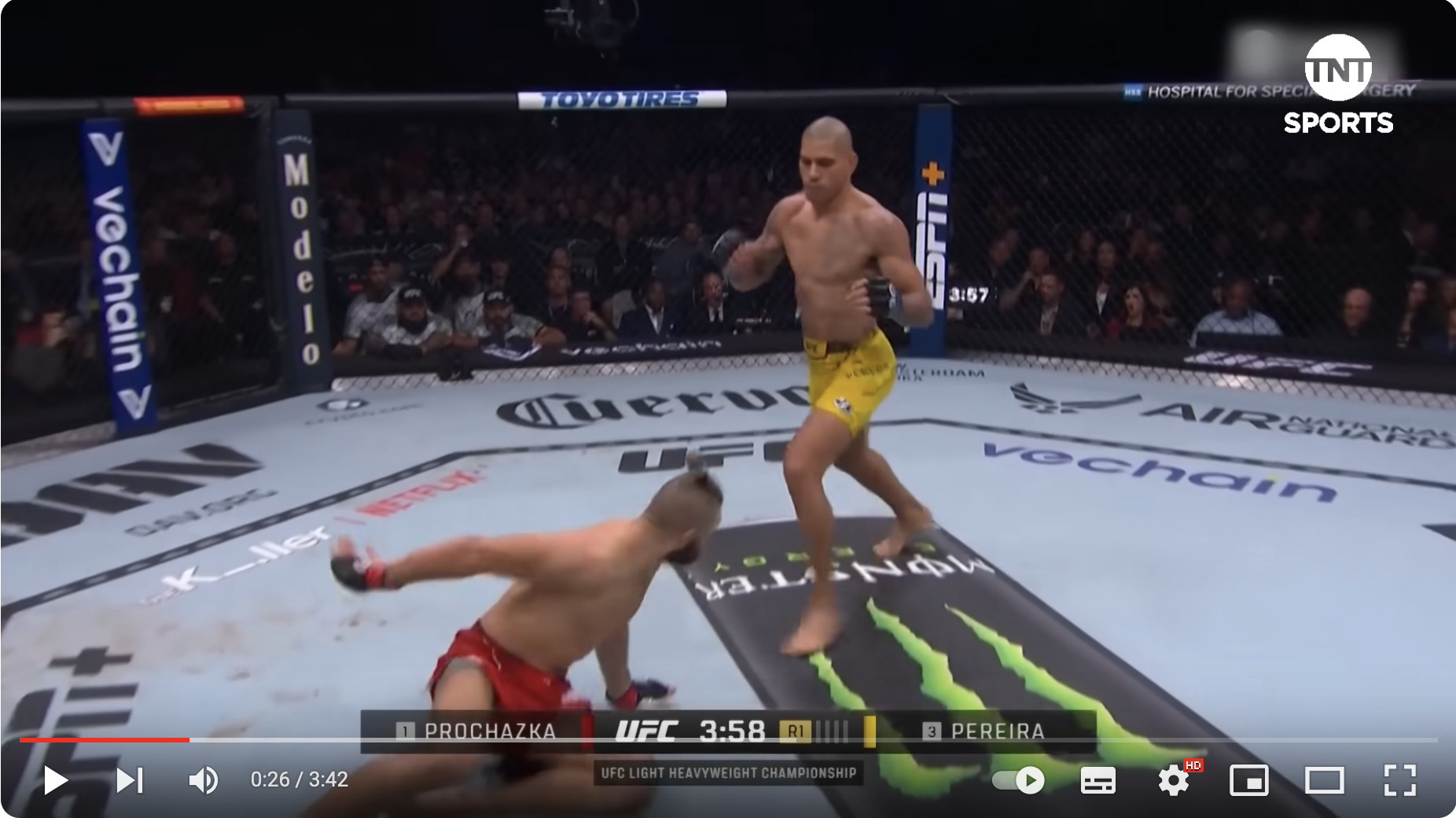
You can see his famous calf kick in action in UFC 295, completely taking Jiri off his feet:

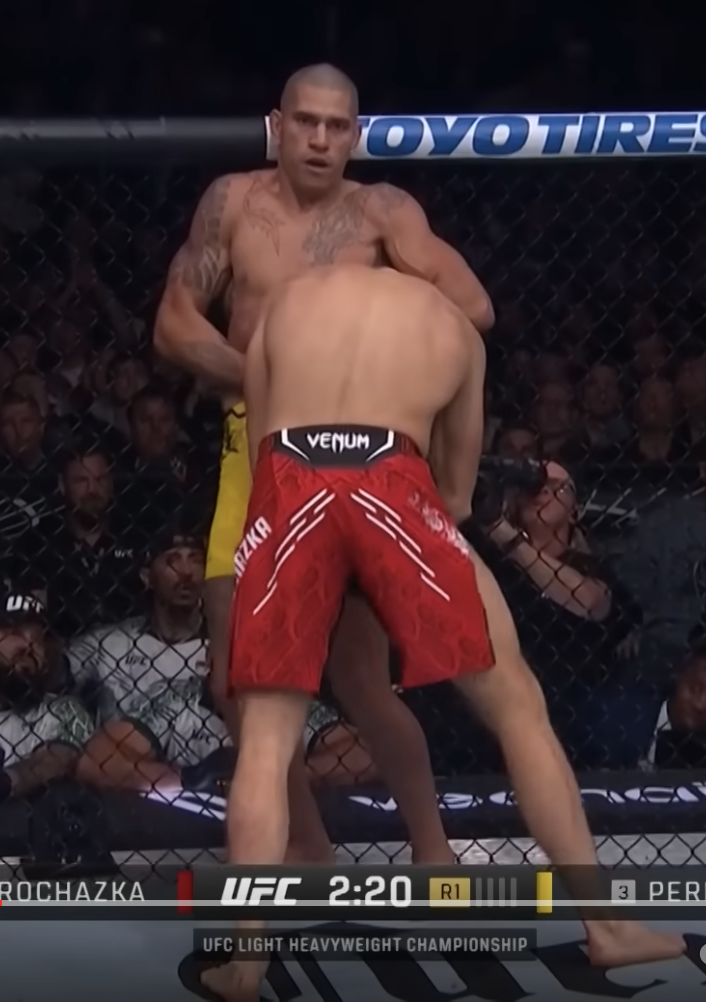
What’s remarkable about the Pereira calf kick is how little wind-up there is, which makes it hard to see coming – he just snaps it out. He does three identical kicks in a row in that part of the fight – the pictures above show the first – but all three hit home. His punches are delivered in the same way – the hand just snaps out with almost no telegraphing movement at all. You can see in the screen captures above of the kick that his body stays facing the opponent at all times. They don’t look like powerful shots, but you can see the deadly effect they have on his opponents. That very tight coil in his body around the spine that he’s using to pop his kicks and punches out is absolutely indicative of Chicken xing. “Chicken shakes its feathers” is a characteristic move of the animal found in Xing Yi links (forms) and somewhat resembles the Fa Jing expression that you see demonstrated in Tai Chi styles:

A chicken shaking its feathers.

Chicken step

When Pereira defends he is using footwork to evade rather than ducking his body – in fact, he stays very upright and his hands are kept high and defensive, just like they are in Xing Yi Chicken, which relies on footwork for evasion.

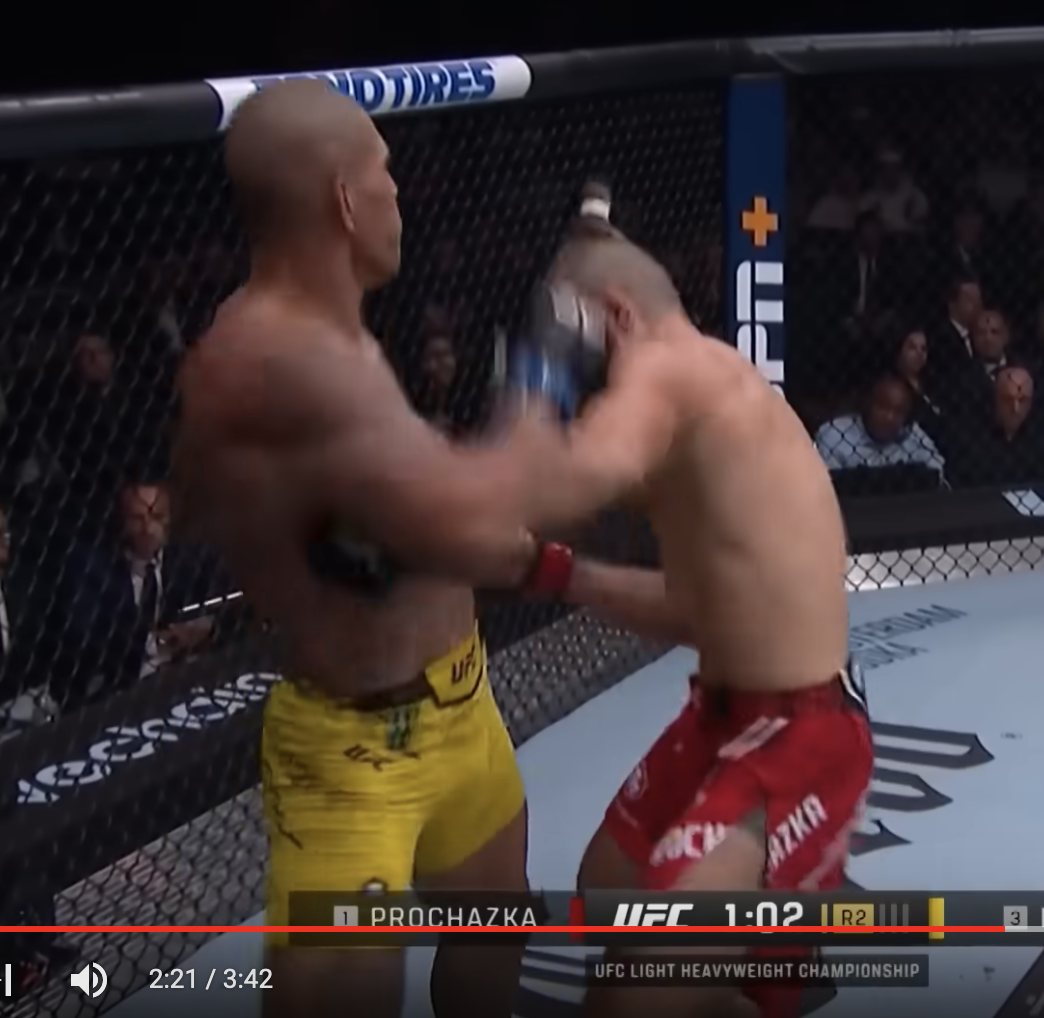
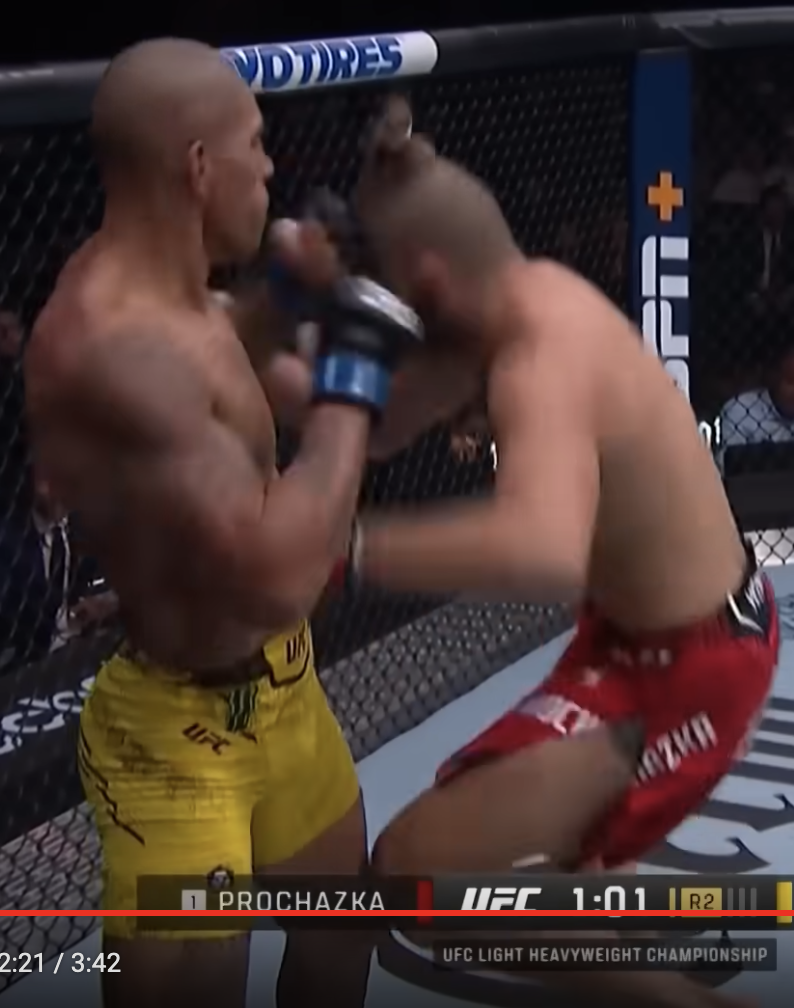
The blows which set up the finish from Pereira were so fast and minimal they were hard to see in real time, but it was a counter 1-2, again delivered with that very upright body with the hips underneath the shoulders that is so characteristic of Chicken:

The very tight techniques of Chicken in Xing Yi are very metal in nature – sharp and cutting.

A perfect example of this Chicken style applied to MMA is the standing guillotine. When somebody shoots in for a takedown, wrapping the neck and using your hips to stand tall, with a narrow base is a very chicken-like technique. In fact, Pereira almost finishes the match with Jiri earlier with one:

Standing guillotine attempt from Pereira.

Here’s a video of me doing some Xing Yi Chicken:

As I mention in the video, Chicken is an important animal in Xing Yi because it provides one of the requirements of the San Ti Shi structure – chicken leg.

Another thing Chicken (done by humans) is famous for are the knee strikes, which in real chickens are enhanced by the spurs it has on the back of its legs, and elbow strikes. You see this with fighting chickens especially. My teacher always said that the martial art that most resembles Xing Yi Chicken is Muay Thai, which is famous for knees and elbows.

The finish in UFC 295 was delivered by downward elbows from Alex Pereira and he has finished UFC fights with his famous flying knee before, delivered here in a way that looks very similar to the knee strikes in the Xing Yi link I do above:

Hopefully I’ve made my case.

To repeat: I’m not saying something simplistic like, “UFC fighters are doing Xing Yi”, but that as a tool for analysing fighting styles, I find Xing Yi really useful and the 12 Animals remain really fascinating.

A bit of homework for you…

Finally, I want to leave you with a bit of homework – also on that card that night at UFC 295 was British heavyweight Tom Aspinall. He managed to secure the interim heavy weight championship belt that evening. To me he’s a clear example of another one of Xing Yi’s 12 animals. The question is which one? You have 10 to choose from! Post your answers, compete with your reasoning, in the comments section below and I’ll give a prize for the correct answer (correct according to me, anyway, and I am the final word in this 😉 ).

Have a watch here:

Swallow Photo by Rajesh S Balouria: https://www.pexels.com/photo/close-up-of-swallow-17484064/

Chicken Photo by Luke Barky: https://www.pexels.com/photo/white-chicken-on-a-concrete-pavement-2886001/

The Chen style knee wobble

Master Ren Guangyi’s signature 21 Form has to be one of the clearest examples of the Chen style knee wobble I’ve seen.

You can see the little wobble of the knee he does before he does a fajin in the form. This knee wobble has been the source of seemingly endless debate. Some lineages of Chen style do it, some don’t. Some do it but it’s very minimal, some do it and it’s quite exaggerated. It doesn’t even seem to be a village vs Beijing style thing either.

So, why do it? It’s a way to involve the knee in the generation of power. The best analogy I can think of is that it’s like retracting your fist before you punch, but instead of having to move your fist back (which has certain obvious martial disadvantages), you store power by moving the knee back instead. This obviously requires a conditioned body, where the hand to foot is all connected, so that when one part moves, all parts move. If you just took your average Joe off the street and they did a knee wobble, I don’t think it would do anything for their punching power. In fact, it would probably decrease it. But for somebody who has built that connection over time throughout the body, it has advantages.

Lots of people are convinced that the knee wobble is the route to ruin for your body, that it’s bio-mechanically inefficient and potentially injurious over time with hard training. I can see where they are coming from since you are using the knee as part of a whip-like kinetic chain for which the hinge joint is not well evolved.

But personally I’m not so convinced that, done properly as part of an overall training system, it is bad for the knee, necessarily. I think if you were holding your weight for a long time on a misaligned knee joint then that would be a bigger problem. But the quick flick of a fajin isn’t like that. There are also plenty of things athletes do all the time that I’d say are potentially much more dangerous. It also depends on the person. The knee is a particular weak point in the evolution of the human beings into an upright posture, and being severely overweight is very dangerous to your knee joints. And if I was severely overweight there is no way I’d be flicking my knee joints about like this, so it very much depends on the overall health of the person doing it.

Disclaimer! I’m not an orthopedic surgeon, or a physiotherapist, so I’d suggest getting your medical advice from somebody who is actually medically qualified.

A simple exercise for opening and closing in Tai Chi

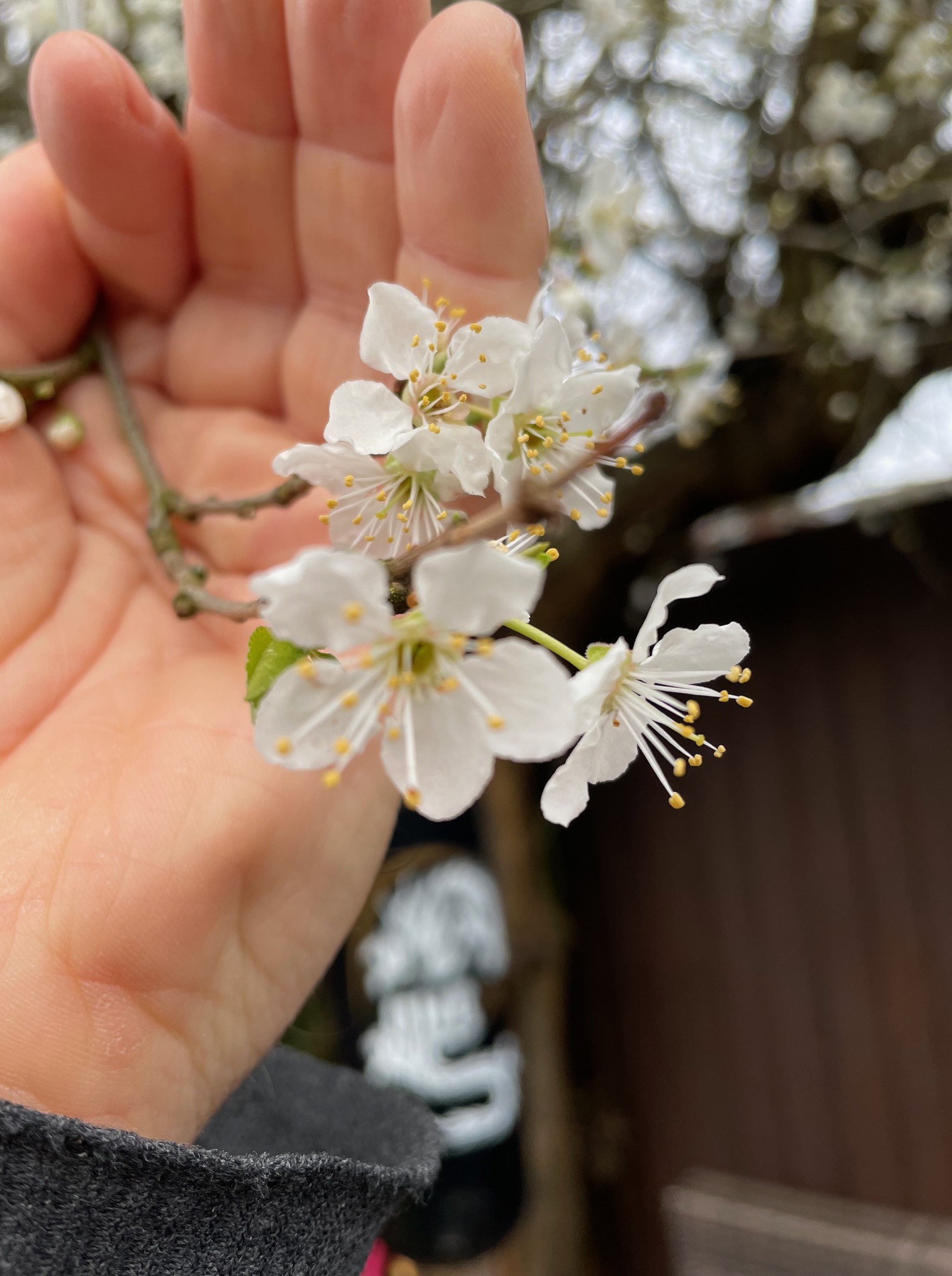
The plum tree in my garden is blossoming, and that can mean only one thing: Spring is here!

Without getting too poetic about it, the potential energy trapped within the tree over Winter is releasing and opening out to the world. So, in keeping with the cycle of the seasons, let’s return our Tai Chi practice to a similar aspect – opening and closing.

All Chinese martial arts contain movements that open and close the body, but I’d go as far as to say that a repeated pattern of opening and closing your body in movement is the fundamental action of Tai Chi Chuan. It’s perhaps the one thing that makes Tai Chi Chuan (Taijiquan) different to other Chinese martial arts.

For instance, a lot of Southern Chinese arts contain movements where the body is tightly closed under tension and then this tension is used to produce a tightly focussed sort of short power. White Crane is a good example – I really like this video of Martin Watts showing the connection between Chinese White Crane and the roots of Japanese Karate, for example.

Then there are also Chinese martial arts that use ‘open’ postures a lot, and produce power from the big turning actions of the waist and shoulders – Choy Li Fut is a good example of this.

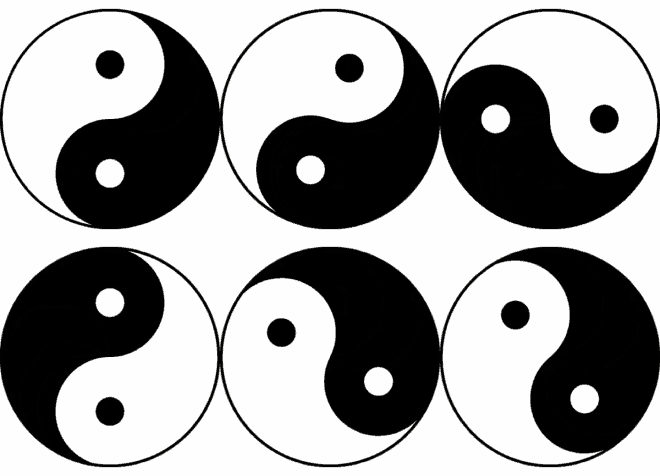
Of course, both these arts make use of both opening and closing movements in application, but what makes Taijiquan different is that it seems to have a rule that the body must constantly cycle through a series of opening and closing postures. You can see this when you look at Tai Chi forms – it shouldn’t matter which style you’re looking at, the opening and closing movements should follow each other in a cycle, very much like the Yin Yang symbol. If you imagine the Yin Yang symbol turning in a clockwise direction then the white fish becomes the black fish, which becomes the white fish, and on and on.

Silk Reeling exercises are a great way to focus on understanding open and close movements, as you just keep repeating the same pattern over and over, so your brain doesn’t get occupied thinking about the movement you are doing next (as it would in a Tai Chi form) and you can focus on the opening and closing actions.

So, what are the opening and closing actions? Well, I went over it in a video series a while ago. You can watch it here:

But it takes a while to watch all that series, so long story short, here’s a written explanation: an opening movement generally stretches out the front of the body (the Yin side – the soft parts, like the inside of the arms, and thigh, calves, and belly) and a closing movement generally stretches out the back of the body (the Yang side – the harder parts, like back of the arms, back and outside of the thighs and shins).

You can see these actions everywhere in nature: Cats tend to stretch along the front and back (yin and yang) of the body when stretching. (And it’s the same with the Yoga “Cat stretch” posture). But you see them in humans too – when you do one of those involuntary yawning/stretching movements in the morning, it tends to be opening the chest (yin stretch), occasionally followed up by a Yang side stretch.

It’s been noted that animals running are opening and closing the Yin and Yang sides of their bodies in sequence. So, this opening and closing action is fundamental to human and animal movement and the more we can utilise it, the more we are returning to our own natural systems of movement. Now, I don’t want to get sidetracked into a debate on what exactly “natural” movement is, but simply put, this opening and closing movement done in the human body feels good, it seems to put you in a good mood and you feel like your body and mind are returning to the way they are supposed to work. It requires less effort to perform tasks using it because it’s very efficient and it feels natural. If you watch skilled workmen and women then you’ll notice that they tend to gravitate towards easy body movements that have this natural opening and closing quality. Many of the people in ancient China who practised kung fu systems would have been agricultural village works who were familiar with natural movement patterns through necessity.


4 Directions Breathing exercise

Silk reeling exercises belong to the Chen style of Taijiquan, and while I (a Yang stylist) have no problem borrowing what works from other styles, a lot of Tai Chi practitioners might not want to do something from another style. However, almost all Qi Gong/Tao Yin type breathing exercises follow the same idea of opening along the Yin side of the body and closing along the Yang side that you find in Silk Reeling exercises.

You probably have some sort of exercise already that’s in your system to try this with, but let’s try one simple exercise to get our heads around the idea of open and close.

Stand in a Horse stance,

  1. Breathe in as you bring your hands up facing you and then move them around a large imaginary ball that’s in front of your chest, so that your hands are facing away from you.
  2. Push the imaginary ball forward away from you as you breathe out.
  3. Turn the hands over and bring them back in towards you as you breathe in, going around the outside of the ball.
  4. Push to the sides as you breathe out.
  5. Bring the hands back in, circling the ball, getting underneath it as you breathe in.
  6. Push upwards as you breathe out.
  7. Bring the hands back in, circling the ball, getting on top of it as you breathe in.
  8. Push downwards as you breathe out.
  9. Bring the hands back in, going around the ball as you breathe in.
  10. Let the palms face down and hands return to your sides as you breathe out.


Adding the opening and closing:

As you bring your arms up and towards you and go around a big ball that’s the opening movement. You can feel the slight stretch opening around the chest area, and you use that slight tension to help push your hands forward. As you do you’ll feel a slight stretch developing along your back. That’s the closing movement. You then use that slight tension to help bring your arms back. This is opening. Then as the arms push to the side, this is closing, and so on.

Here’s a video of me doing it:


Don’t use muscle

You often hear Tai Chi teachers say things like “don’t use muscle”. Normally this drives me mad, as you can’t physically make a movement without using muscles! However, what they’re really talking about is using that slight stretch you can feel to power the movement instead of just moving as you normally would, which results in making it “too physical” for Tai Chi. Finding the right words here is a delicate balance, but what we’re looking for is more of a whole body movement.


Final words

It helps to work on this in a stationary exercise, as described, but when you try your Tai Chi form, try and focus on keeping that feeling of opening and closing going throughout the whole form. The opening and closing movements are already there in the form, it’s up to you to reveal them. It’s a way of approaching the form from the inside, rather than the outside. So, if you’ve been struggling to get a movement to feel right in your form, it could be that the method described here will solve the problem for you. For it to work you have to be “sung” (relaxed) and focused on what you’re doing and the feelings inside the body. If your mind wanders off then inevitably so will your form. This is the start of what we call in the Tai Chi Classics “internal and external combine”.

Further reading: Turning Qigongs into functional Qi exercises

Ep 20: Matt Hill on relaxation, breathing and fire ants!

Matt Hill is the owner of the Systema Academy in Wiltshire, England. Matt has a long history in martial arts, starting with Aikido, training under Morihiro Saito Sensei in Japan in the early 90s. From there he joined the Parachute Regiment leaving as a Captain in 2003. After this he started training in Systema under Vladimir Vasiliev and now teaches Systema, Bushcraft and leads groups trekking through jungles all around the world.

Matt was kind enough to give me a 1-1 in Systema before we recorded this podcast at his academy, where he focused on the four pillars of Systema – breathing, relaxation, posture and movement. We discuss all these things in the podcast as well as the next destination for Matt’s jungle trek.

Links:

Systema Academy:

Podcast:

Listen here.