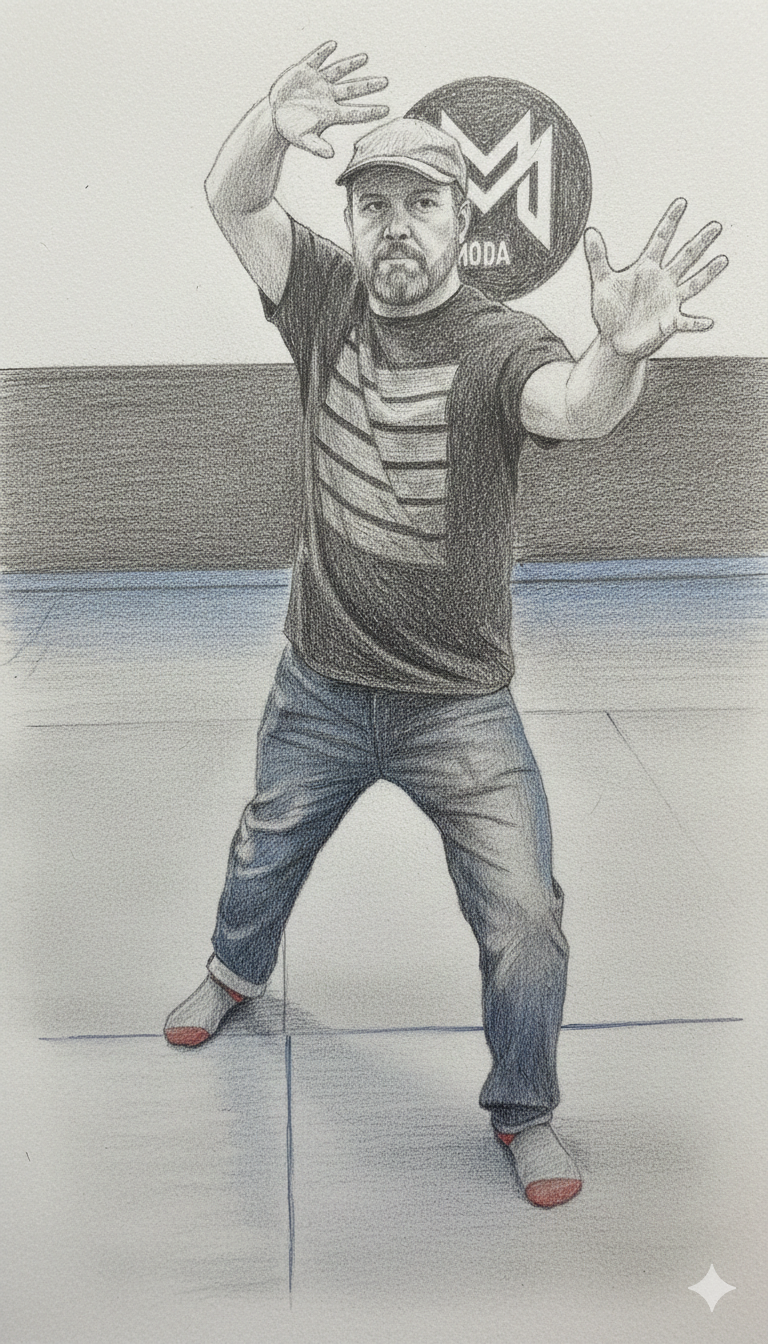
It occurred to me the other day that I’ve been running a tai chi class for a couple of years now but never taken a single group picture. In jiu-jitsu you’re lucky you get out of the door without somebody taking your picture at least once — it’s a totally different culture and it’s interesting to reflect on the reason why.
In a martial arts class you expect your picture to be taken and shared on social media, or maybe you’ll even be captured briefly in a video of the class. I suppose it’s because you’re doing something exciting and worth bragging about. As an activity it’s ‘loud’ – there’s loud music playing a lot of the time.
The instagram for my jiu-jitsu academy is full of pictures of students, for example.
Tai chi is a different sort of activity — it’s quieter, softer and less about showing off. Taking a picture in that sort of environment feels a bit like going against the grain. It’s a shame because pictures can act as markers for when you started tai chi and how long you’ve been doing it, and a reminder of who was in the class then.
But anyway, I did take a group picture of the Tai Chi class last Friday, and I’m glad we’ve got at least one. I won’t post it here because it was just for the group’s Whatsapp. I’ll probably wait a year before I take another one.
Tai Chi has always felt like it’s very good for me — for the mind, the breath, the joints, for my overall functioning as a human being — but I’ve never really considered it a weight-loss tool. That’s despite the rash of frankly hilarious ads currently clogging up social media, bizarrely presenting Tai Chi as the secret to giving men over 50 a six-pack.
What’s even more galling is that if you actually look at the “Tai Chi” weight-loss exercises these products are trying to sell, they’re not Tai Chi at all. They’re what could most generously be described as basic warm-up movements — and the ripped old men demonstrating them are very obviously AI-generated.
Exercise of any kind is beneficial for health, but Tai Chi has never been particularly associated with weight loss. And now, inconveniently for the entire fitness industry, the idea of exercise as a reliable weight-loss tool has just taken a kick in the teeth courtesy of a recent New Scientist article, which argues that exercise, while very good for you, may not lead to weight loss as much as we’ve been led to believe.
According to the article, the basic problem is compensation. When you exercise more, your body simply burns less energy elsewhere to make up for it — and this effect can be even stronger if you’re also dieting.
As the article puts it:
“Exercise is tremendously beneficial for our health in many ways, but it’s not that effective when it comes to losing weight — and now we have the best evidence yet explaining why this is.
People who start to exercise more burn extra calories. Yet they don’t lose nearly as much weight as would be expected based on the extra calories burned. Now, an analysis of 14 trials in people has revealed that our bodies compensate by burning less energy for other things.” – New Scientist
Seen in that light, it makes far more sense to view Chinese martial arts — Tai Chi included — as tools for improving overall quality of life rather than as weight-loss hacks. That includes balance, coordination, joint health, breathing, mental focus, and, perhaps most importantly, social connection.
Feel the burn
If you’re practicing Tai Chi and want to improve your overall fitness while staying within the Chinese martial arts ecosystem, it’s worth pairing it with something more physically demanding. Styles like Choy Li Fut, Hung Gar, or Praying Mantis, for example, place much greater demands on strength and cardiovascular capacity.
Alternatively, you could lean into the more demanding side of Tai Chi itself — weapons forms, longer routines, or more continuous practice sessions can be surprisingly taxing.
Not all Tai Chi is the same. Most people today practice softer styles, where this advice applies most clearly. Some styles — Chen style in particular — include more vigorous stamping, jumping, and explosive movements, and may not require additional training alongside them.
Either way, common sense still applies. For a well-rounded approach to health, it helps to do something that makes you breathe harder than normal.
Tai Chi doesn’t need to promise abs, calorie burn, or dramatic body transformations to justify its existence. Its value lies elsewhere — in longevity, resilience, awareness, and the quiet accumulation of small benefits over time.
If weight loss happens alongside that, fine. But if it doesn’t, Tai Chi hasn’t failed. It’s simply doing what it has always done best: helping people move better, breathe better, and feel more at home in their bodies — no six-pack required.
Just watched a great clip of 1980s Wushu in China – featuring Sun Jianyun, Sun Lu Tang’s daughter performing Bagua. But there’s also some clips of Tai Chi and some kids doing Northern Shaolin (at least I think it’s Northern Shaolin). Well worth a watch. The martial arts are on their way to being the heavily performance-based WuShu we have today, but are not quite there yet, with martial technique still a priority.
The latest way of selling tai chi is to say it gets you jacked
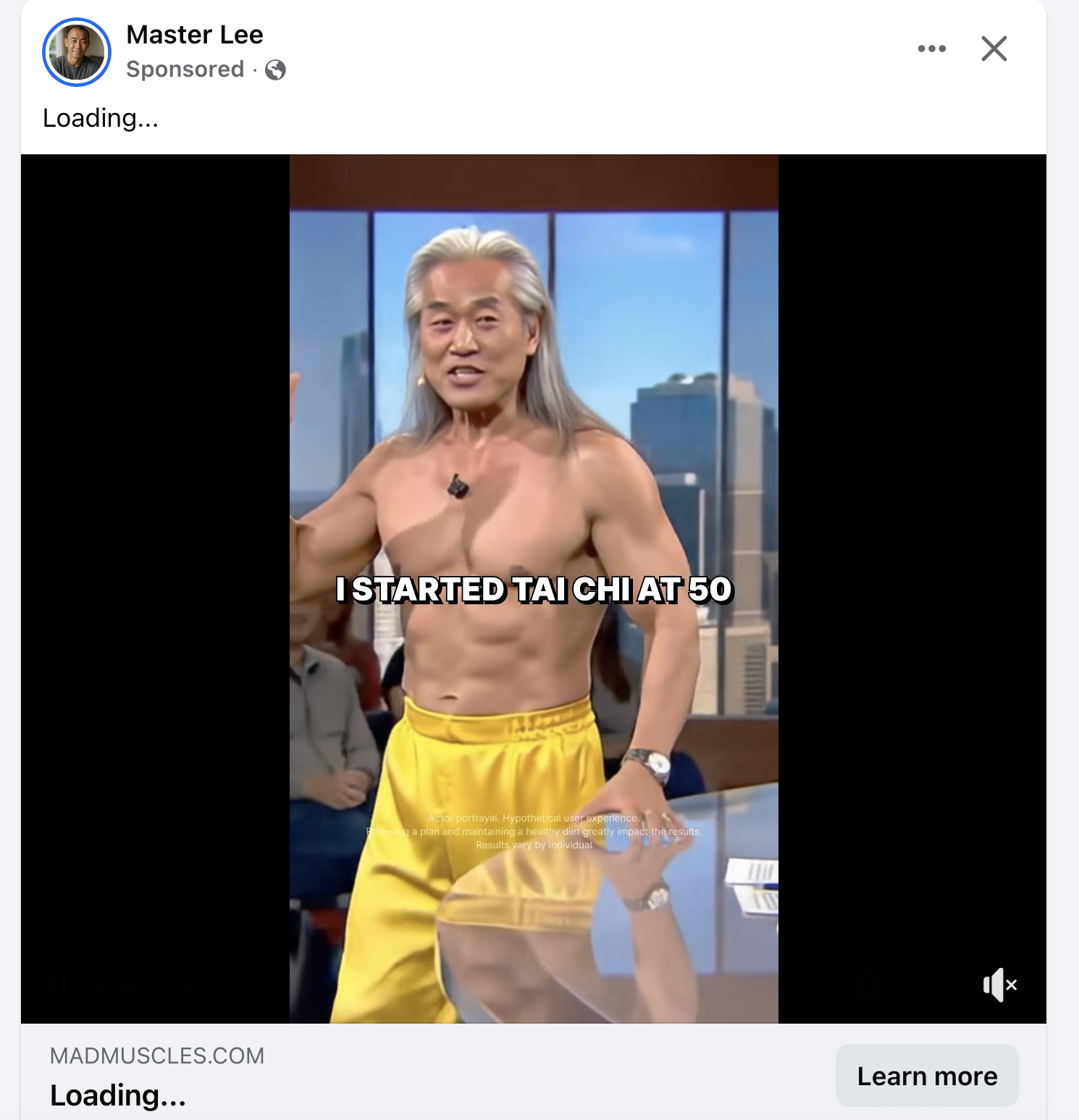
I’ve seen a lot of things come and go in the Tai Chi universe over the years, but the latest marketing trend has got me scratching my head. Almost every advert for Tai Chi courses I see on Instagram and Facebook at the moment promises ripped muscles and a hyper-masculine physique, mainly for men over 50!
Tai Chi, with its soft, slow, flowing, gentle movements, is perhaps the least masculine-looking martial art you could imagine, yet here is “Master Lee” strolling around a TV studio with his top off showing off his impressively-muscled abs, which he says he got from tai chi.
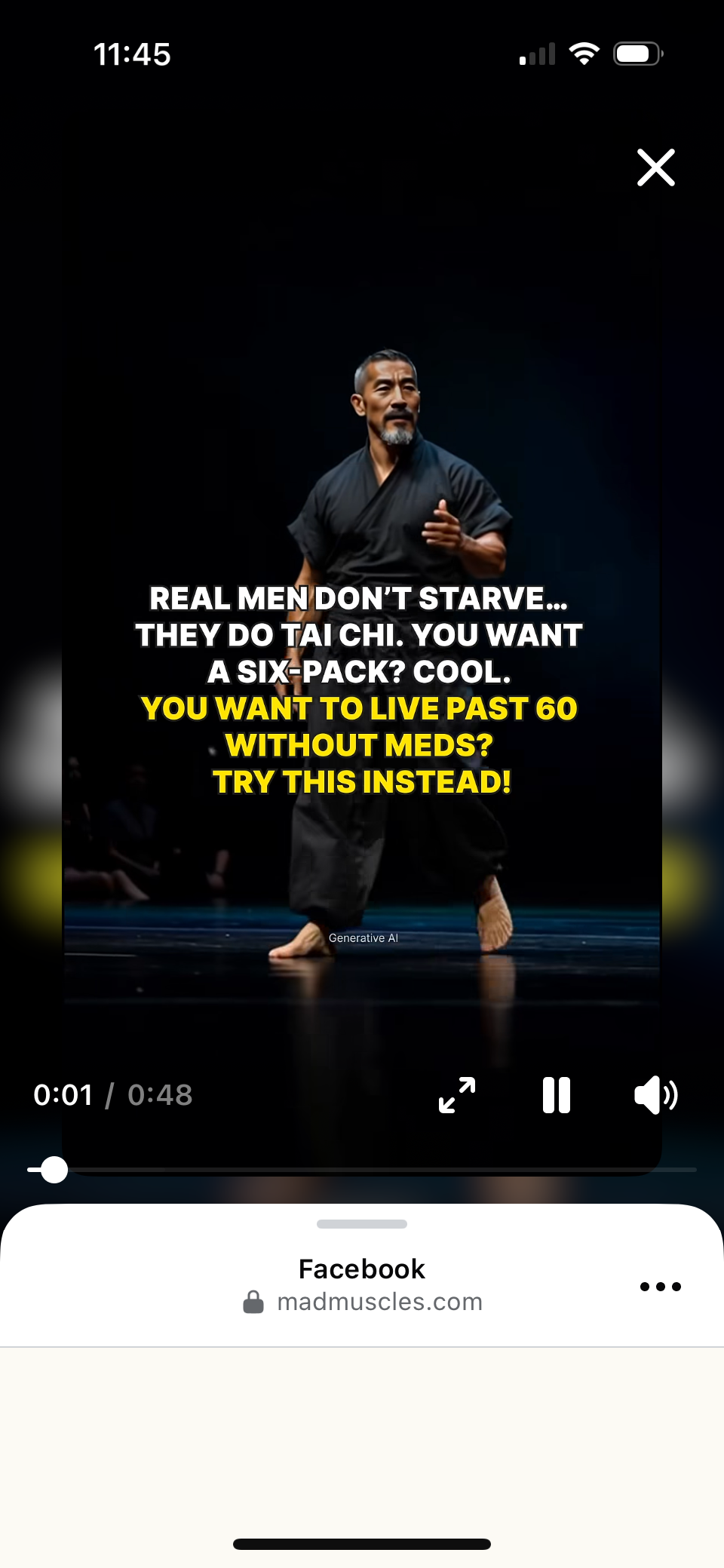
Or this guy, who claims tai chi is the path to a six pack. “Real men don’t starve… they do tai chi”, he proclaims.
So, what’s going on here?
Firstly, these confident, super-tonned Chinese gentlemen, are clearly creations of generative AI video apps. Everything about the videos looks as fake to me as the idea that tai chi on its own will get you that shredded.
Tai chi is good for many things, like learning how to use qi and jin and producing a feeling of tranquility, or as a self-defence system, but producing athletic-looking people over the age of 50 is really not one of them. *
When you look deeper into the exercises being offered here they look like simple, repetitive qigong-style movements. The idea that you’d replace weight training and body weight exercise with these and still build muscle is wrong, as far as I can see.
There’s no getting away from it, if you want to lose weight and build muscle you need a diet, cardio and weight training routine.
—-
* Now, I’m aware that there is another trend at the moment to train intensively with kettle bells and call that “tai chi” or “internal”, but really it’s no different to doing a kettle bell workout and not calling it tai chi.
And why you shouldn’t train with weights when developing your qi
Mike Sigman has sent me an article to publish on this blog. I don’t normally publish other people’s work, or agree to their requests, but I’ll make an exception because it will hopefully generate some discussion. Regardless of how you feel about him, there’s is always a real depth to Mike’s writings and ideas that you can get a lot from, that you don’t really find anywhere else.
The article is primarily about one of the trickiest subjects in Chinese martial arts – qi (or chi).
I have a few thoughts about it:
1) The article starts by trying to “separate the skin-related qi, which includes the subconscious mind’s involvement, from the theoretical qi of traditional Chinese medicine”.
To some, particularly those people who relish Chinese history and the evolution of the concept of qi as it appears in Taoist thought, or medicine, that just won’t be acceptable, but I think this works for me. It moves the discussion into the realm of the physical and practical. It becomes a feeling and a doing thing.
2) It appears to be written partly as a reaction to a recent trend of mixing, or doing, Chinese martial arts conditioning through the medium of kettle bell or weights training. The question is, is that a waste of time if you want to get to the root of the subject, which is what the Chinese martial artists call qi?
Look, I don’t think there’s anything wrong with making yourself physically stronger at all. In fact, it’s obviously advantageous if you’re learning martial arts… But the article states that to master the internal movement, “the body must be completely retrained to learn to move with the qi, jin, and dantian”, and using weights will not help you in that respect. If you have retrained the body, then you could probably add them.
3) As I’ve said, nobody else really talks about this stuff, or if they do it’s watered down with a lot of other guff. If the article is correct on qi then what exactly are all the big names in modern tai chi seminar circuit and online courses out there actually teaching? Because they talk about qi a lot… but they don’t approach it in the same way as this article does, at least as far as I can see.
4) The article describes internal movement, quite simply and quite succinctly: “Ultimately, you develop a form of movement that uses the solidity of the ground as the focus of all forces to and from the body, while the qi covering of the body is manipulated by the lower-body and the middle to bring power to the arms and upper body.”
I find it hard to disagree with that definition, probably because it’s pretty broad. Sure, we can argue over what the “middle” is, or what the “lower-body” means,etc.. but as a succinct definition, it’s not half bad.
Now, let’s move on to how you do it…
The article talks about breathing exercises as a starting point: “Breathing techniques that stretch the surface of the skin and the involuntary muscle layers are the usual start of the progression.”
Now, I have personally trained in some of the methods that Mr Sigman uses (there’s a link to a video at the end of the article), and experienced what he’s talking about, and I’d agree that I can feel what he’s talking about. But I wouldn’t count myself as an expert in it, or knowledgeable about anything to do with it beyond the initial foot in the door stages, however, I have found that alone to be incredibly valuable and shone a light on some of the other things I was already doing. Even getting a foot in the door took a lot of work and a lot of time.
Anyway, I’ll leave you to read the article now and feel free to comment with your thoughts below.
Graham
Practical Development of Qi
And why you shouldn’t train with weights when developing your qi
by Mike Sigman, March 2025
Discussing qi is difficult because the definition of qi has become a bird’s nest of related topics. Let’s try to narrow the discussion and then describe an approach to practical development.
Most of the skills related to qi, in the physical body, have to do with an area near the skin of the body that is referred to as the “protective qi” or “wei qi”. While the protective qi is often referred to as an “energy”, it is actually a physical set of tissues that is controlled via the autonomic nervous system … but when you learn to control it via the subconscious mind, it does indeed feel sort of like an “energy” because it is apart from the topical sensations of the somatic nervous system, and the qi indeed feels odd, like an energy.
So, let’s separate the skin-related qi, which includes the subconscious mind’s involvement, from the theoretical qi of traditional Chinese medicine: that’s where most of the confusion lies. The skin-related qi and the subconscious mind are the artifacts which give us heightened toughness of the skin, odd sensations of qi, added strength by supplemental our muscle-bone strength, and dantian control of the body as whole connected by skin-related qi, among other things. Jin forces, the manipulation of the solidity of the ground and/or downward forces of gravity, are also the product of the skin-related qi: jin is defined as “the physical manifestation of qi” in many Chinese sources.
The qi of traditional medicine theory is/was an effort to explain the workings of strength, including the strength of our involuntary systems. We don’t need to know all the theories about meridians, putative different types of qi, etc., in order to develop the qi. Breathing exercises and focused physical and mental exercises are more important than complex qi-paradigm explanations.
The skin-area wei qi is initially controlled by respiration and “breathing exercises” are our initial approach to control and development of the qi tissues. During inspiration, if we are slightly extended or stretched out, we can feel a slight inward pulling of the tissues of the fingers and hand. Other areas of the body, upon being slightly stretched taut, can also be felt during the inhale, but many tissues in other areas of the body can’t be felt. They must be developed over time by breathing exercises before we can feel them respond to our breathing and before we can develop them further.
Some Chinese texts mention the fact that this superficial qi is something that animals still use (think of a horse quivering its flanks, for example), but which has atrophied in humans over the course of evolution. In order to regain our qi, we must use deliberate exercises of breathing, mental imagery, and posture manipulation.
Training the Qi in General Movement
Jin force-manipulation is a product of the qi tissues applying stressors within the body’s frame. That’s why jin is defined as “the physical manifestation of the qi”, among other things. We use jin unconsciously in our everyday movements, so another common definition of jin is as an “intrinsic strength”. The full-blown traditional movement methodology that permeates the Chinese (and related) martial arts involves both qi and qi’s subset, jin. Qi and jin. Jin forces are the mind-directed forces from the ground and gravity; qi can be thought of, in a simplified sense, as a superficial muscular layer that connects the whole body.
The basic idea of movement with qi and jin is that the power from the ground and lower body is used as the power source for the upper body. The qi and the jin work from the lower body (including the middle/dantian), so what we have with “internal” movement is a system where the arms and hands are controlled and powered by the lower body and the middle.
The general admonition is that muscle and power are used in the lower body, as needed, while the upper body is moved without the use of local muscle. I.e., a person has to learn to control his/her upper body via manipulation of the lower body and the middle. The person who thinks the internal arts would be best supplemented with typical weight workouts at the gym has lost the plot and is giving away a total lack of understanding about how the “internal” martial arts work.
Developing the Qi
Jin skills are actually fairly easy to learn, although it generally takes a few knowledgeable pointers and some personal, hands-on demonstrations to get someone started. There are a number of written attempts at jin explanations on the internet, particularly through the 6H forum.
Qi is difficult to develop because it takes time and the feelings we need to focus our attention are tenuous at first. Breathing techniques that stretch the surface of the skin and the involuntary muscle layers are the usual start of the progression. Many traditional Chinese martial arts talk about “100 Days” of breathing exercises to develop the qi to a usable status.
Movement of the involves directing all forces upward from the solidity of the ground (so you must “sink your qi”) or use the weight of the body as a basis for downward movement.
Ultimately, you develop a form of movement that uses the solidity of the ground as the focus of all forces to and from the body, while the qi covering of the body is manipulated by the lower-body and the middle to bring power to the arms and upper body.
All Asian martial arts that are labelled as “internal” martial arts, formal calligraphy, qigongs, traditional dance, etc., use this combination of qi and jin for movements. Learning the external choreography and appearance of a martial art, a qigong, etc., no matter how much it resembles the movements of an expert, will not be correct until the system of movement is changed over to the qi, jin, and dantian type of movement.
Almost all of the movements we so often see in western semblances of “Tai Chi”, Aikido, Xingyiquan, Baguazhang, etc., are based from normal movement parameters, rather than qi and jin mechanics and it will take effort to re-learn these arts with the correct movement basis. There is an old saying to that effect: “Taijiquan is easy to learn, but difficult to correct”. So, if your goal is to learn Taijiquan, Aikido, or related arts, remember that all the talk about “relaxation”, “don’t use weights”, etc., is because the body must be completely retrained to learn to move with the qi, jin, and dantian.
Here’s a video of Chen Zhaosen, with translation by John Prince, teaching basic movement drills for the Chen-style Taijiquan. Notice his comment about no strength in the upper body, but whatever strength you need in the lower body. https://vimeo.com/141009942
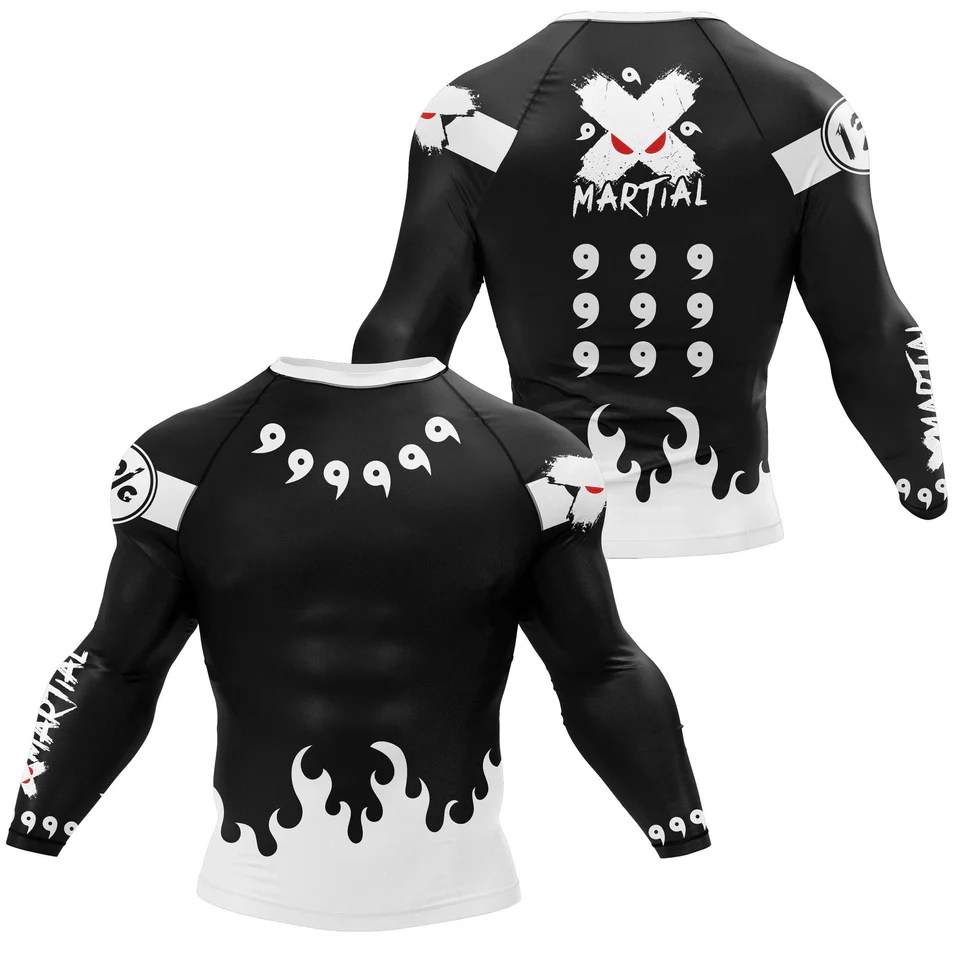
I’m pleased to announce I’m partnering with XMartial for BJJ and general gym-wear clothing. I’ve gone with XMartial because they have a genuinely fun range of designs, and also their website is full of people I actually recognise from the world of BJJ, like John Danaher, Jordan Preisinger from Jordan Teaches Jiujitsu, and B-Mac. Plus, its Reddit customer reviews for quality and shipping to the UK are good and the customer service is highly rated.
Shipping in the US is free, but there is a small $9.50 for shipping to the UK. There are lots of different designs, and XMartial sell gis and hoodies too. So, if you’re looking for new, high quality, BJJ wear and you want to support The Tai Chi Notebook then head over there and have a look at what they’ve got. Thanks!
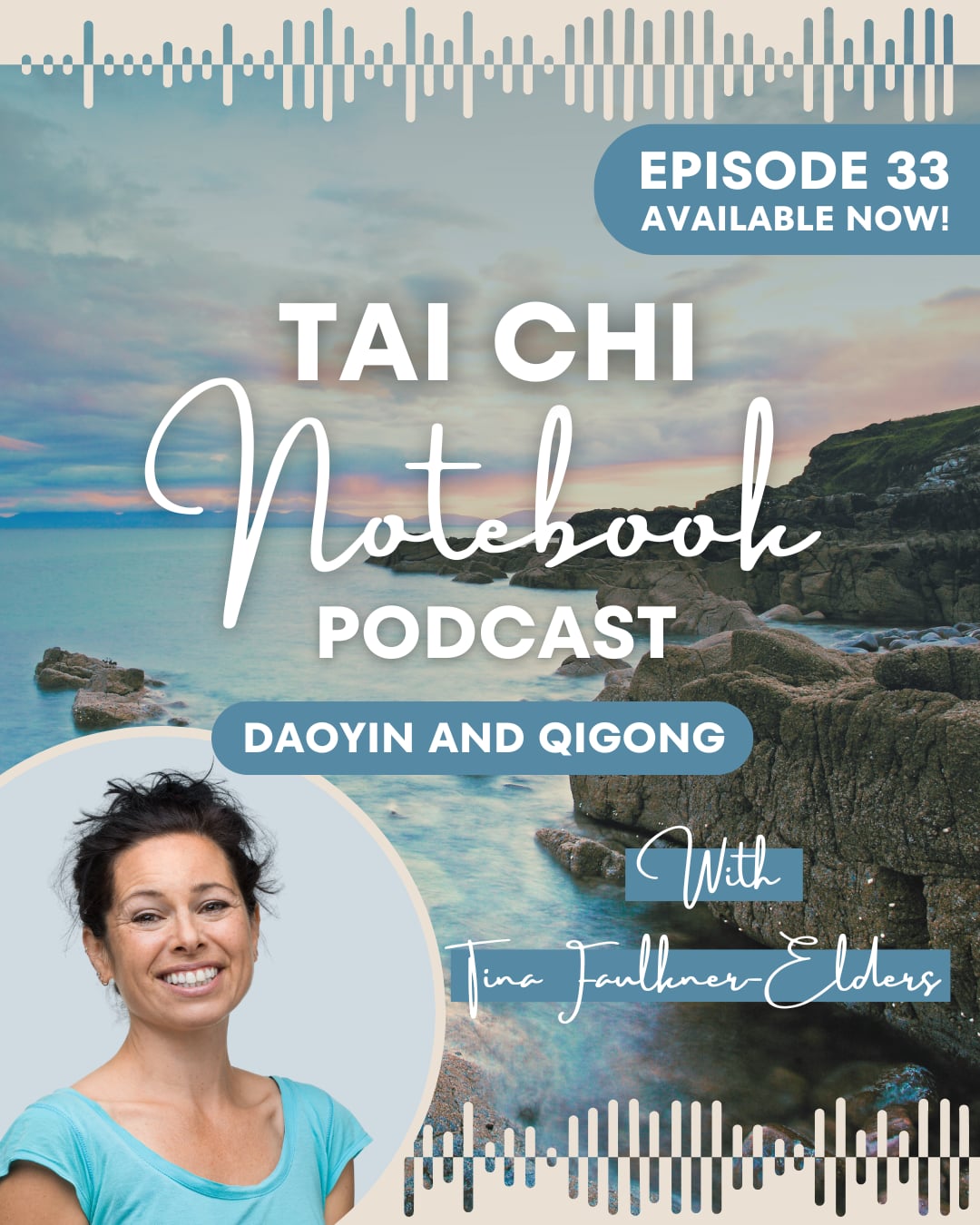
My guest for the latest episode of The Tai Chi Notebook Podcast is Tina Faulkner Elders, chief instructor of the RuYi School of Taijiquan and Qigong in Aberdeenshire. We talk about Tina’s training in qigong, first with her father, then in Beijing, China, and then on Wudang mountain itself, the legendary home of Taoism.
As you age your hips definitely get less flexible. If you do BJJ as well, like I do, then the wear and tear seems to add up exponentially, which is why I’m always interested in mobility routines for the lower back and hips, and I think I’ve found one I really like.
“The main goal here is to get comfortable with “uncomfortable” positions by re-searching them on a daily basis. Ideally first thing in the morning, or as a warm up to your practice. Note: A mobility sequence will not necessarily improve your mobility permanently, but is mostly useful for opening up your normal range of motion by releasing unnecessary tension. For more specific mobility issues, you need more specific and targeted practice”.
A lot of these movements remind me of Yoga for BJJ by Sebastian Brioche, which is no bad thing. I like the way the set it put together, and it makes my hips feel great afterwards. It seems to target all the right areas for me. I could see myself running through this each morning.
Have a go (N.B. consult your doctor first, you do so at your own risk, etc) and let me know how you get on!
Thank you for supporting The Tai Chi Notebook. If you are reading this on a website that isn’t thetaichinotebook.com, then it’s highly likely it’s been stolen. Please let me know so I can issue their webhost a DMCA takedown notice for copyright breach. Thanks.
Tai Chi could be the secret to improving your balance and living longer.
Standing on one leg is one of those things that’s supposed to be very good for you, especially as you get older. It’s the sort of thing that you keep hearing studies about. It’s supposed to reduce falls and make you more coordinated. It’s even an indicator of when you will die. People who cannot stand on one leg for 10 seconds are found to be almost twice as likely to die within 10 years.
“When you attempt the one leg balance, your brain is performing a remarkable amount of coordination. It integrates signals coming from the fluid in your inner ears, visual cues from eyes, and even feedback from your joints and muscles. Signals from your eyes play a big role in maintaining your balance, which helps explain why standing on one leg is significantly harder when you close your eyes. If you can reach 10 seconds with your eyes closed, you’re doing well.”– Michael Mosley.
As you can see, the process of balancing is a lot more complicated than most of us realise. Of course, standing on one leg is also something that we do in Tai Chi a lot, we just don’t make a big deal about it.
Therefore, to hear that a one legged stand has all these extra health benefits is great news, since we’re doing it anyway in our Tai Chi kicks, which are often done slowly, so can take 2-3 seconds to accomplish, all of which is time spent with one leg off the ground.
(That photo, by the way, is a free image from the Unsplash website – and it’s actually very nicely done. A lot of the images on Unsplash that appear for a search on “tai chi” are so bad I can’t use them here, but that one is pretty good. Look at that nice vertical alignment from head to foot down the spine and leg. Perfect!)
I find that balancing on one leg is something that beginner students in Tai Chi really struggle with. They wobble, a lot, but I think it’s just from lack of practice, and as the article says, you can get better at it very quickly. You build new nerve connections and recalibrate your brain, simply by practicing.
As this article by fellow Bath resident and journalist, Joel Snape, explains, having good balance becomes increasingly important as you get older. He also makes the argument for Tai Chi as a great way to improve your balance, and makes the important point that the standing leg needs to be bent:
“Standing on one straight leg isn’t the same as standing on one bent leg,” says Locker, who began practising tai chi with a master who “could throw guys half his age and twice his size around the room”. “When the leg is straight, the skeleton supports the body, not the postural muscles. Older people are commonly advised to practice brushing their teeth standing on one leg to build their balance, but in order to train the postural muscles to support the lower body, you should use one bent leg.” This way, over time, you’ll build not just balance but work capacity.– Joel Snape.
So, it’s important to bend your knee (even if it’s just slightly) when standing on one leg. This is something I notice about beginners in Tai Chi. Whenever the feet come together it’s natural to want to straighten your legs, as if you were doing a Waltz. Learning to keep your feet together and your knees bent is a skill that has to be learned over time, and is much harder to do than you think. As soon as your mind wanders off, your legs will straighten. If you can get good at this, then when it comes to standing on one leg, it will be much easier to keep the standing leg slightly bent at the knee.
Thank you for supporting The Tai Chi Notebook. If you are reading this on a website that isn’t thetaichinotebook.com, then it’s highly likely it’s been stolen. Please let me know so I can issue their webhost a DMCA takedown notice for copyright breach. Thanks.
I’m always on the look out for interesting bio mechanical things and that search recently lead me to a character called David Weck, who is known as the ‘Head over Foot Guy’. Of course, that’s not his only idea about biomechanics- he’s got loads of them – but this video is a good introduction to his Head over Foot idea:
(It’s unfortunate that there’s a picture of the controversial social media influencer Andrew Tate in the header image for that video, because he doesn’t feature in the video. I guess they’re just using him as an example of a good walker, but while he may be a good walker, I don’t like him or his opinions, nor do I think he’s a good example for kids to follow).
The ‘head over foot’ idea can be explained very easily – if you’re going to stand on one leg, then your head has to be directly over your foot if you want your balance to be good. You can try this now, by standing on one leg and playing with where your head balances over your foot. I think he’s right – if you move your head anywhere else but over your foot then your balance starts to go.
Weck then takes this into the idea of walking, so instead of the usual description of walking that you read, which is that it’s a series of controlled falls, if you alternately put your head over your foot as you walk then you end up with a more athletic, balanced and confident walking style with a bit of swagger. You can start off over exaggerating the swagger, then work on reigning it in and making it smaller until it’s hardly noticeable.
I like it – it takes a bit of getting used to, but the alternative of trying to keep your spine neutral and upright (as we are encouraged to do in Tai Chi) ends up with a very forced, stiff, walking pattern. The alternative walking pattern of placing your foot over your head creates a kind of infinity symbol movement around the solar plexus with an alternating pattern of one side of the body shortening and the other side extending.
The idea of being upright is talked about a lot in the Tai Chi classics. For example, the Tai Chi classics say “Stand like a perfectly balanced scale” (from the Treatise) and
“The upright body must be stable and comfortable to be able to sustain an attack from any of the eight directions.” (from the ‘mental elucidation of the 13 postures’.)
But that doesn’t mean that you should look like a robot when you do it. Your body is a fluid collection of hard unbending bones connected by soft joints that allow for movement. It is designed to move in spirals, and the ‘head over foot’ idea promotes this spiral movement.
A lot, in fact, almost all, of the time in Tai Chi your weight is either on one foot or the other, or you are actually standing on one leg with the other leg kicking. So, I find that thinking about whether your head is over your foot as you do the Tai Chi form is actually a good idea. If it is then your balance will be better.
Think about the classic Tai Chi walk. We do this exercise called the Hero Stroll, which looks like this:
It’s worth doing this and thinking about the concept of keeping your head over your foot as you do it, then applying that to your Tai Chi form. Hopefully you’ll find your Tai Chi becomes more balanced, especially in the kicking movements. I find that this is where a lot of beginners have problems – they can’t balance on one leg. Well, here’s the solution!




 The Tai Chi Notebook