A Tai Chi Chuan performer dong a form, as viewed by an observer, is not in a binary right/wrong state. If it were then everyone would be ‘wrong’ because Tai Chi is that point of perfection that everybody is striving towards. I’m not talking about superficial things that form competitions are judged on, like the wrong height for an arm, or the wrong length of stance. I’m talking about maintaining a perfect state of equilibrium (yin/yang balance) throughout the movement. Constantly going from open to close in perfect harmony. Even the best experts are making little errors constantly as they perform a Tai Chi Chuan form, they’re just so much better than the average person that we can’t see or appreciate them.
But equally, all roads to not lead to Rome. Not everyone doing Tai Chi is on the right track. There are so many side roads you can wander off on, especially with so many other tempting martial arts available on the high street that are a bit like it, but not the thing itself.
There’s one particular side road I want to discuss here that is so close to Tai Chi, but also, so far from it, that you’ll never get there if you go too far down it.
“a hair’s breath and heaven and earth are set apart.”
One thing you’ll find a lot of people, particularly instructors who are into the martial side of Tai Chi, doing is putting their weight into things, rather than moving from the dantien.
So what do I mean? Well, think of it like this: if somebody is doing a Tai Chi form and each time they lift and arm they keep their body relaxed and let their body weight fall into the arm they can generate a significant amount of power, while appearing to remain relaxed – all the things Tai Chi is supposed to be.
It’s impressive, and will convince a lot of people of your awesome martial prowess, but it’s not really how Tai Chi is supposed to work. If you’re committing your weight into a technique then you get a lot of power, but you also get a lot of commitment. As an analogy, it’s rather like swinging a lead pipe to hit somebody. If you make contact then fine, you’ll do a lot of damage, but if you swing and miss then you can’t change and adapt quickly enough to deal with the opponent’s counter.
In contrast Tai Chi is supposed to work like a sharp knife – you can generate power without committing your weight into the technique, so you can change and adapt, just as if you were switching cuts with a blade. The knife is so sharp it doesn’t need a lot of weight behind it.
To get this curious mix of non-committed movement and power you need to move from the dantien. This requires a co-ordinated, relaxed body, that’s driven from the central point. This type of movement really does involve re-learning how to move and is developed in things like silk reeling exercises and form practice.
Learning to put your body weight into techniques is comparatively much easier to grasp, and may even be a useful first step, but it should never become the goal of your practice. It’s only when you come up against somebody well trained in dantien usage that you realise the inferiority of other methods.
I just learned that Scott P Philips recently created a new Facebook page, and as I browsed it I ended up on his Books page, which is like leafing through the most comprehensive Tai Chi/Chinese Martial arts section of Waterstones that will ever exist, but never will.
He’s linked reviews in the descriptions of several of them, too, which is a nice touch.I’ve got a lot of these books, but there are way more here than I’ll ever have time to read.
If you’re after some reading material on Taijiquan or the martial arts culture from which is arose, then there are some great ideas here.
Let’s look at how moving in a circular way can produce effortless power.
If you rotate a circle then different parts on the circumference will move in different directions relative to each other. This is crucial to the art of Tai Chi Chuan. Let me explain.
This video of rollback from Yang style is very nicely done. Although I don’t speak Chinese, so I have no idea what he’s saying, the application is nicely shown and very clear.
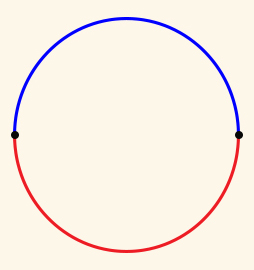
Let’s take a circle.
Notice that the two points in black on the outside that are directly opposite each other.
If you rotate the circle clockwise, or anti clockwise, then the two points will rotate relative to each other. And from the perspective of the centre of the circle, they will be moving in opposite directions.
Now, if you imagine the circle is the view of a Tai Chi practitioner in the video of rollback, but viewed from above, you can see that if they rotate around their centre then the parts of the body on the opposite sides of their circle will be moving in opposite directions.
Now, unless they are spinning constantly, they won’t keep this up for long in the same direction, but it will be happening continually throughout a Tai Chi form, just in different directions and with different parts of the body.
So, while his left hand is rotating backwards to the left, clockwise direction, his right shoulder is moving equally forward to the right, still clockwise. They are the points on opposite sides of the circle. Obviously he then hits the limit of his rotational possibilities (without stepping) and stops.
Obviously Tai Chi is more of a sphere than a flat 2D circle, but hopefully the point stands and shows how circular movement around the centre point can produce power from the whole body.
Scott Park Phillips’s book on Martial arts is now available in paperback/Kindle. (I’m getting the Kindle version, being a cheapskate and all). I haven’t read it yet, but I’ve seen a condensed presentation Scott did based not the material and I therefore expect it to be well written, disruptive, controversial, and at the very least offer some mind-bending new perspectives on what martial arts really are (or rather, were). I also think he’s tapped into something very important with his premise that seems to be on the nail.
The premise is simply that martial arts, theatre and religion were once a single subject.
Fascinating stuff!
Click the “look inside” link on Amazon to read more.
Scott Park Phillips’s much anticipated film about the connection between Tai Chi and Chinese Ritual Theatre is finally here.
I met Scott last year, when he introduced me to his theory of Tai Chi as Ritual Theatre for the first time. His ideas were so ‘out there’ compared to the usual history of Tai Chi that I’d encountered, and his presentation so enthusiastic, that I found both him and his ideas fascinating, and I think you will too. As well as being a historian, he’s a performer and entertainer (and third-wave coffee drinker). He presents his ideas as such. I’ll never forget him spontaneously standing up in the pub and demoing his Chen style form walkthrough (during which he explained his Theatrical interpretation of the postures) for me, and the rest of the pub, whether they wanted it or not! 🙂
It’s hard to grasp these ideas in the written word, so I asked him at the time if he could put down his Chen style walkthrough, on video and he said he was already working on it. Well, it turns out he was, and he’s finished the video project! Here it is:
The video is professionally produced and does a good job of presenting his ideas (although I’d have liked some parts to be a little slower, as there’s so much to absorb). The parts about the Boxer Rebellion I found particularly interesting, for example.
I’ll leave you to decide what you think about his ideas, but personally I think he’s onto something, and (importantly) I don’t think we need to be threatened by these ideas as somehow undermining the seriousness or effectiveness of Tai Chi as either a martial art, a health-giving art, or as a vehicle for delivering internal power.
I can see how some will think that it detracts from the effectiveness of the art we have today, with retorts like, “I don’t practice a dance!” or “I’m not doing a ritual!”
I raised this issue with Scott myself, and his response was along the lines of ‘If you’re a serious martial artists who practices Tai Chi (that puts you in the 0.00004% of practitioners!) then I’d say it doesn’t matter – a skilled martial artists can use anything to make good training out of’. That’s not a direct quote, I’m paraphrasing from memory here. But logically I think he’s right – I don’t think it makes Tai Chi any less martial or any less effective if the ‘form’ that is being used as a vehicle to deliver Six Harmonies movement (to borrow Mike Sigman’s nomenclature) originally came from a theatrical ritual. Also, in the west we have a different association of the words ‘theatre’ than they do in China, where ‘theatre’ always had much more of a religious element. Everything arrises out of a culture, so it’s interesting to look back at the culture that Tai Chi arose out of. Academically there are already several good theories for why the Taoist Chanseng Feng always gets associated with the history of Tai Chi, from politics to spirituality, and Scott’s theory is just another to add to the pile. If you don’t want to add it to your pile, then don’t.
Remember, looking back into the murky origins of Tai Chi isn’t relevant to your actual practice today, or the subsequent direction Taijiquan went in, just keep on doing your thing. If you’re using Tai Chi form to practice fighting applications, or silk reeling, or to clear your meridians, etc, then you’re still doing just that.
Bruce Lee was onto something with his water analogies…
I recently read the phrase, “Don’t push the river, listen to it instead”, and it resonated deeply with me because it’s a great way of summing up my approach to jiujitsu’s rolling and tai chi’s push hands. The water analogy was famously used by Bruce Lee and also crops up a lot in the Tai Chi classics, for example “Chang Ch’uan [Long Boxing] is like a great river rolling on unceasingly.”
The flow of water is analogous to the flow of energy, or movement, when performing a Tai Chi form, or between two people engaged in a martial activity . In both jiujitsu and tai chi your ultimate goal is to ‘go with’ this flow in such a way that you come out on top. You want the opponent to be undone by their own actions.
In jiujitsu that might mean not using excessive strength to press home a collar choke from mount if your partner is defending it well, and switching to an armbar instead, then switching back to the collar choke (and hopefully getting it) when they defend the armbar.
In push hands it could mean not resisting your partner’s push and using Lu to let it pass you by, then switching to an armbar to capitalise on their over extension.
Of course, this is for when you’re engaged in the ‘play’ mode of both these arts, which is the mental space you need to occupy if you want to get better at either of them. This is the relaxed practice that nourishes the soul. It kind of goes without saying that in competition or in a self defence situation you’d be better off in Smash Mode. But when winning isn’t the only thing that’s important you need to open up your game a little and keep it playful. Or ‘listen to the river’ as the phrase has it. It takes a lot of expertise to be able to be that relaxed in a real situation, but as your experience in the art increase so too should your ability to remain relaxed under increasing amounts of pressure.
Rickson Gracie said, ‘you can’t control the ocean but you can learn to surf’ and that’s the heart of what I’m talking about.
To be aware of the way the river is flowing, and not waste futile energy pushing it in a direction it doesn’t want to go you need a degree of self awareness, and the ability to be aware of the situation you are in. And to get that you need to slow down and stay calm. Or, as the ancient Taoists said:
“Do you have the patience to wait
Till your mind settles and the water is clear?
Can you remain unmoving
Till the right action arises by itself?”
Lau Tzu, Tao-te-Ching
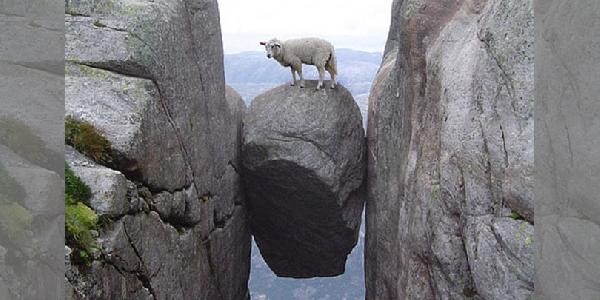
Forget the snake and the crane, Tai Chi is stuck between a rock and a hard place in the modern martial arts world, and it’s hard to see how it’s going to get out
Tai Chi, it is said, was created by the immortal Taoist Chang Sanfeng after watching a fight between a snake and a crane. Seeing the way the snake coiled and retreated to avoid the strikes of the bird’s beak he invented a martial art that relied on the ancient Taoist idea of softness overcoming hardness, and thus Tai Chi Chuan (‘Supreme Ultimate Boxing’) was born. Or so the story goes…
Obviously, you need to take all these origin stories with a hefty pinch of salt. I’ve talked about Chang Sanfeng before, and I’d like to do again at some point, because I think there’s more to say on the subject, but for now let me just point you to a couple of ideas that show the Yin and the Yang extremes of people’s views about him.
On the one hand there the pragmatic, logical, view, that Chang Sanfeng was a sort of Robin Hood-style character and his whole mythology was just a nice little story that people made up as a “made-to-order counterpoint to Bodhidharma” as the founder of Chinese martial arts, and later to hide and ostracise the true creators of Tai Chi, the Chen family of Chenjiagou village. This view is best expressed by Stanley Henning in his classic essay Ignorance, Legend and Taijiquan.
In these more enlightened times, the people who actually believe in the whole Chang Sangfeng story seem to be few and far between, but on the flip side of the coin you’ve got this intriguing point of view from Scott Park Phillips, expressed in his blog post on, Channelling Zhang Sanfeng. Phillips offers a fresh (or should that be old?) perspective on what the Chang Sang Feng connection with Tai Chi was really all about:
“Zhang Sanfeng was a ubiquitous figure in the late 1800s, not just because he was a popular trickster of the theater but because he was the subject of widespread spirit writing cults. Groups of literati would gather together and do a kind of ritual séance, in which they would write in the voice of Zhang Sanfeng.”
Sanfeng therefore becomes a part of the richer cultural world view you need to adopt to understand Tai Chi’s place in history.
Whatever the motives for bringing Chang Sanfeng’s name into the story of Tai Chi Chuan – whether to hide its humble origins amongst simple peasant folk, or as an esoteric way of connecting to a spirit cult, it’s pretty clear that he didn’t exist as a real person, all of which doesn’t bode well for selling Tai Chi as a serious marital art. To make matters worse, the Tai Chi world is full of lunatics and fakes. I’ve written about Tai Chi fakery before, and on the cult of the Tai Chi Magician who can fling his followers around with magic Qi blasts. Sadly, this is all par for the course for the Tai Chi world, and sadly for martial arts in general. It seems that the environment of the martial arts class is the perfect breeding ground for cult masters to recruit their willing followers. They’re everywhere in marital arts, and frequently exposed on YouTube.
I’m not going to talk about these sort of fringe behaviours this time. Instead I’m addressing the meat and potatoes of the Tai Chi world – those teachers who do their best to present an old martial tradition as a living, breathing martial art, and the problems that inevitably throws up in a world where MMA is starting to supplant boxing as the most exciting contact sport in the mainstream’s consciousness.
Where martial Tai Chi now stands
The dominant format for expressing martial arts in modern times, MMA, is generally composed of striking, grappling (with throws and takedowns) and ground work. If you want to look at where Karate fits into this then it’s easy – it occupies the striking segment of the venn diagram of MMA. Similarly, JiuJitsu can be found in both the grappling and ground work section. Tai Chi? It’s not so easy. It doesn’t fit neatly into the formulae. Tai Chi is a mix of standing grappling, locking, throwing and striking. The techniques flow interchangeably between the different stand-up mediums, but never in a way that makes sense to MMA.
As a training device Tai Chi uses Push Hands – a kind of limited rules stand-up grappling that is either done fixed step, or free step within an area. The rules for competition push hands are very, very restrictive. For fixed step, if you move your foot you’re ‘out’, and in free step, you just need to push your opponent out of the area. No strikes or locks are allowed, and there are various other rules restricting grabbing.
This is a typical example of a push hands competition. I’ve got to be honest, if an outsider saw that they’d wonder what on earth it was all about. To somebody with experienced of typical grappling competitions it also looks bizarre. The phrase “Well if you’re going to that then why not just learn proper BJJ/Judo/Wresting (delete as appropriate) instead?” springs to mind…
The problem is that compared to a grappling tournament under Judo, BJJ or Shuai Jiao (Chinese Wrestling) rules the whole thing is slightly on the ludicrous side, but the real problem is that this competition push hands doesn’t really have anything to do with what real Tai Chi push hands, and Tai Chi itself, is supposed to be about.
It’s contentious to say what is ‘real’ and what is not when it comes to Tai Chi, so I’m just going to go with my gut. There are basically two types of training in Tai Chi – training for self defence and training for developing the sorts of skills you need for Tai Chi. Let’s call these “Jin skills”. It turns out that ‘real’ push hands is supposed to be an exercise in learning Jin skills and not a sort of contest to find out who is the best at pushing somebody over (which is on the self defence side). Jin skills involve learning how to deal with an opponent’s incoming force using your Qi and Jin (I’ve blogged about what these terms means in martial arts before). To do this in a Tai Chi way requires you to repattern your body’s habitual way of moving, and not fall back on the way you usually move. The problem is that once you try to push somebody over and they resist, or you add a bit of competitiveness into the mix, that’s invariably what’s going to happen.
One notable teacher of internal arts once remarked to me in conversation that “So far I have never seen a video in which the westerner had even a remote clue how to do push-hands”… which brings me onto this video of Chen Ziqiang, which I think exemplifies the problem that Tai Chi is going to have if it’s going to make any impact on the modern martial arts scene.
Chen Ziqiang is the oldest son of Chen style master Chen Xiaoxing, and he is the nephew of Grandmaster Chen Xiaowang – therefore I think it’s safe to say that he knows what he’s doing. I’m not sure if the video is meant to be push hands, wrestling, or just freestyle playing around, but either way, he’s at a considerable size and weight disadvantage to his opponent, and suffers for it. So, does this mean that Tai Chi doesn’t work? Hardly.
The Chen-style of Tai Chi is famous for its ability to do damage by releasing power suddenly and for its joint-locks … but in a ‘push hands’ format where he can’t use either of his main weapons, Chen is going to be at a big disadvantage. I’m sort of surprised that he keeps allowing people to video his “push hands” matches, which always turns out to be some westerner trying his grappling skills against him. And I’m not sure how this format is going to persuade others that there is some martial skill that is worth perusing Tai Chi for? Why not just do western wrestling?
In short, I’m glad that Chen Ziquang isn’t adopting the usual unassailable mantle of a Tai Chi master who won’t actually get hands-on with students, but the downside of that is he’s going to be made to look very human against bigger people who have wrestling skills. If it is to convince people of the value of its Jin skills,and their use in martial arts, then I don’t know what the answer is, but this isn’t it. Tai Chi remains stuck between a rock and a hard place.
When we talk about Qi (Chi) in martial arts, what do we mean?
Chinese as a language can have meanings on different levels. The basic definition of Chi is ‘air’, but in terms of martial arts we’re talking about vital energy that’s intrinsic to the breath. If you put the word “Qi” into a Chinese/English translation you get all sorts of definitions, for different Chinese characters. So, to clarify the character we’re talking about is (in traditional Chinese)
It’s a bit like a picture of a pot of rice over a fire with steam rising upwards. In simplified Chinese it looks like:
Unfortunately, “vital energy that’s intrinsic to the breath” still doesn’t help much in terms of understanding what is meant by Qi when we talk about it in martial arts. The most practical way to understand what Qi is, is to take a look at Jin. You can think of Jin is the physical manifestation of Qi. When you manipulate your qi using your mind to do something, you manifest a direction of force in the body – and when the force can be expressed in a direction, without impeding it by tensing your muscles, so that it runs all the way from the feet to the hands, then that is Jin. So, if somebody pushes on your hand, you should be able to create a line of force from your foot to your hand (using your mind) that maintains your position, so that they are effectively pushing into the ground, not your hand. If you push on somebody’s outstretched arm and they feel really strong, like a rock, yet they’re not tensing their muscles then you could say they have “strong qi”.
In the following video Mike Sigman takes you though what Jin is, which should hopefully increase your understanding of what Qi is.
You can see that he’s talking about setting up pathways in the body – if you refer back to my previous post about basic silk reeling movement you can see how the two tie-in together.
We’re in a strange situation where the vast majority of people who “do Tai Chi” are performing some kind of elegant, slow-motion movement ritual, but without the required ‘internal’ body movement. There’s not necessarily anything wrong with this, as most of the benefits Tai Chi can give you – like relaxation, better breathing, suppleness, improved general health and flexibility – don’t really require ‘proper Tai Chi movement’. If you’re up and you’re moving then you’re doing your body more good than everybody left on the sofa. This is particularly important for the elderly.
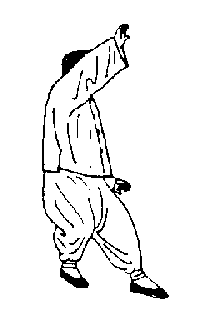
But what do I mean by ‘required internal body movement’? Well, I’m talking about how your body forms the posture of Tai Chi – the movement you use to get into the various postures and flow between them. By default everybody uses a kind of normal human movement – the sort you use when you reach for something in the cupboard, or when you are tidying up a room. You don’t think about it, you just do it. And it’s the same with performing a Tai Chi form. If you’re going to do White Crane Spreads Wings then one hand has to circle up, ending above your head, and the other hand has to circle down, ending near your hip. Like this:
The question is, how did the hands get there?
With ‘normal movement’ we just do it – our brain tells the muscles what to do and they do their thing, in the order and manner they’ve been working in since we were babies.
In Tai Chi we need to repattern the way our body moves to adopt the ‘internal’ model of movement. This involves creating a sense of connection from the toes to the fingers (like you’re wearing a suit), along which you can feel a slight stretch, and then keeping this stretch as you move, while powering and controlling the movement from the dantien and legs, not from the shoulders. In fact, the shoulders shouldn’t be actively doing much at all – they should act as conduits for power, not generators. There are other additives that are used to generate movement, but those are the basics.
It’s a lot easier to practice this sort of movement in a simple controlled way than it is to jump in at the deep end with a Tai Chi form and all the variation it offers. To help you do this, people have created are what have become known as “Silk reeling exercises”.
There are a ton of these on the Internet to watch and follow along with, but like most things of that nature, it’s not the exercise that’s the important thing, it’s how you do the exercise. Luckily, Mike Sigman has recently produced a couple of new videos that not only show the exercise, but also show how you are supposed to do them.
Take a watch, try them out, then see if you can repattern the way you are moving in your Tai Chi form.
Unfortunately, it’s hard to talk about Silk Reeling without getting into some of the style wars within Tai Chi. Silk Reeling is often though of as the preserve of Chen style Tai Chi, and that in other styles of Tai Chi they do something else. You can do you own research on the matter, but the conclusion I’ve come to is that all the various ‘tricks’ that you learn in Tai Chi (like bows, or rotation or sinking and rooting) are all different facets of silk reeling, and you can therefore save yourself a lot of time by just adopting the model wholeheartedly.
Here’s a link to an article on the Yang Family website extolling the virtues of silk reeling and why it’s so useful. I’ll leave you to draw your own conclusions about why it’s up there.
As it says in the article:
“We need to understand the requirement to ‘link everything together’. Not only does moving energy require going through all the joints, it also needs to be sent through the muscles and sinews above and below the joints. This is the function of spiralling silk reeling.”
So, to return to the aforementioned Crane Spreading its Wings – this is how you get your hands to circle up and circle down. Now you just need to go and practice it.






 The Tai Chi Notebook