Paul Brennan has added a new selection of translations to the martial arts manuals contained on his website. This one is Chen Ziming’s “The inherited Chen family Taiji boxing art”.
Sample quote:
My colleague Chen Ziming is a native of the Chen Family Village in Henan and an expert of the Taiji boxing art. After many years of painstaking effort, he has written The Inherited Chen Family Taiji Boxing Art. A month ago, he begged me to proofread it and also to produce a preface. I read it carefully over the course of two weeks and could not help but slap the table in amazement. The Taiji boxing art is truly a means of connecting to the Way, which cannot be said about most other boxing arts. But unless you achieve a high level, you will not be capable of discussing its essentials.
This art as it is taught in modern times can be divided into about three styles: [1 – Chen] Chen Style Taiji is in a direct line of descent from the Chen family in Henan. [2 – Hao] Hao Weizhen taught Sun Lutang what is called “Open & Close Taiji”, but Hao Style was obtained from Wu Yuxiang, who had learned Chen Style. [3 – Yang] The Taiji that Yang Luchan studied was likewise taught to him by a member of the Chen family, Chen Changxing, and then Luchan taught it to his own sons, Banhou and Jianhou, and to this day his version is in fashion everywhere. All three of these versions actually originated from Chen Style. They have each evolved and been improved, and so they each have their differences.
It says in the Tai Chi classics that the movements of Tai Chi should be continuous, like a rolling river:
“Chang Ch’uan[Long Boxing] is like a great river rolling on unceasingly.”
There are a few interesting things to unpack about this quote, taken from the Tai Chi Classic attributed to Chang San Feng. Firstly, it doesn’t call the martial art “Tai Chi Chuan”, instead it calls it “Long Boxing”, which is yet another indicator that what is known as the “Tai Chi Classics” are in fact, just a collection of common sayings about martial arts of the time that have been bundled together.¹ I tend to regard what we know as “Tai Chi Chuan” today, in all its various forms, as the modern expression and amalgamation of older Chinese martial arts; it is an evolution of ideas and techniques, rather than a ‘new’ martial art which was invented in a moment of divine inspiration by somebody having a dream about a Crane fighting a Snake, which is one of its apocryphal origins myths.
Secondly, the image of water harks back to ideas of Taoism, which uses water imagery frequently in its depictions of worldly affairs. The imagery of a river is a good one. And the implication is clear: no stopping. Continual movement.
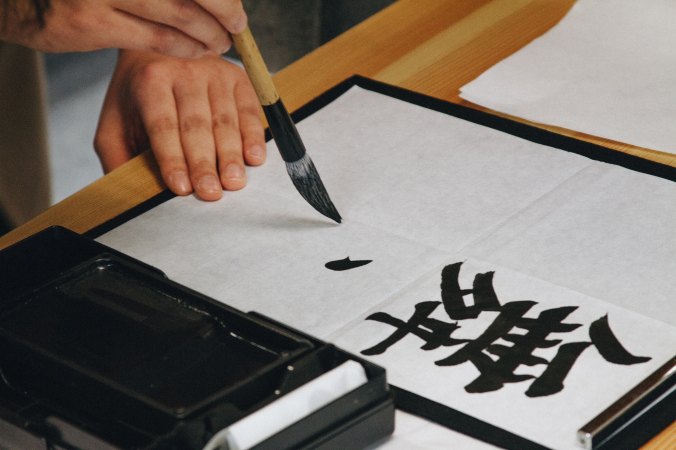
Quite often people who think they are doing a Tai Chi form continuously are not. They’re putting in little stops at the end of movements. My teacher called this “posturing”. A good performance of a Tai Chi form will smooth out all these end points so that the form becomes like a single stroke of a calligrapher’s brush on a canvas.
When approached this way, the Tai Chi form stops being composed of numbered moves which are separate elements. As human beings we’re so ingrained in this type of thinking that we even classify Tai Chi forms with numbers on the end. E.g. the “The Tai Chi 24-step form, the Chen style 48 form, the Yang style 108-posture form, etc..” with the number indicating how many different postures there are in the form. When you do the form as ‘one stroke of the brush’ then the whole form becomes one move from beginning to end. Sure, you move from close to open to close to open, and so on, continuously within the movement, but there is still only one movement.
But why? Well, in terms of aesthetic value, it’s definitely more pleasing to the eye to see somebody who moves like this, but that’s not the only reason. In terms of martial technique, the ability to flow smoothly between techniques is key to being able to respond adaptively to whatever the opponent is doing. If you’ve never put the time into practicing movements smoothly you can’t expect to just pull that skill out of the bag when required.
Another reason is that it’s much easier to learn to coordinate your arms and legs if you can move at a constant rate. It gives you the mental space you need to slow down (which is a whole principle in itself) and become more aware of the movements you’re doing, rather than rushing through them, which creates mental blank spots you may miss.
You need to approach continuity as a task that is going to take you a while to complete. As you do the form become aware of where you’re losing awareness and continuity. Has a hand stopped moving here? An arm become immobile there? Did you pause for a fraction after completing Brush Knee Twist Step? (Here’s a hint, you probably did).
If you make continuity the focus of a complete run through of the form then over weeks and months you can get to the stage where your movement becomes very smooth and even. Now you’re ready to look for a deeper meaning. Consider the aforementioned river – it moves continuously, in that it never stops, but different parts of it move at different rates. Where the river narrows rapids form, where it flattens out the pace is more genteel. The form is like this too. There are faster bits and slower bits – quite obviously in Chen style, but also in the even-paced Yang styles. Let the movements guide you – they’ll tell you where you should naturally ‘go with the flow’. Now your techniques will start to become more realistic and you’ll be able to appreciate the type of movement required to make them work.
“Don’t put power into the form let it naturally arise from the form.”
A guy on a discussion forum called Wayne Hansen uses that quote in his signature. I don’t know if this is a famous quote from an old master, or if it’s just something that Wayne thought of himself, but it’s such a great quote, because it’s absolutely true!
I was reviewing somebody’s form recently and the big thing I noticed was that they were trying to put power into the movements, rather than just accepting that the movements on their own are powerful, and don’t need anything extra to make them work. In fact, when you try and make Tai Chi movements powerful, it just messes them up, because you inevitably revert to tense, upper body muscle use, instead of a smooth flow of connected power, talked about in the Tai Chi classics.
(I think I should mention here that I’m not talking about the explosive bursts of power you typically see in Chen style forms. These are different. Instead, I’m talking about the general movements found in Tai Chi, typified by Yang style and it’s variations, which opt for a smooth form with an even pace throughout).
What that quote doesn’t do however is explain how Tai Chi is done, which is pretty standard in Chinese martial arts. Tai Chi is full of these mysterious sayings, which have very little explanation, and are only useful for people who already understand what they mean. So let’s break this one down and see where we get, starting with:
1. Fang song
In Tai Chi we are frequently admonished to fang song or “relax” as we would say in English. We all instinctively know that a relaxed body can be a powerful body. Think of how heavy a small child can make themselves if they don’t want to be picked up by going all floppy. Similarly, a baby’s grip is surprisingly powerful, but not tense.
Being too tense results in a kind of rigid and brittle strength. It’s strong, but it sacrifices flexibility. This sort of force tends to lie on the surface, like ice on a lake, but break through the surface and it’s nothing but water underneath. In contrast, relaxation can be more like thick sea ice – strong and solid all the way down.
But to be both powerful and relaxed a body also needs to be:
2. Coordinated
On a purely mechanical level that means moving so that the coordinated power of the body arrives together at the same place at the same time. If you can coordinate your body so the legs, hips, torso, and arm are all arriving together in a unified purpose then you can use relaxation to create a kind whole body power that doesn’t rely much on tension at all. But that’s still not the whole story. You also need:
3. Sinking
The next stage is to get used to sinking into the movements. This sinking, which can be described as dropping the weight of the body down into the ground through relaxing, enables power from the ground to rebound up into the hands. It generally moves in an upward and outwards manner, which is the Peng Jin that Tai Chi is famous for. All the movements of Tai Chi need to contain this Peng Jin.
I often read people who criticise sinking as merely “pushing from the legs”. They say that this will just be too slow. To that I’d say, go and ask a boxer if his punches are too slow, because that’s what a boxer does. But more importantly, that’s not what I’m talking about.
It’s true, the legs are very much involved in generating power from the ground, but when you can effectively drop your weight down it’s not a physical movement of pushing from the legs that matters. It’s the internal movement of power that is important, the jin. And the power of the ground arrives in your hands instantaneously, so there’s no delay. It’s not going to be too slow to use.
Once you get used to doing this sinking you can feel it in your form. It requires practice, probably daily practice to get it. But that’s why you do the form every day, right? Every day you are practicing movements where you drop the weight and put the power of the ground in your hands.
Remember, the movements themselves are powerful – you don’t need to add power in. Instead you need to learn to relax, coordinate and sink your ‘energy’.
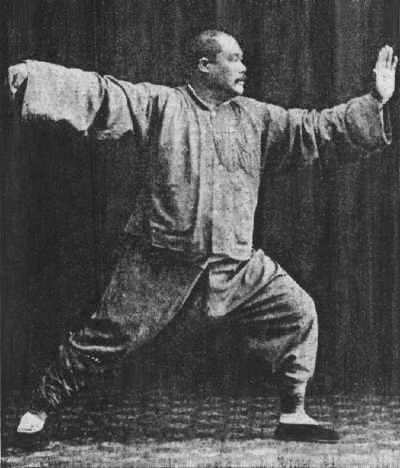
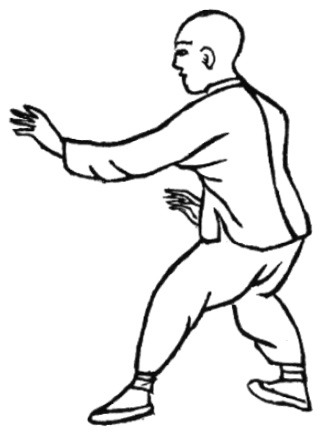
Just look at that picture of the famous Yang style Tai Chi teacher, Yang Cheng Fu. You can see how relaxed he looks and how his weight is sinking down.
I was reading through this excellent interview with Matthew Polly, author of American Shaolin, (a book which has somehow has escaped my bookshelf – a situation I should rectify promptly), when I came across this video of a man performing Chang family Xiao Luohan in a rural village in Henan.
It’s a great little video for a number of reasons. The first is that this is something old and precious that is in danger of dying out as people lose interest in WuShu in modern life. The second is the authenticity of the presentation – it really does look like a rural villiage where he has lived all his life. The third is – it’s a really good performance!
These are the sorts of “old school” martial arts skills that are in danger of dying out in China. To quote from the Matthew Polly interview above:
“As I mentioned in American Shaolin, the idea of chī kǔ (吃苦 ), eating bitterness, is central to the Chinese understanding of learning martial arts, and the value of suffering. And the way in which that contrasts with the western idea of trying to avoid pain in any way. We have an entire society built around the idea of alleviation of pain. We have an opioid crisis because we’re trying to avoid all sorts of pain. I admire progress and evolution in the way mixed martial artists do, but I have a nostalgia and sentimentality for tradition and the way that old man practised the same form for 60 years. There’s something beautiful about that and a sadness in seeing that wiped away as MMA goes like a bulldozer through the traditional kung fu and karate world.”
Chang family boxing is one of the precursors to Taijiquan, at least in terms of martial arts theory, although there are several similar postures to Chen Taijiquan found in its boxing sets, so the connection may be more literal than just in terms of theory.
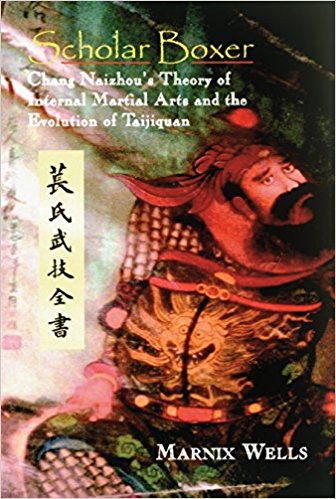
I think research into Chang family boxing would reveal more about the origins of Taijiquan than wondering if it was Taoist. Luckily this research has already been done by Marnix Wells in his book ‘Scholar Boxer: Cháng Nâizhou’s Theory of Internal Martial Arts and the Evolution of Taijiquan‘. Again, another shocking omission from my bookshelf, but by all accounts, this is a very deep piece of research. According to Jess O’Brian (author of Nei Jia Quan: Internal Martial Arts) – “For those interested in the theory, history and practice of the internal martial arts, this book is going to blow your mind.”
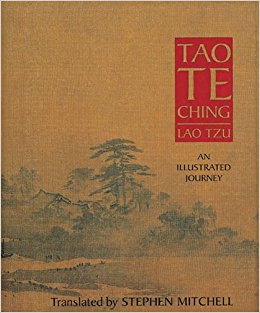
I was giving the Tao Te Ching the cursory glance I occasionally give it recently. I’ve got the copy shown above. I usually flick to a random chapter, read it three times and ponder it deeply. Well, as deeply as I am able to. I landed on chapter 61, and the next day I landed on chapter 8. These two seemed to be linked in theme, so I thought I’d say something about them.
Incidentally, I really like the Stephen Mitchell translation. I’ve no idea how accurate it is compared to the Chinese, but all translation seems to involve some interpretation, and I like the way he’s done it.
Here’s chapter 61:
61
When a country obtains great power, it becomes like the sea: all streams run downward into it. The more powerful it grows, the greater the need for humility. Humility means trusting the Tao, thus never needing to be defensive.
A great nation is like a great man: When he makes a mistake, he realizes it. Having realized it, he admits it. Having admitted it, he corrects it. He considers those who point out his faults as his most benevolent teachers. He thinks of his enemy as the shadow that he himself casts.
If a nation is centered in the Tao, if it nourishes its own people and doesn’t meddle in the affairs of others, it will be a light to all nations in the world.
and chapter 8:
8
The supreme good is like water, which nourishes all things without trying to. It is content with the low places that people disdain. Thus it is like the Tao.
In dwelling, live close to the ground. In thinking, keep to the simple. In conflict, be fair and generous. In governing, don’t try to control. In work, do what you enjoy. In family life, be completely present.
When you are content to be simply yourself and don’t compare or compete, everybody will respect you.
So, firstly let’s look at the imagery of water, one of the classic symbols of the Yin side of the Taiji diagram. Both chapters use water as a metaphor for the correct way of acting or being in the world. It’s a theme that repeats through the Tao Te Ching, and also throughout the history of Asian martial arts, even in modern times. I’m thinking of Bruce Lee in the infamous interview where he says “Be water, my friend!”
I was reading another article about Wing Chun today by Ben Judkins, which also expanded upon this idea of softness overcoming strength, and how this idea has permeated Asian martial arts:
Early reformers in martial arts like Taijiquan (Wile 1996) and Jujitsu sought to shore up their own national identities by asserting that they brought a unique form of power to the table. Rather than relying on strength, they would find victory through flexibility, technique, and cunning (all yin traits), just as the Chinese and Japanese nations would ultimately prevail through these same characteristics. It is no accident that so much of the early Asian martial arts material featured images of women, or small Asian men, overcoming much larger Western opponents with the aid of mysterious “oriental” arts. These gendered characterizations of hand combat systems were fundamentally tied to larger narratives of national competition and resistance (see Wendy Rouse’s 2015 article “Jiu-Jitsuing Uncle Sam” Pacific Historical Review, Vol. 84 No. 4, November, pp. 448-477).
but as the author notes, the situation is often muddied
Shidachi appears to have had little actual familiarity with Western wrestling. It is clear that his discussion was driven by nationalist considerations rather than detailed ethnographic observation. And there is something else that is a bit odd about all of this. While technical skill is certainly an aspect of Western wrestling, gaining physical strength and endurance is also a critical component of Judo training. Shidachi attempted to define all of this as notbeing a part of Judo. Yet a visit to the local university Judo team will reveal a group of very strong, well developed, athletes. Nor is that a recent development. I was recently looking at some photos of Judo players in the Japanese Navy at the start of WWII and any one those guys could have passed as a modern weight lifter. One suspects that the Japanese Navy noticed this as well.
But while the idea of the soft overcoming the hard has already fallen to the level of a cliché, especially when it comes to martial arts, and mixed with political ideas, should we ignore it as a way of being in the world? I’d say not. It does point to a truth.
Anyone with any familiarity in martial arts is aware of the feeling of having to ‘muscle’ a technique to make it work, as opposed to executing a clean technique based on good leverage. This points towards what I think these chapters of the Tao Te Ching are talking about.
When it comes to Tai Chi one of the hardest things to grasp about the techniques exemplified in the forms is that they shouldn’t necessarily feel powerful to you as you do them. My teacher often uses this phrase: “…if you feel it then they don’t – you want them to feel it, not you“.
If you can give up the need to control and struggle with a situation, then you can relax and access your own inner power. See what acliché that statement sounds like already? It sounds like one to me as I wrote it, but I guess all cliches were probably based on something real, otherwise, they wouldn’t be acliché.
In Chinese martial arts that sweet spot between doing and not doing (to bastardize some more Taoist terminology) is called Jin. I’ve written a bit about that before:
Paul Brennan of Brennan Translation has completed a new work, that’s worth a look if you’re a XingYi practitioner. It’s called “The teachings of Li CunYi on XingYi’s 5 Elements“, which are said to be the oral teachings of the famous XingYi boxer, Li CunYi as recorded by Du Zhitang of Guangzong [in Xingtai, Hebei]. There’s no date on the manual, but 1916 is a good guess.
The manual covers the 5 Elements of XingYi (Pi, Zuan, Beng, Pao and Heng) together with a “continuous boxing set”, which is a linking form, where the techniques are linked together in one continuous flow.
The linking form presented in the book is very close to this one:
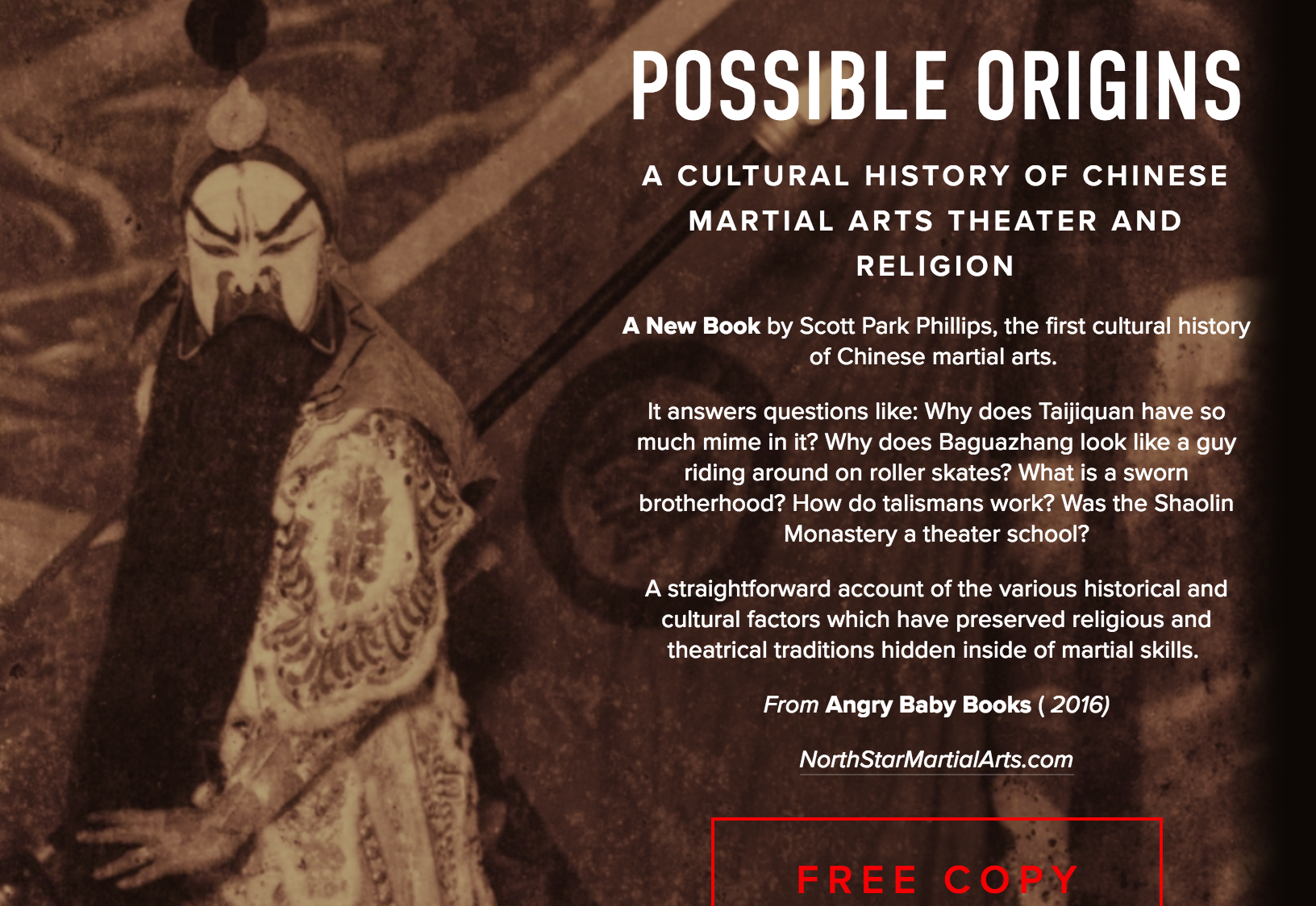
Scott P. Phillips’ book about the origins of Tai Chi Chuan, Possible Origins, is free in digital format for the next 5 days, so make sure you get yourself a copy!
So far I’ve only done a part 1 review, but I’ll do part 2 soon (I promise!). As you can see, I think it’s worth your time.
In his chapter on silk reeling, in the book on Chen Style Tai Chi Chuan (1963) (A snip at only 828 pounds on Amazon in the UK!), Shen Jiazhen writes:
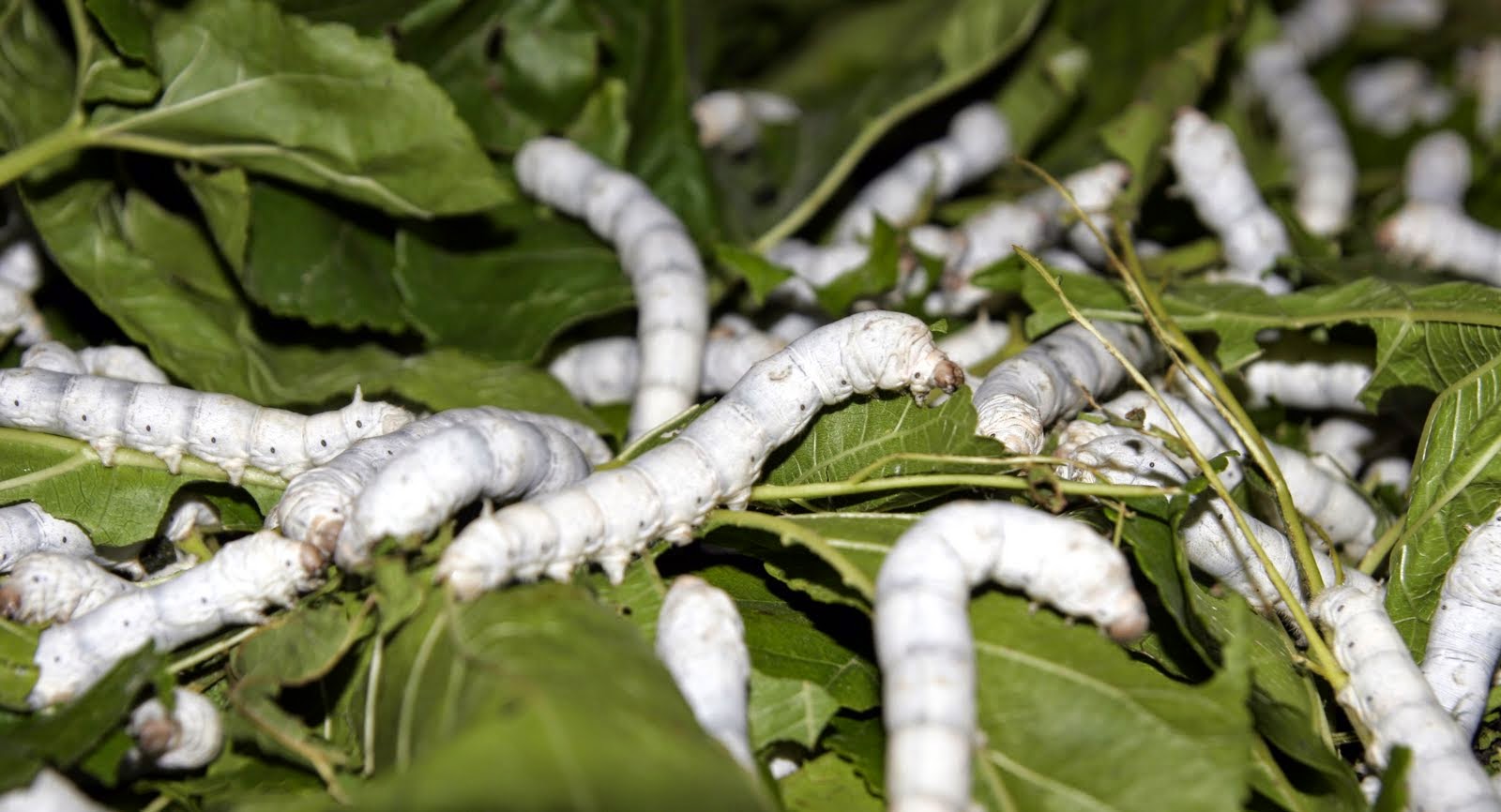
…Tai Chi Chuan movements must be in a shape like pulling silk. Pulling silk [from a cocoon] is done by a circular motion, and because it combines pulling straight and circling, naturally it forms a spiraling shape, which is the unification of the opposites of straight and curved. Silk reeling energy or pulling silk energy both refer to this idea. Because in the process of unreeling, extending out and pulling back the four limbs likewise produce a sort of spiraling shape, therefore the boxing manuals say that whether in large, extended movements or compact, small movements, one must absolutely never depart from this type of Tai Chi energy which unites opposites. Once one has trained in this thoroughly, this silk reeling circle tends to become smaller the more one practices, until one gets to the realm where there is a circle but no circle is apparent, at which point it is known only by intent. 1 This is why the third characteristic of Tai Chi Chuan is that it is an exercise which unifies opposites with silk reeling, both forward and backward.
Thanks to Jerry K for the translation. If you’re interested he’s also translated other chapter of the book – like this one on Empty and Full.
With this in mind I thought it would be beneficial to investigate exactly how silk is pulled from a cocoon. The Chinese have cultivated silk worms for more than 5,000 years. Here’s video showing how silk is cultivated today in Shanghai:
Like any industry, silk production has been automated, but you can still see how people did it using a hand reeling machine in some parts of China:
I’m guessing that the initial spiralling action of her hand she uses to get the starter threads off the brush is where the analogy starts to happen with what you’re doing in silk reeling exercises in Tai Chi Chuan? It reminds me of the way you can play with an elastic band in your hand. With 5,000 years of silk production in China I’m pretty sure the hand reeling machines would have existed at the time Chen style was creating these exercises, some 300-odd years ago, but without a machine then you’d have to be doing it with your hands in that manner.
Either way, I don’t think the silk worm gets out of this alive 😦
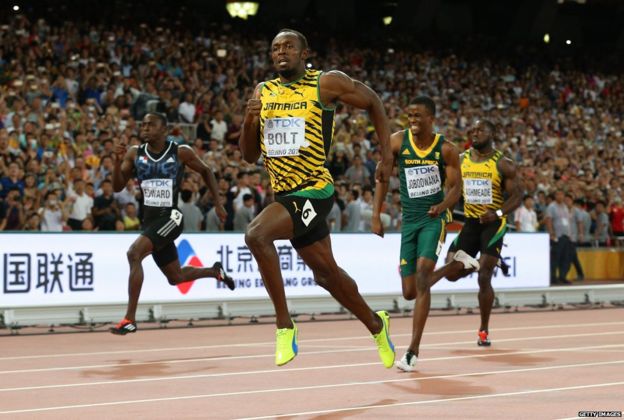
I ran (ha!) across this article by Sam Wuest, thanks to the Steve Morris Facebook page. It’s a really interesting look at how Usain Bolt is the fastest man alive despite not conforming to accepted wisdom on running mechanics.
It turns out Mr Bolt makes clever use of waist rotation when he runs, in contrast to the normal admonitions to reduce rotational movement and increase forward and back movement you’ll get from a lot of running coaches. By turning his waist in coordination with the running motion Mr Bolt is creating a longer lever to the floor, and everybody knows that longer levers create more power than shorter levers over the same distance.
There’s a famous line in the Tai Chi Classics that goes “The waist is like the axle and the ch’i is like the wheel“. At one point in the article, Sam Wuest says
“The rotation of the waist/pelvic region is like the turning of a wheel on an axle. The hip joints are rotating around the imaginary centerline of your body parallel to your spine at about the elevation of the sacrum. It is not a perfect rotation, as the free leg hip will come through higher than the support leg’s hip if the lateral chain is firing correctly. Perhaps it would be better described as a rolling rotation. Which brings us to reason #2 of why this piece of technique is important.”
Sounds familiar, doesn’t it? Reason #2 is interesting too:
Reason #2: Better Muscle Sequencing/Activation
Often, those that rotate better whilst sprinting will look smooth and relaxed. Their strides won’t just look longer, they’ll look more relaxed. Think of Carl Lewis’ famously effortless stride. This is how we are designed to move – the center moves first, then the extremities follow, much like a whip.
The muscles around the pelvis have high muscle-to-tendon ratios (force producers) while the extremities have relatively much more tendon and elastic structures (force amplifiers). In a correctly aligned body, a small movement of the waist can produce large amounts of force elsewhere in the body.
This sounds awfully close to the Tai Chi idea of the dantien as a nexus of muscular and tendon power in the body.
As somebody interested in muscle tendon channels and their effect on movement and silk reeling exercises from Tai Chi I can see the correlation here. Tai Chi uses the same principle of movement coming from the centre (the dantien) and that controlling the movement of the extremities through elastic tissue. We usually think of this sort of movement as having to be learned, rather than occurring naturally, however it appears to be exhibited in high-level athletes, as we see in the article linked to above. Are they just naturally doing it? Have they tapped into the way the body is designed to move? Have they stumbled upon it, or have they had to learn to move this way on purpose?
“Hagakure is the essential book of the Samurai. Written by Yamamoto Tsunetomo, who was a Samurai in the early 1700s, it is a book that combines the teachings of both Zen and Confucianism. These philosophies are centered on loyalty, devotion, purity and selflessness, and Yamamoto places a strong emphasis on the notion of living in the present moment with a strong and clear mind.”
Not being too familiar with Japanese writings I hadn’t come across this book before, but it was brought to my attention by a quote I stumbled across that I really liked:
“There is something to be learned from a rainstorm. When meeting with a sudden shower, you try not to get wet and run quickly along the road. But doing such things as passing under the eaves of houses, you still get wet. When you are resolved from the beginning, you will not be perplexed, though you still get the same soaking. This understanding extends to everything.”
The book seems to be full of pithy, simple, wisdom like that.
I’m not familiar with which translation is the best – probably one you can buy on Amazon since that’s usually the way things work – but there’s certainly a free version of the book you can read here.



 The Tai Chi Notebook