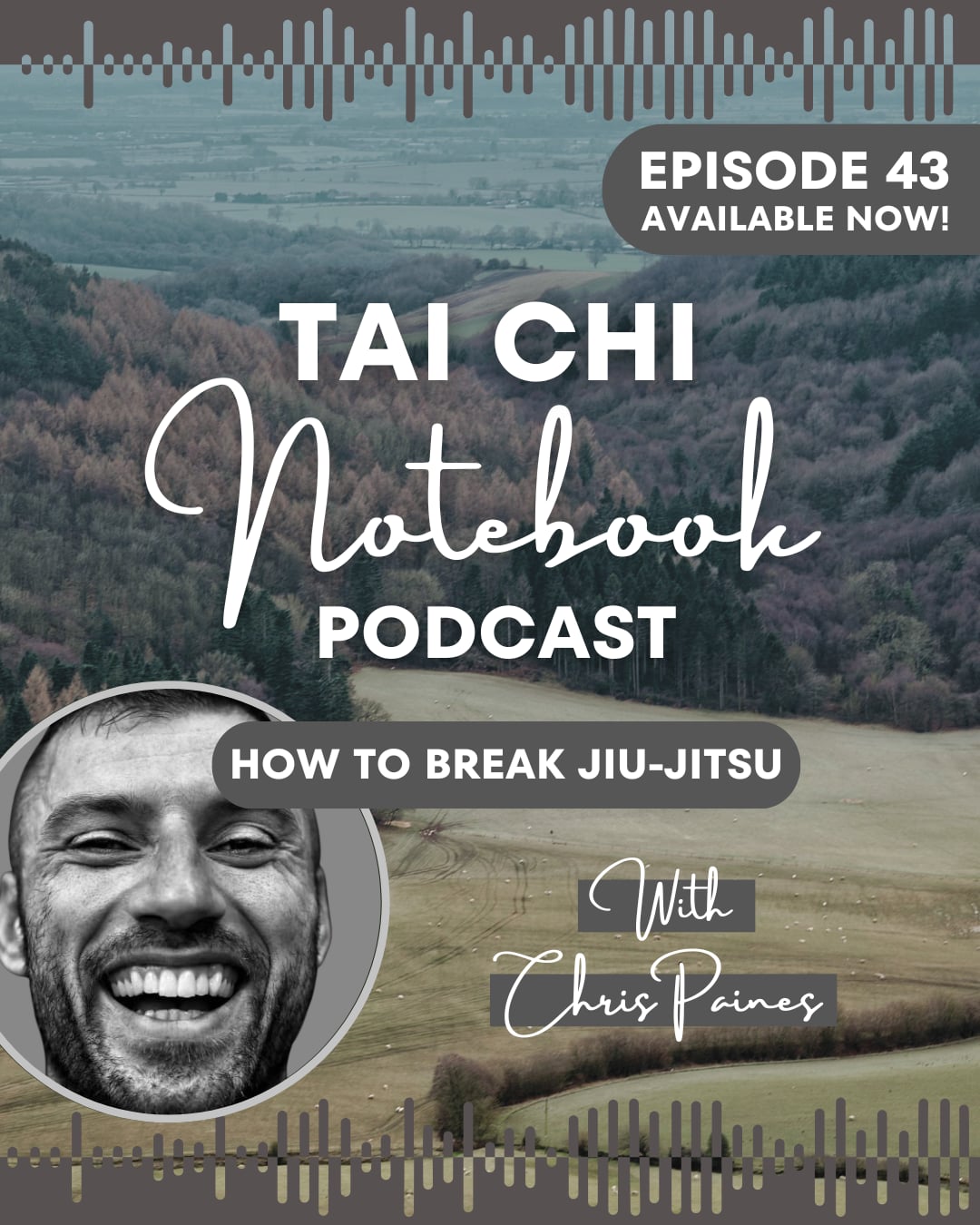
In this episode of the Tai Chi Notebook Podcast I’m joined by Chris Paines, a BJJ black belt from Staffordshire in the UK.
Chris gained a level of fame in the BJJ world for a seminar he taught at a BJJ Globetrotters camp called “How to Defend Everything”, which was wildly successful, especially when that seminar went on YouTube. It got over 100,000 views.
Chris has gone on to develop a system for teaching Jiu-Jitsu that he calls Elements and which can be found on the BJJ Fanatics website under the name ‘Strategic Guard Passing and Pinning’.
You can also subscribe to Chris’ Patreon which is called In Theory BJJ. I’ve known Chris for a few years now and rolled with him and attended his seminars a number of times and I’ve always found his ideas original, innovative and inspiring.
Every year, a BJJ celeb sounds off about how the gi* is dying and no-gi is the future. And yet, the death of the gi never actually happens — and I don’t think it ever will.
While the pro scene screams “no-gi future,” the average BJJ practitioner is still tying their belt every night. Here’s why.
If you only watch professional BJJ, you’d be forgiven for thinking the gi is already dead. But it’s a mistake to confuse what we watch with what we actually do.
Take my own academy as an example: we run roughly twice as many gi classes as no-gi. That’s driven by demand, not coach preference. Not every gym is the same, but I don’t think this is unusual — at least not in the UK.
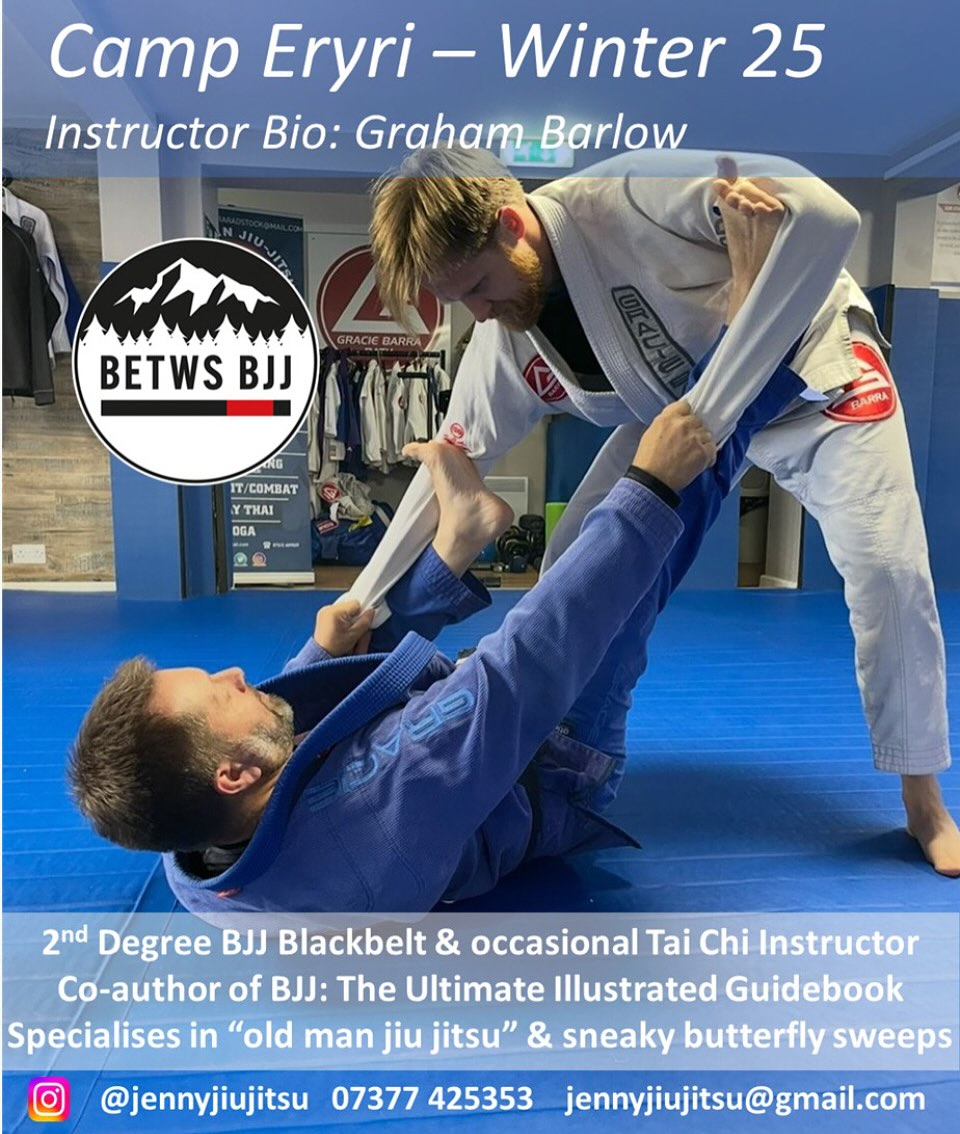
Last year I went to Camp Eryri, a BJJ training weekend in North Wales. There were workshops in both gi and no-gi, but when it came to open rolling, most people chose to train in the gi. The majority of workshops leaned that way too.
Sure, no-gi dominates pro events, streaming, and social media clips. But the gi still dominates hobbyist practice, traditional gyms, and the belt progression culture that keeps people coming back. So why is that?
Why no-gi looks like the future
You often hear that the gi is boring to watch, but I don’t think that holds up. When a gi match appears on a Polaris card, it’s often one of the most engaging fights of the night.
And no-gi isn’t immune to the same problems. Matches can devolve into long stretches of unproductive stand-up, followed by a last-minute scramble or leg lock exchange that feels more like a coin flip than a conclusion.
Let’s be honest: no-gi dominates the pro scene partly because it looks better—more athletic, more modern, more like MMA. Tight rashguards, visible physiques, more tattoos, faster scrambles—it’s easier to sell and easier to package.
With fewer grips, it’s also theoretically easier for casual viewers to understand. There are also supposed to be fewer opportunities to stall—again, in theory. In practice, anyone who’s watched recent ADCC trials knows that stalling is alive and well in no-gi too.
No-gi also benefits from crossover appeal. Wrestlers and MMA fighters can step in more easily, and if BJJ ever pushes for Olympic recognition, the argument tends to favor no-gi.
But the gi isn’t going anywhere.
Belts still matter in BJJ, and people value the sense of progression that comes with them. It’s addictive. It gives structure. It connects you to the history of the art.
Then there’s the technical depth. The gi adds layers—grips, controls, positions—that appeal to the more analytical side of training.
And perhaps most importantly, the gi is still the default language of BJJ worldwide.
I understand why some people prefer no-gi. The gi can be tough on your fingers. It can be frustrating when someone neutralizes your athleticism using your own clothing. And yes, there’s a lot of laundry.
But I don’t mind the laundry. I like having a few clean layers between me and my opponent. It feels more hygienic, and less like I’m stepping into a low-level germ warfare experiment every time I train.
In competition, both styles can be boring. The real issue isn’t the uniform — it’s the rule set.
No-gi will probably continue to dominate the professional scene. The gi will continue to dominate everyday training. And that’s fine.
We haven’t stopped training in the gi—we’ve just stopped paying attention to it.
(* If you’re new to BJJ: the gi is the traditional uniform, similar to judo, while no-gi typically involves a rash guard and shorts.)
It’s a bit annoying that there is clearly something wrong with my microphone, but it is what it is. (At least the video version below has subtitles!)
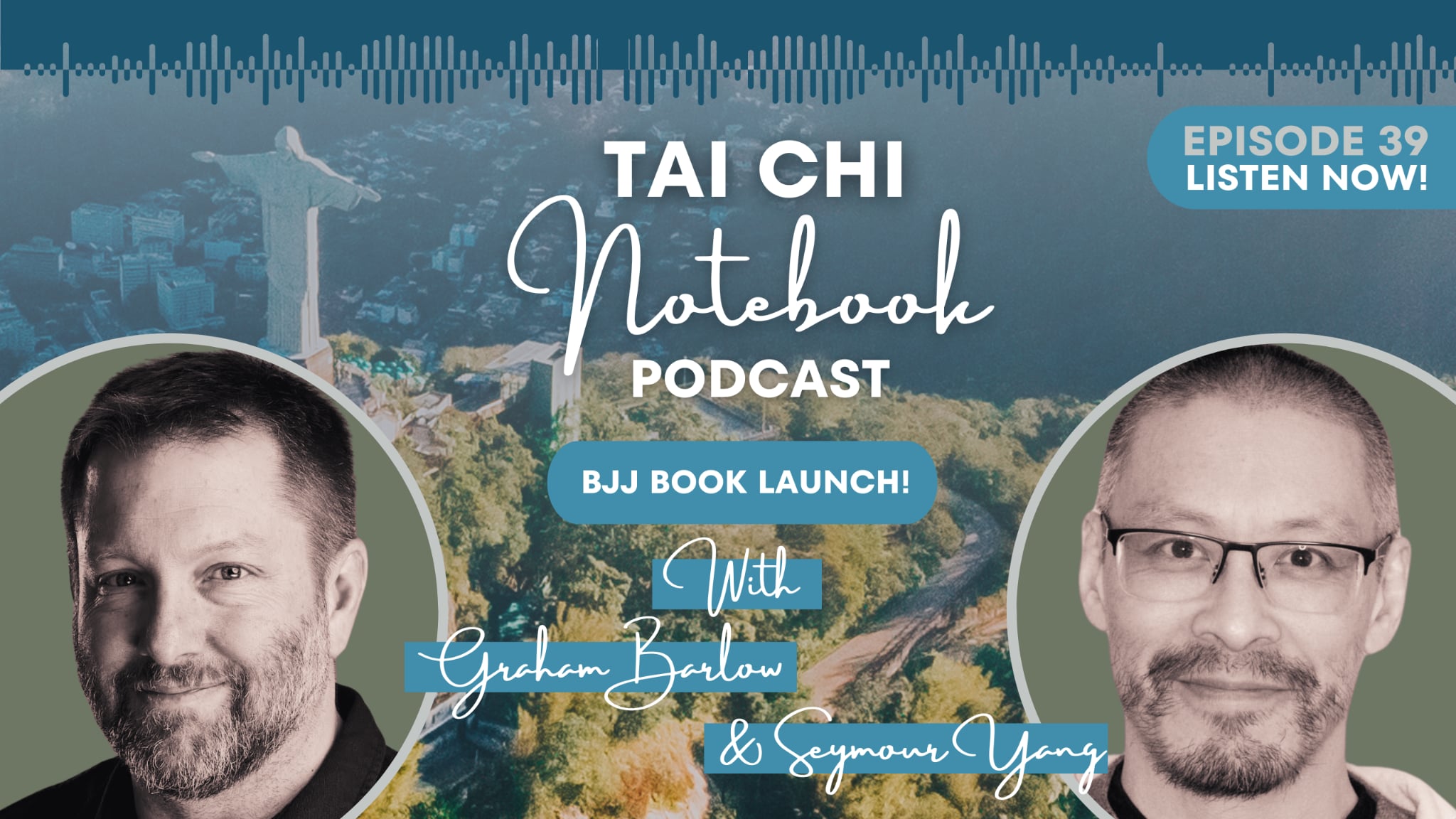
I manged to talk about my BJJ book, what tai chi and Chinese martial arts can bring to Brazilian Jiu-Jitsu training and some thoughts on different ways of learning and training.
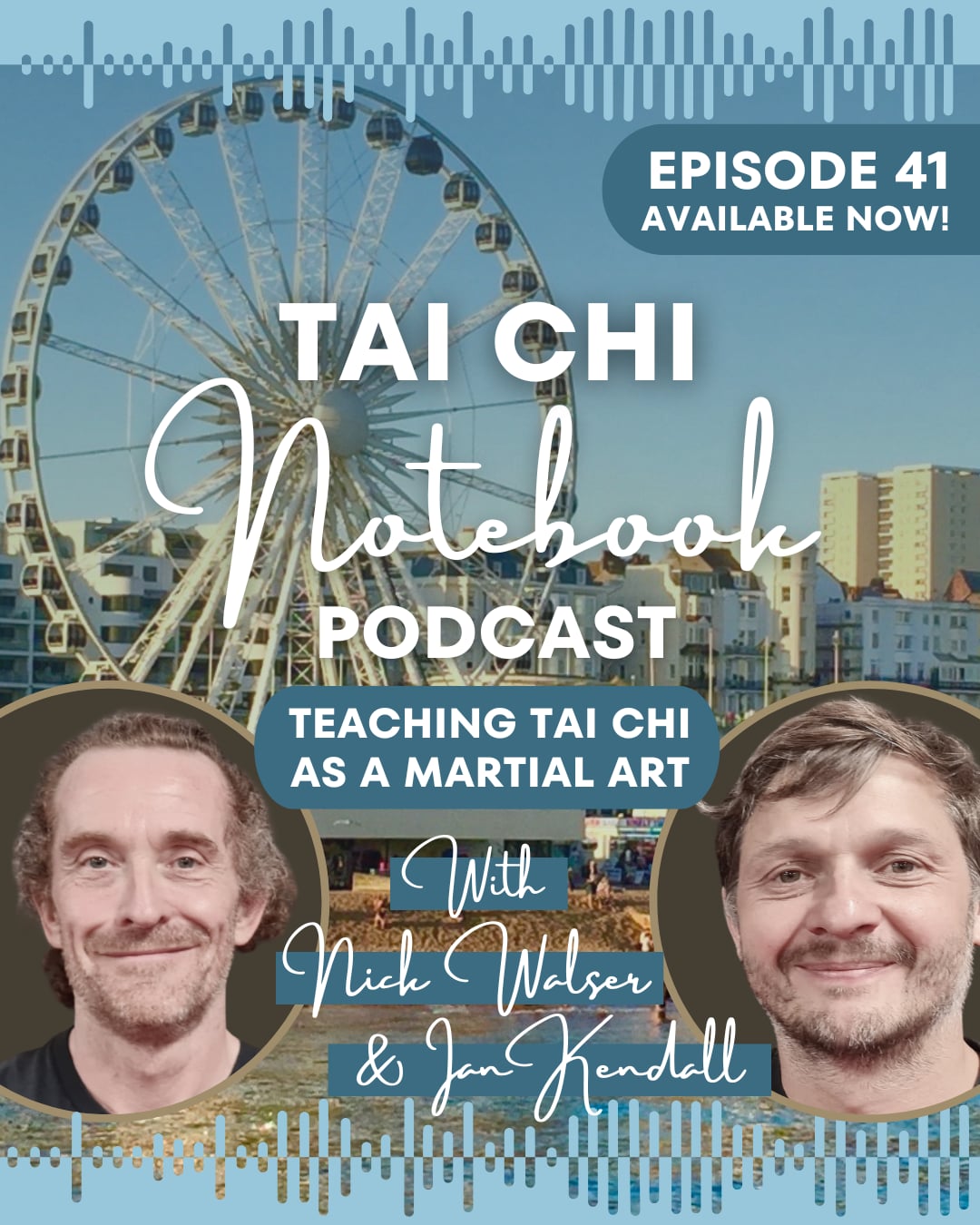
In this episode I talk to two Wudang Tai Chi teachers from Brighton, UK: Nick Walser and Ian Kendall. Both students of the late Dan Docherty, they have continued to practice the tai chi that Dan taught them and developed a new training system called 5 Snake.
5 Snake is a unique and powerful method for finding flow, resilience, and calm through partnered close- quarter practice, and they’re here to tell you all about it.
“An intangible and lively energy lifts the crown of the head.”
One of the things I often notice about my rolling partners in BJJ is that when they’re passing guard, they’re too easy to pick apart and attack because they let their spine bend by allowing their head to drop. As soon as this happens, I can attack their limbs easily because they’re suddenly not as strong. The spine is an integral part of the structure of our body, and when it’s not properly aligned, we’re weaker.
When we’re rolling in BJJ, and I’m in teacher mode, I’ll stop and point out when their head is down, and it’s often a kind of revelation to them. What I mean by “when their head is down” is that their head (and neck) is not in alignment with the rest of their spine. Once your head is aligned with your spine, you’re much stronger physically, without even trying. You’re also much more resistant to attacks from your partner. The game in BJJ then becomes about how you can break their spinal alignment while they try to keep theirs and break yours.
This takes you beyond the realm of just techniques and into the realm of principles. My BJJ book is certainly full of techniques, but I also tried to include a lot of text, especially in the intro pages for each section, about principles and strategy, too.
Having a background in tai chi, I think I’m more aware of spinal position than people who don’t have some sort of bodywork background before they start BJJ. In the 10 essentials by Yang Cheng-Fu as recorded by Chen Wei-Ming, it says, “An intangible and lively energy lifts the crown of the head. This refers to holding the head in vertical alignment in relationship to the body, with the spirit threaded to the top of the head. One must not use strength: using strength will stiffen the neck and inhibit the flow of qi and blood. One must have the conscious intent (yi) of an intangible, lively, and natural phenomenon. If not, then the vital energy (jingshen) will not be able to rise.”
Now there’s a lot of Chinese jargon in there that we can probably do without, and the way it’s written is not incredibly helpful. In BJJ, I usually just say “keep your head up” because that covers a multitude of sins, but what I’m really talking about is keeping your head in alignment with your spine.
If I’m teaching tai chi and I tell a student to keep their spine “vertical,” or lift “the crown of the head,” as it says in Yang Cheng-Fu’s recorded sayings, they almost immediately stiffen up straight like a soldier, holding their shoulders rigid and looking really uncomfortable. That’s not what you want in tai chi.
I think this stiffness is what Yang Cheng-Fu meant when he said in the next sentence of Chen Wei-Ming’s work: “One must not use strength: using strength will stiffen the neck and inhibit the flow of qi and blood.” A good tai chi spine is not a fixed position; it’s an alignment, and that means it’s an ever-changing position that adapts to your movement.
The general movement of your body in tai chi is always down. You are always relaxing and sinking down. That doesn’t mean you give up and slump on the floor like jelly; it means you just stop trying to hold yourself up all the time. You don’t really ‘do’ anything.
Relax the shoulders and just stand still for a bit in a wu chi posture. If you relax and allow it to happen, your head will naturally find the right spot where it sits in balance on top of your spine. The key is to stop trying to make it happen and let it happen. It wants to be there; you’ve just got to get yourself out of the way and allow it to happen. As it says in chapter 2 of the Tao Te Ching, “The sage acts by doing nothing.”
You’ll know when it feels right, and you can transfer that feeling to other situations: driving, working on a computer, and even, doing Brazilian Jiu-Jitsu.
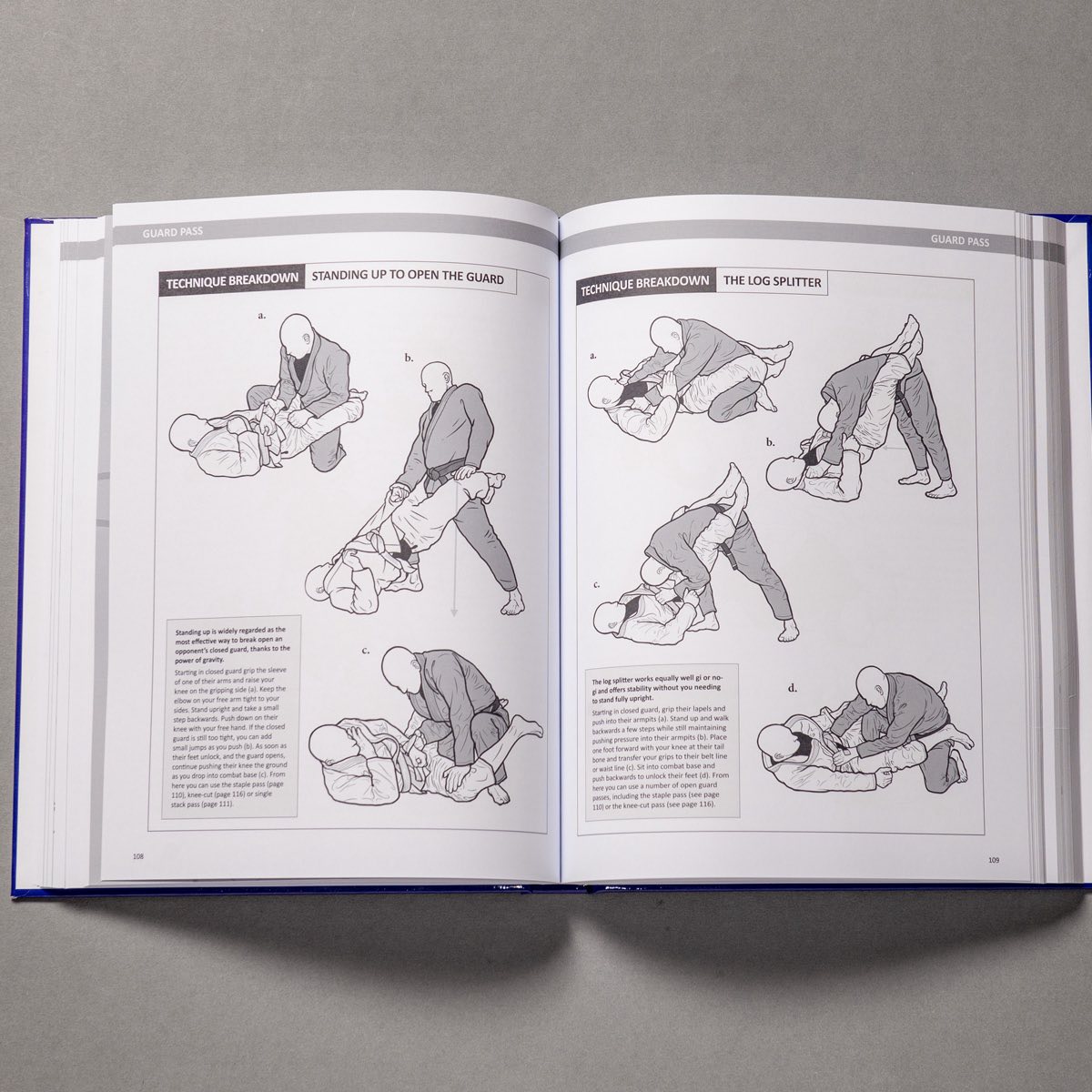
Good news, the softback edition of my co-authored book with Seymour Yang, Brazilian Jiu-Jitsu: The Ultimate Illustrated Guidebook will be available to buy from Meerkatsu.com in a couple of weeks!
With over 260 pages and 970 hand-draw illustrations this is the perfect book for somebody wanting to start BJJ, or just for the martial artists who wants to enjoy a beautifully illustrated book that focuses heavily on technique, but also provides you with concepts, history, strategy advice and more!
The softback will be £10 cheaper than the previous hardback edition, but still feels luxurious thanks to its high-quality printing.
I’ll be teaching at a BJJ camp in North Wales this November — come roll with me in the scenic land of sheep, hills, and armbars! It’s basically a wellness retreat… if your idea of wellness includes being choked by strangers. Book your spot before someone heel-hooks it out from under you!
The age-old debate on sport vs self defence training opens up again, and this time, I’m in it!
“I’ve said it before and I’ll say it again. If you had somebody who has only ever trained sport jiu-jitsu and they’ve done the most sporty of the sport jiu-jitsu – they’re only ever training berimbolos, crab rides and rolling back takes – that’s their whole game, but they’re training against resistance, and they compete, especially if they compete, they are 100 times better at self defence than a guy who just practices self defence techniques in isolation.” – Stephan Kesting
That’s a quote from the first part of this clip that has been making its way around the Internets from Stephan Kesting, one of the shining lights in the Brazilian Jiu-Jitsu community.
He goes on to say more, but the above quote is the essence of what he’s saying.
I completely agree with him, but not only that, I’m actually in the clip – I’m the guy with the glasses at the bottom of the screen.
This clip was part of the longer podcast we recorded I recorded along with my writing partner Seymour Yang (Meerkatsu) with Stephan about our new BJJ book, which is currently being shipped out to people that brought the pre-order.
Incidentally, the book is not on sale anymore, that pre-order was a limited run, hard back, collectors edition. We’ll probably release a softback version in the future on a similar limited print run idea, but we haven’t decided for sure yet.
But back to the clip.
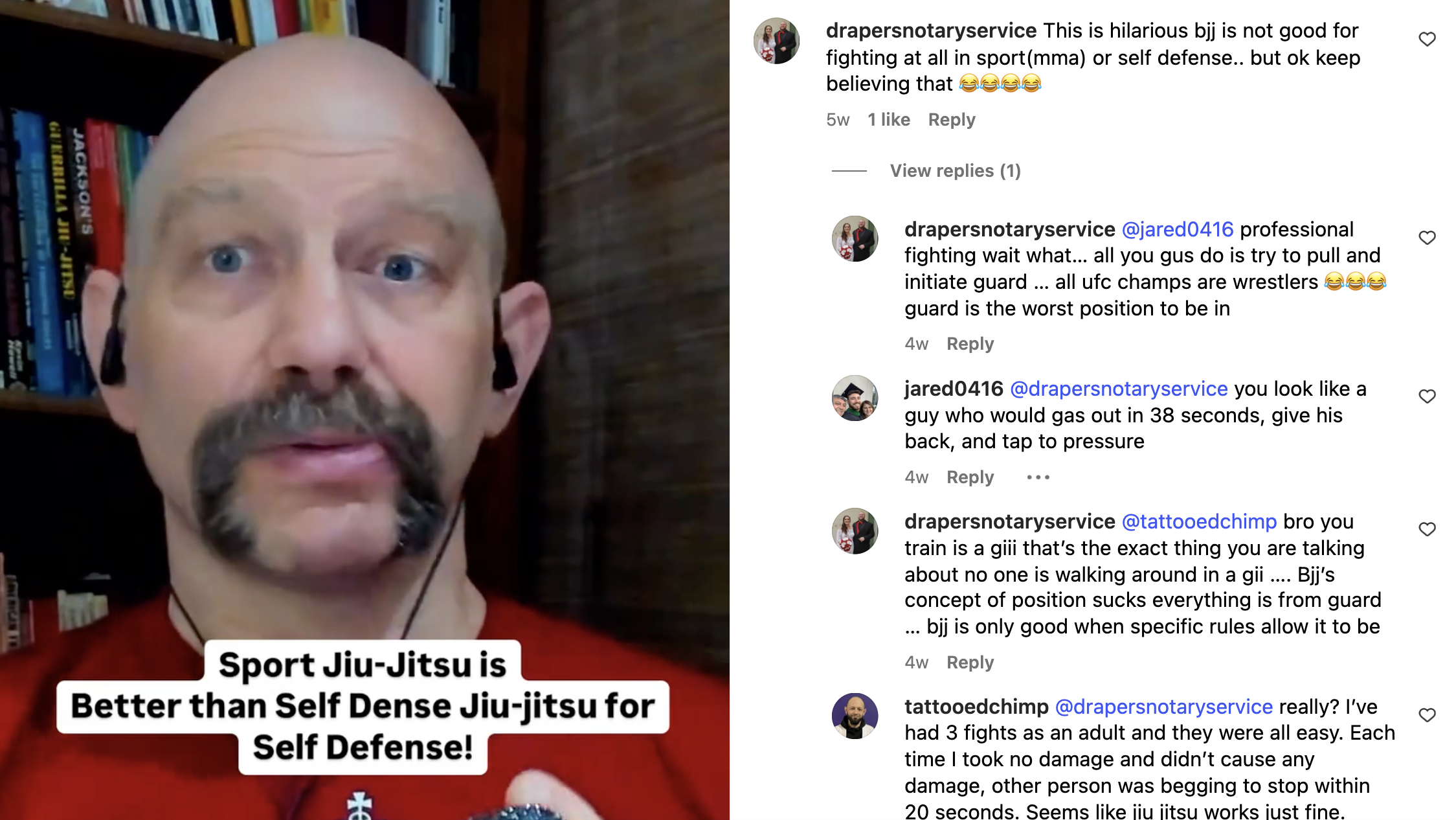
Obviously, because this is the Internet and people can’t read or listen to something without immediately copying and pasting their own opinions about what they think he said, or wrote. So, this clip caused a bit of a ruckus online, attracting comments such as:
“This is hilarious BJJ is not good for fighting at all in sport (MMA) or self defense.. but ok keep believing that “
“I don’t know not all fights end up on the ground right away. And no one’s is gonna wait for you to sit down and start fighting. My complaint with some of the sports jiujitsu has to be Takedowns, it’s like they forgot to do takedowns.”
Now on their own there is some merit to the points being made, however they don’t refer to what was actually being said by Stephan. Let me reframe his statement in the way that Bruce Lee used back in the 1970s with his article called “Liberate Yourself from Classical Karate”:
Stephan is saying that the spontaneity and natural reactions that ‘live’ training will develop is worth 100 times what you’ll learn by practicing ONLY dead forms.
That’s the point, not the applicability of BJJ to self defence or whether all fights end up on the ground. And obviously it’s not an either/or choice, and there’s a lot of grey area in regards to marital arts triaining, but that’s the crux of the matter
Bruce framed the argument around the idea of live, spontaneous training vs repeating dead forms. There are a lot of great quotes in the article by Bruce Lee, but here’s a couple I particularly like:
“It is conceivable that a long time ago a certain martial artist discovered some partial truth. During his lifetime, the man resisted the temptation to organize this partial truth, although this is a common tendency in a man’s search for security and certainty in life. After his death, his students took “his” hypotheses, “his” postulates, “his” method and turned them into law. “
“Prolonged repetitious drilling will certainly yield mechanical precision and security of that kind comes from any routine. However, it is exactly this kind of “selective” security or “crutch” which limits or blocks the total growth of a martial artist. In fact, quite a few practitioners develop such a liking for and dependence on their “crutch” that they can no longer walk without it. Thus, any special technique, however cleverly designed, is actually a hindrance.”
To me the argument that Stephan is making and the argument that Bruce is making are different aspects of the same thing. It’s the ‘learning to swim by never getting in the pool’ analogy all over again. You simply can’t learn to swim without getting wet, no matter how great your theory of swimming may be.
We would all laugh in the face of a theoretical swimmer who only ever practices on dry land and yet we tend to revere the opinions of the theoretical martial artist far too strongly, especially if they have a cool uniform and a black belt with lots of stripes on it.
Personally, I find that the less I practice sparring in a week the stronger the need for coming up with solutions for theoretical situations becomes in my mind. The more actual resistive sparring I engage in, the less my mind craves these sorts of questions. Instead, I’ve actually got something useful to be thinking about, like how I would do a technique from that last round better, or how I would escape a particular situation that actually happened, next time.
Just imagine if you haven’t done any actual sparring for years. There are plenty of ‘martial artists’ like this. Their heads must be full of theoretical knowledge, most of which probably wouldn’t survive an encounter with reality. And all of which can be silenced with just a few seconds of actual sparring practice.
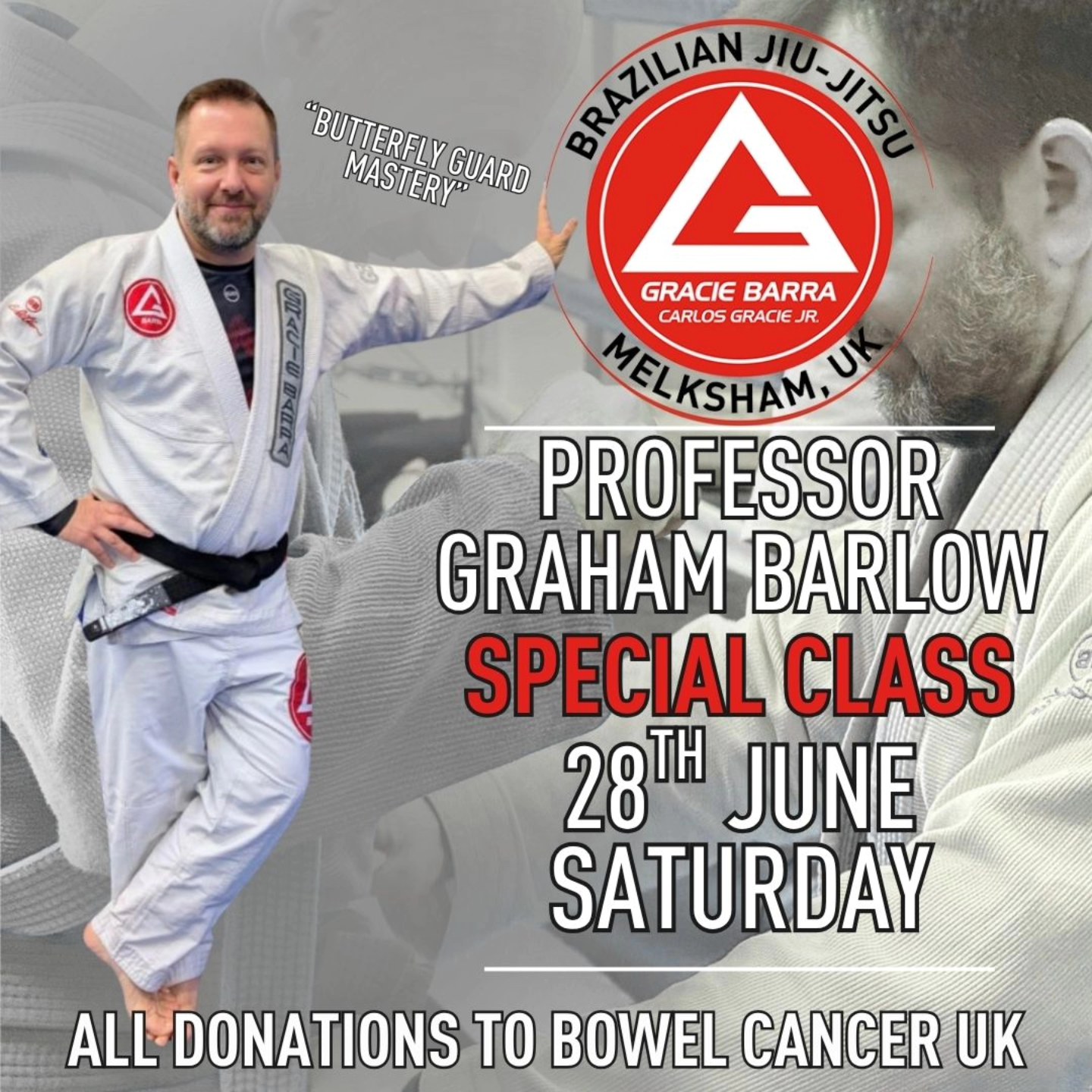
I lost my mum to bowel cancer in May this year. In her memory I’m doing a special class on one of my favourite BJJ topics, butterfly guard, to raise money for Bowel Cancer UK. It’s on 28 June at Gracie Barra Melksham, UK, 12.00pm. All welcome.
This event is in support of @bowelcanceruk and all donations @justgiving link or in person at reception will be donated in total to Bowel Cancer UK.
I wanted to share the process and journey of how Seymour Yang and I made our new Brazilian Jiu-Jitsu book.
First of all it’s worth noting we are both black belt instructors with many years of teaching experience. The book is aimed at beginners to developing white and blue belts and covers everything we felt was useful and relevant in today’s Jiu-jitsu club environment.
After much time planning and researching we then set about creating the contents. Every illustration is based on a photograph or video still that we took of our students or training partners. These stills Seymour used as references to hand draw the line art images. I then wrote the text.
That was just the beginning. The hardest stage was making sure the book was as accurate and tight as possible as a work of reference. For this we spent a long time proofing, editing and redesigning it. We then tested sample after sample from independent book printing companies to find the best one (we did not want to go the Amazon print on demand route)
I’m proud to say the book is finally available for our followers to buy (as a pre-order) and so far it’s proving very popular.
We decided to make it a pre-order as we just didn’t know quite how many to print in advance. A two week window was decided and after the pre-order window closes (June 11) we can then tell the print house how many to make.
If you want to know even more about how we made it then check out this informal 2 hour (2 hour!) video where we chat about making the book (it will be released in a more thoroughly edited audio-only version as an episode of my Tai Chi Notebook podcast shortly):

 The Tai Chi Notebook