Just watched a great clip of 1980s Wushu in China – featuring Sun Jianyun, Sun Lu Tang’s daughter performing Bagua. But there’s also some clips of Tai Chi and some kids doing Northern Shaolin (at least I think it’s Northern Shaolin). Well worth a watch. The martial arts are on their way to being the heavily performance-based WuShu we have today, but are not quite there yet, with martial technique still a priority.
Baguazhang
Mike Sigman on the Practical Development of Qi
And why you shouldn’t train with weights when developing your qi

Mike Sigman has sent me an article to publish on this blog. I don’t normally publish other people’s work, or agree to their requests, but I’ll make an exception because it will hopefully generate some discussion. Regardless of how you feel about him, there’s is always a real depth to Mike’s writings and ideas that you can get a lot from, that you don’t really find anywhere else.
The article is primarily about one of the trickiest subjects in Chinese martial arts – qi (or chi).
I have a few thoughts about it:
1) The article starts by trying to “separate the skin-related qi, which includes the subconscious mind’s involvement, from the theoretical qi of traditional Chinese medicine”.
To some, particularly those people who relish Chinese history and the evolution of the concept of qi as it appears in Taoist thought, or medicine, that just won’t be acceptable, but I think this works for me. It moves the discussion into the realm of the physical and practical. It becomes a feeling and a doing thing.
2) It appears to be written partly as a reaction to a recent trend of mixing, or doing, Chinese martial arts conditioning through the medium of kettle bell or weights training. The question is, is that a waste of time if you want to get to the root of the subject, which is what the Chinese martial artists call qi?
Look, I don’t think there’s anything wrong with making yourself physically stronger at all. In fact, it’s obviously advantageous if you’re learning martial arts… But the article states that to master the internal movement, “the body must be completely retrained to learn to move with the qi, jin, and dantian”, and using weights will not help you in that respect. If you have retrained the body, then you could probably add them.
3) As I’ve said, nobody else really talks about this stuff, or if they do it’s watered down with a lot of other guff. If the article is correct on qi then what exactly are all the big names in modern tai chi seminar circuit and online courses out there actually teaching? Because they talk about qi a lot… but they don’t approach it in the same way as this article does, at least as far as I can see.
4) The article describes internal movement, quite simply and quite succinctly: “Ultimately, you develop a form of movement that uses the solidity of the ground as the focus of all forces to and from the body, while the qi covering of the body is manipulated by the lower-body and the middle to bring power to the arms and upper body.”
I find it hard to disagree with that definition, probably because it’s pretty broad. Sure, we can argue over what the “middle” is, or what the “lower-body” means,etc.. but as a succinct definition, it’s not half bad.
Now, let’s move on to how you do it…
The article talks about breathing exercises as a starting point: “Breathing techniques that stretch the surface of the skin and the involuntary muscle layers are the usual start of the progression.”
Now, I have personally trained in some of the methods that Mr Sigman uses (there’s a link to a video at the end of the article), and experienced what he’s talking about, and I’d agree that I can feel what he’s talking about. But I wouldn’t count myself as an expert in it, or knowledgeable about anything to do with it beyond the initial foot in the door stages, however, I have found that alone to be incredibly valuable and shone a light on some of the other things I was already doing. Even getting a foot in the door took a lot of work and a lot of time.
Anyway, I’ll leave you to read the article now and feel free to comment with your thoughts below.
Graham
Practical Development of Qi
And why you shouldn’t train with weights when developing your qi
by Mike Sigman, March 2025
Discussing qi is difficult because the definition of qi has become a bird’s nest of related topics. Let’s try to narrow the discussion and then describe an approach to practical development.
Most of the skills related to qi, in the physical body, have to do with an area near the skin of the body that is referred to as the “protective qi” or “wei qi”. While the protective qi is often referred to as an “energy”, it is actually a physical set of tissues that is controlled via the autonomic nervous system … but when you learn to control it via the subconscious mind, it does indeed feel sort of like an “energy” because it is apart from the topical sensations of the somatic nervous system, and the qi indeed feels odd, like an energy.
So, let’s separate the skin-related qi, which includes the subconscious mind’s involvement, from the theoretical qi of traditional Chinese medicine: that’s where most of the confusion lies. The skin-related qi and the subconscious mind are the artifacts which give us heightened toughness of the skin, odd sensations of qi, added strength by supplemental our muscle-bone strength, and dantian control of the body as whole connected by skin-related qi, among other things. Jin forces, the manipulation of the solidity of the ground and/or downward forces of gravity, are also the product of the skin-related qi: jin is defined as “the physical manifestation of qi” in many Chinese sources.
The qi of traditional medicine theory is/was an effort to explain the workings of strength, including the strength of our involuntary systems. We don’t need to know all the theories about meridians, putative different types of qi, etc., in order to develop the qi. Breathing exercises and focused physical and mental exercises are more important than complex qi-paradigm explanations.
The skin-area wei qi is initially controlled by respiration and “breathing exercises” are our initial approach to control and development of the qi tissues. During inspiration, if we are slightly extended or stretched out, we can feel a slight inward pulling of the tissues of the fingers and hand. Other areas of the body, upon being slightly stretched taut, can also be felt during the inhale, but many tissues in other areas of the body can’t be felt. They must be developed over time by breathing exercises before we can feel them respond to our breathing and before we can develop them further.
Some Chinese texts mention the fact that this superficial qi is something that animals still use (think of a horse quivering its flanks, for example), but which has atrophied in humans over the course of evolution. In order to regain our qi, we must use deliberate exercises of breathing, mental imagery, and posture manipulation.
Training the Qi in General Movement
Jin force-manipulation is a product of the qi tissues applying stressors within the body’s frame. That’s why jin is defined as “the physical manifestation of the qi”, among other things. We use jin unconsciously in our everyday movements, so another common definition of jin is as an “intrinsic strength”. The full-blown traditional movement methodology that permeates the Chinese (and related) martial arts involves both qi and qi’s subset, jin. Qi and jin. Jin forces are the mind-directed forces from the ground and gravity; qi can be thought of, in a simplified sense, as a superficial muscular layer that connects the whole body.
The basic idea of movement with qi and jin is that the power from the ground and lower body is used as the power source for the upper body. The qi and the jin work from the lower body (including the middle/dantian), so what we have with “internal” movement is a system where the arms and hands are controlled and powered by the lower body and the middle.
The general admonition is that muscle and power are used in the lower body, as needed, while the upper body is moved without the use of local muscle. I.e., a person has to learn to control his/her upper body via manipulation of the lower body and the middle. The person who thinks the internal arts would be best supplemented with typical weight workouts at the gym has lost the plot and is giving away a total lack of understanding about how the “internal” martial arts work.
Developing the Qi
Jin skills are actually fairly easy to learn, although it generally takes a few knowledgeable pointers and some personal, hands-on demonstrations to get someone started. There are a number of written attempts at jin explanations on the internet, particularly through the 6H forum.
Qi is difficult to develop because it takes time and the feelings we need to focus our attention are tenuous at first. Breathing techniques that stretch the surface of the skin and the involuntary muscle layers are the usual start of the progression. Many traditional Chinese martial arts talk about “100 Days” of breathing exercises to develop the qi to a usable status.
Movement of the involves directing all forces upward from the solidity of the ground (so you must “sink your qi”) or use the weight of the body as a basis for downward movement.
Ultimately, you develop a form of movement that uses the solidity of the ground as the focus of all forces to and from the body, while the qi covering of the body is manipulated by the lower-body and the middle to bring power to the arms and upper body.
All Asian martial arts that are labelled as “internal” martial arts, formal calligraphy, qigongs, traditional dance, etc., use this combination of qi and jin for movements. Learning the external choreography and appearance of a martial art, a qigong, etc., no matter how much it resembles the movements of an expert, will not be correct until the system of movement is changed over to the qi, jin, and dantian type of movement.
Almost all of the movements we so often see in western semblances of “Tai Chi”, Aikido, Xingyiquan, Baguazhang, etc., are based from normal movement parameters, rather than qi and jin mechanics and it will take effort to re-learn these arts with the correct movement basis. There is an old saying to that effect: “Taijiquan is easy to learn, but difficult to correct”. So, if your goal is to learn Taijiquan, Aikido, or related arts, remember that all the talk about “relaxation”, “don’t use weights”, etc., is because the body must be completely retrained to learn to move with the qi, jin, and dantian.
Here’s a video of Chen Zhaosen, with translation by John Prince, teaching basic movement drills for the Chen-style Taijiquan. Notice his comment about no strength in the upper body, but whatever strength you need in the lower body.
https://vimeo.com/141009942
New podcast! Ep 35: Baguazhang misconceptions with Edward Hines
My guest for episode 35 of the Tai Chi Notebook podcast is Edward Hines, a long time Baguazhang student of Lou Dexiu. Ed started training Bagua in Taiwan way back in 1991, and has continued ever since. He now teaches online at I-bagua.com and has books about Baguazhang you can find on Amazon.
To frame our chat we decided to cast around for the most common misconceptions you hear about Baguazhang, and address each of them, one at a time.
Links:
How to do takedowns and throws, in Tai Chi, Xing Yi, Baguazhang or any martial art
I came across an interesting video by Ed Hines of i-Bagua.com recently that discussed some general principles of throws and takedowns. There is some good information here, especially about dead angles, and base. Have a watch:
Of course, in my ear I can hear my BJJ friend saying it’s all nonsense, “why not just do wrestling?”, or “he’s doing zero hand fighting!”. My friend tends to think that everything you can know, or ever want to know, about throwing and standup grappling is already inside wrestling.
He probably has a point, and a lot of the clever ‘internal’ things that Tai Chi teachers demonstrate are really just found in wrestling basics, or are obvious if you do wrestling. But here’s the thing – not everybody wants to do wrestling or even can do wrestling! It’s time-intensive hard, physical work, from which you will probably get injured, and, frankly, it’s for young people, not anybody over the age of 30. Not to mention that you’ll also need to invest in a good quality BJJ mat for grappling training.
If you’re going to approach takedowns without having the time or energy required to learn wrestling, then you’re going to need a softer approach. Oh, hello internal arts.
How to defend everything
I wonder if you’ve ever seen the video “how to defend everything” by Chris Paines on YouTube? (It won’t embed, so I’ve had to link it). It’s about BJJ, not internal arts, and focused ground work, not standing, but those principles he’s expounding, I feel, are universal to all grappling, and they’ve really changed my approach to takedowns. It’s also very simple. Simple is good – simple is practical.
At 50 minutes it’s quite a long video, and some of the important points don’t happen until near the end, so I’ll give you a quick summary: In a nutshell, there are 5 parts of the human body that you need to access in at least one place to achieve a throw or takedown.
Part 1. Back of the head,
Parts 2-3. Armpits and
Parts 4-5. Back of the knees.
(back of knee area extends down to ankle, armpit area extends down to hip).
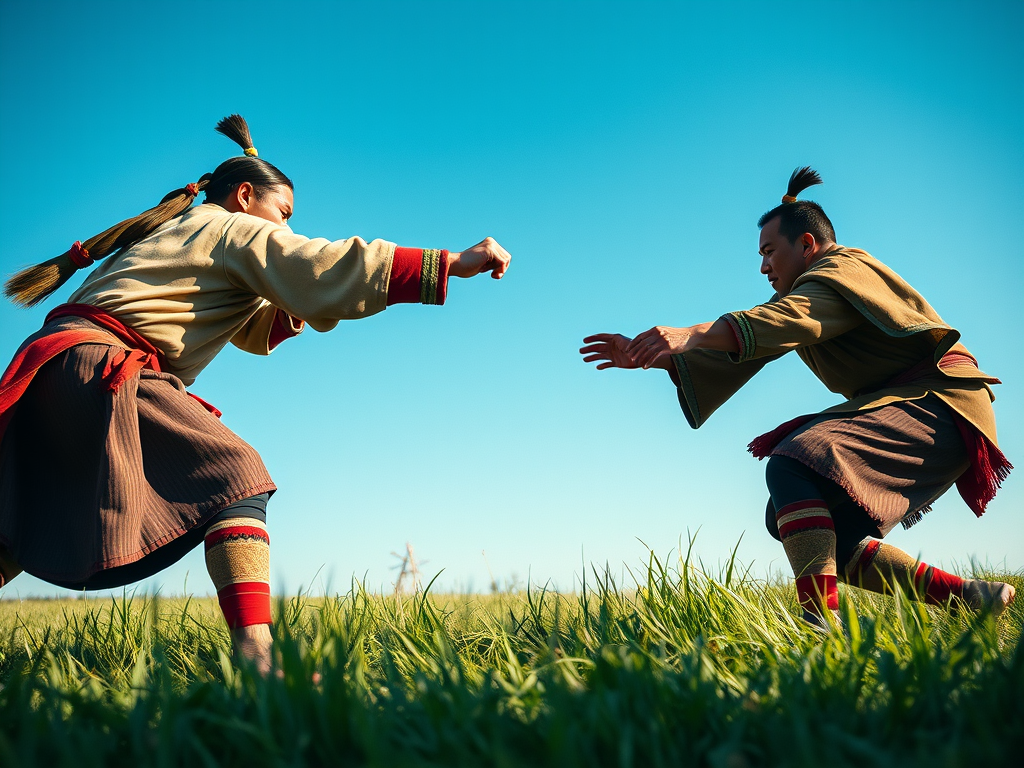
When I do takedowns I just keep looking to insert a part of my body (arm/hand/foot/head/whatever) into one of those places. I just keep spamming it as an attack. If you keep doing that then eventually you manage to ‘own’ one of those places and a takedown will sort of present itself, especially if you get more than one.
You can analyse any throw on YouTube and you’ll find that the person who did the throw got some part of their body into at least one of those places to make it happen. Now, that might mean that the model being used is too general (i.e. it covers a lot of the body!), however, I think it’s still a useful model if you want to work on defence (which people rarely do!)
If you’re doing some grappling and you get taken down, then replay what happened in your mind – you will have let your opponent into one of the 5 spaces for too long. Long enough for them to get a takedown on you. The answer to preventing the takedown then becomes about reclaiming control over those 5 points of your body, rather than trying to do some sort of pre-scripted counter to the throw.
N.B. You can look at standing on the foot as a possible exception to these rules, however… that doesn’t tend to work in a pure grappling environment, unless you also get one of the other 5 as well. Standing on a foot and striking somebody however is a different beast – it’s much more effective. It’s the same with standing wrist locks… they can work, but 9 times out of 10 they won’t – i.e. they are very low percentage, and almost certainly don’t work against experienced people. Your time is better spent trying to get one of the 5 control points. (Apologies to Aikido 🙂 )
N.B. 2 – But what about the gi or wrestling jacket? Well, think of it this way, a collar grip is simply a very effective lever to the under armpit area, so when you grip the collar, you are effectively cheating because it’s giving you easy access to their armpit area. It’s why, when we go for chokes we grip deep on the collar, under the ear, but when we go for throws we tend to grip much lower down, so that the lever to the armpit is stronger.
Anyway, some food for thought.
Open up your hips with these Bagua mobility exercises
As you age your hips definitely get less flexible. If you do BJJ as well, like I do, then the wear and tear seems to add up exponentially, which is why I’m always interested in mobility routines for the lower back and hips, and I think I’ve found one I really like.
This is Carsten Stausberg – Martial Arts, Movement & Nutrition Coaching and this is the mobility routine he recommends for students of his Bagua course.
In Carsten’s own words:
“The main goal here is to get comfortable with “uncomfortable” positions by re-searching them on a daily basis. Ideally first thing in the morning, or as a warm up to your practice. Note: A mobility sequence will not necessarily improve your mobility permanently, but is mostly useful for opening up your normal range of motion by releasing unnecessary tension. For more specific mobility issues, you need more specific and targeted practice”.
A lot of these movements remind me of Yoga for BJJ by Sebastian Brioche, which is no bad thing. I like the way the set it put together, and it makes my hips feel great afterwards. It seems to target all the right areas for me. I could see myself running through this each morning.
Have a go (N.B. consult your doctor first, you do so at your own risk, etc) and let me know how you get on!
Thank you for supporting The Tai Chi Notebook. If you are reading this on a website that isn’t thetaichinotebook.com, then it’s highly likely it’s been stolen. Please let me know so I can issue their webhost a DMCA takedown notice for copyright breach. Thanks.
Gong Li Quan, “power-building boxing”, and the truth about Ching dynasty martial arts
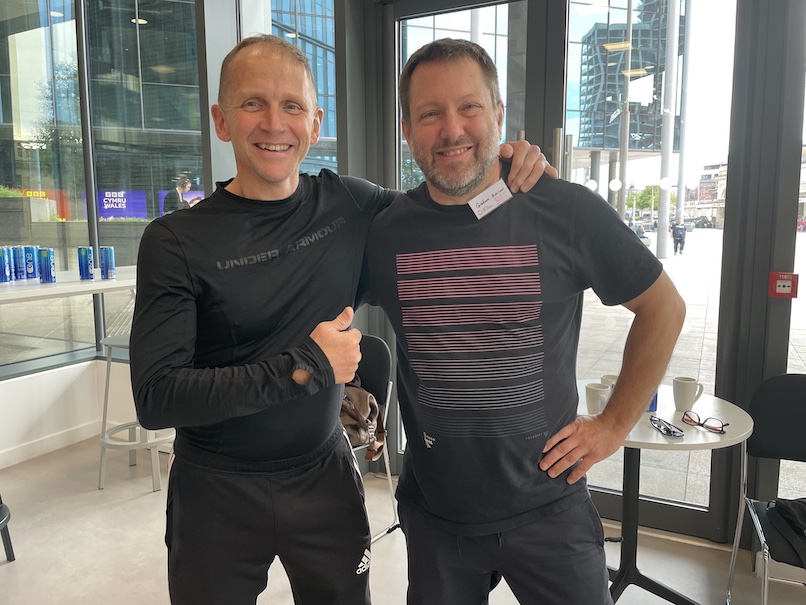
At the recent 2024 Martial Arts Studies conference in Wales I had the good fortune to meet Randy Brown of Mantis Boxing and Brazilian JiuJitsu in Massachusetts, USA. We had a blast at the conference discussing martial history, theory and even demonstrating a few techniques on each other into the small hours in a pub in Cardiff city center! Not only is Randy highly skilled in mantis boxing, but he’s also a black belt in Brazilian Jiujitsu, so we had a lot in common.
When I was exchanging techniques with Randy he noticed that the Choy Li Fut I was showing was identical to moves from a form he knew called gong li quan, which translates as “power-building boxing”. It was a form he had learned that was used as foundational training for various Ching dynasty martial arts, like long fist, eagle claw boxing and praying mantis boxing.
On gong li quan, Randy writes:
Gōng Lì Quán, or Power Building Boxing, is a unique boxing set from northern China, and is included as a training routine amongst a variety of boxing styles in the north to include: long fist, eagle claw boxing, and praying mantis boxing. This form likely intermixed with the latter two styles when it was included as part of the Jīngwǔ Athletic Association’s fundamental wu shu curriculum. At Jīngwǔ, gōng lì quán was one of the mandatory six empty hand and four weapons sets taught to kung fu practitioners. These ten sets were required as a prerequisite to the study of: xingyiquan, bagua, taijiquan, eagle claw, or mantis boxing; considered by Jīngwǔ founders to be more ‘advanced’ styles.
Our meeting seems to have sparked a desire in Randy to delve further into gong li quan and resurrect this old form he’d forgotten about and try to bring the movement to life with grappling applications. He’s been kind enough to share video of his research.
3 Rings Trap the Moon
This was the original move we discussed in Cardiff, 3 Rings Trap the Moon, which in Choy Li Fut would be a gwa choy (back fist) followed by a sau choy (sweeping fist) followed by a biu choy (an outward forearm strike). Randy shows the original move from gong li quan, then his grappling applications. It’s pretty cool!
Twining Silk Legs
Randy has been updating his blog post with new applications as he goes, so keep checking back. One of his latest is the move Twining Silk Legs:
Twining Silk Legs is two upper cuts followed by two kicks. Again, Randy shows the move and then his grappling interpretation of the applications. What’s really interesting to me is that, once again, there’s a parallel in Choy Li Fut with this move. If you look at the move starting at 1.22 in the following Choy Li Fut video you’ll see what is essentially the same move as Twining Silk Legs – two upwards strikes followed by a kick. (Ok, just the one kick here, not two, but still…)
You could look at this as further proof that gong li quan and Choy Li Fut share a common ancestor back in the mists of time, but since I’d be willing to bet that other Chinese martial arts practitioners would also recognise these moves from their own systems, I’d venture to say that is is further evidence for Randy’s theory that the explosion of different martial styles during the end of the Ching dynasty (which is where we get Choy Li Fut, mantis, Wing Chun and the other well-known styles) was more about branding the martial arts, for commercial reasons, and that they actually shared a common pool of knowledge.
An extract from the abstract of Randy’s excellent presentation reads:
“A question needs to be asked, did ‘Chinese boxing’ of the era, have a similar common pool of knowledge? Qī Jì guāng’s manual would hint at such. Within ‘Chinese Boxing’, attributes, feats, or skills defining one fighter over another became definitive styles of their own right due to events of the time”.
(The Qi Ji Guang he’s referring to is the Ming dynasty general who fought off Japanese pirates and because a hero to the people. He wrote a famous manual which documented the martial arts of the time. The techniques in the manual seem to crop up in all sorts of Ching dynasty martial arts.)
You can learn more about the the tumultuous events of the Ching dynasty and the explosion of martial arts styles that happened during it in Randy’s video of his presentation from the 2019 Martial Arts Studies Conference:
2025 Martial Arts Studies Conference
Today I heard the exciting news that next year’s 2025 Martial Arts Studies Conference will also be held in Cardiff, Wales. This will be the 10th anniversary of the original 2015 conference, which was held on the 10th-12th June in Cardiff, and will be held on exactly the same dates. It’s almost too perfect. See you there?
The Martial Arts Studies Network has also released a new (and free as always) issue 15 – check it out, it’s full of top-quality articles on martial arts. Oh, and don’t forget, I also recorded a podcast with Randy while we were at the conference – here it is:
The origin of internal arts, with Peter Lorge
“The origin of internal arts” is probably what I’d have called this really interesting podcast with Peter Lorge about the history of internal martial arts, however Kung Fu Genius decided to name it “Chinese Martial Arts History is Mostly FAKE” because, well, it probably generates more clicks, or something. Anyway, Lorge turns over a few sacred cows here, and I also liked what he had to say about BJJ.
Have a listen:
I think Peter makes a great point about all these different ‘internal’ things throughout Chinese history all definitely existing, but all being completely separate and unconnected until the 1920s Guoshu Institute needed to create the category of “internal” to exist in opposition to shaolin and external, so it brought them all together. (The gentleman whose name he forgets when talking about this is obviously Sun Lu Tang.)
I do wonder if instead of looking back for mentions of “internal” throughout Chinese history a look back for the phrase Liu He “six harmonies” would make a better connection between the dots of Chinese martial arts history. While the term “Neijia” may not appear very often pre-1920s, Liu He definitely did. If we’re looking at how we got where we are today, then that’s probably a better bet.
Bagua Boy Documentary
Alex Kozma of Line of Internet has made his 1+ hour documentary on Paul Rogers and his son available free online. It concentrates on how Paul learned in China in the 1990s then back in the UK has trained his son from the age of 5 in Baguazhang. Definitely worth a watch.
The elbow positioning is interesting in this style of Bagua. Thanks to Mr Kozma for making this free as it’s definitely worth a watch. Check out Line of Intent’s online store for their other releases.
And here’s part 2 looking at spear and more:
New podcast: Discovering Neijiaquan, with Jess O’Brien

My guest for this episode is Jess O’Brien, author of the book Neijiaquan and co host of the Neijiaquan podcast, which he runs with Isaac Kamins.
Since 1999, Jess has studied extensively under BK Frantzis. Over the years, he has also trained with other, preeminent internal martial artists like Luo De Xiu. He has been active in martial arts since his teens.
In this episode we discuss what drew Jess to the internal arts and how he trained with various different teachers before becoming a student of Bruce Kumar Frantzis.
NEW PODCAST Simon Cox on Zhang Sanfeng and the Wudang connection to Tai Chi
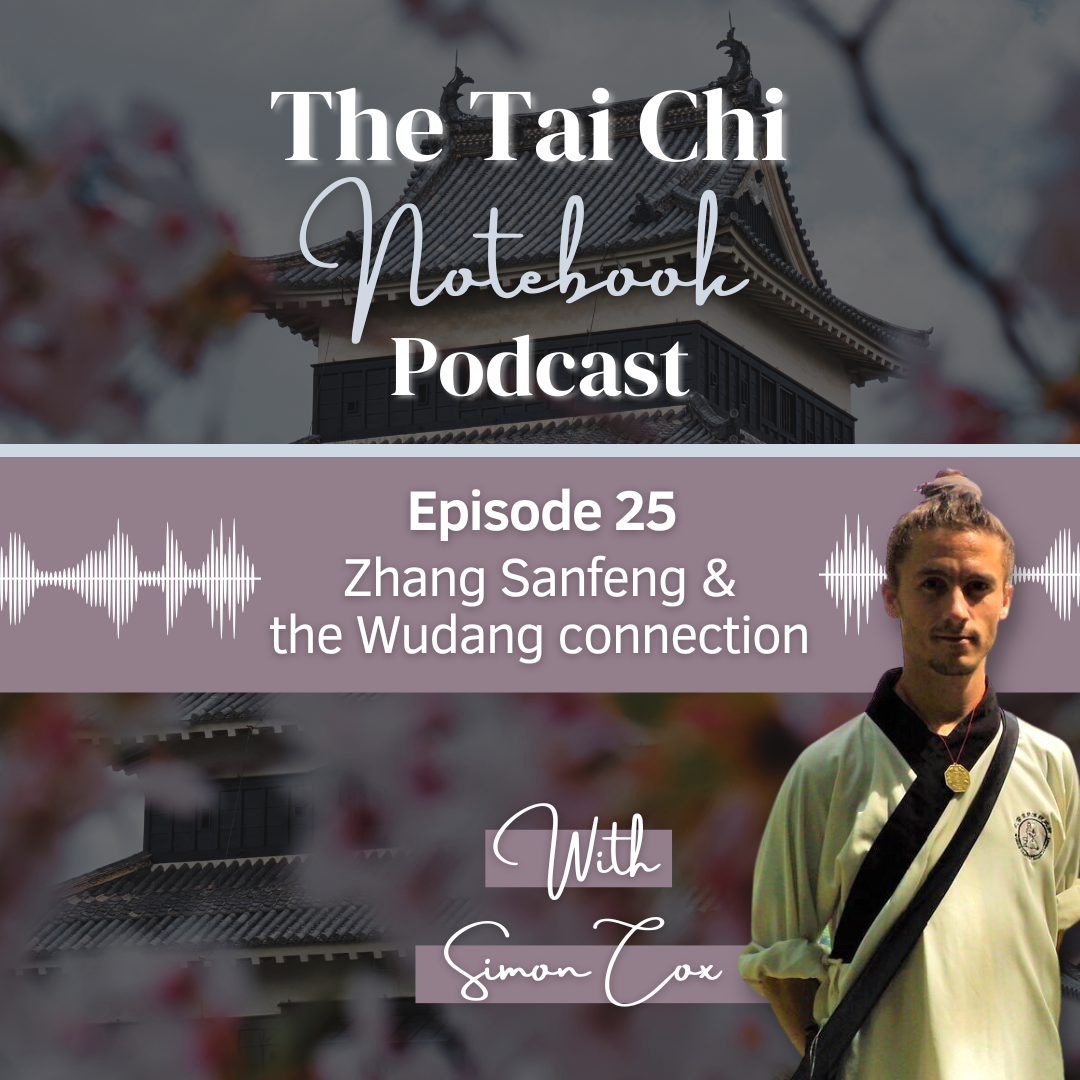
New podcast! My guest today is Simon Cox, who co runs the Okanagan Valley Wudang with his wife Brandi in Penticton, British Columbia.
Simon and Brandi spent six years living and training in China under master Yuan Xiu Gang at the Wudang Daoist Traditional Kung Fu Academy. While there they studied Kung Fu, Tai Chi, Qi Gong, meditation, herbal medicine, Daoist music, and ancient and modern Chinese language.
After returning to the West, they started a Kung Fu school and community group in Houston Texas, where Simon was working on his PhD in Chinese and Tibetan mysticism at Rice University. At the end of 2019, they moved up to the Okanagan Valley and began sharing Wudang teachings with the local community.
What I really wanted to get at with Simon was an elucidation on his article about Zhang Sanfeng – exactly who was this mysterious Taoist immortal who is often credited as the founder of Tai Chi Chuan? I also wanted to find out more about Wudang mountain, and where its martial arts really come from. I hope you enjoy are conversation!
 The Tai Chi Notebook