
Here’s a great academic essay, by Alexandra Ryan, on the introduction of Tai Chi Chuan (Taijiquan) to Britain. Well worth a read.
Here’s a great academic essay, by Alexandra Ryan, on the introduction of Tai Chi Chuan (Taijiquan) to Britain. Well worth a read.

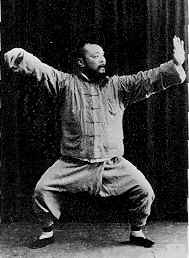
Yang Cheng Fu performing the Single Whip posture.
Single Whip is one of the most recognisable yet least understood postures in any Tai Chi form. I think the confusion arrises from the name. Hearing “whip” most people think of an Indiana Jones style whip – a strip of leather or cord fastened to a handle. Add to this the phrase “whipping power” that’s often used to describe the type of force used in many Chinese Martial Arts and you get people trying to use the Single Whip posture as a strike that’s like a whip crack. Worse you also see them trying to use the beak-like rear hand to strike with, but more of that later.
Let’s try and solve this mystery.
Personally, I don’t think Tai Chi does use a whipping type of power at all – not in the same way that other Chinese martial arts, like Choy Lee Fut, for example, do. Choy Lee Fut genuinely does use a whipping power – the arms whip out, somewhat wildly, powered by the turning motions of the waist and body, but that’s not the same as Tai Chi movement. When you ‘whip’ the arms out in this manner you give up control of them for a brief moment, so they’re moving independently. In the Tai Chi classic by Wu Yuxian it says:
“Remember, when moving, there is no place that does not move.
When still, there is no place that is not still.”
It’s not possible to stop a whipping motion like this, once it’s started, which means it’s not really Tai Chi Chuan, at least not in my book.
Here’s the deal: The ‘whip’ mentioned in the name of the Tai Chi posture isn’t a flexible whip, as you’d imagine it was – it’s more like a stick. If you think about it not all whips are flexible – take a riding crop, for instance. The posture is called Single Whip because the finishing posture looks like somebody carrying a yoke, but only on one side, hence the “Single”.
The Chinese have used yokes – sticks carried across the shoulders and back – to transport good since ancient times. Buckets are usually hung from the ends of the yoke. Here’s a picture from a historical website of an 1860’s Chinese gold digger, starting for work with his tools suspended from a yoke on his shoulders.
Now take a look at this illustration of a Chinese man carrying a yoke with just one hand on the yoke:
That’s starting to look very like Tai Chi’s Single Whip posture, isn’t it?
The ‘whip’ could also be used as a weapon in Chinese Marital Arts. Again, it was usually referring to a short stick, not a flexible whip. In the excellent “Chinese Martial Arts Training Manuals” by Brian Kennedy and Elizabeth Guo you’ll find a description of a book called “Tiger Tail Whip” by Jiang Rong Qiao published in 1930. It features a “long routine for the metal tiger tail ‘whip’, which is rigid and actually amounts to a type of cane.”

In English the words ‘Single Whip’ cause an understandable confusion. The name is simply an aid to memory for the visual shape of the posture, and it’s not meant to be a clue to how you use it.
And the beak-like hand? It’s simply a stylised version of a grab to the opponents wrist. It’s more elegant to make your finger tips touch your thumb when you perform the form, and it reminds you that this is a wrist grab. A simple application of the Yang style version of Single Whip is to grab one of their wrists and pull it in one direction, while striking them in the face with your other hand. There’s nothing mysterious there, either!
Wu Jianquan of Wu style Tai Chi demonstrating how to centre the coccyx perfectly.
People often get very confused about “tucking the tailbone” in Tai Chi Chuan. It’s a posture requirement that’s mentioned in the Song of the 13 Postures, where it says:
“When the tailbone is centered and straight,
the shen [spirit of vitality] goes through to the headtop.”
The tailbone is what’s more normally known as the coccyx. Notice, there’s no mention of “tucking” here at all, just keeping it centered and straight, which makes me wonder where everybody gets the idea of tucking it from? It’s quite a crucial misunderstanding because the word “tucking” implies bending the hips and tucking under, which results in an unnatural and distorted posture that isn’t comfortable at all. You can’t even stand comfortably like that, let alone fight!
I find that the best way to achieve a centered coccyx is to first bend the knees (you can’t ‘centre’ you coccyx with straight legs) and then relax the lumbar region of your spine. You’re looking for a natural feeling of lengthening. A dropping down. Once you’ve got that feeling then your coccyx will be in the right place. You shouldn’t feel any of the muscles or tendons in the backs of your legs being activated when you do this either, so look out for introducing tension there – it’s usually a sign that you’re starting to “tuck”, rather than lengthen the spine.
I was talking with a practitioner of a so-called ‘external’ style of martial arts today and he said:
“The kwa is very important. Opening and closing the kwa builds energy in all the stances… A weak kwa leads to weak footwork, which leads to a lack of jin in hand techniques.”
Sounds like an ‘internal’ martial art, doesn’t it? I’ve been thinking about what this quote means to Tai Chi. People can mean all sorts of things like the hip or pelvis by “kwa”, but the kwa in this context is referring to the inner thigh (before you Chinese language geeks leap on this, I clarified that this was the area he meant later in the conversation). Obviously as you move through Tai Chi postures the kwa opens and closes. It does this by itself if you let it, you simply need to be aware of it.
After playing around with the form and having this quote in mind I was reminded of something my Tai Chi teacher once said to me. It sounds like a quote from the Tai Chi Classics, but isn’t (I’ve looked for it) – so it must just have been something his teacher said to him once.
“Tai Chi is often called ‘boxing with the legs'”.
At the time it washed over me, but now I think I understand.
You can think of it as being a more pithy and concise version of the earlier quote. What powers the punch in Tai Chi? It’s the legs. How do the legs do it? Through correct posture – the kwa rounded and firm, upper body relaxed and able to channel the power of the ground up through the legs and into the hand. Every time you punch feel that it’s the legs doing the ‘punching’, not the hand or arm – that’s where the source of the power comes from. Put your mind in your feet, not in your head. Do this practice sincerely and you slowly start to feel how the whole body is involved in everything you do – it’s your whole stance and posture that moves into the technique, not segmented bits flailing in an uncoordinated manner. It’s truly a wonderful, wholesome feeling of unity in your self.
Work at it, get it right and you can start to feel how your Tai Chi can become “boxing with the legs”.
“Think over carefully what the final purpose is:
to lengthen life and maintain youth.”
– Song of the 13 postures.
I’m basing today’s sermon on this often overlooked couplet from the Song of 13 Postures. You see, there’s a lot of talk on online discussion forums asking where it all went wrong for Tai Chi Chuan. How did this deadly pugalistic art of the Chen and Yang families from the bloody 1800s in China become this watered-down, series of sanitised slow-motion movements for old people to do in parks?
As this line from the classic points out, it was never just about fighting anyway. Tai Chi Chuan was always about something more. The argument for staying healthy is a strong one. Even if your main purpose in pursuing the art is to acquire fighting skills what good are they if you’re overweight, ill or have limited movement in your joints? If you’re not healthy then that’s going to seriously inhibit your ability to defend yourself. Yet, do the historical masters of Tai Chi Chuan live up to this ideal? Sadly not. The famous Yang Cheng-Fu was also famously obese and his most famous student, Cheng Man-Ching, was often famously inebriated. Neither of these two unfortunate facts takes anything away from their skill levels in the art.
Is Tai Chi Chuan enough for health? Bear in mind when the words of the Song of 13 Postures were written. Daily life was much more of a grind in 1800s China than it is for us today, with all our fantastic labour (and boredom) saving devices. These days very few of us lift heavy objects, walk very far or move about as much as people used to do on a regular basis. We also eat a lot more, and most of it is high-sugar, high-fat crap.
Quietly, to myself, I often ponder whether the health benefits to be gained by Tai Chi Chuan match up to those that can be gained by, say, going ballroom dancing twice a week. In conclusion, I’d say ballroom dancing is probably the more healthy option, but you can’t go ballroom dancing for those brief 10 minutes in the morning when you’ve got the kitchen to yourself before the kids charge down the stairs and start wrecking the joint. You can’t ballroom dance in that last half hour of the day while the wife is catching up on her soap operas and you slip, unnoticed into the back yard to do a little bit of the form under the stars. And most importantly, for me, you can’t ballroom dance your way out of a violent confrontation.
So, I’m left with Tai Chi Chuan. The great all-rounder. It’s hard to but a label on what it is exactly. It doesn’t specialise in one area too much, but touches on many. Jack of all trades, master of none, or universal panacea? You decide.
This week in class we were working on Peng Jin (Ward off energy), the fundamental Yang energy (Jin) of Tai Chi Chuan.
A lot as been written and debated about Peng Jin in Tai Chi circles, but I think the following quote sums it up pretty well, for me at least.
“The Song of Peng
What is the meaning of Peng energy?
It is like the water supporting a moving boat.
First sink the ch’i to the tan-t’ien,
then hold the head as if suspended from above.
The entire body is filled with springlike energy,
opening and closing in a very quick moment.
Even if the opponent uses a thousand pounds of force,
he can be uprooted and made to float without difficulty.
I like the imagry of water and a boat floating on water. I also like to use the imagery of a rubber ball when teaching Peng to people. If you imagined that you were punching a large rubber ball then the bounce-back you’d experience is Peng. The hard part is turning yourself into that rubber ball!
To manifest Peng you need to be relaxed (sung) – excess physical tension really spoils the technique. There are various exercises you can do to help you develop the feeling of Peng, one of which I present here: Hold out your arms and get a partner to press down on your arms, then try to compress their force into your centre and bounce them out. The big mistake you’ll make first is to use your arms too much to try to push them off you – that’s not it. In this video you can see that my arms are nice and relaxed. You’re looking for that springy force coming back up from the ground.
This exercises also requires that your partner hold their arms somewhat rigidly. If they let their arms go all soft and floppy as you bounce them then nothing happens. This is just a training exercise after all, and not a martial technique, so it require some co-operation, so give your training partner a hand and don’t be too difficult to work with!
Great blog post.
“Our ancestors are very great, the principle of Taichi is very mysterious and beyond every word,” I heard this all the time.
I am not denying the greatness of that circle composed with two fishes, although according to some experts, the two-fish circle can only be called yin-yang diagram, the real taichi diagram is just a plain circle. Besides, it really looks cool when a person practices taichi in that circle or builds a house by drawing that circle at the center of the house or puts that circle on the clothes. It is so popular that as long as Chinese culture is mentioned, it mostly probably comes out covered with a mysterious face with the introducers’ blinky words. If you have some questions, they would say, “it is normal that you don’t understand, it is very deep and our ancestors are too smart.”
I think just this can best show the attitude of modern Chinese to traditional Chinese culture— they pretend to know it by pretending not to know it.
Sometimes it’s good to use Push Hands as a base from which to practice applications from the form. Here’s some Tai Chi throwing apps we were working on in class this week.
A question that comes up a lot from beginners seems to be “what defines Tai Chi Chuan?”. Non-beginners seem to not worry about this question and just practice, which is for the best, but it seems everybody goes through a stage where their mind needs to define and categorise what it is they’re doing. What makes it Tai Chi Chuan, as opposed to, say, Bagua, or JuJitsu?
I can only answer from my current understanding. I’ve been doing Tai Chi long enough to realise that today’s epiphany is tomorrow’s half-truth, so I wouldn’t say this will be my final word on the subject, but it’s something I’ve settled on recently.
When defining what Tai Chi Chuan is I look first at the name – TaiChi boxing/fist. So, it’s a martial art whose chief feature is about TaiChi – the interaction of Yin and Yang. Therefore, for a movement to be Tai Chi Chuan it requires that the interaction of yin and yang is correctly distinguished (i.e. in harmony) in all the movements, and (crucially) also in the fighting strategy (no double-weighting).
That’s it!
On one level my answer sounds like a ridiculous over simplification, and it is, but that doesn’t make it ring any less true. It’s only when you ask yourself ‘what does distinguishing yin and yang mean?’ that you realise how deep the wormhole goes. There are obvious, simple, answers like always having your weight on one leg and not both at the same time, but there are much more subtle answers to do with where force is inside the body, and how it is utilised.
A good place to start with this line of enquiry is by looking at your own form with No.4 of Yang Cheng-Fu’s 10 Important Points in mind.
4.) Differentiate between insubstantial and substantial. This is the first principle in T’ai Chi Ch’uan. If the weight of the whole body is resting on the right leg, then the right leg is substantial and the left leg is insubstantial, and vice versa. When you can separate substantial and insubstantial, you can turn lightly without using strength. If you cannot separate, the step is heavy and slow. The stance is not firm and can be easily thrown of balance.
No.2. in Yang’s 10 Important Points is “Sink the chest and pluck up the back”.
Yang says: “2.) Sink the chest and pluck up the back. The chest is depressed naturally inward so that the ch’i can sink to the tan-t’ien [field of elixir]. Don’t expand the chest: the ch’i gets stuck there and the body becomes top-heavy. The heel will be too light and can be uprooted. Pluck up the back and the ch’i sticks to the back; depress the chest and you can pluck up the back. Then you can discharge force through the spine. You will be a peerless boxer.”
Personally, I like thinking of it as ‘shelter’ the chest, rather than “sink” or “hold in”, even if that’s not the exact translation. I think that works better in English for me, it implies a more natural position with less force being used than ‘hold in’ does. YMMV.
The whole thing is intimately related to the breath and ‘sinking the chi to the dantien’. If you change the focus of the breathing to the dan tien area, so that area expands when you breathe in and contracts when you breathe out (that’s ‘normal’ dan tien breathing, there’s reverse as well, but let’s not get into that) then your upper chest will natural soften and have the feeling of hollowing – so it’s not so much something you actively ‘do’, it’s more like something that happens as a result of doing something else. The old Wu Wei idea of doing without doing. The whole posture in Tai Chi should be as natural as possible without any artificial additions – but it does require effort (including mental effort) to do, paradoxically – you have to make an effort to be as relaxed as possible, usually by getting rid of the unnatural habits we pick up through doing things like typing on this computer or misusing our bodies in other ways, such as stiff shoulders and neck.
If you let the upper chest expand as you perform the movements then you are effectively ‘letting the chi rise up’ rather than ‘sinking it to the dan tien’. In Tai Chi you need to make your centre of gravity the dan tien area, and this requires letting the tension in the upper body release downwards (of course, you still need that opposite feeling of being drawn upwards from the crown that’s talked about in the classics, and in the above quote as “pluck up the back”, otherwise you slump, or get that crumpled ‘old man’ look I see too often in Tai Chi practitioners, which is not good either IMHO).
One of the meanings of chi is air, or breath, so you can see how ‘sinking the chi to the dantien’ relates to breathing from that area, and how ‘letting the chi rise up’ relates to the breath being too high in the body. All the posture requirements of Tai Chi (as featured in Yang Cheng-Fu’s 10 Important Points essay) are all part of the same thing really, so it can sometimes be misleading to consider them on their own as separate things – or as Mike Sigman said:
In relation to the tail-bone tuck (which I think really just says that the tail-bone should point downward and says nothing about “tuck”), one way of looking at that requirement is that it’s for the same reason the gua is sunk and relaxed, the back is relaxed, the head is suspended, the armpit is rounded, the crotch is rounded, the chest is hollowed and the back rounded slightly, and the stomach is relaxed. They are all done to affect the same thing which connects them all.
All this being said, there are a wide variety of interpretations of what these things mean amongst the different styles. Amongst Tai Chi stylists (mainly from Yang Lu Chan lines, since Chen guys seem to want to be a law unto themselves  ) I think my view above is by far the most common IMHO, but you can counter pose it with the view amongst some Bagua stylists that the chest should be expanded outwards, but this seems to be part of a complete system and way of doing things that is very complete and detailed, and includes circulating energy in directions counter to the more usual way of doing it.
 The Tai Chi Notebook