Joanna Champion: It’s all in the legs

You get hurt, hurt ‘em back. You get killed… walk it off.

tuf_23_finale

There’s a moment in Marvel Avengers: Age of Ultron when Steve Rogers addresses his assembled superheroes before going into battle against impossible odds with: “You get hurt, hurt ’em back. You get killed… walk it off.”

I’m not saying Poland’s Joanna Jędrzejczyk is a Captain America fan, but she must have been listening to the same advice when she fought  Cláudia Gadelha in Friday’s TUF 23 Final at the MGM Grand Garden Arena in Las Vegas.

As a perfect example of fighting back from a bad start, this fight was unmissible, and far better than any fight I saw in the UFC 200 show the following day. Cláudia, a BJJ black belt, spent the first two rounds on the offensive, with clinch followed by takedown after takedown, totally dominating the fight, but Jonanna always found a way to get back to her feet without ever sustaining any real damage. Eventually Cláudia’s repeated takedown attempts took their toll and her gas tank veered perilously close to empty. By the third round the tide was turning and Joanna had Cláudia on the run. With Cláudia too tired to continue the takedown attempts, Joanna could open up with her strikes and kicks. She unleashed hell.

Joanna is well known for her unpredictable staccato style of striking mixed with devastating flurries, like this:
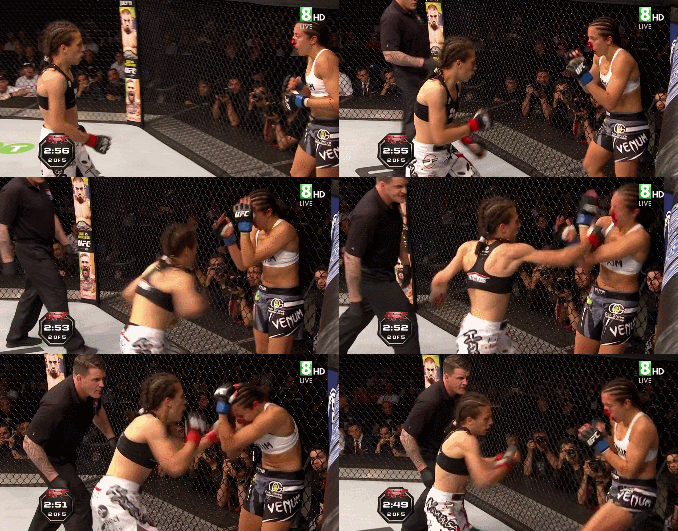
fluiddisloyalalaskanmalamute


And the accuracy of her strikes. Like this:
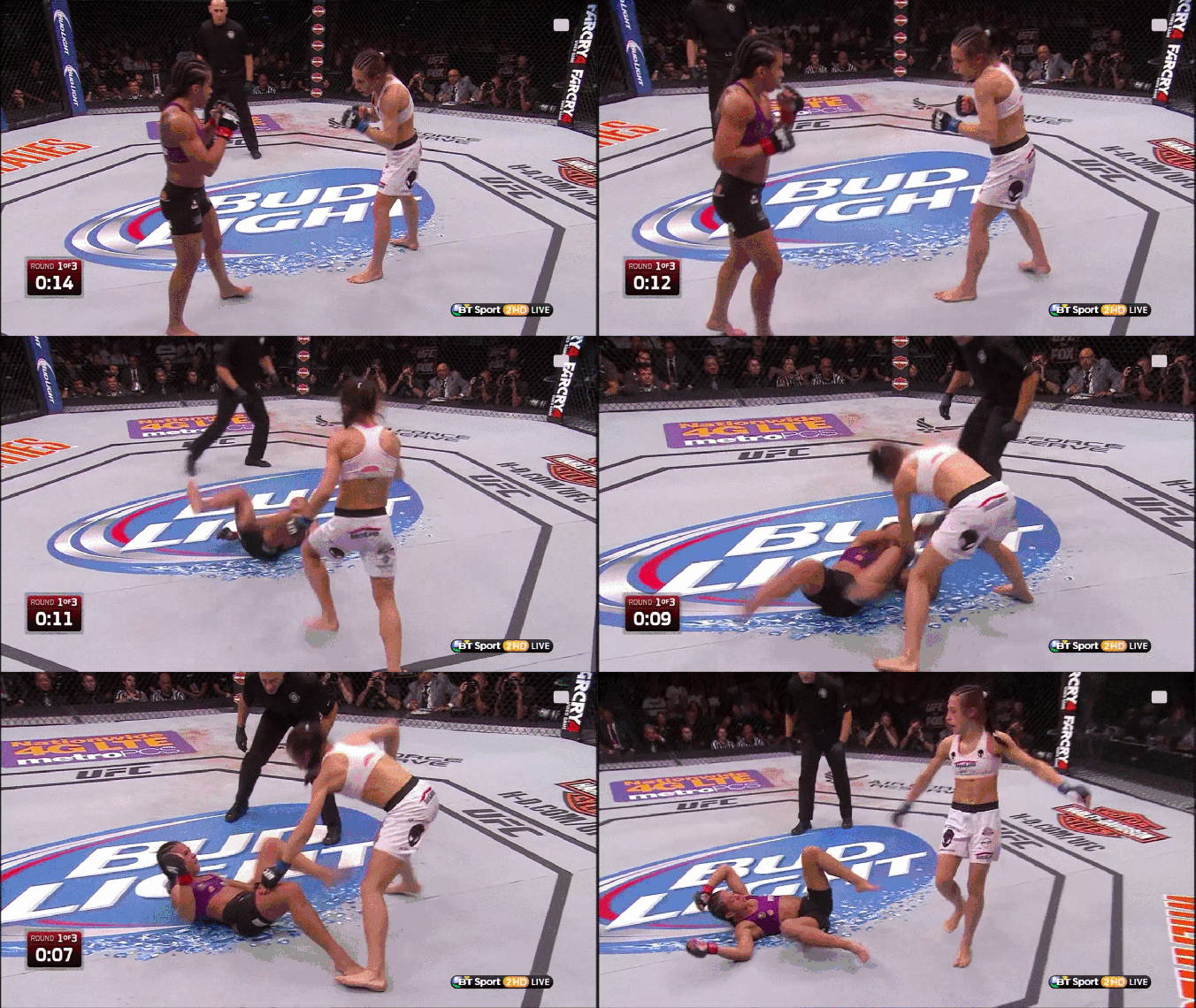
women2bf

and this:

leadingrewardinggentoopenguin


Her hand speed is often the big talking point, but watching her move, I am always struck by how much her legs are involved in everything she does. Whether it was getting back to her feet again, or resisting the constant stream of takedown attempts from Claudia, her legs and hips are always being used. And when it comes to punching, she never just launches with her body or arms, as her opponents always seem to do. Her legs are never the passive carriers of her upper body – she’s always driving every action from them. Look at the clips above again and see if you can get what I’m talking about.

I’m not suggesting she’s doing Tai Chi movement, but I do think there are parallels to observe between what she’s doing and the way we are taught to use our legs in the ‘internal’ martial arts.

As for her heart and ability to come back from adversity. I don’t think you can teach that. She’s a real life superhero.

The Grand Poobah

Let’s be honest: Not everything in the martial arts garden is coming up roses. There’s still a lot of bullshit out there.

6181018387_6dd8665826

I find it uncomfortable when ‘normal’ people find out I do a martial art. The problem is that they usually want to talk to me about it. For example, they want to tell me about their nephew/son or daughter who does “What’s that one like Karate but with the kicking in?” And 99 times out of 100 I have nothing to say about that because it has no connection with anything I do at all. Also 99 out of 100 times I find that everything they think about martial arts is based on the image of it projected by the media, thus entirely a fantasy. I try my hardest to not sound disinterested and quickly change the subject.

It’s often even worse when you do meet people who practice a martial art themselves, because quite often they’re not exactly what I’d call ‘normal’ either. They can be the sort of people who flock to “combatives” training so they can learn to defend themselves from a machine gun attack, or maybe they like wearing a uniform, hierarchy and belts, or standing in lines screaming and punching the air. Oh, and by “people” I mean “men” here. I’ve found that women who practice a martial art are usually on the level (with a few notable exceptions). Women are usually attracted to martial arts as a way to prepare themselves for the physical reality of conflict.  They need to have some sort of defence if they ever find themselves in an uncomfortable situation with a larger, stronger male.

In a way I find that admitting you do a martial art to another person (if you’re a man) can be a bit like saying “Hi! There’s a high probability I’m a little odd!”

But let’s ignore the larger martial arts world and look at the small subset that is the Internal martial arts (IMA)- things like XingYi, Bagua and Tai Chi and other Chinese martial arts (CMA). I was talking about this with a friend recently. And in his own (paraphrased) words:

The problem is a lot of IMA people are looking for the “holy grail”. They are drawn to obscure jargon, high prices, “special” training and the idea that if it doesn’t work it is YOUR fault.

Certain teachers capitalises on all that very well, along with the bullying persona, being the alpha male in the room full of aiki-bunnies. People have bought so much into a particular view of MA it’s difficult for them to understand or appreciate anything outside of that view. I’m sure we both know people who would take apart 99% of IMA “masters” in a “relaxed” way, yet their work is ignored because they don’t “do it properly”.

If an IMA teacher is making constant reminders of “choking out” MMA guys and “destroying” people then it highlights his main area of worry – he knows he would struggle in either of those environments, yet he is not man enough to admit it or even – heaven forbid – go train with any of the top guys. Big fish small pond. This attitude is supported by some because it feeds into their inferiority complex and/or need to feel “special” by being accepted by the Grand Poobah. It’s largely this attitude that has almost destroyed CMA in this country – at one time CMA classes were heaving….these days…?

You can go a long way in the Chinese martial arts world, and specifically the internals, by being the guy who doesn’t mind punching civilians in the face at your seminar, to show who is top dog. If you encounter one of these controlling and manipulative individuals I’d suggest just walking away, and fast. You can’t change them, and nothing good will happen to you when you point out their obvious lies. Their followers have usually brought into the lie 100% and just shift their reality to accommodate the latest half truth or nonsense they spew.

Walk away – you don’t need these people in your life.

Strikes: Soul meets body

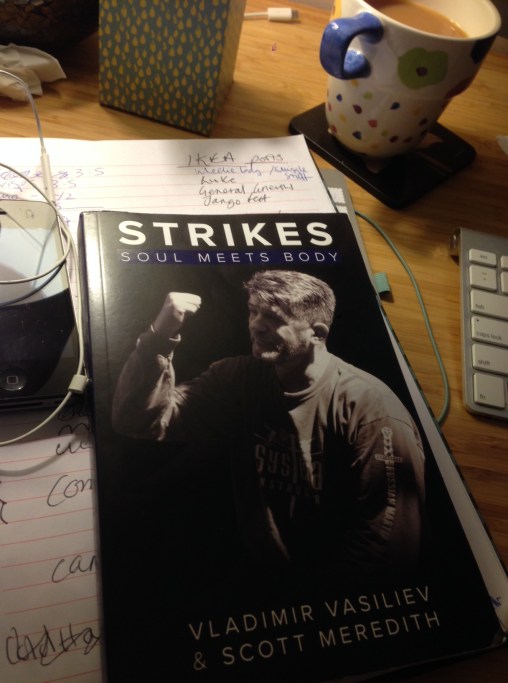
The new book by Vladimir Vasiliev and Scott Meredith has arrived. Mood: excited!

IMG_0769

Yesterday, the new book on Systema striking “Strikes Soul Meets Body” by Scott and Vladimir I’d ordered arrived. First of all, at over 300 pages this book is an absolute beast! It feels a lot thicker than their last one on Systema breathing (“Let every breath”) so it’s going to take me a while to plough through it and do a full review, but before I do I wanted to post my initial reactions.

Firstly, the production values are high – nice cover, good photo quality (black and white) inside, and nicely produced pages in a relaxed looking typeface that makes reading easy.

Secondly – what’s it all about? In Scott’s own words “In this book, we are presenting the Russian martial art of Systema through the focused lens of one of its key skills”. That’s important, because it’s not just about striking. In Systema, it seems that each of the main skills is like a finger on a hand – meaning it’s impossible to separate each one out and still have a working fist. So, it discusses everything to do with Systema, including massage, stick work, mobility training and, most importantly, breathing.  Striking in Systema is unique in that it requires huge degrees of freedom, which can only come from a body and mind that moves freely, and that’s what this book is concerned with creating in you.

The book contains lots of drills and exercises, many of which requite a partner, so it’s quite practical, not just theoretical. I also think it looks like it’s going to be of interest to any martial artist who is interested in the details of how things work, not just a Systema practitioner, (although they are obviously going to get the most out of it). For example, the introduction starts of by analysing what a strike really is, looking at how legends like Rocky Marciano produced so much power. It’s also very well written. Scott has a great writing style, as you’ll know from his other books. The majority of the book is written in his voice, but with lots and lots of interjections from Vladimir, usually relating directly to training, and he’s quoted by name, so you can tell who has written which bits.

In short -if you’re wondering if you should buy this book, then yes. Just get it. From my initial scan it looks very, very good. But does it actually live up to its promise of teaching you how to move, strike (and live?) with absolute freedom? Those are bold claims. More on that later when I’ve read it all!


Does BJJ work on the street?

Chris Haueter’s new speech at BJJ Globetrotters addresses the seemingly eternal question people have about Brazilian Jiujitsu.

Chris Hauter is one of the original 12 American black belts in the art of Brazilian Jiujitsu. In this new 1.5 hour (yes, 1.5 hour!) speech he addresses a question which continually dogs BJJ:”Does BJJ work in the street?” He tackles the subjects of sport Jiujitsu compared to self defence Jiujitsu. It’s interesting because he might not say what you expect him to say…

Have a watch:

Cracking the Code: Tai Chi as Enlightenment Theatre

Scott Park Phillips’s much anticipated film about the connection between Tai Chi and Chinese Ritual Theatre is finally here.

I met Scott last year, when he introduced me to his theory of Tai Chi as Ritual Theatre for the first time. His ideas were so ‘out there’ compared to the usual history of Tai Chi that I’d encountered, and his presentation so enthusiastic, that I found both him and his ideas fascinating, and I think you will too. As well as being a historian, he’s a performer and entertainer (and third-wave coffee drinker). He presents his ideas as such. I’ll never forget him spontaneously standing up in the pub and demoing his Chen style form walkthrough (during which he explained his Theatrical interpretation of the postures) for me, and the rest of the pub, whether they wanted it or not! 🙂

It’s hard to grasp these ideas in the written word, so I asked him at the time if he could put down his Chen style walkthrough, on video and he said he was already working on it. Well, it turns out he was, and he’s finished the video project!  Here it is:

The video is professionally produced and does a good job of presenting his ideas (although I’d have liked some parts to be a little slower, as there’s so much to absorb). The parts about the Boxer Rebellion I found particularly interesting, for example.

I’ll leave you to decide what you think about his ideas, but personally I think he’s onto something, and (importantly) I don’t think we need to be threatened by these ideas as somehow undermining the seriousness or effectiveness of Tai Chi as either a martial art, a health-giving art, or as a vehicle for delivering internal power.

I can see how some will think that it detracts from the effectiveness of the art we have today, with retorts like, “I don’t practice a dance!” or “I’m not doing a ritual!”

I raised this issue with Scott myself, and his response was along the lines of ‘If you’re a serious martial artists who practices Tai Chi (that puts you in the 0.00004% of practitioners!) then I’d say it doesn’t matter – a skilled martial artists can use anything to make good training out of’. That’s not a direct quote, I’m paraphrasing from memory here. But logically I think he’s right –  I don’t think it makes Tai Chi any less martial or any less effective if the ‘form’ that is being used as a vehicle to deliver Six Harmonies movement (to borrow Mike Sigman’s nomenclature) originally came from a theatrical ritual. Also, in the west we have a different association of the words ‘theatre’ than they do in China, where ‘theatre’ always had much more of a religious element. Everything arrises out of a culture, so it’s interesting to look back at the culture that Tai Chi arose out of. Academically there are already several good theories for why the Taoist Chanseng Feng always gets associated with the history of Tai Chi, from politics to spirituality, and Scott’s theory is just another to add to the pile. If you don’t want to add it to your pile, then don’t.

Remember, looking back into the murky origins of Tai Chi isn’t relevant to your actual practice today, or the subsequent direction Taijiquan went in, just keep on doing your thing. If you’re using Tai Chi form to practice fighting applications, or silk reeling, or to clear your meridians, etc, then you’re still doing just that.

For more information on Scott check out his weakness with a butterfly half step twist martial arts blog (or whatever it’s called these days), and he’ll be in the UK giving a lecture at the second Marital Arts Studies Conference in July, which I’m hoping to attend.

Enjoy!


Brexit blues

dscf0087-8462206_std

I’ll be honest, I’m so depressed about what just happened to my country (voting to leave the EU) and the inevitable break up of the United Kingdom that will follow that I don’t feel like contributing to the world in a positive way right now, so I’m going to shutter my blog until I feel differently.

Britain, I am disappoint. You used to be better than this.


The power of concentration

xavier-professor-x-x-men-first-class-22804470-2560-1707

A great little story that’s worth sharing.

“Once during His visit to Chicago, USA, Swami Vivekananda was taking a  stroll on the banks of a river. There he saw some young boys with an air  gun trying to shoot at eggshells floating in the river. As the shells  rolled up and down on the choppy water, the boys could not hit them.  None of the boys hit an eggshell, despite trying many times.

Swami Vivekananda was watching their game with keen interest. Seeing  this, the boys called out to Him, “Sir, you have been watching us all  this time. Would you like to give it a try?” Swami Vivekananda smiled  and said that He would like to try. Taking the air gun in His hand, He  aimed at the eggshells and concentrated on the target for some time.  Then He fired the gun twelve times and hit an eggshell each time!

The boys were awestruck on seeing Swamiji’s skill and asked, “Well,  Sir, how could you do this? Have you had a lot of shooting practice?”  Swamiji laughed and said, “No, I have never practiced shooting.” The  boys were confused, “Then how is it that you shot so well?” Swami  Vivekananda replied, “Well, let me tell you a secret. Whatever you do,  concentrate all your attention on it. Think of nothing else. If you are  shooting, keep your mind only on the target. Your aim will not fail.  Concentration can work wonders. Even when you are studying, think only  of the lesson at hand. Then you will easily remember what you study.”

(Found on Quora.com)

The visual language of Tai Chi

91796153_tai-chi_377x171

How do the images of Tai Chi we are presented with colour our thinking about it?

My previous post about Stoicism started a few things turning over in my brain about the ‘visual language’ of subjects and how that can influences our thoughts about them. For example, the visual language of Stoicism is really populated with old paintings and ancient stone statues of dead old men. It all feels very cold, remote and ‘serious’. When, in fact, the day to day reality of being a member of the Stoic school of philosophy could have been very different. Had we the ability to travel back in time to the original Stoa in Athens circa 3rd century BC, we may have found that the Stoics were lively, warm friendly debaters. Or maybe they weren’t? But either way their daily reality would have been made up of different visual images then the statues of old men we are left with today.

zeno_citium

Zeno of Citium, founder of Stoicism

It also made me wonder about the visual language of Tai Chi, and how that influences the way we think about it. A good way to see what the ‘visual language’ of a subject is, is to put its name into Google and do an image search.

If we put “Tai Chi” into Google Images we get a proliferation of black silhouettes of people doing Tai Chi postures in front of dramatic sunsets. It all looks very new agey and spiritual. To me this suggests the world sees Tai Chi as some sort of mental/spiritual wellbeing system, a bit like Yoga.

And well, maybe it is. But it’s also a lot of other things too.

Stoic Mindfulness and Resilience Training 2016

a272120416e13205c0b5336e5950839a

Your chance to become more resilient to the ups and downs of life

One of the reasons that so many people look East to find ancient warrior traditions is that in the West they largely died out. Thankfully, writings and manuals of Western martial arts remain, and good work is being done to recreate them, but there is rarely an unbroken teacher/student link to the past. On the philosophical side of the arts, Stoicism is one of the ancient traditions of European culture that also died out, but has seen a huge resurgence in popularity recently.

I’ve always been interested in the philosophical side of Tai Chi – particularly Taoism and the writings of Lao Tzu. In fact, that was where my initial interest in the art began. I was looking for something that would help me become more resilient to the ups and downs of life, rather than a self-defence course. More recently I discovered Stoicism, and noticed how many parallels there are with “Tai Chi philosophy”. Stoicism is fundamentally different however, and perhaps more suited to a Western mind. It is especially useful for dealing with worry and anxiety, and puts a lot of emphasis on living a better, more meaningful life.

SMRT 2016 will be starting on Sunday 19th June and continues for four weeks. If you want to find out more about Stoicism then it’s a great opportunity to do so in a practical (and free!) way, since the course contains exercises to do on a daily basis. Click here to find out how to sign up.

As an example of Stoic philosophy, the Roman emperor Marcus Aurelius, the famous Stoic, once wrote:

“Begin each day by telling yourself: Today I shall be meeting with interference, ingratitude, insolence, disloyalty, ill-will, and selfishness – all of them due to the offenders’ ignorance of what is good or evil. But for my part I have long perceived the nature of good and its nobility, the nature of evil and its meanness, and also the nature of the culprit himself, who is my brother (not in the physical sense, but as a fellow creature similarly endowed with reason and a share of the divine); therefore none of those things can injure me, for nobody can implicate me in what is degrading. Neither can I be angry with my brother or fall foul of him; for he and I were born to work together, like a man’s two hands, feet or eyelids, or the upper and lower rows of his teeth. To obstruct each other is against Nature’s law – and what is irritation or aversion but a form of obstruction.”

Qialance’s Top 15 Tai Chi blogs

9dcc4d5fe2ee89cfbb0d5688153467f3ecea50e7fd9c1dffe35c3f6e90c7143c

A while ago my blog got mentioned in the ‘Top 15 Tai Chi blogs‘ by Qialance. Well, the lovely Angelika from Qialance did a little interview with me the other day, which should go live on 15th June. I’ll update this post with the live link once it has.

In the meantime, check out her blog for some interesting thoughts on Tai Chi, like this post about why you should practice every day.

Edit: here’s the link to the interview