This video is a blast from the past (for me, at least). It was filmed in 2003 and I’m in it!
It’s the film of a demonstration the Yongquan Chinese Martial Arts group did in London. There are lots of the arts I was training at the time shown off here – Choy Lee Fut, Northern Shaolin, Tai Chi, Push Hands, then some breaking demonstrations. I’m doing a broadsword form in the demo that I can’t even remember anymore! There’s some Iron palm (a granite pebble broken with a chop) from Donald and a kerb stone gets broken over Doug’s head with a sledge hammer!
Since I was actually in this demo I know that none of these materials are faked – they’re all the genuine article. Real bricks, etc..
At the end of the demonstration there are some clips of us practicing for the demo. These are more enjoyable for me to watch as they bring back some good memories of training with my teacher and the rest of the guys back in the day.
What I like most in the video is the very last clip, where Doug is practising the Press (Ji) technique from Tai Chi on a line of people. Done right it’s meant to be very minimal physical effort with a big results (using Jin not Li) – the power should penetrate through the line of people so that the people at the back of the line fly away first. He does a ‘not very good’ version of it (too much Li – physical force) so it all looks very physical. Donald comes over to tell him off and show him how it should be done, and without any set up does a perfect Ji – really minimal effort and the guy at the end of the line flies off – then Doug has another go and gets it right. I’m glad that got captured on video.
This is a follow up post to yesterdays post about Tai Chi vs MMA. As I said in the last post, I thought the Tai Chi guy took way too much damage if the point of it was to discover if Tai Chi worked in an MMA environment. Obviously, it was more of a challenge match involving a clash of egos, so it didn’t go down like that, but there are better and friendlier ways to test your traditional martial arts in a more challenging environment.
That’s why I really like this clip of a 13-year Aikido guy trying his stuff on an MMA fighter in a ring. Nobody gets hurt and the Aikido guy has the chance to let the scales fall from his eyes without suffering brain trauma in the process.
It’s a great video and well worth watching. Well done to both of them – and let’s see more of this please!
A video clip has been doing the rounds on the Internet recently about a “Tai Chi master” called Lei Gong who accepted the challenge of a Chinese MMA fighter/coach called Xu Xiaodong to an actual fight. Here’s what happened:
As you can see the Tai Chi master had his bell rung very quickly and very convincingly. The whole video lasts 47 seconds. It’s clear from the first few seconds of the actual fight that Lei Gong is way out of his depth and shouldn’t be in there with Xu. He had no idea how to deal with an opponent who was actually attacking him, not just dancing around making strange shapes in the air, like his student presumably do for him.
(The stoppage by the ref was a bit late for me, and Lei Gong ended up taking more punishment than he should have. The effects of head trauma are all too real, but it seems that this is the price he had to pay to be woken from his dream of magic fighting ability).
Generally, I think that this fight was a good thing for Tai Chi as a whole. Let me explain.
The challenge arose after Lei Gong appeared on a Chinese Television programme called “Experiencing Real Kung Fu” claiming to have sparring and fighting ability with Tai Chi. He spared one of the hosts of the show in the programme. See below at 9.30:
Xu’s beef with the show was that people claiming these sorts of abilities better be able to back it up.
The sad truth is that most things in China are fake, including their TV shows! I’ve seen so many of these types of shows now where Tai Chi masters go up against Muay Thai or Karate people, or wrestlers. They’re all fake. Does that mean Tai Chi is fake too? I don’t think so, but I think it exposes the complete lack of realism that is prevalent in the Tai Chi culture. It’s not rocket science: if you want to be able to actually fight with any art, then you have to practice actually fighting with it.
Xu seems to have a particular problem with the big dogs of Chen village who charge a lot of money for people to become disciples to learn their special skills. I can see where he’s coming from – if you look at what you learn in a typical seminar from a big name in the Chen style, then none of this is going to prepare you for an encounter like the one Lei Gong was in.
Xu’s argument, which I think is logically valid, is that if you’re going to charge all that money for something you better be able to prove it works. He’s now challenged the son of Wang Xi’an, one of the “4 tigers of Chen village”, but Wang’s son will only send his student, who has also been trained in SanDa (Chinese kickboxing with throws as well) to fight Xu. Xu, understandably says this will not do, because he wants to test Chen style Tai Chi. This will probably rumble on a bit and lead nowhere.
I was chatting with a friend about the whole thing and he said something like “I think that all martial arts, once they actually spar end up looking like some version of MMA”.
I think he’s probably right. I’ve written before about the delusion of grace under pressure and how so many people’s idea of what Tai Chi should look like in a fight is so way off.
MMA is what martial arts look like when stripped down to pure functionality. When all the cultural trappings have been removed. Chinese Martial Arts does contain its own bad-ass martial artists, but still, those arts contain things that are not purely about fighting. And for a good reason – they perform a useful social function. MMA also performs a useful social function, but more in the same way that Western boxing does, not in the way that Chinese Martial Art does.
Perhaps we’re all missing something. There are special skills you can only get from Tai Chi, and I think people have a right to teach these things without having to fight MMA to prove it works. I also don’t believe that all the people who are paying lots of money to become indoor disciples of Chen style masters think they are being given a kind of ‘master-key’ to martial arts that will mean they will be able to fight 21-year old athletes without ever having to spar first. It’s more like they are buying into a tradition. Once they buy in they’ll (hopefully) get the skills the tradition is famous for*, and be able to set themselves up as teachers. The problem comes when they get delusional and start to see themselves as bad-ass fighters when they don’t have a right to. This situation is made worse by the acceptance of fakeness, or cheating, in Chinese culture and TV shows.
It’s a messy situation, but it is what it is. Welcome to the world of Tai Chi. What matters is you and your training. Use your own reasoning to asses what you’re doing and what skills it is actually giving you, and don’t start to claim you can do things you can’t, otherwise you might suffer a painful wake-up call, like Lei Gong did.
*Of course, whether somebody who is not Chinese and not even from Chen village would ever really be taught the real skills of the family is open for debate anyway.
One MMA fighter I haven’t paid much attention to is Michelle Waterson, “the Karate Hottie”, who fights “Thug” Rose Namajunas in UFC211 tonight. The winner of which will presumably challenge the formidable Joanna Jędrzejczyk, who I have written about before, for the Women’s Strawweight title.
In her last outing with the UFC Michelle made short work of the UFC’s golden girl, Page VanZant, winning by rear naked choke in the first round:
What’s interesting about Michelle is that she comes from a traditional Karate background, although to look at her fight these days she looks more like a Muay Thai/Jiujitsu fighter, but in the Page fight she made frequent use of the sidekick, a staple from Karate.
In the following video she talks about the problems of adapting traditional Karate kicking techniques to the MMA world. It’s interesting on a technical level and very refreshing in its honesty about what happens when ideas meet reality:
In the brash, trash-talking, world of MMA Waterson, with her traditional ideas of martial arts respect and humility, seems like a breath of fresh air. She’s down-to-earth, possessing a natural charm.
Her journey from Karate fighter, to MMA fighter, to world Champion with Invicita then moving to the UFC, having a daughter and her supportive husband, who gave up his boxing career for her are all documented in the brilliant film Fight Mom, which you can watch in full here:
Win or lose tonight, Michelle has had a hell of a ride to get to where she is today, and I look forward to every chance I get to see what she can do in the UFC.
We brush our teeth twice a day, morning and night. It’s a ritual that we don’t really think about, we just do it. But how about this for a little life hack? Stand in a Horse stance while you brush your teeth.
If you brush your teeth for 2 minutes a session, then switching to a Horse Stance will mean that’s 4 minutes of Horse Stance a day you’re now doing. That’s 28 minutes a week, 112 minutes a month and 1,460 minutes (or over a whole day) of standing in Horse stance a year.
So, why do this?
Firstly, why not? It’s dead time that you aren’t doing anything else, so you might as well get a bit of training in.
Secondly, training a Horse stance is really good for your health. It makes your legs stronger. I’ve heard it said that the Chinese believe we die from the ground up. If you look at old men they generally have skinny legs. By working the muscles in your legs in a Horse stance you stop them withering away. It’s a bit like the benefits you get from squats, but more evenly distributed over all of the muscles in the legs, not just the big ones in your thighs. Having well muscles legs helps your heart pump blood around your body – the calf muscle (specifically the Gastrocnemius/Soleus) is often described as a ‘second heart‘ because it helps to return blood from the lower leg.
And for the more superficial amongst us, you’re also working your butt muscles 😉
Thirdly, as your muscles complain and tighten you need to consciously relax them, smile through the pain and after a while it starts to feel enjoyable. You might not be able to do a full 2 minutes to start with, but after a few days, you will. You can feel the gains you make very quickly.
This ability to relax through the tension is essential for any sport or martial activity. You’re programming your responses to change from their habitual reaction of tensing to relaxing.
How to do a Horse Stance
A typical horse stance.
There are many varied and contrasting opinions on what a Horse Stance is, but I’m going to show you how to do the one I do, which I feel is the most doable, and has the added bonus of being mechanically sound.
Stand with your feet one and a half times your shoulder width distance apart.
Keep the outside edges of your feet parallel with each other.
Sink down until your thighs are at 45 degrees.
The weight is evenly distributed between right and left feet.
That’s it! If you look down you should see your big toe on the inside of your knee. If you can’t then you might be letting your knees collapse inwards, so just gently push them out a bit.
To stand in this position you keep your lower back relaxed (watch out for tension here) and keep your shoulders aligned vertically over the top of your hips (no leaning forward!) Keep your head aligned as if pulled up by a thread from the crown point (your neck should lengthen at the back and your chin tucks in slightly). The spine is lengthening upwards. Remember, don’t lean forwards. Stay upright so you can work with gravity, not against it.
If you do need to bend forward to pick up your toothbrush, etc, then try and hinge your body from your hips. Keep your spine lengthened and your head in the same alignment with your neck and shoulders. N.B. Don’t curve your spine to reach forward – keep it extended.
There are more extreme versions of the horse stance with the thighs parallel with the ground. Leave that for the young and foolish for now.
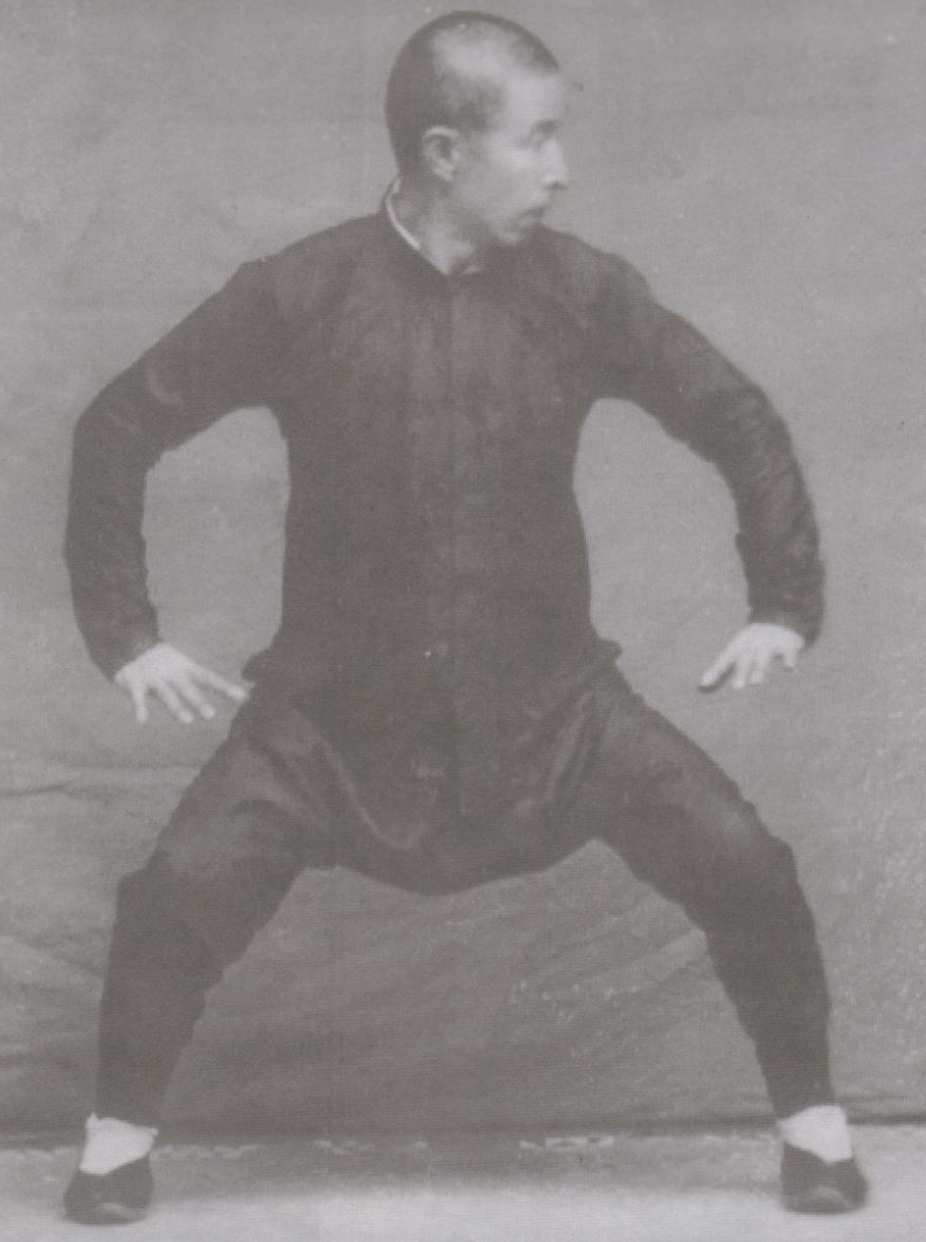
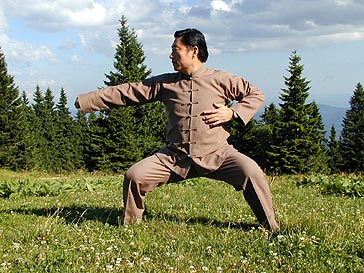
Here are some pictures of tai chi masters showing the type of Horse Stance I’m talking about:
Sun Lu Tang in a horse stance.
Chen Xiaowang
Taking it further
You don’t have to stop at just brushing your teeth in a Horse Stance. I like to also wash my face in the stance as well. I would shave there too, but I can’t see myself in my bathroom mirror when I sink down into a Horse stance, so that’s currently a no go for me. Perhaps I’ll get myself a second shaving mirror…
This is such a well made documentary about BJJ by Tim Ferriss that I just had to share it. It doesn’t hurt that it features Marcelo Garcia – my favourite BJJ practitioner of all time – and it’s clearly cost a lot of money to make, because the production quality is really high.
Here’s the premise: Tim Ferriss – one of those highly productive/annoying bloggers/podcasters/millionaires/motivational/4 hour week talker types – is going to challenge himself to learn BJJ in one week using a concept from his best bud the chess champion Josh Waitzkin to do with starting at the finish. Instead of learning all about BJJ in the way the rest of us do, he’s going to start with a finish move, the guillotine, then work backwards from there, and then try to do it live on a world champion. Yeah, good luck with that!
I’ve been a fan of Jack Slack’s fight breakdowns on Vice.com for years now. He’s got a keen insight into the fight game and a knack of knowing exactly why, on a technical level, one fighter just beat another. I’d go as far to say that he’s totally changed my appreciation of the depth of the technicalities of Mixed Martial Arts, and even inspired me to write a few breakdowns of my own.
So, I was really looking forward to Notorious, the life and fights of Conor McGregor, his first proper foray into the book world, in which Jack (that’s his nom de plume) applies his writing sharps to tackle the MMA phenomena that is Conor McGregor. But here’s the thing – in short articles, his keen observational style shines, especially when backed up with video or GIFs of the situations he’s describing. In book format he’s limited to drawings to illustrate his points. The result is a bit like listening to a boxing match on the radio – you just end up thinking this would be so much better if I could see what was going on.
But don’t let that put you off, especially if you’re a Conor McGregor fan. The book is essentially Jack describing every single Conor fight (up to his second Nate Diaz fight in 2016) in detail – right from his humble beginnings in Cage Warriors to to his title fights in the UFC. The endless blow by blow accounts of every match become something of a battle to get through themselves, and I found myself skipping paragraphs just to get to the more interesting and high profile fights later in the book.
It’s also noticeable that Conor the man is entirely missing from this book. There are no new interviews with him, no interviews with his friends or coaches. With no access to the star of the book all we have is a few quotes from other people’s interviews and UFC press conferences. We don’t really get any insight into the mind of McGregor. I’d love to know exactly how a kid with a background in pure boxing picked up all those Taekwon Do and Capoeria kicks. Where did he get them from? What was his inspiration? And how, exactly did he get so good at them? What are his training secrets?
Perhaps I’m being too harsh because there are plenty of fun moments to be had in these pages, especially later on when he gets into MMA politics, but Jack is more of an analyst than a Booker prize-winning writer. In a longer format, and without video clips to illustrate his points, he slips too easily into cliche – repeatedly calling blood “claret” – or churning out questionable analogies, like “with arteries closing faster than those of a Glaswegian chain smoker”.
If you want to find out exactly how the conflicting styles of Nate Diaz and Conor McGregor’s produced two of the most entertaining MMA fights in history then read on, for glimpses of what inspired the creative genius behind the techniques, we’re still waiting.
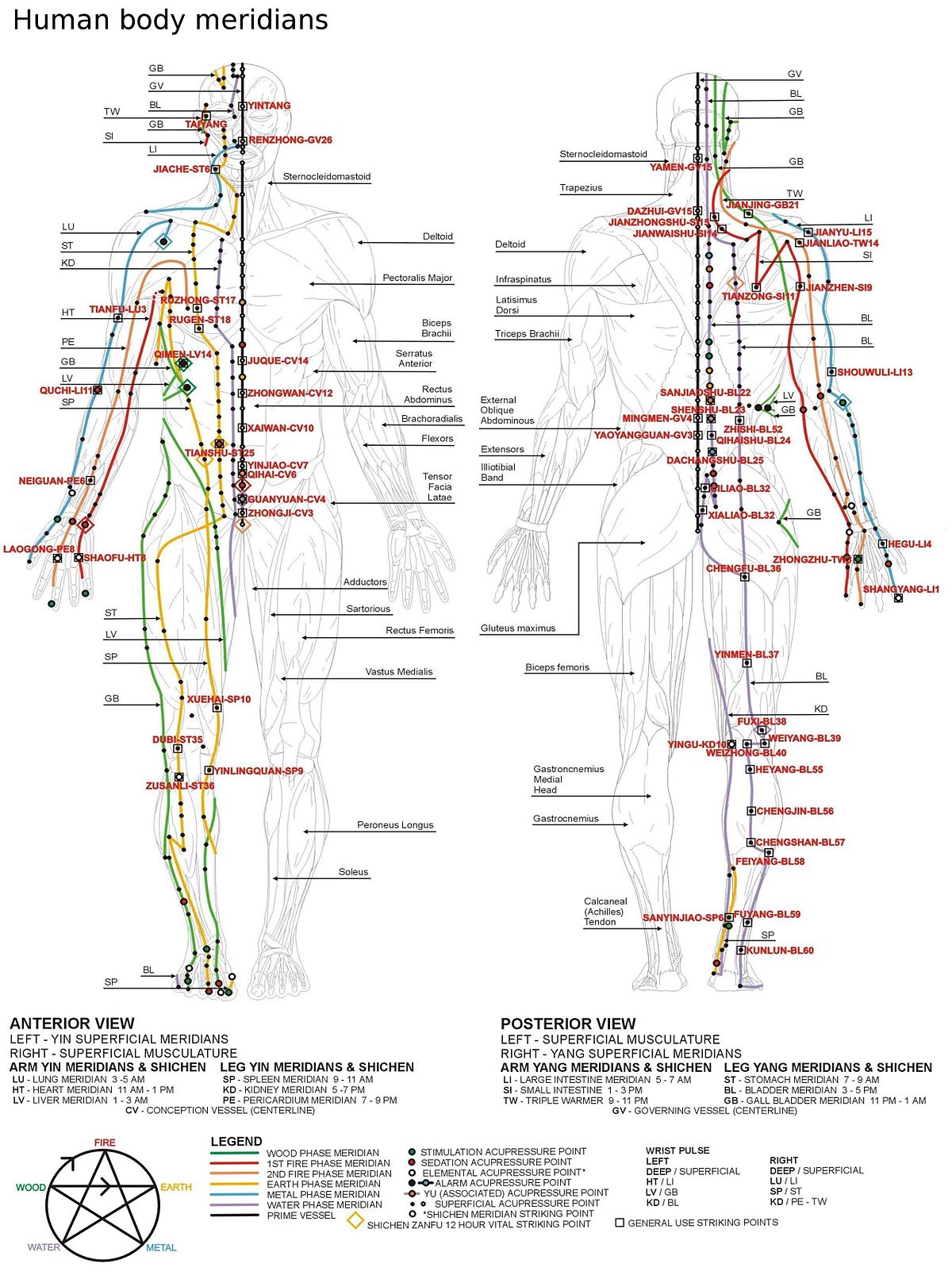
I think that somebody doing some background research into “Tai Chi” inevitably ends up looking at a picture of the “acupuncture meridians” and starts to wonder how they relate to Tai Chi Chuan.
The meridians are used in traditional Chinese medicine practices like acupuncture, massage and pulse diagnosis.
It’s very easy to jump to the conclusion that specific moves in Tai Chi Chuan must affect specific meridians (since, you know, they’re both Chinese…), and indeed a lot of Tai Chi literature will tell you things like this – for example, you’ll see it written that Wave Hands Like Clouds works on the belt meridian or Needle At Sea Bottom works on the bladder meridian.
Do they really? Who knows.
I remember asking my Tai Chi teacher about this and he just brushed it off as unimportant. He was right, too. The thing is, when you do an opening outwards movement, Qi (if there is such a thing, and if there is, then it’s probably not what you think it is) is moving through all the meridians equally in an outward direction, and when you do a closing movement it moves equally through them all in an inward direction. This sequence of opening moves turning into closing moves, which turn again into opening moves, and so on, is repeated throughout all Tai Chi Chuan forms, and is therefore the key feature of the art, and where it gets its name – you continually move from Yin to Yang to Yin to Yang, etc…
You don’t need to worry about the acupuncture meridians for practical considerations. The meridians are not exactly the same as the muscle tendon sinew channels (Jing Jin)first described in the Yellow Emperor’s Inner Classic (Huang Di Nei Jing) that Chinese experts will talk about. The meridians are more modern, and roughly drawn over the top of the old channels (so are useful for illustrating a general concept, like their same sidedness, for example) but they’re more detailed/fiddly, and not as useful for practical work because of that. You need broader brush strokes.
In internal martial arts you want to develop the connections in the muscle sinew channels so you can actually feel them. You’re starting point for developing these connections would be to use open and close movements. So (generally) the channels that go up the outside of the legs and up the back of the body are used for ‘opening’ and the ones on the front of the body are for ‘closing’ movements.
Using reverse breathing you try and feel a slight tension on the surface of the body and turn that into an opening outward, or a pulling inward, sensation, matched with the movement. (E.g. I breathe in and try and feel a pull along the ‘close’ channels of my arm, and let that lead my movement). You need to let this connection become the driver of the movement, taking over from the local muscles. Your shoulders are usually a source of problems, as is relaxing the lower back sufficiently. Remember to drive power (Jin) from the lower body (closest to the ground). Connections start gossamer thin and build up over time.
Any Tai Chi form movement would work for this, so find one you are familiar with and open up the back and close down the front. However, if I were to pick a movement to start with then a single arm silk reel would make most sense. Like this:
After months of this work you should develop a sense of how the Dantien naturally controls things.
I believe this is the basic path.
Alternatively (using the way most of us Westerners get taught) people learn lots of forms, techniques and exercises that make them feel like they know a lot, but then in 20 years they might meet an expert and realise that they didn’t start with the basics…
My old XingYi teacher’s Shamanism podcast is producing more material than I can actually keep up with, however a recent email pointed to three episodes that contain practical exercises that I though I’d share:
So…
Ep 16 lays down the foundation for what stage 2 is. The Amsgar, which literally means The breath. This is a deep look at the biology and science behind what it is we are doing here.
This is not to be missed. Its a fascinating foundation for whats about to come up.
Episode 17 introduces… wait for it… the Shamans Drum. Now this is like nothing you will have heard before. Its not about banging it and entering a so called trance. There is so much more to it.
Does the drum need to have a smell?
Listen to the episode to find out all about authentic and traditional shaman drums as well as a step by step look at this practical exercise called Boekhgeen Khengreg.





 The Tai Chi Notebook