I remember when I started Tai Chi in the 90s, one of the things that was talked about a lot was that you should never let your knees go beyond the line of your toes in a forward stance.
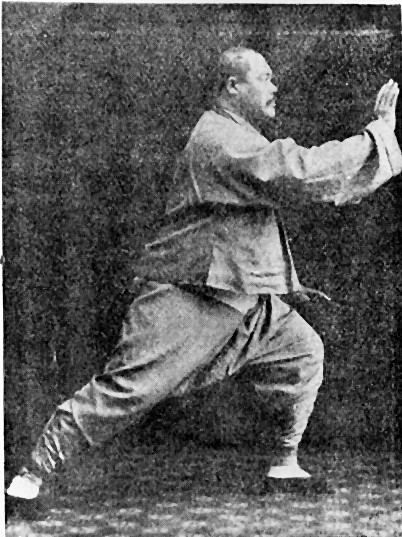
YCF: Knees not extending past the line of the toes.
Letting this happen was always seen as unequivocally bad. Not only was knees beyond toes seen as structurally unsound (your weight is too far forward making you easy to pull off balance), but this was seen as the primary cause of the epidemic of so many Tai Chi people having bad knees.
The Snake Creeps Down posture in particular was quite often used as an example of a badly done posture by Western dilettantes.
But it always struck me as a bit odd that it was seen as being such a dangerous thing to do. If you were training the martial side of Tai Chi then you were being punched, thrown and armlocked on the regular. Worrying about your knees going over the line of your toes seemed a minor danger in comparrison.
Fast forward to 2021 and today I found out that a lot of BJJ people (an art that specialises in slowly destroying your body over time) were raving about the benefits of the method espoused by the Knees Over Toes Guy on YouTube, who had achieved great results reparing people’s knees using a traning methods that empahsises, yes, you guessed it, putting your knees beyond the line of your toes as much as possible.
Interesting. Here’s what he says:
A year went by with no results. In fact, I was certain I needed another surgery when a spark of truth finally presented itself…
“The athlete whose knees can go farthest and strongest over his or her toes is the most protected.”
Everything I had been taught up to this point by dozens of trainers and physical therapists was very clear: NO KNEES OVER TOES — but when I read this statement, I immediately knew it was true.
Knees Over Toes Guy
The write up of his method is here. And here’s a video of his basic method is here:
The logic seems sound to me, so if you’ve got knee trouble, you might want to give it a try.
It makes me think – is the epidemic of Tai Chi people with bad knees (if it really exists) caused by the knees going over the toes? Or is it more likely because that group self-selects for other unhealthy behviours?
I think push hands is completely flawed as a competitive sport, which is why it ends up as a shoving match, but somebody (Jet Li?) is trying to change the rules to make it work better as an Olympic sport…. So here it is! It’s essentially more like wrestling, which is probably a good thing as it means you can move your foot.
And it’s got takedowns, but I think the question is then always … why not just compete at Shuai Jiao?
“I’m not aware of too many things, I know what I know if you know what I mean.”
Edie Brickell
I was listening to the Drunken Boxing podcast recently in which Byron Jacobs and Phil Morrell were talking about Phil’s training history in Fan style Baguazhang. At one point he mentioned two of his teachers and how different their approaches were. One, the daughter of the old master, would deal with tricky questions by showing the answer with a physical demonstration, but if you asked for an explanation of the technical details she would sometimes struggle. She could however, just do it. The other he mentioned had been a professional martial arts teacher all his life, and as such had a more varied teaching method. He could answer questions at a variety of levels, from physical demonstration to a discussion of theory.
Most people’s first introduction to Kung Fu was through the work of Bruce Lee – either his films, or the TV series Kung Fu, which he didn’t write, but was based on his idea. The TV series was full of flashbacks to Master Po teaching his Shaolin philosophy, and Enter the Dragon has the classic master and student discussion at the start, which anchors the whole film in a kind of generic Taoist philosophy. So, from the very beginning in the West, Kung Fu and philosophy arrived hand in hand.
Theory is one of those things that martial arts is chock full of, whether it’s yin yang symbolism or lofty philosophical ideas of the merits of the soft defeating the hard or the theory of the meridians and Chinese medicine. It’s impossible to deny that Kung Fu is built on theory.
But there’s an opposite view that theory has a limited place in the grand scheme of things and it’s inherently prone to misinterpretation. It’s an aid to understanding at a certain point, but quite a limited one.
Theory is an undisputed source of dispute in martial arts, especially online. The typical online argument about martial arts (as we discussed in our most recent Heretics podcast on martial arts and shamanism) is usually about the definition of terms. Different styles and different teachers tend to say the same things in slightly different ways, which are correct from their own perspective – provided the teacher understands it of course – but appear opposite when written down.
I think we can all agree that it’s perfectly possible to learn the practical application of kung fu without ever hearing the theory, but could most people could learn the theory and deduce the practical application?
True or not, he makes a good case for the move not being the backfist or punch it is usually shown as, and being a throw instead. In a way, there’s no right answer – the move is whatever you use it for.
But it made me think a lot about how Kung Fu postures are repurposed and reused through the years.
If we go back to one of the earliest written descriptions of Kung Fu by General Qi Jinguang in his “Boxing Classic” of 1560 we can see that all he’s showing are a series of still postures with written verse about the move in question.
You can see that the first posture shown, “Lazily pulling back the robe” shares some similarties with the posture discussed above.
Lazily pulling back the robe, Qi Jinguang, 1560
A Confucian cuture of respect for tradition and elders would naturally lead to respect for older kung fu postures, and you can see how they would get reused and repurposed to fit new needs over the generations.
I bet the current Yang style Single Whip posture is not chosen because it’s the optimal way of pushing forward with a single palm. Instead, it’s more likely a posture that has been passed down from older generations. Maybe it’s original meaning (if it had one) has been lost, over the years. Maybe it was once a Suai Jiao throw? Maybe it was once a posture from Chinese theatre or religious ritual? Who knows.
The important thing is, as always, what can you do with it now?
The classic TV series is back! This time the lead is female and the cast is almost all Asian. I’m looking forward to seeing what they’ve done with it. I thought the trailer was pretty good. Not sure how I watch this in the UK though…?
One admonition from Yang Cheng Fu’s 10 important points, that has become something of a law in Tai Chi Chuan, is to ‘keep the head suspended, as if from above’. In the Tai Chi Classics it also states “Stand like a perfectly balanced scale and move like a turning wheel”, whilst also saying, “Don’t lean in any direction; suddenly appear, suddenly disappear.”
These quotes have produced all sorts of controversies in the Yang style side of the Tai Chi universe. If you look at ChengFu’s student Cheng ManChing, who did so much to popularise Tai Chi in the West, you can see that he changed his form to truly embody this principle of suspending the head and standing like a perfectly balanced scale. In a forward posture, Cheng ManChing kept his head, neck and back vertical in relation to the ground at all times. He allowed no forward incline at all. To stay vertical he softened his back knee a bit, which removed the straight line from the heel to the head, producing a much softer posture than his teacher, Yang Cheng-Fu, exhibited.
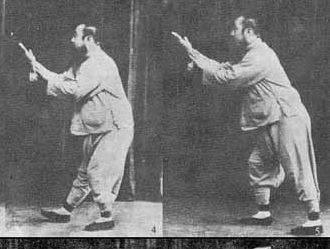
Whereas, if you look at pictures of Yang Cheng-Fu in a similar forward posture you can clearly see that he holds his head in the same vertical alignment, but holds his back with a slight forward incline. He keeps his back leg straighter, forming a straight line from his back heel to his head, meaning that his posture is slightly harder than Cheng ManChings, and he exerts more of a forward pressure.
Both of these approaches can be seen as interpreting the advice to not “lean in any direction” differently. The situation becomes even more confusing when you look at the Wu style of Tai Chi Chuan, derived from the version of the form practiced by ChengFu’s peer Wu Jianquan. Wu holds an even more inclined position, which keeps the head vertical, but often seems to break the line at the hip, so that the back heel is no longer in a straight line all the way to the head. Being of Manchu heritage, Wu Jianquan had a shuai-jiao background. He was taught martial arts by his father who was a student of Yang LuChan and also a cavalry officer and imperial palace guard, as he was, so a change in his preference for grappling techniques could very well account for the changes in his version of the form.
I used to ponder these discrepancies a lot, but these days I have become more interested in the relation of the back (including the neck) to the hands and arms, regardless of its orientation in the vertical plane. When we lift and use our arms our tendency is to bend the top of our spine and drop the head forwards, a fact that can be proved each and every time you type on a laptop. The next time you’re sitting at a laptop observe what happens when you start to type. Notice that your head wants to move towards your focus of attention, the object you are interacting with.
Recently I was watching an excellent performance by a child doing Bak Sing Choy Li Fut, filmed in the 1960s. Young children doing martial arts can be great teachers because they effortlessly keep their posture as they move. It is only as we become adults that we seem to lose this ability.
Search for the video “Old Kung Fu Footage in Hong Kong in the 1960’s” on YouTube and you’ll see what I mean. Watch the good posture he keeps throughout – his back remains still in relation to the movement of his arms allowing his neck to stay extended and space and awareness to be present.
This is what I think is being asked for in Yang Cheng-Fu’s writings and the Tai Chi Classics, not mere fussing about how vertical a posture is. What is required is the freedom to move our arms, but to keep our back still, and maintain our head and neck relationship without falling into the trap of bending towards the object of our attention.
But how do we train this? Here’s something simple you can try. Get a 4-pint carton of milk out of the fridge and swing it in a figure of 8 in front of you. Now do it again and notice how you head wants to be pulled forward. Resist the pull and feel the work done by the neck and back muscles to prevent it from happening. It shouldn’t feel like they’re straining, but they should feel active.
You can do the same thing with a heavy sword, of course, if you want to look more like a traditional martial artist, and less like a deranged milk man. And once you get a feeling for it you can try it without a heavy object, in which case it becomes more like a silk reeling exercise, or you can try and keep the same feeling when you do the Tai Chi form. In which case it doesn’t look like anything.
Obviously, when you are standing still, or sitting, in meditation you can achieve the same relationship of the torso, neck, head and arms but with even less use of muscle to maintain the position. Initially at least. If you try standing in a Zhan Zhuang posture with your arms extended for a few minutes you’ll start to feel your neck and shoulder muscles tighten. This is where you need to work on relaxing them, yet maintaining your posture. You need to let the weight of the upper body rest on the lower body, and flow down into the ground through the centre of the foot, or through the sitting bones if you are seated.
A human head is quite heavy, at around 5KG, which is a lot more than a typical bowling ball weighs. If the head moves forward of the hips too far then we have to start using a lot of muscle to hold it up. In a way, the neck being tense, or feeling tired, after we’ve been doing an activity is a warning sign that we’re not using our body to the best of our ability. If we can maintain the relaxed, neutral, position of the neck through movement, then the weight of the head is transfered down to the ground through our frame instead. Our breathing will be better, and we won’t lose that sense of lightness and ease that the kid in the Choy Li Fut video from the 1960s so effortlessly demonstrates.
Finally, his idea of keeping an open relationship between the head, neck, back and arms raises a few good questions when applied to martial arts. What springs first to my mind is, should you have your head in that position to fight? I’d say probably not – you want to tuck your chin in a bit more when you fight, for obvious reasons, but the real question is how you tuck your chin. The idea of the extended neck that you’re training by working on your posture can be transferred into the way you tuck your chin. Dropping the head towards the opponent has all the same disadvantages we’ve outlined above when applied to martial arts, and will inhibit the free movement of your arms, so critical to fluid punching, not to mention making you more hittable.
So, keep your head up, as people say to you when you’re looking down. Walk lightly, smile brightly!
“Western enthusiasts often feel impelled to strip away these religious trappings and construct a version of the martial arts that is neither simple gymnastics nor religion, but emphasizes true hand-to-hand combat skills. The question remains, is this an authentic understanding of the martial arts?”
Charles Holcombe, Theater of Combat (1990)
I think it’s important to bear in mind Charles Holcombe’s classic article, Theater of Combat, when thinking of Chinese martial arts.
One recurring trope that I encounter from, as Holcombe puts it, “Western enthusiasts”, (a label I would apply to myself) is the idea that the Chinese martial arts styles evolved as effective fighting systems in a purer time, before the use of firearms became widespread, and that they gradually went out of favour as practical self defence arts in the face of modern weapons, and turned their attention instead to the more lofty goals of attaining physical fitness, health and spiritual enlightenment.
The idea gives credence to the original version of these arts being purely pugilistic. It follows that once the evil West showed up with their firearms the martial arts needed to find some other way to survive, so it tended towards gymnastic displays or spiritual attainment. It’s a neat idea, but it doesn’t really hold sway with reality.
People forget that China is credited with inventing gunpowder and that the ‘older’ version of its martial arts was intricately embedded within a culture whose religious expression was revealed through performance at festivals and ceremonies, often officiated by a priest performing a ritual with a sword or a troupe of performing martial artists acting out conversations with the gods.
Also, I think the “whiff of ancient mysticism” (as Judkins calls it) around the martial arts makes people think of them as being incompatible with modern methods of warfare, like the gun. A popular theme within marital arts films, for example, is that of the introduction of guns destroying the old order, usually involving the death of an old master at the hands of a less skilled and resentful disciple who only had to pull the trigger.
But, as Judkins explains, these media perceptions have twisted the truth:
“Historically speaking, this is totally backwards. First the guns came, and then the modern martial arts developed. What we see in China is quite similar to the puzzle that made life difficult for Perrin when he discussed Japan.
Firearms have been a fact of life in China since the 1300s. At first they were difficult and expensive to manufacture, but the government employed large numbers of hand cannons, field artillery pieces and even massive rocket launchers from an early period. If you are curious about what early military gunnery looked like you should check out theFire Dragon Manual. At the start of the Ming dynasty Chinese firearms were probably the most advanced in the world. So what happened?”
“Sport” is kind of a trigger word for a lot of martial art practitioners, at least some of the ones I’ve met! So telling them they should train their martial art more like a sport usually goes down like a cold bucket of sick, but really I think they should listen.
When here’s the thing: Training your martial art like a ‘martial art’ is often an excuse for not working very hard and not really pressure testing anything you do.
Sport is a sweaty, dificult, thing to do that usually involves doing something pretty athletic (unless you count darts). Sport is also structured. Quite often in a martial art there is no real training methodology. People just turn up, do a few forms, practice a few safe applications against little or no resistance then go home again. The learning process can be a bit random.
I should stress, I don’t really think that there’s anything wrong with that, depending on your motivations for training, which often change as you age. Just feeling good about doing something is certainly reason enough to do it, but I think you should ask yourself, what progress are you really making? And, worse, are you becoming delusional?
Sports, in contrast, tend to be very structured. You train attributes specifically, and you engage in a focussed practice where you can drill to increase your ability in tightly defined things. Sometime those things are measured. You sit down and discuss progress with your coach. You troubleshoot and then you give it a go against somebody who is going to be uncooperative and gives you feedback. That’s real testing against nature – the sort of thing a human shaman would engage in 10,000 years ago.
Martial arts also have strange rules that sports don’t have – we have to call people odd titles like Sifu or Professor. There’s bowing and etiquette that looks strange to people outside the system. I can understand the cultural reasons for a lot of these things, but I often wonder that when these arts are put into a different culture, whether some of these things should be left behind because they’re not helpful and, in fact, can stand in the way of progress. For example, the little quirks like bowing to photos of dead guys or using a 1-2-3 clap system can gradually breed a cult-like quality of obedience that makes us stop questioning things.
I saw a brilliant video of a Muay Thai coach recently. I love the tiny details he’s giving. Muay Thai is an interesting martial art because it’s probably the most traditional martial art remaining on the planet, but it’s also a sport. It is undoubtedly effective and trained at the highest level in popular combat sports. I think there’s something to learn from that.
As I said earlier, I don’t think we need to make all martial arts into competative sports, but I think we can take elements of the sporting approach and apply it to what we’re doing, regardless of the martial art we’re doing.
Finally, the inspiration for this post is the latest brilliant episode of the BJJ Mental Models podcast to featuring Priit Mihkelson, about how to train your martial art like a sport. Give it a listen.
One of the frequent criticisms I hear of the idea that there is a connection between Chinese martial arts and Chinese theatre and religion is that no respectable Chinese martial arts teacher has ever implied their work comes from dance or spiritual ritual, so the idea is laughable. I have experienced a pretty negative reaction from some of my Chinese martial arts friends to these ideas. The thought that the rough and tough martial art they genuinely suffered to learn and dedicated their lives to had religious or (worse) theatrical origins is anathema to their world view, akin to an insult.
But the question really is, how can they not be theatrical? Just look at Chinese martial arts – of course they’re theatrical!
Here are some questions to ask yourself: Why do we do long complex, showy forms at all? Why is Chinese martial arts still so strongly associated with Lion Dance? Why do its modern day performers so often put on demonstrations for the local community, on stages? Why do performances sometimes have chaotic drumming soundtracks?
I’m sure any competent Chinese martial arts practitioner can produce answers to all these questions based entirely in the physical realm of pugilism – it’s all physical training at the end of the day – but when you put all these questions together an obvious picture begins to form.
Nobody looks at Capoeira and says, “this has nothing to do with dance”. So, why do most Chinese martial arts practitioners look at their long theatrical forms and say, “this has nothing to do with theatre or religious practice”?
There’s an inherent mystery to Tao Lu, or “forms” found in Chinese martial arts. This great video by The Scholar-General hopes to provide some answers:
The blossom is out on my tree and spring is in the air! So, it’s time to record a new video.
Yesterday was St. Patrick’s Day, the saint who drove the “snakes” out of Ireland (a country which has never had snakes). I see a lot of people doing Xing Yi snake forms and generally I don’t like most of it. Sorry. It always seems a bit “dumbed down” to me. Linear and basic, and not very representative of the actual animal. Snakes coil, they twist, they wrap and they strike suddenly and swiftly. Those characteristics need to be present if you are going to embody the Snake (She Xing).
But rather than post videos of other people’s work and criticise it, (which seems to be a favourite pastime of people on the Internet), I thought I’d make my own and try to promote my mate Glen’s Xing Yi Snake book in the process:
Somebody commented on another of my videos that they liked the weapons work I’ve included previously, so I put some Snake sword in there too. As with all Xing Yi, you can see the barehand work is simply a translation from the weapons work. The application pictures are from Glen Board’s book Xing Yi Snake, (which I’ve reviewed here), that I worked on with him.
I actually recorded this video just before I did my regular Tai Chi practice, and I noticed that my Tai Chi form became infused with the flavour of the Snake Xing I’d been practicing previously and became very coily indeed! This is what the Xing Yi animals are like – they’re like strong flavours of tea, that you add to your hot water. Ultimately you should be able to blend all 12 freely. I don’t think there’s enough lifetimes left for me to do that though, which is why I tend to stick to the ones I prefer. Different Xing Yi practitioners tend to be heavily ‘flavoured’ by the animals they prefer.
But why snakes? What’s the advantage in studying them? There are many legends about snakes, but not many actual snakes to be found in the UK, so we don’t generally know too much about them, but it’s pretty clear from watching this YouTube video showing python attacks that they’re absolutely fearless predators:
What surprised me most about that video is how close the python manages to get to its prey before it strikes. I guess it must be to do with being absolutely silent as it moves? I don’t know. Either way, a python is a terrifying grappler and an ambush predator combined into one. You can see why horses, monkeys and man has a built-in snake phobia.
As Wikipedia notes: “Historically, serpents and snakes represent fertility or a creative life force. As snakes shed their skin through sloughing, they are symbols of rebirth, transformation, immortality, and healing. The ouroboros is a symbol of eternity and continual renewal of life. … In Hinduism, Kundalini is a coiled serpent.”
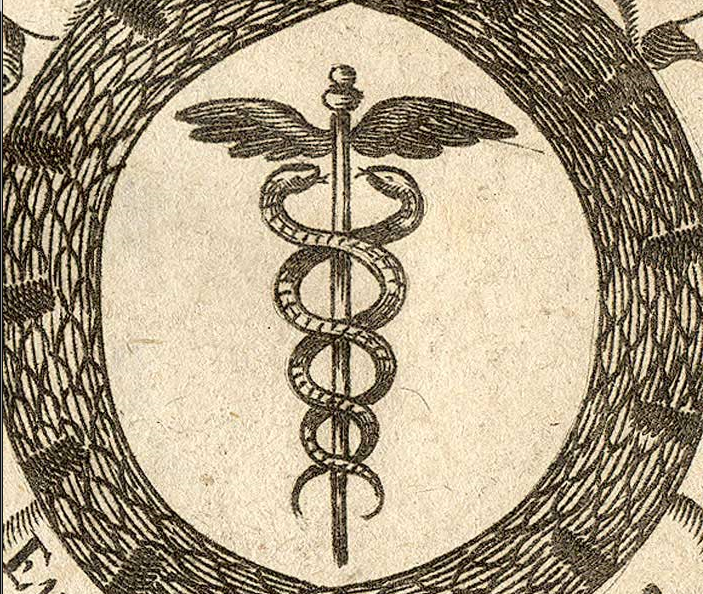
Carl Jung had a lot to say about snakes. The ouroboros is cool symbol, a Western Yin/Yang, but the most recognisable snake symbol in our daily lives is the caduceus, the traditional symbol of Hermes and a symbol used in many esoteric religions and associated with healing:
The (very similar) Rod of Asclepius is still used on ambulances today:
Close Up of Caduceus Medical Symbol on Rear Corner of Ambulance Vehicle
“Some accounts suggest that the oldest known imagery of the caduceus has its roots in a Mesopotamian origin with the Sumerian god Ningishzida; whose symbol, a staff with two snakes intertwined around it, dates back to 4000 BC to 3000 BC.[3]“
In Roman mythology the caduceus was often held by Mercury, harald of the gods, which brings me back to where I started, with the blossom on my tree being the herald of Spring.
And, bit like the ouroboros itself, I took a circuitous route to get there!





 The Tai Chi Notebook