I discovered this amazing poem recently and thought it was too good not to share. I think it relates nicely to the world of Tai Chi. I hope John Roedel doesn’t mind me sharing it. Check out his book on Amazon.
“I wrote this poem 8 months ago and it changed my life” by John Roedel
my brain and heart divorced a decade ago over who was to blame about how big of a mess I have become eventually, they couldn’t be in the same room with each other now my head and heart share custody of me I stay with my brain during the week and my heart gets me on weekends they never speak to one another
instead, they give me the same note to pass to each other every week and their notes they send to one another always says the same thing: “This is all your fault” on Sundays my heart complains about how my head has let me down in the past and on Wednesday my head lists all of the times my heart has screwed things up for me in the future they blame each other for the state of my life there’s been a lot of yelling – and crying so, lately, I’ve been spending a lot of time with my gut who serves as my unofficial therapist most nights, I sneak out of the window in my ribcage and slide down my spine and collapse on my gut’s plush leather chair that’s always open for me ~ and I just sit sit sit sit until the sun comes up last evening, my gut asked me if I was having a hard time being caught between my heart and my head I nodded I said I didn’t know if I could live with either of them anymore “my heart is always sad about something that happened yesterday while my head is always worried about something that may happen tomorrow,” I lamented my gut squeezed my hand “I just can’t live with my mistakes of the past or my anxiety about the future,” I sighed my gut smiled and said: “in that case, you should go stay with your lungs for a while,” I was confused
the look on my face gave it away “if you are exhausted about your heart’s obsession with the fixed past and your mind’s focus on the uncertain future your lungs are the perfect place for you there is no yesterday in your lungs there is no tomorrow there either there is only now there is only inhale there is only exhale there is only this moment there is only breath and in that breath you can rest while your heart and head work their relationship out.” this morning, while my brain was busy reading tea leaves and while my heart was staring at old photographs I packed a little bag and walked to the door of my lungs before I could even knock she opened the door with a smile and as a gust of air embraced me she said “what took you so long?”
Rushing is probably the cause of most of our problems. That time you didn’t notice the uneven paving stone and tripped? You were probably rushing. That time you shouted at the kids because they couldn’t get their shoes on fast enough while leaving the house? You were rushing. That time you accidentally emailed a picture of yourself drunk to everybody in the company? You were definitely rushing then.
In nature, wild animals can move a lot faster than we do, but do they ever look like they’re rushing? A rabbit sprinting for its life to avoid a fox still moves with poise, dignity and grace. Compare that to the embarrassment of the average human running for a bus, an act in which the stakes are considerably lower! Even a cat, an animal known for incredible bursts of speeds pauses for a second before it makes that leap onto a table, so it can be aware of the entirety of the situation.
But how can we learn to stop rushing all the time and regain this poise which animals seem to naturally have? One answer is Tai Chi.
If you’ve been doing Tai Chi for a while, a good number of years, then you’ll know the form inside out. It’s no longer a fresh, new and exciting thing. In fact, your mind is probably bored with it. Here we go again, this same old moves. Sigh. Stand for a moment before you do the form and you’ll notice feelings of impatience start to creep in. Part of you will want to start rushing, to get it over with as quickly as possible
This is where your slowness training is useful. Do the form slowly, at an even pace and just keep doing it. Resist the call the start speeding up and rushing sections. Treat all parts with equal importance. Even the linking moves between the classic postures. Notice your breathing. Keep your awareness on what you’re doing. Don’t let the mind wander off – keep it in the body and keep bringing it back. If you do notice that it’s wandered off completely then stop and start the form again, no matter how far you’ve got. Slowly, day after day you build a kind of mental strength, and if you’re lucky you’ll find it seeps over into the rest of your life, and you’ll be less prone to rushing than you were before.
Stop rushing and you no longer slip up,
Stay in the moment and strains are no longer felt,
When strains and no longer felt, stresses start to disappear,
I’ve been meaning to write a post on Shaui Jiao, the Chinese wrestling style, for a while now. We covered Shuai Jiao in one of our Heretics Podcast episodes a while ago, but you can’t say that it was a particularly good primer on what Shuai Jiao is. As usual, Damon found an obscure angle and the episode is really more about the strategies associated with the Azure Dragon in China, and linked somewhat tangentially to Shuai Jiao.
Shuai Jiao is wrestling. It’s done in a jacket, which can be gripped, and consists of a variety of throws and trips, the aim being to get your opponent to touch the ground with any part of their body other than their feet. It’s popular in various parts of China and regional styles have sprung up in different areas.
Almost any book you buy on Shuai Jiao will inevitably start with a history section, where the author links Shuai Jiao back to various ancient Chinese wrestling styles from different points in time – things like Jiao Di (‘Horn butting’) get mentioned. The idea is to establish a link between the Shuai Jiao practiced in China today and ancient wrestling arts spanning back several dynasties. The propaganda arm of the Chinese government would really like you to know that Shuai Jiao is 1) ethnically, Chinese, the ancient art of the Han peoples, and 2) Old.
Unfortunately, neither of these things are true. While things like Jiao Di, and actual wrestling styles existed in the past, there is no connection between them and Shuai Jiao.
Shaui Jiao itself is neither ancient or “Chinese” in origin. It has no direct connection to anything practiced by the ethnic Han Chinese. It was actually imported by the Manchu, the northern tribe who invaded China, overthrew the Ming Dynasty and started the Ching dynasty from 1644-1912. Like the Mongols before them, the Manchu loved wrestling as a form of strengthening soldiers and entertainment.
Byron Jacobs has produced an extensive history of Shuai Jiao over three videos that’s well worth a watch if you want to understand where Shaui Jiao really came from:
Of course, the origins of an art have no direct relationship to its effectiveness. As Damon says in the Heretics episode, being good at any form of wrestling is a big advantage in any martial art. Physical conditioning, being a strong robust person who is fit and good at physical alignment is a useful thing.
But wrestling often has more of a community function than other martial arts, and it’s the same in China as it is in the West – wrestling can be great fun. There is a Chinese Shuai Jiao tradition called Tian Qiao Shuai Jiao, which is an intangible cultural heritage of China. It’s a style of wrestling-based entertainment that any body who is familiar with the same tradition in the West will instantly recognise:
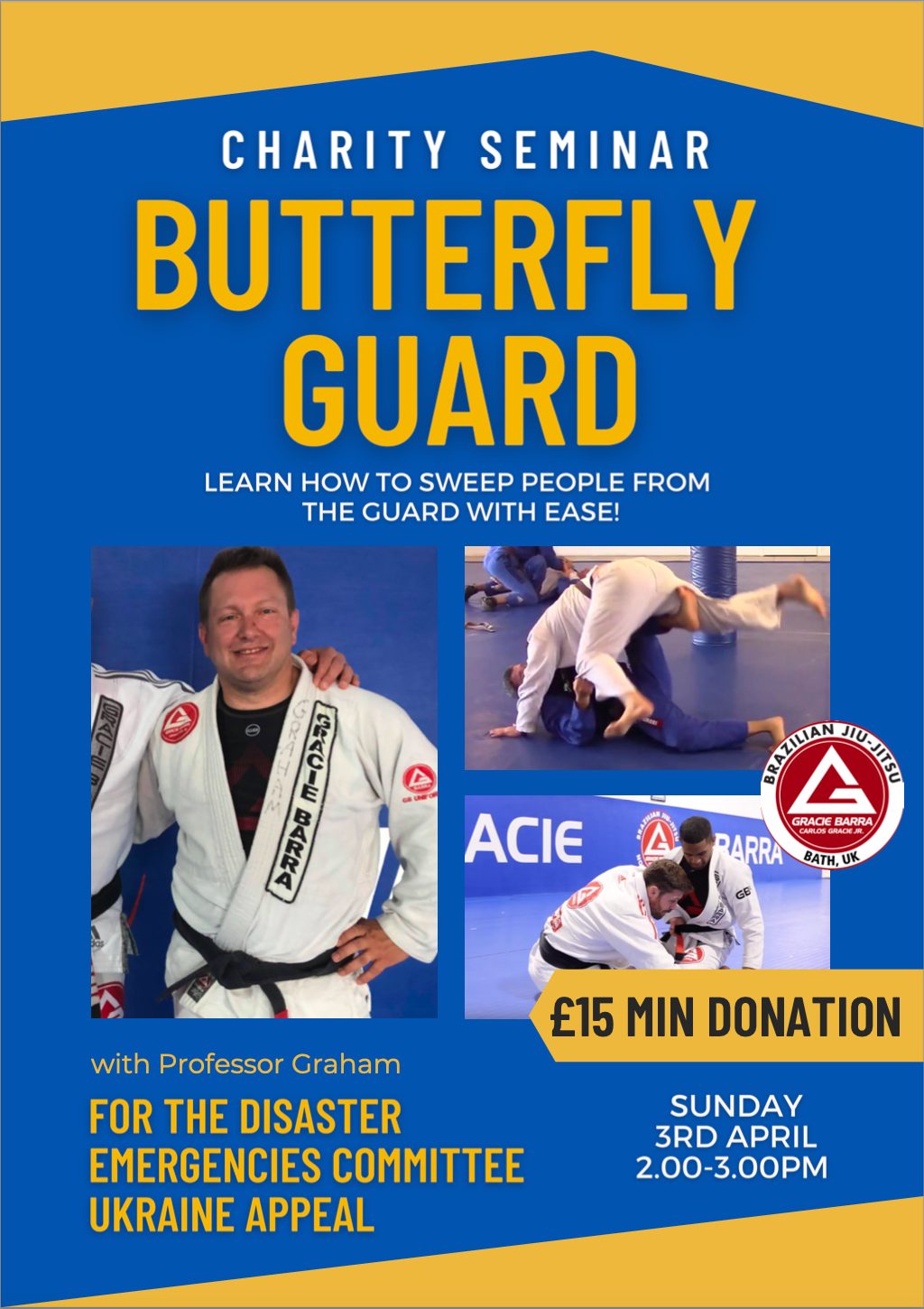
Just a heads up, I’m doing a BJJ seminar on Sunday at Gracie Barra Bath in aid of the Disasters Emergency Committee, Ukraine appeal. It’s open to all and £15 minimum donation. The Justgiving page is here. Thanks.
Let’s take a little diversion into the world of Brazilian Jiujitsu. Here is a video I shot this morning that shows some of my favourite options for getting submissions from side control. For some reason the sound didn’t work, but hey ho, let’s roll.
I’m demonstrating how I like to keep my knees off the mat, so that my body weight is going straight into my opponent, which I use to pin him, freeing up my hands. The hands are then free to see submissions. I show some chokes and armbars. The very last choke, where they get choked by their own arm across their body is my most common submission. It’s quite opportunistic, but the opportunity is there quite a lot if you know to look for it.
If you enjoyed this sort of content then you’ll probably enjoy my chat with BJJ black belt Stephan Kesting of GrappleArts.com. We talk about a lot of BJJ issues and also how BJJ has changed over the years.
Arlene Faulk is the author of Walking on Pins and Needles, her memoir of living with multiple sclerosis without a diagnosis for many years, spending two years not getting up from the couch and how she eventually found Tai Chi and how it helped her combat the disease and regain her health, eventually becoming a Tai Chi teacher herself. Make sure you listen right to the end as we have some tips from Arlene on how you can use Tai Chi principles discussed in the Tai Chi Classics to feel better right now as you listen to the podcast.
This Xingyiquan video caught my eye recently. It’s a good performance and demonstrates a nice range of material drawn from Xing Yi’s animals and elements. The performer is doing it well, and using some untypical examples of the animals in some cases, which adds a nice bit of variety.
Check it out:
Xing Yi is typically split mainly into two big demographic styles known as Shanxi and Hebei. The video shown here is a good example of Hebei style. It’s practiced by Sun Liyong, a famous Xingyiquan master from Beijing Simin Wushu Club.
If you’d like to know more about the different styles of Xing Yi and how they evolved then check out my history of Xing Yi podcast series.
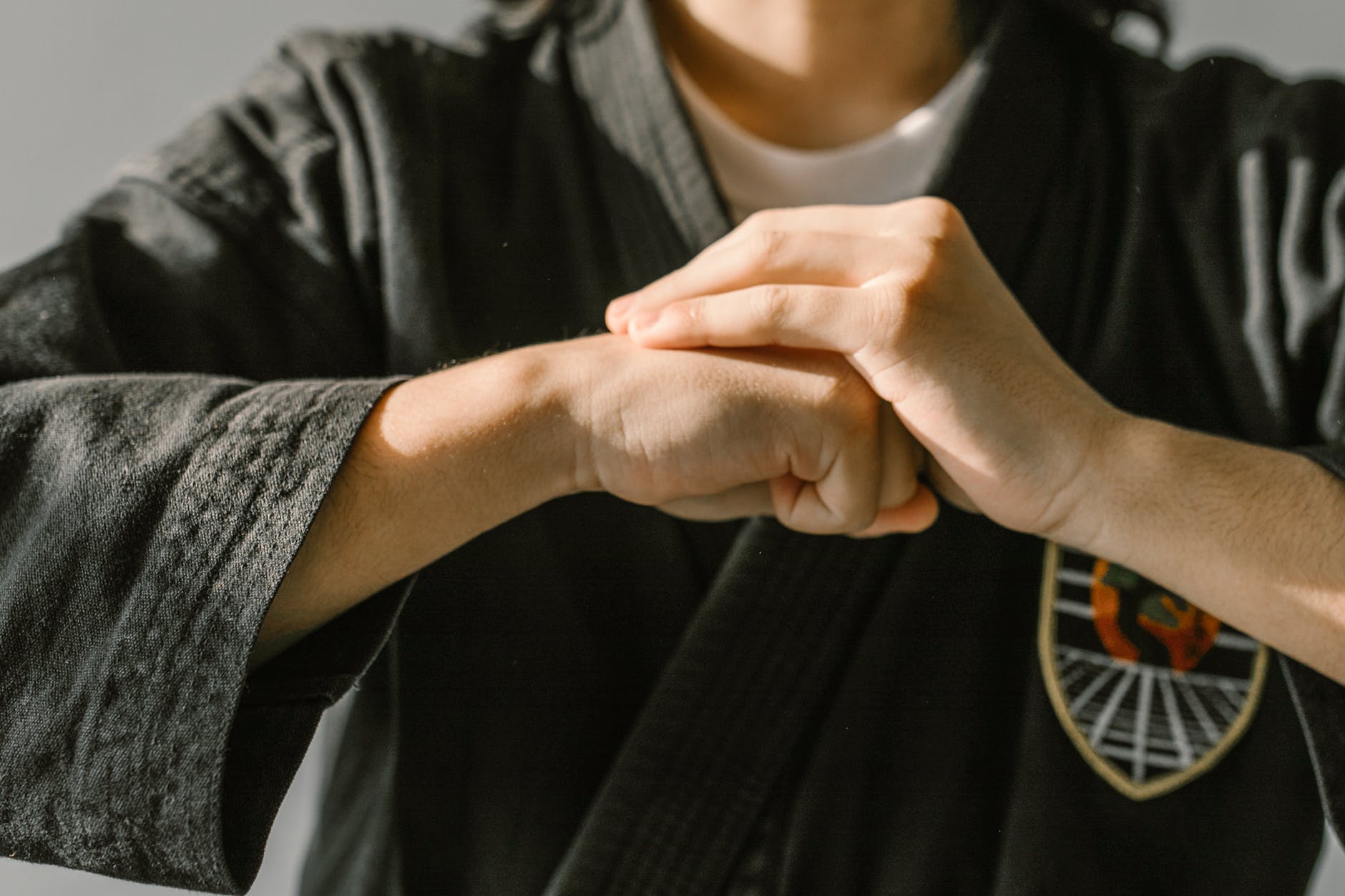
A sphere is one of the strongest shapes regardless of the direction of force. Photo by Laura Tancredi on Pexels.com
I wanted to talk today about the concept of the Tai Chi ball, or more accurately, Tai Chi sphere. While it might sound simple, I think it’s really an advanced concept because it’s taking the Tai Chi teachings out of the realm of specifics, of things like ‘relax that shoulder’, ‘move that foot’, ‘drop that elbow’, ‘align that hip’, etc…, and into the realm of concepts, which are much harder to pin down into physical details.
The Tai Chi Classics talk about Tai Chi being circular a lot. For example, it says:
“The postures should be rounded and without defect, without deviations from the proper alignment; in motion, your form should be continuous, without stops and starts.”
At a certain point the position of the hands and feet and other body parts in Tai Chi gets subsumed by the general sense of keeping your body and all your movement rounded, like a ball. (Newsflash: despite a thousand form corrections from seminar masters, the exact position off your hands isn’t what’s important.)
What’s important in Tai Chi is that your body is creating a ball-like structure, with ‘you’ at the centre. That’s what determines if you hands and arms are in the correct position, not angles and degrees. If you are making a sphere with your movement and body, then everything will be in the right place, and if you aren’t, it’s not.
The advantage of creating a sphere is that force can comes in and be rolled off without too much interference and muscular tension. A sphere is a Tai Chi symbol write large, in 3 dimensions.
The Tai Chi Classics talk about Tai Chi Chuan being circular. Photo by Sindre Stru00f8m on Pexels.com
The idea of separating empty and solid in the body goes hand in hand with creating a Tai Chi sphere. In fact, I don’t think you can do it successfully without a separation of empty and solid – or yin and yang – in the body.
But here’s the kicker. You can’t just decide one day to do this practice. You can’t go outside right now and do you form and decide to make your Tai Chi like a sphere because it will be meaningless. Instead, it’s a situation where you gradually discover, after many years of practice, that Tai Chi is like a sphere. One day you’re practicing and you suddenly notice it, and bang! Your Tai Chi will never be the same again. It’s like that famous picture that looks a bit like an old man but isn’t:
You either know or you don’t! Can you see what this is a picture of?
Most people are unable to see what that is actually a picture of at first glance, but once you get it, no amount of me trying to persuading you otherwise will prevent you from knowing exactly what it is.
It’s the same with the Tai Chi sphere. Your Tai Chi has always been a sphere, you just didn’t know it, until one day you did, and then it was suddenly obvious to you.
Referring to the Tai Chi Classics can help your practice. Photo by RODNAE Productions on Pexels.com
I’m writing this as a kind of follow up to my previous article on 3 views of qi in Tai Chi. That article contained the 3 different things I think people really meant when they talk about qi in Tai Chi. This article aims to do the same thing with yi. I don’t consider myself an authority on either matter, but I have had some skin in the Tai Chi game for a while now, and I’ve read enough of other people’s writings to come to some conclusions about what I think they’re talking about. Hopefully you’ll find these definitions helpful, and I’d be interested to hear your thoughts in the comments section.
Yi gets a few mentions in the Tai Chi Classics, and is usually translated into English as “intent”, or “mind-intent”, a translation which I think can be problematic because there are at least 3 different things that people mean when they say “intent” in Tai Chi, and while the three are obviously related, they’re also quite distinct from each other.
Before we get into the definitions, let’s have a look at what the Tai Chi Classics have to say about yi:
The most quoted line regarding Yi is in the Tai Chi Classic: “All movements are motivated by yi, not external form”, which can also be translated as “use the mind, not force”. In no.6 of Yang Cheng-Fu’s 10 important points he says:
“6.) Use the mind instead of force. The T’ai Chi Ch’uan Classics say, “all of this means use I [mind-intent] and not li.” In practicing T’ai Chi Ch’uan the whole body relaxes. Don’t let one ounce of force remain in the blood vessels, bones, and ligaments to tie yourself up. Then you can be agile and able to change. You will be able to turn freely and easily. Doubting this, how can you increase your power?”
So, here the emphasis is on relaxing and not using “force”, but why? And What does that mean? I will explain later.
Interestingly, right after that line, the Tai Chi Classic then goes on to say:
“If there is up, there is down; when advancing, have regard for withdrawing; when striking left, pay attention to the right.
If the yi wants to move upward, it must simultaneously have intent downward. “
Definition 1: Martial intent
Given the lines quoted in the Tai Chi classics above I find it strange that the most common interpretation of yi in Tai Chi is as a kind of martial intent. Here intent is “your intent to do something”, and in Tai Chi people generally mean a martial intention that needs to be contained within every particular posture or movement. So, for example, when you do the ward off movement, you need to have the intention of deflecting a blow away. If you movement lacks that intention, it is said to be empty.
Now this may all be true, and not knowing the martial applications of a movement inevitably leads to it becoming too abstract and unfocused, but this understanding of ‘intent’ is clearly not what is being talked about in the Tai Chi Classics when it admonishes us to “use the mind, not force”. If all it meant was to have a martial intention behind the movements, then it’s impossible to see how that can match up with lines from the classics like:
“If the yi wants to move upward, it must simultaneously have intent downward.”
What has that got to do with martial intent?
Clearly this is talking about something else. Yes, a martial spirit is obviously important for Tai Chi, and some Chinese teachers refer to an “eye spirit” which his making sure you are focused and looking in the right place in form performance, and you look like your actions are martially proficient, but I don’t really think this is what is specifically meant by yi in the Tai Chi classics.
Definition 2: A line of intent from the ground up
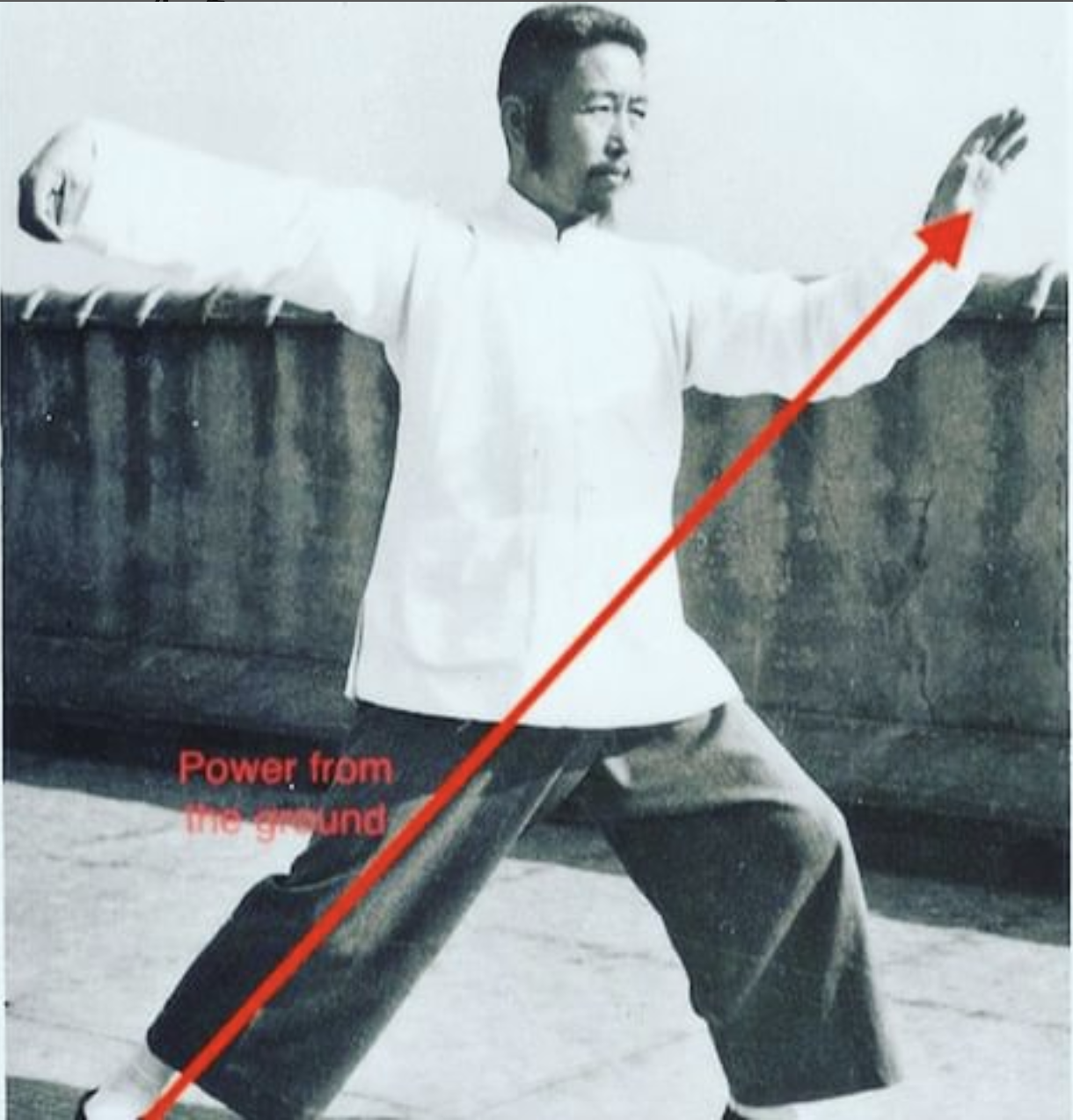
The second way that people refer to intent in Tai Chi is as a line of force, usually from the ground to the point of contact with the opponent. The idea in Tai Chi is to bring the solidity of the ground to your point of contact with the opponent. How do you do this? Well, firstly by relaxing, so that your body can function as a whole, connected, unit, and then by feeling a line of connection from the point where you contact your opponent (in push hands that would be your palm or wrist) directly to your foot (the part of you that is closest to the ground). By imagining the force of your opponent going straight down to the ground in a straight line from your palm to your foot then you can make use of jin – which is a force obtained from bringing the solidity of the ground to the point of contact with your opponent. This jin force stands in contrast to the normal force of the body produced by exerting your muscles, which the Chinese call li. Of course, muscles are involved in generating jin (otherwise you’d collapse not he ground), but they kept as neutral and relaxed as possible, so that excess force is avoided.
If you send force from the ground to your point of contact with your opponent, using jin, you can bounce them back off you.
Of course, you cannot be thinking of the ground if you want to project somebody away from you. Your work in creating the path to the ground is already done – in the bow analogy this is the drawing of the bow. All that remains now is to fix a direction and release the arrow:
As it says in the classics:
“Release the chin like releasing the arrow.
To fajin [discharge energy], sink, relax completely, and aim in one direction!”
This use of Jin fits in better with the lines in the classic that say
“If the yi wants to move upward (i.e. bounce your opponent back) it must simultaneously have intent downward. (i.e. you imagine a line of force to the ground).
(N.B. this straight line of force obviously goes through empty space, so it’s not the actual line any force from the ground will take, but it’s a case of your mind having the overall goal in mind, and your body filling in the details on a kind of subconscious level.)
Definition 3: A part of the mind
This definition is about yi being a part of your mind and the hardest to put into words. Obviously, definitions 1 and 2 also involve using the mind, so you can see how all 3 definitions are kind of wrapped up in each other.
In everyday life when you want to do something, like say pick up a pen or bring a cup of tea to your lips, the idea to do it appears in your head before the physical action takes place.
In internal arts the 6 harmonies get a lot of press. Of these 3 relate to the physical body, and 3 relate to the internal make up of the person. In the West we tend to have one word “mind” to relate to all the different and distinct parts that the Chinese have words for, like xin, shen and yi, but the three internal harmonies (san nei he) are:
1) The heart (Xin) harmonises with the intention (yi).
2) The intention (yi) harmonises with the chi.
3) The chi harmonises with the movement (li).
The heart mind (Xin) is related to our desire to do something, the yi (intent-mind) is the part of our mind that makes things happen on a subconscious level. When you pick up the cup to bring it to your lips you don’t think “hand move to cup, fingers wrap around handle”, etc.. It just happens because your intent-mind is taking over, based on what you desired to happen. The intent-mind is therefore a kind of subconscious process.
Now, going along with the idea that there are these different parts of our mind that exist as separate entities comes the idea that we can train these separate entities in isolation to gain a deeper ability with them. So, for example, by repeated practice of a Tai Chi form (or Zhan Zhuang standing practice), in which we are trying to access the subconscious intent-mind, rather than brute force, to perform action we might, in fact, get better at it and develop some ability that ‘normal’ people who lack this cultivation don’t have. It’s an interesting idea!
A good starting point for developing this intent-mind is Zhan Zhuang standing practice. One common practice is to stand in the ‘hugging a tree’ posture and try and get the mental sense that your hands are expanding outwards, yet without physically moving them. You are cultivating your intent-mind when you do this. This is starting with just one direction, but in standing practice people often talk about training 6 directions at once.
When performing a Tai Chi form it’s obvious that you are dealing with moving energy (in a physical sense) in different directions. If you can utilise your mind to “think” in these directions then you can start to train your yi, and it can start to feel like your movements are generated by yi and not by physical force.
Conclusions
It’s not easy to talk about what is meant by yi in Tai Chi, but hopefully I’ve provided you with some good starting points and ideas. I’ll repeat again my assertion that the three definitions I’ve given are all important parts of the practice that makes up Tai Chi Chuan and all inter-related. And while yi may be tricky to describe, it is of utmost importance to all the internal arts. There is a line from the Xing Yi classics that goes:
“There is nothing but structures and nothing by qi”
On hearing this line I remember my Tai Chi teacher saying “Oh, that’s good, I like that, but I’d change it to:
There is nothing but structures and nothing by yi”.
Structure and intent. When it comes right down to it, that’s all the internal arts are made up of. That’s how important yi is.







 The Tai Chi Notebook