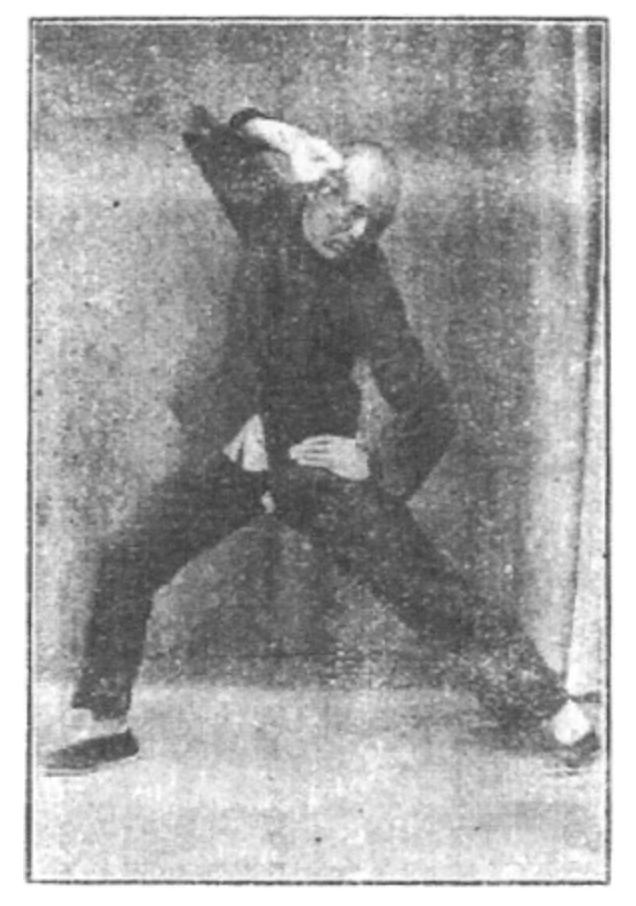
Making your own form

“If correct timing and position are not achieved,
the body will become disordered
and will not move as an integrated whole;
the correction for this defect
must be sought in the legs and waist.

When you’ve been practicing Tai Chi for a while – a few years maybe – you’ll get to the stage where you start to think about making your own form. Something that puts all the bits you really like together, and is either shorter than what you usually do, or longer, or uses less space, or fits into your garden better, or… something.

It’s potentially driven out of a need to make your own mark on the world; perhaps a sense of ego. You want something that is yours! Or maybe it’s just that you are a creative person and you have a need to continually create. Or perhaps it’s just to bring a sense of aliveness and play back into your Tai Chi…

What will then happen is you’ll start making a form, and then you fiddle with it, and fiddle with it and fiddle with it… and years pass and you’re still fiddling with it.

Ultimately, you’ll realise that this process never ends, and that your form will never be “finished”. Just when you think you’ll got it finished, you’ll notice a part of it isn’t quite right.

Whenever I mentioned to my teacher, over the years, that I’d made my own little form he was usually completely nonplussed. I mean, he asked to see it, but I could tell it wasn’t setting his world on fire 🙂

As I was pondering on my millionth version of my form this morning, another thought occurred to me. An obsession with creating your own form is probably an indication that you are getting a little too concerned with the external aspects of Tai Chi.

Switch your focus in Tai Chi back to the ‘internal’ elements – your perception of your body in space. Slow down, put your mind on what you are doing, notice your breathing, feel the (for want of a better word) energy inside the movements, notice where your weight is on your feet, push up from the ground, etc…

Now you’ll find that it doesn’t really matter to you what form you are doing – it’s all the same. If you are focused on the inside, your concern for what order movements come in and how many times you repeat something isn’t what matters anymore.

Suddenly, the idea of creating your own sequence of moves seems a bit, well, meaningless. Instead, you create your own form every time you practice, with every movement you do.

Ep 24: George Thompson on Tai Chi and Taoism from Wudang mountain

George Thompson is a film maker and Tai Chi teacher who studied on Wudang Mountain in China under Master Gu.

His videos at https://www.youtube.com/@George-Thompson have been watched by over 15 million people and has over 200K subscribers. He runs the Wayfinder Academy at https://www.wayfinder.academy through which he teaches online courses for balanced living.

In this episode I ask George what it is like to live and train Tai Chi on Wudang Mountain, what Wudang Tai Chi is like and what lessons he’s learned from Taoism.

You too can learn from George’s teacher, Master Gu, 15th generation of Wudang Sanfeng Pai of Wudang mountain via his online learning site at https://www.taoistwellness.online/

Click on the 7 day trial option, then use the coupon code TAICHINOTEBOOK when you sign up and you’ll get a lifetime 8% discount. That’s equivalent to one free month a year!

You can get a similar discount from George’s website https://www.wayfinder.academy/ using the same discount code TAICHINOTEBOOK when you sign up.

Podcast.

The power of the Shaolin brand

We just recorded a fun podcast about the myth and reality of the Shaolin brand over on the Heretics podcast. If you like Chinese martial arts then I think you’ll like it.

“When you can take the pebble from my hand, it will be time for you to leave.” – Master Kan

Here’s the blurb:

“Did Western movies and TV lead to the creation of the Shaolin Warrior monks? Did the modern Shaolin fake something that had already been reinvented anyway? Did the Qing Dynasty really destroy the Shaolin temple, or did they instead create it? What influence did three subsequent phases of communism have on Shaolin? Was there a Southern Shaolin Temple, and what about the modern stuff at Wudang Mountain? These questions and more answered in our new episode on the infamous temple and its monks.”

Check out the full episode on Heretics.

Happy World Tai Chi and Qigong day (for yesterday)!

Yesterday was World Tai Chi and Qigong day (note the crazy mix of Wade-Giles and Pinying Romanisation going on there!)

So, I hope you celebrated the day by doing some sort of practice somewhere. I saw a couple of posts in my feed showing groups practicing Tai Chi in the park. Here’s one taken by Donald Kerr of Spinning Dragon Tao. Check out his YouTube channel.

Just a group of people getting together and peacefully practicing Tai Chi. Given the state of the world today, that’s no small thing.

On violence.

A deep dive into Matt Thornton, Sam Harris and Mr Inbetween

One of the most interesting things I listened to this week was Matt Thornton’s interview with Sam Harris on his Making Sense podcast. Matt Thornton is the founder of the Straight Blast MMA gym network and an early advocate of Jeet June Do, and cross-training in multiple martial arts. He moved quite strongly into practicing Brazilian Jiujitsu after encountering the genius of Rickson Gracie. He was an early advocate of the concept of ‘aliveness’ in training, as well as his uncompromising attitude to martial arts, which is probably what he’s most famous for.

He’s got a new book out called The Gift of Violence, and is promoting it via the Sam Harris podcast. It’s an hour long podcast that you can listen to for free. It goes on longer, but that requires a subscription to the Making Sense podcast. (To be honest, Thornton has done lots of other interviews before, which can be found on YouTube, so you can probably get the info from the bits we are missing by listening to a selection of those.)

Here’s the book cover:

(That’s a terrible, terrible cover, design btw. Using “Full Justify” on text on a cover is a true crime against humanity, not to mention design. Plus, the gorilla looks like it’s yawning, and is badly cut out. However, since Matt’s picture on the BJJ Heroes website is of him in non-matching blue Gi top and white Gi pants, I don’t think fashion sense, design or style is really on his radar, and that has its own attraction)

Check out the podcast on YouTube:

Thornton is quite blunt about stating his belief that most martial arts simply don’t work and are therefore silly or a waste of time. I noticed that his comments seemed to annoy quite a few of the more serious Chinese marital arts practitioners that I follow online.

I’m somehow stuck in the middle on this. I find Thornton’s views on practicality quite compelling – the martial arts are full of stuff that is hardly what I’d call best practice for actually protecting yourself, and if I was being less generous, downright bad advice, however I can’t get onboard with his eagerness to throw every martial art that isn’t 100% dedicated to practical, alive, self defence training 100% of the time, under the bus.

As I’ve talked about before, I believe Chinese martial arts were never ‘just’ marital arts. They are part of a complex web that linked all sorts of aspect of life in ancient China together – religion, ritual, festival, theatre, healing, medicine and of course, self defence. And while several attempts were made throughout history to isolate just the self defence aspect of Chinese marital arts and separate is out from the rest (particularly after the disastrous Boxer Rebellion in 1900, and then again much later by the Communists in the 70s and their attempts to stamp out individuality and ‘rotten old traditions’ ) much of the previous branches remain – their roots go deep. But is that really a bad thing? People are multifaceted beings too. We don’t only do martial arts for one thing either. I know in my own training for instance, I don’t only train just for self-defence. I train because I enjoy it and it is good for me! I enjoy the puzzle-solving challenge that is Brazilian Jiujitsu, I enjoy the workout of forms in Chinese marital arts and the sense of mental balance and peace it gives me. I enjoy the ritual of having a little morning routine that I practice by myself and the quiet time it gives me. I enjoy the friends I make doing martial arts and the discussions we have, etc.

But I think Thornton’s opinions on martial arts are a side issue here to the most valuable insights you can get from him. What I’m most interested in from Thornton are his insights into violence. I haven’t read his book yet, but I’m going to. The book blurb makes some great points about violence

“In today’s modern world, we are largely isolated from the kind of savagery our ancestors faced on a daily basis. Although violence was as natural to our evolutionary development as sex and food, it has become foreign to most of us: at once demonized and glamorized, but almost always deeply misunderstood.”

Matt Thornton

That sounds exactly right to me – our approach to violence in the modern world have become very unnatural. We glamorise it in almost every TV show we watch, yet we’ve lost connection to it in daily life.

One TV show I’ve been rewatching recently (for the third time I think!) makes very much the same points about violence and its role in society is the the award-wining Australian series, Mr Inbetween created by the brilliant Scott Ryan. I don’t think any other show since The Sopranos has really tried to peel the lid on violence quite so effectively.

Scott Ryan as Ray Shoesmith. A man who knows a thing or two about violence.

As it says in this interview, Ryan’s character represents consequences. The show also deals with another factor that the modern day martial arts are often called in to deal with – bullying. Whether its children or adults being bullied, this is perhaps the one area of modern life that we as a society struggle to deal with the most, and it’s perhaps one area where violence really is the answer. Or is it?

In the UK, Mr Inbetween is on Disney+. I’d recommend it.

Should you focus more on external arts as you get older?

Seeing these old masters from Taiwan looking so good while practicing their external arts has made me wonder about switching my priorities.

I’ve been enjoying the recent series of videos from Will on his Monkey Steals Peach YouTube Channel of his tour of Taiwan Kung Fu schools. The latest one features Long Fist. It’s been great to see so much good technique demonstrated and also a few of the younger students, proving the arts have a future. 

But of course, a lot of the practitioners Will has featured are older, but that doesn’t stop them being proficient in dealing out the ass whoppings. This has made me reflect on my own training priorities. A lot of these fit-looking older men are training in arts that would be classified as ‘external’ like Long Fist and Mantis, rather than the so-called ‘internal’ arts like Tai Chi or Xing Yi, which are more normally associated with older people. 

Perhaps shifting focus to these external arts, which have longer postures with more twisting and stretching, and are practiced more vigorously is a good idea as you get older?

I’ve got to admit, that while I do feel good after a few run throughs of the Tai Chi form, I probably feel more energised and exercised after a few runs through of a Choy Li Fut form. My cardiovascular system is placed under more stressed for one thing, and my joints get moved through a larger range of motion.

“When you practice the form, the slower the better!” – Yang Cheng-Fu

Of course, Yang Cheng-Fu in his 10 Important Points, famously used this distinction between internal and external to explain that external arts were “harmful” for you, and the fact that you don’t get out of breath doing Tai Chi proved its superiority! He wrote (recorded by Chen Weiming, and translated by Jerry Karrin):

“External martial artists prize leaping and stomping, and they do this until breath (chi) and strength are exhausted, so that after practicing they are all out of breath. In Tai Chi Chuan we use quiescence to overcome movement, and even in movement, still have quiescence. So when you practice the form, the slower the better! When you do it slowly your breath becomes deep and long, the chi sinks to the dantian, and naturally there is no harmful constriction or enlargement of the blood vessels. If the student tries carefully they may be able to comprehend the meaning behind these words.”

Yang Cheng Fu

Now, it doesn’t take a genius to make an observation that Yang Cheng-Fu could have done with losing a few pounds himself, and that since he died relatively young his thoughts on longevity should be taken with a pinch of salt. Frankly, I think he could have done with getting a bit out of breath now and again!

It’s also fairly obvious to anybody who has seen Chen style Taijiquan that ‘leaping and stomping’ can be a part of Taijiquan too.

However, I do think there’s something to what he’s saying. When moving slowly and achieving a mediative state of mind you can experience profound levels of relaxation that do feel different to other types of exercise. When you “slow your breath” and it becomes “deep and long” it can feel wonderful. However, is that enough? I think it’s a mistake to use this type of exercise to replace more traditional cardiovascular exercise, and your body will not thank you in the long run.

Why not do both? Tai Chi has its place, but so do external arts of the Shaolin variety. Perhaps the best approach is to not skew too heavily in favour of either, but to adopt a balanced approach where you train both equally? Let me know what you think.

Chinese (Taiwanese) Folk Religion

I was just catching up with a recent episode of Will Wain’s trip to Taiwan to visit various martial arts schools. The episode I was watching was about a style called Six Harmony Mantis. Six Harmony Mantis looks like (and is!) a combination of Xing Yi/Xin Yi and Preying Mantis Kung Fu.

What I like about it is that the way the two arts have been combined is exactly the same way I would have done – take the best bits of both. So, it’s the Xing Yi footwork and body method with a few cool Mantis techniques on top. It’s a great idea!

But what really caught my attention about this episode was the second half, which is a fascinating look into the living tradition of Chinese Folk Religion and how its practiced in Taiwan. I mentioned in a previous post that there are a lot of influences on Chinese Martial Art that don’t come from a military background, and this is a strong one – Chinese Folk Religion. It’s a blend of all sorts of things, and a good contender for being the most widely practiced religion in the world.

In this episode you can learn about family temples, the gods that are honoured on them, spirit possession and more. I think spirit possession and martial arts have a big connection. Often when a person is possessed by a war-like god they perform war-like movements. A bit like marital arts forms…

Upcoming interview with George Thompson

I don’t normally do a preview of my podcasts guests before the podcast comes out, but in the case of George Thompson I think it’s worth doing one because not only is he a fellow Bristolian, but he has so much great media out there for you to view that it’s worth watching some of it before the next podcast drops (which will be episode 24, due in a few weeks).

George has a great YouTube channel that has lots of Tai Chi and Taoism videos. He spent time in the Wudang mountains learning in a small Tai Chi school and there are lots of great videos shot in China that just look amazing.

He also makes hour-long films and I’d recommend giving Journey to the East a go, it’s a documentary of his last trip to Wudang and his adventures getting there because he was attempting to travel by train across Europe to China just at the same time as the pandemic was breaking in 2020. Check it out!

Episode 23 – Mike Ash on using Xing Yi Quan for combat

There’s a lot of great martial stuff in Xing Yi Quan, which is feeling more and more like an untapped resource these days. With that in mind I interviewed one of my old training partners, Mike Ash, for the latest episode of my podcast. Mike has always been interested in training Xing Yi Quan as a martial art, and that’s what we talk about. He’s also practiced plenty of other martial arts and has recently started a new study into Taijiquan.

We talk about all of that, plus the spiritual side of martial arts. Here’s the podcast:

Yes, Shifu!

When I started in Tai Chi I was taught that “Sifu” was a rank you were awarded only after years of dedicated practice when a certain level of mastery had been obtained in your martial art. Then one of my students took a trip to Hong Kong and it turned out that everybody was called Sifu! Your taxi driver, your chef in a restaurant, a car mechanic, etc. it just meant somebody who was skilled at something.

Sifu is Cantonese, Shifu (simplified Chinese: 师傅 or 师父; traditional Chinese: 師傅 or 師父; pinyin: shīfù) is Mandarin.

The character 師/师 means “skilled person” or “teacher,” while 傅 means “tutor” and 父 means “father.”

From Wikipedia:

So, it wasn’t wrong to call your martial arts teacher your Sifu, but it wasn’t a rank that could be awarded. Something had got lost in translation.

Photo by Artem Podrez on Pexels.com

In Brazilian JiuJItsu (BJJ) we don’t have Sifus or Shifus, but we do have Professors. That sounds even grander than Shifu, yet how many people know that Professor is just the Portuguese word for teacher? It’s like saying “coach”, but in a culture like ours that has real Professors (i.e. people working in academia) it gets a sort of elevated status. (Actually, professor is a slippery term in the West as well, because in North America it can mean anybody who is a researcher or teacher in a university, whereas in Europe it is generally used to indicate distinction in a field.)

Professor is, unlike Sifu a rank that can be awarded mainly because BJJ has a belt culture. (I’m sure that if Chinese marital art had a belt/rank culture then Sifu /Shifu would inevitably become the black belt rank.)

But BJJ has its own weird cultural oddities. Certain BJJ teams and academies have rules that every black belt must be addressed formally as Professor by lower ranked students at all times. How seriously these rules are taken tends to be up to the academy owner though.

I’m a professor myself, but I never insist somebody call me professor. That would be nuts. I just let them call me whatever they’re comfortable with, but I don’t object to it if they do call me professor. There are some black belts who make a big fuss if you call them professor, going as far as making fun of the person who said it or going on a mad rant. I think that’s just rude. It’s just as bad as being one of the people who insist on being called professor!

I prefer a middle way. Some people like the whole rank and respect thing, I get that, and they’re just trying to be respectful by calling me Professor, so I appreciate their effort. I just don’t make a thing out of it.

I’ve always believed that trying to control what other people do or say too much never turns out well in the long run. The same can be applied to martial technique. Whenever I try and force something to happen in a sparring situation, it rarely turns out well, even if I’m really good at it! And this is where my personal philosophy in BJJ aligns perfectly with Tai Chi. I find it much better to ‘go with what the guy is giving you’ rather than to try and impose your will on them. If he’s giving you his leg then stop trying to go for his arm and take his goddamn leg and do something with that instead!

It’s amazing how simple this strategy sounds, but how hard it is to apply against somebody really trying to get you, with real resistance. It’s so tempting to try and ‘just do your thing’ and impose your will on the opponent. Yes, sure, this can work, and you see it work all the time in competition. The problem is it requires serious amounts of athleticism and effort to achieve. It’s a high risk, yet high reward strategy. And one of the risks is that you might get injured because you’re usually going to have to use some force against force. I’m too old for that type of game, and I’d also like to say, too wise, but that sounds a bit pompous, especially when I’m the same guy who just this morning tried to feed that cat my (human) breakfast cereal by mistake.

When you catch yourself doing that, it’s hard to think of yourself as a Sifu, Shifu or a Professor. You’re just a guy who wasn’t paying attention to what he was doing, and who now owns a cat with a newfound taste for Chocolate Chip Mini Weetabix.

Now bow to your Sensei!

Photo by Kelvin Valerio on Pexels.com