FYI:Owls can rotate their necks up to 270 degrees!
To some Tai Chi people it’s important to know where the eyes are looking when doing a Tai Chi form for slightly esoteric reasons: “your eyes lead your intention and your intention leads your chi.” But I think we can come up with reasons for using the eyes in Tai Chi that require no mention of intention (yi) or chi.
Try this: Sit comfortably. Turn your head slowly to the side, back to the middle then the other side. It’s a typical neck stretching exercise that you’ll find done at the start of your typical Kung Fu, Tai Chi, or Yoga class. It’s good for your neck, but there’s nothing particularly special about it.
Now try this: Instead of just turning your head to the side, actively look to the side. Lead the movement with your eyes looking to the side. Now compare the feeling of doing that to the feeling of just turning your head to the side.
If you’re anything like me you’ll find the experience quite different. When you are looking to the side for a reason your whole body co-ordinates better, not to mention, I think you can turn your head a bit further too. I’m sure there is a scientific word for this purpose driven movement, but I don’t know it.
Think of an owl, when it turns its head to look at something interesting that might potentially be prey – the eyes are always locked in.
When doing the Tai Chi form, try actively looking with your eyes and turning your head in the direction you are going. Hopefully you’ll notice the different in the quality and coordination of your overall movement.
I was observing the usual argument/discussion between two people about ancient Chinese words like Yi and Qi that frequently happen in Tai Chi circles, and it was going down a familiar route..
“Don’t lecture me! I read classic Chinese and Yi means ‘idea’ and Qi means ‘movement’.”
“Really? Wang Yongquan wrote ‘To mobilize Qi, you create an empty space, by Soong and a light Yi to empty the area. The differentiation of yin and yang is what makes Qi flow.”
“Seems quiet different then…”
Confused! Photo by Oladimeji Ajegbile on Pexels.com
And on and on and on…
Recently I had a conversation with a very experienced Chinese martial artist (it will be released as a podcast soon, don’t worry) about how these things are trained in Asia vs how we do it in the West.
He made the point that in the West we have to understand something intellectually before we will do it. i.e. we have to know we’re not wasting our time, that we will get something out of this. It has to ‘make sense’. And we usually ask loads of questions before even trying it. In contrast, in Asia, there is a lot less questioning and a lot more doing. You just do it. If you’re doing it wrong you hope your teacher will notice and put you on the right track. But generally you just keep doing it secure in the knowledge that eventually you will get it. It’s all in the feel. If you have the feel right, then you are doing it. End of story.
Nowhere is this distinction between the Eastern and Western approach more clearly represented that on discussion forums about Tai Chi that are full of Westerners. We love to argue about what these ancient concept and words like Qi, Yi and Xin really mean. As if one day we will arrive at the ultimate answer. It seems we can’t get enough of it.
But here’s the secret: it doesn’t matter how you define these words, what concept or theory you use for their implementation, or how well you read Classical Chinese from the Ming Dynasty. What matters is – can you do it?Can you show it to me?
If I said, “Show me your Yi. Let me feel your Jin” Could you do it?
If you can then it doesn’t matter wether you define Yi as “idea”, “mind” or “intent”. I’m sure we’re all familiar with the famous phrase coined by Polish-American scientist and philosopher Alfred Korzybski, who gave a paper in 1931 about physics and mathematics in which he wrote that “the map is not the territory” and that “the word is not the thing”, encapsulating his view that an abstraction derived from something, or a reaction to it, is not the thing itself.
So, all these online arguments about Qi and Yi, are effectively pointless. They are map, not territory. However, I do think that a little intellectual understanding can be useful. Especially if it stops you asking questions long enough to just practice. Also, there’s always this temptation to think that if I can just understand something perfectly, or write it down in the perfect, most simple way, then eventually everyone will go “Yes! That’s it!”
Anyway, as I was practicing this morning a thought popped into my head which I thought felt right, so I thought I’d write down and share it:
“Yi is the direction you’re sending your mind in, and the Jin follows.”
To me, Yi is always about a direction. And it is directed. It’s the opposite of a vague, warm, fuzzy haze. It has a steadfastness and a focus. There. Did that help? Or did it just make you more confused. Answers in the comments section please. If you have your own pithy phrase to summarise a concept as subtle as Yi that works for you, then feel free to add it below.
I’ve written before about Yi in Tai Chi Chuan. So, you can have a read of that too.
I’m writing this as a kind of follow up to my previous article on 3 views of qi in Tai Chi. That article contained the 3 different things I think people really meant when they talk about qi in Tai Chi. This article aims to do the same thing with yi. I don’t consider myself an authority on either matter, but I have had some skin in the Tai Chi game for a while now, and I’ve read enough of other people’s writings to come to some conclusions about what I think they’re talking about. Hopefully you’ll find these definitions helpful, and I’d be interested to hear your thoughts in the comments section.
Yi gets a few mentions in the Tai Chi Classics, and is usually translated into English as “intent”, or “mind-intent”, a translation which I think can be problematic because there are at least 3 different things that people mean when they say “intent” in Tai Chi, and while the three are obviously related, they’re also quite distinct from each other.
Before we get into the definitions, let’s have a look at what the Tai Chi Classics have to say about yi:
The most quoted line regarding Yi is in the Tai Chi Classic: “All movements are motivated by yi, not external form”, which can also be translated as “use the mind, not force”. In no.6 of Yang Cheng-Fu’s 10 important points he says:
“6.) Use the mind instead of force. The T’ai Chi Ch’uan Classics say, “all of this means use I [mind-intent] and not li.” In practicing T’ai Chi Ch’uan the whole body relaxes. Don’t let one ounce of force remain in the blood vessels, bones, and ligaments to tie yourself up. Then you can be agile and able to change. You will be able to turn freely and easily. Doubting this, how can you increase your power?”
So, here the emphasis is on relaxing and not using “force”, but why? And What does that mean? I will explain later.
Interestingly, right after that line, the Tai Chi Classic then goes on to say:
“If there is up, there is down; when advancing, have regard for withdrawing; when striking left, pay attention to the right.
If the yi wants to move upward, it must simultaneously have intent downward. “
Definition 1: Martial intent
Given the lines quoted in the Tai Chi classics above I find it strange that the most common interpretation of yi in Tai Chi is as a kind of martial intent. Here intent is “your intent to do something”, and in Tai Chi people generally mean a martial intention that needs to be contained within every particular posture or movement. So, for example, when you do the ward off movement, you need to have the intention of deflecting a blow away. If you movement lacks that intention, it is said to be empty.
Now this may all be true, and not knowing the martial applications of a movement inevitably leads to it becoming too abstract and unfocused, but this understanding of ‘intent’ is clearly not what is being talked about in the Tai Chi Classics when it admonishes us to “use the mind, not force”. If all it meant was to have a martial intention behind the movements, then it’s impossible to see how that can match up with lines from the classics like:
“If the yi wants to move upward, it must simultaneously have intent downward.”
What has that got to do with martial intent?
Clearly this is talking about something else. Yes, a martial spirit is obviously important for Tai Chi, and some Chinese teachers refer to an “eye spirit” which his making sure you are focused and looking in the right place in form performance, and you look like your actions are martially proficient, but I don’t really think this is what is specifically meant by yi in the Tai Chi classics.
Definition 2: A line of intent from the ground up
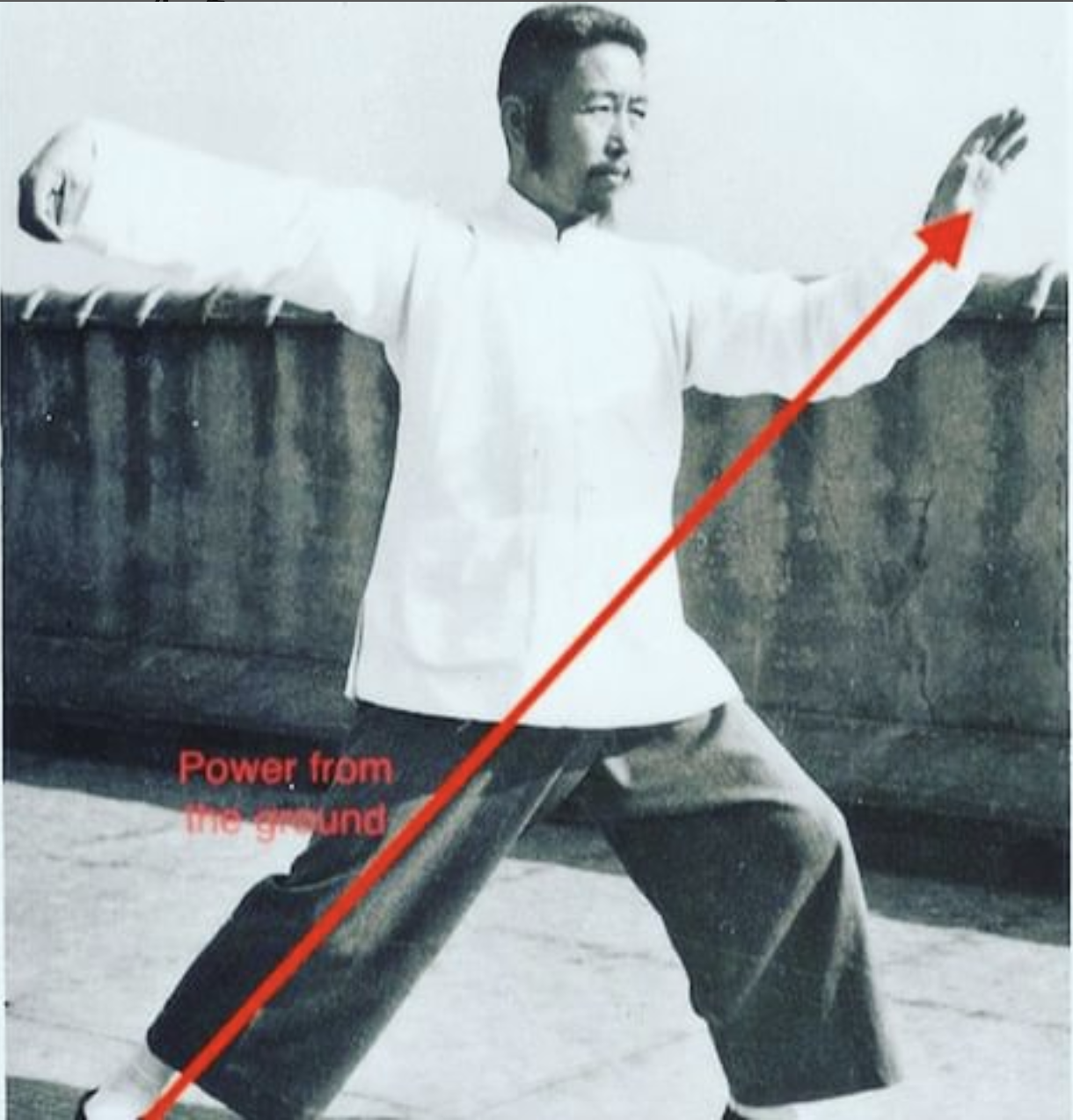
The second way that people refer to intent in Tai Chi is as a line of force, usually from the ground to the point of contact with the opponent. The idea in Tai Chi is to bring the solidity of the ground to your point of contact with the opponent. How do you do this? Well, firstly by relaxing, so that your body can function as a whole, connected, unit, and then by feeling a line of connection from the point where you contact your opponent (in push hands that would be your palm or wrist) directly to your foot (the part of you that is closest to the ground). By imagining the force of your opponent going straight down to the ground in a straight line from your palm to your foot then you can make use of jin – which is a force obtained from bringing the solidity of the ground to the point of contact with your opponent. This jin force stands in contrast to the normal force of the body produced by exerting your muscles, which the Chinese call li. Of course, muscles are involved in generating jin (otherwise you’d collapse not he ground), but they kept as neutral and relaxed as possible, so that excess force is avoided.
If you send force from the ground to your point of contact with your opponent, using jin, you can bounce them back off you.
Of course, you cannot be thinking of the ground if you want to project somebody away from you. Your work in creating the path to the ground is already done – in the bow analogy this is the drawing of the bow. All that remains now is to fix a direction and release the arrow:
As it says in the classics:
“Release the chin like releasing the arrow.
To fajin [discharge energy], sink, relax completely, and aim in one direction!”
This use of Jin fits in better with the lines in the classic that say
“If the yi wants to move upward (i.e. bounce your opponent back) it must simultaneously have intent downward. (i.e. you imagine a line of force to the ground).
(N.B. this straight line of force obviously goes through empty space, so it’s not the actual line any force from the ground will take, but it’s a case of your mind having the overall goal in mind, and your body filling in the details on a kind of subconscious level.)
Definition 3: A part of the mind
This definition is about yi being a part of your mind and the hardest to put into words. Obviously, definitions 1 and 2 also involve using the mind, so you can see how all 3 definitions are kind of wrapped up in each other.
In everyday life when you want to do something, like say pick up a pen or bring a cup of tea to your lips, the idea to do it appears in your head before the physical action takes place.
In internal arts the 6 harmonies get a lot of press. Of these 3 relate to the physical body, and 3 relate to the internal make up of the person. In the West we tend to have one word “mind” to relate to all the different and distinct parts that the Chinese have words for, like xin, shen and yi, but the three internal harmonies (san nei he) are:
1) The heart (Xin) harmonises with the intention (yi).
2) The intention (yi) harmonises with the chi.
3) The chi harmonises with the movement (li).
The heart mind (Xin) is related to our desire to do something, the yi (intent-mind) is the part of our mind that makes things happen on a subconscious level. When you pick up the cup to bring it to your lips you don’t think “hand move to cup, fingers wrap around handle”, etc.. It just happens because your intent-mind is taking over, based on what you desired to happen. The intent-mind is therefore a kind of subconscious process.
Now, going along with the idea that there are these different parts of our mind that exist as separate entities comes the idea that we can train these separate entities in isolation to gain a deeper ability with them. So, for example, by repeated practice of a Tai Chi form (or Zhan Zhuang standing practice), in which we are trying to access the subconscious intent-mind, rather than brute force, to perform action we might, in fact, get better at it and develop some ability that ‘normal’ people who lack this cultivation don’t have. It’s an interesting idea!
A good starting point for developing this intent-mind is Zhan Zhuang standing practice. One common practice is to stand in the ‘hugging a tree’ posture and try and get the mental sense that your hands are expanding outwards, yet without physically moving them. You are cultivating your intent-mind when you do this. This is starting with just one direction, but in standing practice people often talk about training 6 directions at once.
When performing a Tai Chi form it’s obvious that you are dealing with moving energy (in a physical sense) in different directions. If you can utilise your mind to “think” in these directions then you can start to train your yi, and it can start to feel like your movements are generated by yi and not by physical force.
Conclusions
It’s not easy to talk about what is meant by yi in Tai Chi, but hopefully I’ve provided you with some good starting points and ideas. I’ll repeat again my assertion that the three definitions I’ve given are all important parts of the practice that makes up Tai Chi Chuan and all inter-related. And while yi may be tricky to describe, it is of utmost importance to all the internal arts. There is a line from the Xing Yi classics that goes:
“There is nothing but structures and nothing by qi”
On hearing this line I remember my Tai Chi teacher saying “Oh, that’s good, I like that, but I’d change it to:
There is nothing but structures and nothing by yi”.
Structure and intent. When it comes right down to it, that’s all the internal arts are made up of. That’s how important yi is.
As I was reading Glen Board’s excellent new book Xing Yi: A study of Tai and Tuo Xing I thought there really needs to be a video of these linking sequences he’s presenting in the book so people can see how the moves work and get a flavour of it. So I made one myself in a bit of free time instead of my usual morning practice.
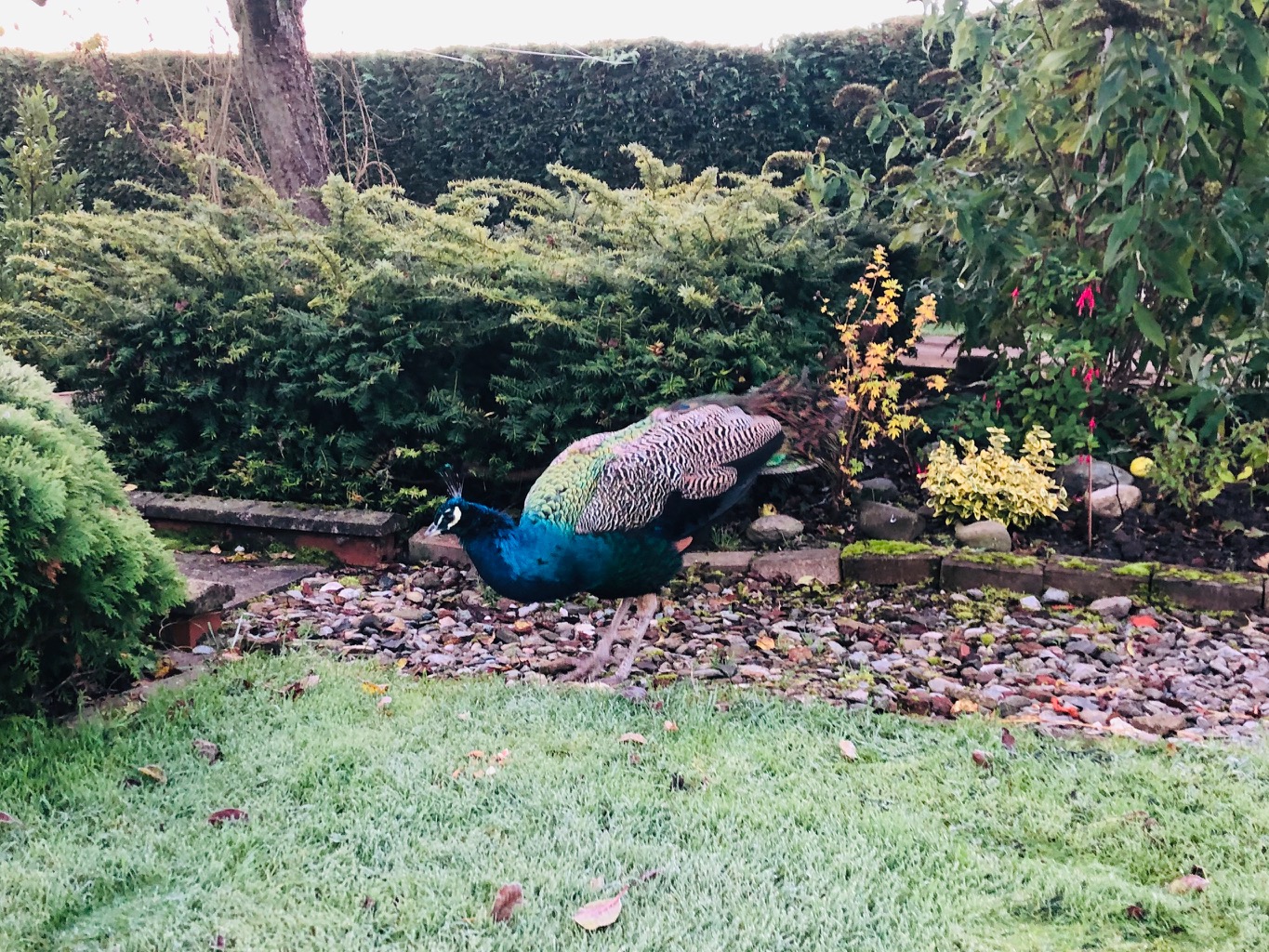
During filming I got a visit from a local village Peacock (we call him Peter) who decided to bless my video with his presence. Tai is the flycatcher, a small to medium bird with a long tail. Now, while Peter may also have a long tale, he’s a very large bird. Also, he’d be more like Chicken Xing (Ji Xing), so he’s a not a perfect fit with Tai, but you have to use what you’ve got.
Peter, standing proud.
Here’s the first video:
The problem is, (as I discovered) if you want make a video of animals Xings that if useful for people to follow along you have to take a lot of the character of each animal out, and it becomes a bit bland and (dare I say it….?) more like Tai Chi…
So I did another video that had less emphasis on relaxed movement and accuracy and more on expressing the Xing of each animal. Glen described the Xing well in his book, but in short, I’m trying to generate more torsion through the dragon body in Tuo and more agility, abrupt change of direction and surprising strikes in Tai.
My Xing Yi is always a work in progress, and I’ve been out of the loop with it for a few years, but Glen’s book has inspired me to pick it up again, so I’m not presenting myself as a “Laoshi” or expert here or anything, just a glimpse into my personal training. Anyway, here it is and hopefully people who buy the book will find it helpful in some way:



 The Tai Chi Notebook