UFC 295 – Alex Pereira vs Jiri Prochazka: Chicken vs Swallow fight analysis

One of the things I like to do when watching UFC fights is to try and analyse what the fighters are doing in terms of Xing Yi’s 12 animals. Now, I’ve got at least one friend who hates when I do this because he believes it makes people think that by practicing a few Xing Yi moves twice a week in your back yard you can somehow be on the level of professional MMA fighters. Yeah, I get that. Comparing martial arts can easily lead to delusion… however, my No. 1 one rule for The Tai Chi Notebook is this: this is my blog and I can write what I want! So, I’m going to do it anyway. But also, I genuinely think that if you’re a Xing Yi practitioner yourself, then trying to analyse MMA fighters in terms of the 12 animals is a really valuable hobby to get into. It will increase your understanding of not only the animals, but also of fighting itself.

Viewed through the modern Xing Yi lens (by modern, I mean, post Boxer Rebellion, from the early 20th century onward) it’s popular to understand the 12 Animals of Xing Yi as merely variations on the 5 Elements. This approach is indicative of the reductive, simplistic, winds of change that blew through Chinese martial arts over that century. It’s not a wrong view technically (the 5 elements are the basics, so of course they are inside the 12 animals), but it’s also a huge misunderstanding. The 12 Animals are more than just variations of the 5 Element fists, they are older and contain the essence of the art. They’re a continuation of a tradition that started back in the Song Dynasty. If you really want to understand that point of view then I’d point you towards the History of Xing Yi series we’ve been doing on the Heretics Podcast for a few years now – and is currently up to part 15, about to start the Ming Dynasty section.

But coming back to the present day, last week saw Alex Pereira vs Jiri Prochazka for the UFC Light Heavyweight belt at UFC 295. It was a great fight resulting in a knockout for Pereira, but honestly it could have gone either way. There was some debate about the finish being an early call from the ref, but Jiri himself said he was out cold, so it was fair. Highlights here:

Looking through my Xing Yi lens at what the fighters were doing, UFC 295 was a good one because it was very clear what animal strategy each of them was using. (Obviously, neither gentleman has probably ever heard of Xing Yi, however, like I said earlier, I’m simply using the 12 animals to analyse fighting styles.)

Swallow (yan xing)

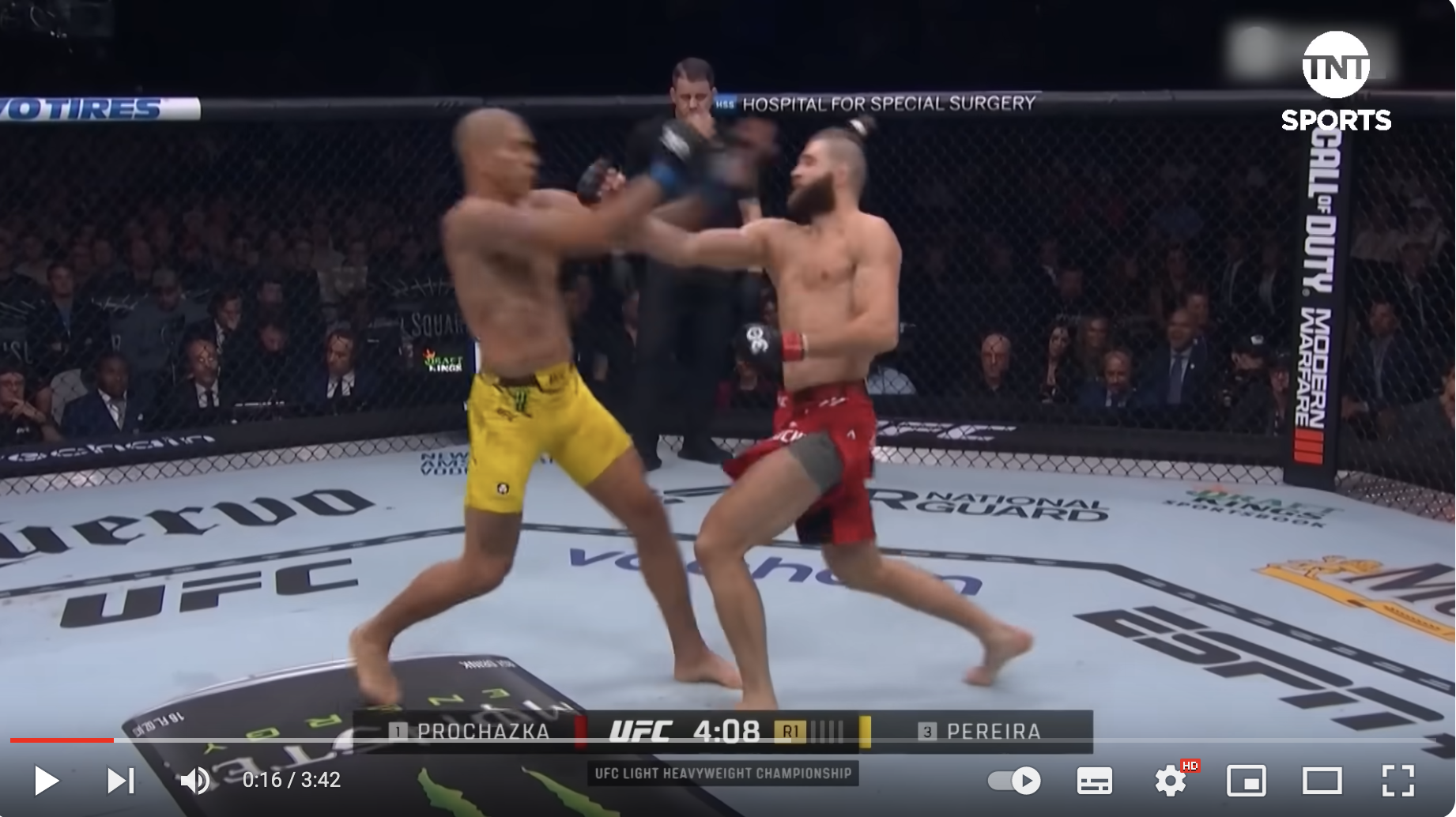
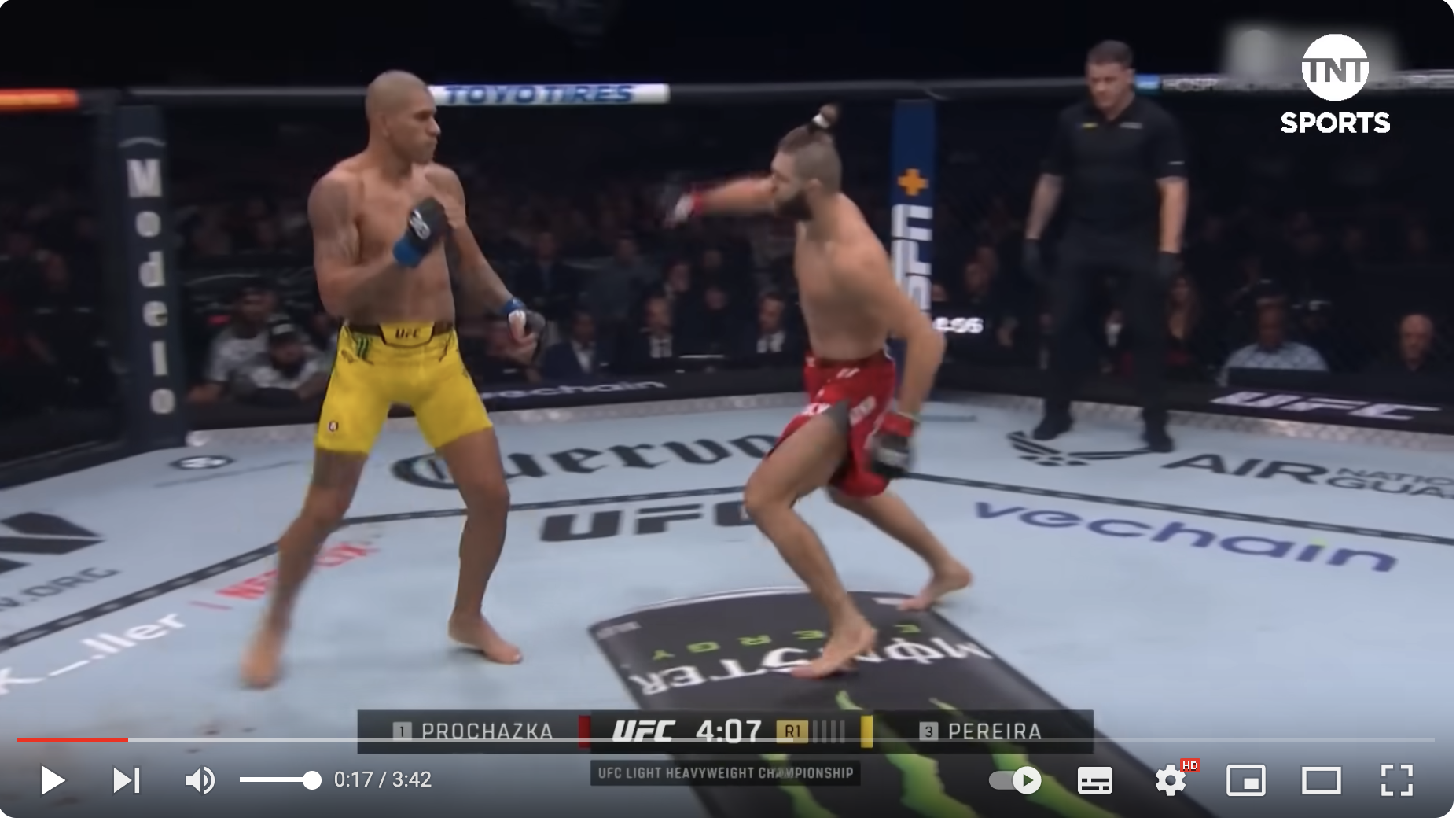
So, on one hand we have Jiri Prochazka (red shorts) whose attacks frequently go from high to low:

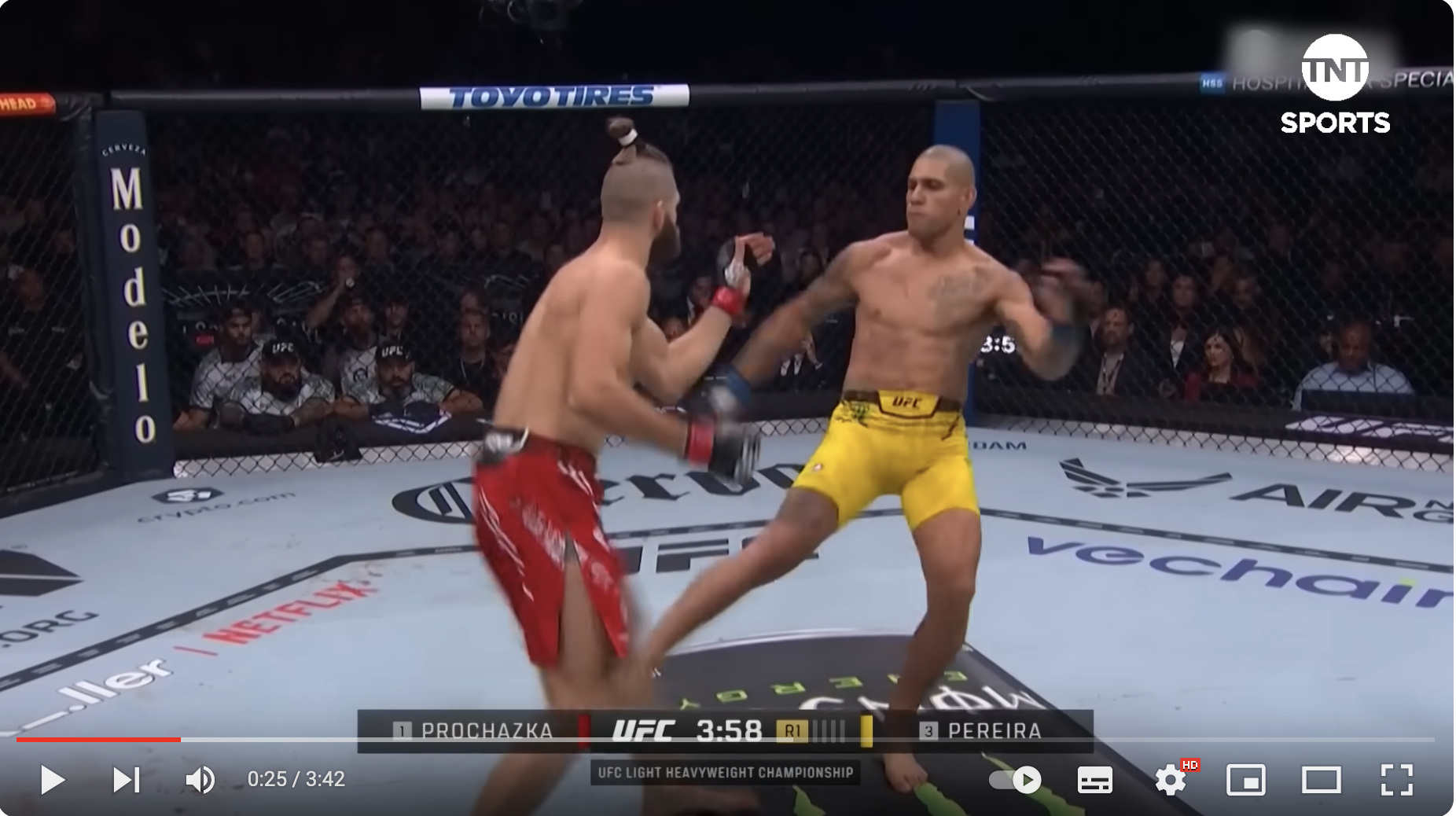
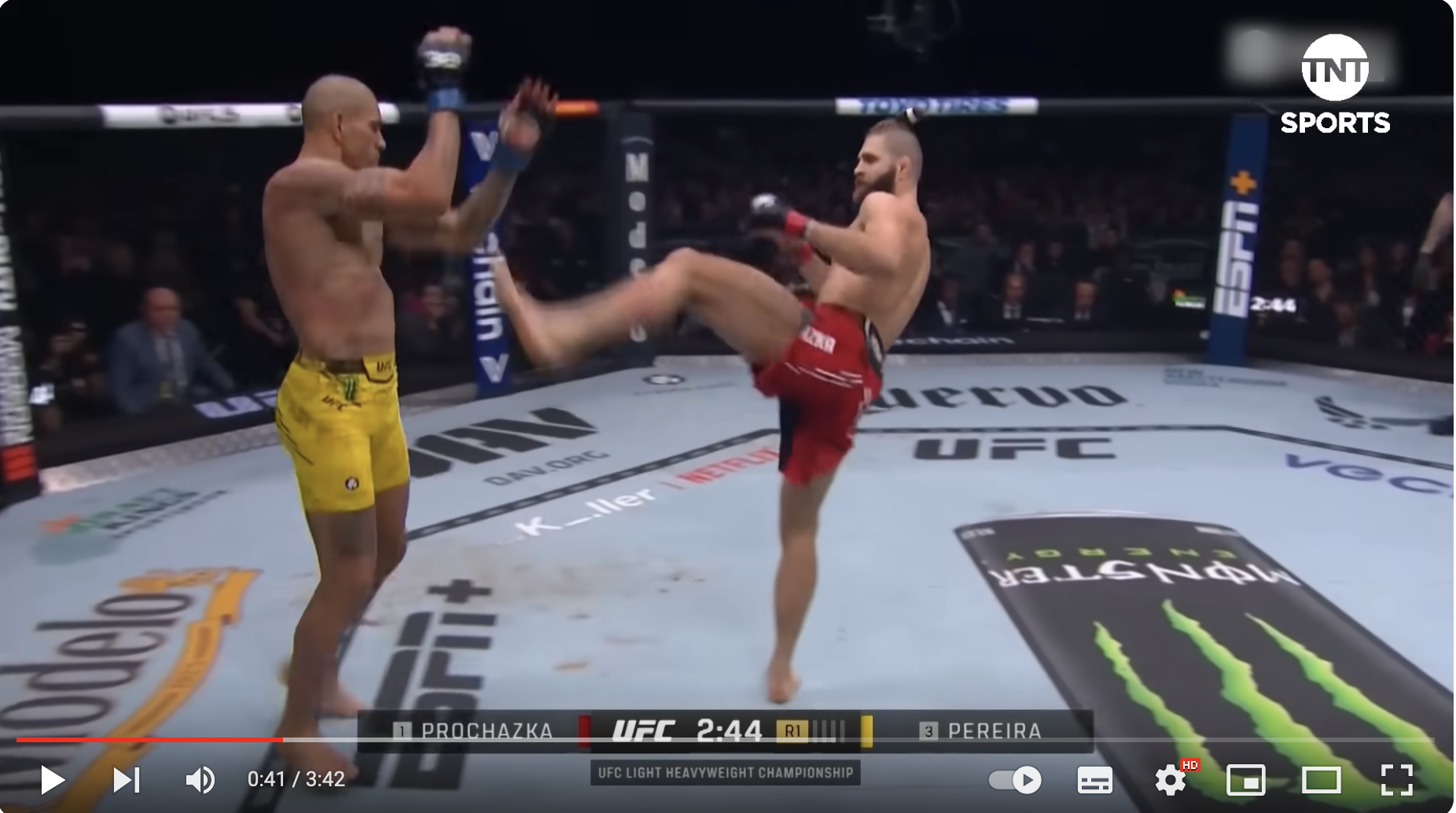
He kicks high to the head, then kicks low to the ankle:
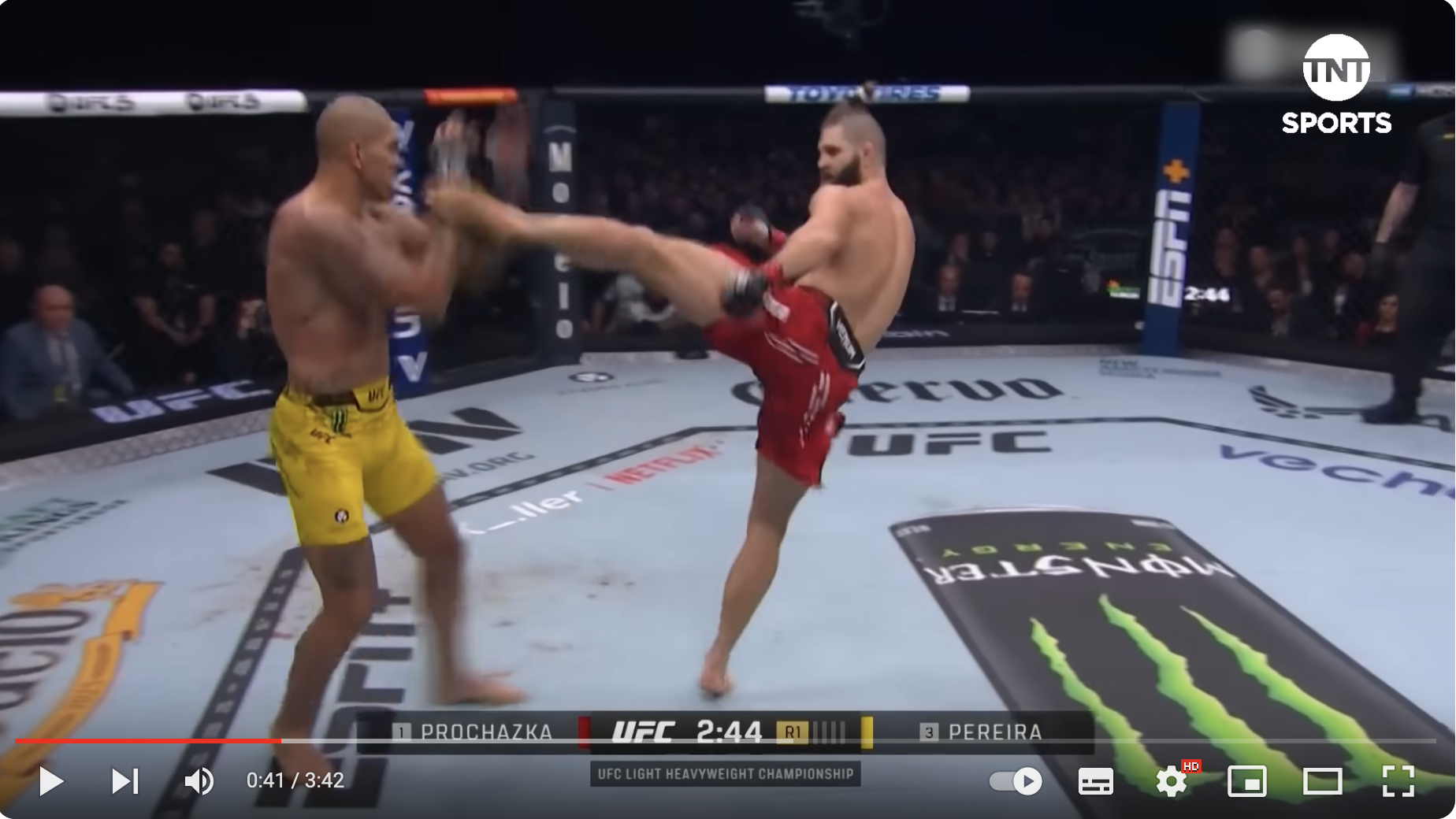

(Obviously a lot, but not all, MMA fighters kick to both heights, but it’s the alternating way he does it, as a strategy, that I’m interested in. It’s not the techniques that make something an animal style, it’s the intent and strategy behind them, but also certain styles lend themselves naturally to certain techniques – which is a subtle point)

He dummys a wrestling shot low but then comes up with an upper cut.
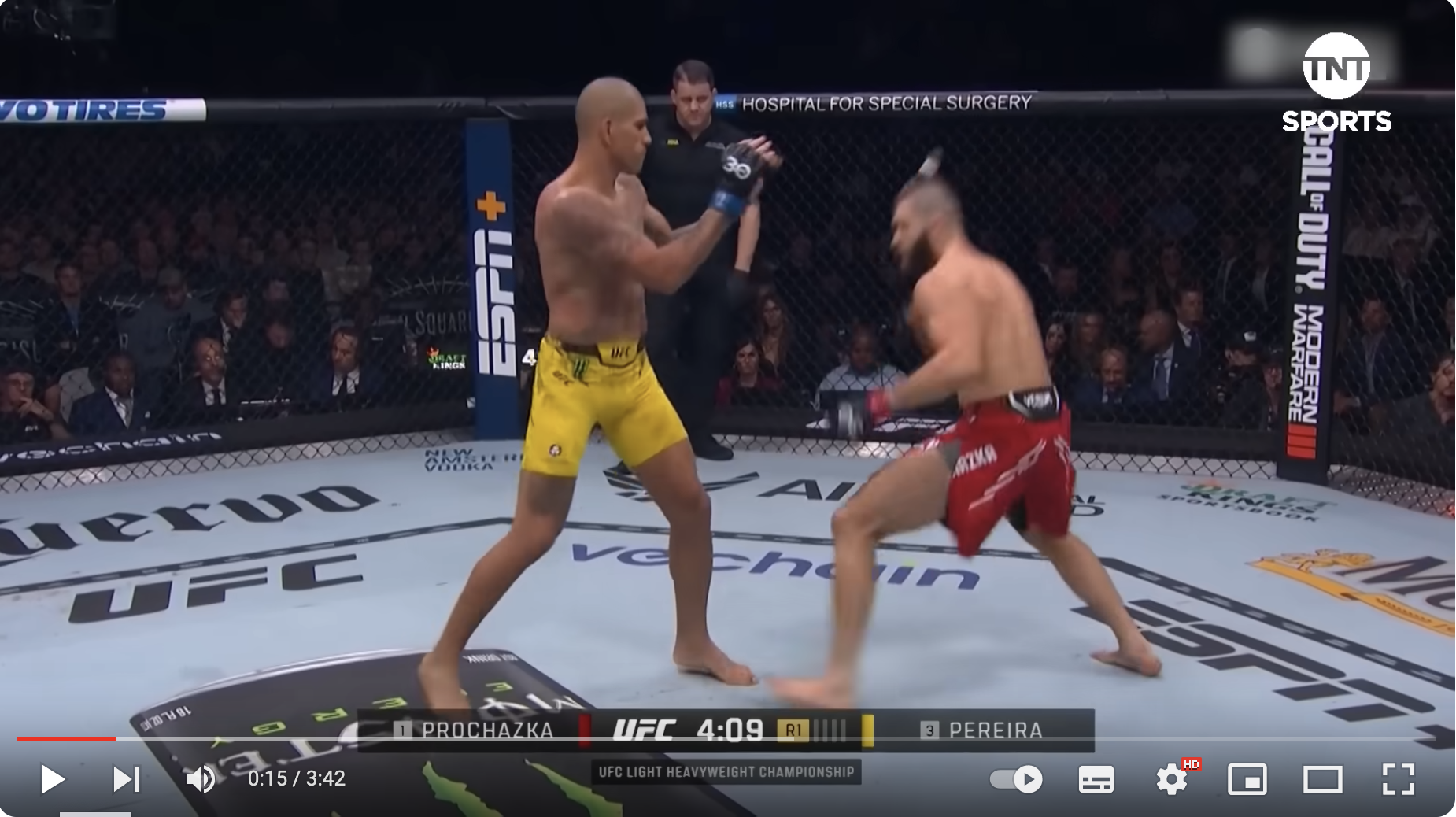
His preferred range is long, and when he punches he throws arcing punches that start low, go high and finish low:
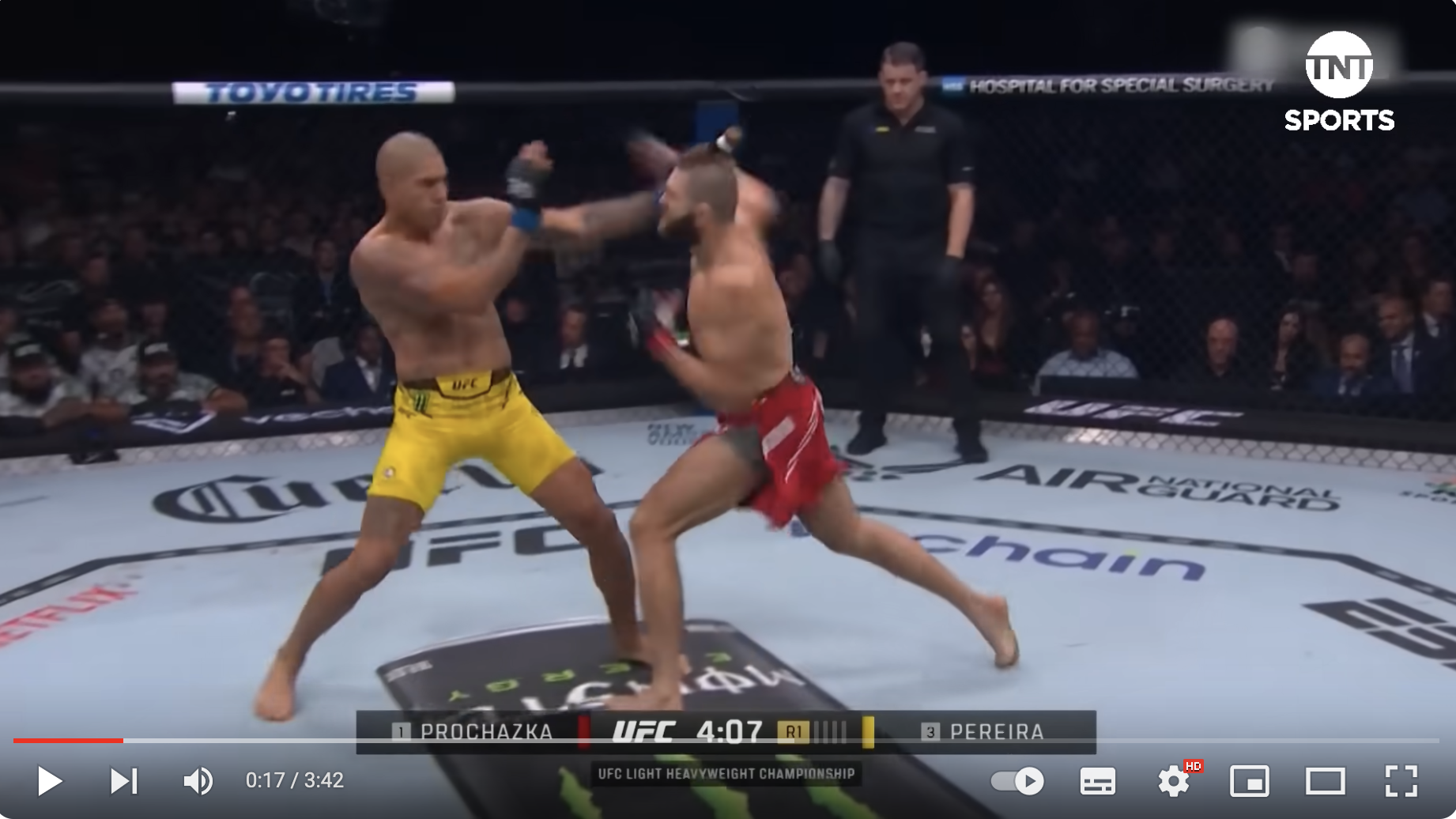
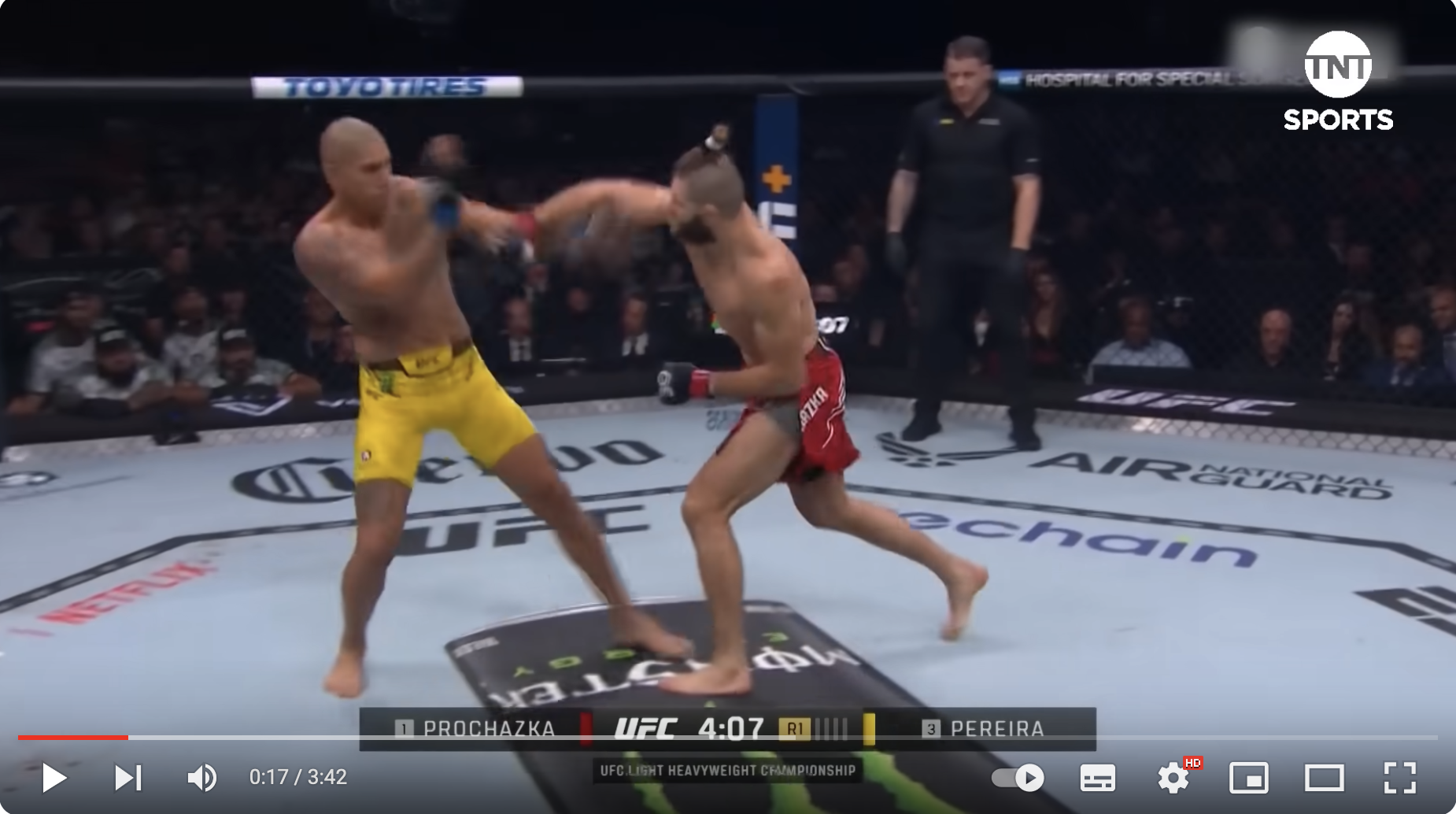
To me this is clearly a Swallow strategy. Swallow is a bird you wouldn’t normally associate with fighting, but it aggressively hunts insects on the wing, and defends its nesting location by dive bombing potential intruders, including humans! Its characteristics are swooping low then going high, particularly over water and “swallow skims the water” is a name often given to a popular swallow movement in forms in Xing Yi, Bagua and Qigong. But the swallow is also famous for its absolutely beautiful aerial acrobatics that are always elegant and graceful.

A swallow defending its nest – I like this clip because you can see the speed that the swallow attacks with, and how unafraid it is of something as big as a human.
The classic “swallow skims water” in action, by the true masters of the art – the swallows themselves.

A typical “swallow skims water” movement found in Chinese martial arts. This one from Cheng style Bagua.

Chicken (ji xing)

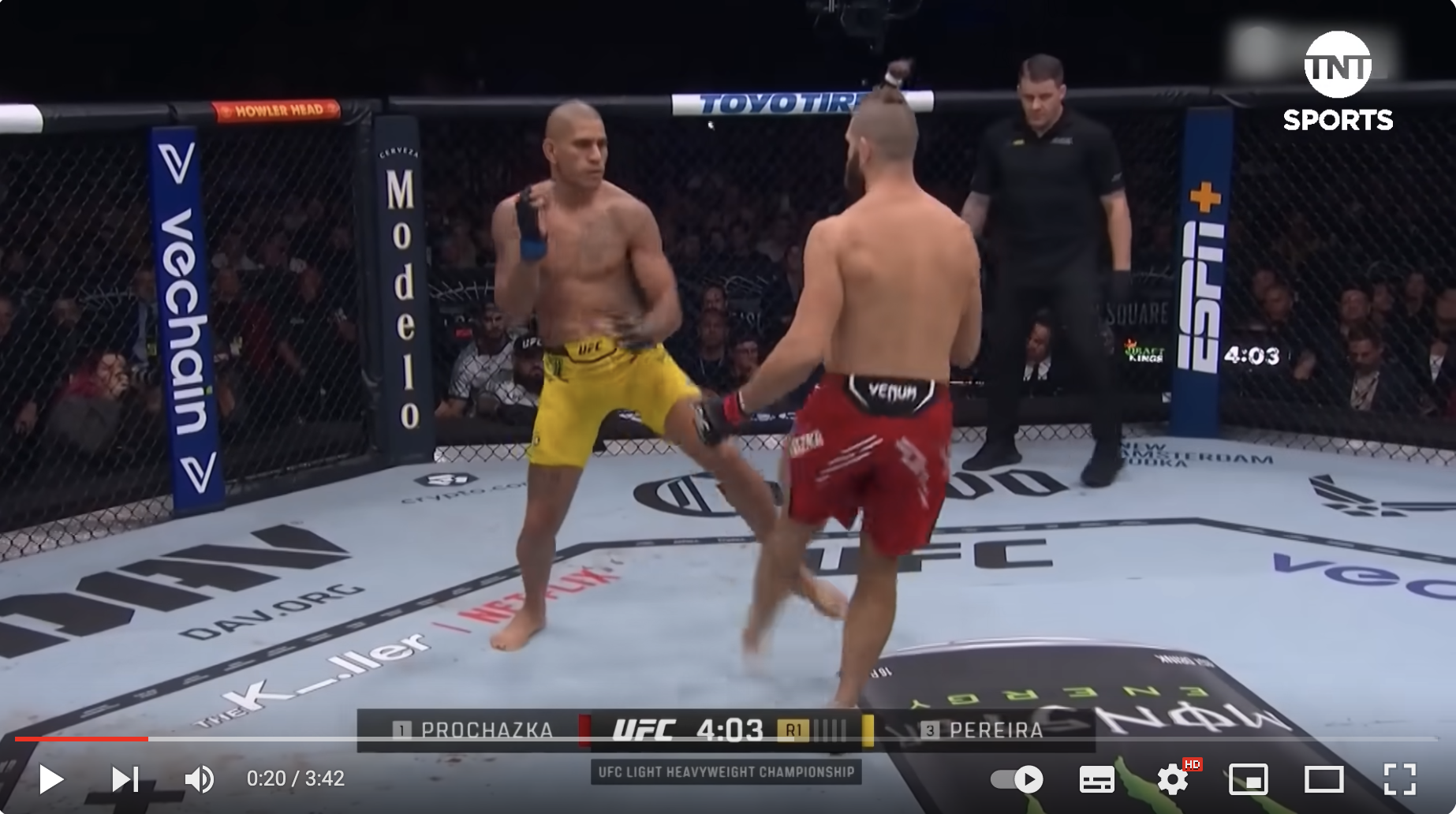
But let’s get back to UFC 295. In contrast his opponent, Alex Pereira is famous for his minimal movement and crushing low calf kicks. There’s a great clip of him playing about with UFC commentator Daniel Cormier taking his low kick:

A native of Brazil, Pereira is also famous for his indigenous face paint he wears to the weigh in events:

(For people that like to argue that Shamanistic things have no part in MMA, I always like to point them to double UFC champion, Alex Pereira!)

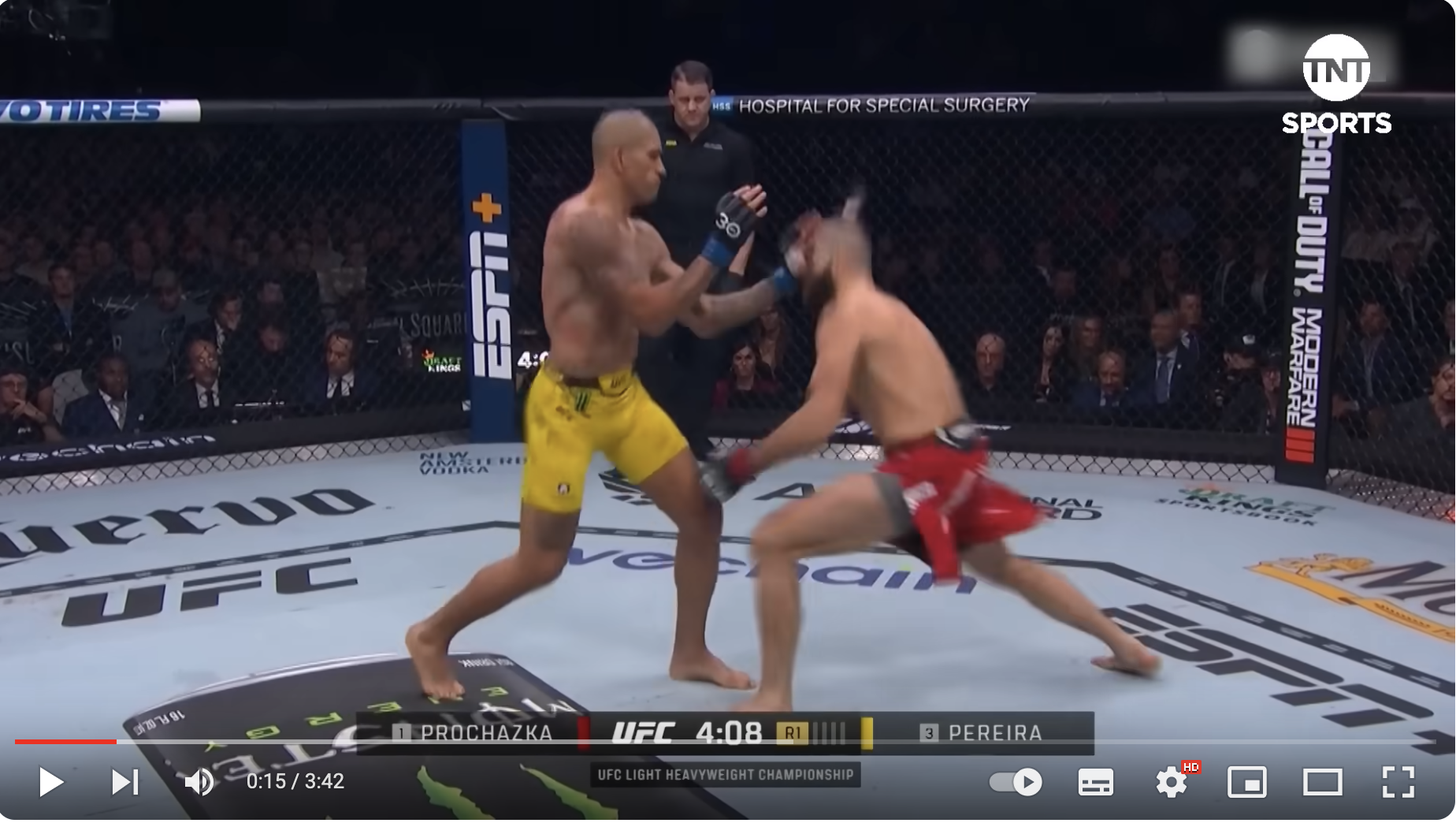
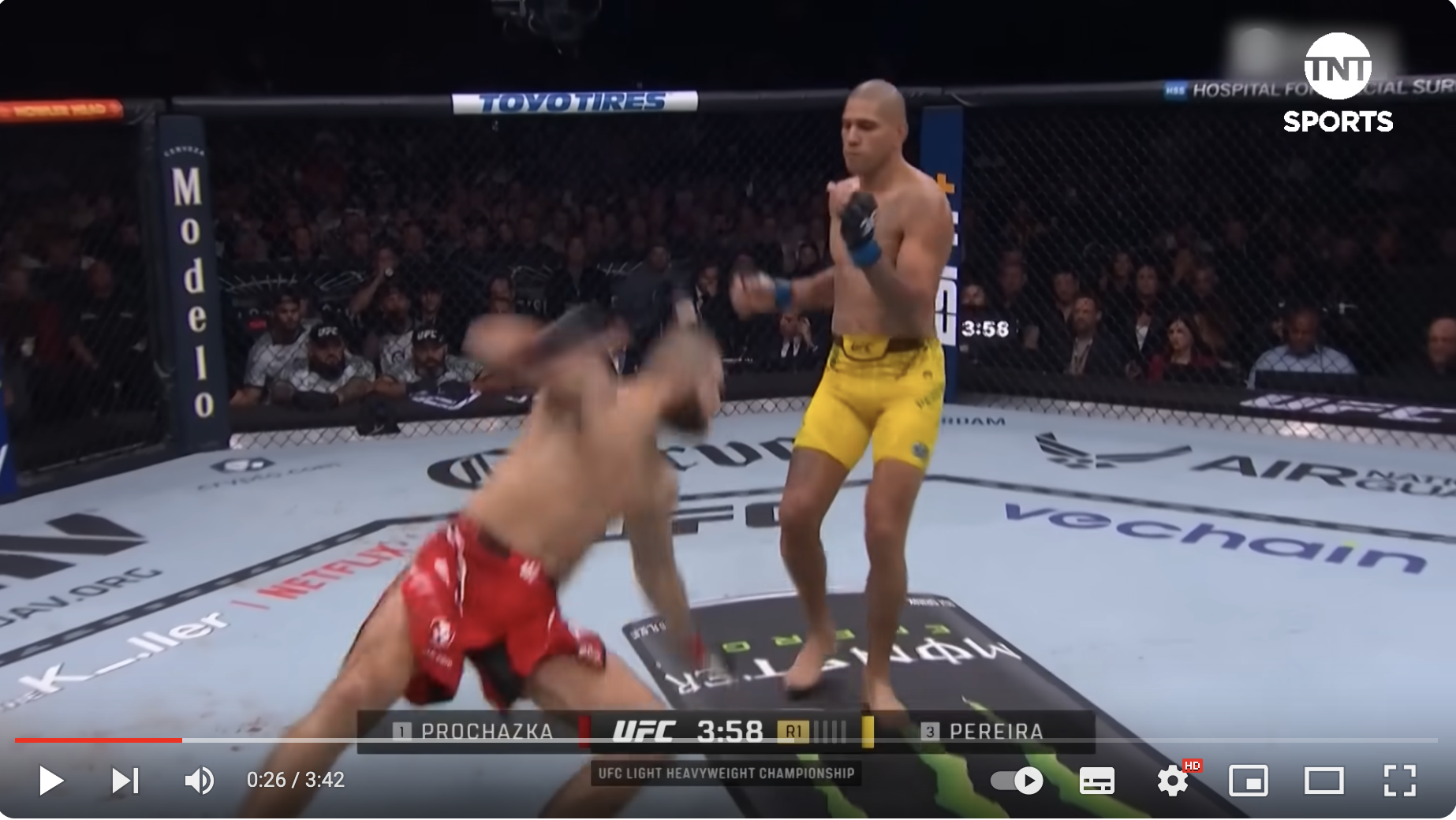
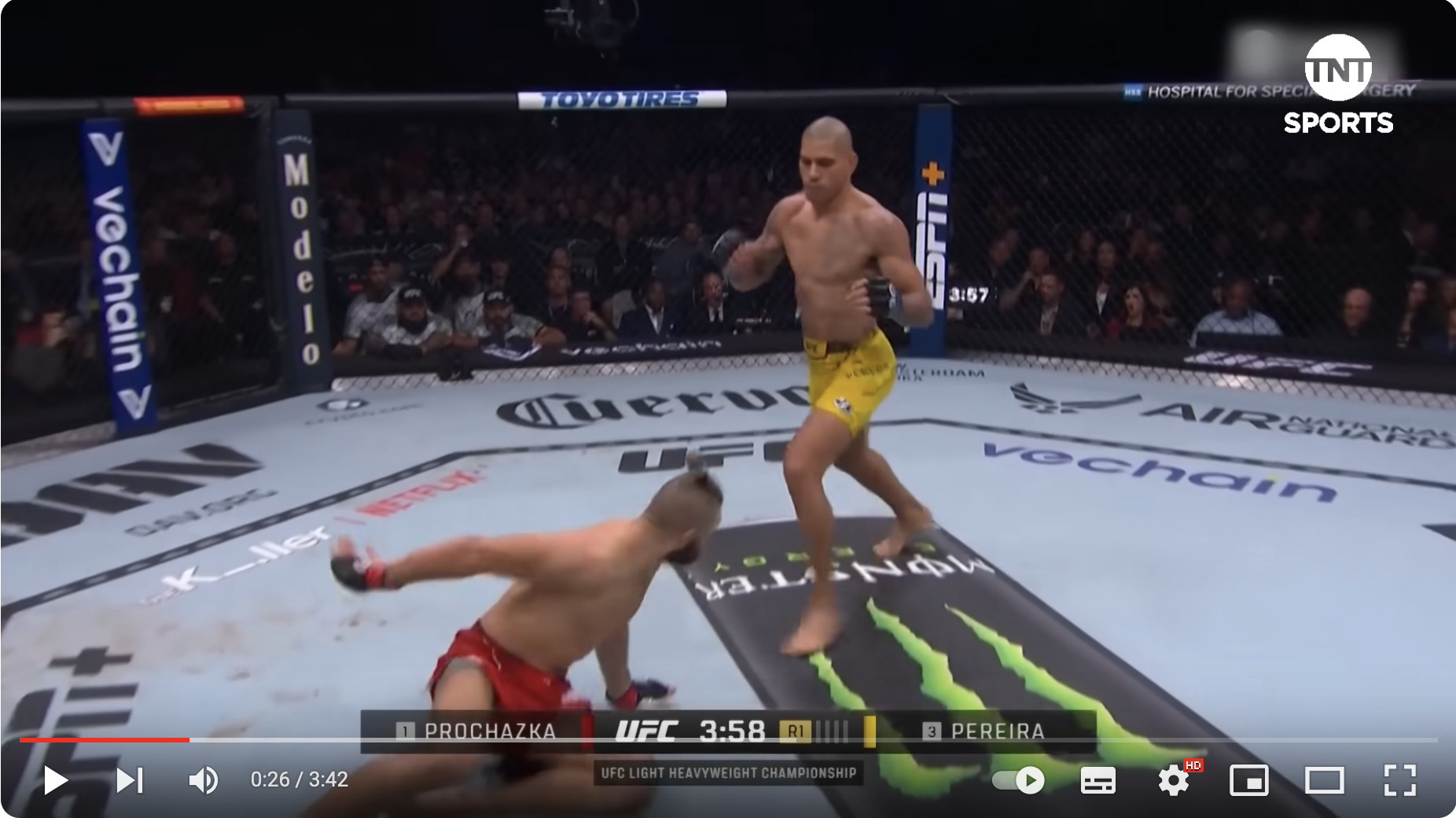
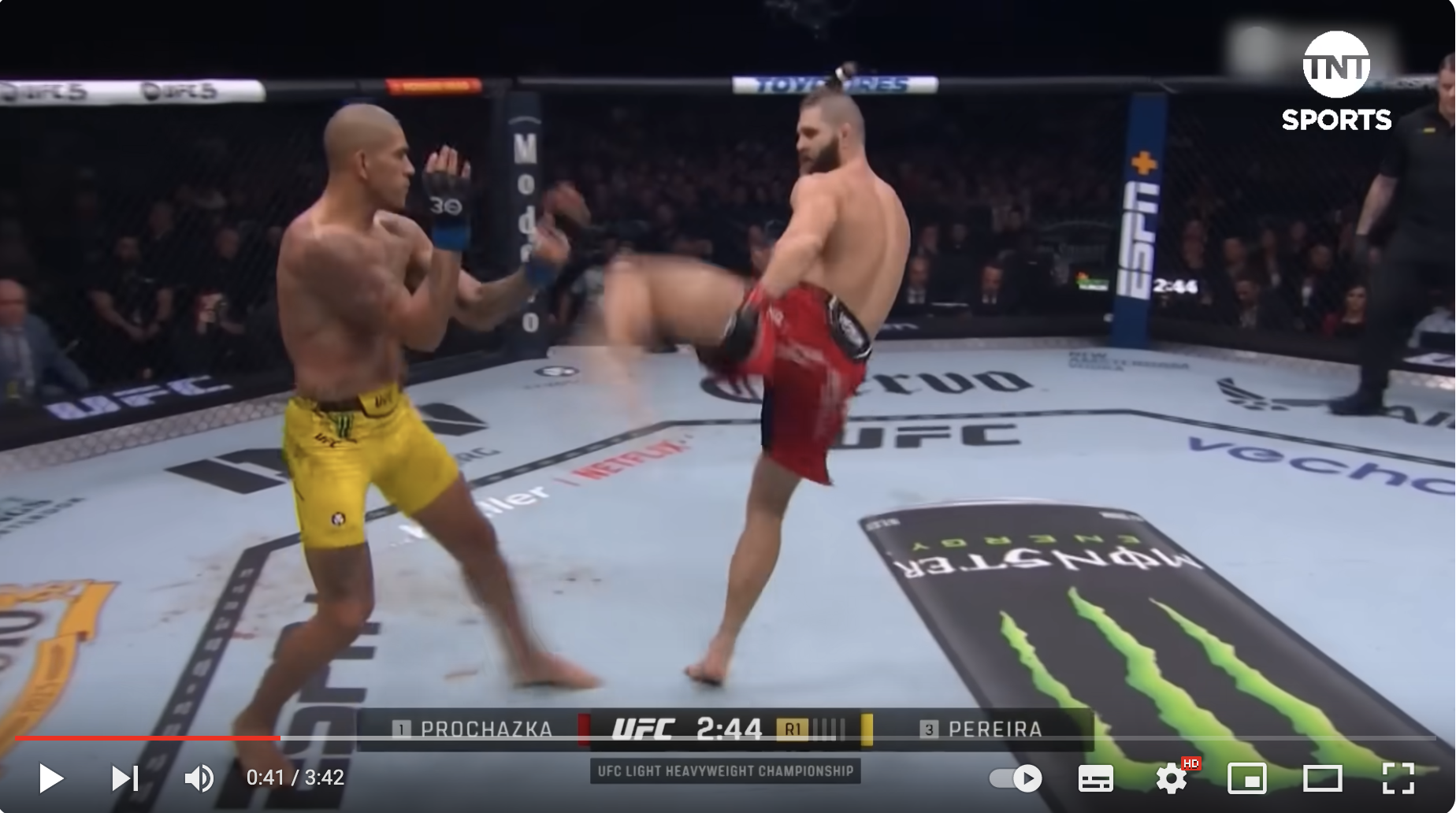
You can see his famous calf kick in action in UFC 295, completely taking Jiri off his feet:
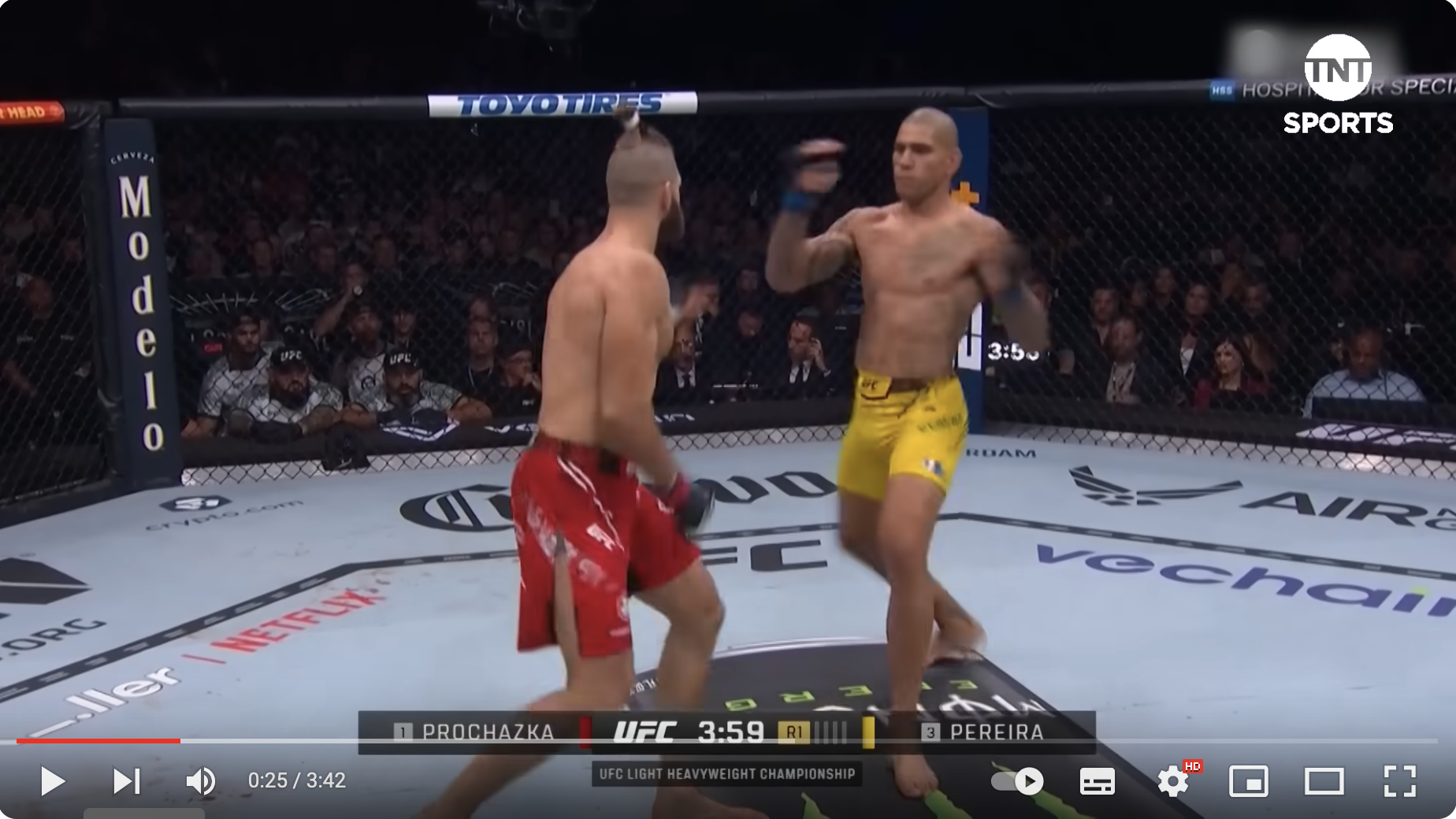
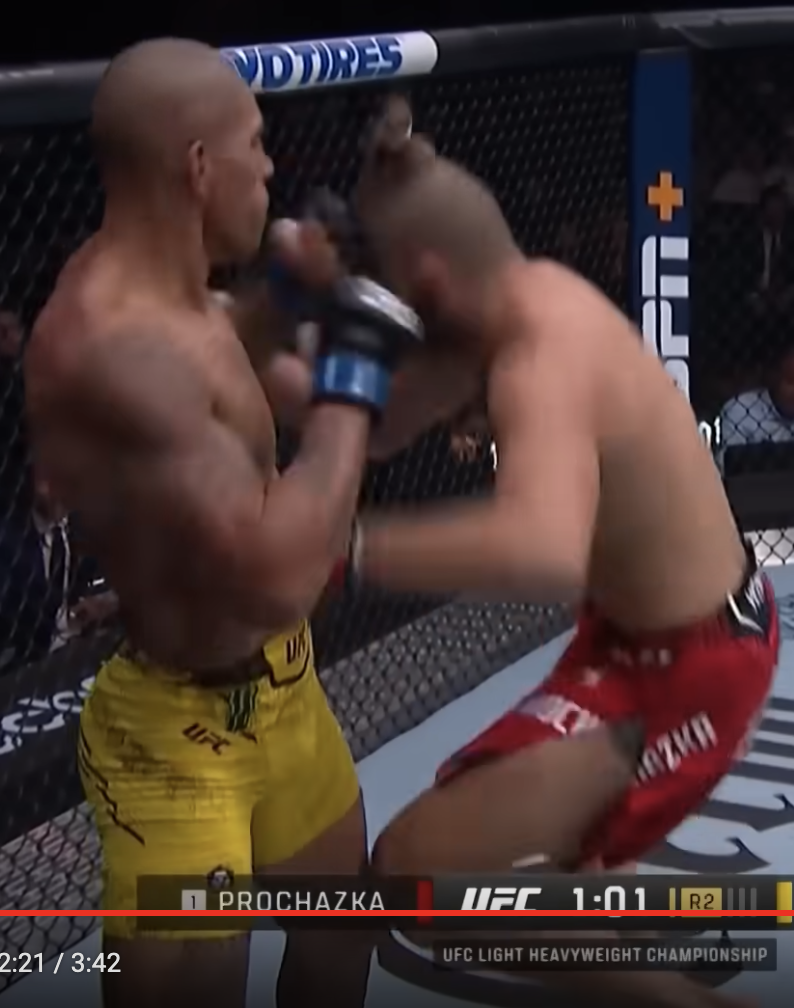
What’s remarkable about the Pereira calf kick is how little wind-up there is, which makes it hard to see coming – he just snaps it out. He does three identical kicks in a row in that part of the fight – the pictures above show the first – but all three hit home. His punches are delivered in the same way – the hand just snaps out with almost no telegraphing movement at all. You can see in the screen captures above of the kick that his body stays facing the opponent at all times. They don’t look like powerful shots, but you can see the deadly effect they have on his opponents. That very tight coil in his body around the spine that he’s using to pop his kicks and punches out is absolutely indicative of Chicken xing. “Chicken shakes its feathers” is a characteristic move of the animal found in Xing Yi links (forms) and somewhat resembles the Fa Jing expression that you see demonstrated in Tai Chi styles:

A chicken shaking its feathers.

Chicken step

When Pereira defends he is using footwork to evade rather than ducking his body – in fact, he stays very upright and his hands are kept high and defensive, just like they are in Xing Yi Chicken, which relies on footwork for evasion.
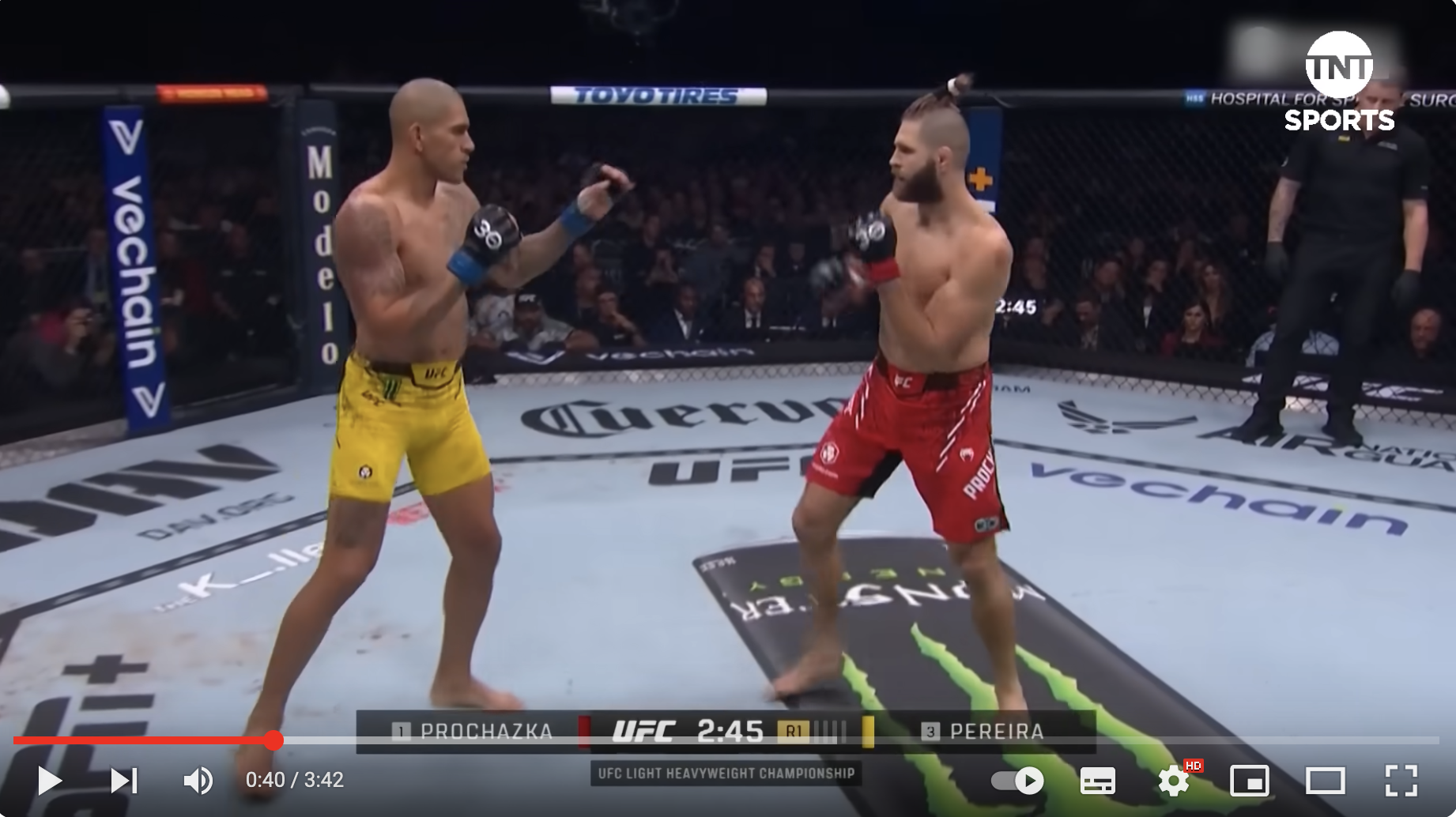
The blows which set up the finish from Pereira were so fast and minimal they were hard to see in real time, but it was a counter 1-2, again delivered with that very upright body with the hips underneath the shoulders that is so characteristic of Chicken:
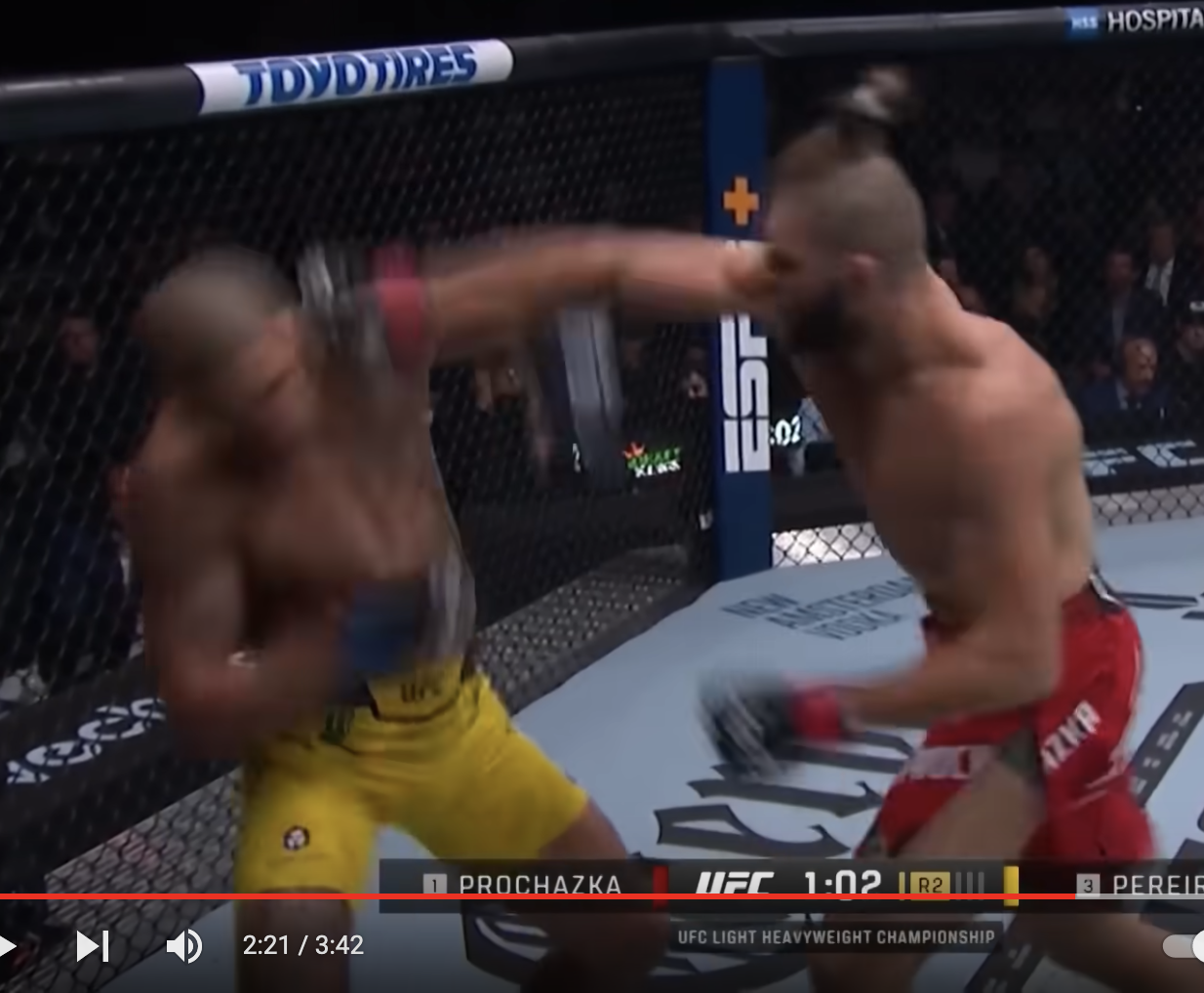
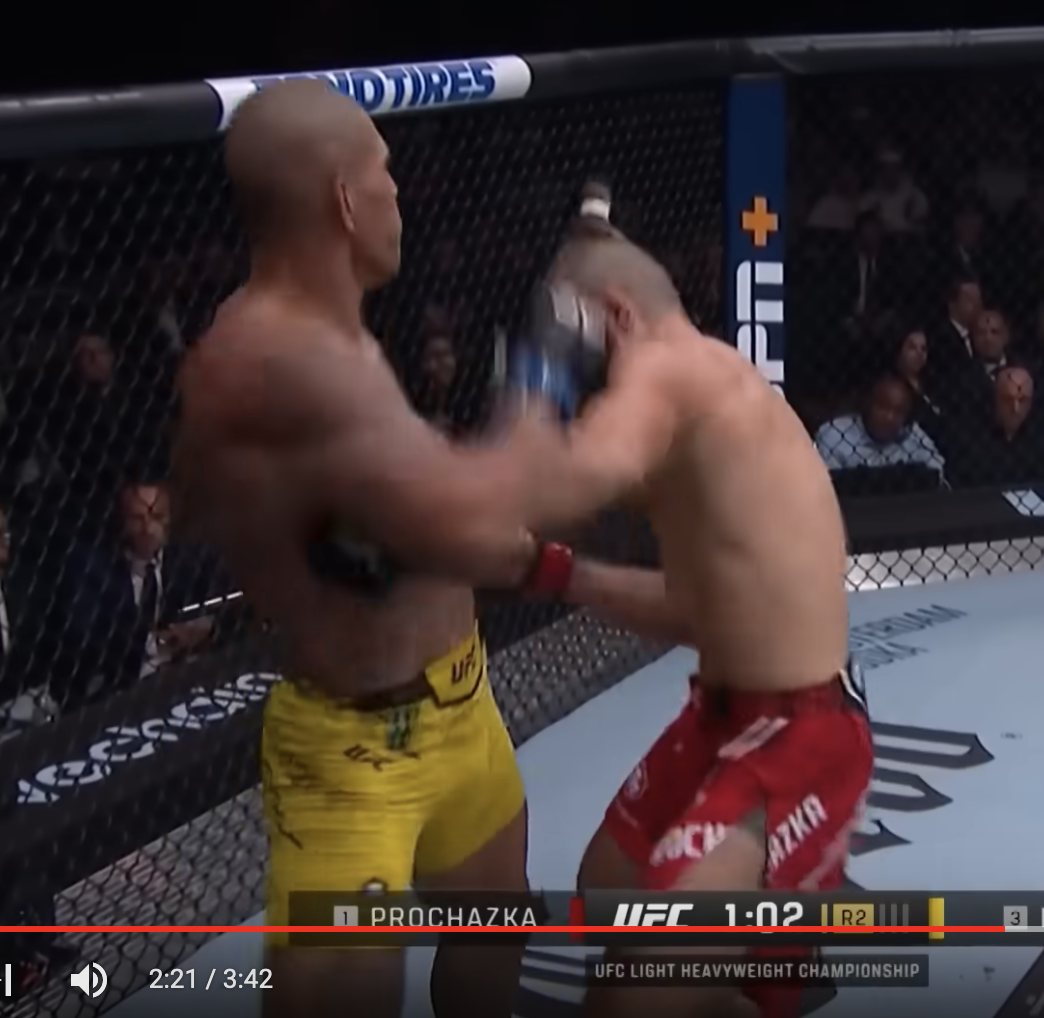
The very tight techniques of Chicken in Xing Yi are very metal in nature – sharp and cutting.

A perfect example of this Chicken style applied to MMA is the standing guillotine. When somebody shoots in for a takedown, wrapping the neck and using your hips to stand tall, with a narrow base is a very chicken-like technique. In fact, Pereira almost finishes the match with Jiri earlier with one:
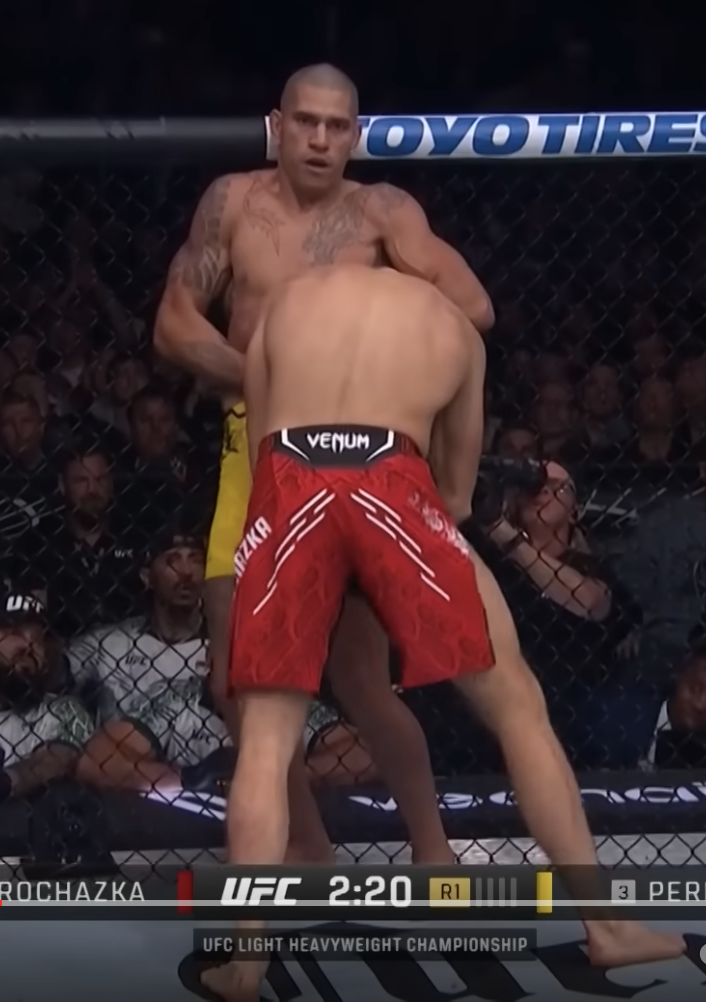
Standing guillotine attempt from Pereira.

Here’s a video of me doing some Xing Yi Chicken:

As I mention in the video, Chicken is an important animal in Xing Yi because it provides one of the requirements of the San Ti Shi structure – chicken leg.

Another thing Chicken (done by humans) is famous for are the knee strikes, which in real chickens are enhanced by the spurs it has on the back of its legs, and elbow strikes. You see this with fighting chickens especially. My teacher always said that the martial art that most resembles Xing Yi Chicken is Muay Thai, which is famous for knees and elbows.

The finish in UFC 295 was delivered by downward elbows from Alex Pereira and he has finished UFC fights with his famous flying knee before, delivered here in a way that looks very similar to the knee strikes in the Xing Yi link I do above:

Hopefully I’ve made my case.

To repeat: I’m not saying something simplistic like, “UFC fighters are doing Xing Yi”, but that as a tool for analysing fighting styles, I find Xing Yi really useful and the 12 Animals remain really fascinating.

A bit of homework for you…

Finally, I want to leave you with a bit of homework – also on that card that night at UFC 295 was British heavyweight Tom Aspinall. He managed to secure the interim heavy weight championship belt that evening. To me he’s a clear example of another one of Xing Yi’s 12 animals. The question is which one? You have 10 to choose from! Post your answers, compete with your reasoning, in the comments section below and I’ll give a prize for the correct answer (correct according to me, anyway, and I am the final word in this 😉 ).

Have a watch here:

Swallow Photo by Rajesh S Balouria: https://www.pexels.com/photo/close-up-of-swallow-17484064/

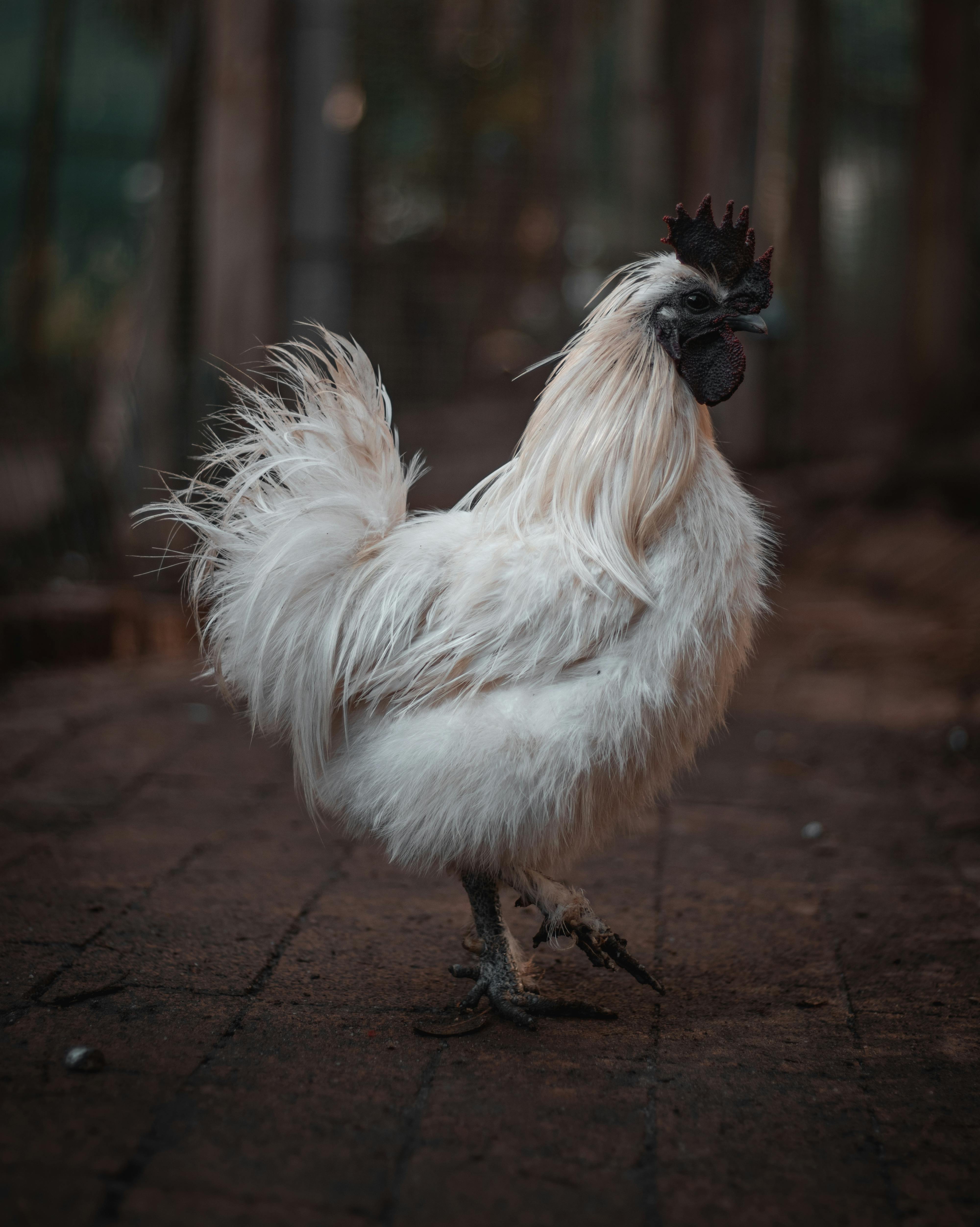
Chicken Photo by Luke Barky: https://www.pexels.com/photo/white-chicken-on-a-concrete-pavement-2886001/

Where should your elbows be in Xing Yi?

Today’s blog is about a weird quirk of the Xing Yi world. There’s a surprisingly large amount of online debate in Xing Yi circles about where the elbow should be when performing Xing Yi. I mean, a surprisingly large amount of debate. Especially for a matter that might, forgive me for saying this, be seen as trivial by people actively engaged in combat sports that actually spar with resistance.

Obviously, if you have some sort of two person free practice in your Xing Yi system that you actually engage in regularly, I’m not talking to you. I think the real reason why all these debates happen is simple – too much forms and not enough fighting.  

But, ok, there are other reasons. For example, details do matter in internal arts. Quite often we’re being asked to look in detail at our movements and micro movements to get the most perfectly coordinated and natural human movement possible. But without keeping one foot on the ground, (and grounded in the reality that sparring provides), the theoretical arguments start taking over and the art disappears up its own bum. A martial art that is predominantly forms-first is always going to be theoretical at best. To take the well worn analogy – you don’t learn to swim by practicing on dry land.

Long, explanatory videos have been made, back and forth, about why a certain person is doing it right or wrong because his elbows stick out or tuck in.

The problem stems from the fact that there’s a line in the Xing Yi classics that translates as: 

“The hands do not leave the heart and the elbows do not leave the ribs”.

But it’s how literally you take these words seems to be the crux of the matter. Now, I’ve seen videos of respected Xing Yi masters quoting this passage while demonstrating and their elbows are clearly leaving the ribs, if not in the horizontal axis, at least in the vertical axis. 

The reasoning behind keeping the elbows tight is sound – in boxing, kickboxing and MMA it’s generally considered best practice to keep your shoulders high and elbows tucked in close to the body to help protect the ribs. But boxers don’t tend to get hung up on this – as their individual style develops they don’t feel like they have to conform to the same ‘rules’ that the novice has to. They are free to develop their own personal style through experimentation and testing in the ring. I’m sure Prince Naseem was taught the same basics as Mike Tyson, but look how differently their boxing styles turned out in the end.

So, (and I know, dear reader, that you are just dying the hear this), what’s my take on where the elbow should be in Xing Yi?

Well, I’m glad you asked. Rather than getting hung up on words in an old writing (that may or may not be old at all) I prefer to get hung up on history. I mean, you have to get hung up on something, right?

Xing Yi is generally considered to be descended from military spear fighting. If you hold a heavy spear it becomes readily apparent that your best chance of wielding it with power is to keep it in front of the body, not out to the sides. It’s the same when you hold any heavy object – you are stronger when your arms are in front of you holding it than when they are at your side holding it. This is the truth I feel these words are aiming towards, and generally the postures and techniques of Xing Yi all comply with this idea of keeping the elbows in and the arms in front of the body, not to the sides. There are exceptions though. For example, Xing Yi Bear has a much rounder posture, with gaps under the elbows, more like the Yi Quan standing postures.

Professor Yu Yong Nian, demonstrated Yi Quan standing posture from https://zhanzhuangchikung.files.wordpress.com/

Some postures in our Xing Yi dragon and chicken links are for hitting with the elbows and we hold them out to the side when doing so, but in these cases you are normally (but not always) standing side-on to the opponent, so the elbow tip is pointing at the opponent, so in that sense it is not ‘out to the side’. 

A good example is this famous Liang Yi Zhuang posture from Baji, which is similar to the chicken posture I was talking about. (Baji is another Northern Chinese martial arts, that is a bit similar to Xing Yi).

Picture from https://bajiquan.fandom.com/wiki/Liang_Yi_Zhuang_两仪桩

I mean, we could decide that viewed from the opponent’s position the elbow is in line with the body, therefore it is not leaving the ribs, but the hands are not in front of the heart. No way. Are we therefore going to decide that this posture, taken out of context on its own, is wrong because it doesn’t correspond literally to some ancient writing that may, or may not, have been referring to a specific context?

Here’s another theory: I think what the whole thing is quite possibly about how soldiers work in formation on a battlefield. If Xing Yi does have military roots then a line of soldiers on a battlefield would all be orientated towards the enemy, standing side by side in a line. That’s another good reason to stick the elbows to the ribs. Any bladed weapons going towards your sides would definitely not be welcomed by your brothers in arms. 

Ultimately, I don’t expect this post to have really made a difference to the debate. I feel like this one is just going to run and run forever. So long as there are mainly theoretical practitioners of the art there will be always be many theoretical debates about how what somebody is doing is right or wrong in relation to some ancient writing.

I just think people’s efforts would be better put to trying moves out on other people and getting feedback that way. As one of my teachers used to say often:

“There is no such thing as correct technique, there is only appropriate technique.”

The military roots of Xing Yi

So, as a kind of counterpoint to my previous post questioning whether all Chinese martial arts come from military methods, I’d like to focus on one that definitely does – Xing Yi. Although, this really just emphasises my previous point because Xing Yi looks very different to most other Chinese martial arts and the reason it looks different is because it comes from weapons-based military methods and is therefore more concerened with military engagements than civilian. As our podcast series is showing, there is a verifiable historical connection between Xing Yi and soldiers – for example, the oldest historically verifiable practitioner linked to Xing Yi – Ji Long Feng, was a real life soldier in the Ming Dynasty army.

But the real reason you can tell Xing Yi descends from military methods is that you can simply look at it. The arms and legs are generally close together and close to the body, the posture is narrow and the direction of techniques is straight in front of you. Everything is done within the profile of the body. There are two main reasons for this 1) you were wearing armor and had to accommodate for the weight of it, and 2) you were using weapons, which were probably quite heavy, since they had to penetrate armor.

The Xing Yi we have today is what military arts would look like if you did them without wearing armor and using hand techniques instead of weapons. Of course, many people still do Xing Yi with a spear, but it’s rare to see anybody wearing armor doing it these days, which I think leads people to get the wrong idea about it.

Take a look at this video of my friend Byron Jacobs from Beijing doing Xing Yi Zuan Quan (Drilling fist). Look how tight everything is to the body and how the hands are kept within the profile of the body:

Here’s an example:

All this leads me to this excellent new video by Karate Nerd, Jessie Enkamp called “I trained like a Samurai for a day”. Here he gets Dr. Kacem Zoughari, a Japanese martial arts expert to take him around the Samurai Museum Berlin. It’s pretty interesting then half way through, it gets super interesting because he gets to wear old Samurai armor and have a go with a few authentic weapons. Now this is really valuable because he tries to do Karate movements in the armor and very quickly realises that it’s completely inefficient and exposes all the vital parts of the body to strikes from the opponent. The expert, Dr. Kacem Zoughari, gets him to change his movements so that everything happens within the profile of the body and makes him use the footwork, momentum and body to power the arm movements. The strikes become hidden, and tight to the body rather than telegraphed and open… and bingo! It starts to look just like Xing Yi! He suggests a cross step at one point and it looks a lot like Xing Yi Dragon step. The strikes he has to do start to look like parts of the 5 Elements – Pi, Beng, Tzuan.

Take a look:

Now you may be thinking Japanese armor isn’t the same as Chinese armor and therefore none of this is relevant, but you would be wrong. That armor at the top of this post is not Samurai armor, (although I bet if you took the average person off the street and asked them what it was they would think it was Samurai armor). It’s based on Chinese armor from the Song Dynasty. This would have been officer armor, not what your average soldier was wearing, but the same principles would apply – you want your movements to protect your vulnerable areas – the neck and joints in particular.

Xing Yi is based on these principles – minimal movement, a tight profile, using the body, momentum and the step to power the arms, strikes based on timing rather than speed, etc. And that’s why it looks so different to something like Karate or Norther Shaolin or Long Fist, etc.

Further reading:

Listen to parts 7 and 8 of our podcast on Xing Yi which focuses on Chinese armor and its influence on Xing Yi.

Chinese armour breakdown

I try not to do too many posts that are basically just a video, but I thought this one from Kung Fu world showing how the various parts of Chinese armour were worn was pretty good. There’s not much information provided with the video, but from looking at it I think it’s based on Song Dynasty (960 – 1279AD) armour – I could be wrong about that, but what’s interesting about it is that your average person saw this they would probably think this is Samurai armour from Japan, especially because she’s holding a sword that looks a bit like a katana.

Chinese armour really reached a peak in terms of technology in the Song Dynasty because the Chinese were fighting their most difficult opponents at the time, the Mongol army. This was the time of the folk hero General Yue Fei, who is traditionally associated with the martial art of Xing Yi and Xin Yi. Eventually the Song Dynasty collapsed and the Mongols took over, creating the Yuan Dynasty which only lasted from 1271 to 1368.

Internal power and the 3 internal harmonies: Going beyond words like Xin, Yi and Qi to direct experience

Almost by accident I watched Onama vs Landwher from UFC: Marlon Vera vs Dominick Cruz this morning and heavens above, that was one hell of a fight! Possibly the fight of the year. I’ve no idea how you’d score it. Landwher won by decision, but it was possibly the MMA fight of the year. Wild exchanges throughout with both fighters being so tired they could hardly stand up, but somehow kept going. It looked like they both had almost beyond the levels of human endurance, going from looking so tired they could barley move to pulling off flashy 3 move combinations.

You could almost see their spirit rising within to propel them on. It reminded me of all the phrases about the internal harmonies (san nei he) that we use in the Internet arts. The Xin (heart) leads the Yi (intention/mind), the Yi leads the Qi (energy to work) and the Qi leads the Li (physical movement). Initially this seems rather simplistic, say if you want to do something like make a cup of tea then you first have a desire to do it (heart) that travels to the brain (yi) that decides and then it ends up in a physical movement (li) and you find your feet moving you towards the kettle.

But that process happens automatically in humans and all animals, so why do we need to make a big deal of it and describe all the parts that build up to making an automatic process happen?

It’s often explained as putting the intention and will (the brains and heart) behind the movement. You can do things with a sense of purpose, or you can do them absent mindedly. In the internal arts, like Xing Yi, Bagua and Tai Chi, your actions need to have a sense of purpose. Your mind needs to be on the job, not half engaged. That’s one reason, but I think there’s more to these internal harmonies than just this.

I remember in BJJ training sometimes being so exhausted it was like my mind left my body and I became somewhat detached from my surroundings. It’s at moments like that that you start to be able to feel your “spirit” or mind as an identifiable thing. Through a sheer act of will you can force your mind to not give up and get back to the job and it can give you the energy you need to carry on fighting. That’s what I saw happening in Obama vs Landwher. A sheer force of will was being used to make them continue – their internal was leading the external.

Frankly, most people training only internal arts without hard sparring pay a lot of lip service to the internal co-ordinations, but do they ever reach an intensity of training where they can actually feel these things as tangible elements?

I’m not saying that you need to get an an MMA cage to experience your internal state under extreme physical stress before you have any idea what it is, but you can experience it in a safer way through things like Jiujitsu. Maybe Systema, too. Just some food for thought, and another reason why I think all Tai Chi instructors who re physically able should try and get a blue belt in BJJ if they are teaching the art beyond the health aspects.

There’s a risk, when reading this that people might think that using your Yi, or Xin in Tai Chi technique simply means to furrow you brow, put on a mean face, stare hard at something, get really tense and act like you really mean it, man. Because that’s not it either. That’s not what using “martial intent” or Yi means in internal arts at all. If I see people practicing internal arts like that I think it’s just bad karate. Not that there’s anything wrong with karate, of course.

Your internal state can be serious, but come from a place of calm. It’s a strange contrast between being expansive, yet laser focused, like the eyes of an eagle who is high up in the sky looking for prey. He’s taking in all his surroundings, but can pinpoint down on a single point when required. That’s using the 3 internal harmonies properly.

I think this is a Kite, not an Eagle, but you get the idea. Photo by Flo Maderebner on Pexels.com

The Tai Chi classics say:

To fajin,
sink,
relax completely,
and aim in one direction!

There it is – the (sung) relaxed body is the first requirements, once you have it you can ‘point your mind’ in the direction you want your power to go, so that the internal movement matches the external movement. When the inner and outer harmonise together, then you have internal power.

Xing Yi Stepping Basics

One of the hardest things I think that there is to convey in Xing Yi, to the perspective new student, is how the 5 fists work with the stepping. All the time I see people doing the arm positions of the five fists in a highly stylistic and precise way, but the body isn’t right. If the body isn’t right then the fault can usually be found in the legs and waist, and most likely it’s the stepping. In Xing Yi your stepping is the delivery system for the power of the body.

The words of the Xing Yi Classic of Unification apply here:

“When the upper and lower move, the centre will attack.
When the centre moves, the upper and lower support,
Internal and external, front and rear are combined,
This is called “Threading into one”,
This cannot be achieved through force or mimicry.”

i.e. everything moves together, as one.

In this video I look at some of the common faults I see in Xing Yi stepping, which could be described as problems of partiality. First, the foot arriving before the hand, then the hand arriving before the foot, and finally the foot and hand landing (i.e. finishing their journey) at the same moment with no penetration.

The real Xing Yi stepping is deeper and more penetrating. You’re hitting the person (or bag) while your front foot is still in the air, as you move through them, displacing their mass. That’s the trick.

(N.B. this style of striking in Xing Yi is more popular in the Hebei style – other styles of Xing Yi have different specialties).

Good Hebei style Xing Yi Quan (Xingyiquan)

This Xingyiquan video caught my eye recently. It’s a good performance and demonstrates a nice range of material drawn from Xing Yi’s animals and elements. The performer is doing it well, and using some untypical examples of the animals in some cases, which adds a nice bit of variety.

Check it out:

Xing Yi is typically split mainly into two big demographic styles known as Shanxi and Hebei. The video shown here is a good example of Hebei style. It’s practiced by Sun Liyong, a famous Xingyiquan master from Beijing Simin Wushu Club.

If you’d like to know more about the different styles of Xing Yi and how they evolved then check out my history of Xing Yi podcast series.

Are set forms the death of creativity?

Xing Yi Eagle link

Tai Chi is just one of a number of Chinese martial arts that have extended forms practice as a key component of their training methods. An incredible amount of time in Tai Chi is dedicated to performing the form in just the right way. Of course, there are lots of martial arts that don’t have forms, but they tend to be more sportive and wrestling based, although striking arts like boxing don’t have set forms either. Exactly why so many Chinese martial arts have forms at all is another question – one that relates back to their cultural origin and use in entertainment and religious festivals, and has relatively little to do with martial efficiency. It’s a contentious point, so for now let’s just accept that most Chinese martial arts today do have forms, and if you’re going to practice a Chinese martial art in 2022, then you’ll be practicing forms too.

In my training I’ve been exposed to various Chinese martial arts, and they all had a number of “set in stone” forms to train, until that is, I was introduced to Xing Yi. Or rather, I should say, to my Xing Yi teacher. His method of teaching Xing Yi was entirely different to most modern teachers – he really didn’t like the idea of set forms. Beyond the 5 Element form (the basics of Xing Yi) he didn’t really believe that any form should be ‘set in stone’. In fact, he wouldn’t even let you call them “forms”. You had to metaphorically put a pound in the swear jar every time you said the word “form”. He preferred the term “linking sequence” (lian huan, in Chinese) because it implied that the postures were linked together and could just as easily be linked together in an entirely different way. This is not entirely true, either. Sometimes he would teach you a particular sequence that was the way one of his teachers did it, and we’d call it the “master xyz linking sequence”, on the basis that you had to start somewhere, but if you ever quizzed him too deeply about a particular movement sequence then the answers would soon start to turn into the “well you could do it this way, or you could do it this way…” territory. He really didn’t want to be pinned down into a specific way of doing anything.

Xing Yi Bear link

I think the reason he was like this is that he didn’t want to kill the natural creativity in his students, and he wanted to keep the practice vital and alive. It should be obvious that your goal in martial arts is to be a formless fighter – even a small amount of light sparring will reveal the universal truth to you that if you try and adopt fixed methods to a live situation, the results are never good. To deal with any kind of live situation you need to be able to respond and adapt freely to whatever is happening. I think he saw the popular “fixed forms” training method as being part of the reason that some Chinese martial arts were less than successful when applied for real. It was also the way he’d been taught Xing Yi, and he wanted to teach in the manner in which he’d been taught. Of course, this makes it a lot harder to teach – having a few set forms makes teaching much easier, and also transfers to large groups well. Being spontaneous requires much closer attention from a teacher and is almost impossible to expand to teaching larger groups of people. The best class size is always 1-1, and commercially that’s a hard thing to pull off. Luckily money was never part of the equation when we trained! I can’t say his method was universally successful in creating good students either – it’s definitely not. I’ve seen students of his who ended up being pretty delusional about their own abilities from following this method. It requires time (years) of prolonged contact so that you can absorb a martial art this way. If you get separated from the teacher too much then you can easily go off on the wrong track. It’s a bit like throwing mud at a wall – sometimes it sticks, sometimes it doesn’t. And sometimes the mud decides it’s somebody who has nothing left to learn from other people, and develops delusions of grandeur while trying to maintain the illusion of being humble. But, c’est la vie.

Anyway, I’ve peppered some video of me throughout this post so you can see some examples of what I mean by linking sequences – these are little Xing Yi linking sequences I’ve create to fit the space I’m working in. I like this sort of practice where you create new links each time you practice. You can combine different animals and elements in an almost endless number of variations. You can even do the movements from one animal but in the style – the xing – of another. Each day you train is different and depends on how you feel and the environment you’re training in. In fact, letting your environment (preferably, nature) into your practice is part of the training.

Xing Yi Tiger link

Now contrast that to typical Tai Chi training – you practice the same form in the same way, every day, for the rest of your life. Sounds a bit dull, doesn’t it?

Well, perhaps not. While the sequence in a Tai Chi form never varies, you can introduce a tremendous amount of variation within that fixed frame. This was how my Tai Chi teacher taught me, years before I started Xing Yi. After you’d learned the form you’d do the form in different ways, depending on what you were working on. The size of the postures could vary, the height of the postures could vary, the speed could vary from very fast to very slow, or you could focus on the breathing, on separating empty and solid. Again, the list was almost endless. It worked better if you stuck to one particular ‘thing’ for a good few months though, before you moved on to the next. Again, close contact with a teacher is required, over years. 

Once the Communist ideology took over in China it infiltrated everything, including martial arts, and it’s influence is still there today. The Communist ideal is that everything looks the same, and is done in the same way. The individual identity is subsumed by the group identity. You can see this influence in the martial arts of the period and its effects echoing into modern times. Row upon row of silk pyjama-wearing Tai Chi people practicing exactly the same form in perfect unison. If you want to get good at martial arts, that’s the thing you want to avoid. And if you’re thinking right now that your practice doesn’t involve enough spontaneity or creativity, then perhaps some of the ideas contained in this post can help.

Xing Yi Chicken link

Three views of qi in Tai Chi

Photo by Greg Rakozy on Unsplash

When it comes to “qi” it seems that every teacher has a slightly different view about what it is. After meeting many martial arts teachers, over the years (and ignoring the clearly delusional amongst them) I’ve paired these various views down to three models that I feel can act as a guide for helping the practitioner sort out what your teacher means when he or she says “qi”, and therefore, what you mean. I don’t think the three are exclusive at all – following one does not negate the others – and all three can be applied at once.

Many people would rather we kept qi out of Tai Chi Chuan teaching altogether, and I respect that view, however the Tai Chi Classics refer to qi quite often, so I think we’re stuck with it. And if you can’t beat ‘em, join ‘em.

Of course, qi relates to things well outside of the realm of martial arts too, so I think that it’s important to say that what follows is from a martial arts perspective. I’m looking at qi with a view to how it relates to the human body in things like Xing Yi and Tai Chi Chuan. If I was thinking about how qi related to, say the universe, or the landscape, I’d be looking in different places. Although, it has to be said that in Chinese thought the microcosm often mirrors the macrocosm.

Biological qi

The first view we’ll call the biological model. This is the view that what the Chinese call qi is simply the energy the body creates in the cells using the ATP cycle. We’re not talking about a controversial “bio energy” here, just the normal way energy is created in the cells of the body.

Adenosine triphosphate (ATP) is the energy-carrying molecule found in the cells of all living things and the universal energy carrier in the living cell. The German chemist Karl Lohmann discovered ATP in 1929.

ATP contains three phosphates and when it is converted to Adenosine Diphosphate (ADP) a phosphate is removed and energy is released that cells can use for processes like movement, synthesis and active transport.

https://www.britannica.com/science/adenosine-triphosphate

While the chemical process of the ATP cycle is hard to explain, the impact on things like Tai Chi and martial arts is quite simple and uncomplicated – qi is nothing mysterious here, and all movement therefore requires qi.
In this model, qi is related to breath because oxygen is required for the ATP cycle, which ties into the Chinese view of qi being related to breath quite nicely. The lungs therefore take over a prominent role in qi production, since oxygen is required for the ATP cycle to work.

Teachers that have this view of qi tend to focus more on the middle dantien in the body, as the the focus of movement, since qi production is higher in the body, towards the lungs, compared to the lower dantien. Stances tend to be higher and not as wide. Mobility is stressed over stability. Arts like Xing Yi and Yi Quan are good examples of these sorts of martial arts.

Qi as strength in a conditioned body

The second view of qi fits in more with Chinese concepts of acupuncture. This view sees the body as containing a number of muscle-tendon channels that run from finger tips to toes. On the soft yin parts on the front of the body we find the yin channels, and on the harder yang parts of the body, the yang channels. These qi channels are the channels along which strength can ‘flow’. By strength we’re not talking about the normal isolated limb movements, but the type of springy whole-body strength exhibited by animals and some marital artists. You can view movement in animals (and humans following this model) as a series of opening and closing movements using these channels. When we contract inwards, for example, we pull along the yin channels and when we open the body outwards we are pulling along the yang channels.

Think of the movements of a Cheetah running – as the legs stretch out the yin part on the front of the body is ‘opened’ and the back ‘closed’. As the legs retract inwards, the front closes and the back expands and opens. The process repeats in a cycle. This movement from yin to yang and back again is the Tai Chi cycle in action.

These channels are not real anatomical structures in the body, but constructed as distinct pathways containing various muscles, tendon, ligaments and fascia groups. (The acupuncture meridians that most people are familiar with are a similar idea, but came later and are obviously based on this idea of muscle-tendon channels in the body.)

In a normal human being these channels are not particularly strong or well developed, and work is required to strengthen them – to give you a “strong qi” – which is what neigong and chigong is for.
Qigong practice is therefore designed to condition these muscle-tendon channels – notice a lot of Qigong practice is to do with stretching along these muscle-tendon channels, using the breathing to assist (e.g. the baduanjin set of exercise). Over time this stretching and breathing can strengthen the channels so that they become a tangible, physical presence in the body. Once they are strong enough to physically manipulate the body with, various martial arts feats can be performed using them, like explosive punching (Fa Jin) or strong twisting and coiling movements.

You most often find this qi model used in arts like Chen Taijiquan, which is known for its twisting and coiling locking and throwing methods (chin na) and its explosive, whole body strikes called Fa Jin. Silk reeling exercises, which are part of Chen style Tai Chi, are excellent for developing this kind of conditioned strength.

Qi as a non-physical body

The final, more esoteric, view of Qi is as a non-physical body. Chinese medicine has the concept of the Sanbao – the three bodies. The physical body – Jing (related to our ability to replicate ourselves by reproduction), the energy or Qi body and Shen the mental or spiritual body. All three bodies are thought to inhabit us at once.

The physical body is the most apparent being the one we use most obviously, but through practices such as Zhang Zhuang Qi Gong, where you stand and hold postures over time, we can gradually become more aware of the more subtle energy body. The Qi body becomes apparent through sensation observed over time. The act of being aware of the qi body, usually in standing Qigong postures, (although seated or lying meditation practice also exists), strengthens your connection to it and your appreciation of it. The same is, presumably, also true of the Shen body, but that is not something I’ve ever experienced myself.

These more esoteric practices tend to be associated with spiritual groups (Taoist internal alchemy traditions), secret societies (exploited in the Boxer Rebellion) and martial arts groups that tend more towards stillness in their practice – like Yang style Taijiquan, or ones that practice seemingly impossible feats of conditioning, like iron palm and iron body practices.

While this view of qi is the one that’s hardest to ‘prove’, it’s also one of the most accessible. Practicing with stillness over a period of time can be done by anybody anywhere and usually produces some tangible results – heat in the hands, etc. But I think this is also the qi model it’s easiest to become deluded with. After all, if your only feedback is judging the things you experience yourself it’s easy to lose your objectivity. This is of course why having a good teacher is important.

Thoughts on Tai Chi Push Hands

Photo by mana5280 on Unsplash

Range

People tend to do push hands at the wrong range. I think the combat benefits of training push hands disappear almost entirely when you are too far out.

I notice when I train it with people they keep wanting to edge back. You need to be a range that feels uncomfortably close, until it feels comfortable.

If you look at MMA (sorry to use that as an example, if it rubs you the wrong way, but it provides brilliant examples and feedback of the dynamics of two people in a violent encounter) one of the big, high-percentage, often fight-ending, techniques is the counter left (or right) hook; the check hook. This happens after the fighter throws a jab – you move back (or slip) and throw your hook over the top – that’s the range push hands is working in, and a good practical example of what skill at that range can do.

If you watch this video of Cheng Man Ching pushing hands you can see he tries to stay in close all the time – in fact, when he’s launching people he kind of ‘cheats’ and takes an extra half step in so he’s right inside their base, which enables him to show off a bit more on the distance he can push them – this is only possible because they are keeping their ‘front door’ open with a wide stance. The way I was taught is that your toes match the opponent’s heels, fist width apart to allow for ‘shin biting’. (Lots of people do this distance correctly, but go shoulder width apart – leaving the groin too open and letting people step in to launch them. It’s just a bad habit to get into).

Don’t mistake push hands for sparring

Chinese martial art people in general I think spend too long in these double or single ‘arm contacted’ type positions – in more martial sparring sessions these moments happen in split seconds. People don’t stay here. If you end up putting your arms out looking for that position you get punched on the nose. I think doing too much of it breeds bad habits. You’re doing that ‘safe’ training to learn skills that are hard to acquire, which then get used in freer environments, rather than try to mimic the ‘safe’ environment in freer training.

Staying in this range all the time with another person doing ‘soft’ stuff like push hands seems to lead to teachers who start showing off and generating cult-like guru behaviour. It’s a trap you can fall into if you’re not careful. If your students start treating you like a holy saint, then that’s a red flag!

I’m really not a fan of the kind of following that builds around some of the big names in Tai Chi, like this guy, Adam Mizner. He plays the guru card well, and I’ve seen lots of videos where his students really overreact to him in a way that makes me think they all fell down a rabbit hole years ago. However, the guy clearly has some good skills at push hands, as you can see in this video. This video I think is one of the least worst of his I’ve seen (in terms of over reaction from his students) – yet the group still all stop what they are doing to ‘watch the master’ and play his guru game:

Fighting

It’s always worth repeating, even though its kind of obvious, – you don’t need push hands to fight. Combat sports turn out accomplished fighters quickly without these methods.

You can practice all the applications in a Tai Chi form in push hands – it’s one step up from doing them as stand alone techniques because it requires more timing, flow and ‘listening’, but this is still not ‘fighting’.

Jin

One of the reasons for push hands is to learn to use Jin not Li. For a short answer of what that means, I mean using the ground strength in your movement (jin), not local strength (li). It’s easy to fool yourself that you’re ‘doing it’ when you perform a Tai Chi form, because there’s nobody else there. Can you ‘do it’ when somebody is providing some light resistance? Or trying to ‘do it’ back to you? Push hands enables you to find out. I wish people would view push hands more as a tool for learning that, not as a competitive sport of limited wrestling. It’s like people have been given a knife, but they insist on using it like a spoon.

And the use of Jin in directions also requires a strategy to use them, which can also be practiced in the laboratory of push hands. Listen, stick, yield, neautralise and attack.

In push hands you ‘listen’ to the push from the opponent (with your body), you stick to their limbs (so you can feel and listen) then you yield to their pressure, which leads to neutralising their attack, so that you can attack yourself.

In sparring you use the same idea, but you cannot rely on being stuck to their arm. However, you need to keep the same process going that you’ve learned in push hands, just sometimes there will be no contact – you can still neautralise, and yield, through subtle changes in body posture and position, thanks to your use of sensitivity. Once you take ‘push hands’ into a more real sparring environment, I think you’re in the same territory where Xing Yi spends most of its time training. In Xing Yi it’s just the same idea, even if it looks different – you do not attack blindly at the opponent – that won’t lead to success against somebody good, bigger or stronger. In Xing Yi we have this phrase “don’t attack when you see an opening, attack when you see the heng” – I would interpret that as you only attack once the opponent’s attack has been neautralised (heng being the point of neautralisation); depending on your level of timing, this can be before the attack has even been launched. Good opponents will leave fake ‘openings’ for you to attack. Therefore you don’t attack based on what your eyes alone see – you attack based on feeling for that moment of neautralisation. Different training methods – same results.