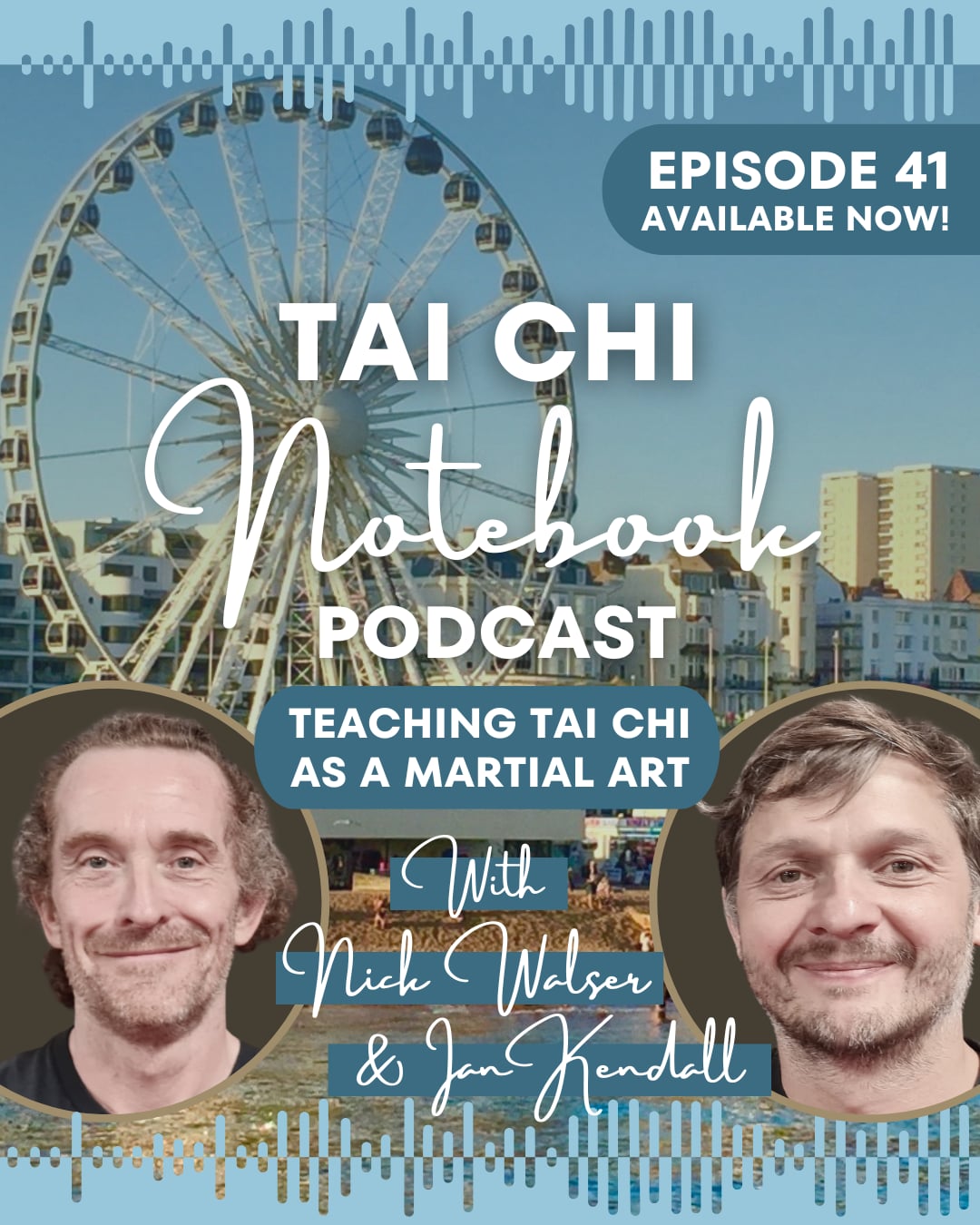
In this episode I talk to two Wudang Tai Chi teachers from Brighton, UK: Nick Walser and Ian Kendall. Both students of the late Dan Docherty, they have continued to practice the tai chi that Dan taught them and developed a new training system called 5 Snake.
5 Snake is a unique and powerful method for finding flow, resilience, and calm through partnered close- quarter practice, and they’re here to tell you all about it.
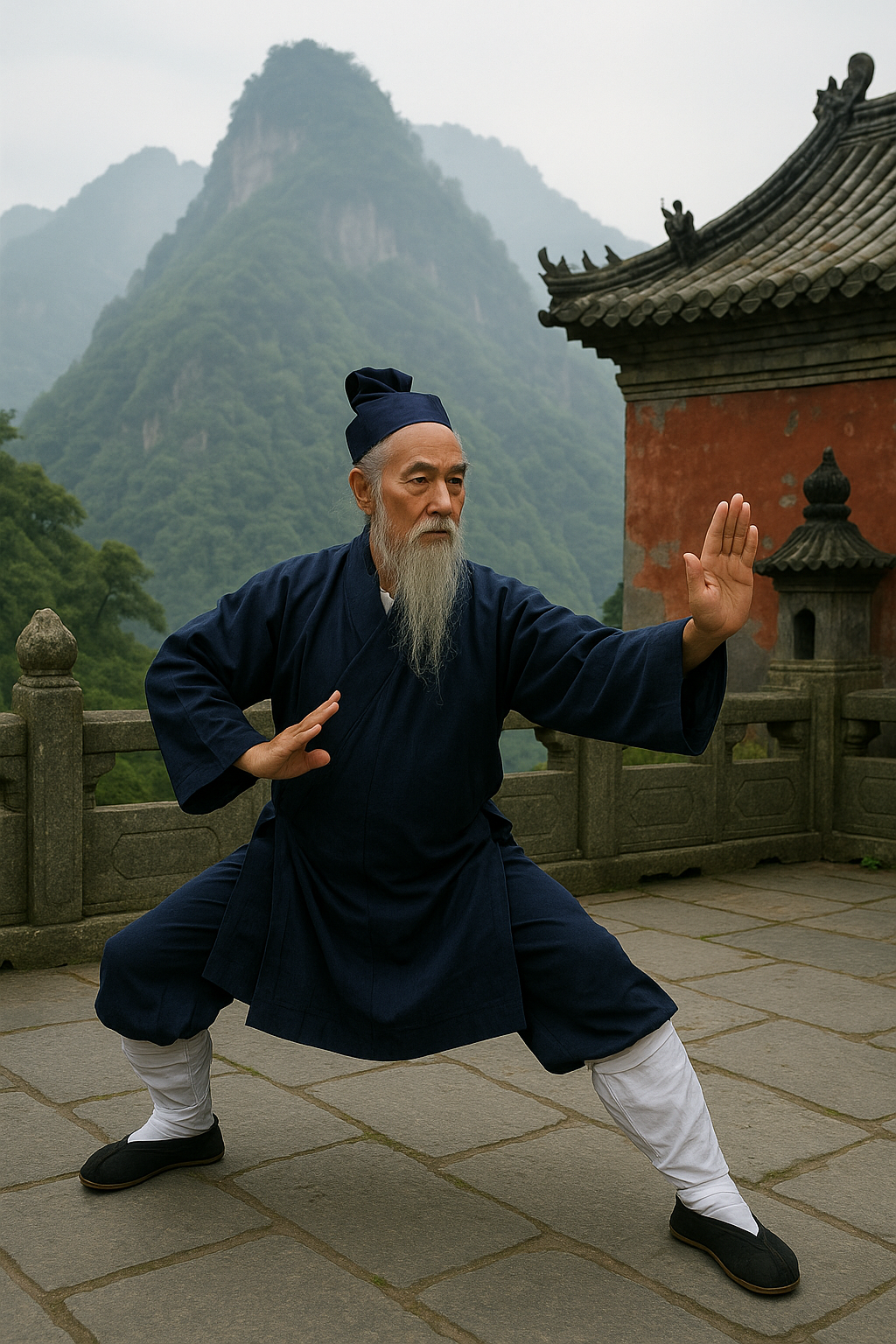
(FYI AI-generated image of a monk practicing martial arts at Wudang).
This is an excellent article called The Sacred Cash Cow: Wudang Mountain’s Martial Arts Tourism Empire by The_Neidan_Master on the massive amount of commercialisation of the martial arts in Wudang, which has really leaned into its claims as the birthplace of tai chi.
I don’t think it’s worth debating the authenticity of these claims again, I’ve done a couple of podcasts with people who have lived at Wudang and trained there, one with Simon Cox, and the other with George Thompson – both very different experiences, which reflects the diversity over such a wide area, since Wudang is a vast collection of mountains and temples/schools, rather than a single place – and I don’t know what more is gained by going over that ground, but I think it’s better to simply accept that there is a growing cultural force that is pushing Wudang, a traditional home of Taoist studies, as one of the centers of modern tai chi training.
If your goal is to train tai chi at Wudang then its worth reading the article to get a balanced view of the place before going there.
Here’s a great quote:
“For travelers seeking authentic martial arts experiences at Wudang, awareness of these commercial realities provides crucial context. Understanding that most schools are modern businesses rather than ancient temples allows for more informed decisions about where and how to invest time and money.”
I think we have to accept that for ancient traditions to exist and continue in the modern age there needs to be some soft of commercial aspect, but that means that you need to approach these traditions with eyes wide open.
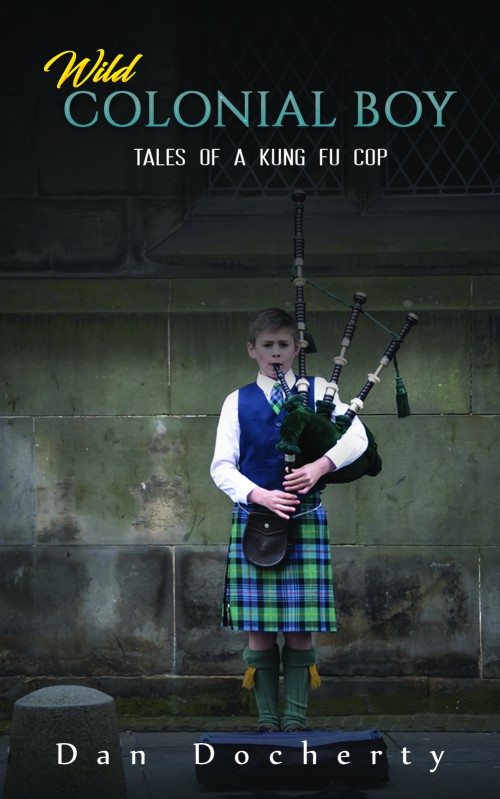
My latest podcast with Alan Wychereley, who was as student of the late UK tai chi legend Dan Docherty inspired my listener/reader Steffan Stringer to track down Dan’s autobiography “Wild Colonial Boy” (I have to admit, I’d heard of this book before, but never read it, and in my mind it was always called “Wild Caledonia Boy”, which, I think, given the Scottish-centric design of the cover would have been a far better title!)
“In 1975, Dan Docherty, a young Scots law graduate and karate black belt, left Glasgow to spend nine years as a Hong Kong police inspector.
As well as serving as a detective and vice squad commander, he also took up Tai Chi and won the 5th Southeast Asian Chinese Full Contact Championships in Malaysia in 1980.
In 1985, he was awarded a postgraduate diploma in Chinese from Ealing College.
He travels extensively teaching Tai Chi and has written four books on the subject.”
When I started Tai Chi in the early 90s everybody had heard of Dan Docherty, and he was something of a big name, not only because of his competition success, but also because of his reputation for unmasking frauds. I remember him gaining a lot of notoriety for pouring a bottle of water over the head of an ethnically Chinese Qigong teacher who was doing seminars on Ling Kong Jin or “Empty force”. Dan’s reasoning was that if he could move people without touching them then he should be able to deflect the bottle without the need for physical contact. It didn’t work. He was also famous for “getting into it” with one of the Yang family representatives in the UK, who ended up leaving the UK after their encounter.
Sadly Dan Docherty died of complications from Parkinson’s disease in 2021. I never met Dan in real life, but his impact on the UK tai chi community continues to be felt long after his death. That’s probably the best legacy a tai chi teacher could hope for.
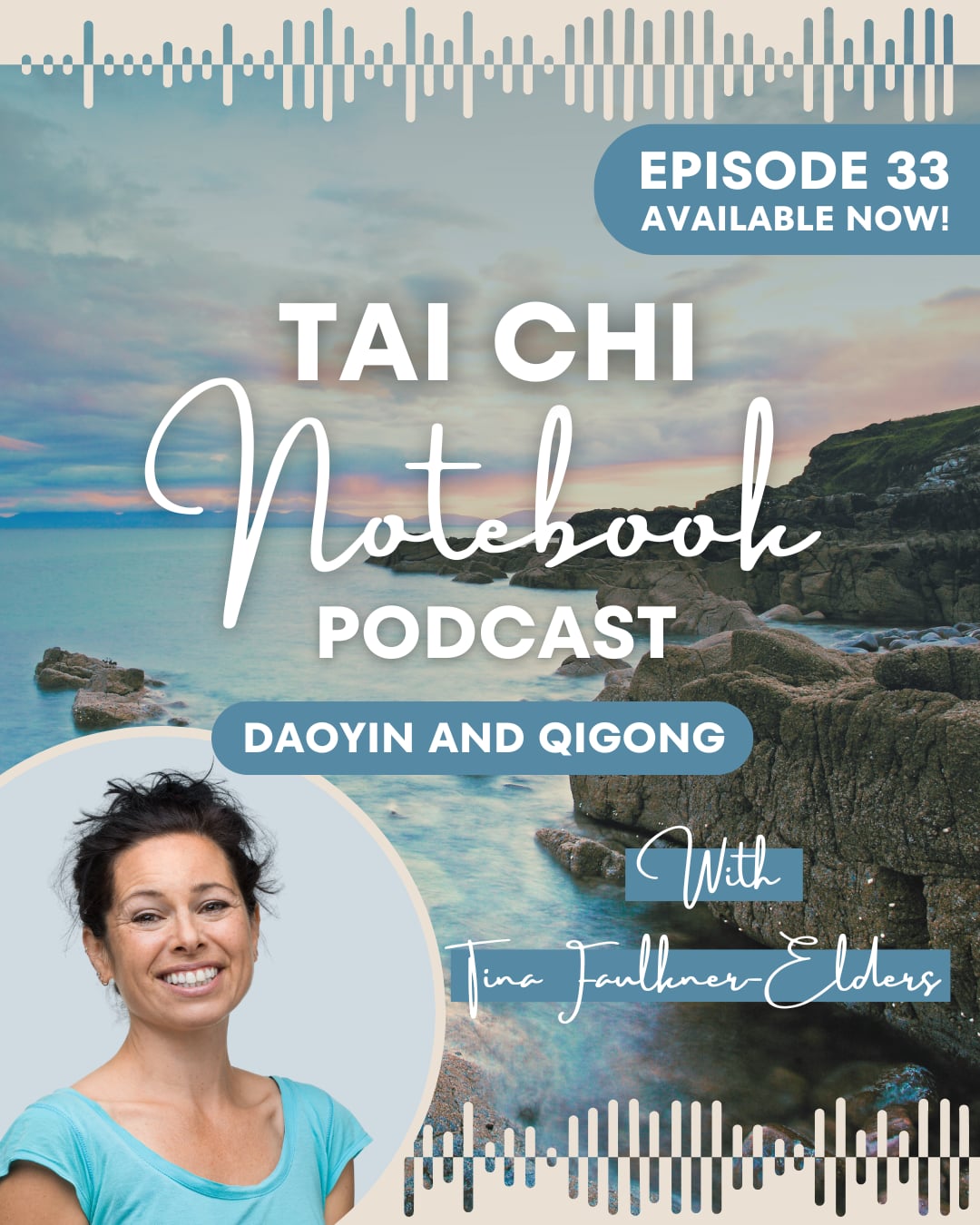
My guest for the latest episode of The Tai Chi Notebook Podcast is Tina Faulkner Elders, chief instructor of the RuYi School of Taijiquan and Qigong in Aberdeenshire. We talk about Tina’s training in qigong, first with her father, then in Beijing, China, and then on Wudang mountain itself, the legendary home of Taoism.
Simon and Brandi spent six years living and training in China under master Yuan Xiu Gang at the Wudang Daoist Traditional Kung Fu Academy. While there they studied Kung Fu, Tai Chi, Qi Gong, meditation, herbal medicine, Daoist music, and ancient and modern Chinese language.
After returning to the West, they started a Kung Fu school and community group in Houston Texas, where Simon was working on his PhD in Chinese and Tibetan mysticism at Rice University. At the end of 2019, they moved up to the Okanagan Valley and began sharing Wudang teachings with the local community.
What I really wanted to get at with Simon was an elucidation on his article about Zhang Sanfeng – exactly who was this mysterious Taoist immortal who is often credited as the founder of Tai Chi Chuan? I also wanted to find out more about Wudang mountain, and where its martial arts really come from. I hope you enjoy are conversation!
The article On the Historical Mystery of Zhang Sanfeng by Simon Cox, on the history of Tai Chi Chuan and its connection to Zhang Sanfeng is great. I’ll just quote a couple of paragraphs from near the end, but recommend you read the whole thing for context:
It seems like Tai Chi was really a Republican era (1912-1949) category that became a sort of umbrella term for various Chinese martial arts that are practiced slowly, containing such multitudes as the ancient martial arts of Chen village, the later arts of the Yang family, and the weird things people were doing at Wudang, in Zhaobao village, and even the government-created variations on these styles. From this view, asking which style started it all is rather meaningless. The historical connections simply aren’t there. From the densest of historical positions, there is no evidence anyone practiced anything called Tai Chi Fist before the 20th century. It arises as a high prestige category in the context of post-Qing Chinese nationalism. Every slow-ish martial art in China seems to have been automatically re-branded as a form of Tai Chi.
According to the Yang Family oral tradition, Yang Luchan 杨露禅 (1799-1872), the founder of the style, called his art variously Cotton Fist 綿拳 or Transforming Fist 化拳, and it was only during his time in Beijing that a Confucian scholar Weng Tonghe 翁同龢 (1830-1904) witnessed him demonstrating his style and wrote a poem about how it embodied the principles of Tai Chi. According to this oral tradition it was after this event that the art came to be known as Tai Chi Fist. This story was first published in the 1930’s and is almost certainly apocryphal. But even if we take it at face value, we arrive at the inevitable conclusion that Tai Chi Fist was an appellation applied first to Yang family martial arts and then later, during the first decades of the 20th century, expanded to include Wudang and Chen styles.
Simon Cox – On the Historical Mystery of Zhang Sanfeng
I don’t normally do a preview of my podcasts guests before the podcast comes out, but in the case of George Thompson I think it’s worth doing one because not only is he a fellow Bristolian, but he has so much great media out there for you to view that it’s worth watching some of it before the next podcast drops (which will be episode 24, due in a few weeks).
George has a great YouTube channel that has lots of Tai Chi and Taoism videos. He spent time in the Wudang mountains learning in a small Tai Chi school and there are lots of great videos shot in China that just look amazing.
He also makes hour-long films and I’d recommend giving Journey to the East a go, it’s a documentary of his last trip to Wudang and his adventures getting there because he was attempting to travel by train across Europe to China just at the same time as the pandemic was breaking in 2020. Check it out!
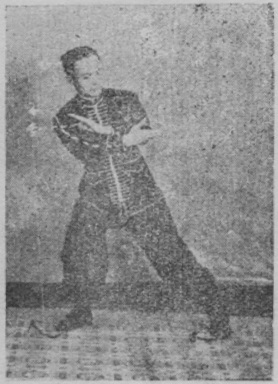
Long Zixiang performing the “press” movement of Tai Chi Chuan (1952, Brennan Translation).
People always want their favourite martial art to be really old, as if that somehow makes it more effective. In reality, age has no bearing on effectiveness and it’s the practitioner that is effective anyway, not the art.
In short, it doesn’t matter what martial art you practice, it matters what you can do with it.
Looking for scraps of evidence to somehow prove your art is older than it is, is a pedantic and pointless route to go down.
I’ve still seen no credible evidence that Tai Chi existed before 1850 beyond legends and myths. However there were plenty of Republican era Tai Chi manuals published in China by the Kuomintang, and almost all of them include some sort of dubious history section that traces Tai Chi back over a thousand years. Don’t latch onto these things – they are a product of their time, a time when the martial arts was being politicised to strengthen the nation in the face of foreign aggression and burn out the memory of previous humiliation by European powers who had advanced all the way to Beijing and captured the city during the second Opium war, forcing humiliating concessions from the Ching.
Thanks to the Brennan Translation website, you can read a lot of these Republican era manuals for free, and look at the photos, which are a fascinating insight into martial artists of the time and what they looked like.
Gu Ruzhang, “King of iron palm” and author of Taiji Boxing.
Myths and legends
For example, the famous Gu Ruzhang, the “King of Iron Palm”, wrote a 1936 “Taiji Boxing” manual which contains one of these history sections.
He writes: “China’s boxing arts have many names, but amount to no more than the internal skill and the external skill. The ancestor of the external is Shaolin. Its movements are all magnificently expressed. Since its principles have been spelled out by many previous generations, they do not need to be repeated here. The ancestor of the internal is Wudang. Its strength is stored within, such as in Taiji Boxing. Its power not being outwardly displayed, it instead has a pure naturalness. Like an unending circle, its movements are lively. And so it is deemed internal and is different from Shaolin. Taiji Boxing’s origin can be separated into five versions:”
The idea of Taiji Boxing being different to Shaolin is the thing he’s highlighting here – he’s trying to create something in contrast to Buddhist outside influence. Something Chinese that can bind the nation together in the face of foreign aggression (British and French before and Japan had just invaded). So, he’s saying that anything from this “internal school” is “Taiji Boxing’s origin”, without an actual lineage connection, this is a bit dubious at best, but let’s go with the flow.
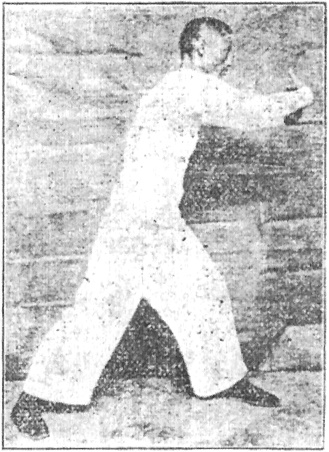
Gu Ruzhang performing the Press movement from Tai Chi Boxing. 1936 Brennan Translation.
One “Chinese” lineage he then mentions is Chan Seng Feng on mount Wudang (which has no validity, and is just myths and legends):
He writes: “What Zhang Sanfeng taught was of the Wudang branch (because he was living in the Wudang mountains), and it was known as the “internal school” of boxing. This version had the highest number of movements yet. Again the name was changed, now to Taiji Boxing, and it went down two paths:
Again, Wudang = Taiji Boxing!
Another 2 lineages of Taiji Boxing he lists starting in the Tang dynasty (the Tang Dynasty was 618AD-907AD, which is over a thousand years ago!), he also lists 1 southern and 2 northern lineages for Taiji Boxing that go through Chen village (our podcast has discussed this and found it unlikely, but not impossible).
It appears that Taiji Boxing is springing up everywhere in China from multiple sources!
He concludes with: “These are just the people we know about, to give a general idea. To cover every person who has received it and make a clear survey of the prominent practitioners of each generation, that will have to wait for a future edition. More will be added later so that future students can know about the source of their art.”
This statement seems to be that he’s admitting he doesn’t really know. It’s just a collection of things he’s been told. None of which there is credible evidence for beyond what he’s been told. Sure there could be a document somewhere proving “Yu family taught something called Innate Nature Boxing” in the Tang dynasty, but how does that related to Taiji Boxing?
There’s no connection beyond the idea that anything Wudang-like must be the origins for Taiji Boxing because,….. it just is, ok?
Obviously, nothing comes from nothing – whatever Yang Luchan created post 1850 in Beijing was from what he learned previously. You could use the same logic to argue for a lineage all the way back to the pre-human monkey in 2001 banging bones together in front of a black monolith. Or you could go back to the start of the universe. It’s an interesting philosophical question, but for sanity’s sake I think you have to start somewhere with a style that has a name and a collection of training methods called “Tai Chi Chuan”. Otherwise, all martial arts are infinity years old.
But to get back to my point. It’s not the age of the art that matters, it’s what you can do with it that does. These old boxing manuals are a real treasure, but I look at them for their practical advice, their description of forms and strategies and applications, not their accounts of history from an age where saying the wrong thing could get you beheaded. Unfortunately for the writers of many of these manuals, the Communists took over in 1949 and they were forced to flee to Taiwan and Hong Kong. A lot of them didn’t make it.
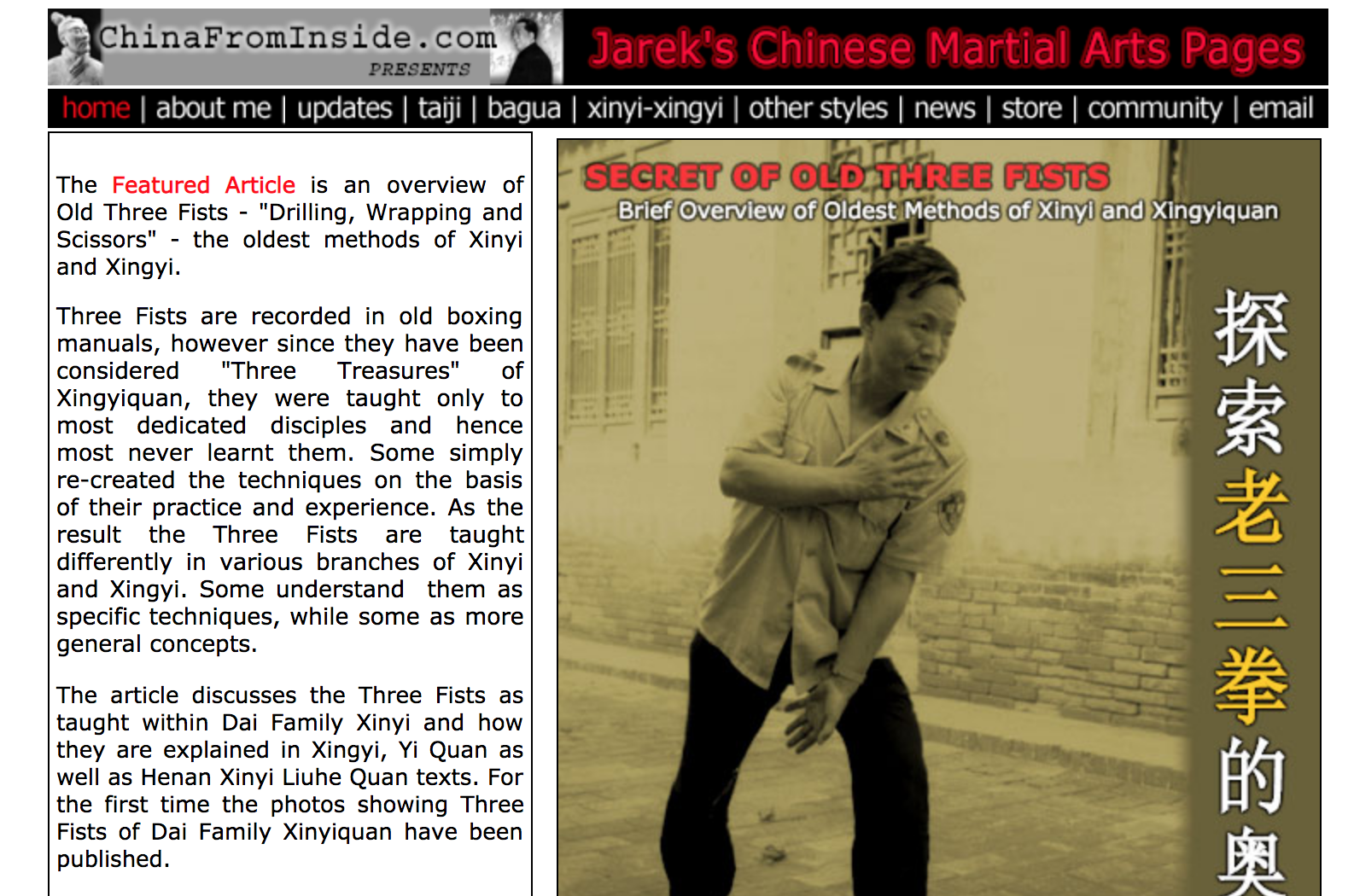
Jarek Szymanski’s website, China from Inside was one of the first and best resources on the web for the history and practice of Chinese Martial Arts, written by a European living and working inside China. It was particularly good for finding out how internal martial arts, like XinYi, XingYi, Bagua and Taijiquan were actually practiced in their native environement.
I remember reading his website back in the 1990s, and it’s still there!
Nick at Masters of the IMA has been working together with Jarek over the last few months on recording some of his experiences in China back in the 90s – how he came to end up living in China, his experiences investigating the history of various CMA, etc.
He’s posted the first parts of the interviews on his website, and it’s well worth a read. You can find out all about his experiences on Mount Wudang and Beijing, and get his opinions on how modern Chinese martial arts related to the older traditions, and how they differ. I really liked his insights into places like the Shaolin temple and Mount Wudang (see part 5) and how they’ve changed over the years compared to his visits there in the 90s.
“When we got there, we saw some Shaolin monks (wuseng) giving performances not in a stadium, but just in an open space outside the temple. As far as I can tell they were demonstrating some forms and hard qigong, iron shirt (tie bu shan), etc. My Polish friend and I had great fun ‘testing out’ the iron shirt guy – when he invited members of the audience out to test his iron shirt, I don’t think he was expecting to be punched full force in the stomach by two 6-foot Polish guys (laughter). It was at that point that I realised so-called iron shirt is not that special, most demonstrations of iron shirt are just a combination of timed breathing and muscle contraction, similar to what I had practiced in my early karate years.”


 The Tai Chi Notebook