Resonant Space

Religion, Theatre, and the Chinese Martial Arts, by Daniel Mroz
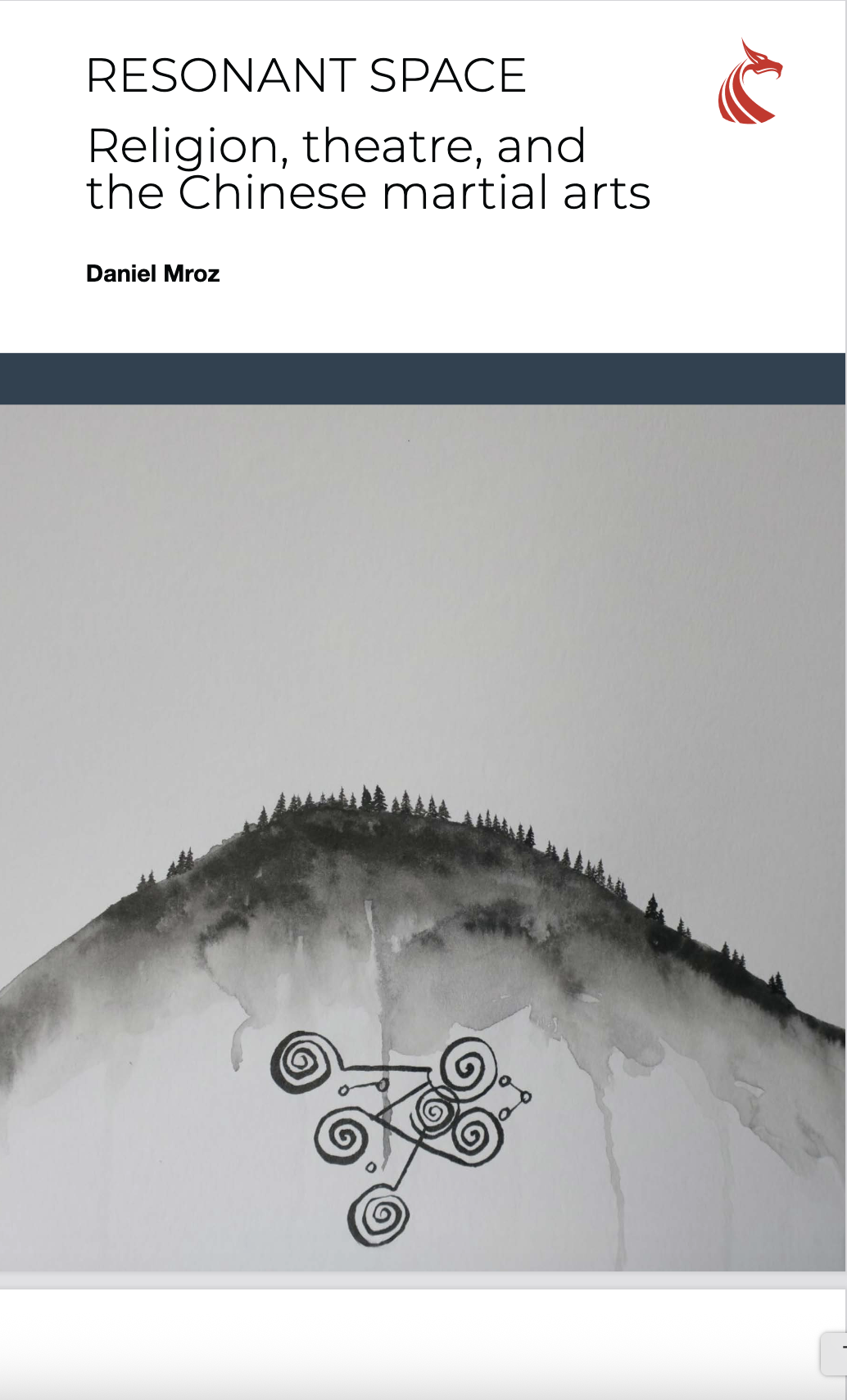
My good friend Daniel Mroz’s new book Resonant Space is out now! Daniel was the first guest on my podcast — back when I had no idea what I was doing with recording and editing audio, so it sounds pretty bad compared to my more recent efforts. However, what he talked about remains as insightful and up to date now as it did then. This book takes his ideas even further.

Here’s the blurb:

“Resonant Space constellates the martial, ritual, and theatrical elements of the Chinese martial arts with the practice of contemporary theatre and dance. This interdisciplinary approach blends the embodied experiences of the author, a lifelong student of the Chinese martial arts and a theatre director and dance dramaturg, with the study of Chinese cultural history. This is a work for scholars and practitioners of the Chinese martial arts, of contemporary dance and theatre, and for scholars of Chinese religion and cultural history.”

The best bit? You can read the whole book for free digitally, or buy a printed version for a reasonable price.

If you are at all interested in the intersection of Chinese martial arts, magic, theatre, military methods, violence, dance, self defence and religion, then you can’t miss this. I have read bits of this book already (it’s excellent), but I haven’t read it all yet, so I’m yet to appreciate it as a whole, and to see how he makes all the pieces fit together. I’m very excited to finally get to read the complete thing.

If you’re a practitioner of Chinese marital arts, then I can guarantee that this book will make you think. In good ways. There’s almost an embarrassment of riches packed into every page. So, rather than attempt to describe it, I thought I’d just throw three random quotes at you from the first chapter of the book, without context. Hopefully they’ll make you want to find out more.

“In the Chinese martial arts and in military strategy more generally, excellence in fighting is secondary to trickery and wisdom.”

“Perhaps the most famous failure of war magic was experienced by the Yìhéquán 義和拳 fighters of the Boxer Rebellion of 1899, who discovered they were not impervious to the bullets of Western colonial powers.”

“Given its spectacular nature and emphasis on dramatic fights, it comes as no surprise that Chinese theatre, or xìqǔ 戲曲, employs many training methods that are virtually identical to those used in martial arts.”

Again, you can read the whole book for FREE from Cardiff University Press as a PDF, or you can buy a printed copy for a reasonable price. Don’t miss this!
Making up your own forms – it’s not as easy as you think

I had an interesting comment on my last post that made me think about the whole idea of making up your own forms (or Tao Lu) – in Tai Chi, Xing Yi, or whatever.

I’ve tried to do this over the course of several years and I’ve come to a few conclusions about it, which I’ll elaborate on here. Firstly, it’s hard. Making up new forms is not as easy as you think. But secondly, it depends what martial art you are making up a form in.

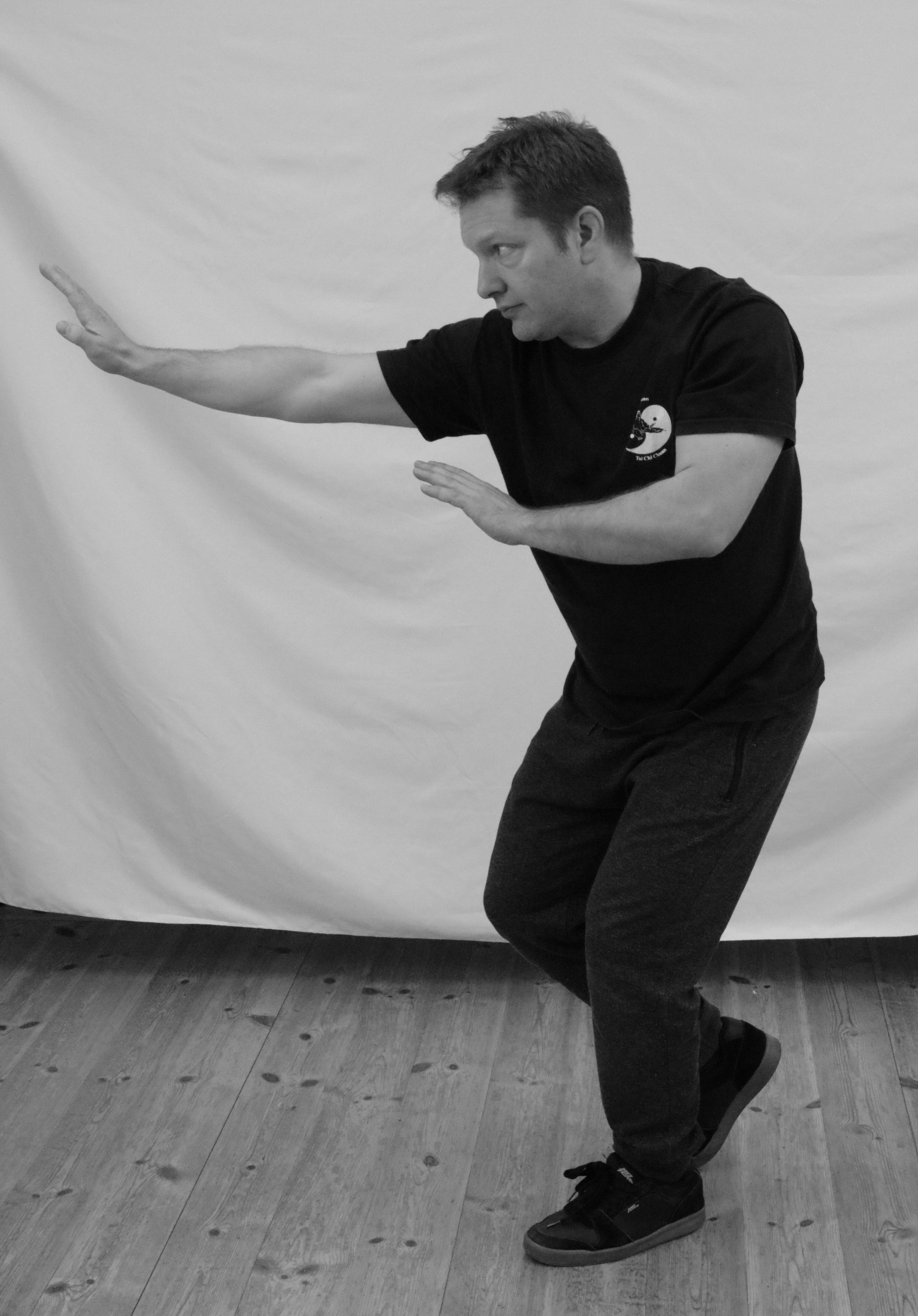
Author, performing Xini Yi Chicken (Ji) posture

If your martial art has forms that are constructed like lego bricks that can be slotted together in any order and still seem to work then it’s pretty simple to concoct a new form. Xing Yi is a good example of a martial art that has this quality. I was always told never to call Xing Yi tao lu by the English name “forms” because the correct term was lian huan which means “linking sequence” for this very reason.

The idea, (in our Xing Yi at any rate), is that all the links you learn are just examples, and you need to be constantly moving towards being able to spontaneously vary them as required, and then ultimately spontaneously create them. This idea has become heretical in the modern Xing Yi world to a large extent because modern Xing Yi has lost a lot of this spontaneous feel it used to (I admit that’s a subjective point) have, and things have become set in stone – forms that were once supposed to be fluid and flexible have become fixed and rigid. Forms of famous masters from the past now tend to be fixed forever. When words like “orthodox” start appearing to describe something you know it’s already dead, or on the way to dying.

But of course, anybody can make up a form, but is it any good? That’s a different matter. And it usually depends on the person doing it, not the moves themselves. With Xing Yi animals you can also ask the question – can I see the character of the animal being used coming out through the moves?

With Tai Chi I find it a lot harder to make up a form. Tai Chi’s approach to a form is quite different to Xing Yi, or other Kung Fu styles. The Tai Chi form tends to be a highly crafted piece of work that has been honed to perfection over many years. It is fixed because you need to be able to forget about the moves and concentrate more on what’s inside. It helps to do that if you don’t have to worry about what’s coming next because you’ve done it so many times that you can let go of that part of your brain and let it be aware of other things.

Tai Chi forms tend to start and finish in the same place for this reason. Usually, anyway. While long forms don’t tend to be balanced on left and right, a lot of the more modern, shorter forms make more of an effort to balance left and right movements.

If you understand Tai Chi and how to ‘pull’ or direct the limbs from the dantien movement then, sure you can make up your own Tai Chi forms, however, there is almost zero history of doing this in Tai Chi circles and it’s not really encouraged. I think this is because Tai Chi has push hands, which can be used as a kind of free-form expression of Tai Chi, completely away from the form and in contact with a partner to give you something to respond to, which is the whole strategy of Tai Chi Chuan, at least according to the Tai Chi Classics it is. To ‘give up yourself and follow the other’ you have to be spontaneous. There’s no other choice!

So, to conclude. I think that’s it’s in its application where the spirit of improvisation and spontaneity can be found in Tai Chi, not in the forms. I don’t think Tai Chi is particularly concerned with creating endless variations of forms and patterns like Xing Yi is, at all. Xing Yi, having a weapons starting point, doesn’t use this hands-on feeling and sensitivity to get started with spontaneity. Instead, it likes to create patterns, then vary them endlessly. Of course, you work with a partner when required, but it’s a different approach. Which is all quite natural, as these are two different martial arts, created by entirely different groups of people in a different locations and time periods.

You might like our Heretics history of Tai Chi and Xing Yi for more on that.


The great mystery of Kung Fu forms

One of the frequent criticisms I hear of the idea that there is a connection between Chinese martial arts and Chinese theatre and religion is that no respectable Chinese martial arts teacher has ever implied their work comes from dance or spiritual ritual, so the idea is laughable. I have experienced a pretty negative reaction from some of my Chinese martial arts friends to these ideas. The thought that the rough and tough martial art they genuinely suffered to learn and dedicated their lives to had religious or (worse) theatrical origins is anathema to their world view, akin to an insult.

But the question really is, how can they not be theatrical? Just look at Chinese martial arts – of course they’re theatrical!

Here are some questions to ask yourself: Why do we do long complex, showy forms at all? Why is Chinese martial arts still so strongly associated with Lion Dance? Why do its modern day performers so often put on demonstrations for the local community, on stages? Why do performances sometimes have chaotic drumming soundtracks?

I’m sure any competent Chinese martial arts practitioner can produce answers to all these questions based entirely in the physical realm of pugilism – it’s all physical training at the end of the day –  but when you put all these questions together an obvious picture begins to form.

Nobody looks at Capoeira and says, “this has nothing to do with dance”. So, why do most Chinese martial arts practitioners look at their long theatrical forms and say, “this has nothing to do with theatre or religious practice”?

There’s an inherent mystery to Tao Lu, or “forms” found in Chinese martial arts. This great video by The Scholar-General hopes to provide some answers: