I see you, doing Tai Chi in the park

Photo by Pixabay on Pexels.com

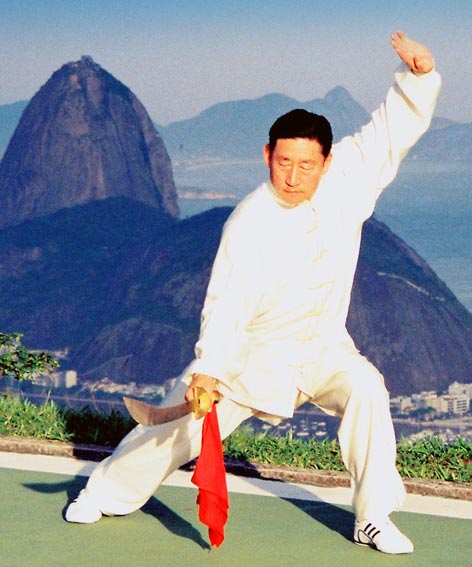
I live in the suburbs of Bristol. While Bristol itself is one of the most culturally diverse cities in the UK the suburbs tend towards leafy suburbia where you can feel the crushing weight of normality on your shoulders. So, while seeing somebody in a central Bristol park doing Tai Chi on their own wouldn’t be unusual, it’s almost unheard of in my local parks. I’ve done Tai Chi in my local park of course – usually when training with somebody else and it’s not something I do solo, since I can just imagine the amount of funny looks it would generate around here.

Imagine my surprise then when I saw somebody else doing Tai Chi in my local park this morning. I looked to my right as I entered the park on the way back from the supermarket and facing towards me in the Push posture, just a couple of meters away was a man doing Tai Chi. One glance was all I need to identify that he was doing Yang style, or possibly the Beijing 24-step, which is based on Yang style. He had that large frame posture and super slow movement speed.

He was an older man with striking white hair, brushed back and John Lennon-style glasses, but tinted, so you couldn’t see his eyes. It was that moment where you see something that you recognise but it’s in the wrong place at the wrong time, so your brain takes a moment to process it and you freeze like a rabbit in the headlights. The Germans probably have a word for it.

After over 20 years of living in an area where it would be considered odd, even weird, to do Tai Chi in a local park, it had finally happened. I’d seen somebody doing Tai Chi in the park! And do you know what my first thought was on seeing him?

‘Gee, what a weirdo!’

I just walked off without saying a word and he just carried on, his attention rapt up in his movements.

Calling out Bullshido

Fantasy or reality?

I’ve been involved in a lot of discussions recently (and for years!) about what in Chinese martial art is fantasy and what is real. Realness, keeping it real, being truthful, whatever you want to call it, it is seen as a big deal. The question of the essential realness of a technique, a style or a whole person’s lineage, cuts to the heart of the matter, always.

Discussions of these types have flourished along with the growth of online video and the means to talk about these videos online. These discussions usually go along the line of:

1) A famous practitioner puts up a clip of himself (it’s usually always a male) demonstrating something visually impressive on a student. The purpose of the clip is self promotion for fame or seminars or online teaching material. Maybe they show a student go flying through the air from the lightest of touches, or they resist a strong push without any visible effort – you know the sort of thing.

2) Somebody comments and goes – “that’s bullshit!”

3) All hell breaks loose in the comments section between rival sections.

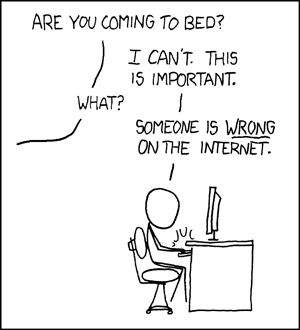
I can understand the strong urge to want to point these things out. I get involved in these things too. Sometimes I see something that is such obvious nonsense I can’t help but point it out. It’s like this old XKCD cartoon that is funny because it’s true:

The argument is logical: There are so many good things in Chinese martial arts and the fantasy stuff is damaging to that. And it’s therefore up to us to call out the fantasy, not accept it. If we don’t then we just invite ridicule, especially from other martial artists.

However, even when that attitude is adopted I see people tend to be more interested in calling out the fantasy stuff that other people do, or that is in other styles, not their own! And never in anything they do themselves or their teachers do. We all have our own blind spots and biases.

But I’ve been thinking differently about this issue recently…

When you look into the close connection between martial arts and street theatre, or opera troops and (as technology progressed) Kung Fu movies, it’s impossible not to conclude that showbiz (for want of a better word) has always been connected in some way with Chinese martial arts from the very beginning.

That doesn’t mean that Chinese martial arts masters of old weren’t bad ass. They were bad ass! But they also knew how to perform Lion Dance, or put on a show at New Years, or impress a prospective student with a. few tricks if they had to. These things were so interconnected in Chinese culture that it seems impossible to separate them (although successive Chinese governments gave it a good go throughout the 20th century).

Showbiz has always been there in Chinese martial art. It’s what makes amazing movie fight scenes like this one from The Grand Master possible:

Beauty, artistry, story telling. It’s all there. It’s using “real” techniques from martial arts and presenting them in a hyper-real, perfected, way.

Of course, the problem comes when people get conned into believing that the hyper-real is the real and that can take people to some very weird places, involving cult-like practices, exploitation and usually a lot of money being handed over. That’s where the problems start for me.

There are no easy answers, but I think that viewing some of these things that are not quite real as merely a part of the showbiz side to Chinese martial art, is perhaps an easier way to deal with it.

For instance, what is going on in this clip with Chen ManChing bouncing people around?

I can imagine a lot of Chen style Tai Chi people getting upset about that, as the sort of nonsense that doesn’t tend to happen in their style… and yet, what’s going on in this clip:

Is it as bad? Is it worse, even?

I don’t know.

It might just be easier to look at both these clips say,

It’s just showbiz”, and shrug your shoulders and laugh.

Closing in Taijiquan

Photo by Gratisography on Pexels.com

Opening and closing are in every movement of Tai Chi. But what does it mean to close?

To me the closing movements in the form feel like a squeeze. Closing in Tai Chi doesn’t mean shutting off. I think of the movement of Taijiquan as being like a garden hose that’s always on – the water (or if you want to get all mystical about it, the qi) is flowing regardless, and all you are doing with the closing movements is compressing the mouth of the hose a little, or putting your thumb over the lip, to increase the pressure, so the velocity of the water increases. 

Quite often the closing part of the movement is when you form the end of a posture – the finish position of Single Whip, the end of Ward off, for example. When the body closes it’s like the pressure increases and the velocity of the water becomes higher, then as you open again the mouth of the hose opens allowing more water comes out but at a lower velocity. That’s opening and closing.

How do I pick a Tai Chi teacher?

“Hi,

I will understand if you don’t have time for this or are unable to give a meaningful answer. I bumped into your website about a year ago, and since your writing seems to make sense to me, I thought I’ll ask.

I’d been exposed to Tai Chi some years back, and have continued trying to learn a bit more about it on and off since then, but given I’m an inlander in Australia I don’t have any practitioners nearby (nearest is ~over 300 mi away) it’s proving to be a slow process of breaking down videos and trying to assess myself against these.

Which is sort of the ignorant leading the ignorant. I’m making progress, but it’s slow.

I’ve spent a bit of time this weekend watching one of the classes that happens “close” to me, and looking at patterns that are the same but different, so that was my first in person exposure to differences between schools.

Given the distances involved in this, and my general reluctance to travel that much, I’m wondering about how well the online courses work?
But that also leads onto a more basic question, of how do you pick a teacher in the first place?
(I have worked out that at least one of the groups near to me attach to the “lineage” responsible for “Tim” being in a cult so I’m counting that one out.)

Is it just a case of pick one and go until it stops making sense?

Thank you for your time, and the blog posts.

Regards,
Henry.”

Hi Henry,

Firstly, greetings to a reader from down under! What an amazing thing it is that I can write these blog posts here in the UK and on the other side of the world somebody is reading them. That really does make me think my time isn’t entirely being wasted.

Now, to the question of “how do I choose a Tai Chi teacher?” That is indeed a weighty one. A teacher/student relationship can be a big influence on your life, mainly because you will spend a lot of time practicing with them and people tend to rub off on you, so you should be careful of who you spend your time with. I also don’t want to advise you wrongly, and be responsible for you wasting years on the wrong track, or equally missing out on some great possibilities because the teacher didn’t quite live up to some standard I’ve set. People are human, fallible and weak, and they all make mistakes. Even mighty Tai Chi masters.

Members of a group that we might initially write off as a cult, could still be worth checking out. Just keep your wits about you. At the end of the day there are very few individuals who are good enough at Tai Chi to actually teach it, and your chances of finding one of those, especially one who isn’t charging an arm and a leg, is minimal, so we have to work with what is.

I think what we’d all like is to stumble across our very own Mr Miyagi, in a situation where we somehow befriend the keeper of an ancient family martial style who is happy to divulge his secrets to us if we do a bit of fence painting for him. If you manage to stumble across your very own Mr Miyagi then consider yourself to be incredibly lucky, because it’s not very likely to happen. However, we have the Internet these days, and while Mr Miyagis may be in short supply, there are an increasing number of Daniel-sans out there who may, or may not, be able to band together and form a practice group around a similar set of goals or perhaps an online teacher. You see, as well as a teacher to tell you what to train, you are mainly going to need a group of training partners of the same level to practice this stuff with when the teacher isn’t around. The majority of that work will look ugly, be full of mistakes and be unpaid, but it’s essential. That’s what nobody tells you.

Anyway, my top tips when meeting a new teacher are to trust your gut, ask questions and try and get hands on. Ask politely to try and feel what they’re doing. If they won’t let you or start making excuses, there’s your red flag. How do the other students act? Do they behave in an overly obedient way that makes you question what’s being presented? And what about their history? They should be able to answer basic questions about who they learned from and where they trained.

Of course, on the other side of the coin, it’s quite possible that you have entirely unrealistic expectations about what a Tai Chi teacher should be. Just remember: There’s no point checking everybody in the room if you don’t check yourself. Are you sure you’re not letting a good learning situation go by just because the teacher in question only has 3 of the 5 specialist Tai Chi skills you are looking for? A rule of thumb I used to use was “can this guy do something I can’t do and do it well enough that I want to learn it?” If they could then that was a good reason to learn from them. You can learn something from pretty much anybody.

And be clear with yourself what you actually want to learn. Some teachers are better at the fighty stuff than others, but if you don’t want the fighty stuff, then you can save a lot of time by not training it.

But what if the worse should happen and you get taught “wrong”? Well, that’s always a risk, but is it as bad as you think? It could be that you need to be taught wrong a few times, just so you can appreciate what’s right. Think of it as the price of an education.

The big thing I’ve learned over the years is that in the end it matters more how we treat each other, than what special knowledge somebody has access to. At one period in my life I trained with a Tai Chi teacher who was very good at what he did, but was also a complete asshole. I could tell he was an asshole, and the frequent bust ups he had with long term students were a constant reminder, but I wanted to get what he had, so I put up with him. I turned a blind eye to his various escapades into what would be called “bullshido” these days. But in the end I just couldn’t take it anymore and I left. It turned out to be the best thing I could have done. It was like a weight had been lifted, and I realised it was that weight that had been holding me back the whole time, I just couldn’t see it.

Anyway, I hope that helps.

Here are some typical Australians, about to be murdered by sharks. Photo by Belle Co on Pexels.com

Ji – To press or crowd in

I was reading through my latest purchase, Chen Style Illustrated, again recently and I got to something that piqued my interest – it’s the section where they are describing the 8 energies and we get to Press (Ji)

“When in contact the aim of this gradual rolling move is is to unsettle the balance of he opponent.”

It’s not a bad description at all, but I don’t resonate with the word “gradual” there. The most common application you tend to see for Press is of a kind of “bump” that puts the person off balance, but my experience of Ji has been that there’s nothing particularly gradual about it. That bump can be applied in a hard sharp way. Jin done in a forward direction (which is Press) can often be quite jolting and it hurts inside.

The 8 energies are:

掤 peng, 捋 lu, 挤 ji, 按 an, 採 cai, 挒 lie, 肘 zhou, 靠 kao

Google translates 挤 as “press” or “crowd in”. (I’m not sure that another translation you often see of “squeeze” is helpful. I’ve read people writing about squeezing the hands together – that’s not it at all. ) From that you get the sense of a situation where you are already in contact with the person and, perceiving a point of weakness in their defence you press them further on the point. It reminds me a lot of the strategy of Horse in Xing Yi, which is to attack a point of defence that is already defended but has a weakness you can exploit.

Cheng Man Ching doing Press

In the Tai Chi form Ji is usually done with the back of the hand in the typical Grasp Bird’s Tail sequence (presumably because it the easiest way to capitalise on a good position you’ve already achieved), but there’s nothing about the energy you’re using that means it has to be done with the back of the hand. It can be done with a fist or palm too.

And this is where the Tai Chi waters get a bit murky. There is the martial technique Press, which is to do with pressing further forward into an opponent you are already contacted with, and then there is the abstract concept of “jin in a forward direction”. Anytime you express jin (strength derived from the ground through a relaxed body) in a forward direction you could be said to be doing 挤, but when you put it into a Tai Chi context it takes on this quality of crowding in and pressing that attack.

What you can learn from Tai Chi kicks

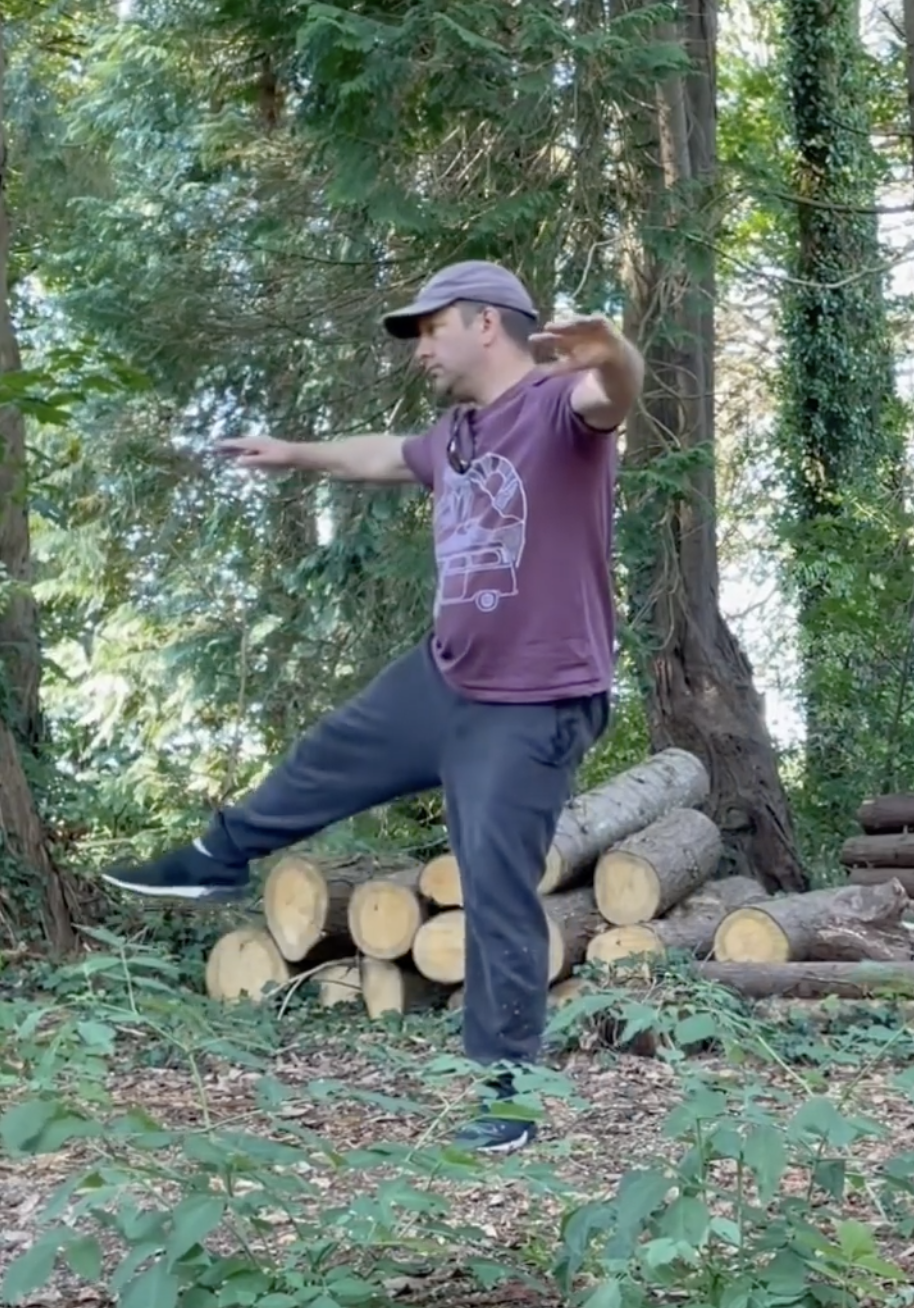
Tai Chi: balanced on one leg.

Tai Chi kicks are a great way of testing your balance. Due to the circular nature of Tai Chi technique the sections of the forms where you are kicking often involve turning the body to the left or right while you are standing on one leg. It’s more challenging than a simple one direction kick and is a great training for your balance.

I shot this during this morning’s Tai Chi practice. It’s the kicking section of the short form that we practice in the Yongquan Tai Chi Chuan Association:

You’ll notice that the kicks are done lower than you see in a lot of modern Tai Chi forms. That’s because we’re aiming at the knee. The classical technique for these moves is to block their knee with your foot and pull their arm in the opposite direction to get a takedown. Effectively using the foot as a kind of brace, not really as a kick.

But it’s the training these techniques offer in balance that is their real value I think – a lot of people end up very wobbly on the standing leg when performing these techniques. The key to making it silky smooth is not to think about sinking down into the ground as you raise the leg, but to ‘raise the back’ as you lift the leg. That upward ‘pull’ holds you in place securely so you can deliver a smooth kick.

Practicing Tai Chi in nature: Being like a teabag in the ocean

On holiday in the southwest of England for a week I managed to find some time each morning to practice Tai Chi in a lovely old wooded area.

So often we have to practice Tai Chi in our front rooms, back gardens or patios because of time pressures. Or maybe we only get to practice at a class in a village hall, gym or community centre. Either way, our surroundings are often far from natural.

Being able to practice Tai Chi in an environment where there were no other people, no human sounds and no interruptions was a blessing. It was possible to really sink into the environment for once, and not just my legs!

It’s a process one of my teachers calls “being a teabag in the ocean”. If you want to take in the good stuff from the natural world around you then you need to adopt the attitude of being like a teabag in the ocean – i.e. let nature move through you as well as around you, so that you don’t feel like something separate to it. Absorb it, soak it in. I’d say most people practice Tai Chi as if they are a teabag that’s sealed inside a plastic bag then dropped in the ocean. They can be doing great Tai Chi, but they are perfectly contained within themselves and not interacting with the environment. Often there’s not much environment to interact with, as mentioned previously, but if you get the chance to practice Tai Chi out in the woods, you should take it and take the opportunity to get out of that plastic bag.

Before you practice the form, stand for a few moments and try to let the barriers between you and your surroundings break down. Your mind should be focused on the moment and on your breathing, after all, that is as much a part of nature as anything else. Stand like that for a while before doing the form and just experience it, don’t think about experiencing it.

Then as you go through the movements of the form, you’ll start to feel like you are moving with the natural patterns around you. Don’t worry if your form takes on a subtly different quality than normal. It’s all part of the process.

I find that I don’t have as much free time for this in my normal life as I do when I’m on holiday, but I’m going to try and make an effort to get out to a secluded place now and again and practice my Tai Chi out there because the effort is well worth it.

The inherent potential of the Tai Chi form

More thoughts inspired by Chen Taijiquan Illustrated

“Training the form helps one to learn the core substance of Taijiquan. Practicing the various push hands methods trains how to apply its inherent potential.”

The function and reason for forms (tao lu) in Chinese martial arts continues to fascinate me. Were they planned to be like this all along, or is the usage of tao lu a happy accident born out of ancient religious ritual festival celebrations and the hiding of marital arts in theatrical traditions? The answer is probably a bit of both, and more of the “wrong” answer than you’d like to admit, no matter which of the two views you take.

I think all Tai Chi practitioners, beyond the mindless followers practicing in parks, 12 rows deep from the front, have a basic understanding that the Tai Chi form contains martial applications which can be brought out in push hands. But it’s the wording of the quote above that caught me: “the inherent potential” of the form.

That’s exactly it – the form isn’t explicitly martial. Certain compromises are necessarily made to maintain an aesthetic and flow to the movements. If it wasn’t then Tai Chi would look more like more practical Shuai Jiao solo drills or jiujitsu kata. And I think that’s what bugs a lot of people who laugh at the idea that Tai Chi can be used as a martial art. The martial essence is there in the movements, but it’s not on the surface. It’s buried, inherent potential that you’ll need to mine if you want to discover it.

How to make use of your dexterous and non-dexterous hands in Tai Chi

Except for that tiny minority of ambidextrous people, most human beings have a dexterous hand and a non-dexterous hand. We use our dexterous hand for things that require precision, like writing and the non-dexterous hand for holding and framing. I’m sure we’ve all tried to write with our non-dexterous hand before and found it almost impossible, but here’s another thing to try…

Put your non-dexterous hand behind your back and try to write as normal with your dexterous hand. You’ll find it’s hard because you use your non-dexterous hand more than you think, in this case, to steady the paper you’re writing on and stop it moving. Both hands are actually involved in writing, but both have different jobs. If you wanted to get all “Tai Chi” about it we could call it a Yin and Yang split between the hands, which work together as a whole, and talk about the sword hand, but layering a bit more philosophy on the concept is probably not necessary, I prefer the phrases dexterous and non-dexterous hands.

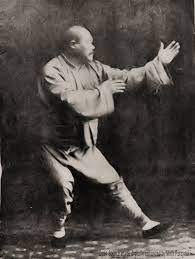
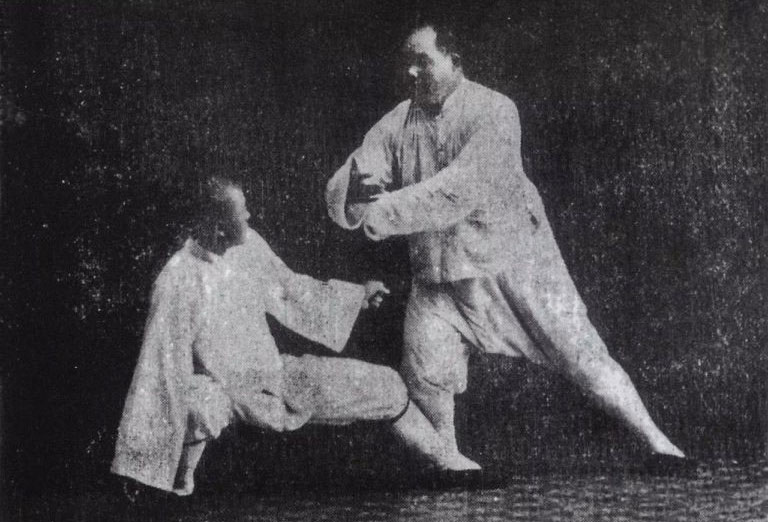
Large-Scale Postures Boxing Set by Huang Hanxun 1959

It’s the same in martial arts. I’m sure we’re all used to doing a technique quite competently on one side, then swapping it to the other side and feeling like a complete beginner. For this reason I’m quite against the idea that we should be able to do everything equally on both sides. Learning to do a technique on your non-dexterous side will be arduous, time-consuming and you’ll never be able to do it with the same flair, so why invest all that time in a pointless campaign?

If you look at the Tai Chi form (I’m thinking of Yang style, here since it’s the one I’m most familiar with) then you’ll see that some techniques are done equally on both side (brush knee, for example) but some techniques are only done on one side (all the grasp bird’s tails, for example go to the right, while all the single whips end to the left). I believe this is because the creators of these movements were well aware of the difference between our dexterous and non-dexterous hands.

In stand up arts of punching you see the same thing – people generally poke a jab with their non-dexterous hand to set up the big overhand from the dexterous side. I find if I put my dexterous side forward (southpaw) it results in a jab I can hit harder with but a cross that is less accurate.

But how do you choose which techniques to do on one side and which to do equally? The answer is simply to feel what works. And for this you’re going to need to do a lot of practice on another human, not solo form.

For example, in jiujitsu I have developed this one-sided approach through countless hours of practice. It’s most noticeable in my guard passing, but it also applies to my guard playing, although I’m not sure the idea extends to the legs – they both seem equally non-dexterous when compared to our arm! But in guard passing I notice that I naturally do some passes to my left and different passing to my right. For example, I knee cut with my right knee on both sides of the opponent’s body, so if I’m going left, I lead with my right knee and if I’m going to the right I also lead with my right knee – this naturally leads to two different techniques being used.

So, the answer is to feel, and don’t try to force yourself to do techniques that feel awkward because they are on the “wrong side” – look to see if there is something else you can do in that situation that fits better.

Thoughts on Chen Taijiquan Illustrated #1 – Yang style vs Chen style

The newest addition to my collection!

My copy of Chen Taijiquan Illustrated arrived, and I’ve almost finished it. It’s an easy read since the word count isn’t very high – it’s essentially a series of high quality training notes, illustrated, which I think really helps to convey the message in a way that text alone cannot. I’m not going to do a full review for a while, I’m going to let the book sink in first, but I might do a series of posts on ideas it has sparked in me.

Here’s the first one.

The thing I wanted to talk about today was how similar Chen style (as described in this book) is to Yang style. I think a Yang stylist would get almost as much out of this book as a Chen stylist. While the content and methods described in the book all clearly derive from Chen style, as do the illustrations, I’d say 90% (or more) of what’s described here is exactly the same as Yang style.

So what’s different? Bits and bobs on silk reeling, some stepping methods and stance details and the bits on fajin. But even then, they’re not something alien to a Yang stylist, and would be easily within reach of anybody who wanted to take their practice in that direction.

What’s the same? The emphasis on posture is really good here – how to round the back, contain the chest, round the kua, the eight energies, the 5 steps, push hands strategy and training methods, quotes from the classics, being centred and upright, rooting, the dantien, martial applications, etc.

What was I surprised not to find more of? Opening and closing using the 5 bows, and empty and solid. Perhaps more on using the force from the ground… There are mentions of these things throughout, but the book never really goes deeply into them. Perhaps it was too complex for the illustrated book-based approach? There’s only so much you can fit in one book, and there’s plenty of content here.

However, the emphasis on the body requirements of Tai Chi, and explanation of why these things are done, is excellent and transfers effortlessly across Tai Chi styles. It’s reminded me a lot how similar Yang style and Chen style are ‘under the hood’, so to speak. I wrote a post recently where I talked about them being similar but different. I still kind of think that. My view is that at some point Chen style incorporated the ideas contained in “Taijiquan” wholesale from Yang Luchan’s lucrative teaching business in Beijing into its larger, pre-existing, village style (which was more militia fighting and weapons-based) – it absorbed it whole – a bit like a whale swallowing a smaller fish. It was easy because all Chinese styles are similar to some extent. But of course, this means that the Yang style is still there inside Chen, and it’s impossible not to see how ‘almost the same’ they are when reading this book. (I think the spiraling and silk reeling stuff was from the pre-existing Chen style). Your opinion may be different. Food for thought!