I was reading through my latest purchase, Chen Style Illustrated, again recently and I got to something that piqued my interest – it’s the section where they are describing the 8 energies and we get to Press (Ji)
“When in contact the aim of this gradual rolling move is is to unsettle the balance of he opponent.”
It’s not a bad description at all, but I don’t resonate with the word “gradual” there. The most common application you tend to see for Press is of a kind of “bump” that puts the person off balance, but my experience of Ji has been that there’s nothing particularly gradual about it. That bump can be applied in a hard sharp way. Jin done in a forward direction (which is Press) can often be quite jolting and it hurts inside.
The 8 energies are:
掤 peng, 捋 lu, 挤 ji, 按 an, 採 cai, 挒 lie, 肘 zhou, 靠 kao
Google translates 挤 as “press” or “crowd in”. (I’m not sure that another translation you often see of “squeeze” is helpful. I’ve read people writing about squeezing the hands together – that’s not it at all. ) From that you get the sense of a situation where you are already in contact with the person and, perceiving a point of weakness in their defence you press them further on the point. It reminds me a lot of the strategy of Horse in Xing Yi, which is to attack a point of defence that is already defended but has a weakness you can exploit.
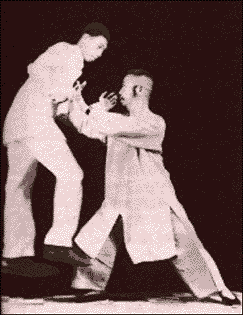
Cheng Man Ching doing Press
In the Tai Chi form Ji is usually done with the back of the hand in the typical Grasp Bird’s Tail sequence (presumably because it the easiest way to capitalise on a good position you’ve already achieved), but there’s nothing about the energy you’re using that means it has to be done with the back of the hand. It can be done with a fist or palm too.
And this is where the Tai Chi waters get a bit murky. There is the martial technique Press, which is to do with pressing further forward into an opponent you are already contacted with, and then there is the abstract concept of “jin in a forward direction”. Anytime you express jin (strength derived from the ground through a relaxed body) in a forward direction you could be said to be doing 挤, but when you put it into a Tai Chi context it takes on this quality of crowding in and pressing that attack.
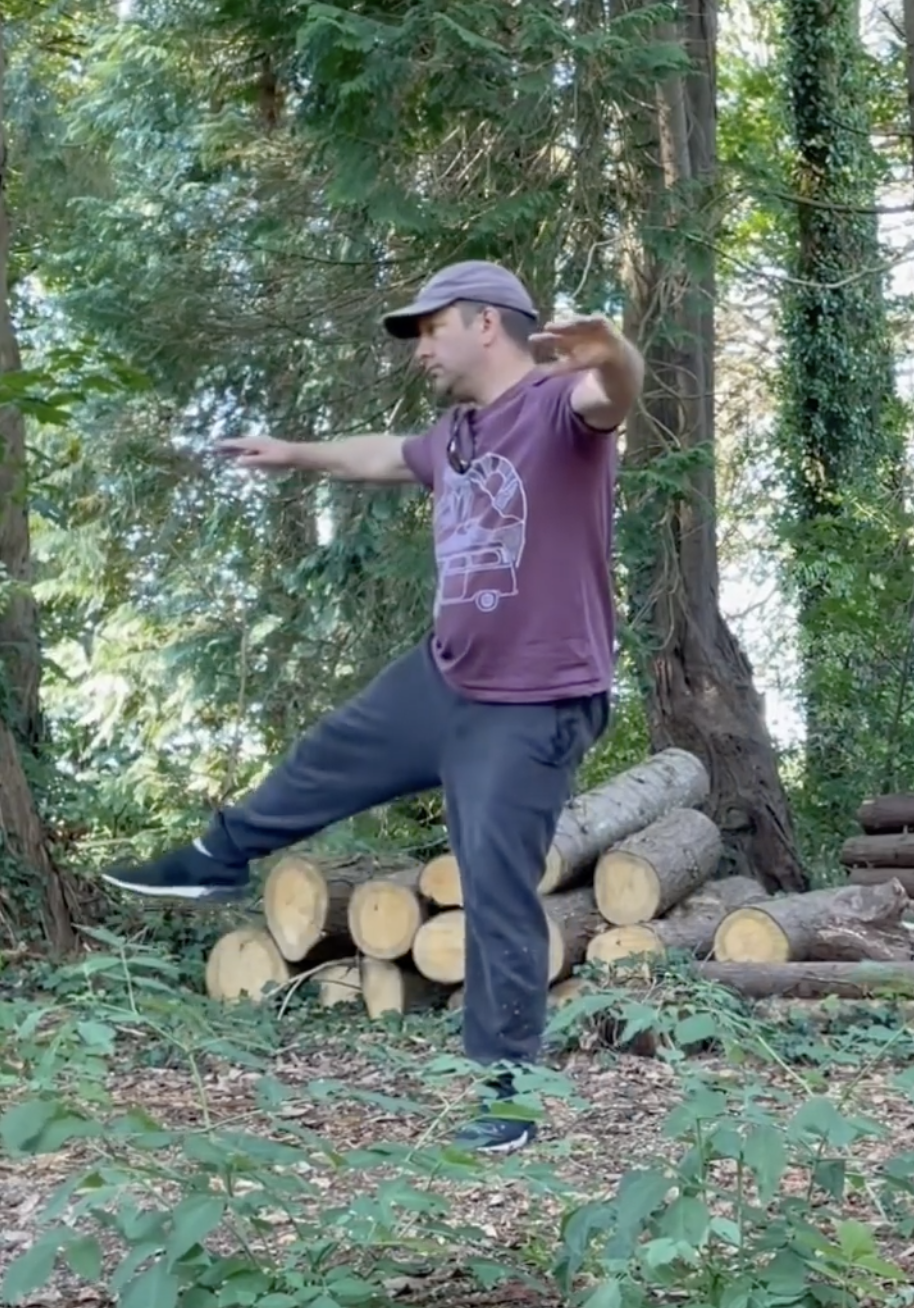
Tai Chi kicks are a great way of testing your balance. Due to the circular nature of Tai Chi technique the sections of the forms where you are kicking often involve turning the body to the left or right while you are standing on one leg. It’s more challenging than a simple one direction kick and is a great training for your balance.
I shot this during this morning’s Tai Chi practice. It’s the kicking section of the short form that we practice in the Yongquan Tai Chi Chuan Association:
You’ll notice that the kicks are done lower than you see in a lot of modern Tai Chi forms. That’s because we’re aiming at the knee. The classical technique for these moves is to block their knee with your foot and pull their arm in the opposite direction to get a takedown. Effectively using the foot as a kind of brace, not really as a kick.
But it’s the training these techniques offer in balance that is their real value I think – a lot of people end up very wobbly on the standing leg when performing these techniques. The key to making it silky smooth is not to think about sinking down into the ground as you raise the leg, but to ‘raise the back’ as you lift the leg. That upward ‘pull’ holds you in place securely so you can deliver a smooth kick.
So often we have to practice Tai Chi in our front rooms, back gardens or patios because of time pressures. Or maybe we only get to practice at a class in a village hall, gym or community centre. Either way, our surroundings are often far from natural.
Being able to practice Tai Chi in an environment where there were no other people, no human sounds and no interruptions was a blessing. It was possible to really sink into the environment for once, and not just my legs!
It’s a process one of my teachers calls “being a teabag in the ocean”. If you want to take in the good stuff from the natural world around you then you need to adopt the attitude of being like a teabag in the ocean – i.e. let nature move through you as well as around you, so that you don’t feel like something separate to it. Absorb it, soak it in. I’d say most people practice Tai Chi as if they are a teabag that’s sealed inside a plastic bag then dropped in the ocean. They can be doing great Tai Chi, but they are perfectly contained within themselves and not interacting with the environment. Often there’s not much environment to interact with, as mentioned previously, but if you get the chance to practice Tai Chi out in the woods, you should take it and take the opportunity to get out of that plastic bag.
Before you practice the form, stand for a few moments and try to let the barriers between you and your surroundings break down. Your mind should be focused on the moment and on your breathing, after all, that is as much a part of nature as anything else. Stand like that for a while before doing the form and just experience it, don’t think about experiencing it.
Then as you go through the movements of the form, you’ll start to feel like you are moving with the natural patterns around you. Don’t worry if your form takes on a subtly different quality than normal. It’s all part of the process.
I find that I don’t have as much free time for this in my normal life as I do when I’m on holiday, but I’m going to try and make an effort to get out to a secluded place now and again and practice my Tai Chi out there because the effort is well worth it.
“Training the form helps one to learn the core substance of Taijiquan. Practicing the various push hands methods trains how to apply its inherent potential.”
The function and reason for forms (tao lu) in Chinese martial arts continues to fascinate me. Were they planned to be like this all along, or is the usage of tao lu a happy accident born out of ancient religious ritual festival celebrations and the hiding of marital arts in theatrical traditions? The answer is probably a bit of both, and more of the “wrong” answer than you’d like to admit, no matter which of the two views you take.
I think all Tai Chi practitioners, beyond the mindless followers practicing in parks, 12 rows deep from the front, have a basic understanding that the Tai Chi form contains martial applications which can be brought out in push hands. But it’s the wording of the quote above that caught me: “the inherent potential” of the form.
That’s exactly it – the form isn’t explicitly martial. Certain compromises are necessarily made to maintain an aesthetic and flow to the movements. If it wasn’t then Tai Chi would look more like more practical Shuai Jiao solo drills or jiujitsu kata. And I think that’s what bugs a lot of people who laugh at the idea that Tai Chi can be used as a martial art. The martial essence is there in the movements, but it’s not on the surface. It’s buried, inherent potential that you’ll need to mine if you want to discover it.
Except for that tiny minority of ambidextrous people, most human beings have a dexterous hand and a non-dexterous hand. We use our dexterous hand for things that require precision, like writing and the non-dexterous hand for holding and framing. I’m sure we’ve all tried to write with our non-dexterous hand before and found it almost impossible, but here’s another thing to try…
Put your non-dexterous hand behind your back and try to write as normal with your dexterous hand. You’ll find it’s hard because you use your non-dexterous hand more than you think, in this case, to steady the paper you’re writing on and stop it moving. Both hands are actually involved in writing, but both have different jobs. If you wanted to get all “Tai Chi” about it we could call it a Yin and Yang split between the hands, which work together as a whole, and talk about the sword hand, but layering a bit more philosophy on the concept is probably not necessary, I prefer the phrases dexterous and non-dexterous hands.
Large-Scale Postures Boxing Set by Huang Hanxun 1959
It’s the same in martial arts. I’m sure we’re all used to doing a technique quite competently on one side, then swapping it to the other side and feeling like a complete beginner. For this reason I’m quite against the idea that we should be able to do everything equally on both sides. Learning to do a technique on your non-dexterous side will be arduous, time-consuming and you’ll never be able to do it with the same flair, so why invest all that time in a pointless campaign?
If you look at the Tai Chi form (I’m thinking of Yang style, here since it’s the one I’m most familiar with) then you’ll see that some techniques are done equally on both side (brush knee, for example) but some techniques are only done on one side (all the grasp bird’s tails, for example go to the right, while all the single whips end to the left). I believe this is because the creators of these movements were well aware of the difference between our dexterous and non-dexterous hands.
In stand up arts of punching you see the same thing – people generally poke a jab with their non-dexterous hand to set up the big overhand from the dexterous side. I find if I put my dexterous side forward (southpaw) it results in a jab I can hit harder with but a cross that is less accurate.
But how do you choose which techniques to do on one side and which to do equally? The answer is simply to feel what works. And for this you’re going to need to do a lot of practice on another human, not solo form.
For example, in jiujitsu I have developed this one-sided approach through countless hours of practice. It’s most noticeable in my guard passing, but it also applies to my guard playing, although I’m not sure the idea extends to the legs – they both seem equally non-dexterous when compared to our arm! But in guard passing I notice that I naturally do some passes to my left and different passing to my right. For example, I knee cut with my right knee on both sides of the opponent’s body, so if I’m going left, I lead with my right knee and if I’m going to the right I also lead with my right knee – this naturally leads to two different techniques being used.
So, the answer is to feel, and don’t try to force yourself to do techniques that feel awkward because they are on the “wrong side” – look to see if there is something else you can do in that situation that fits better.
My copy of Chen Taijiquan Illustrated arrived, and I’ve almost finished it. It’s an easy read since the word count isn’t very high – it’s essentially a series of high quality training notes, illustrated, which I think really helps to convey the message in a way that text alone cannot. I’m not going to do a full review for a while, I’m going to let the book sink in first, but I might do a series of posts on ideas it has sparked in me.
Here’s the first one.
The thing I wanted to talk about today was how similar Chen style (as described in this book) is to Yang style. I think a Yang stylist would get almost as much out of this book as a Chen stylist. While the content and methods described in the book all clearly derive from Chen style, as do the illustrations, I’d say 90% (or more) of what’s described here is exactly the same as Yang style.
So what’s different? Bits and bobs on silk reeling, some stepping methods and stance details and the bits on fajin. But even then, they’re not something alien to a Yang stylist, and would be easily within reach of anybody who wanted to take their practice in that direction.
What’s the same? The emphasis on posture is really good here – how to round the back, contain the chest, round the kua, the eight energies, the 5 steps, push hands strategy and training methods, quotes from the classics, being centred and upright, rooting, the dantien, martial applications, etc.
What was I surprised not to find more of? Opening and closing using the 5 bows, and empty and solid. Perhaps more on using the force from the ground… There are mentions of these things throughout, but the book never really goes deeply into them. Perhaps it was too complex for the illustrated book-based approach? There’s only so much you can fit in one book, and there’s plenty of content here.
However, the emphasis on the body requirements of Tai Chi, and explanation of why these things are done, is excellent and transfers effortlessly across Tai Chi styles. It’s reminded me a lot how similar Yang style and Chen style are ‘under the hood’, so to speak. I wrote a post recently where I talked about them being similar but different. I still kind of think that. My view is that at some point Chen style incorporated the ideas contained in “Taijiquan” wholesale from Yang Luchan’s lucrative teaching business in Beijing into its larger, pre-existing, village style (which was more militia fighting and weapons-based) – it absorbed it whole – a bit like a whale swallowing a smaller fish. It was easy because all Chinese styles are similar to some extent. But of course, this means that the Yang style is still there inside Chen, and it’s impossible not to see how ‘almost the same’ they are when reading this book. (I think the spiraling and silk reeling stuff was from the pre-existing Chen style). Your opinion may be different. Food for thought!
Thanks to Ken Gullette at Internal Fighting Arts I just caught wind of this new book that’s just come out called Chen Taijiquan Illustrated. I had a quick look on Amazon using the “Look Inside” feature and the illustrations look fantastic. It looks like it’s designed to be halfway between an instruction manual and a comic. It’s a very cool style that’s quite unlike any Tai Chi book I’ve seen before.
Chen Taijiquan Illustrated – available now!
I think that often Tai Chi books, with pages after pages of printed text, can be a bit off putting for people who are learning an art that is all about feel, movement and “doing it”, not “reading about it”. And when they do have photographs in them they are often black and white and a bit dull and lifeless. So, for the visual learners out there, I think the colourful and imaginative approach found in Chen Taijiquan Illustrated will work very well.
Here’s an example:
An extract from Chen Taijiquan Illustrated by David Gaffney and Davidine Siaw-Voon Sim
Here’s another thing: Looking at the contents page, this is the first Tai Chi book I’ve seen that mentions the concept of Man, which translates as Slowness, apart from the book written by my Tai Chi teacher. Man is a concept my teacher talks about a lot, and it’s nice to see it mentioned in another Tai Chi book – I was starting to think that it was a concept that was unknown to the rest of the Tai Chi world!
Tai Chi Chuan a comprehensive training manual by Raymond Rand
Obviously everybody and their dog knows that Tai Chi is done slowly, but Man is more of a mental quality than a reference to the speed of the form. It can be thought of as “not rushing”. The speed you are moving at is irrelevant to the concept of Man, but if you want to acquire the ability of Man then the best way is by slowing the form down and focusing on keeping your mind on what you are doing. Whenever you find your mind wandering off you just stop the form (no matter how far through it you are) and start again. After a few weeks or months you’ll find you are much better at staying focused on your form than you were before. By adopting the qualities of “not rushing” you open up the headspace required to be aware of other things going on, things that you would simply miss otherwise. I’ve written about not rushing before.
At £16 Chen Taijiquan Illustrated is not particularly expensive for a colour book either. And I’d love it if there was a book on Brazilian Jiutjisu that was written and illustrated in the same manner because I think it would also benefit from this approach. Incidentally, there was a good book written about Brazilian Jiujitsu recently, that has colour photos (and very nice ones too) that I still dip into now and again called Nonstop Jiujitsu, by Stephan Kesting and Brandon Mullins. I reviewed it on my blog recently, so check out my review.
Nonstop Jiujitsu by Brandon Mullins and Stephan Kesting
I’ve ordered my copy of Chen Taijiquan Illustrated so will review it at some point in the future.
Back when I interviewed Michael Babin on my podcast he mentioned that in addition to Yang style he also practiced Sun style on the side. He felt he got quite a lot out of it because Sun style emphasised different things when compared to his main style.
Single whip posture by Sun Jianyun, 1957
I didn’t mention it at the time, but I also have a Tai Chi-style (1) that I do on the side, and I practice it for exactly the same reasons as Michael: I get things out of it that aren’t emphasised to the same extent in my main style.
While my Yang style uses deep, wide stances with obvious circular movement coming from the dantien, my side style has slightly higher, narrower stances and is less obviously centred around the dantien area. Both styles use whole body movement, but with the different physical emphasis there’s more headspace available to focus on other ways of achieving whole body movement – effectively making more use of opening and closing the body. I think that is also exactly how Sun style compliments Yang style, too. By practicing my side style I get to focus more exclusively on the opening and closing of the body, and I can then bring that back into my Yang style practice.
Of course, style purists will find fault with this approach. I’ve nothing against people who only practice one Tai Chi style all their life, or even practice only one martial art all their life. There’s definitely something to be said for ‘don’t fear the man who has practiced 10,000 techniques, but fear the man who has practiced one technique 10,000 times’. And, of course, any Tai Chi style should be enough, on its own, to take you to the highest levels of the art. But I think that if you only practice one style then it’s at least worth dabbling in another, just to get that new perspective on what you already do. In my experience this will make you a better Tai Chi practitioner and a more well-rounded martial artist, if for no other reason than you’ll gain experience of defending attacks from more than just one style.
When we look at well known martial arts masters of the past there’s a pervading view that they only practiced one style, or were only permitted to practice one style by their teachers, but history is full of examples of famous masters who were well known for cross training – Ku Yu Chang, Sun Lu Tang and Wang Xiangzhai, to name but 3.
In terms of biology, nature prefers diversity, if the gene pool of a species starts to become too small you get inbreeding leading to genetic defects. You can see this happen in marital arts styles that become too insular as well. They maintain their purity, but at what cost? They becoming dysfunctional.
I’m all for diversity in my martial arts training and in life.
—
The side style of Tai Chi I practice is a UK-centric style called Li style. I’ve been doing it since the 90s and while my interest in it can wax and wane it’s been a constant for over 30 years now. The Li style form is a nice, relaxing form to do. It’s slightly controversial because you can’t find the style in China, which is an obvious red flag, but I stopped caring about that a long time ago. I do it because I enjoy it. If I didn’t enjoy it I wouldn’t do it. It doesn’t matter to me if it was “made up” in the 1950s, or not. I mean, at some point everything was “made up” anyway, right? So what matters is if you get something out of it and if you can do it following the Tai Chi principles, which in the case of Li style, you can.
Li style essentially looks a bit like Wu (Jianquan) stye. The form starts off following (very) roughly the same pattern as Wu Jianqan style, but after White Crane Spreads Wings it splits off into its own sequence, which is nothing like any other Tai Chi style I’ve seen before. It’s a very long form, with no repeated sections, and I’ve never quite been able to get to the end of it and remember all of it satisfactorily, but I can get quite a long way through it. Here’s a video of the Li form being done.
My recent podcast with Chen stylist Ken Gullette has led to me thinking a lot about the differences between Yang style and Chen style Tai Chi Chuan. I know the official view is that these two arts are both the same art – “there is only one Tai Chi” – but I’m not really sure I believe that entirely.
Single whip posture by Li Xianwu, 1933.
The issue is confusing because a lot of highly partisan Tai Chi practitioners tend to view one of the arts as being a more ‘watered down’ or ‘less internal’ version of the other – if they’re on the Chen side of the argument then they view Yang style as a “watered down for the masses” version of Chen style, and if they’re on team Yang style then they view Chen style as a more “external and Shaolin” aberration of Tai Chi.
I’ve never been interested in either of those two arguments myself as they betray a kind of small-minded “my style is THE BEST” attitude that seeks to simply put down the other style for no good reason beyond “I don’t like it”. It reminds me of the worst aspects of jingoism that seeks to war with other countries simply because they are not us.
When I say I think Yang style and Chen style are really different beasts I mean it in a positive sense – they’re both good, and share a lot of similarities, and both exist under the banner of “Tai Chi”. But the emphasis is quite different between the two. I find Chen style seems to be more concerned with the body mechanics like silk reeling and opening and closing in different parts of the body, and going from being soft to sudden explosive movements (hard) then back to soft again.
Of course, opening and closing is there in Yang style too, but I don’t really know of any Yang stylists that put as much emphasis on it as Chen stylists do, especially the Chen Yu branch of the art, which goes really deep on it (to my eye at least). And as for silk reeling, that seems to be absent in Yang style.
Yang style, in contrast, has its main emphasis on a kind of “needle in cotton” feel throughout. It’s soft on the outside and hard on the inside and all done at the same speed – drawing silk, rather than reeling silk, like a long river flowing. That’s not to say that Chen style can’t be like that too, but the emphasis on that way of being is greater in Yang style.
Of course, the official view from the Chinese government (and Yang and Chen families) is that Chen style is the ancestor of Yang style. End of story. But like most things in China, I suspect it’s more about political expediency than historical accuracy. For example, there’s a complete lack of evidence that Yang Luchan ever visited Chen village, let alone trained there for years and years. (If you want to get picky, there’s hardly any evidence available anywhere that Yang Luchan actually existed at all!) And the Chen family didn’t get in on the Tai Chi teaching business until 1928, which is very, very late in the day compared to Yang style, since Yang Luchan was reputedly teaching Tai Chi in the Forbidden City from the 1860s onwards. There are a lot of holes in the official story. Now that doesn’t necessarily mean that the official story can’t be true, but there are enough holes in it to make me the journalist in me question it.
But anyway, In Yang Cheng-Fu’s 10 Important Points, we find number 6 – use the mind not force. Cheng-Fu goes on to explain that, “In practicing T’ai Chi Ch’uan the whole body relaxes. Don’t let one ounce of force remain in the blood vessels, bones, and ligaments to tie yourself up. Then you can be agile and able to change. You will be able to turn freely and easily. Doubting this, how can you increase your power?”
I’m willing to bet that this piece of writing is responsible for leading more than a few Tai Chi practitioners down the wrong path, towards wet-noodle Tai Chi. The attitude of being a needle in cotton is the antithesis of this. If you’re going to make the outside soft then the inside of the body has to be hard, otherwise you are just a wet noodle, which sadly a lot of Tai Chi practitioners are. That’s how the Yin/Yang balance is maintained in Yang style.
Importantly, Yang Cheng-Fu goes on to say: “The T’ai Chi Ch’uan Classics say, “when you are extremely soft, you become extremely hard and strong.” Someone who has extremely good T’ai Chi Ch’uan kung fu has arms like iron wrapped with cotton and the weight is very heavy.”
There it is – the needle in the cotton.
If you can imagine a needle (or an iron bar) wrapped in cotton, then just brushing your hand over the cotton we feel like everything was soft. But if you squeezed the cotton you’d feel that hardness at its centre. That is how the whole body should be when practicing Yang style. It’s a kind of presence that can only be acquired by long practice of Tai Chi Chuan, learning to move while relaxing the muscles and letting the flesh hang from the bones, while keeping the skeletal stricture strong. Both light and heavy at the same time.
I also think it’s very hard to get this feel by only practicing Tai Chi Chuan, and that’s one of the reasons that standing practice and Yi Quan has become so popular amongst Tai Chi practitioners. I think standing practice (Zhan Zhuang) provides a kind of shortcut to the kind of power required to be a needle in the cotton, but that’s a story for another day.
In this episode of the Tai Chi Notebook podcast I’m teaming up with Ken Gullette, to answer the kind of questions that Tai Chi teachers get asked all the time.
YouTube version for people who, er, like YouTube?
Ken is an all-round good guy and owner of the Internal Fighting Arts website where he teaches the arts of Xing Yi, Bagua and Tai Chi at a very reasonable monthly cost. Check him out at www.internalfightingarts.com
Ken is a Chen style guy, and I’m a Yang style guy so it’s no surprise we have slightly different views on a lot of different topics, but that’s part of the fun of it all.
And if you’d like to help out my podcast then you can now become a friend of the Tai Chi Notebook on Patreon. Head over to Patreon.com/taichinotebook and you’ll be able to get a downloadable version of the podcast as well as support my work and get exclusive articles.


 The Tai Chi Notebook