I found an interesting post on Slantedflying.com about Chen village and how it’s grown. There’s a video in it that shows an aerial view of the village and the massive training hall. It’s more like a small city than a “village” now!
It’s incredible how the popularity of Tai Chi has transformed this “rural backwater” (as I’ve often heard it described) into a bustling, modern, mini-city.
I was giving the Tao Te Ching the cursory glance I occasionally give it recently. I’ve got the copy shown above. I usually flick to a random chapter, read it three times and ponder it deeply. Well, as deeply as I am able to. I landed on chapter 61, and the next day I landed on chapter 8. These two seemed to be linked in theme, so I thought I’d say something about them.
Incidentally, I really like the Stephen Mitchell translation. I’ve no idea how accurate it is compared to the Chinese, but all translation seems to involve some interpretation, and I like the way he’s done it.
Here’s chapter 61:
61
When a country obtains great power, it becomes like the sea: all streams run downward into it. The more powerful it grows, the greater the need for humility. Humility means trusting the Tao, thus never needing to be defensive.
A great nation is like a great man: When he makes a mistake, he realizes it. Having realized it, he admits it. Having admitted it, he corrects it. He considers those who point out his faults as his most benevolent teachers. He thinks of his enemy as the shadow that he himself casts.
If a nation is centered in the Tao, if it nourishes its own people and doesn’t meddle in the affairs of others, it will be a light to all nations in the world.
and chapter 8:
8
The supreme good is like water, which nourishes all things without trying to. It is content with the low places that people disdain. Thus it is like the Tao.
In dwelling, live close to the ground. In thinking, keep to the simple. In conflict, be fair and generous. In governing, don’t try to control. In work, do what you enjoy. In family life, be completely present.
When you are content to be simply yourself and don’t compare or compete, everybody will respect you.
So, firstly let’s look at the imagery of water, one of the classic symbols of the Yin side of the Taiji diagram. Both chapters use water as a metaphor for the correct way of acting or being in the world. It’s a theme that repeats through the Tao Te Ching, and also throughout the history of Asian martial arts, even in modern times. I’m thinking of Bruce Lee in the infamous interview where he says “Be water, my friend!”
I was reading another article about Wing Chun today by Ben Judkins, which also expanded upon this idea of softness overcoming strength, and how this idea has permeated Asian martial arts:
Early reformers in martial arts like Taijiquan (Wile 1996) and Jujitsu sought to shore up their own national identities by asserting that they brought a unique form of power to the table. Rather than relying on strength, they would find victory through flexibility, technique, and cunning (all yin traits), just as the Chinese and Japanese nations would ultimately prevail through these same characteristics. It is no accident that so much of the early Asian martial arts material featured images of women, or small Asian men, overcoming much larger Western opponents with the aid of mysterious “oriental” arts. These gendered characterizations of hand combat systems were fundamentally tied to larger narratives of national competition and resistance (see Wendy Rouse’s 2015 article “Jiu-Jitsuing Uncle Sam” Pacific Historical Review, Vol. 84 No. 4, November, pp. 448-477).
but as the author notes, the situation is often muddied
Shidachi appears to have had little actual familiarity with Western wrestling. It is clear that his discussion was driven by nationalist considerations rather than detailed ethnographic observation. And there is something else that is a bit odd about all of this. While technical skill is certainly an aspect of Western wrestling, gaining physical strength and endurance is also a critical component of Judo training. Shidachi attempted to define all of this as notbeing a part of Judo. Yet a visit to the local university Judo team will reveal a group of very strong, well developed, athletes. Nor is that a recent development. I was recently looking at some photos of Judo players in the Japanese Navy at the start of WWII and any one those guys could have passed as a modern weight lifter. One suspects that the Japanese Navy noticed this as well.
But while the idea of the soft overcoming the hard has already fallen to the level of a cliché, especially when it comes to martial arts, and mixed with political ideas, should we ignore it as a way of being in the world? I’d say not. It does point to a truth.
Anyone with any familiarity in martial arts is aware of the feeling of having to ‘muscle’ a technique to make it work, as opposed to executing a clean technique based on good leverage. This points towards what I think these chapters of the Tao Te Ching are talking about.
When it comes to Tai Chi one of the hardest things to grasp about the techniques exemplified in the forms is that they shouldn’t necessarily feel powerful to you as you do them. My teacher often uses this phrase: “…if you feel it then they don’t – you want them to feel it, not you“.
If you can give up the need to control and struggle with a situation, then you can relax and access your own inner power. See what acliché that statement sounds like already? It sounds like one to me as I wrote it, but I guess all cliches were probably based on something real, otherwise, they wouldn’t be acliché.
In Chinese martial arts that sweet spot between doing and not doing (to bastardize some more Taoist terminology) is called Jin. I’ve written a bit about that before:
I recently came across these “invisible Systema” videos, and I thought they were so well made they were worth a share, but I thought I’d also say a few words about Systema first.
Having met lots of people who have trained with Vladimir Vasiliev now, some for quite a period of time, the description I always get of him is that he’s a world-class martial artist. You can see in these clips the natural, unhindered way he’s moving through his attackers as if they’re not there. It’s beautiful to watch.
People often equate Systema with Tai Chi because it is relaxed movement, but I really can’t make that connection beyond a kind of superficial understanding. Sure, they both involve relaxed movement, but Tai Chi is (or rather Tai Chi is supposed to be…) about generating movement from your centre, with a connection to the ground through which you can generate Jin (a kind of ground force) to the point of contact with an opponent. Systema (to me) seems to involve much less of these “rules” about how you are supposed to move or fight. It looks freer.
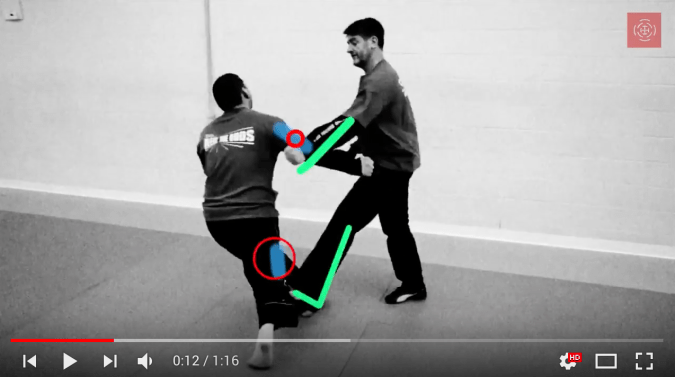
If anything, these “Invisible Systema” videos, where the movement of Vladimir and Mikhail is analysed in detail to reveal the “hidden” moves, really highlight the differences between Systema and something like Tai Chi.
The other point I’d like to make is just how many little strikes, controls or attacks you fail to notice the first time you watch any of the techniques in these videos. Both the Systema masters shown here also seem to be masters of deception. These are the same skills you find in experienced street performers, stage magicians or actors. And again, this brings me back to Chinese Martial Arts connection with Chinese theatre and magic.
Enjoy the videos, and remember – the hand is quicker than the eye!
Writing for Jetli.com is taking up more of my free time, so I haven’t posted too much original content here, but I guess I’m waiting for the muse to find me before I do.
In the meantime, here’s my latest article for Jetli.com
There are so many technical aspects to Taijiquan, that it’s easy to forget to simply breathe and enjoy the practice, keeping that awareness of the breath as you go.
“If you are depressed you are living in the past.
If you are anxious you are living in the future.
And if you are at peace you are living in the present.”
This great video is worth coming back to again and again. Obviously, there has been some manipulation – the sequence of each player is paused or slowed down at key moments so that they stay in sync, but it shows how Chen style and Yang style, which initially look quite different, are in fact, variations of the same form.
As Winter draws to a close here’s a little clip I recorded as the UK was getting battered by storms – some branches had come down in the garden so I used them as improv training tools! Clip is a mix of Choy Lee Fut, Tai Chi and a splash of XingYi.
This blog post grew from a discussion on RSF, a discussion forum on internal marital arts where I’m a pretty active user. Some members were expressing their displeasure at what they saw as low-level skill displayed in the recent 2012 Olympics Judo contest in London.
I was incredulous, since competing on an international stage in a tough sport like Judo requires the athlete to have levels of skill far beyond those of the mere mortal. Yet phrases like “low level” and “muscling” were being thrown about with abandon. The standard thing the detractors of modern Judo say, while explaining how Judo has entered a state of decline from which it can never possibly recover, is that modern athletes are not as good as the old timers. Then they post a black and white video of Mifune (The “God of Judo”) practicing with his students back in the day.
I have one right here:
As you can see, he’s effortlessly controlling his opponent, and demonstrating what is clearly agreed upon as “high level skills”.
Well, for a start, since Kyuzo Mifune was considered the greatest Judo technician to have ever lived, nobody would compare well to him, but that’s beside the point. Their point is that it looks nothing like Olympic Judo, and of course they’re right! Competition Judo will never look like the Mifune demo, because… (drum roll please) it’s a demo!
It’s exactly the same in every martial art – put a Tai Chi fighter in a sparring contest and inevitably people say “that’s not Tai Chi” because it doesn’t look like the super smooth demonstration their instructor does every Friday night at their class, as he effortlessly repels a doddery middle-aged gentleman who is gently pushing on his arm… Quite simply, competition fights do not look like martial arts demos and never will! I am truly perplexed that people can’t understand this… it’s a sort of collective human delusion. And it’s not just martial artists that have this delusion, it’s seeped into the popular consciousness too because of movies like Enter the Dragon, The Matrix, or James Bond. Most people think that if you “know kung fu” you’ll be able to pull some Jackie Chan moves out of your ass in the middle of a real violent encounter. Nothing could be further from the truth.
There are plenty of clips of martial arts masters under real pressure on YouTube, if you look for them. They all have one thing in common – it stops looking like the perfect martial art demo and starts to look scrappy as soon as they have to deal with real resistance, and not a willing student.
Here’s the thing: We’re confusing the training methods with the end result time after time.
Example:
Here’s Kochi Tohei looking graceful, poised and in control while doing a demonstration of Aikido:
This comment on that last video from YouTube is typical of the collective human delusion I am describing:
“if tohei used aikido techniques against this man,which he is not doing until the last bit of the clip,serious injury to uke could have resulted. this was only an exercise in balance.”
You know how it is when you can tell a section of your form has gone to seed, but you can’t put your finger on exactly why? While doing the form this morning I was having major problems with one particular move. Which one is of no consequence, all that’s important is that it just didn’t feel right whatever way I did it. My form felt week and uncoordinated in that one particular spot. So, what is a student to do when they get stuck like this?
Luckily, I have a video of my teacher doing the form, so after failing to find the fault myself I simply popped open my laptop to watch how he approached that move. Immediately I saw my problem. He does the move with a lot more waist turning than I do. In fact, he does a lot more waist turning on all the moves compared to me, not just this one. The waist and legs are of utmost importance in TCC. In fact, it should have been the first place I looked for the solution to my problem rather than turning to a video, since the Tai Chi Classics already tell you that this is where you should be looking first to correct errors in your form. The Tai Chi Chuan Treaste (attributed to Chang Sang Feng) says it quite clearly:
If correct timing and position are not achieved,
the body will become disordered
and will not move as an integrated whole;
the correction for this defect
must be sought in the legs and waist.
That seems pretty clear – if your movement feels uncoordinated or generally wrong to you then first look to the legs and waist for a solution to your problem. The emphasis on the waist echoes on through out the rest of the Classics. In the “Song of the Thirteen Postures” (Unknown Author) the first two lines are: “The Thirteen Postures should not be taken lightly; the source of the postures is in the waist.” And later: “Pay attention to the waist at all times; completely relax the abdomen”. From the Five Character Secret by Li I-Yu it says: “The ch’i is like a wheel, and the whole body must mutually coordinate. If there is any uncoordinated place, the body becomes disordered and weak. The defect is to be found in the waist and legs”, and also Yang Cheng-Fu recaps the whole matter neatly in his 10 Important Points:
“3.) Sung [Relax] the waist. The waist is the commander of the whole body. If you can sung the waist, then the two legs will have power and the lower part will be firm and stable. Substantial and insubstantial change, and this is based on the turning of the waist. It is said “the source of the postures lies in the waist. If you cannot get power, seek the defect in the legs and waist.””
On a purely physical level it’s the turning actions of the waist that generate Sung Jin (Relaxed force) in Tai Chi Chuan. For example, regardless of which style of Yang you do, after raising then lowering the hands most Yang forms start with a turn to the right accompanied by a ‘Ward Off’ movement with your right arm. For that movement to actually ward something off it needs to have power in it, rather than just being as soft as a noodle. But it needs the right type of power to avoid using just brute force. It’s the turning action of the body to the right that initiates the arm movement and puts the correct type of power (Sung Jin) in the arm. Rather than it being a separate movement powered only the arm muscles independantly, the movement is done by the whole body forming a unified shape. Still with me? Good. If not then read that again, and maybe watch a video of somebody who is good doing Yang style, like this guy.
The rotation of the waist is usually done in the horizontal vector and is most evident on the transitional movements between postures in the form*, but the waist is also the commander in forward and backwards motions which don’t involve rotations to the left or right, like the Push posture.
Integral to the idea of moving from the waist is the idea of empty and solid. If you consider the waist to be a like a wheel, which is what the Classics advise, then when you turn it to the left the upper body also turns to the left, and when you turn it to the right then the upper body also turns to the right. In Push Hands if you feel force applied to one side of your body you need to turn the waist, taking that side away from the force, effectively ‘emptying’ it, but at the same time ‘filling’ the other side. It is crucial that you fill the other side of your body at the same time as you are emptying the side that’s being pushed, otherwise your movement will be disordered and you will be pushed over. This can be trained in the form practice too, even without a partner to push you, using a simple mental awareness that whenever you turn the waist you are effectively emptying one side of the upper body as you fill the other. Imagine a fluid being transferred smoothly around your body if that helps. The principle of empty and solid is much further reaching than just this simple example, but it can really help you understand why the Classics stress that “the source of the postures is in the waist”, and later admonish you to “Pay attention to the waist at all times”.
If you’re looking to correct your form, then that’s the place to start.
* In effect, there are no fixed postures in any TCC form, but if you’re teaching it to beginners you have to stop somewhere. Once you’ve learned the form it needs to be smoothed out, so these fixed positions all dissolve into one flowing movement. That’s easier said than done though, since the process of smoothing out your form to a good enough standard to start incorporating other principles can easily take over a year.




 The Tai Chi Notebook