I think this is one of the best historical videos of Tai Ch you’ll find. I’ve seen this film before, but the quality wasn’t great. This version of the Tai Chi documentary however seems to have been edited to make it smoother and sharper:
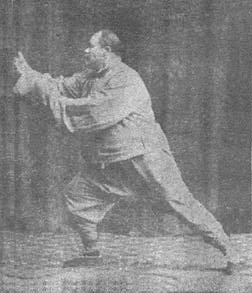
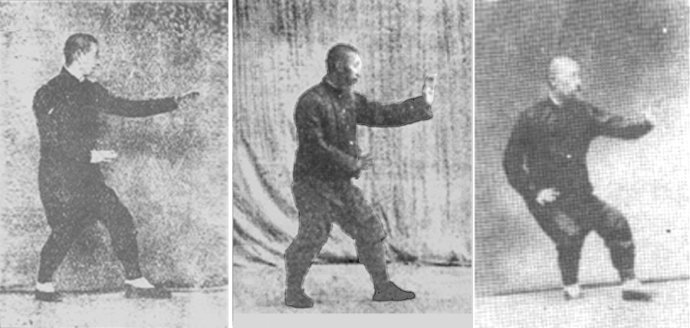
In the video you’ll find the most famous masters teaching Tai Chi in Beijing in the 1950s. It’s a good cross section of the different styles being taught. The masters are (and I think I’ve got the order correct): Li Yaochen, Li Bingqi, Chen Zhaokui (the youngest son of the famous Chen style patriarch, Chen Fake), Yang Yunting, who learned from Quan Yu, who was a direct student of Yang Lu Chan. Sun Jianyun (daughter of the famous Sun Lu Tang). Wang Yongquan, who performs the Yang long form and was a student of Yang Jianhou and Yang Shouhou. And finally Li Jing Wu, who was a student of Wu style and Chen style, but here is performing the Beijing 24 step form.
A new YouTube video landed a day or so ago that has caused something of a sensation. It’s a trailer for a movie called The Power of Chi and has some well known UFC fighters and professional athletes in it, all experiencing the power of a Tai Chi master’s “chi”. And there’s a voice over by Morgan Freeman. I kid you not! Yes, the Morgan Freeman!
From the trailer, this mysterious chi is presented as a force that can be produced by the master and defies all explanation. To be honest, this tai chi master has been producing very similar YouTube videos for years now, but he’s usually demonstrating on no-name seminar attendees, this time however it’s a big budget production with well known fighters like Fabricio Werdum and Lyoto Machida being demonstrated on.
You can see the trailer here:
Now I haven’t seen the full film, and frankly, I’m not going to pay to download it, but colour me unimpressed with that. It all seems a bit silly to me.
Friend of the Notebook, Rob Poyton (who I recorded a podcast with recently) has produced his own video response to the trailer and I think it’s hard to argue with his conclusions, but feel free to make your own mind up:
I like Rob’s point at the end, that if you’re going to demonstrate things like this, then what are the functional uses of it? That’s what you should be demonstrating.
I came up with the title of this blog post by bastardising the old Chinese martial arts saying, “Southern Hands, Northern Legs”, but I don’t really have Kung Fu Toes (the mind boggles!) but what I really want to talk about today is your feet.
In Tai Chi we talk a lot about the waist and the joints, the spine and the kua, but we rarely give the feet a mention. Every part of your body is important, but your feet are especially so. You can think of your feet as the gateway to movement. If they are injured in some way, or have foot pain, you are immediately impaired in pretty much everything you do.
Lots of Tai Chi styles pay special attention to which parts of the sole are in contact with the floor. One style of Tai Chi I did instead that the foot had to be in contact with the ground in nine, (yes, nine!) places at all times for you to be ‘on balance’. It was perhaps an excessive number of point to realistically pay attention to. Other styles of Tai Chi talk about a more manageable 3 points of contact with the ground through the foot, and other styles don’t really place that much importance on what points of the foot are in contact with the floor, just that some of it is.
In general in Tai Chi I think it’s pretty safe to say that you don’t want to be rolling the weight of your body onto the edges of your feet. Why? Because it misaligns the ankle and therefore puts you at risk from injury not to mention ruins your body structure and posture, which is so important to Tai Chi.
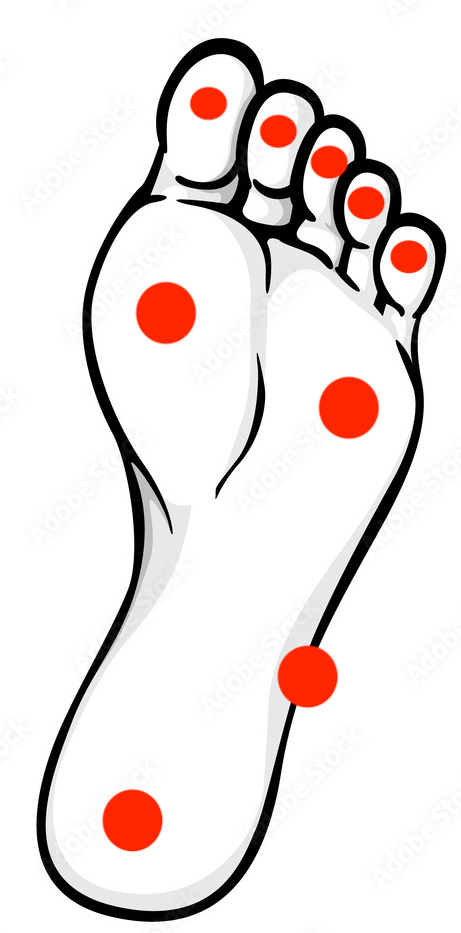
Remember that style I said that talked about 9 points? Let’s go back to that because it was a pretty thorough guide to keeping your foot aligned. Here are the 9 points:
The 9 points are the 5 toes, the outside edge, the two ‘pads’ and the heel.
However, before you start to shift you weight around on your feet to get all nine points touching, let’s just remember the position of the foot is maintained by the muscles of the hips. That’s a key point. If you are having trouble keeping these 9 points (or 3 in a simplified model) on the ground when you stand, or do Tai Chi, the problem could be that your lateral hip, hamstring, gluteal, and adductor (or inner thigh) muscle strength is weak. You may need to take these areas through fuller ranges of motion than a Tai Chi form allows to enable them to losen up. Tight hips are definitely going to be limiting to your foot function. You might want to look into some form of stretchy Qi Gong or Yoga to open up your hips if you want to get your feet to be flatter.
It’s also worth considering what you’re wearing on your feet when doing Tai Chi. Have you ever done Tai Chi barefoot? Do you wear chunky trainers, or (heaven forbid!) shoes with a heel, to do Tai Chi in?
It’s quite possible that the muscles in your feet have atrophied from years of under use. In our shoe-wearing, chair-bound society we aren’t given the chance to give or feet the workout they require from daily use.
Wearing minimal shoes while doing Tai Chi is probably the best option. But remember, we wear shoes these days to protect us from our overly-rigid environment. Training on stone flagstones or hard flooring will come as a shock to your feet, especially if they have been used to being continually protected from these environments, so you may need to take things slowly if you’re doing barefoot Tai Chi for the first time. Don’t push your atrophied foot muscles too far too soon!
Here’s an exercise you can do to help you feel where your weight is on your feet:
Exercise 1:
Stand as you would at the beginning of the Tai Chi form. Toes pointing forward, knees off lock and weight distributed evenly between your feet.
Now ‘think forward’ and feel what happens to the weight in your feet. Think to the right, feel again, think to the left, and behind and repeat. You may notice a subtle shift in your body weight towards the direction you are thinking. This shows you how important your mental focus is when doing a Tai Chi form.
Exercise 2:
Now let your weight move around in an anti-clockwise circle. Forward first then around to the left. After a few circles you can change direction. You should notice that as your weight shifts the distribution of it over the 9 points (and therefore down to the floor through your feet) changes. As you move more to the left the right hand edge of your foot loses some contact with the ground.
Now try and centre yourself over your feet so that all 9 points are equally weight baring. That’s your point of balance.
Now do your Tai Chi form and just pay attention to these 9 points of the feet. When do they feel light and when do they feel heavy? Is the weight equally distributed? This might give you something to think about as you do the form.
If you need some additional listening/reading about your feet I’d recommend this podcast/article by Katy Bowman on wearing minimal shoes to go hiking in and how to strengthen you foot muscles.
Rushing is probably the cause of most of our problems. That time you didn’t notice the uneven paving stone and tripped? You were probably rushing. That time you shouted at the kids because they couldn’t get their shoes on fast enough while leaving the house? You were rushing. That time you accidentally emailed a picture of yourself drunk to everybody in the company? You were definitely rushing then.
In nature, wild animals can move a lot faster than we do, but do they ever look like they’re rushing? A rabbit sprinting for its life to avoid a fox still moves with poise, dignity and grace. Compare that to the embarrassment of the average human running for a bus, an act in which the stakes are considerably lower! Even a cat, an animal known for incredible bursts of speeds pauses for a second before it makes that leap onto a table, so it can be aware of the entirety of the situation.
But how can we learn to stop rushing all the time and regain this poise which animals seem to naturally have? One answer is Tai Chi.
If you’ve been doing Tai Chi for a while, a good number of years, then you’ll know the form inside out. It’s no longer a fresh, new and exciting thing. In fact, your mind is probably bored with it. Here we go again, this same old moves. Sigh. Stand for a moment before you do the form and you’ll notice feelings of impatience start to creep in. Part of you will want to start rushing, to get it over with as quickly as possible
This is where your slowness training is useful. Do the form slowly, at an even pace and just keep doing it. Resist the call the start speeding up and rushing sections. Treat all parts with equal importance. Even the linking moves between the classic postures. Notice your breathing. Keep your awareness on what you’re doing. Don’t let the mind wander off – keep it in the body and keep bringing it back. If you do notice that it’s wandered off completely then stop and start the form again, no matter how far you’ve got. Slowly, day after day you build a kind of mental strength, and if you’re lucky you’ll find it seeps over into the rest of your life, and you’ll be less prone to rushing than you were before.
Stop rushing and you no longer slip up,
Stay in the moment and strains are no longer felt,
When strains and no longer felt, stresses start to disappear,
Arlene Faulk is the author of Walking on Pins and Needles, her memoir of living with multiple sclerosis without a diagnosis for many years, spending two years not getting up from the couch and how she eventually found Tai Chi and how it helped her combat the disease and regain her health, eventually becoming a Tai Chi teacher herself. Make sure you listen right to the end as we have some tips from Arlene on how you can use Tai Chi principles discussed in the Tai Chi Classics to feel better right now as you listen to the podcast.
A sphere is one of the strongest shapes regardless of the direction of force. Photo by Laura Tancredi on Pexels.com
I wanted to talk today about the concept of the Tai Chi ball, or more accurately, Tai Chi sphere. While it might sound simple, I think it’s really an advanced concept because it’s taking the Tai Chi teachings out of the realm of specifics, of things like ‘relax that shoulder’, ‘move that foot’, ‘drop that elbow’, ‘align that hip’, etc…, and into the realm of concepts, which are much harder to pin down into physical details.
The Tai Chi Classics talk about Tai Chi being circular a lot. For example, it says:
“The postures should be rounded and without defect, without deviations from the proper alignment; in motion, your form should be continuous, without stops and starts.”
At a certain point the position of the hands and feet and other body parts in Tai Chi gets subsumed by the general sense of keeping your body and all your movement rounded, like a ball. (Newsflash: despite a thousand form corrections from seminar masters, the exact position off your hands isn’t what’s important.)
What’s important in Tai Chi is that your body is creating a ball-like structure, with ‘you’ at the centre. That’s what determines if you hands and arms are in the correct position, not angles and degrees. If you are making a sphere with your movement and body, then everything will be in the right place, and if you aren’t, it’s not.
The advantage of creating a sphere is that force can comes in and be rolled off without too much interference and muscular tension. A sphere is a Tai Chi symbol write large, in 3 dimensions.
The Tai Chi Classics talk about Tai Chi Chuan being circular. Photo by Sindre Stru00f8m on Pexels.com
The idea of separating empty and solid in the body goes hand in hand with creating a Tai Chi sphere. In fact, I don’t think you can do it successfully without a separation of empty and solid – or yin and yang – in the body.
But here’s the kicker. You can’t just decide one day to do this practice. You can’t go outside right now and do you form and decide to make your Tai Chi like a sphere because it will be meaningless. Instead, it’s a situation where you gradually discover, after many years of practice, that Tai Chi is like a sphere. One day you’re practicing and you suddenly notice it, and bang! Your Tai Chi will never be the same again. It’s like that famous picture that looks a bit like an old man but isn’t:
You either know or you don’t! Can you see what this is a picture of?
Most people are unable to see what that is actually a picture of at first glance, but once you get it, no amount of me trying to persuading you otherwise will prevent you from knowing exactly what it is.
It’s the same with the Tai Chi sphere. Your Tai Chi has always been a sphere, you just didn’t know it, until one day you did, and then it was suddenly obvious to you.
Referring to the Tai Chi Classics can help your practice. Photo by RODNAE Productions on Pexels.com
I’m writing this as a kind of follow up to my previous article on 3 views of qi in Tai Chi. That article contained the 3 different things I think people really meant when they talk about qi in Tai Chi. This article aims to do the same thing with yi. I don’t consider myself an authority on either matter, but I have had some skin in the Tai Chi game for a while now, and I’ve read enough of other people’s writings to come to some conclusions about what I think they’re talking about. Hopefully you’ll find these definitions helpful, and I’d be interested to hear your thoughts in the comments section.
Yi gets a few mentions in the Tai Chi Classics, and is usually translated into English as “intent”, or “mind-intent”, a translation which I think can be problematic because there are at least 3 different things that people mean when they say “intent” in Tai Chi, and while the three are obviously related, they’re also quite distinct from each other.
Before we get into the definitions, let’s have a look at what the Tai Chi Classics have to say about yi:
The most quoted line regarding Yi is in the Tai Chi Classic: “All movements are motivated by yi, not external form”, which can also be translated as “use the mind, not force”. In no.6 of Yang Cheng-Fu’s 10 important points he says:
“6.) Use the mind instead of force. The T’ai Chi Ch’uan Classics say, “all of this means use I [mind-intent] and not li.” In practicing T’ai Chi Ch’uan the whole body relaxes. Don’t let one ounce of force remain in the blood vessels, bones, and ligaments to tie yourself up. Then you can be agile and able to change. You will be able to turn freely and easily. Doubting this, how can you increase your power?”
So, here the emphasis is on relaxing and not using “force”, but why? And What does that mean? I will explain later.
Interestingly, right after that line, the Tai Chi Classic then goes on to say:
“If there is up, there is down; when advancing, have regard for withdrawing; when striking left, pay attention to the right.
If the yi wants to move upward, it must simultaneously have intent downward. “
Definition 1: Martial intent
Given the lines quoted in the Tai Chi classics above I find it strange that the most common interpretation of yi in Tai Chi is as a kind of martial intent. Here intent is “your intent to do something”, and in Tai Chi people generally mean a martial intention that needs to be contained within every particular posture or movement. So, for example, when you do the ward off movement, you need to have the intention of deflecting a blow away. If you movement lacks that intention, it is said to be empty.
Now this may all be true, and not knowing the martial applications of a movement inevitably leads to it becoming too abstract and unfocused, but this understanding of ‘intent’ is clearly not what is being talked about in the Tai Chi Classics when it admonishes us to “use the mind, not force”. If all it meant was to have a martial intention behind the movements, then it’s impossible to see how that can match up with lines from the classics like:
“If the yi wants to move upward, it must simultaneously have intent downward.”
What has that got to do with martial intent?
Clearly this is talking about something else. Yes, a martial spirit is obviously important for Tai Chi, and some Chinese teachers refer to an “eye spirit” which his making sure you are focused and looking in the right place in form performance, and you look like your actions are martially proficient, but I don’t really think this is what is specifically meant by yi in the Tai Chi classics.
Definition 2: A line of intent from the ground up
The second way that people refer to intent in Tai Chi is as a line of force, usually from the ground to the point of contact with the opponent. The idea in Tai Chi is to bring the solidity of the ground to your point of contact with the opponent. How do you do this? Well, firstly by relaxing, so that your body can function as a whole, connected, unit, and then by feeling a line of connection from the point where you contact your opponent (in push hands that would be your palm or wrist) directly to your foot (the part of you that is closest to the ground). By imagining the force of your opponent going straight down to the ground in a straight line from your palm to your foot then you can make use of jin – which is a force obtained from bringing the solidity of the ground to the point of contact with your opponent. This jin force stands in contrast to the normal force of the body produced by exerting your muscles, which the Chinese call li. Of course, muscles are involved in generating jin (otherwise you’d collapse not he ground), but they kept as neutral and relaxed as possible, so that excess force is avoided.
If you send force from the ground to your point of contact with your opponent, using jin, you can bounce them back off you.
Of course, you cannot be thinking of the ground if you want to project somebody away from you. Your work in creating the path to the ground is already done – in the bow analogy this is the drawing of the bow. All that remains now is to fix a direction and release the arrow:
As it says in the classics:
“Release the chin like releasing the arrow.
To fajin [discharge energy], sink, relax completely, and aim in one direction!”
This use of Jin fits in better with the lines in the classic that say
“If the yi wants to move upward (i.e. bounce your opponent back) it must simultaneously have intent downward. (i.e. you imagine a line of force to the ground).
(N.B. this straight line of force obviously goes through empty space, so it’s not the actual line any force from the ground will take, but it’s a case of your mind having the overall goal in mind, and your body filling in the details on a kind of subconscious level.)
Definition 3: A part of the mind
This definition is about yi being a part of your mind and the hardest to put into words. Obviously, definitions 1 and 2 also involve using the mind, so you can see how all 3 definitions are kind of wrapped up in each other.
In everyday life when you want to do something, like say pick up a pen or bring a cup of tea to your lips, the idea to do it appears in your head before the physical action takes place.
In internal arts the 6 harmonies get a lot of press. Of these 3 relate to the physical body, and 3 relate to the internal make up of the person. In the West we tend to have one word “mind” to relate to all the different and distinct parts that the Chinese have words for, like xin, shen and yi, but the three internal harmonies (san nei he) are:
1) The heart (Xin) harmonises with the intention (yi).
2) The intention (yi) harmonises with the chi.
3) The chi harmonises with the movement (li).
The heart mind (Xin) is related to our desire to do something, the yi (intent-mind) is the part of our mind that makes things happen on a subconscious level. When you pick up the cup to bring it to your lips you don’t think “hand move to cup, fingers wrap around handle”, etc.. It just happens because your intent-mind is taking over, based on what you desired to happen. The intent-mind is therefore a kind of subconscious process.
Now, going along with the idea that there are these different parts of our mind that exist as separate entities comes the idea that we can train these separate entities in isolation to gain a deeper ability with them. So, for example, by repeated practice of a Tai Chi form (or Zhan Zhuang standing practice), in which we are trying to access the subconscious intent-mind, rather than brute force, to perform action we might, in fact, get better at it and develop some ability that ‘normal’ people who lack this cultivation don’t have. It’s an interesting idea!
A good starting point for developing this intent-mind is Zhan Zhuang standing practice. One common practice is to stand in the ‘hugging a tree’ posture and try and get the mental sense that your hands are expanding outwards, yet without physically moving them. You are cultivating your intent-mind when you do this. This is starting with just one direction, but in standing practice people often talk about training 6 directions at once.
When performing a Tai Chi form it’s obvious that you are dealing with moving energy (in a physical sense) in different directions. If you can utilise your mind to “think” in these directions then you can start to train your yi, and it can start to feel like your movements are generated by yi and not by physical force.
Conclusions
It’s not easy to talk about what is meant by yi in Tai Chi, but hopefully I’ve provided you with some good starting points and ideas. I’ll repeat again my assertion that the three definitions I’ve given are all important parts of the practice that makes up Tai Chi Chuan and all inter-related. And while yi may be tricky to describe, it is of utmost importance to all the internal arts. There is a line from the Xing Yi classics that goes:
“There is nothing but structures and nothing by qi”
On hearing this line I remember my Tai Chi teacher saying “Oh, that’s good, I like that, but I’d change it to:
There is nothing but structures and nothing by yi”.
Structure and intent. When it comes right down to it, that’s all the internal arts are made up of. That’s how important yi is.
Tai Chi is just one of a number of Chinese martial arts that have extended forms practice as a key component of their training methods. An incredible amount of time in Tai Chi is dedicated to performing the form in just the right way. Of course, there are lots of martial arts that don’t have forms, but they tend to be more sportive and wrestling based, although striking arts like boxing don’t have set forms either. Exactly why so many Chinese martial arts have forms at all is another question – one that relates back to their cultural origin and use in entertainment and religious festivals, and has relatively little to do with martial efficiency. It’s a contentious point, so for now let’s just accept that most Chinese martial arts today do have forms, and if you’re going to practice a Chinese martial art in 2022, then you’ll be practicing forms too.
In my training I’ve been exposed to various Chinese martial arts, and they all had a number of “set in stone” forms to train, until that is, I was introduced to Xing Yi. Or rather, I should say, to my Xing Yi teacher. His method of teaching Xing Yi was entirely different to most modern teachers – he really didn’t like the idea of set forms. Beyond the 5 Element form (the basics of Xing Yi) he didn’t really believe that any form should be ‘set in stone’. In fact, he wouldn’t even let you call them “forms”. You had to metaphorically put a pound in the swear jar every time you said the word “form”. He preferred the term “linking sequence” (lian huan, in Chinese) because it implied that the postures were linked together and could just as easily be linked together in an entirely different way. This is not entirely true, either. Sometimes he would teach you a particular sequence that was the way one of his teachers did it, and we’d call it the “master xyz linking sequence”, on the basis that you had to start somewhere, but if you ever quizzed him too deeply about a particular movement sequence then the answers would soon start to turn into the “well you could do it this way, or you could do it this way…” territory. He really didn’t want to be pinned down into a specific way of doing anything.
Xing Yi Bear link
I think the reason he was like this is that he didn’t want to kill the natural creativity in his students, and he wanted to keep the practice vital and alive. It should be obvious that your goal in martial arts is to be a formless fighter – even a small amount of light sparring will reveal the universal truth to you that if you try and adopt fixed methods to a live situation, the results are never good. To deal with any kind of live situation you need to be able to respond and adapt freely to whatever is happening. I think he saw the popular “fixed forms” training method as being part of the reason that some Chinese martial arts were less than successful when applied for real. It was also the way he’d been taught Xing Yi, and he wanted to teach in the manner in which he’d been taught. Of course, this makes it a lot harder to teach – having a few set forms makes teaching much easier, and also transfers to large groups well. Being spontaneous requires much closer attention from a teacher and is almost impossible to expand to teaching larger groups of people. The best class size is always 1-1, and commercially that’s a hard thing to pull off. Luckily money was never part of the equation when we trained! I can’t say his method was universally successful in creating good students either – it’s definitely not. I’ve seen students of his who ended up being pretty delusional about their own abilities from following this method. It requires time (years) of prolonged contact so that you can absorb a martial art this way. If you get separated from the teacher too much then you can easily go off on the wrong track. It’s a bit like throwing mud at a wall – sometimes it sticks, sometimes it doesn’t. And sometimes the mud decides it’s somebody who has nothing left to learn from other people, and develops delusions of grandeur while trying to maintain the illusion of being humble. But, c’est la vie.
Anyway, I’ve peppered some video of me throughout this post so you can see some examples of what I mean by linking sequences – these are little Xing Yi linking sequences I’ve create to fit the space I’m working in. I like this sort of practice where you create new links each time you practice. You can combine different animals and elements in an almost endless number of variations. You can even do the movements from one animal but in the style – the xing – of another. Each day you train is different and depends on how you feel and the environment you’re training in. In fact, letting your environment (preferably, nature) into your practice is part of the training.
Xing Yi Tiger link
Now contrast that to typical Tai Chi training – you practice the same form in the same way, every day, for the rest of your life. Sounds a bit dull, doesn’t it?
Well, perhaps not. While the sequence in a Tai Chi form never varies, you can introduce a tremendous amount of variation within that fixed frame. This was how my Tai Chi teacher taught me, years before I started Xing Yi. After you’d learned the form you’d do the form in different ways, depending on what you were working on. The size of the postures could vary, the height of the postures could vary, the speed could vary from very fast to very slow, or you could focus on the breathing, on separating empty and solid. Again, the list was almost endless. It worked better if you stuck to one particular ‘thing’ for a good few months though, before you moved on to the next. Again, close contact with a teacher is required, over years.
Once the Communist ideology took over in China it infiltrated everything, including martial arts, and it’s influence is still there today. The Communist ideal is that everything looks the same, and is done in the same way. The individual identity is subsumed by the group identity. You can see this influence in the martial arts of the period and its effects echoing into modern times. Row upon row of silk pyjama-wearing Tai Chi people practicing exactly the same form in perfect unison. If you want to get good at martial arts, that’s the thing you want to avoid. And if you’re thinking right now that your practice doesn’t involve enough spontaneity or creativity, then perhaps some of the ideas contained in this post can help.
Somebody posted a quote by (founder of Yi Quan) Wang Xiang Zhai from his 1940s interview containing his thoughts on Tai Chi. It is pretty clear, unambiguous and to the point. Have a read:
Wang Xiang Zhai on Taijiquan (from an early 1940’s interview):As masters of the original Taijiquan, I should recommend the Yang brothers Shouhou and Chengfu. They are my friends, and I know that their Taiji has some knowledge of mechanics. But out of one hundred students, not even one gains its essence…and even then, it is still one-sided, because the skills of intuitive perception died out a long time ago. Originally, Taiji consisted of three fists, Wang Zongyue changed it into thirteen postures, and it was later embellished into as much as one hundred and fifty postures. This is the cause of the distortion.Sticking to mechanical movements, seeking beautiful postures and mistaking it for the glory of martial arts…that is terrible. Such a person cannot comprehend boxing for life. If a man of insight sees such a performance, he will feel sick for ten days.As a means of health preservation, Taijiquan restrains the spirit, and brings discomfort to its practitioner. For combat, it harms the practitioner’s limbs and trunk, and causes a useful body to become a mechanical and stiff thing…it’s nothing more than a waste of time.As for the training method—a punch with the fist here, a slap with the palm there, a kick to the left, and another one to the right—it is pitiful and laughable.As for dealing with an enemy in a fight: please do not even consider it. So ruined is this boxing that it has become useless. There are many more things, but I feel embarrassed to say them.
He doesn’t think much of Tai Chi, but there are some things to consider.
Wang was building a brand – Yi Quan – in a commercial setting. Setting out how you are different to/better than your competition is the first stage of building a brand.
2. This “three old fists” idea of history I don’t put much stock in. I think it’s a reference to the three old fists of Xin Yi (info on Jarek’s website), which he is therefore assuming as the origin of Tai Chi Chuan, but there’s not much of a link there that I can see. Or if there is, it’s very tenuous.
3. I think he’s criticising the Tai Chi training method, more than the art. He seems to hold the Yang brothers in high regard, but it’s their students and training methods he thinks are flawed. Wang was never a fan of forms training.
4. I think we need to consider what was happening in China in 1940. China has never (and still doesn’t) had a free press. If this was published it would conform to the political direction of the day.
From Wikipedia:
“In 1940, the Japanese set up the collaborationistWang Jingwei regime, with its capital in Nanking, which proclaimed itself the legitimate “Republic of China” in opposition to Chiang Kai-shek’s government, although its claims were significantly hampered due to its being a puppet state controlling limited amounts of territory.
The United Front between the Kuomintang and the CCP had salutary effects for the beleaguered CCP, despite Japan’s steady territorial gains in northern China, the coastal regions and the rich Yangtze River Valley in central China. After 1940, conflicts between the Kuomintang and Communists became more frequent in the areas not under Japanese control. The Communists expanded their influence wherever opportunities presented themselves through mass organizations, administrative reforms and the land- and tax-reform measures favoring the peasants and, the spread of their organizational network, while the Kuomintang attempted to neutralize the spread of Communist influence. Meanwhile, northern China was infiltrated politically by Japanese politicians in Manchukuo using facilities such as the Wei Huang Gong.”
So while all this conflict with Japan is going on I think the general trend is towards westernising and modernising China, leaving behind the older traditions that had held China back. This interview – looking towards newer scientific methods of martial arts – is in keeping with that trend. Japan was also very into adopting western military methods and building an empire, like the British had.
5. Both Yang Shao-Hou and Yang Cheng-Fu died in 1936, yet Wang is talking about them as if they are still alive in the 1940s, so something doesn’t add up. This interview is either doctored, or was done a long time before it was published in the 1940s.
6. You can get a better idea of his larger themes by reading the whole interview.