Qigong enters the lockdown matrix

Let me just pop up in your feed to recommend you give this video by Paul Bowman a watch – it’s about 20 minutes long, then questions after, but the main part of it is a nice little summary of what happened with things like Tai Chi, Qigong and Yoga over the lockdown period in the pandemic and how the marketing of these things subtly changed. I keep getting adverts for the same sort of Qigong classes in my social media feeds too, so it’s interesting to speculate on why this is happening. Worth a watch!

I see you, doing Tai Chi in the park

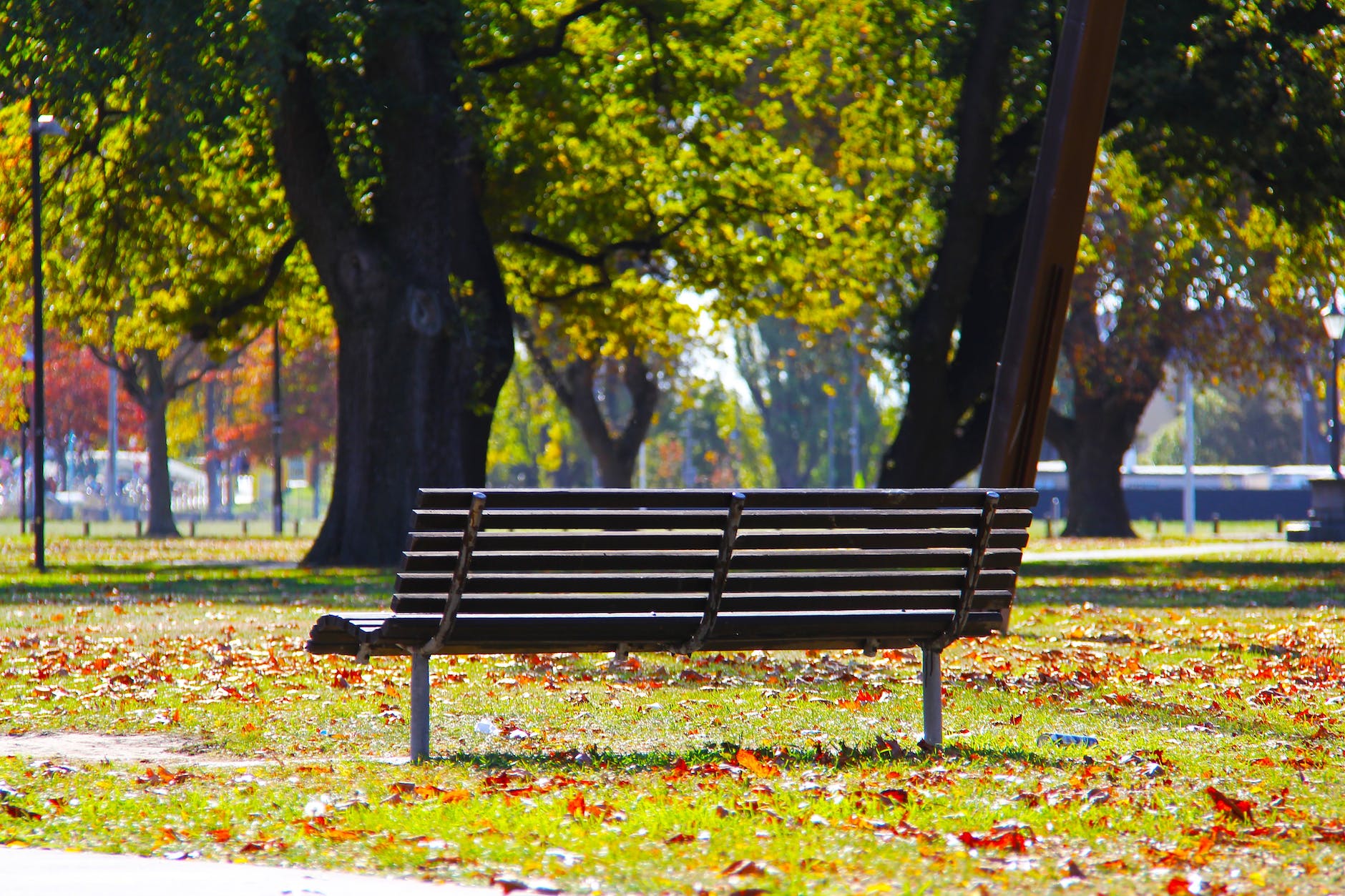
Photo by Pixabay on Pexels.com

I live in the suburbs of Bristol. While Bristol itself is one of the most culturally diverse cities in the UK the suburbs tend towards leafy suburbia where you can feel the crushing weight of normality on your shoulders. So, while seeing somebody in a central Bristol park doing Tai Chi on their own wouldn’t be unusual, it’s almost unheard of in my local parks. I’ve done Tai Chi in my local park of course – usually when training with somebody else and it’s not something I do solo, since I can just imagine the amount of funny looks it would generate around here.

Imagine my surprise then when I saw somebody else doing Tai Chi in my local park this morning. I looked to my right as I entered the park on the way back from the supermarket and facing towards me in the Push posture, just a couple of meters away was a man doing Tai Chi. One glance was all I need to identify that he was doing Yang style, or possibly the Beijing 24-step, which is based on Yang style. He had that large frame posture and super slow movement speed.

He was an older man with striking white hair, brushed back and John Lennon-style glasses, but tinted, so you couldn’t see his eyes. It was that moment where you see something that you recognise but it’s in the wrong place at the wrong time, so your brain takes a moment to process it and you freeze like a rabbit in the headlights. The Germans probably have a word for it.

After over 20 years of living in an area where it would be considered odd, even weird, to do Tai Chi in a local park, it had finally happened. I’d seen somebody doing Tai Chi in the park! And do you know what my first thought was on seeing him?

‘Gee, what a weirdo!’

I just walked off without saying a word and he just carried on, his attention rapt up in his movements.

The Balance Tai Chi Brings To Your Weight

Have you ever been in a situation where you suddenly felt a subtle change in your body? Maybe your body is feeling a bit weaker, sluggish, or even a tad stiffer than usual? Maybe you’ve put on a bit of weight, and your body decided to send you a little message. It is interesting how you always have the sense that you need to move, as if your body is trying to tell you something.

Your mind is a powerful instrument. It knows exactly when you need a push and how much push you should be giving your body. One great way to harness your mind’s capability is to channel it through Tai Chi. Tai Chi requires a type of resilience that no other exercise can provide – it requires you to develop the resilience to work slowly and methodically even when your mind is telling you that it would rather do something much more intense. During high-intensity workouts, you can easily tune out and smash your way through them as you blast out tunes to keep you going. Tai Chi requires that you stop and reconnect with your breath before you go through your routine. You are then expected to keep your mind present and engaged throughout. The mental fortitude you develop while doing Tai Chi – which even the British Heart Foundation points out is required for a healthy lifestyle – will better serve you as you face more daunting tasks, like losing weight.

Here are a few beginner-friendly routines to get you started in Tai Chi, if you haven’t started already:

Exercise #1: Tai Chi Walking

As you go through this routine, concentrate on shifting your weight smoothly and without wobbling. Pay particular attention whilst you’re shifting forward onto the turned-out foot as you are twisting your torso. Complete beginners will often find this challenging, so don’t feel frustrated if you have a hard time. Your body will get used to this movement the more often you practice. To make sure you are getting the most out of the workout, try to keep your centre of gravity levelled. Be aware of how much you bend your legs and keep your body from moving up and down as you shift weight.

Exercise #2: Wild Horse Parting Mane

The key to this Tai Chi exercise is to try to combine the weight transfer, torso twisting, and arm separation and perform them in a flowing motion. Be mindful that your legs should be driving the pelvis forward. Feel your spine being in charge of rotating your shoulders as your shoulders propel your arms.

Exercise #3: Cloud Hands

As much as you are able to, draw circles with your arms in a smooth, continuous motion and keep your speed uniform all throughout the routine. With constant practice, you will begin to notice the overhand arm pulling while the underhand arm pushes/stabs. This movement activates the posterior chain on one side of the body while simultaneously engaging the anterior chain on the other.

Committing to a regular exercise routine, like Tai Chi, helps bring you closer to your ideal weight. Moreso, small lifestyle changes like being aware of what you put in your body will also help you tremendously. WeightWatchers notes that the best weight loss programmes work optimally when their main goal is to help you find movement you enjoy. This way, your decision to move becomes a healthy habit that sticks.

If you are still not convinced of the weight loss potential you can get from Tai Chi, you might be surprised to find out that the calm, rhythmic flow of Tai Chi works equally as well as cardiovascular exercise and strength training. The results from Tai Chi are comparable to the mentioned exercises in terms of reducing waist size and cholesterol improvement. A trial published by the Annals of Internal Medicine showed that three 1-hour weekly sessions of this low-impact practice helped the participants lower their level of triglyceride (a type of fat found in the blood). This eventually led to greater drops in body weight.

When it all boils down to it, the best way for you to lose weight is to find an activity that you enjoy, and that makes you feel good. If you are looking for a workout that would help you strengthen your mind as you strengthen your body (and lose weight in the process), give Tai Chi a try.

Calling out Bullshido

Fantasy or reality?

I’ve been involved in a lot of discussions recently (and for years!) about what in Chinese martial art is fantasy and what is real. Realness, keeping it real, being truthful, whatever you want to call it, it is seen as a big deal. The question of the essential realness of a technique, a style or a whole person’s lineage, cuts to the heart of the matter, always.

Discussions of these types have flourished along with the growth of online video and the means to talk about these videos online. These discussions usually go along the line of:

1) A famous practitioner puts up a clip of himself (it’s usually always a male) demonstrating something visually impressive on a student. The purpose of the clip is self promotion for fame or seminars or online teaching material. Maybe they show a student go flying through the air from the lightest of touches, or they resist a strong push without any visible effort – you know the sort of thing.

2) Somebody comments and goes – “that’s bullshit!”

3) All hell breaks loose in the comments section between rival sections.

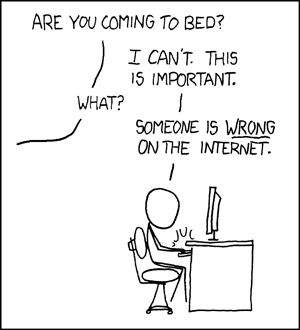
I can understand the strong urge to want to point these things out. I get involved in these things too. Sometimes I see something that is such obvious nonsense I can’t help but point it out. It’s like this old XKCD cartoon that is funny because it’s true:

The argument is logical: There are so many good things in Chinese martial arts and the fantasy stuff is damaging to that. And it’s therefore up to us to call out the fantasy, not accept it. If we don’t then we just invite ridicule, especially from other martial artists.

However, even when that attitude is adopted I see people tend to be more interested in calling out the fantasy stuff that other people do, or that is in other styles, not their own! And never in anything they do themselves or their teachers do. We all have our own blind spots and biases.

But I’ve been thinking differently about this issue recently…

When you look into the close connection between martial arts and street theatre, or opera troops and (as technology progressed) Kung Fu movies, it’s impossible not to conclude that showbiz (for want of a better word) has always been connected in some way with Chinese martial arts from the very beginning.

That doesn’t mean that Chinese martial arts masters of old weren’t bad ass. They were bad ass! But they also knew how to perform Lion Dance, or put on a show at New Years, or impress a prospective student with a. few tricks if they had to. These things were so interconnected in Chinese culture that it seems impossible to separate them (although successive Chinese governments gave it a good go throughout the 20th century).

Showbiz has always been there in Chinese martial art. It’s what makes amazing movie fight scenes like this one from The Grand Master possible:

Beauty, artistry, story telling. It’s all there. It’s using “real” techniques from martial arts and presenting them in a hyper-real, perfected, way.

Of course, the problem comes when people get conned into believing that the hyper-real is the real and that can take people to some very weird places, involving cult-like practices, exploitation and usually a lot of money being handed over. That’s where the problems start for me.

There are no easy answers, but I think that viewing some of these things that are not quite real as merely a part of the showbiz side to Chinese martial art, is perhaps an easier way to deal with it.

For instance, what is going on in this clip with Chen ManChing bouncing people around?

I can imagine a lot of Chen style Tai Chi people getting upset about that, as the sort of nonsense that doesn’t tend to happen in their style… and yet, what’s going on in this clip:

Is it as bad? Is it worse, even?

I don’t know.

It might just be easier to look at both these clips say,

It’s just showbiz”, and shrug your shoulders and laugh.

Closing in Taijiquan

Photo by Gratisography on Pexels.com

Opening and closing are in every movement of Tai Chi. But what does it mean to close?

To me the closing movements in the form feel like a squeeze. Closing in Tai Chi doesn’t mean shutting off. I think of the movement of Taijiquan as being like a garden hose that’s always on – the water (or if you want to get all mystical about it, the qi) is flowing regardless, and all you are doing with the closing movements is compressing the mouth of the hose a little, or putting your thumb over the lip, to increase the pressure, so the velocity of the water increases. 

Quite often the closing part of the movement is when you form the end of a posture – the finish position of Single Whip, the end of Ward off, for example. When the body closes it’s like the pressure increases and the velocity of the water becomes higher, then as you open again the mouth of the hose opens allowing more water comes out but at a lower velocity. That’s opening and closing.

How I popped my SI joint back in, using baduanjin

A couple of months ago I put my Sacroiliac joint out doing Jiujitsu. Typical symptoms are pain walking, standing in one spot and generally everything involving being alive. I didn’t know it was out initially so carried on training for a couple of days, but the pain steadily increased until I sought help from a sports therapist who diagnosed me, followed by a painful massage which felt good afterwards, not during!

This video shows where the Sacroiliac joint (SI joint) is located (it’s the meeting of the sacrum and the iliac.) The pelvis is not one bone, it’s three bones and the SI joints are what connects them together. The presenters are a bit crazy, but I kind of like them:

As you can see, there’s not much movement in the joint at all, and when it gets jolted it can move out of alignment and that’s when you get all the problems I had. Naturally, your other muscles and tendons have to compensate for the joint being out, and they object, strongly! In my case my piriformis was particularly unhappy about the situation and wanted to let me know by inflaming. Ouch!

I want to post a picture of the piriformis showing its location, but at lot of these medical pictures are copyrighted, so I’ll link to a page that has one instead here. The picture of the posterior of the pelvis is here.

Now the video above shows various ways to pop your SI joint back in the right place, but I did it using the baduanjin exercise I was taught as part of Chinese Qigong, so I thought it was worth talking about here.

After a sports massage to relax the tendons I did the usual Baduajin routine I do regularly as part of my morning routine, and during one particular exercise I felt the SI joint pop back in place straight away.

Baduanjin 八段錦 (translates as ‘8 silk force’ or ‘8 pieces of brocade’) are a set of Chinese exercises that could be up to a thousand years old. Simon Cox has a great history of the baduanjin (including a video of them being done) on his website here.

The version of baduanjin I do is way simpler than Simon’s version from Wudang mountain. Here’s a video of my version done by Sifu Kerr of the Spinning Dragon Tao Youtube channel (whose videos are worth checking out as well):

At 6.48 he does “Stretch and Glare to the Horizon” which is the exercise that immediately popped my SI joint back in. I prefer to do that one with my hands in fists rather than the “sword fingers” Sifu Kerr is using, I don’t think it would make any difference to what’s happening to your SI joint either way.

In the Okanagan Valley Wading video that exercises is called “7. 攒拳怒目增力气 Make a fist and with glaring eyes increase your power and qi,”:

But they do it with the fist vertical and very much as a hard punch. The variation I prefer myself is doing it as a slower stretch and I keep my fists horizontal, and a bit bent downwards, so effectively out of alignment for a punch, but with an increased stretch across the yang channels on the outside of the forearm. With the slower stretch version you can really feel the counter rotation on the spine as one arm is stretching forward, the other is simultaneously stretching backwards and you are doing your best to not let your pelvis move – just keep it facing 100% forward and level in a horse stance… And that’s what did it – pop! I felt my SI pain immediately go and the joint felt normal again. Relief!

Clench the Fists and Glare Fiercely, circled in red, was the exercise that did it for me.

As you can see, there are many variations on the baduanjin, (just look at how many you can find on YouTube!). So, I’d suggest sticking with whatever version your teacher gives you. The important thing is these exercises put my SI joint back in place, and for that I’m very thankful, as is my piriformis, which took a couple of weeks to quieten down, but hasn’t bothered me since.

If you ever put your SI joint out, it’s good to know how to put it back, so try the above. I’d recommend a sports massage as well, to deal with the inflamed tendons caused by it being out of place.

Just as an aside, Ellis Amdur wrote a brilliant article that I’d recommend about Baduanjin Used as a Therapeutic Activity Within a Youth Detention Facility. Check it out.

Internal power and the 3 internal harmonies: Going beyond words like Xin, Yi and Qi to direct experience

Almost by accident I watched Onama vs Landwher from UFC: Marlon Vera vs Dominick Cruz this morning and heavens above, that was one hell of a fight! Possibly the fight of the year. I’ve no idea how you’d score it. Landwher won by decision, but it was possibly the MMA fight of the year. Wild exchanges throughout with both fighters being so tired they could hardly stand up, but somehow kept going. It looked like they both had almost beyond the levels of human endurance, going from looking so tired they could barley move to pulling off flashy 3 move combinations.

You could almost see their spirit rising within to propel them on. It reminded me of all the phrases about the internal harmonies (san nei he) that we use in the Internet arts. The Xin (heart) leads the Yi (intention/mind), the Yi leads the Qi (energy to work) and the Qi leads the Li (physical movement). Initially this seems rather simplistic, say if you want to do something like make a cup of tea then you first have a desire to do it (heart) that travels to the brain (yi) that decides and then it ends up in a physical movement (li) and you find your feet moving you towards the kettle.

But that process happens automatically in humans and all animals, so why do we need to make a big deal of it and describe all the parts that build up to making an automatic process happen?

It’s often explained as putting the intention and will (the brains and heart) behind the movement. You can do things with a sense of purpose, or you can do them absent mindedly. In the internal arts, like Xing Yi, Bagua and Tai Chi, your actions need to have a sense of purpose. Your mind needs to be on the job, not half engaged. That’s one reason, but I think there’s more to these internal harmonies than just this.

I remember in BJJ training sometimes being so exhausted it was like my mind left my body and I became somewhat detached from my surroundings. It’s at moments like that that you start to be able to feel your “spirit” or mind as an identifiable thing. Through a sheer act of will you can force your mind to not give up and get back to the job and it can give you the energy you need to carry on fighting. That’s what I saw happening in Obama vs Landwher. A sheer force of will was being used to make them continue – their internal was leading the external.

Frankly, most people training only internal arts without hard sparring pay a lot of lip service to the internal co-ordinations, but do they ever reach an intensity of training where they can actually feel these things as tangible elements?

I’m not saying that you need to get an an MMA cage to experience your internal state under extreme physical stress before you have any idea what it is, but you can experience it in a safer way through things like Jiujitsu. Maybe Systema, too. Just some food for thought, and another reason why I think all Tai Chi instructors who re physically able should try and get a blue belt in BJJ if they are teaching the art beyond the health aspects.

There’s a risk, when reading this that people might think that using your Yi, or Xin in Tai Chi technique simply means to furrow you brow, put on a mean face, stare hard at something, get really tense and act like you really mean it, man. Because that’s not it either. That’s not what using “martial intent” or Yi means in internal arts at all. If I see people practicing internal arts like that I think it’s just bad karate. Not that there’s anything wrong with karate, of course.

Your internal state can be serious, but come from a place of calm. It’s a strange contrast between being expansive, yet laser focused, like the eyes of an eagle who is high up in the sky looking for prey. He’s taking in all his surroundings, but can pinpoint down on a single point when required. That’s using the 3 internal harmonies properly.

I think this is a Kite, not an Eagle, but you get the idea. Photo by Flo Maderebner on Pexels.com

The Tai Chi classics say:

To fajin,
sink,
relax completely,
and aim in one direction!

There it is – the (sung) relaxed body is the first requirements, once you have it you can ‘point your mind’ in the direction you want your power to go, so that the internal movement matches the external movement. When the inner and outer harmonise together, then you have internal power.

What you can learn from Tai Chi kicks

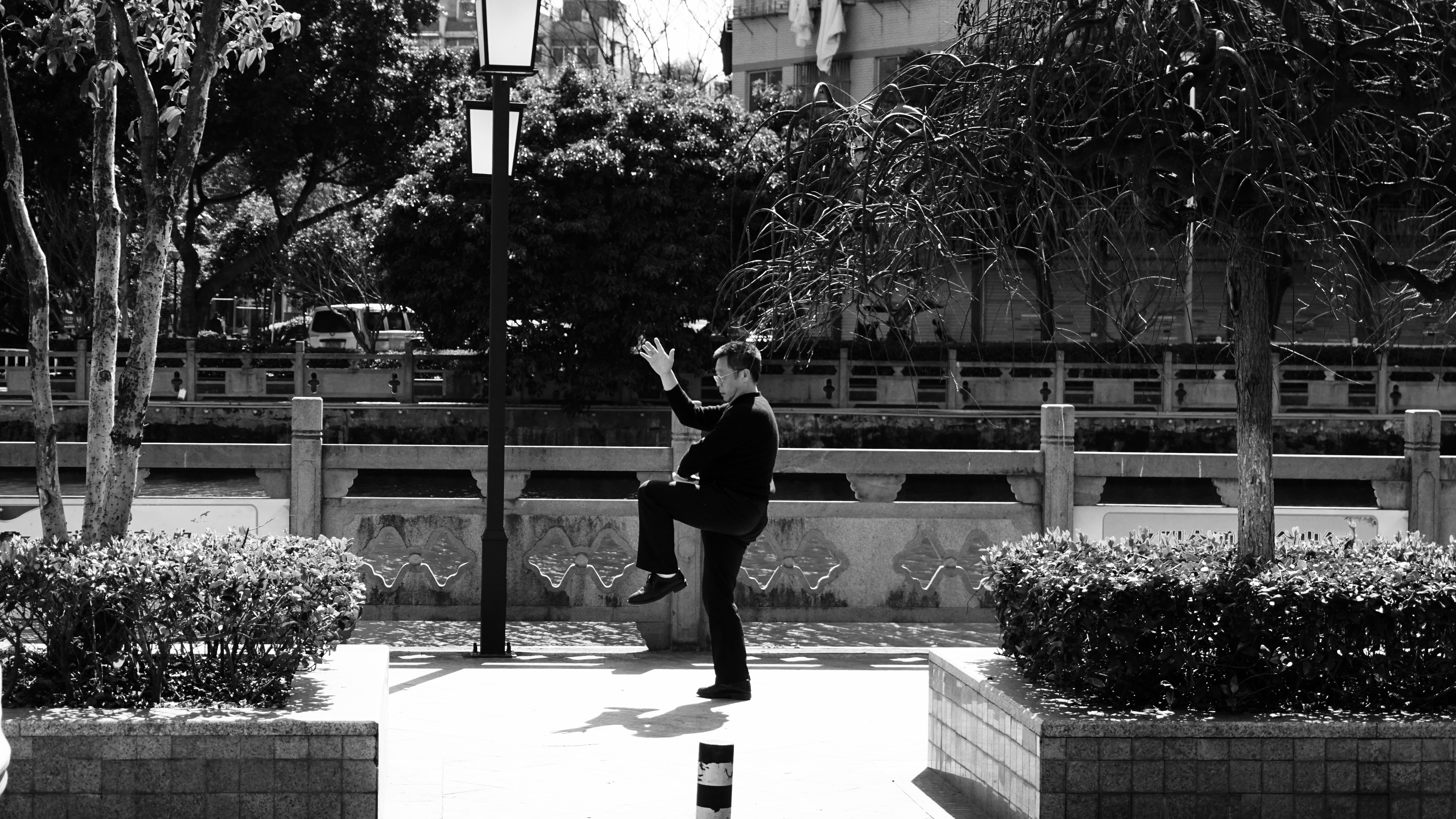
Tai Chi: balanced on one leg.

Tai Chi kicks are a great way of testing your balance. Due to the circular nature of Tai Chi technique the sections of the forms where you are kicking often involve turning the body to the left or right while you are standing on one leg. It’s more challenging than a simple one direction kick and is a great training for your balance.

I shot this during this morning’s Tai Chi practice. It’s the kicking section of the short form that we practice in the Yongquan Tai Chi Chuan Association:

You’ll notice that the kicks are done lower than you see in a lot of modern Tai Chi forms. That’s because we’re aiming at the knee. The classical technique for these moves is to block their knee with your foot and pull their arm in the opposite direction to get a takedown. Effectively using the foot as a kind of brace, not really as a kick.

But it’s the training these techniques offer in balance that is their real value I think – a lot of people end up very wobbly on the standing leg when performing these techniques. The key to making it silky smooth is not to think about sinking down into the ground as you raise the leg, but to ‘raise the back’ as you lift the leg. That upward ‘pull’ holds you in place securely so you can deliver a smooth kick.

Practicing Tai Chi in nature: Being like a teabag in the ocean

On holiday in the southwest of England for a week I managed to find some time each morning to practice Tai Chi in a lovely old wooded area.

So often we have to practice Tai Chi in our front rooms, back gardens or patios because of time pressures. Or maybe we only get to practice at a class in a village hall, gym or community centre. Either way, our surroundings are often far from natural.

Being able to practice Tai Chi in an environment where there were no other people, no human sounds and no interruptions was a blessing. It was possible to really sink into the environment for once, and not just my legs!

It’s a process one of my teachers calls “being a teabag in the ocean”. If you want to take in the good stuff from the natural world around you then you need to adopt the attitude of being like a teabag in the ocean – i.e. let nature move through you as well as around you, so that you don’t feel like something separate to it. Absorb it, soak it in. I’d say most people practice Tai Chi as if they are a teabag that’s sealed inside a plastic bag then dropped in the ocean. They can be doing great Tai Chi, but they are perfectly contained within themselves and not interacting with the environment. Often there’s not much environment to interact with, as mentioned previously, but if you get the chance to practice Tai Chi out in the woods, you should take it and take the opportunity to get out of that plastic bag.

Before you practice the form, stand for a few moments and try to let the barriers between you and your surroundings break down. Your mind should be focused on the moment and on your breathing, after all, that is as much a part of nature as anything else. Stand like that for a while before doing the form and just experience it, don’t think about experiencing it.

Then as you go through the movements of the form, you’ll start to feel like you are moving with the natural patterns around you. Don’t worry if your form takes on a subtly different quality than normal. It’s all part of the process.

I find that I don’t have as much free time for this in my normal life as I do when I’m on holiday, but I’m going to try and make an effort to get out to a secluded place now and again and practice my Tai Chi out there because the effort is well worth it.

The inherent potential of the Tai Chi form

More thoughts inspired by Chen Taijiquan Illustrated

“Training the form helps one to learn the core substance of Taijiquan. Practicing the various push hands methods trains how to apply its inherent potential.”

The function and reason for forms (tao lu) in Chinese martial arts continues to fascinate me. Were they planned to be like this all along, or is the usage of tao lu a happy accident born out of ancient religious ritual festival celebrations and the hiding of marital arts in theatrical traditions? The answer is probably a bit of both, and more of the “wrong” answer than you’d like to admit, no matter which of the two views you take.

I think all Tai Chi practitioners, beyond the mindless followers practicing in parks, 12 rows deep from the front, have a basic understanding that the Tai Chi form contains martial applications which can be brought out in push hands. But it’s the wording of the quote above that caught me: “the inherent potential” of the form.

That’s exactly it – the form isn’t explicitly martial. Certain compromises are necessarily made to maintain an aesthetic and flow to the movements. If it wasn’t then Tai Chi would look more like more practical Shuai Jiao solo drills or jiujitsu kata. And I think that’s what bugs a lot of people who laugh at the idea that Tai Chi can be used as a martial art. The martial essence is there in the movements, but it’s not on the surface. It’s buried, inherent potential that you’ll need to mine if you want to discover it.