Tai Chi basics: Rounding the kwa to make your tai chi form better

Paying attention to your inner thighs can bring better structure and a feeling of power to your tai chi form

If you’ve read my last post about keeping the knees bent during tai chi practice, and most importantly can do your whole tai chi form without violating this principle, then the kwa (inner thigh) is a good thing to focus on next.

Quite often in Zhan Zhuang chi kung standing practice we use the imagery of balloons supporting various parts of the body. You can imagine balloons supporting your arms, under your armpits and that you’re sitting on an imaginary beach ball. Balloons are soft but strong when pressured, so they’re a good image to help with the idea of staying relaxed and that feeling of springy peng (‘bounce’) energy that needs to be in the body during tai chi.

We don’t tend to use the supportive balloons imagery when explaining tai chi because it’s a moving practice, so the imaginary balloons would inevitably float off at some point! But you can still use the imagery in a couple of places – imaging balloons under the armpits and one held between your thighs that is gently pressing the knees outwards is a good place to start.
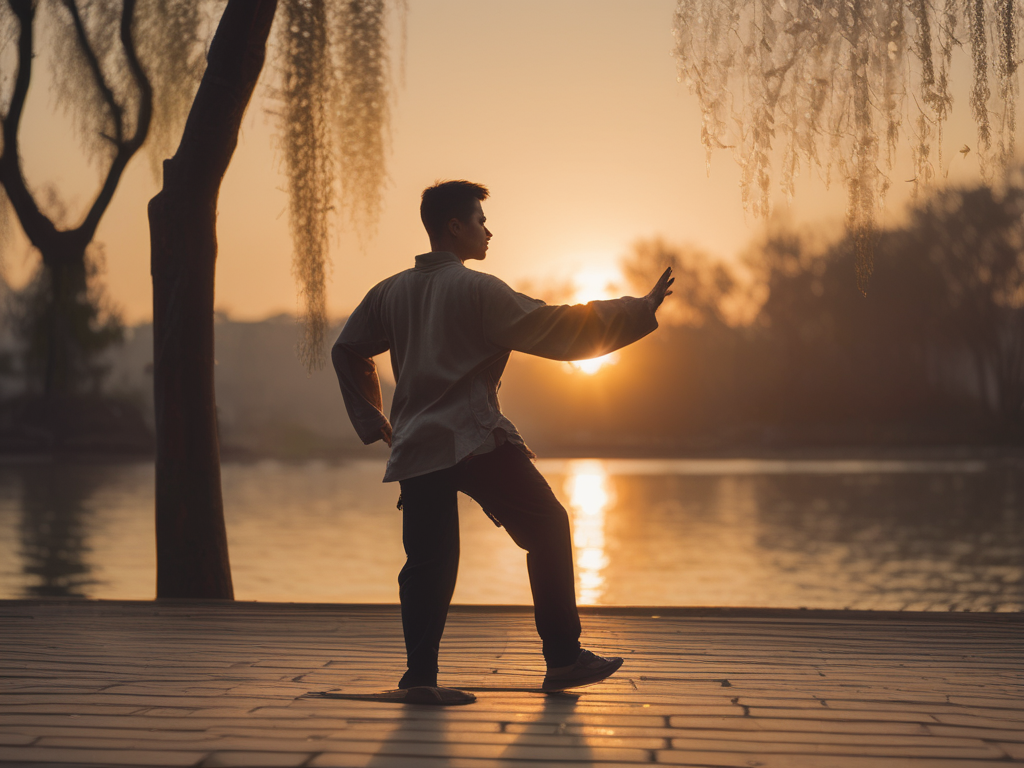
The kwa needs to be kept open at all times in tai chi practice.

One of the things beginners often fail at in Tai Chi is sufficiently rounding the kwa. By kwa I mean the area of the inner thigh and groin. I’ve been told that this area is more correctly called the dang in Chinese, but kwa/dang/whatever, I mean the arch formed by the inside of the thighs and containing the pelvic floor. As I’ve discussed before, beginners tend to want to straighten their legs, rising everything up in their stance, which has the effect of collapsing this kwa area, so that it effectively closes as the thighs move together.

In tai chi we always want to maintain the feeling that we’re holding a small balloon between the thighs so that this area is always rounded. Of course, there is opening and closing going on in tai chi all the time. As you progress through a move, one side of the kwa is opening and the other is closing, but regardless of any opening and closing movement that is going on, you need to keep a general feeling of openness in the whole area throughout the form. Even in postures where the feet are together. If you stand with your legs together, then that is considered a closed kwa, but in tai chi that area always has the feeling of being open – even when the legs are together.

You might find that last statement confusing, but it’s helpful to remember that in tai chi we are not performing an exact science, but we are dealing with feelings. The feeling of being open is what I’m talking about.

The last thing to mention is the why. Why do you need to do this? That’s where you need a teacher to give a demonstration of the application of tai chi against a simple push. With the kwa rounded you create a good base from which you can receive and launch attacks. When pushed, you can use that base the rounded kwa gives you to receive and then bounce away an attacker. If your kwa collapses when your upper body is pressured then you can’t do this without using a lot of effort and strength in the upper body. In tai chi this is wrong. Using your legs is always a better way.


Thank you for supporting The Tai Chi Notebook. If you are reading this on a website that isn’t thetaichinotebook.com, then it’s highly likely it’s been stolen. Please let me know so I can issue their webhost a DMCA takedown notice for copyright breach. Thanks. And if you have the great idea of starting a tai chi website by stealing other people’s work to fill it with content for clicks then take a good hard look at yourself, and do better.

Zhan Zhuang tips – standing like a tree

two brown trees

Photo by Johannes Plenio on Pexels.com

In the internal arts, Zhan Zhuang is one of the practices that gives you the most immediate benefits. It’s a practice that (initially) involves nothing more than standing and relaxing, yet this simple practice can produce a feeling of deep calm in the body and mind, and even give you the feeling of having more energy throughout the day.

How is this achieved? I’d warrant that it’s something to do with the effect of the calming action on your nervous system, plus standing for prolonged periods with your arms held away from the body is actually pretty physically challenging, so there are a lot of the benefits you experience from cardio-vascular exercise, but without you getting out of breath.

At more advanced levels of pratice, Zhan Zhuang a great way to practice Jin in different directions.

I came across a very good article recently written by Tony Dove full of good tips for starting a standing practice. Here it is.

Some good quotes:

“Use the breath as your focal point. Whenever your mind begins to wander, gently ask yourself, “Am I breathing? How am I breathing?” Bring your attention back to your breathing. Physiological awareness brings self-awareness. The mind becomes silently attentive to the subtleties of what is happening in the here and now, rather than thinking about the past, the future, or abstractions disconnected with the present.”

and

“Discomfort reveals places of dysfunction and should be welcomed as an opportunity for improvement.”

and

“Build gradually to a minimum of twenty minutes daily Standing, and a maximum of forty minutes. This is a small investment of time considering that you will probably have more energy during the day and need less sleep at night.”

Master Lam Kam Chuen’s TV series of how to begin your own standing practice is on YouTube, and a great way to get started:

Bad news people – Qi is not mystical


woman holding eye and concentrating

Magic? Or something else…

I read this in a blog post today:

“I remember one time when a student was showing a qigong posture she was taught from another teacher and spoke about how qi circulated through it. He adjusted her posture slightly and said “now you have qi circulation”. “

From here. 

When you read something like this I think it reinforces the incorrect idea that Qi is some type of etheric, mystical energy that rises in our bodies like steam and can be directed by the mind… (in fact, that’s what the article goes on to talk about)

Well, frankly, it isn’t. At least in the context of martial arts, it isn’t. Acupuncturists probably have a different opinion on that, but I’m not talking about acupuncture.

But at the same time, if you know what is meant by “Qi” (through your practical understanding) then that original sentence I quoted above does make sense. Let me explain.

You’ve got to remember that when a Chinese teacher talks about Qi in terms of martial arts, what they are talking about is related to your physical structure. The stuff that makes you up. Skin, bones, tissue, muscles, etc…

If you have “strong Qi” then it means you are physically strong. So, for example, a strong athletic young guy or gal would be described as somebody with “strong chi”. Usually, the posture is good, the eyes bright, the hair shiny, etc… These are all aspects of “strong Qi”.

A weak slumped, tired, or sick-looking person would be described as having “weak Qi”.

man old depressed headache

You, my friend, have “weak Qi”.

So, an old person could have either “strong chi” or “weak chi” depending on how they presented themselves. If you’re bright-eyed and bushy-tailed, you’re doing well. Your Qi is strong.

close up photo of blue peacock

Strong Qi, or BDE as the Yooth say today…

In Tai Chi your Qi refers to your physical structure in a movement, as well as a special type of conditioning of the body’s structures that takes place through exercises like Standing Post and Silk Reeling. Through these exercises, you can strengthen the felt connection from your fingers to your toes – a kind of all-over body suit. It’s the strengthening of this ‘body suit’ that explains the circus-style feats of strength you see martial arts groups demonstrating. Things like throwing a needle through glass, bending a spear on your neck, being resistant to blades and breaking rocks with your hands.


I would not suggest trying these things at home! Sure, there are often ways to fake feats like the ones above, but there are also ways to do it correctly, utilising the conditioning of the body’s Qi.

Martial arts techniques in Tai Chi require two things – Qi and Jin. Here we’re only talking about Qi. I’ve talked about Jin before.

Qi (Chi) relates to structure. So, if you adopt a Tai Chi posture that’s relaxed, sunk, stable and strong (i.e. your structure is good), then you are “using your Qi well”. And it could be said the “Qi is circulating well”. (Actually, nothing is circulating in the sense of water in a pipe). If your structure is off in some way then it could be said that your “chi is not circulating well”.

So, if we read that quote again, with the new knowledge that it is to do with posture and structure:

“He adjusted her posture slightly and said, “now you have qi circulation”. 

Could equally be written:

“He adjusted her posture slightly and said, “now you have better structure”.

So, to me that means, he corrected some defect in her posture (say an overly tense lower back, or tense shoulders, for example), so that her “Qi” started to circulate – i.e. the posture regained its natural strength.

Sorry guys, but none of this has anything to do with steam or heat or a mystical energy in the body. But it’s so easy to assume that this is what is meant when you read quotes like the one above.

Especially once you add to that the fact that people can feel pretty much anything they can imagine. 


The inner body

nature-3151869_640

Standing Chi Kung exercise, or Zhan Zhuang, as it’s known in Chinese is one of the most powerful exercises for developing your inner power.

There’s a brilliant series of videos on YouTube on the subject of Zhan Zhuang taught by Master Lam Kam Chuen. They’re presented in a very ‘easy to follow’ manner, and they’re a great way to get started with standing exercises.

Here’s the first episode:

One question people often have is “what should I be doing in these postures?” Well, “it’s complicated” is probably the best answer. It depends what you’re working on.

But if you have to start somewhere then I think the following words written by Eckhart Tolle from The Power of Now, (and apologies in advance to anybody who gets offended by even the merest whiff of anything New Age) where he talks about connecting to the inner body, are a good start:

“CONNECTING WITH THE INNER BODY

Please try it now. You may find it helpful to close your eyes for this practice. Later on, when “being in the body” has become natural and easy, this will no longer be necessary. Direct your attention into the body. Feel it from within. Is it alive? Is there life in your hands, arms, legs, and feet — in your abdomen, your chest? Can you feel the subtle energy field that pervades the entire body and gives vibrant life to every organ and every cell? Can you feel it simultaneously in all parts of the body as a single field of energy? Keep focusing on the feeling of your inner body for a few moments. Do not start to think about it. Feel it. The more attention you give it, the clearer and stronger this feeling will become.

It will feel as if every cell is becoming more alive, and if you have a strong visual sense, you may get an image of your body becoming luminous. Although such an image can help you temporarily, pay more attention to the feeling than to any image that may arise. An image, no matter how beautiful or powerful, is already defined in form, so there is less so there is less scope for penetrating more deeply.

The feeling of your inner body is formless, limitless, and unfathomable. You can always go into it more deeply. If you cannot feel very much at this stage, pay attention to whatever you can feel. Perhaps there is just a slight tingling in your hands or feet. That’s good enough for the moment. Just focus on the feeling. Your body is coming alive. Later, we will practice some more. Please open your eyes now, but keep some attention in the inner energy field of the body even as you look around the room. The inner body lies at the threshold between your form identity and your essence identity, your true nature. Never lose touch with it.”