Forget Mount Wudang, the latest hot Kung Fu mountain is Mount Emei, and this time it’s girl groups leading the way

It’s all about the needles

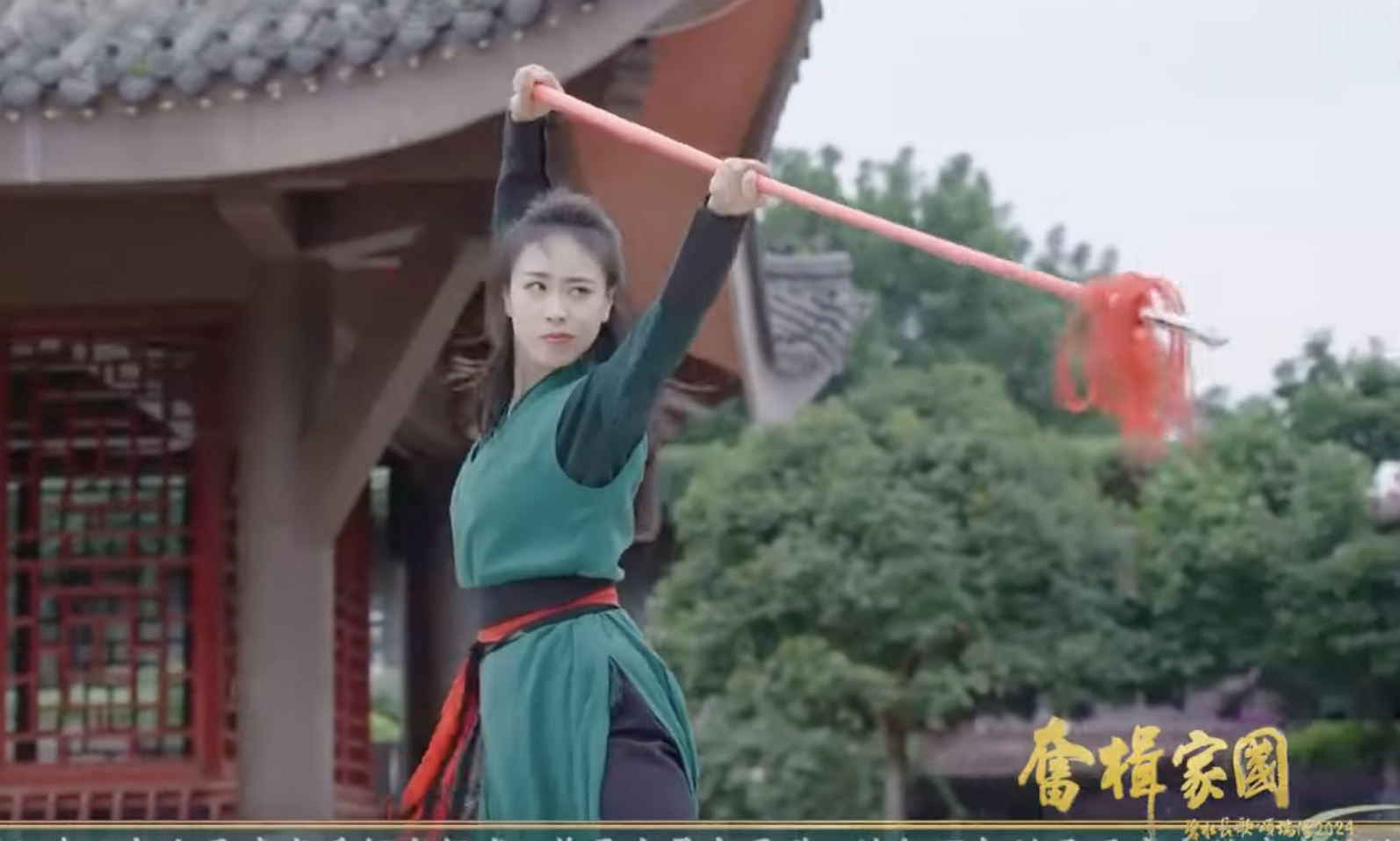
Emei Mountain is the latest hot Kung Fu trend coming out of China, and a group of Kung Fu girls is leading the charge, according to a new article in China’s GlobalTimes.

In April 2024 a video appeared showing nine female Kung Fu performers doing Kung Fu moves against the backdrop of Emei Mountain.

Chen Yufei, 23, one of the group members is quoted in the article: “Unlike the dramatized versions of Emei kung fu in TV shows, which ­focus on legends, our practice is rooted in the practical skills and traditions of Emei martial arts.”

The video shows performance with a variety of Kung Fu weapons including double whips, swords and of course, the famous Emei needles *, but the phrase “traditions of Emei martial arts” raises a few red flags for me.

A standout line from the article reads “In 2008, Emei martial arts, with a history spanning over three millennia, were designated a National Intangible Cultural Heritage.”

Ok, hang on, what?

Mount Emei has long been a sacred mountain for Buddhism, sure. But a 3,000 year old tradition of Kung Fu?

If you look up Kung Fu training camps on Mount Emei you’ll find a complete history of the martial arts and styles there: “Emei School has 1,093 bare-hand fighting skills, 518 skills with weapons, 41 pair practice routines and 276 practice methods.”

Call me a cynic, but I don’t believe any of this. It appears to me that the Kung Fu traditions of Emei Mountain really belong to the work of modern wuxi fiction of author Jin Yong who wrote a lot about a fictional Emei Sect. In his book, The Heaven Sword and Dragon Saber, the Emei School is founded during the early Yuan dynasty by Guo Xiang around the same time as when the Wudang School is established.

Of course, this being a complete fiction hasn’t stopped the Kung Fu tourist industry from setting up shop on Mount Emei. As this 2012 article describes, there was not much Kung Fu on the mountain back then, but it was starting to be set up, complete with a history. But if you look up Mount Emei today you’ll find Kung Fu competitions are held there, and very much like the operation at Mount Wudang, you can go there to study Kung Fu, for the right price.

The all-female Kung Fu troop heralding from Mount Emei seem to be as much a creation of the Kung Fu tourist industry as anything else, at least to me.

So where does their martial arts come from? Looking through various pages on the Internet I found a Reddit post that sounds true to me: ” “Emei” is just a generic term for martial arts from Sichuan, extremely few styles have any actual direct relation to anyone who loved or practiced on Emei shan.  Also almost everything called “Emei” today are modern offshoots of northern Chinese martial arts brought to Sichuan with nationalist troops as they were forced westward by the Japanese in WWII.”

None of which, of course, is to take away from the performance of the Emei all-female Kung Fu group, who are pretty damn good at WuShu.

  • Note 1: Mount Emei even has its own weapon, the Emei Ci which are sharp steel rods known as needles or piercers, that can be worn on a ring on your finger and spun around.

A visit to Mount Emei by Will of Monkey Steals Peach:

Daniel Mroz on defining Chinese martial arts – a podcast conversation

Daniel Mroz

After battling hard through various technical challenges I’ve finally managed to create a Tai Chi Notebook podcast with humans on! (Previous episodes of my podcast have been a robot voice reading my blogs). I’m pleased to have my good friend Daniel Mroz on board for my first real episode where we have a conversation about what Chinese martial arts might be.

You can find it on all the usual places you find podcasts – search for The Tai Chi Notebook on Apple podcasts, Spotify, etc.. or here’s a link:

Spotify: https://open.spotify.com/episode/6tuptU … c1bb1b468f
Apple: https://podcasts.apple.com/gb/podcast/t … 0530576920
Web: https://anchor.fm/graham47/episodes/Ep- … /a-a68h1lv

What is the relationship between Chinese martial arts and Chinese theatre, religion, mime, serious leisure activities and military tactics? How do all these factors intermingle and produce the arts we have today? In this wide ranging discussion between Graham Barlow of the Tai Chi Notebook Podcast and Daniel Mroz, Professor of Theatre at the University of Ottawa we tackle all these subjects and more. As well as being a professor of theatre, Daniel is also a Choy Li Fut and Taijiquan practitioner and has spoken at the Martial Arts Studies conference and contributes articles to various journals including the Martial Arts Studies journal.

Podcast Notes

1)
That Daniel Mroz quote in full:


“By ‘Chinese martial arts’, I refer to folkways that began to assume their present forms from the mid 19th to the early 20th centuries, at the end of the Imperial, and the beginning of the Republican periods of Chinese history. These arts train credible fighting abilities through exacting physical conditioning; through partnered, combative drills and games; and through the practice of prearranged movement patterns called tàolù  套路 (Mroz, 2017 & 2020). For millennia, up end of the Imperial period in 1912, China explicitly understood itself as a religious state (Lagerwey 2010). Communities across China not only used their martial arts to defend themselves, they performed them as theatrical acts of religious self-consecration, communal blessing, and entertainment in an annual calendar of sacred festivals (Ward, 1978; Sutton, 2003; Boretz, 2010; Amos, 2021). Modernization, and secularization at the end of the Imperial period removed the original context of these practices. The Chinese martial arts were transformed over the course of the 20th century by both their worldwide spread, and by their ideological appropriation by the Chinese Republic of 1912, and the Communist state that succeeded it in 1949 (Morris, 2004). Their religious heritage forgotten in many social, and cultural contexts within greater China, and internationally, the arts we practice today combine a legacy of pragmatic combat skill, religious enaction, participatory recreation, competitive athleticism, and performed entertainment.”

2)
THE STRENUOUS LIFE PODCAST WITH STEPHAN KESTING
334 – Ten Guru Warning Signs with Dr Dr Chris Kavanagh
https://kesting.libsyn.com/334-ten-guru … s-kavanagh

3)
Peter Johnsson
http://www.peterjohnsson.com/higher-und … reckoning/

Peter Johnsson – long video: https://www.youtube.com/watch?v=J6N3x_4 … 3gQGXHpgSG

Peter Johnsson – short video: https://www.youtube.com/watch?v=FiSoLMx3v0I