Let’s see if we can explain this without getting lost in too much theory…
(N.B. I’m writing this, to help my own thought process, rather than producing a tidy finished article, so let’s see where we go.)
Yi is one of those confusing terms in taijiquan. I don’t think you can talk about it without reference to jin and fangsong (probably qi too, but let’s try to leave that for now).
Amongst the taijiquan community there are a lot of varied ideas about jin, the “refined strength” or “trained strength” that you find mentioned in the Chinese marital arts, particularly taijiquan.
Many people seem to think that jin is about generating force maximally for whatever movement you’re doing, so a swimmer has ’swimmer jin’ or a weightlifter has ‘weightlifting jin‘.
It’s a tempting idea – after all who wouldn’t want to move with the grace, power and agility of an athlete, but I don’t think that practicing taijiquan should be looked at as some sort of shortcut to those abilities.
Athletic abilities are hard won, don’t last forever and require an awful lot of maintenance to keep a hold of. You can’t just short-cut them.
In taijiquan that is not what’s really meant by the word jin anyway, or there wouldn’t be anything different, at a fundamental level, between the training a boxer does and the training a taijiquan player does (and at this point you may actually be standing on the sidelines shouting, “No, there isn’t and difference!”, however, that’s your choice, but let me try and change your mind…)
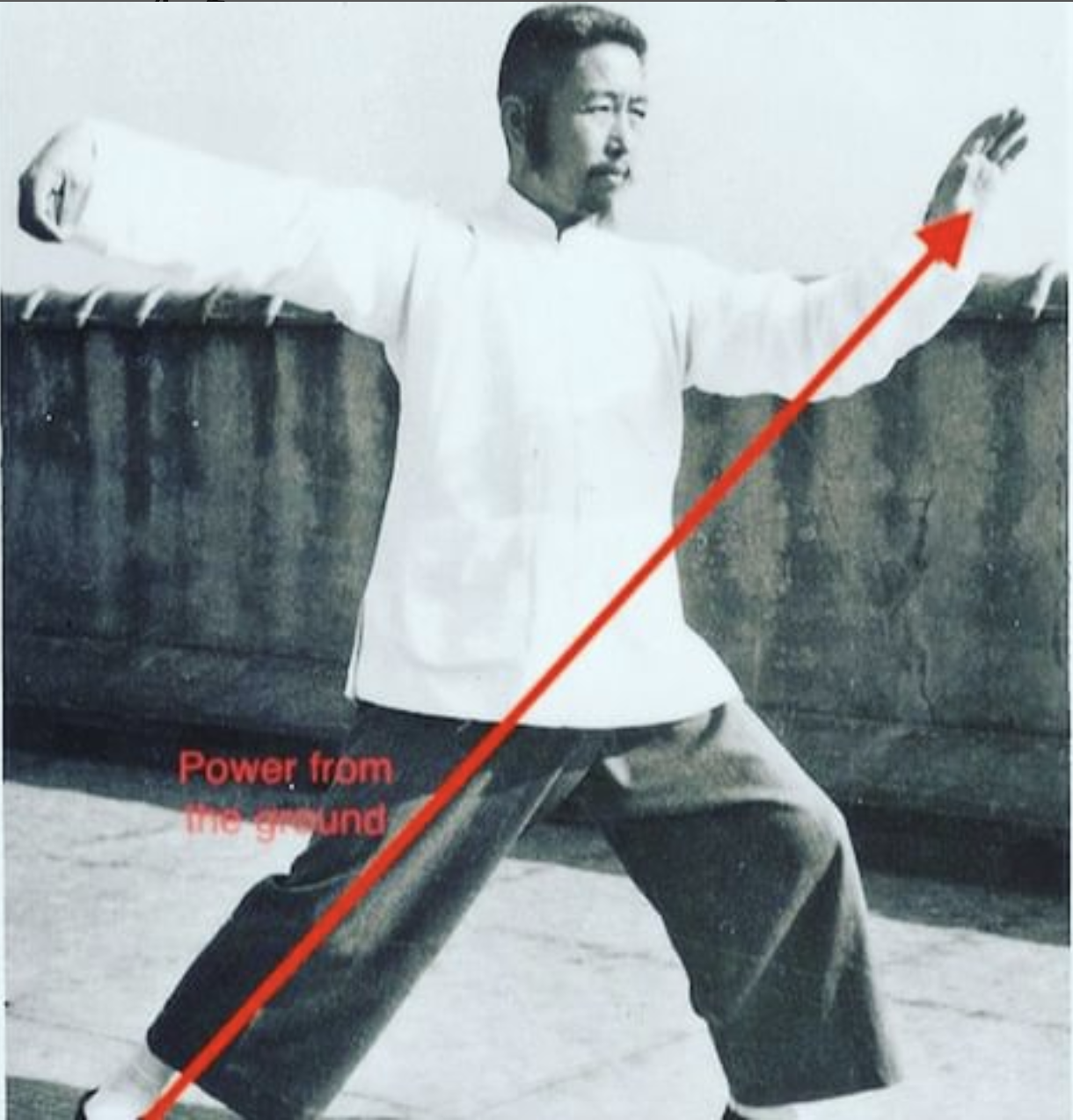
In taijiquan we are specifically talking about ground force when we talk about jin. By ground force I mean the solidity of the ground manifested to our fingers. As the saying in the taiji classic says
The jin should be rooted in the feet, generated from the legs, controlled by the waist, and expressed through the fingers.
This is achieved by letting whatever forces we’re working with find their way to your foot to rest on the ground. This ground force can be bounced back from where it comes, turning it into something that can be used actively as well as passively.
When people talk about jin the next word out of their mouth is usual fangsong, to relax. There’s a reason for this.
The only way to let the forces you’re working with rest on the ground as directly as possible is by relaxing your upper body. (Relaxing your legs doesn’t really help much, since the weight of the body is sinking down into them). It’s getting the tension out of your upper body, by letting it dissolve down, that works the magic.
So what does it mean to ‘let forces rest on the ground’, and how do you do it?
Let’s make this a practical example.
If you’re sitting at a desk right now reading this on a laptop, I want you to pick up your laptop with your hands.
Got it? Good. (If you haven’t got a laptop, grab something of equal weight)
Now, you might think you’re fairly relaxed as you sit there holding your laptop off the desk, but what happens if you say to yourself “let the weight of this laptop go to the ground, through my chair”.
Now, if you’re anything like me you’ll notice that something invisible subtly changes inside yourself when you do this. There’s a noticeable switch of the internal musculature of your body (the qi) that is rearranging things for the weight you are holding to be supported by the ground.
I don’t know what exactly changes, because subconsciously your body just does it, and that subconscious switching is a function of your yi, which is usually translated as “intent”.
You can put your laptop back down now.
What I notice when I do this is that when direct forces to the ground my neck feels freer, my shoulders looser and space seems to open up. Mentally I also feel clearer. These are a lot of the benefits that you get from practicing taijiquan.
Your yi is activated when you imagine a direction that you want to send a force into. It does all the hard work of plotting the path through your body on a subconscious level that you aren’t usually aware of. In fact, trying to work out how it’s doing it is a sure way to mess up actually doing it.
If you see people practicing taijiquan, or other internal arts, with that kind of faraway focus that’s about halfway between open awareness and fixed attention, that’s what they’re doing. They’re not communing with the angles, they’re imagining directions for the jin to ‘flow’ in. They are using their yi while doing the form.
Now that was quite a lot of concepts to throw at you in a short while, and probably enough for now, so let’s stop there.
Notable Tai Chi teacher, Damo Mitchell, just released a new video with Adam Mizner where he addresses some of the controversy over The Power of Chi documentary that is worth watching, if you care about these sorts of things.
Damo Mitchell and Adam Mizner are a couple of the most well-known modern Tai Chi teachers on the seminar circuit, both of whom have a lot of followers on social media, and large organisations of students behind them. The Power of Chi was a movie where Adam Mziner demonstrated his chi/qi on a number of athletes from various sports. The movie has since mysteriously disappeared from the Internet, as far as I can tell, but the trailer is still on YouTube:
You can see from the start of the clip where Damo’s thinking is at (around the 4 minute mark) – the reason people criticise the movie, or himself and Adam, is because they are jealousof how well he and Adam are doing and that the people who criticise them have less followers so are below them and it’s therefore wrong to “punch down” by replying to them. These low level people also “are not in a good space mentally”’. His other point is that the movie was not made by Adam, he was just a paid performer in it, therefore everybody’s criticism is misplaced.
Well, talk about missing the point entirely!
At no point does he address the central issue I and many others had with the movie – that all this “chi” stuff is nothing to do with chi/qi!
Now, I’m not egotistical enough to think that Damo is addressing this video specifically to me, but my original post about the documentary is still there for everybody to read. As you can see, I said I thought the whole thing was a bit silly. That’s about the worst of it!
You can decide for yourself if that means I am racked with jealousy about how many students Adam and Damo have, and how great their lives are… I really am not even playing in the same league as Adam and Damo – they are professional Tai Chi teachers making a living off this, I’m not. I have a real job, and just run this blog in my spare time for fun. It’s the same with my podcast. But that doesn’t mean I’m not serious about my practice.
The other thing I did in my original post was link to my friend Rob Poyton’s video response to the trailer showing how all the supposed Chi feats in the trailer were really done – which I thought was quite cool, but seems to have really put the cat amongst the pigeons. I mean part of the attraction of seeing a stage magician is working out how the magic is really done, right?
Rob Poyton explaining how to do the feats seen in The Power of Chi movie.
Now that video by Rob seemed to raise the ire of many of Adam’s followers (who posted in the comments section of my blog, which are still there and you can read) who replied with such gems as this:
“I’m disappointed in your entire take on internal power, as indicated by your dismissive way of talking about those who actually do possess some genuine internal power as using “tricks”. To be blunt, you’re just ignorant–that is, you have no personal experience with real practitioners and assume everyone showing such power must be a charlatan. “
“Why do you have a website about Taiji (that’s the correct pinyin spelling btw) when you’ve never met any of the top taiji practitioners – and refuse to meet them before publishing negative theories about the limits of the art? So the best explanation to you is that the top practitioners in the world who have trained thousands of students are merely liars with fake reviews from professional athletes and professional teachers?”
“So you did not see the move, or met anyone in the movie to experience this skill/ attribute first hand. Kind of strange to have such strong opinions on something you have no experience in….”
You can see from the comments that the followers of Adam and Damo really do believe that the feats presented in the movie, The Power of Chi, are real demonstrations of chi power, (or Qi power.) Again, that’s my issue with all this stuff, not that they’re making a good living off teaching Tai Chi.
As a complete co-incidence Rob just released another clip in the last few days, this time about the subject of Empty Force, that’s also worth a watch, and will undoubtedly upset all these same people all over again, for exactly the same reasons:
There’s a long history of the Tai Chi magician. Empty Force is something that the Tai Chi Magicians of the world engage in regularly, and once again, I think it’s cool that Rob is posting a video showing how it works.
As for Damo and Adam, I hope they keep enjoying their cocktails and cigars – they seem to be having a great time, hidden away in all that smoke, being Tai Chi Gurus. I’m not jealous that we have very different lives at all. I wouldn’t trade mine for anything. Spending a month on a retreat in Thailand training Tai Chi full time, (let alone a year!), sounds like absolute hell to me. I’m sure it would send me potty! I’d rather be with my family, friends and pets, thanks.
It looks like Adam and Damo have some real skills in Tai Chi push hands – I’m not doubting that. After all, they’ve had years training full time to get good at this stuff, so they better have something by now. But as with everything in the internal arts – it pays to keep your feet firmly on the ground.
For me the latest video from Damo and Adam is just another fascinating glimpse into how the mind of a Tai Chi Guru works.
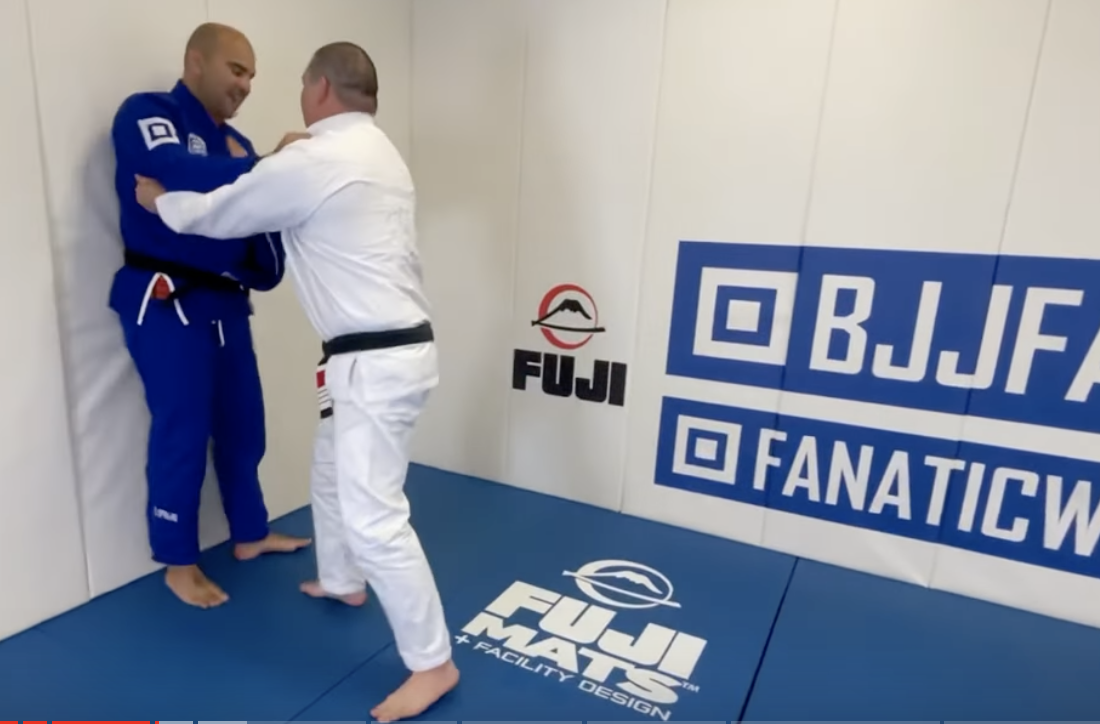
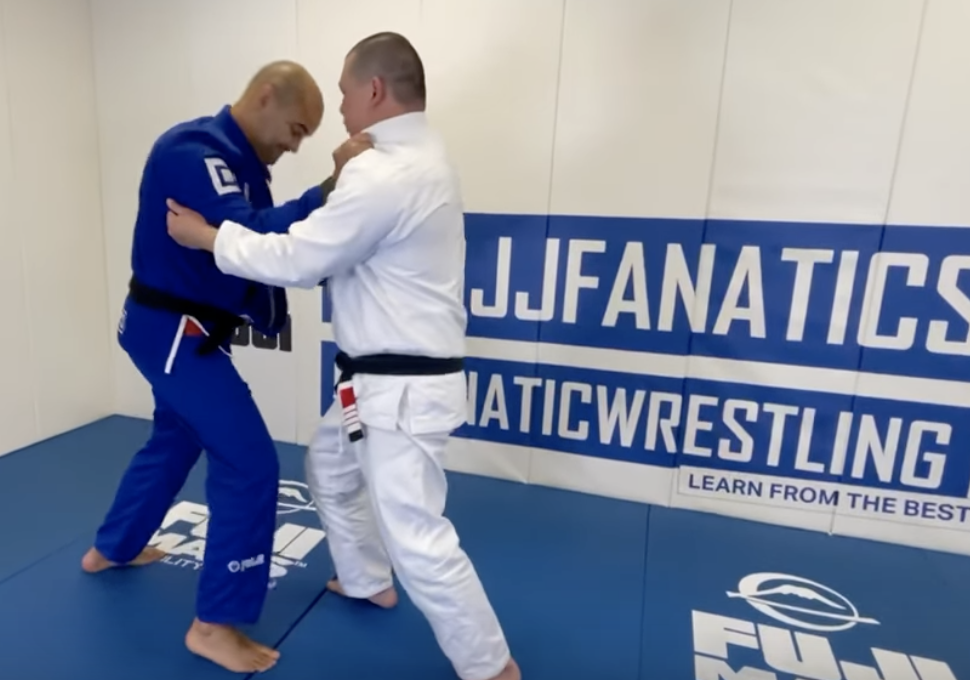
I like it when you can find those rare moments where martial arts seem to cross boundaries and blend into each other. I came across this video recently of Henry Akins explaining the concept of connection in BJJ, as taught to him by Rickson Gracie, and it doesn’t half remind me of Tai Chi…
There’s a lot of talking at the start, but he gets down to action at around the 4 minute mark and starts demonstrating rooting – something that you’ll find being practiced in most Tai Chi classes. These are what you’d see described as ‘simple jin skills’ or ‘jin tricks’ by a lot of Tai Chi experts. And they are what you are supposed to be doing in Tai Chi all the time, when you practice the form and when you do push hands. They’re the root (ha!) of classic phrases from the Tai Chi classics like, “4oz defeats a thousand pounds”.
In fact, a lot of people seem to think that these jin skills alone qualify something as being internal, which is why you see the descriptor, “internal”, being added to the name of a lot of martial arts, like ‘internal Wing Chun’ or ‘internal Karate’.
My take would be that, sure, these are an essential part of the internal package, but they’re not the whole enchilada. For instance, Henry is not doing anything particular with his dantien, and indeed, you don’t need to do anything in particular with your dantien to do these things. But these are still the first few steps to being an internal art.
As you know if you’ve read my blog for a while, I’m a BJJ practitioner myself, so it’s great to see somebody like Henry applying these principles to BJJ. I see it as a path to a version of the art that you can still do as you get older. I don’t think you’re going to be winning any competitions if you dedicate yourself to practicing these jin skills (the power and aggression of youth is pretty darn overwhelming to fight against in competition, particularly if it’s being done by dedicated athletes who train to a level the average guy with a job and two kids can only dream of). All I’m after is something that gives me the edge in friendly, hobbyist rolling and enables me to stay in the game and on the mat for as long as possible. “Do not go gentle into that good night”, as Dylan Thomas put it.
Push it, push it real good
In particular, Henry deals with one of the favourite subjects of Tai Chi – pushing. Henry pushes Bernardo, using power from his legs, not his arms – this is Tai Chi 101 – and then shows how to receive a push by aligning his body so that the push goes into the ground. He, (dare I say it?) tucks his butt, so that the force goes down his legs to the ground, rather than knocking him backwards. This is what you need to be working on in push hands when people push you. N.B. Tucking your butt does not mean adopting a forced and unnatural posture, it just means flattening the lower back and aligning the lower part of your spine with the upper, so that your bum doesn’t stick out.
What I like about this clip is that Henry, coming from a non-Chinese marital art, doesn’t use words like Jin and Qi – he just talks about alignment, relaxing and using the legs and ‘using the ground for support’. It seems much less mystical than the way it is typically presented in Tai Chi, and it goes to show that you can explain a lot of Tai Chi things without having to use words that are nebulous or hard to grasp for the Western mind.
But it’s really the concept of connection that Henry is teaching. As he says, a lot of the time in grappling what you want to do is connect to your opponent to use your techniques, and then learn how to disconnect from them when they try their techniques on you. He sees connection working in three main ways – and this is where I think Tai Chi teachers can benefit from his teaching –
Connecting within yourself,
Connecting to the opponent
Connecting to the ground.
That’s not a bad way to look at grappling at all, and I think it is a good way to help people understand that, when doing push hands, you can’t apply no force at all to the other person in a sort of noodle arms-display of rooting into the ground, because then you have no connection to them. If you move, they don’t move. Instead, you need to apply enough force at all times so that you are connected to their body and through listening (ting) you can feel when it’s time to break this connection too. Think of it a bit like an insect using the surface tension of the water to stay afloat.
Great work Henry, I would buy your instructional on Connection, if only it wasn’t almost $300. 🙂 But thanks for sharing that video above for free. I’ll have to wait for it to come into the ‘daily deal’ section of Fanatics, where they reduce the price. Osss!
This is a very interesting interview with scholar and practitioner Simon Cox, PhD, whose book on the history of the concept of the subtle body is available on Amazon. Simon lived and trained full time in the Wudang mountains for over five years and has lots to tell…
I’m hoping to have Simon as an upcoming guest on my podcast, so if you can think of any questions you’d like me to ask him about what it’s like training Taoist martial arts in an actual Taoist monastery then put them in the comments. Thanks.
If you’d like to learn more about Simon, see amazing photos from his time in China, and join his mailing list to hear about all the cool stuff he’s offering, check out okanaganvalleywudang.com.
I was observing the usual argument/discussion between two people about ancient Chinese words like Yi and Qi that frequently happen in Tai Chi circles, and it was going down a familiar route..
“Don’t lecture me! I read classic Chinese and Yi means ‘idea’ and Qi means ‘movement’.”
“Really? Wang Yongquan wrote ‘To mobilize Qi, you create an empty space, by Soong and a light Yi to empty the area. The differentiation of yin and yang is what makes Qi flow.”
“Seems quiet different then…”
Confused! Photo by Oladimeji Ajegbile on Pexels.com
And on and on and on…
Recently I had a conversation with a very experienced Chinese martial artist (it will be released as a podcast soon, don’t worry) about how these things are trained in Asia vs how we do it in the West.
He made the point that in the West we have to understand something intellectually before we will do it. i.e. we have to know we’re not wasting our time, that we will get something out of this. It has to ‘make sense’. And we usually ask loads of questions before even trying it. In contrast, in Asia, there is a lot less questioning and a lot more doing. You just do it. If you’re doing it wrong you hope your teacher will notice and put you on the right track. But generally you just keep doing it secure in the knowledge that eventually you will get it. It’s all in the feel. If you have the feel right, then you are doing it. End of story.
Nowhere is this distinction between the Eastern and Western approach more clearly represented that on discussion forums about Tai Chi that are full of Westerners. We love to argue about what these ancient concept and words like Qi, Yi and Xin really mean. As if one day we will arrive at the ultimate answer. It seems we can’t get enough of it.
But here’s the secret: it doesn’t matter how you define these words, what concept or theory you use for their implementation, or how well you read Classical Chinese from the Ming Dynasty. What matters is – can you do it?Can you show it to me?
If I said, “Show me your Yi. Let me feel your Jin” Could you do it?
If you can then it doesn’t matter wether you define Yi as “idea”, “mind” or “intent”. I’m sure we’re all familiar with the famous phrase coined by Polish-American scientist and philosopher Alfred Korzybski, who gave a paper in 1931 about physics and mathematics in which he wrote that “the map is not the territory” and that “the word is not the thing”, encapsulating his view that an abstraction derived from something, or a reaction to it, is not the thing itself.
So, all these online arguments about Qi and Yi, are effectively pointless. They are map, not territory. However, I do think that a little intellectual understanding can be useful. Especially if it stops you asking questions long enough to just practice. Also, there’s always this temptation to think that if I can just understand something perfectly, or write it down in the perfect, most simple way, then eventually everyone will go “Yes! That’s it!”
Anyway, as I was practicing this morning a thought popped into my head which I thought felt right, so I thought I’d write down and share it:
“Yi is the direction you’re sending your mind in, and the Jin follows.”
To me, Yi is always about a direction. And it is directed. It’s the opposite of a vague, warm, fuzzy haze. It has a steadfastness and a focus. There. Did that help? Or did it just make you more confused. Answers in the comments section please. If you have your own pithy phrase to summarise a concept as subtle as Yi that works for you, then feel free to add it below.
I’ve written before about Yi in Tai Chi Chuan. So, you can have a read of that too.
I’ve just finished recording my next podcast with the mighty Seymour Yang whose martial arts clothing range goes under the name Meerkatsu. It will be out soon. At one point he asked me how Tai Chi practice fits into my life after I started BJJ and I replied that when you wake up the morning after a hard training session you inevitably feel a bit stiff. I run through my Tai Chi form a few times and pretty soon I feel good again and able to train BJJ later. That’s a great benefit in my view.
Sun Lu Tang put it like this:
“Those of you who are weak, suffering from fatigue, injury or illness, or who have weakened your Qi from practicing other martial arts to the point that you no longer have the strength to train, all of you can practice Tai Ji Quan. With practice, qi will quickly return to a balanced state and become strong, while the spirit returns to a state of wholeness.”
– Sun Lu-Tang, A Study of Taijiquan, 1924
To me that sounds like the same thing, except there’s no need to mention Qi these days. As Notebook reader Richard commented on a recent post:
“When a Chinese traditional teacher answered, How is this done? with the answer, “qi.” He was essentially saying biomechanics, or physics, or motor control, or sports psychology, or some other subject he couldn’t fully explain. Or more specifically, by qi, he was saying, “I can’t explain the details of why, but it falls in the category of qi.”
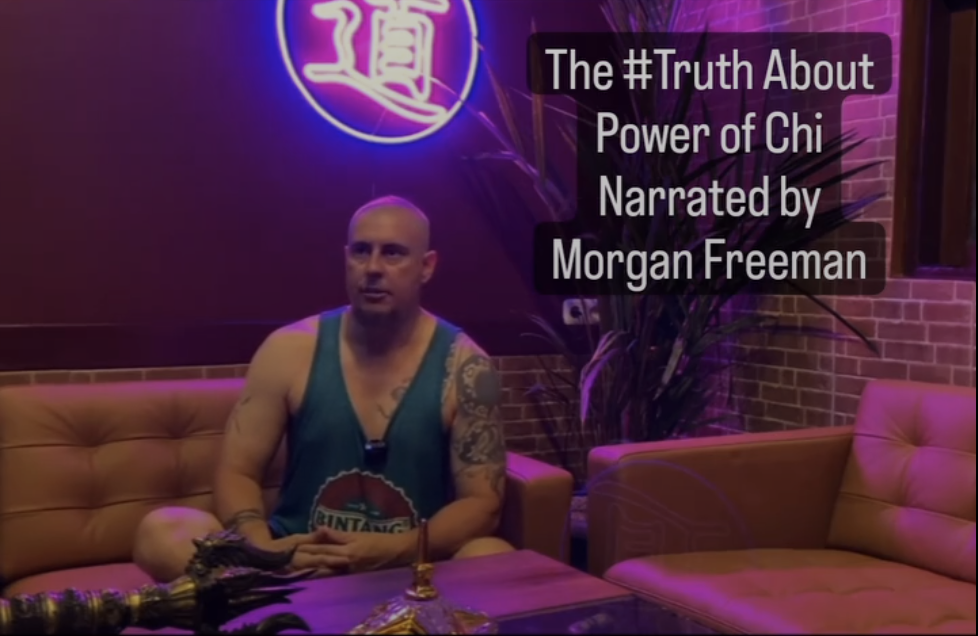
A new YouTube video landed a day or so ago that has caused something of a sensation. It’s a trailer for a movie called The Power of Chi and has some well known UFC fighters and professional athletes in it, all experiencing the power of a Tai Chi master’s “chi”. And there’s a voice over by Morgan Freeman. I kid you not! Yes, the Morgan Freeman!
From the trailer, this mysterious chi is presented as a force that can be produced by the master and defies all explanation. To be honest, this tai chi master has been producing very similar YouTube videos for years now, but he’s usually demonstrating on no-name seminar attendees, this time however it’s a big budget production with well known fighters like Fabricio Werdum and Lyoto Machida being demonstrated on.
You can see the trailer here:
Now I haven’t seen the full film, and frankly, I’m not going to pay to download it, but colour me unimpressed with that. It all seems a bit silly to me.
Friend of the Notebook, Rob Poyton (who I recorded a podcast with recently) has produced his own video response to the trailer and I think it’s hard to argue with his conclusions, but feel free to make your own mind up:
I like Rob’s point at the end, that if you’re going to demonstrate things like this, then what are the functional uses of it? That’s what you should be demonstrating.
I’m writing this as a kind of follow up to my previous article on 3 views of qi in Tai Chi. That article contained the 3 different things I think people really meant when they talk about qi in Tai Chi. This article aims to do the same thing with yi. I don’t consider myself an authority on either matter, but I have had some skin in the Tai Chi game for a while now, and I’ve read enough of other people’s writings to come to some conclusions about what I think they’re talking about. Hopefully you’ll find these definitions helpful, and I’d be interested to hear your thoughts in the comments section.
Yi gets a few mentions in the Tai Chi Classics, and is usually translated into English as “intent”, or “mind-intent”, a translation which I think can be problematic because there are at least 3 different things that people mean when they say “intent” in Tai Chi, and while the three are obviously related, they’re also quite distinct from each other.
Before we get into the definitions, let’s have a look at what the Tai Chi Classics have to say about yi:
The most quoted line regarding Yi is in the Tai Chi Classic: “All movements are motivated by yi, not external form”, which can also be translated as “use the mind, not force”. In no.6 of Yang Cheng-Fu’s 10 important points he says:
“6.) Use the mind instead of force. The T’ai Chi Ch’uan Classics say, “all of this means use I [mind-intent] and not li.” In practicing T’ai Chi Ch’uan the whole body relaxes. Don’t let one ounce of force remain in the blood vessels, bones, and ligaments to tie yourself up. Then you can be agile and able to change. You will be able to turn freely and easily. Doubting this, how can you increase your power?”
So, here the emphasis is on relaxing and not using “force”, but why? And What does that mean? I will explain later.
Interestingly, right after that line, the Tai Chi Classic then goes on to say:
“If there is up, there is down; when advancing, have regard for withdrawing; when striking left, pay attention to the right.
If the yi wants to move upward, it must simultaneously have intent downward. “
Definition 1: Martial intent
Given the lines quoted in the Tai Chi classics above I find it strange that the most common interpretation of yi in Tai Chi is as a kind of martial intent. Here intent is “your intent to do something”, and in Tai Chi people generally mean a martial intention that needs to be contained within every particular posture or movement. So, for example, when you do the ward off movement, you need to have the intention of deflecting a blow away. If you movement lacks that intention, it is said to be empty.
Now this may all be true, and not knowing the martial applications of a movement inevitably leads to it becoming too abstract and unfocused, but this understanding of ‘intent’ is clearly not what is being talked about in the Tai Chi Classics when it admonishes us to “use the mind, not force”. If all it meant was to have a martial intention behind the movements, then it’s impossible to see how that can match up with lines from the classics like:
“If the yi wants to move upward, it must simultaneously have intent downward.”
What has that got to do with martial intent?
Clearly this is talking about something else. Yes, a martial spirit is obviously important for Tai Chi, and some Chinese teachers refer to an “eye spirit” which his making sure you are focused and looking in the right place in form performance, and you look like your actions are martially proficient, but I don’t really think this is what is specifically meant by yi in the Tai Chi classics.
Definition 2: A line of intent from the ground up
The second way that people refer to intent in Tai Chi is as a line of force, usually from the ground to the point of contact with the opponent. The idea in Tai Chi is to bring the solidity of the ground to your point of contact with the opponent. How do you do this? Well, firstly by relaxing, so that your body can function as a whole, connected, unit, and then by feeling a line of connection from the point where you contact your opponent (in push hands that would be your palm or wrist) directly to your foot (the part of you that is closest to the ground). By imagining the force of your opponent going straight down to the ground in a straight line from your palm to your foot then you can make use of jin – which is a force obtained from bringing the solidity of the ground to the point of contact with your opponent. This jin force stands in contrast to the normal force of the body produced by exerting your muscles, which the Chinese call li. Of course, muscles are involved in generating jin (otherwise you’d collapse not he ground), but they kept as neutral and relaxed as possible, so that excess force is avoided.
If you send force from the ground to your point of contact with your opponent, using jin, you can bounce them back off you.
Of course, you cannot be thinking of the ground if you want to project somebody away from you. Your work in creating the path to the ground is already done – in the bow analogy this is the drawing of the bow. All that remains now is to fix a direction and release the arrow:
As it says in the classics:
“Release the chin like releasing the arrow.
To fajin [discharge energy], sink, relax completely, and aim in one direction!”
This use of Jin fits in better with the lines in the classic that say
“If the yi wants to move upward (i.e. bounce your opponent back) it must simultaneously have intent downward. (i.e. you imagine a line of force to the ground).
(N.B. this straight line of force obviously goes through empty space, so it’s not the actual line any force from the ground will take, but it’s a case of your mind having the overall goal in mind, and your body filling in the details on a kind of subconscious level.)
Definition 3: A part of the mind
This definition is about yi being a part of your mind and the hardest to put into words. Obviously, definitions 1 and 2 also involve using the mind, so you can see how all 3 definitions are kind of wrapped up in each other.
In everyday life when you want to do something, like say pick up a pen or bring a cup of tea to your lips, the idea to do it appears in your head before the physical action takes place.
In internal arts the 6 harmonies get a lot of press. Of these 3 relate to the physical body, and 3 relate to the internal make up of the person. In the West we tend to have one word “mind” to relate to all the different and distinct parts that the Chinese have words for, like xin, shen and yi, but the three internal harmonies (san nei he) are:
1) The heart (Xin) harmonises with the intention (yi).
2) The intention (yi) harmonises with the chi.
3) The chi harmonises with the movement (li).
The heart mind (Xin) is related to our desire to do something, the yi (intent-mind) is the part of our mind that makes things happen on a subconscious level. When you pick up the cup to bring it to your lips you don’t think “hand move to cup, fingers wrap around handle”, etc.. It just happens because your intent-mind is taking over, based on what you desired to happen. The intent-mind is therefore a kind of subconscious process.
Now, going along with the idea that there are these different parts of our mind that exist as separate entities comes the idea that we can train these separate entities in isolation to gain a deeper ability with them. So, for example, by repeated practice of a Tai Chi form (or Zhan Zhuang standing practice), in which we are trying to access the subconscious intent-mind, rather than brute force, to perform action we might, in fact, get better at it and develop some ability that ‘normal’ people who lack this cultivation don’t have. It’s an interesting idea!
A good starting point for developing this intent-mind is Zhan Zhuang standing practice. One common practice is to stand in the ‘hugging a tree’ posture and try and get the mental sense that your hands are expanding outwards, yet without physically moving them. You are cultivating your intent-mind when you do this. This is starting with just one direction, but in standing practice people often talk about training 6 directions at once.
When performing a Tai Chi form it’s obvious that you are dealing with moving energy (in a physical sense) in different directions. If you can utilise your mind to “think” in these directions then you can start to train your yi, and it can start to feel like your movements are generated by yi and not by physical force.
Conclusions
It’s not easy to talk about what is meant by yi in Tai Chi, but hopefully I’ve provided you with some good starting points and ideas. I’ll repeat again my assertion that the three definitions I’ve given are all important parts of the practice that makes up Tai Chi Chuan and all inter-related. And while yi may be tricky to describe, it is of utmost importance to all the internal arts. There is a line from the Xing Yi classics that goes:
“There is nothing but structures and nothing by qi”
On hearing this line I remember my Tai Chi teacher saying “Oh, that’s good, I like that, but I’d change it to:
There is nothing but structures and nothing by yi”.
Structure and intent. When it comes right down to it, that’s all the internal arts are made up of. That’s how important yi is.
When it comes to “qi” it seems that every teacher has a slightly different view about what it is. After meeting many martial arts teachers, over the years (and ignoring the clearly delusional amongst them) I’ve paired these various views down to three models that I feel can act as a guide for helping the practitioner sort out what your teacher means when he or she says “qi”, and therefore, what you mean. I don’t think the three are exclusive at all – following one does not negate the others – and all three can be applied at once.
Many people would rather we kept qi out of Tai Chi Chuan teaching altogether, and I respect that view, however the Tai Chi Classics refer to qi quite often, so I think we’re stuck with it. And if you can’t beat ‘em, join ‘em.
Of course, qi relates to things well outside of the realm of martial arts too, so I think that it’s important to say that what follows is from a martial arts perspective. I’m looking at qi with a view to how it relates to the human body in things like Xing Yi and Tai Chi Chuan. If I was thinking about how qi related to, say the universe, or the landscape, I’d be looking in different places. Although, it has to be said that in Chinese thought the microcosm often mirrors the macrocosm.
Biological qi
The first view we’ll call the biological model. This is the view that what the Chinese call qi is simply the energy the body creates in the cells using the ATP cycle. We’re not talking about a controversial “bio energy” here, just the normal way energy is created in the cells of the body.
Adenosine triphosphate (ATP) is the energy-carrying molecule found in the cells of all living things and the universal energy carrier in the living cell. The German chemist Karl Lohmann discovered ATP in 1929.
ATP contains three phosphates and when it is converted to Adenosine Diphosphate (ADP) a phosphate is removed and energy is released that cells can use for processes like movement, synthesis and active transport.
While the chemical process of the ATP cycle is hard to explain, the impact on things like Tai Chi and martial arts is quite simple and uncomplicated – qi is nothing mysterious here, and all movement therefore requires qi. In this model, qi is related to breath because oxygen is required for the ATP cycle, which ties into the Chinese view of qi being related to breath quite nicely. The lungs therefore take over a prominent role in qi production, since oxygen is required for the ATP cycle to work.
Teachers that have this view of qi tend to focus more on the middle dantien in the body, as the the focus of movement, since qi production is higher in the body, towards the lungs, compared to the lower dantien. Stances tend to be higher and not as wide. Mobility is stressed over stability. Arts like Xing Yi and Yi Quan are good examples of these sorts of martial arts.
Qi as strength in a conditioned body
The second view of qi fits in more with Chinese concepts of acupuncture. This view sees the body as containing a number of muscle-tendon channels that run from finger tips to toes. On the soft yin parts on the front of the body we find the yin channels, and on the harder yang parts of the body, the yang channels. These qi channels are the channels along which strength can ‘flow’. By strength we’re not talking about the normal isolated limb movements, but the type of springy whole-body strength exhibited by animals and some marital artists. You can view movement in animals (and humans following this model) as a series of opening and closing movements using these channels. When we contract inwards, for example, we pull along the yin channels and when we open the body outwards we are pulling along the yang channels.
Think of the movements of a Cheetah running – as the legs stretch out the yin part on the front of the body is ‘opened’ and the back ‘closed’. As the legs retract inwards, the front closes and the back expands and opens. The process repeats in a cycle. This movement from yin to yang and back again is the Tai Chi cycle in action.
These channels are not real anatomical structures in the body, but constructed as distinct pathways containing various muscles, tendon, ligaments and fascia groups. (The acupuncture meridians that most people are familiar with are a similar idea, but came later and are obviously based on this idea of muscle-tendon channels in the body.)
In a normal human being these channels are not particularly strong or well developed, and work is required to strengthen them – to give you a “strong qi” – which is what neigong and chigong is for. Qigong practice is therefore designed to condition these muscle-tendon channels – notice a lot of Qigong practice is to do with stretching along these muscle-tendon channels, using the breathing to assist (e.g. the baduanjin set of exercise). Over time this stretching and breathing can strengthen the channels so that they become a tangible, physical presence in the body. Once they are strong enough to physically manipulate the body with, various martial arts feats can be performed using them, like explosive punching (Fa Jin) or strong twisting and coiling movements.
You most often find this qi model used in arts like Chen Taijiquan, which is known for its twisting and coiling locking and throwing methods (chin na) and its explosive, whole body strikes called Fa Jin. Silk reeling exercises, which are part of Chen style Tai Chi, are excellent for developing this kind of conditioned strength.
Qi as a non-physical body
The final, more esoteric, view of Qi is as a non-physical body. Chinese medicine has the concept of the Sanbao – the three bodies. The physical body – Jing (related to our ability to replicate ourselves by reproduction), the energy or Qi body and Shen the mental or spiritual body. All three bodies are thought to inhabit us at once.
The physical body is the most apparent being the one we use most obviously, but through practices such as Zhang Zhuang Qi Gong, where you stand and hold postures over time, we can gradually become more aware of the more subtle energy body. The Qi body becomes apparent through sensation observed over time. The act of being aware of the qi body, usually in standing Qigong postures, (although seated or lying meditation practice also exists), strengthens your connection to it and your appreciation of it. The same is, presumably, also true of the Shen body, but that is not something I’ve ever experienced myself.
These more esoteric practices tend to be associated with spiritual groups (Taoist internal alchemy traditions), secret societies (exploited in the Boxer Rebellion) and martial arts groups that tend more towards stillness in their practice – like Yang style Taijiquan, or ones that practice seemingly impossible feats of conditioning, like iron palm and iron body practices.
While this view of qi is the one that’s hardest to ‘prove’, it’s also one of the most accessible. Practicing with stillness over a period of time can be done by anybody anywhere and usually produces some tangible results – heat in the hands, etc. But I think this is also the qi model it’s easiest to become deluded with. After all, if your only feedback is judging the things you experience yourself it’s easy to lose your objectivity. This is of course why having a good teacher is important.
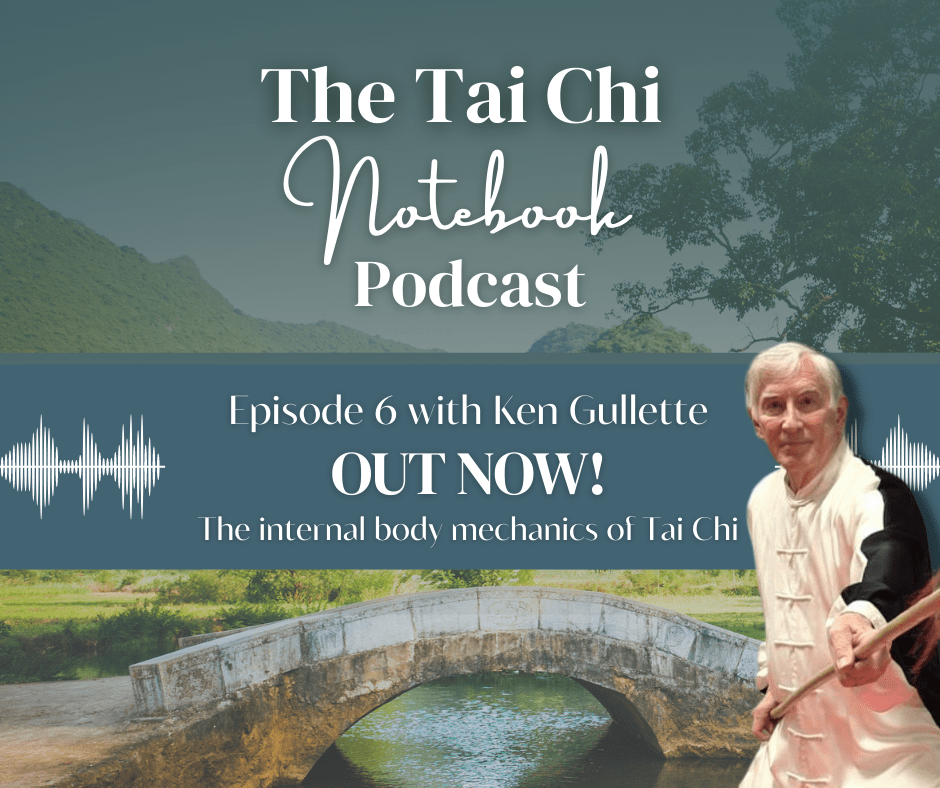
In this episode Tai Chi Notebook podcast my guest is Ken Gullette, a native of Illinois, USA, where he trains in all three of the main internal arts – Tai Chi, Bagua and Xing Yi. Ken also runs a website called internalfightingarts.com where he trains students from around the world in the three internal arts using a combination of recorded and live classes.
Ken is quite famous for his focus on body mechanics, internal power and getting to the root of these arts in a non-mystical and no-nonsense way. In fact, he’s written an excellent book that’s available on Amazon – it’s called ‘Internal body mechanics for Tai Chi, Bagua and Xing Yi’, and I’d recommend you get a copy.
In this episode we discuss the internal body mechanics of Tai Chi, training with disciples in the Chen family linage and there’s also a few stories of the times Ken has had to use his arts in real situations.




 The Tai Chi Notebook