Episode 41: Teaching Tai Chi as a Martial Art with Nick Walser and Ian Kendall

My new podcast is out.

In this episode I talk to two Wudang Tai Chi teachers from Brighton, UK: Nick Walser and Ian Kendall. Both students of the late Dan Docherty, they have continued to practice the tai chi that Dan taught them and developed a new training system called 5 Snake.

5 Snake is a unique and powerful method for finding flow, resilience, and calm through partnered close- quarter practice, and they’re here to tell you all about it.

Find out more at 5 Snake and on Instagram, YouTube and Facebook.

How to get a better tai chi push by pushing a wall

The power of relaxation

Mike Sigman’s post on qi has made me want to think more about jin and qi again. I realise I haven’t been posting about it very much recently – partly because I’ve been distracted by writing a book about BJJ – but now the book is finished it’s time I came back to the subject. I read another post Mike made recently on his 6H group about pushing against a wall, which I think is a brilliant idea, because it’s so simple.

In a way this post is just me writing it out in my own words as an exercise, so I can understand it, and contextualise it a little more in terms of my tai chi practice.

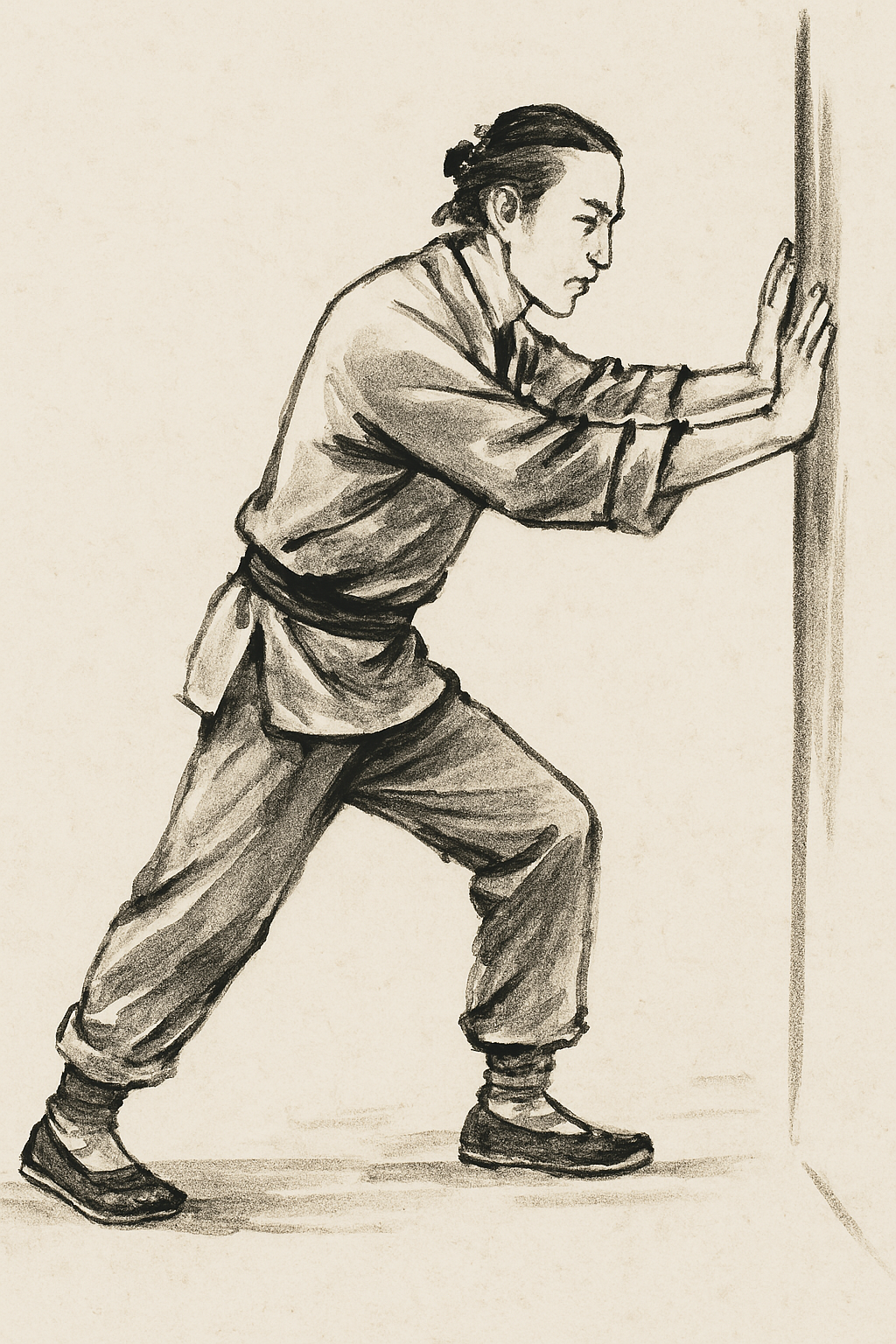
Pushing is a big deal in tai chi because it features so prominent in the form – one of the four ‘energies’ of tai chi is called push in English, which (as I discussed with Ethan Murchie in my last podcast) is confusing since the translation of “an” into English is more accurately to “press down”, which isn’t what the push posture in tai chi looks like, or how you’d push a wall.

An AI-generated tai chi ‘push’ against a wall


Pushing is also part of tai chi’s two person exercise, tui shou – “push hands”. So most tai chi people are pretty familiar with the concept of pushing.

Now imagine you are pushing against a wall and somebody asked you to push harder. Most people would simply push harder with their arms and lean harder into the wall. What you’ll feel when you do this (try it) is that it pushes your upper body backwards and away from the wall quite a bit because it’s impossible to push hard with your arms without introducing excess tension into the system.

This is the “you’re using your shoulder too much!” criticism that a lot of tai chi teachers sling at their students, without really explaining how not to push using the shoulder.

So, let’s look at exactly how you could push harder without using the shoulder.

The only another way to increase the power of your push is to increase the downwards power through your legs. Now, it’s pretty hard to push downwards with your legs, since we have nothing above us to push off from if we want to push downwards. Instead, all we have in a downwards direction is gravity, so how do we use that gravity power? The answer is to relax and sink down into your legs harder.

Put your hands on a wall and try it.

As you sink and relax more through the legs you should feel the power in your arms increasing.

What you’ll notice is that you have to internally align your body correctly for this power to reach your hands. The good news is that you don’t need to think very hard to do this, you can just feel how you need to arrange yourself and your subconscious will do the rest. But you need to properly relax. If you tense up parts of your body – your shoulder being the main culprit – the power won’t slow smoothly and uninterruptedly through the body to reach its destination.

At this point you should start to realize why the word relax (or “sung” in Chinese) is said so often in tai chi practice.

That path from floor to hands is what you’d call a ground path, or a jin path. And the force you are channeling into your hands is known as jin in Chinese. The usual English translation of jin that you see used is “refined strength”.

Again, don’t get hung up with where the path goes through the body, just where you want the force to go.

You should also notice that as the jin force in your arms increases, you don’t get knocked or pushed backwards as easily as you did when you were using brute strength, because there is less tension in your upper body.

Obviously you are not going to push a wall over! But you can now feel the forces in your body that we should be dealing with when doing the tai chi form, and hopefully when you do “push” in the form, your push will now be a little bit different, more refined, a little less clumsy and a lot more tai chi-like.

“I tried Tai Chi and it’s not what I expected”

This is a nicely made video about Tai Chi Push Hands:

Some quick observations:

1) I quite like the emphasis on feeling where the opponent is during push hands instruction – I think this is bang on.

2) “Sensei Seth” correctly identifies very quickly that push hands competitions are very, very, similar to Sumo. And if you’re good at Sumo then you should be good at this, and indeed, he is.

3) There are some fascinating insight into the teaching process here. Seth seems to do a few things that are “wrong” according to the laws of Tai Chi, but are working (i.e. sticking his butt out and leaning forward), however, he gets corrected by the instructor to stop doing it. I just find that interesting. The “Stop cheating, it makes you win!” mentality is rife all over the Tai Chi world. It’s one of the reasons I avoid push hands with people unless the conditions are right (i.e they are the right sort of person). I much prefer the “Hey, if it works, then it works! It’s up to you to figure out what I’m doing and stop me” mentality of BJJ.

4) In the end, with competitive push hands, the better wrestler always wins the exchange (for example, when they are doing the ‘foot outside the square’ push hands). So, if you want to be good at competitive push hands then why not just learn some wrestling? You can even keep things Chinese by learning Shuai Jiao.

5) I like this coach – he’s clearly skilled, but competitive push hands is the problem here. Even this coach gets super tense when under pressure because of the need to win. I just think that Push Hands is better used as a training exercise for learning TCC skills – when it gets competitive, all the principles go out the window (unless you are very, very, very very good).

The number 1 mistake people make in Tai Chi push hands and how to fix it

I got to meet up with a local Tai Chi instructor recently, and it was a good chance for me to do some hands-on work in push hands. One of the things working with somebody else at Tai Chi, as opposed to the endless solo practice that mainly makes up the art, brings up is the question of range.

Range is an interesting one in Tai Chi. You actually need to be in really close for Tai Chi to work. I think this is one of the things that has been forgotten along with the martial aspects of the art. I very rarely find another Tai Chi person who is comfortable working at the correct range.

How to fix your range

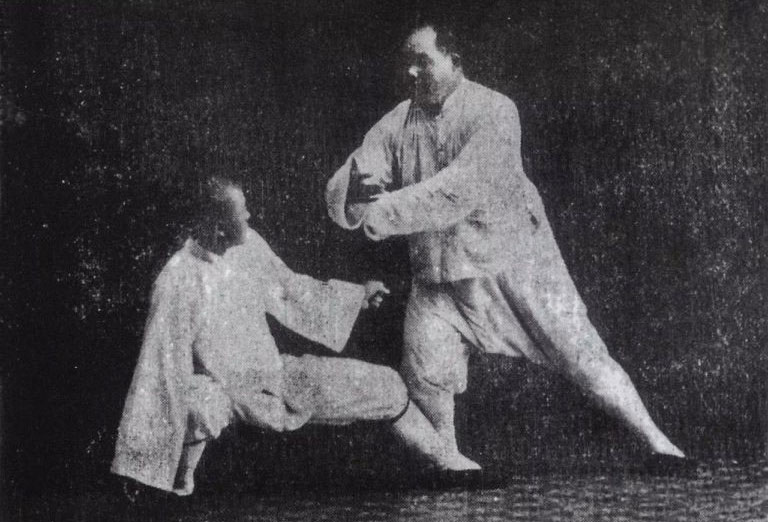
To get the correct range your front foot should be one fists-width apart from your opponents foot on the horizontal axis and your front toes should be roughly matching the back of heel. His front toes are then roughly matching your heel. (Look at the foot position in the photo).

This distance feels uncomfortably close to do any sort of combat actions to most people, however, this is where Tai Chi lives. At this range you will need to use subtle movements of the kua and rotation of the body to neutralise your opponent’s force, and it takes some practice. You also need to make use of Ting – or “listening” because you are definitely within punching range here, but from here you can go even closer (body to body) and turn it into wrestling if so desired, which will protect you from punches.

At the correct distance the Tai Chi techniques will work. When you are further out, they won’t work so well at all. So, this is where you should be when practicing push hands.

When it comes to actually fighting, I’m not suggesting you should “hand around” in this range, because that will just get you clipped. However, you do need to move into this range to do all the good stuff that the Tai Chi Classics talk about – controlling your opponent, knowing him before he knows you, etc. I think a lot of the time that Tai Chi fighting is described as “bad kick boxing” it’s because of the range being used. People stay too far out and pot shots at each other. Kick boxing is perfect for this range.

More of my writing on push hands:

Thoughts on Tai Chi Push Hands

Photo by mana5280 on Unsplash

Range

People tend to do push hands at the wrong range. I think the combat benefits of training push hands disappear almost entirely when you are too far out.

I notice when I train it with people they keep wanting to edge back. You need to be a range that feels uncomfortably close, until it feels comfortable.

If you look at MMA (sorry to use that as an example, if it rubs you the wrong way, but it provides brilliant examples and feedback of the dynamics of two people in a violent encounter) one of the big, high-percentage, often fight-ending, techniques is the counter left (or right) hook; the check hook. This happens after the fighter throws a jab – you move back (or slip) and throw your hook over the top – that’s the range push hands is working in, and a good practical example of what skill at that range can do.

If you watch this video of Cheng Man Ching pushing hands you can see he tries to stay in close all the time – in fact, when he’s launching people he kind of ‘cheats’ and takes an extra half step in so he’s right inside their base, which enables him to show off a bit more on the distance he can push them – this is only possible because they are keeping their ‘front door’ open with a wide stance. The way I was taught is that your toes match the opponent’s heels, fist width apart to allow for ‘shin biting’. (Lots of people do this distance correctly, but go shoulder width apart – leaving the groin too open and letting people step in to launch them. It’s just a bad habit to get into).

Don’t mistake push hands for sparring

Chinese martial art people in general I think spend too long in these double or single ‘arm contacted’ type positions – in more martial sparring sessions these moments happen in split seconds. People don’t stay here. If you end up putting your arms out looking for that position you get punched on the nose. I think doing too much of it breeds bad habits. You’re doing that ‘safe’ training to learn skills that are hard to acquire, which then get used in freer environments, rather than try to mimic the ‘safe’ environment in freer training.

Staying in this range all the time with another person doing ‘soft’ stuff like push hands seems to lead to teachers who start showing off and generating cult-like guru behaviour. It’s a trap you can fall into if you’re not careful. If your students start treating you like a holy saint, then that’s a red flag!

I’m really not a fan of the kind of following that builds around some of the big names in Tai Chi, like this guy, Adam Mizner. He plays the guru card well, and I’ve seen lots of videos where his students really overreact to him in a way that makes me think they all fell down a rabbit hole years ago. However, the guy clearly has some good skills at push hands, as you can see in this video. This video I think is one of the least worst of his I’ve seen (in terms of over reaction from his students) – yet the group still all stop what they are doing to ‘watch the master’ and play his guru game:

Fighting

It’s always worth repeating, even though its kind of obvious, – you don’t need push hands to fight. Combat sports turn out accomplished fighters quickly without these methods.

You can practice all the applications in a Tai Chi form in push hands – it’s one step up from doing them as stand alone techniques because it requires more timing, flow and ‘listening’, but this is still not ‘fighting’.

Jin

One of the reasons for push hands is to learn to use Jin not Li. For a short answer of what that means, I mean using the ground strength in your movement (jin), not local strength (li). It’s easy to fool yourself that you’re ‘doing it’ when you perform a Tai Chi form, because there’s nobody else there. Can you ‘do it’ when somebody is providing some light resistance? Or trying to ‘do it’ back to you? Push hands enables you to find out. I wish people would view push hands more as a tool for learning that, not as a competitive sport of limited wrestling. It’s like people have been given a knife, but they insist on using it like a spoon.

And the use of Jin in directions also requires a strategy to use them, which can also be practiced in the laboratory of push hands. Listen, stick, yield, neautralise and attack.

In push hands you ‘listen’ to the push from the opponent (with your body), you stick to their limbs (so you can feel and listen) then you yield to their pressure, which leads to neutralising their attack, so that you can attack yourself.

In sparring you use the same idea, but you cannot rely on being stuck to their arm. However, you need to keep the same process going that you’ve learned in push hands, just sometimes there will be no contact – you can still neautralise, and yield, through subtle changes in body posture and position, thanks to your use of sensitivity. Once you take ‘push hands’ into a more real sparring environment, I think you’re in the same territory where Xing Yi spends most of its time training. In Xing Yi it’s just the same idea, even if it looks different – you do not attack blindly at the opponent – that won’t lead to success against somebody good, bigger or stronger. In Xing Yi we have this phrase “don’t attack when you see an opening, attack when you see the heng” – I would interpret that as you only attack once the opponent’s attack has been neautralised (heng being the point of neautralisation); depending on your level of timing, this can be before the attack has even been launched. Good opponents will leave fake ‘openings’ for you to attack. Therefore you don’t attack based on what your eyes alone see – you attack based on feeling for that moment of neautralisation. Different training methods – same results.


Park life

Friend of the Notebook, Byron Jacobs, who lives in Beijing, recently posted a video giving a glimpse into the martial arts culture found in Beijing parks. You can see people doing all sorts of martial practices, like calisthenics, chi kung, Tai Chi, sword and push hands.

Byron comments:

“Beijing’s public spaces and parks have been gathering places for people from all walks of life for generations. This includes martial artists, who would meet regularly at such places to practice as part of their general lifestyle. Throughout the many parks of the capital, you can find practitioners of various styles and standards getting together to train regularly. This is a glimpse of some of these special places. The first episode features the Temple of Heaven.”

The future of push hands

I think push hands is completely flawed as a competitive sport, which is why it ends up as a shoving match, but somebody (Jet Li?) is trying to change the rules to make it work better as an Olympic sport…. So here it is! It’s essentially more like wrestling, which is probably a good thing as it means you can move your foot.

And it’s got takedowns, but I think the question is then always … why not just compete at Shuai Jiao?

The Tai Chi Miasma, or “No, the fight is not over just because you’ve got me off balance.”

pangu2

I had an interesting chat with another Tai Chi teacher this week. Generally, Tai Chi teachers are nice people who have trained hard at something for a number of years and developed a lot of skill in it. They’re often not that into the martial side of the art, (even if they say they are), yet they’ve managed to pick up a lot of what I call “Tai Chi Miasma” along the way.

(If you want to know what a Miasma is, I do a podcast about the subject and how it reverberates through human history. Click the link above. A brief summation of Tai Chi Miasma would be, “a set of unconscious and often faulty assumptions about combat influenced by Tai Chi training”, but I’d also have to include a lot of Chinese miasma about yin and yang, qi and tao that was incorporated into Tai Chi by the influence of the Neo Confucian Zhu Xi amongst the intellectual class.)

For example, I find that there’s a pervasive belief amongst Tai Chi practitioners that the fight is effectively over once they have taken your balance. They’ll say things like, “once I’ve got you off balance I can walk you around the room”.

I’m sorry to break it to you (pun intended) but no, the fight is not over just because you have broken my balance!

It’s not over even if you get me off balance and whack me in the face, unless I’m unconscious or too hurt to continue by your deadly 5 point exploding palm technique.

Yes, I’m sure you’ve seen your master controlling people with the lightest of touches and walking them around the room in a wrist lock or arm control of some kind, but that’s happening in a controlled training environment. In real life, it’s not like that.

Just watch any combat sport with live training against resistance. Say wrestling or judo. The players are in a constant state of flux. They are losing their balance and regaining it over and over. Often they willingly sacrifice their balance for a superior position.

giphy-1

Judo. It’s crazy.

They get thrown, they get taken down, they get pinned, but they fight their way back up and go again. The fight is not over just because one person takes the other’s balance, however skilfully or with the lightest of touches they did it.

“Ah!”, they say, “but once you get them off balance it’s easy to keep them off balance. ”

No, no it’s not.

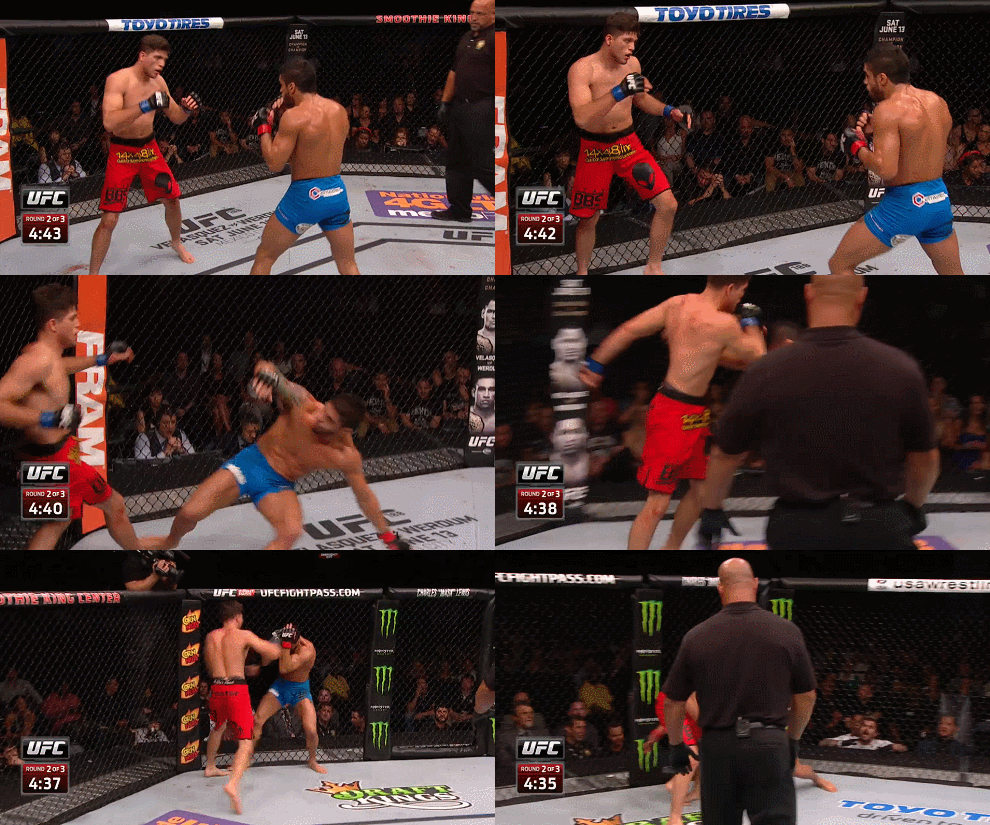
Just look at MMA. MMA is an even better example than pure grappling arts because it involves strikes. Sometimes the strikes are controlled and orderly, but a lot of the time, especially after people get hurt and tired, there are wild punches being thrown looking for a KO, resulting in people falling all over the place, people slipping, kicks missing, etc.
giphy

MMA. It’s painful.

The 80/20 rule.

In grappling sports, people spend a lot of time training what to do after the balance has been taken – or “finishing moves” if you like. That’s where 80% of the training is, because they know it’s not easy and they want to secure the win.

In contrast, Tai Chi partner work seems to be 80% about balance taking and 20% about what to do afterwards… if you’re lucky.

That’s fine if you are aware of that, but not fine if you then start to make grand pronouncements about what would happen in a combat situation because you’ve been told about what should happen next in the method you are teaching, rather than your direct experience.

Yes, I’m making a huge generalisation, and I’m sure it doesn’t apply to YOUR school. [wink emoji for sarcasm] But allow me the exaggeration to make my point.

By the way, I’m sure I have my own martial arts miasma too. We all do, but what I’m saying is that we should be aware of it.

Catch yourself saying these things about what should happen next, or what would happen next, if you can. Let your actions speak, not your words.

There’s nothing wrong with focussing on balance breaking. It’s fun, and skilful, and nobody is getting hurt, but also make it a point to spend significant time sparring with resistance.

It keeps you honest.
 

Stop fighting in push hands

goats-animal-bock-billy-goat-67280.jpeg

Photo by Pixabay on Pexels.com

I don’t really enjoy push hands.  I used to, I used to enjoy it much more when I saw it as a medium for exploring arm locks, takedowns, wrist locks, throws. In short, when I saw it as a way to practice techniques. I used to love it.

In more recent years I’ve reframed my view of what push hands is. Partly this is because I took up BJJ, and found I got more than enough scrapping in my diet to satisfy my craving to try out locks, throws and sweeps. That’s essentially what we do in BJJ, we practice locks, throws and sweeps over and over until we get very good at them and can do them under full resistance.

Inevitably the BJJ player ends up going one of two ways over the years. Either he (or she) gets softer and more flowing. So, when the other person is pushing you should be pulling, and when they’re pulling you should be pushing. By learning to flow with the dynamic movement between two people you learn to blend, yield and overcome. Or they end up getting very good at smashing people. Whatever is in front of them they can just smash through it using precise, accurate bursts of speed and power.

Inevitably all BJJ players tend towards the first approach as they age, if they want to keep training, that is. Or they give up either through injury or changing life circumstances.

But back to push hands. Once I had found a way to get my regular fix of fighty, I found I could step back and view push hands as something else. Perhaps what it was originally intended for.

Now when somebody pushes on my arm I don’t immediately think “how can I lock this arm?”, I am thinking, “where is his force going?”. Is it going to my feet? If not, I try and send it there, turn and yield. When it’s my turn to push back I ask myself where I’m pushing from. Is it the ground? If not, why not? What am I doing that’s stopping that? Where am I tense?

Pushing hands like this might not be as much fun, but I think overall, it’s more satisfying.

Proper push hands lacks the thrills of the fighty approach, but it instils qualities in you that make your fighty better.

That’s a difficult concept to really understand, and even harder to do when the other person just wants to fight. If the other person wants to fight then I sometimes just fight back. Inevitably I slip into BJJ mode and we end up in some armlock on the ground, and it’s fun…

…but it’s probably not what we should be doing.


Brush Knee Twist Step: Tai Chi application and style comparison

yang-chengfu-comparison-brush-knee-e1438221143941

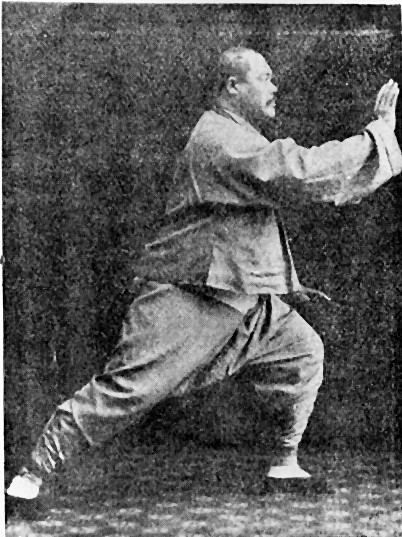
Yang Cheng-Fu Brush Knee Twist Step

Brush Knee Twist Step (called “Walk obliquely with twist step”, which was probably its original name) is a fundamental movement in all Tai Chi styles.

Chen Zheng Lei performing “Walk obliquely with twist step”:

giphy-5

The Yang style Brush Knee looks like a slightly simplified version of this. Here performed by Yang Jun, grandson of Yang Cheng-Fu :

giphy-4


And Sun Style looks like the Yang style, but with added steps. Here performed by Sun Peng who is Sun Lu Tang’s grandson :

giphy-3


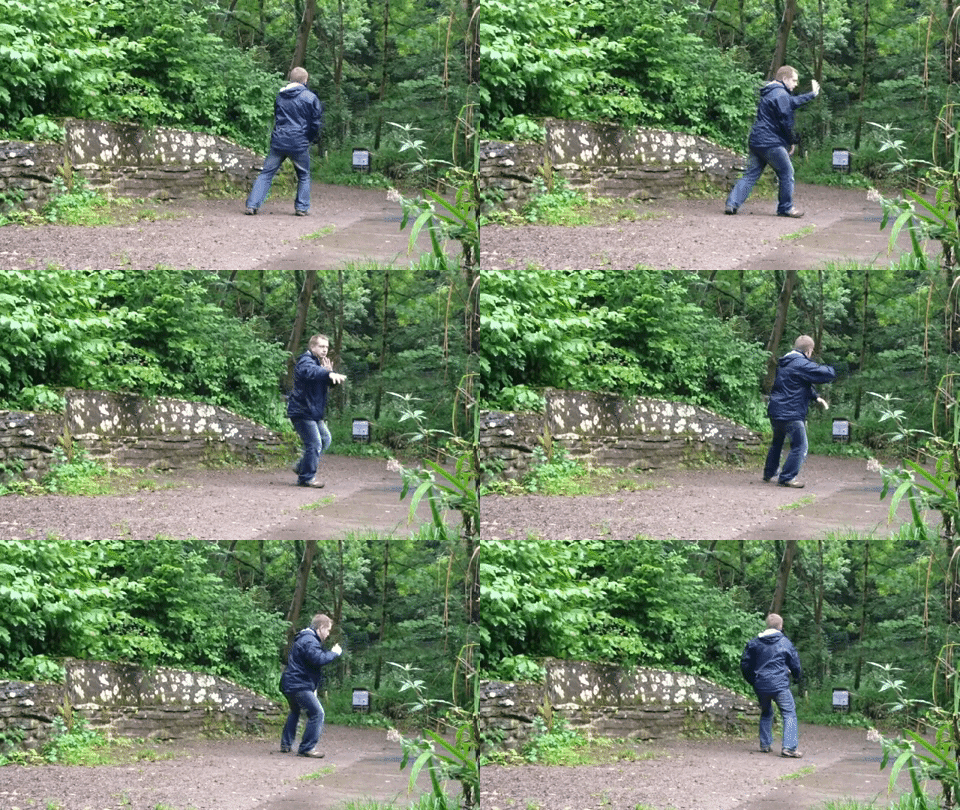
The version I personally do is somewhere between the traditional Sun and Yang styles. It’s got a step, but it’s most like Yang. Here’s a little GIF showing me doing an application of Brush Knee Twist Step in push hands from the Tai Chi style I practice.

giphy-1

Here’s how it looks in my form (a Yang style variant from the Gu Ru Zhang lineage that had input from Sun Lu Tang).

giphy-2

Of course, there are many possible applications of this movement, and I’m just showing one, but hopefully, that gives some indication of the usage.