The debate over leaning vs upright posture may have less to do with force and more to do with identity
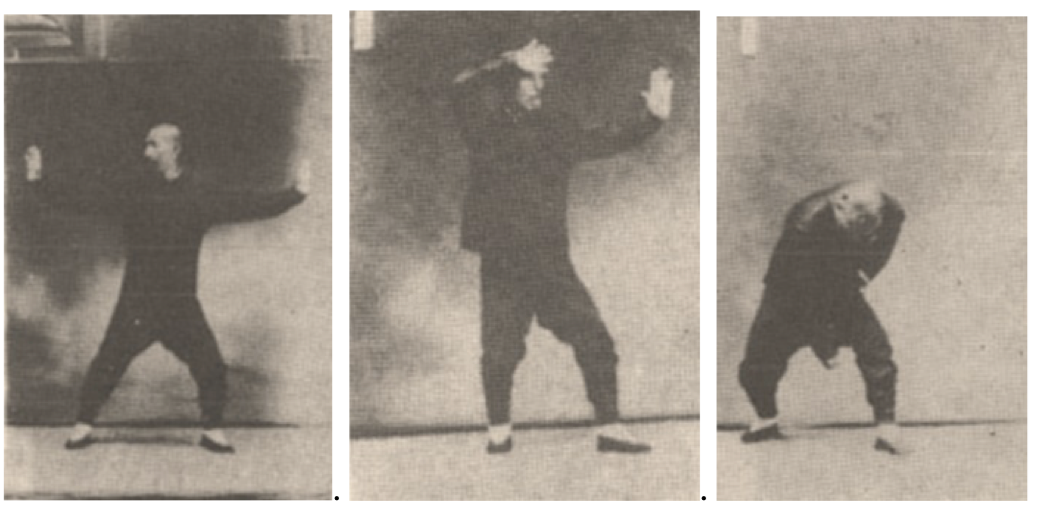
Sun Lu Tang performing tai chi
Does your tai chi style lean forward or stay upright? The debate over which is “correct” has been raging for decades now. Well, maybe “raging” isn’t quite the right word for a group of tai chi practitioners, but at the very least there’s been some polite disagreement.
The usual way of looking at this issue is biomechanical. Which structure delivers force—jin—more efficiently? Which alignment is stronger, more stable, more effective?
But what if we’ve been looking at this the wrong way?
What if the difference isn’t really about efficiency at all, but about who the posture was for?
I’ve just been watching a lecture by Sander L. Gilman called Stand up Straight! Cultural Perspectives on Posture, and it adds an angle to this debate that feels like it’s been missing.
Gilman’s core idea is simple, but powerful: the body isn’t just biological—it’s cultural. The way we stand, move, and hold ourselves isn’t neutral. It’s shaped by what society thinks is healthy, respectable, or even fully human.
Historically, posture has been loaded with meaning. Standing upright has been associated with discipline, control, and refinement. Slouching, or anything that deviates from that ideal, has often been framed as a lack of those qualities.
Crucially, those ideas have often been tied to class.
In one example Gilman highlights, early 20th-century medical writing didn’t just describe posture, it judged it. Working-class bodies and rural populations were sometimes compared unfavorably to “primitive” forms, while upright posture was framed as something closer to a civilized ideal. (source).
Strip that down, and you get a striking idea: “respectability” is something performed through the body. Posture becomes part of that performance.
So what happens if we apply that lens to tai chi?
Most histories trace tai chi back to Chen Village in Henan province, but its spread through Beijing brought it into very different social contexts. Some styles developed in courtly or intellectual circles, others among martial artists, soldiers, and working practitioners. And when you look at the postures, a pattern starts to emerge.
Styles associated with more scholarly or “refined” figures, like Wu (Hao) style or Sun style, developed by the famously intellectual Sun Lutang, tend to emphasise a more upright frame.
By contrast, versions of Yang style and Wu style, shaped by professional martial artists and military figures, often include a noticeable forward lean.
Of course, these systems evolved over time and weren’t defined purely by class. But the contrast is hard to ignore.
Even Cheng Man-Ch’ing, often described as a scholar and artist as much as a martial artist, modified what he learned from Yang Chengfu into a distinctly upright form. His idea of the “five excellences” — calligraphy, painting, poetry, tai chi, and medicine — paints a clear picture of the kind of cultivated identity he was expressing.
Seen through Gilman’s lens, this looks like a cultural divergence, rather than one based on pure technique.
Maybe upright posture isn’t just about alignment. It’s about signaling control, refinement, and education. And maybe the forward-leaning versions reflect a different set of priorities: function, application, and practicality over presentation.
When I’m teaching my Friday class one of the things I quite often say is “don’t look down” – however, like most of the short, pithy statements you hear delivered by Tai Chi teachers… it’s not really true. Rather, it depends on the context of what you’re doing. Let me explain.
Yes, generally speaking, you want to be looking at the horizon when doing Tai Chi because you want to keep your head and neck aligned with your spine. Specifically with the head and neck we are talking about the posture principle of ‘suspending the head’. However, there are times in Tai Chi, where it is perfectly acceptable to look down – particularly on moves where the direction of the application is down towards to the ground.
The reason I say “don’t look down” a lot when teaching is that people learning a Tai Chi form have a general tendency to look down (me included!). Generally as we age our posture seems to become more slumped forward, perhaps because we sit down a lot in modern life, but also because scanning the horizon for signs of danger has long since stopped being an evolutionary priority. We also use computers, phones and devices all the time, and they lead to a general posture of our heads being tilted forward slightly. This can result in people doing the whole Tai Chi form while never looking up from the ground.
Extending the qi
In Tai Chi you want to have a feeling of a slight stretch all over the exterior of the body at all times – that’s really what following the posture principles of Tai Chi gives you – things like flattening the lower back, rounding the shoulders and suspending the head. This is known as ‘extending the qi’ all over the body. When you stand in a Zhan Zhuang posture you can feel this slight stretch all over the surface of the body that the posture generates – it’s subtle, but that’s what you’re looking for.
Suspending the head is part of that extension of the qi over the head, and you can keep that extended feeling even when you glance down. What you definitely don’t want to do is break the alignment of the spine and neck, which is what typically people do when looking at their phone, or their feet:
If you want a good fix for this then I find regular Zhang Zhuang (“post standing” or “standing like a tree”) practice is a good way to remedy this and retrain your head position on a subconscious level. Master Lam has a 10-day course on the subject.
The problem with looking down is that our head is rather heavy (between 2.3 and 5kg), and when you take your neck out of alignment with your spine your body automatically compensates for the extra weight that is pulling it forward (or you’d fall) and it does that by tensing some of its posture control muscles, particularly in the middle of the body, and that can interfere with the relaxation and freedom of movement we are looking for in Tai Chi. You also aren’t creating an optimal path for sending incoming forces to the ground or for sending jin up to the head. You are also not ‘extending qi’ to the head.
If you’re going to look down then you need to do it while keeping that slight stretch up the back of the neck and over the head.
Ward-off and martial applications
‘Ward off’ is another example of a posture where I do look down, although it’s only briefly. I look down because of the martial application I’m thinking of. My active hand in that posture is first the back hand, which I’m using to send my imaginary opponent to the floor. The front hand can then be used as a deflector, so after I’ve dispatched the first opponent to the floor, I then look up and deflect the second attack, which leads into the ‘roll back’ posture.
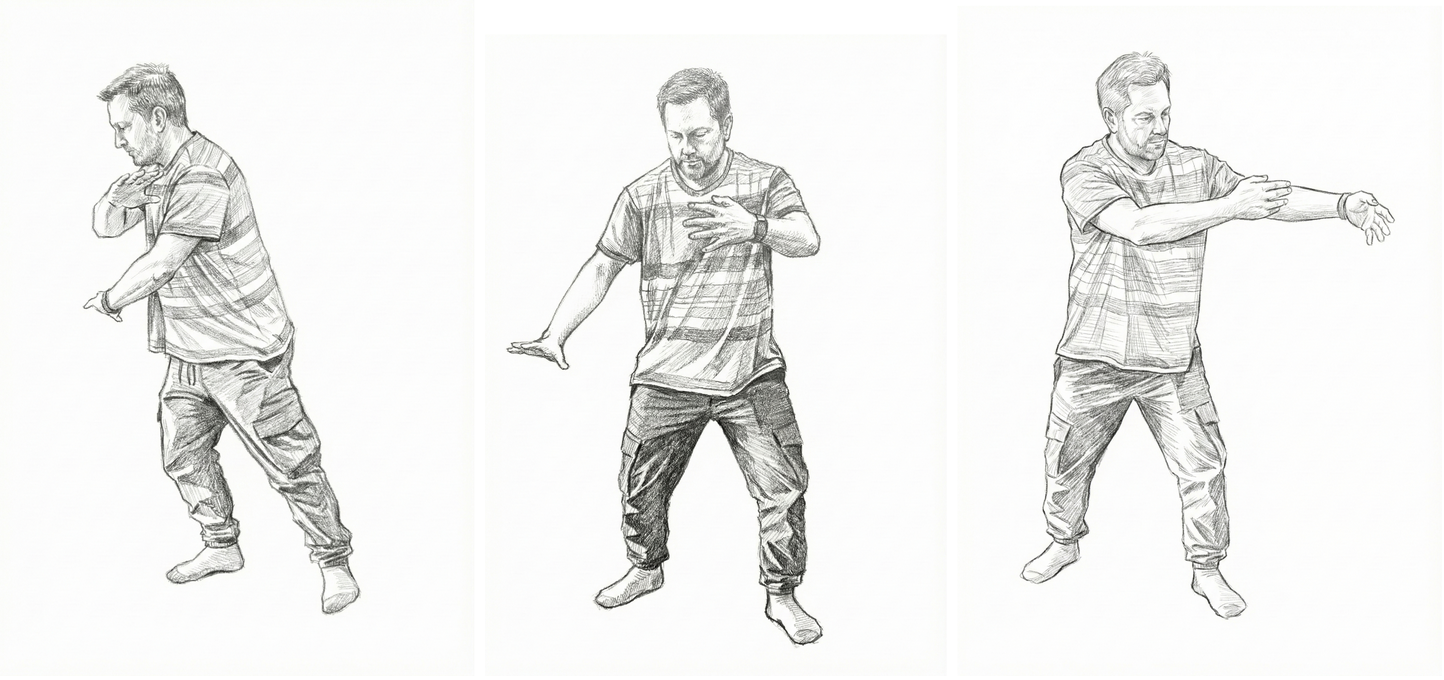
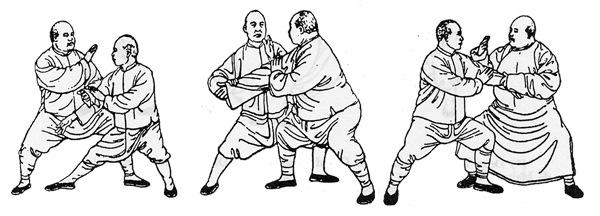
Here is the sequence:
In this sequence, the ‘ward off’ is the middle picture, and my focus is on my right hand pushing down from where it was in the previous picture, then in the next picture I refocus on the left hand deflecting, and getting ready to perform a ‘roll back’.
Here’s a much younger and hoplessly naive version of myself showing the marital application at around 19 seconds in this video:
As you can see, where you are looking in the Tai Chi form is dependent on what application you have in mind when doing the movement. So, while there are some useful maxims to remember in Tai Chi, such as ‘don’t look down’, it’s important that you know when it’s acceptable to bend the rules so that your Tai Chi becomes a living practice, with things done for a reason, not just blindly following the rules.
Paying attention to your inner thighs can bring better structure and a feeling of power to your tai chi form
If you’ve read my last post about keeping the knees bent during tai chi practice, and most importantly can do your whole tai chi form without violating this principle, then the kwa (inner thigh) is a good thing to focus on next.
Quite often in Zhan Zhuang chi kungstanding practice we use the imagery of balloons supporting various parts of the body. You can imagine balloons supporting your arms, under your armpits and that you’re sitting on an imaginary beach ball. Balloons are soft but strong when pressured, so they’re a good image to help with the idea of staying relaxed and that feeling of springy peng (‘bounce’) energy that needs to be in the body during tai chi.
We don’t tend to use the supportive balloons imagery when explaining tai chi because it’s a moving practice, so the imaginary balloons would inevitably float off at some point! But you can still use the imagery in a couple of places – imaging balloons under the armpits and one held between your thighs that is gently pressing the knees outwards is a good place to start.
The kwa needs to be kept open at all times in tai chi practice.
One of the things beginners often fail at in Tai Chi is sufficiently rounding the kwa. By kwa I mean the area of the inner thigh and groin. I’ve been told that this area is more correctly called the dang in Chinese, but kwa/dang/whatever, I mean the arch formed by the inside of the thighs and containing the pelvic floor. As I’ve discussed before, beginners tend to want to straighten their legs, rising everything up in their stance, which has the effect of collapsing this kwa area, so that it effectively closes as the thighs move together.
In tai chi we always want to maintain the feeling that we’re holding a small balloon between the thighs so that this area is always rounded. Of course, there is opening and closing going on in tai chi all the time. As you progress through a move, one side of the kwa is opening and the other is closing, but regardless of any opening and closing movement that is going on, you need to keep a general feeling of openness in the whole area throughout the form. Even in postures where the feet are together. If you stand with your legs together, then that is considered a closed kwa, but in tai chi that area always has the feeling of being open – even when the legs are together.
You might find that last statement confusing, but it’s helpful to remember that in tai chi we are not performing an exact science, but we are dealing with feelings. The feeling of being open is what I’m talking about.
The last thing to mention is the why. Why do you need to do this? That’s where you need a teacher to give a demonstration of the application of tai chi against a simple push. With the kwa rounded you create a good base from which you can receive and launch attacks. When pushed, you can use that base the rounded kwa gives you to receive and then bounce away an attacker. If your kwa collapses when your upper body is pressured then you can’t do this without using a lot of effort and strength in the upper body. In tai chi this is wrong. Using your legs is always a better way.
Thank you for supporting The Tai Chi Notebook. If you are reading this on a website that isn’t thetaichinotebook.com, then it’s highly likely it’s been stolen. Please let me know so I can issue their webhost a DMCA takedown notice for copyright breach. Thanks.And if you have the great idea of starting a tai chi website by stealing other people’s work to fill it with content for clicks then take a good hard look at yourself, and do better.
If you’ve been doing Tai Chi, meditation or yoga for any length of time you’ll have heard the old adage to ‘put your tongue behind the two front teeth‘. The explanation given for this is usually that it “connects the two meridians that go up the back and down the front of the body called the Ren and Du meridians, creating the micro-cosmic orbit”.
Micro cosmic orbit connected… man. Photo by Elina Fairytale on Pexels.com
Personally, I have my doubts about the whole idea of ‘energy’ or Qi ‘flowing’ around the body. I often think it’s really an ancient aberration of the simple idea of forces moving inside the body. In Chinese martial arts there’s a phrase you often hear – rise, drill, overturn, fall, which matches this circuit in the body with a martial technique. The best example of which is Pi Quan from Xing Yi, during which forces in the body (jin) rise up and then come crashing down into a strike.
Strength and balance
However, it’s not just Chinese medicine that recommends this tongue position. I’ve recently discovered that there are a lot of Western sources advocating the same tongue position. For example, Colgate toothpaste has an article about correct tongue position on its website that recommends the exact same thing – the tongue resting on the upper palette behind the two front teeth. The article links to a study in Radiology and Oncology called “Three-dimensional Ultrasound Evaluation of Tongue Posture and Its Impact on Articulation Disorders in Preschool Children with Anterior Open Bite“, which notes that “children with poor tongue posture were reported to have a higher incidence of anterior open bite, a type of malocclusion where the front teeth don’t touch when the mouth is shut. This may be because the tongue puts pressure on the teeth which can shift their position over time.” (Colgate).
In this article from Healthline, Dr. Ron Baise, dentist of 92 Dental in London explains “Your tongue should be touching the roof of your mouth when resting… It should not be touching the bottom of your mouth. The front tip of your tongue should be about half an inch higher than your front teeth.“
While dentists may be aware of the benefits of good tongue position for your teeth and preventing problems with your speech, or mouth breathing from occurring, some exercise enthusiasts are going further and claiming that proper tongue position actually increases your strength and balance, something that is undoubtedly important for martial arts, like Xing Yi.
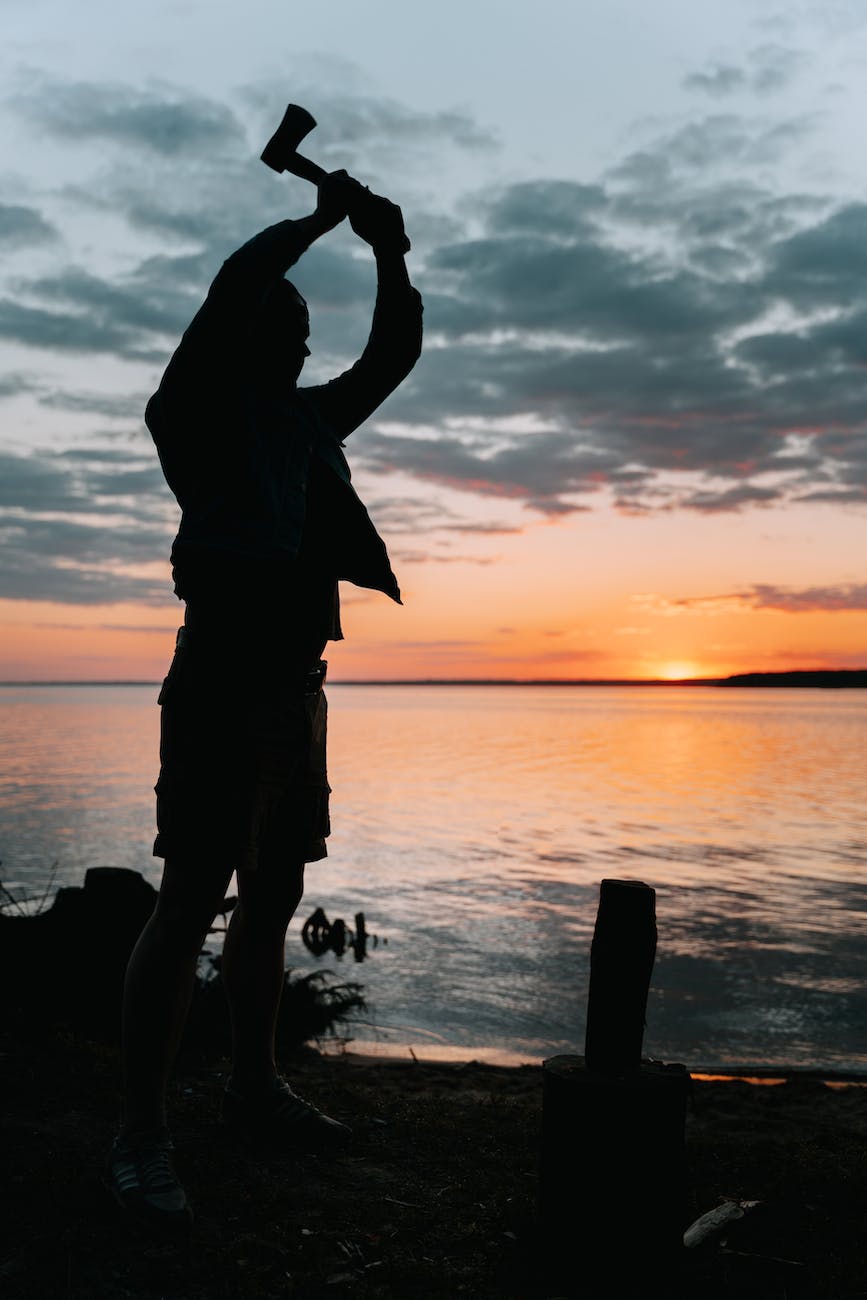
Pi Quan is said to be like the swinging of an axe. (Photo by Ivan Samkov on Pexels.com)
Now, I’m as aware as the next Tai Chi blogger that cherry picking studies that confirm your beliefs (and presumably ignoring everything that doesn’t) is a bit of a red flag. However, the idea that your tongue position effects strength and balance makes more sense to me than imaginary energy channels (Du/Ren) that may, or may not, exist in real life.
Apparently, good tongue placement can give you superpowers!
I remain slightly skeptical about the whole issue, however, my tongue does naturally rest behind my two front teeth on the upper pallet of my mouth… I can feel it there now as I write this. Was it always there? Or have I turned this into my natural position thanks to starting Tai Chi in my 20s?… I don’t know. All I can say is that it feels comfortable, and if my Ren and Du channels are connecting because of it, and my strength and vision is better because of it then…. so much the better.
“Stop doing the wrong thing and the right thing does itself.”
– F. Mathias Alexander.
Breathing has become a hot topic these days. There’s Wimm Hoff with his patented breathing methods for overcoming extreme cold all over TV and YouTube, breathing classes have sprung up in every town where you can go to where you spend an hour focusing on your breath (just type in the town you live in an ‘breathing classes’ into Google and I bet you find something), and of course, there still are all sorts breathing methods you can find out there in yoga, tai chi and qigong classes.
Often in Tai Chi we’re told that we should be performing abdominal breathing, or ‘Taoist breathing‘ – so, as you breathe-in the abdomen should expand and as you breathe out, the abdomen should contract*. We equate this abdominal breathing with deep breathing – almost as if the more we can ‘fill’ our abdomen with air, the deeper and better the breathing will be – and think that it therefore must be healthy. (* there is also reverse breathing, but that’s another topic).
Just breathe! (Photo by Spencer Selover on Pexels.com)
How to breathe
I recently started reading the excellent book ‘How to breathe’ by Richard Bennan, which has made me reconsider the way I’ve been approaching breathing in Tai Chi.
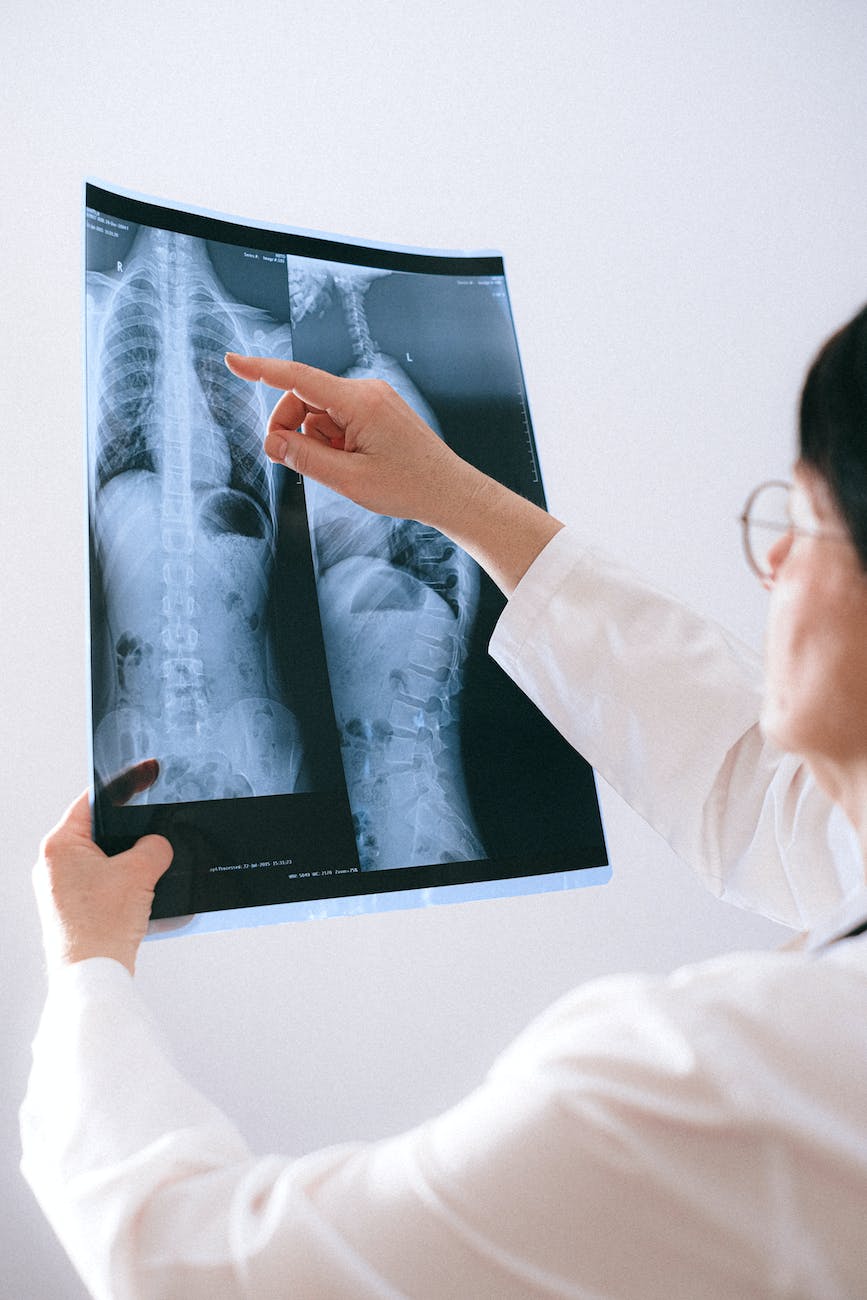
Firstly, let’s start with the basics. It’s worth remembering where your lungs are. They are behind the ribs and reach up higher than the collar bones on each side. Look at the picture below and you’ll be surprised by how far up the lungs go. So, when you expand your belly on an in-breath the air isn’t going down into your belly – it all stays in your upper torso. Of course, that might already be obvious to you, but you’d be surprised how many people think their belly is filling with air when they breathe in! It’s not.
When you practice ‘belly breathing’ what you should be doing is expanding the whole torso on an in-breath, and it’s this expansion of the lungsand the dropping of the diaphragm that pushes the abdomen down and outwards (on all sides, not just the front). If you start to try to use your abdomen muscles to lead the process, or force-ably expand or contract the belly as you breathe in and out then you are just adding tension to the whole process, which is the exact opposite of what you want. There should be as little tension as possible for efficient breathing. Trust the process – it will work on its own.
So, with me now, try an in-breath and focus on the lungs themselves filling up and expanding and this wave of expansion being the motivating force for expanding the belly. It doesn’t really happen in a step by step way either – everything expands at once. So, don’t try to fill one section of the torso, then another, that is also just adding tension. Equally, don’t try and keep the ribs still. They are designed to expand and contract with the lungs. If you try and keep them still, then, you guessed it… You’re just adding more tension.
Once you can visualise where your lungs are, (and how far up they go above the collar bones), then just focus on letting them expand freely, and stop interfering with the breathing process. Less is often more.
You might also like to think about the posture requirements of Tai Chi and what effect these might be having on your breathing. We often hear words like “round the shoulders”, “lift the back” and “hollow the chest” in Tai Chi. Think for a minute about what effect those directions, if followed literally, might be having on your breathing. Do you think they are beneficial or harmful? It’s something to consider anyway.
Breathing should feel amazing. It should feel smooth, natural and healing. And it will, if you stop interfering with it.
* I think reverse breathing is a deliberate hack to the body’s natural way of breathing, but I don’t think people should be attempting it before they’ve got better at breathing in a natural way first. If you are already breathing in an unnatural way, and then you try and add on something else, well, it doesn’t take a genius to realise that you’re headed for long term problems.
Today’s Tai Chi tip is all about how to get better at push hands simply by adjusting your posture.
Push hands should really be an exercise in which we get to test our ability to absorb Jin from an opponent and project it into an opponent as required, to uproot them.
It shouldn’t devolve into a pushing and shoving match to see who can ‘win’. Once it turns into that then I don’t think anybody is learning anything anymore. There are far superior methods of grappling and I think you’d be better off spending your time learning those if your goal is simply to win a grappling exchange.
But before we can focus on using Jin we have to get our body in a position where it conforms to the Tai Chi principles of posture, where we’re not fighting it all the time, and it’s working to our advantage instead.
It is said, “Jin does not flow through tense muscles”
So, we need to get our body into a structural position where we can be as relaxed as possible, without collapsing, yet still maintain our connection to the ground. In Chinese terms you would call this a posture where your “qi is strong”, but you are not tensing muscles more than they need to be.
Of course, this optimum qi structure is one of the first things to go out of the window once we start push hands. In push hands we get to test our Tai Chi under a limited amount of pressure. Faults that lie dormant in the form rise to the surface like bubbles.
Here we’re going to go over a few.
1. Head position and leaning
Head position in the form goes hand in hand with the issue of leaning. Some styles of Tai Chi, like Wu style and Yang Cheng-Fu’s Yang style, opt for a slight angling forward of the torso in forward-weighted bow stances. Other styles like Sun style, Chen style and Cheng Man-Ching style all keep an upright posture as often as they can, even in front-weighted stances. (See pictures below)
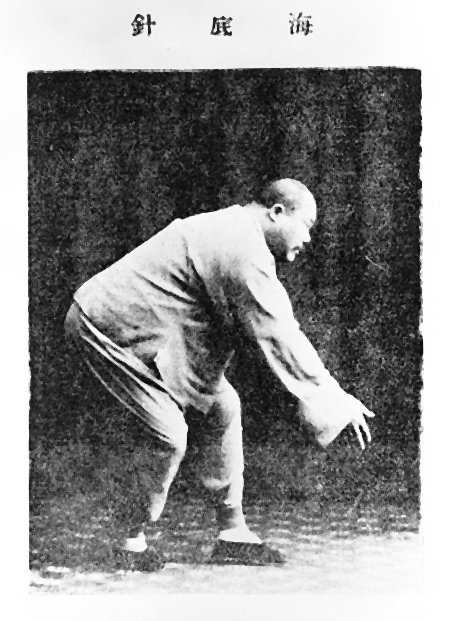
But the thing is, all styles are upright in their back stances (or should be). And even styles that maintain an upright stance, have to lean forward to do throwing techniques that take the person to the ground like Needle at Sea Bottom or Punch to the ground, for example.
Here are some examples of different Tai Chi practitioners:
Chen Xiaowang, upright and stable.
Cheng Man-Ching, very upright.
Sun Lu Tang, no leaning.
A variety of postures from Wu Jian Quan, showing sometimes leaning, sometimes not.
Yang Cheng-Fu showing sometimes a slight leaning, sometimes not.
I think it’s time to get to the point of all this:
It’s not the lean itself that matters.
It’s maintaining an unbroken spinal alignment that is the key issue!
All these practitioners have one thing in common, they are not letting their heads droop, and they are not looking at the floor when they don’t need to.
For example, when even a practitioner who is famous for his upright posture does Needle at Sea Bottom, he or she bends forward, she just doesn’t break the alignment of the spine.
Needle at Sea Bottom
The Tai Chi classics talk a lot of carrying the head as if “suspended from above”. If you let your head droop you break the spinal alignment. You are easy to off-balance in push hands because your posture is broken. But if you hinge properly from the hips then you can still keep this spinal alignment even when you bend forward.
Think of the spine as including the neck (which anatomically, it does of course). If the neck goes offline in relation to the spine then the weight of the head has to be compensated by muscles elsewhere in the body. And this extra tensing of muscles results in a less efficient transfer of Jin from (or too) the ground.
Because we are quite used to this happening while standing or sitting, we don’t really feel our head being off centre so much. Switch to working on the ground, in a yoga posture for example, and you can instantly feel the difference your head position makes.
On a technical level, if you are using Jin you should be able to let the solidity of the ground be apparent at the point of contact with the opponent. If you have to use too much muscle then your pure Jin starts to turn into “Muscle Jin”. Muscle jin, isn’t as adaptable to change as pure jin. You can’t easily change direction, for instance. It also just doesn’t feel as it should. It might help you win a push hands competition, but you’ll find it lacking when it comes to martial technique.
And when it comes to the thorny issue of leaning, I’d recommend trying to stay upright in push hands. As I said before, the leans you tend to see in Tai Chi forms are to do with the application of a technique. Sure, you can lean to apply power according to a technique (just make sure you keep your spine aligned) but for the usual back and forth of push hands I’d recommend trying to keep as upright as possible. You’ll find it gives you more freedom of movement in the horizontal axis.
If you watch this clip of Wang Hai Jun doing some push hands with applications in it, you’ll notice that he’s staying upright during the push hands, but he’ll lean to apply a technique:
2. Shoulder usage
I posted before about learning how to sink in Tai Chi Chuan. One of the benefits of sinking is that you can be powerful yet relaxed at the same time. Again, this is a body requirement for the use of Jin. I don’t really care about relaxing the legs so much (although see point 3 later on) they key thing is making sure that all the tension of the upper body is dissolved down into the lower body.
You want to feel like your upper body is empty, while your lower body is full. “Hands like clouds, legs like mountains”, is a phrase that springs to mind.
The big stumbling block here is always the shoulder. Either we use our shoulder too much, and the movement becomes local and isolated from the rest of the body, or we don’t relax it sufficiently, and it becomes a blockage to the smooth flow of power from the ground that you’re looking for.
One really effective way of bypassing the shoulder in push hands, and relying more on sinking and the power of the ground, is to imagine a tube that runs from your hand, all the way up your arm, and down your back to the foot and the ground. Imagine another tube for the other side of the body. Now, when you want to move your arm, you have to move the whole tube. Start your power at the foot.
Over time, once you get the hang of it, it will become intuitive to start to direct your ‘tube movement’ from the waist area, and ‘moving from the dantien’ starts to become your preferred method of movement.
3. Using the back leg as a brace
Another trap people fall into is using the back leg like a brace, held stiff against the ground. Again, this leads to muscle Jin, not the relaxed release of power we are looking for. If you engage in the push and shove type of push hands you typically see at push hands tournaments then this is a great way to win. Unfortunately, ‘winning’ makes no difference if your goal is to get better at Tai Chi Chuan.
Don’t get me wrong, a little physical scrap like this is good for you now and again, and it’s good fun to push yourself physically! But these days I tend to let BJJ rolling get that all out of my system, so I can focus more on developing push hands skill in the right way when I’m engaged in push hands practice. .
So that’s a bunch of stuff you shouldn’t be doing. But what should you be doing?
I’d put forward the following 3 suggestions. This is just my personal opinion, of course.
1. Posture, posture, posture.
As you push hands keep your focus on your posture. Mentally note when you lean forward, note when you feel unbalanced sideways. Stop looking at the floor. Look at the horizon, through your opponent. Note when your feet aren’t flat on the ground. Where is your breathing? Low down or up in the chest? I count breathing as a posture consideration since it will affect your posture.
2. Sink.
I’ve said it before and I’ll say it again. Sinking is the key to changing from using Li to learning to use Jin. Learn to relax the upper body completely and drop your weight into your lower body, then use that to power your movements.
3. Listen.
Once you are relaxed and able to sink your weight (Sung in Chinese) you should start to ‘listen’ – Ting Jin in Chinese. This enables you to detect where your partner is weak in their structure. How just a little push here or there will send them off balance. That’s where you need to start experimenting in your attacks.
Great little video clip on good posture and how it relates to martial arts from my friend Matt Hill who runs the Systema Academy in Wiltshire, UK. I like the point he makes about animals in nature, and how they are always in good posture.




 The Tai Chi Notebook