The use of force in tai chi (taijiquan)

Let’s see if we can explain this without getting lost in too much theory…
(N.B. I’m writing this, to help my own thought process, rather than producing a tidy finished article, so let’s see where we go.)

Yi is one of those confusing terms in taijiquan. I don’t think you can talk about it without reference to jin and fangsong (probably qi too, but let’s try to leave that for now).

Amongst the taijiquan community there are a lot of varied ideas about jin, the “refined strength” or “trained strength” that you find mentioned in the Chinese marital arts, particularly taijiquan.

Many people seem to think that jin is about generating force maximally for whatever movement you’re doing, so a swimmer has ’swimmer jin’ or a weightlifter has ‘weightlifting jin‘.

It’s a tempting idea – after all who wouldn’t want to move with the grace, power and agility of an athlete, but I don’t think that practicing taijiquan should be looked at as some sort of shortcut to those abilities.

Athletic abilities are hard won, don’t last forever and require an awful lot of maintenance to keep a hold of. You can’t just short-cut them.

In taijiquan that is not what’s really meant by the word jin anyway, or there wouldn’t be anything different, at a fundamental level, between the training a boxer does and the training a taijiquan player does (and at this point you may actually be standing on the sidelines shouting, “No, there isn’t and difference!”, however, that’s your choice, but let me try and change your mind…)

In taijiquan we are specifically talking about ground force when we talk about jin. By ground force I mean the solidity of the ground manifested to our fingers. As the saying in the taiji classic says

The jin should be
rooted in the feet,
generated from the legs,
controlled by the waist,
and expressed through the fingers.

This is achieved by letting whatever forces we’re working with find their way to your foot to rest on the ground. This ground force can be bounced back from where it comes, turning it into something that can be used actively as well as passively.

When people talk about jin the next word out of their mouth is usual fangsong, to relax. There’s a reason for this.

The only way to let the forces you’re working with rest on the ground as directly as possible is by relaxing your upper body. (Relaxing your legs doesn’t really help much, since the weight of the body is sinking down into them). It’s getting the tension out of your upper body, by letting it dissolve down, that works the magic.

So what does it mean to ‘let forces rest on the ground’, and how do you do it?

Let’s make this a practical example.

If you’re sitting at a desk right now reading this on a laptop, I want you to pick up your laptop with your hands.

Got it? Good. (If you haven’t got a laptop, grab something of equal weight)

Now, you might think you’re fairly relaxed as you sit there holding your laptop off the desk, but what happens if you say to yourself “let the weight of this laptop go to the ground, through my chair”.

Now, if you’re anything like me you’ll notice that something invisible subtly changes inside yourself when you do this. There’s a noticeable switch of the internal musculature of your body (the qi) that is rearranging things for the weight you are holding to be supported by the ground.

I don’t know what exactly changes, because subconsciously your body just does it, and that subconscious switching is a function of your yi, which is usually translated as “intent”.

You can put your laptop back down now.

What I notice when I do this is that when direct forces to the ground my neck feels freer, my shoulders looser and space seems to open up. Mentally I also feel clearer. These are a lot of the benefits that you get from practicing taijiquan.

Your yi is activated when you imagine a direction that you want to send a force into. It does all the hard work of plotting the path through your body on a subconscious level that you aren’t usually aware of. In fact, trying to work out how it’s doing it is a sure way to mess up actually doing it.

If you see people practicing taijiquan, or other internal arts, with that kind of faraway focus that’s about halfway between open awareness and fixed attention, that’s what they’re doing. They’re not communing with the angles, they’re imagining directions for the jin to ‘flow’ in. They are using their yi while doing the form.

Now that was quite a lot of concepts to throw at you in a short while, and probably enough for now, so let’s stop there.
Jin, by definition, requires intent

Screen Shot 2018-08-26 at 7.18.57 AM

My post called Don’t put power into the form, let it naturally arise from the form got a few nice reactions, so I wanted to write a follow up because as always in Tai Chi, today’s epiphany is tomorrow’s half truth.

In the last post I was talking about how, if you let the power of the movements naturally arise, it just works, as opposed to trying too hard to put power in them, which always leads to you screwing it up. But that doesn’t mean that if you just sink your weight and relax that your Tai Chi will become naturally powerful all on it’s own. If you want to send force outwards using Jin you need to be consciously aware you’re doing it.

I was reminded of this recently by a post by Robert Van Valkenburgh:

Jin, by definition, requires intent. If you don’t know you’re doing it, how can you be doing it?

As I explained in the last post, using Jin (ground-based force) as opposed to Li (muscle-based force) requires a relaxed body with the ability to sink the weight down to the ground, so it can rebound into the hands.

What I neglected to mention was that if you just sink the weight downwards, then that’s the direction it will go. It’s not going to magically just appear in the hands. So how do you get it there? The answer is, using the Yi.

The Yi is one of those hard-to-define Chinese terms we so often come across in Tai Chi. The most general ‘catch all’ translation you find is “intent”. But you can also think of it as “the mind directed to do something” or “the mind directed in a direction”.

So how do you get the force of the ground into the hands? By using the mind to direct it there. In fact, you want to direct it outwards and past your hands and into your opponent. I like to think of directing it from my foot (the part of me that is nearest to the ground) all the way to the horizon, through my hands, when I do an outward expressive movement, and down and in towards my foot when I do an inwards movement.

Don’t think of the path of power ( a Jin path) as going up the leg, through the torso and then down the arm and out – trapping the mind inside your body like that will not help the energy go outside it, which is what you want.

So, don’t worry about the path it takes, just ‘think’ in a straight line from your foot to your hand and out. The Jin path you create with your mind usually goes from your foot, through the air (at some point) and to your hands and in a straight line, since that’s the quickest route.

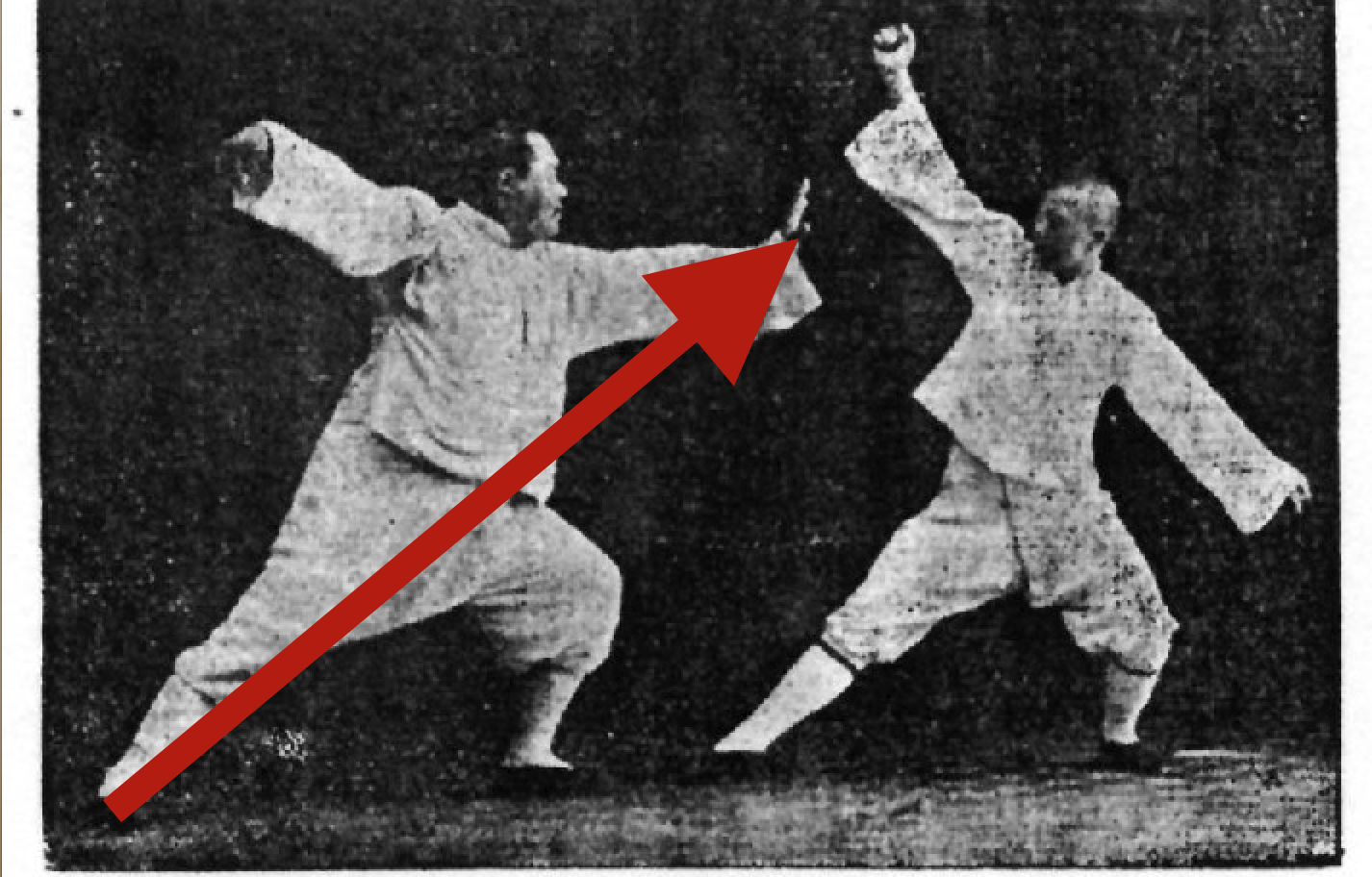
In the picture of Yang Cheng Fu below you can imagine that the Jin path goes from his back foot to this hand like this:

Screen Shot 2018-08-26 at 7.18.57 AM

Jin path

So when you run through the form, your mind needs to be creating these jin paths as you practice. As well as you doing everything I said in the last post – relaxing, sinking the chi and coordinating the body so all the separate parts arrive together. That’s the Tai Chi form in action.

Of course, that’s a tall order, and I’d suggest that beginners who are interested in this type of training pick a favourite move (a simple Push movement is a good one) and just practice it over and over, paying particular attention to mentally directing the path of forces in the body.

Without a teacher who can show you what it feels like it will be a bit like fumbling for something in the dark when you don’t know what it is or looks like. So get out there, try and get ‘hands on’ with a good teacher and you’ll get a better idea of what it feels like. If you find somebody who can do this then you can recognise it. It doesn’t feel like normal strength.

Ken Gullette, whose book I recently reviewed, has a good video that I hadn’t seen before which I think can give you a sense of what you’re looking for – the feeling of the ball under the water. That’s the main thing to focus on in this video.

Once you understand this concept then some of the lines in the Tai Chi classics will start to make more sense. Like, for example:

“The jin should be 
rooted in the feet, 
generated from the legs, 
controlled by the waist, and 
manifested through the fingers.”

“All movements are motivated by Yi, 
not external form.”

“6.) Use the mind instead of force. The T’ai Chi Ch’uan Classics say, “all of this means use yi and not li.” In practicing T’ai Chi Ch’uan the whole body relaxes. Don’t let one ounce of force remain in the blood vessels, bones, and ligaments to tie yourself up. Then you can be agile and able to change. You will be able to turn freely and easily. Doubting this, how can you increase your power?”

“The yi and ch’i must interchange agilely, 
then there is an excellence of roundness and smoothness.
This is called “the interplay of insubstantial and substantial.”