The head over foot guy, and Tai Chi

I’m always on the look out for interesting bio mechanical things and that search recently lead me to a character called David Weck, who is known as the ‘Head over Foot Guy’. Of course, that’s not his only idea about biomechanics- he’s got loads of them – but this video is a good introduction to his Head over Foot idea:

(It’s unfortunate that there’s a picture of the controversial social media influencer Andrew Tate in the header image for that video, because he doesn’t feature in the video. I guess they’re just using him as an example of a good walker, but while he may be a good walker, I don’t like him or his opinions, nor do I think he’s a good example for kids to follow).

The ‘head over foot’ idea can be explained very easily – if you’re going to stand on one leg, then your head has to be directly over your foot if you want your balance to be good. You can try this now, by standing on one leg and playing with where your head balances over your foot. I think he’s right – if you move your head anywhere else but over your foot then your balance starts to go.

Weck then takes this into the idea of walking, so instead of the usual description of walking that you read, which is that it’s a series of controlled falls, if you alternately put your head over your foot as you walk then you end up with a more athletic, balanced and confident walking style with a bit of swagger. You can start off over exaggerating the swagger, then work on reigning it in and making it smaller until it’s hardly noticeable.

I like it – it takes a bit of getting used to, but the alternative of trying to keep your spine neutral and upright (as we are encouraged to do in Tai Chi) ends up with a very forced, stiff, walking pattern. The alternative walking pattern of placing your foot over your head creates a kind of infinity symbol movement around the solar plexus with an alternating pattern of one side of the body shortening and the other side extending.

The idea of being upright is talked about a lot in the Tai Chi classics. For example, the Tai Chi classics say “Stand like a perfectly balanced scale” (from the Treatise) and

“The upright body must be stable and comfortable
to be able to sustain an attack from any of the eight directions.
” (from the ‘mental elucidation of the 13 postures’.)

But that doesn’t mean that you should look like a robot when you do it. Your body is a fluid collection of hard unbending bones connected by soft joints that allow for movement. It is designed to move in spirals, and the ‘head over foot’ idea promotes this spiral movement.

A lot, in fact, almost all, of the time in Tai Chi your weight is either on one foot or the other, or you are actually standing on one leg with the other leg kicking. So, I find that thinking about whether your head is over your foot as you do the Tai Chi form is actually a good idea. If it is then your balance will be better.

Think about the classic Tai Chi walk. We do this exercise called the Hero Stroll, which looks like this:

It’s worth doing this and thinking about the concept of keeping your head over your foot as you do it, then applying that to your Tai Chi form. Hopefully you’ll find your Tai Chi becomes more balanced, especially in the kicking movements. I find that this is where a lot of beginners have problems – they can’t balance on one leg. Well, here’s the solution!
Facing adversity

Why do we exercise? It may be that we have been told we must by a doctor because we are facing some sort of health crisis, for which the most obvious solution is to take up more regular exercise. Usually these problems are related to being overweight and the multitude of health problem this can exacerbate, or indeed cause. But sometimes it can be something more subtle, like just not feeling comfortable in our body. We know when our body feels weak, soft, stiff or unused and needs exercise. The sense that we need to move, to stretch or to run is always there within us, if we choose to listen to that inner voice.

The Stoics were very big on the idea of accepting “voluntary hardships” as a kind of “shortcut to virtue”. Like the Cynics before them, or the holy men of India at the time of the Buddha, they would often become beggars, or live like poor people for extended periods of time to refocus on what was important in life, or to simply stop themselves from getting too soft. In life we generally try and avoid pain and discomfort in all areas, and this can lead us into tremendous difficulties in the long run. By seeking to avoid pain we let small problems fester until they become big problems.

Photo by Kelvin Valerio on Pexels.com

“although most people don’t like pain and discomfort, we generally accept that learning to endure it within reason can potentially toughen us up.  That’s what most physical exercise is about, to some extent.  It improves our fitness but also teaches us to endure pain and fatigue.”

Donald Robertston

Which brings me on to Tai Chi. Generally motivating yourself to get out of bed, or off the couch, to practice Tai Chi involves the same mental toughening up process that is involved in motivating yourself to do any other form of exercise. There’s no difference there, but the difference is in the type of exercise.

Tai Chi is a slow burn. It requires a different type of resilience. You need to develop the resilience to work slowly and patiently at something when your mind is telling you that you’re bored now and you should really be doing something much more exciting or intense.

To some extent you can turn your mind off during sets of star jumps, squats and push ups and just blast through them, maybe while listening to pumping music to help keep you going. In contrast, the first thing you are asked to do in Tai Chi is to stand still and connect with your breath before you even lift a finger. Then you are expected to keep your mind on the job throughout.

But if you try it, you’ll find that this “getting in touch with yourself” first before exercising can lead to a different kind of experience. It’s the gateway to marvels. Maybe you won’t burn as many calories as you do down the gym with your mind on autopilot, but your body will feel better for it, reconnecting with the living spirit of nature that flows through you, and (if Obi-Wan Kenobi is to be believed) all things.

It starts with the breath. Become aware of the breath. Don’t interfere with it, just watch it rise and fall. Once you do that you’ll find that facing minor adversity doesn’t feel like such a big problem anymore, and you can just do it.

Never let your knees go over your toes… or should you?

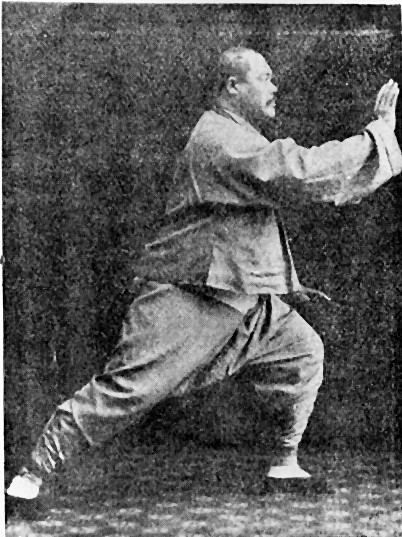
I remember when I started Tai Chi in the 90s, one of the things that was talked about a lot was that you should never let your knees go beyond the line of your toes in a forward stance.

YCF: Knees not extending past the line of the toes.

Letting this happen was always seen as unequivocally bad. Not only was knees beyond toes seen as structurally unsound (your weight is too far forward making you easy to pull off balance), but this was seen as the primary cause of the epidemic of so many Tai Chi people having bad knees.

The Snake Creeps Down posture in particular was quite often used as an example of a badly done posture by Western dilettantes.

But it always struck me as a bit odd that it was seen as being such a dangerous thing to do. If you were training the martial side of Tai Chi then you were being punched, thrown and armlocked on the regular. Worrying about your knees going over the line of your toes seemed a minor danger in comparrison.

Fast forward to 2021 and today I found out that a lot of BJJ people (an art that specialises in slowly destroying your body over time) were raving about the benefits of the method espoused by the Knees Over Toes Guy on YouTube, who had achieved great results reparing people’s knees using a traning methods that empahsises, yes, you guessed it, putting your knees beyond the line of your toes as much as possible.

Interesting. Here’s what he says:

A year went by with no results. In fact, I was certain I needed another surgery when a spark of truth finally presented itself…

“The athlete whose knees can go farthest and strongest over his or her toes is the most protected.”

Everything I had been taught up to this point by dozens of trainers and physical therapists was very clear: NO KNEES OVER TOES — but when I read this statement, I immediately knew it was true.

Knees Over Toes Guy

The write up of his method is here. And here’s a video of his basic method is here:

The logic seems sound to me, so if you’ve got knee trouble, you might want to give it a try.

It makes me think – is the epidemic of Tai Chi people with bad knees (if it really exists) caused by the knees going over the toes? Or is it more likely because that group self-selects for other unhealthy behviours?

Get outside and move more

Tai Chi wants you to create a balanced approach to life. You can tell this from the way the form itself is balanced; the posture is balanced, the mind is balanced and the breathing is balanced. Therefore it makes sense to look at your whole life, not just the part of it spent doing Tai Chi, if you want to get the best out of it.

Matt Haig, who wrote one of my favourite books How to Stop Time, shares his top tips (from his new book Notes on a Nervous Planet) for leading a balanced life here:

Matt talks about the importance of getting outside in that video.

Another Matt that I know is Matt Hill of the Systema Academy in Wiltshire, and he’s all about getting outside more. He wrote a recent blog post I’d like to share about the importance of getting outside for a good 3 hours at least once a month.

Finally, here’s a podcast by movement biomechanist Katy Bowman about How To Integrate Movement Into Your Life – And Enjoy It There are lots of tips here on how to integrate more movement into your day to day life.