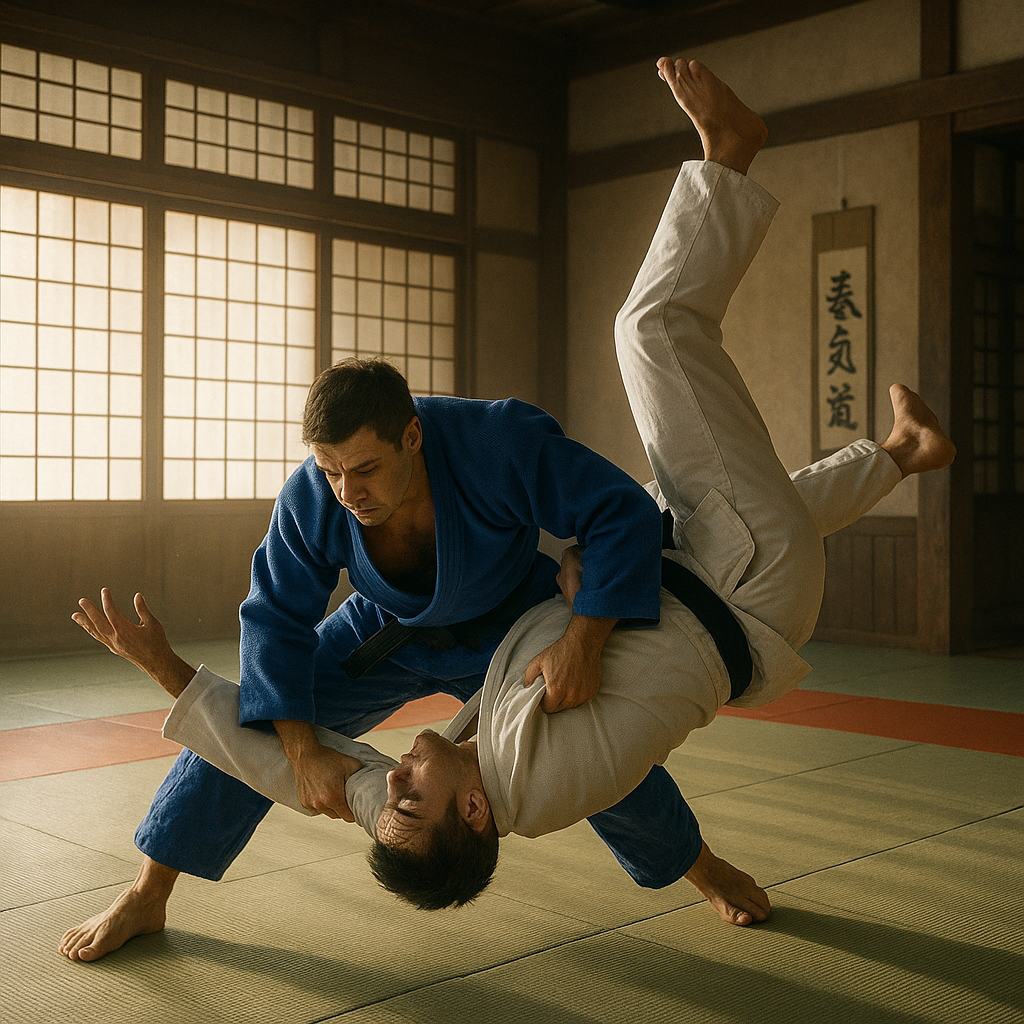
Judo and (Brazilian) Jiu-Jitsu might have exactly the same origins, but they’ve gone down really different paths in their evolution. While Judo has focused more on the sporting elements and becoming an Olympic grappling sport, BJJ has always wanted to keep things closer to its Value Tudo origins, which evolved into modern MMA.
Even today, many BJJ classes have a strong self-defence element, however BJJ is a broad church and some associations and classes are much more orientated towards sport grappling, particularly the no-gi variation.
One of the frequent criticisms of modern Olympic-style judo was that it had sacrificed too much realism in pursuit of beautiful big throws in competition. One way it did this was to make any grab of the pants or legs illegal. This seemingly simple rule change had dramatic effects on the sport. Since the legs were no longer a target the stance of judo players became more upright in their stance, leading to more possibilities for big dramatic throws.
Remember, under Judo rules a match can be won with an Ippon, a throw that lands the opponent on his or her back. In BJJ no such rule applies – a spectacular throw simply earns you two points and the match continues.
All Japan tournament rules
I hadn’t noticed before, but there has been a recent rule change in judo, in a particular Japanese tournament called the All Japan Championship, that means you are allowed to grab the legs again, opening up a whole range of possibilities for long-forgotten judo techniques to make a reemergence.
There are some restrictions though. To grab the pants you have to have a grip on the upper body with one hand, and you cannot grab the legs with two hands. This rules out popular BJJ and wrestling techniques like the single leg or double leg.
Will the new rules get adopted by wider judo federations and ultimately the Olympics? It’s unclear at this stage, and too early to say, but it will mean that going forward, judo could end up looking very different to the way it does now.
I had a chat with Alan Wycherley from the In Defence of the Traditional Martial Arts YouTube channel for my podcast and the episode is now live. We talk about how Tai Chi can be used as a realistic self-defence system and Alan’s encounters with traditional martial artists from different kung fu systems.
Now, you can agree or disagree with Rantwo’s opinion on whether the Pak Mei guy can fight or not. Personally I think Rantwo brings up some good points, but I’ve heard other people argue that he’s kind of missing the point – sparring never looks good.
Anyway, I don’t want to get into that. My comment on the video would be that Rantwo is making the classic mistake that a lot of people make when looking at videos of traditional master getting beaten up by average/bad kickboxers and then deciding that martial art XYZ must be no good: It’s always a reflection on the person involved, not the whole style.
I don’t think you can view a couple of videos of Pak Mei guys then decide the whole style is “not for fighting”. I can guarantee you there are Pak Mei guys out there who have no problem throwing down. To just dismiss a whole style like that seems to be incredibly naive.
When it comes to sparring, I don’t think there are styles, there are just individuals. At least that’s the way I look at it.
I came across an interesting video by Ed Hines of i-Bagua.com recently that discussed some general principles of throws and takedowns. There is some good information here, especially about dead angles, and base. Have a watch:
Of course, in my ear I can hear my BJJ friend saying it’s all nonsense, “why not just do wrestling?”, or “he’s doing zero hand fighting!”. My friend tends to think that everything you can know, or ever want to know, about throwing and standup grappling is already inside wrestling.
He probably has a point, and a lot of the clever ‘internal’ things that Tai Chi teachers demonstrate are really just found in wrestling basics, or are obvious if you do wrestling. But here’s the thing – not everybody wants to do wrestling or even can do wrestling! It’s time-intensive hard, physical work, from which you will probably get injured, and, frankly, it’s for young people, not anybody over the age of 30. Not to mention that you’ll also need to invest in a good quality BJJ mat for grappling training.
If you’re going to approach takedowns without having the time or energy required to learn wrestling, then you’re going to need a softer approach. Oh, hello internal arts.
How to defend everything
I wonder if you’ve ever seen the video “how to defend everything” by Chris Paines on YouTube? (It won’t embed, so I’ve had to link it). It’s about BJJ, not internal arts, and focused ground work, not standing, but those principles he’s expounding, I feel, are universal to all grappling, and they’ve really changed my approach to takedowns. It’s also very simple. Simple is good – simple is practical.
At 50 minutes it’s quite a long video, and some of the important points don’t happen until near the end, so I’ll give you a quick summary: In a nutshell, there are 5 parts of the human body that you need to access in at least one place to achieve a throw or takedown.
Part 1. Back of the head, Parts 2-3. Armpits and Parts 4-5. Back of the knees.
(back of knee area extends down to ankle, armpit area extends down to hip).
When I do takedowns I just keep looking to insert a part of my body (arm/hand/foot/head/whatever) into one of those places. I just keep spamming it as an attack. If you keep doing that then eventually you manage to ‘own’ one of those places and a takedown will sort of present itself, especially if you get more than one.
You can analyse any throw on YouTube and you’ll find that the person who did the throw got some part of their body into at least one of those places to make it happen. Now, that might mean that the model being used is too general (i.e. it covers a lot of the body!), however, I think it’s still a useful model if you want to work on defence (which people rarely do!)
If you’re doing some grappling and you get taken down, then replay what happened in your mind – you will have let your opponent into one of the 5 spaces for too long. Long enough for them to get a takedown on you. The answer to preventing the takedown then becomes about reclaiming control over those 5 points of your body, rather than trying to do some sort of pre-scripted counter to the throw.
N.B. You can look at standing on the foot as a possible exception to these rules, however… that doesn’t tend to work in a pure grappling environment, unless you also get one of the other 5 as well. Standing on a foot and striking somebody however is a different beast – it’s much more effective. It’s the same with standing wrist locks… they can work, but 9 times out of 10 they won’t – i.e. they are very low percentage, and almost certainly don’t work against experienced people. Your time is better spent trying to get one of the 5 control points. (Apologies to Aikido 🙂 )
N.B. 2 – But what about the gi or wrestling jacket? Well, think of it this way, a collar grip is simply a very effective lever to the under armpit area, so when you grip the collar, you are effectively cheating because it’s giving you easy access to their armpit area. It’s why, when we go for chokes we grip deep on the collar, under the ear, but when we go for throws we tend to grip much lower down, so that the lever to the armpit is stronger.
When Josh Robenblatt got to the age of 32 and realised he wanted to fight in an MMA match, he had to confront a lot of physical problems as well as inner demons before he set foot inside the cage. While the physicality of fighting is explored, this book is mostly about Josh’s internal struggles as a lifelong pacifist coming to terms with the casual approach to violence that MMA engenders. For many people Josh’s exact internal struggles wouldn’t exist (especially his frequent reference to his Jewish ancestry), but in a general sense they do exist in some form in all of us, and that’s what makes this book fascinating for anybody who trains in a martial art. It’s also a rare insight into the realities of training for an MMA fight – how much training is actually required, dealing with injuries, how it affects your relationships with friends and family and what the brutal realities of weight cutting are all about.
Josh writes well, particularly when it comes to articulating his inner thoughts on the subject of dealing with actual violence, either as a participant or an observer, and the transformative, almost transcendent, power that coming to terms with it often provides. I found he had managed to put into words something I’d felt before in my own life, but never stopped long enough to really think about and verbalise. As such ‘Why We Fight’ kept my attention constantly until the end, and you do become drawn into his underdog story and intrigued to find out what happens when he finally gets into that MMA match. I won’t spoil it here.
I always find the labels ‘traditional’ and ‘modern’ misleading because something that’s current and popular, like Brazilian Jiujitsu, is actually quite old in comparison to some of the martial arts we would call traditional, like Aikido or Taekwondo. But even recently created martial arts are built on older traditions, so where do we start dating a martial art from? From the day it was named, or from the arts the proceeded it? If it’s the later then all martial arts are the same age and have existed (potentially) forever.
Another way of differentiating between traditional and modern is using the self defence vs sporting dichotomy, however so many martial arts exist in a grey area between the two – take Muay Thai for example, that I don’t think that’s a good way to do it either.
“For me, one of the best, i.e. concise and precisely written and kind of encompassing scholarly starts on traditional martial arts was and is the following by Moenig & Kim (orig. 2018; republished as a book chapter 2021):
“[T]he expression ‘traditional martial arts’, which has become very fashionable, is one of the most misrepresented and misused terms in the general discourse. ‘Traditional’ projects an image of a long history and of continuity throughout history, without change. In reality, most modern Asian martial arts are only a few hundred years old or are an evolutionary product of the twentieth century. On the other hand, some western combat sports, such as boxing and wrestling, actually have traditions as long as, or longer than, most modern, popular Asian martial arts, and nobody would ever classify them as ‘traditional martial arts’. The term ‘traditional’ seems wholly reserved as a reference to Asian martial arts. However, to the contrary, many present-day East Asian martial arts developed only recently, and are not ‘traditional’ by most definitions. Most traditional martial art proponents do not consider sports as having any philosophical aspects, as being mostly irrelevant, and as ‘merely’ a physical activity without any spiritual merits. Surveying the available literature on martial arts reveals that leaders and practitioners of traditional martial arts have often monopolized the discussion about philosophy, educational values, and realism in martial arts training; labelling the sports aspect inferior regarding educational benefits in addition to being unrealistic for real combat“ (Moenig & Kim in: Hong & Li, 2022: 43). Original reference Book reprint/republishing
You might also like to listen to the lecture, Inventing Traditional Martial Arts a lecture by Prof. Peter Lorge from one of the Martial Arts Studies conferences.
One of the things that martial arts training should give you, over the years, is better self control. At least in theory. You see some higher ranked people and it’s clear that it doesn’t always work out that way, but that’s the plan, at least in theory.
I’m a bit fan of Japanese martial arts expert Ellis Amdur who wrote the excellent book Hidden in Plain Sight about Aikido. That’s not the only book he’s written of course, and I really should try to read some of his others, but he’s done a lot of work in the fields of mental health and dealing with conflict resolution in a professional capacity. He made a recent short video, on the use of the word “triggered”, his point is that how we define or label something becomes your reality. If you define yourself as triggered by something, then you are saying that you have no control over the situation. You are, in effect, helpless. But if you redefine how something makes you feel, using a different word then you can define yourself as having agency, and that is the kind of training that martial arts can give you. I kind of agree, but not entirely*.
As Viktor E. Frankl said, “Between stimulus and response there is a space. In that space is our power to choose our response. In our response lies our growth and our freedom.” I think martial arts training should be a way to get used to stressful situations so you can more easily inhabit that space.
Of course, you need to be engaging in practices that take you out of your comfort zone to get these benefits. Most of the time being outside your comfort zone is not where you want to be but with repeated exposure to the discomfort of being pinned, attacked, thrown, etc, you can start to take these things less heavily, and you can learn to play within the spaces that appear once you stop panicking.
*I’d counter argue the point that Ellis is making – just because you say you are triggered by something that doesn’t necessarily imply action. Ellis equates the word trigger to imply a gun, and once a gun has been shot it can’t be un-fired. Well, maybe, but “triggered” could also just mean the state of readiness you are in to fire a gun – you still have that moment to take your finger off the trigger.
There’s a risk of being lost in semantics here, so let’s not lose sight of the whole thing – the point is, finding that moment of freedom and growth between stimulus and response and learning to live in it. Now that is one of the real benefits of martial arts.
So, it turns out that they’re remaking the classic 1989 film Road House because, well, I guess some Hollywood executive has decided that it will make money. I can’t think of another reason why you’d want to remake one of the best-loved and enduring “fighty” films from the ’80s. The new version starts Jake Gyllenhaal as Dalton, and MMA superstar Conor McGregor as his nemesis, Knox. It’s combining more modern things like MMA into the mix, but it looks like it’s essentially the same plot. Trailer:
The original Road House is probably not classified as a martial arts film, because it mixed so many different film styles together, and didn’t really feature any famous “martial artists” in the cast, but Road House always felt like a classic martial arts film to me, just with more Western style fighting in the fight scenes.
It started Patrick Swayze as the bouncer of the aforementioned Road House, who has to deal with an onslaught of progressively worse ‘bad guys’ who are trying to bust up his bar, until he faces the final bad guy in a fight that remains forever legendary for its brutal throat ripping out scene, at least it’s legendary in my mind. It also had some great Blues music played ‘live‘ in the Road House, by the Jeff Healey Band.
Swayze was most famous for his role as a sexy dancing Butlins-entertainer in another classic ’80s film, Dirty Dancing. Casting him as a tough guy who could convincingly take out bad guys armed with knives and the like with his bare hands was a risky casting move, but he pulls it off with style and grace, perhaps proving once again that dancing is the best base for martial artists to emerge from (Bruce Lee was a Cha Cha dancer).
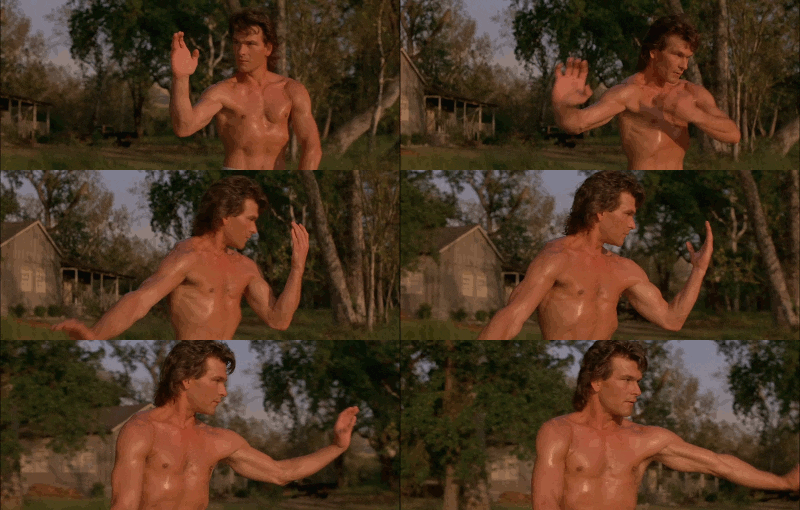
But what I liked most about Road House was the Tai Chi. When Dalton wanted to kick back and get away from the pressures of life he rocked up to the local lake shore and did some Tai Chi, (without his shirt on, obviously*.)
Ok, it wasn’t great, but at least it looked like Tai Chi. The implication was that Dalton was so good at fighting, and secretly enjoyed it so much, that he had to work hard to keep calming himself down otherwise his killing power would bubble up and overwhelm him, taking his humanity with it – kind of like the Hulk. He talks all the way through the film about not liking fighting, and how he does everything to avoid it. Eventually the bad guys push him too far and he unleashes the beast, resulting in the classic throat ripping scene.
I’ve always wondered why Tai Chi never had its Patrick Swayze moment. Wing Chun has been riding on the coat tails of Bruce Lee for half a century now, yet nobody really associates Tai Chi with Patrick Swayze, or this film. Perhaps if he’d gone on to make more Tai Chi or martial arts related films then things would have been different. Instead we got Ghost with Demi Moore and sexy pottery because his most associated activity!
Perhaps I’m being too hasty – when I started a Tai Chi class recently 4 women turned up asking if what they were going to learn was “like Patrick Swayze in Road House”? To be honest, I got the impression that they were more into shirtless Patrick than Tai Chi 🙂
Just remember: “I want you to be a nice…until it’s time to not be nice.”
“*” there was clearly a homoerotic subtext to the original Road House. While Swayze pratices shirtless Tai Chi he is gazed at by multiple men. Check out this exhaustive breakdown of Road House for more on that. Perhaps that’s another reason why Road House didn’t end up being a Tai Chi-promoting juggernaut?
We often label other martial arts groups as a cult, and laugh at their silly behaviour and rituals, but at the same time we are a bit blind to the cult-like aspects to the things we do, because that’s ‘normal’ to us.
I went to a different BJJ school one time and they kept making jokes about my home school being a cult because we have to wear an official gi when training, which is more expensive to buy than a normal gi. There were a few other things mentioned, but that was their main issue. A white belt from another branch of my school had visited previously and he had committed the cardinal sin of facing the corner while tying his belt – that was apparently also a sign of a cult and they recounted the story with much hilarity – “I thought he was having a piss in the corner!”.
However, in that school I observed students doing several things that were equally cult-like, but were apparently completely normal to them:
If you stepped on the mat without bowing, that was 10 burpees.
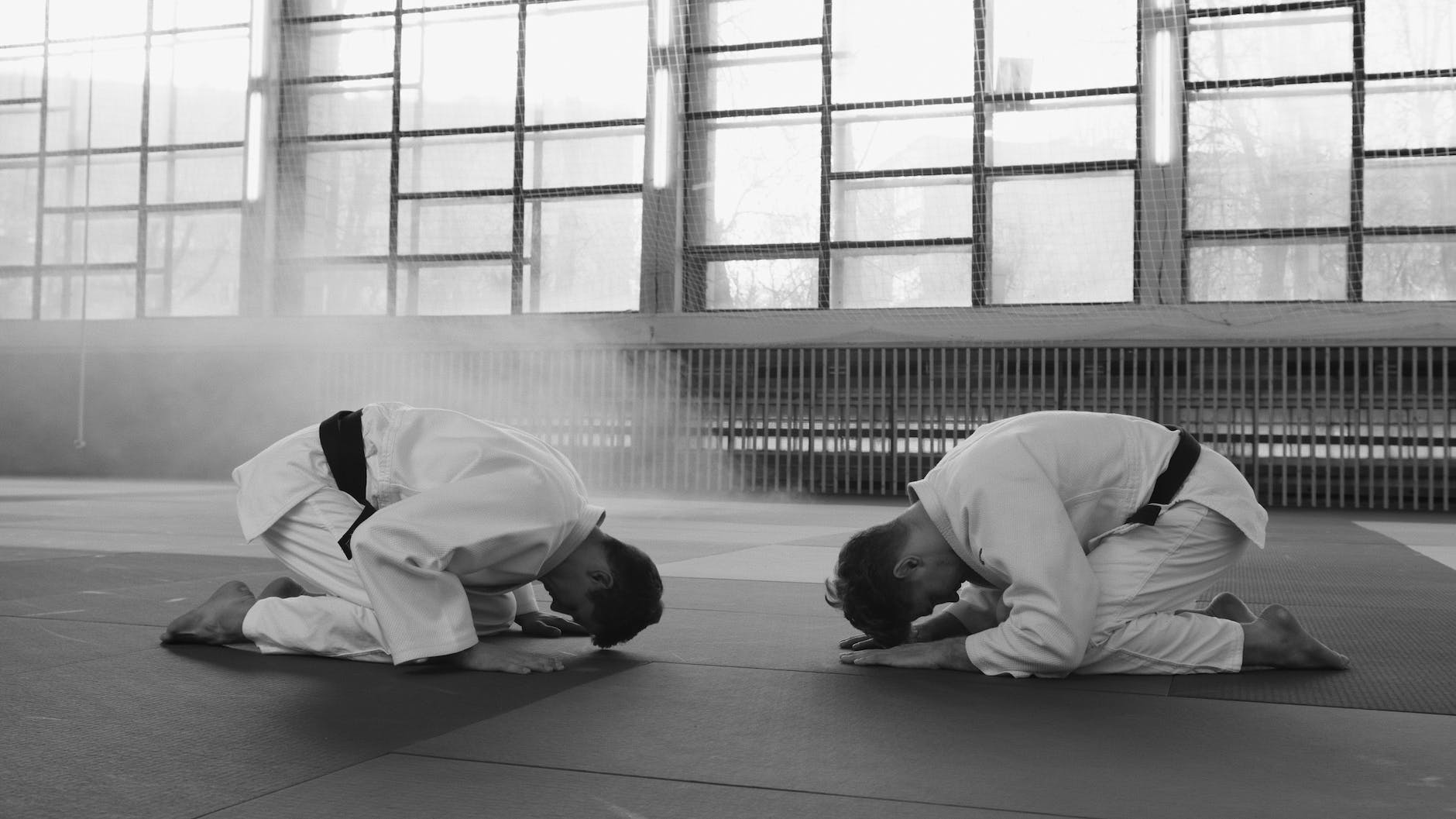
Classes started and ended by lining up and bowing to the teacher.
I (a grown man) had to ask permission from the teacher to have a sip from my water bottle, or if I wanted to leave the mat for any reason. And then ask permission to come back on.
If a black belt asked somebody to roll, they weren’t allowed to say no, even if they had already agreed to roll with another person.
Now we do some of those things in my school too – we line up and bow at the start, for example, and bow onto and off the mat, but some of those things we don’t do. However, they’re all just different versions of showing respect to each other before and during training. We are learning techniques that have the ability to kill and maim, and people could easily get hurt in the training if we weren’t respectful of our partners safety. Building an atmosphere of respect around the training will hopefully instill that in the actual training.
There is something of an uneasy tension in modern martial arts between capitalism and customs. In modern times the people in a martial arts class are usually paying to be there – they are, as modern capitalism likes to call it “paying customers”. The phrase “the customer is always right” has not entirely entered the martial arts vocabulary yet. It still retains these throwbacks to its “traditional” student and master martial arts heritage, for the reasons outlined above.
But let’s not muse on capitalism too much. The point of this post is to draw attention to the blind spots we all have. To return to that BJJ school – the higher belts were technical, but also fighty without being overly aggressive or dangerous, and the instruction was good and clear, the rolls were good too. But I could have done without the undercurrent of tribalism that that had been instilled in the students and was reinforced by the higher belts.
I think it’s worth repeating that all martial arts are cults, and if you think yours isn’t… then isn’t that exactly what a cult member would say? My attitude is to accept the various rules and customs of each particular cult or organisation as the price for them existing. Without any rules anarchy and disorder would break out and there would be no club at all. The Xing Yi classics famously say – “There is only structure, and there is only Chi”. With no structure, the Chi just leaks all over the place, and with too much structure I guess it can’t flow anywhere. A happy medium is what you’re after.
We (human beings) have the same attitude to our own bodies as well – we don’t see our own blind spots. The way we walk feels natural to us, but that might involve pointing the toes outwards at 45 degrees, compromising our lower back, instead of forward, for no good reason except habit. We might have been doing that for 30,40,50 years, and will probably keep doing it until the day we die without question, until somebody comes along and points out our blind spot, at which point it has become our ‘normal’ and it feels weird to walk in any other way.
A little period of self refection on the subconscious and conscious beliefs we hold true, without thinking about them, is always a good thing.
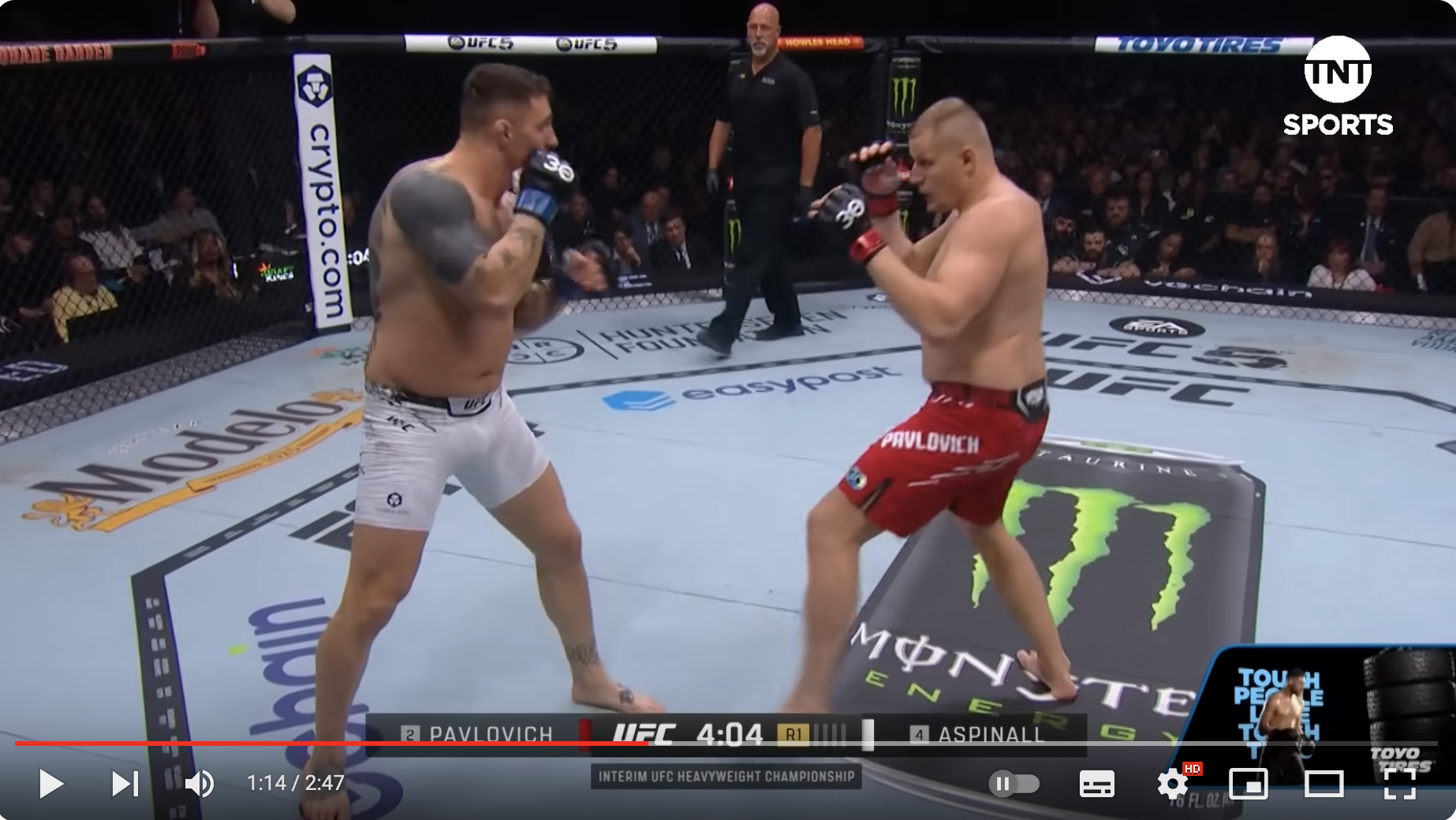
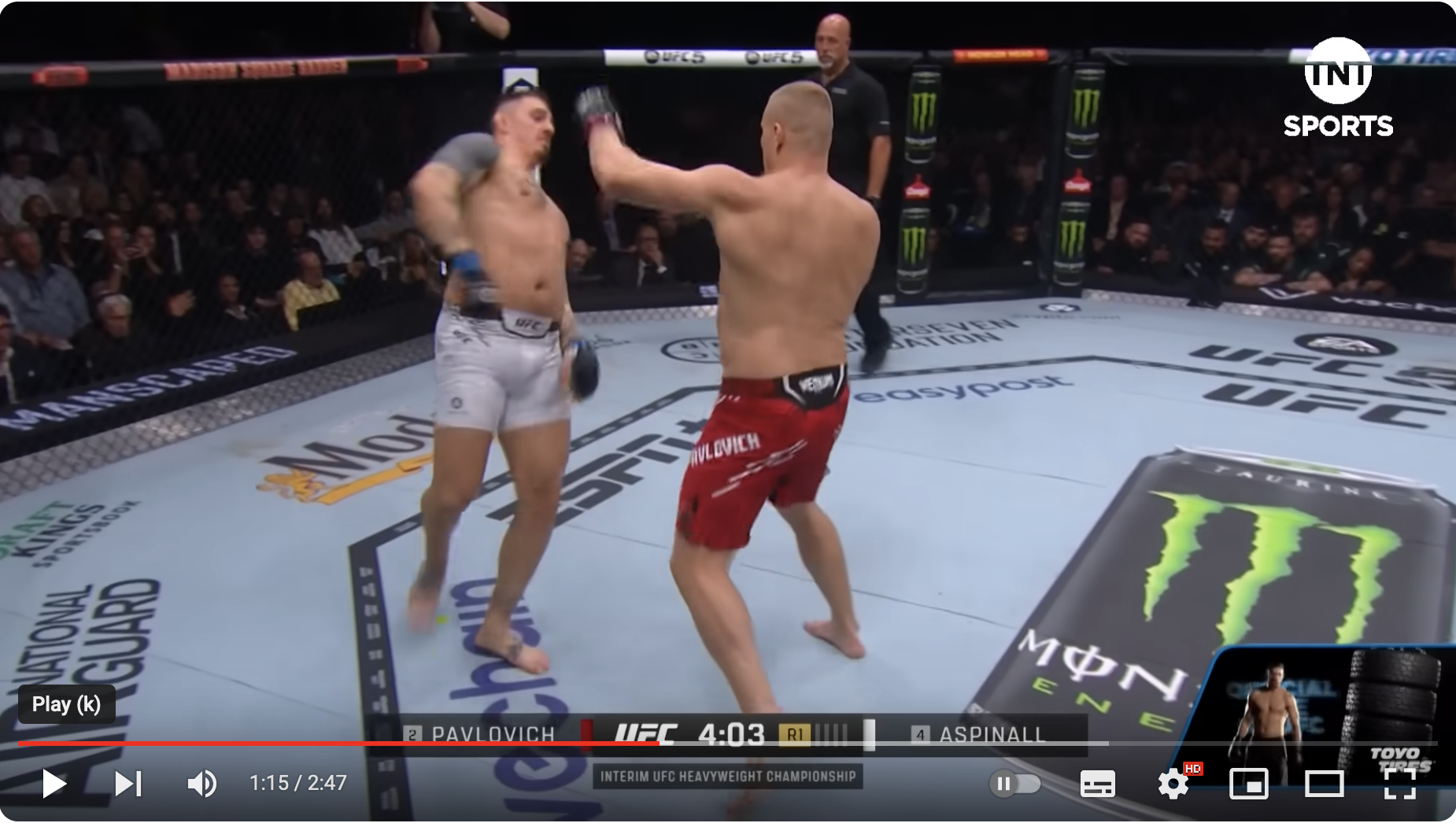
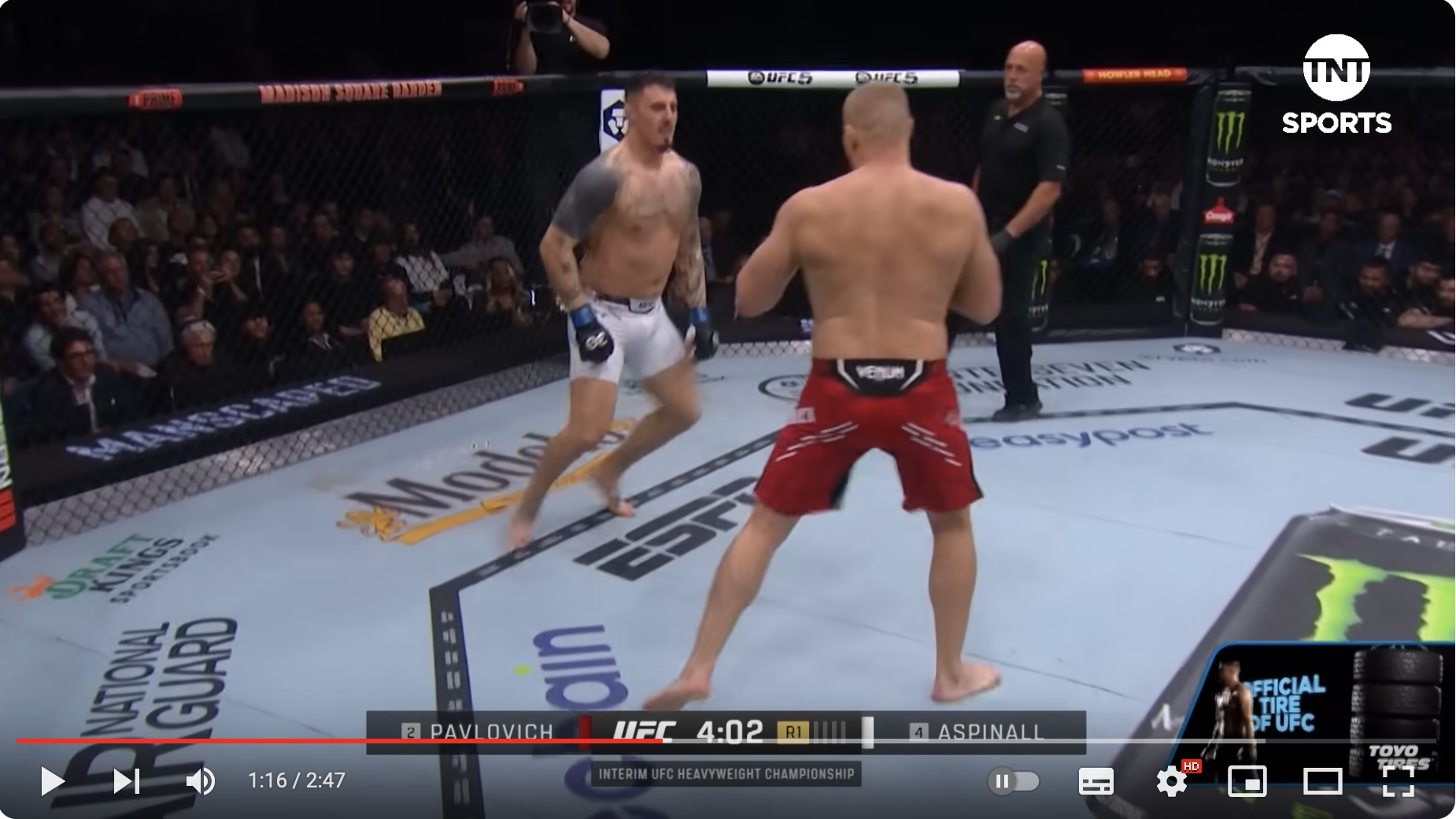
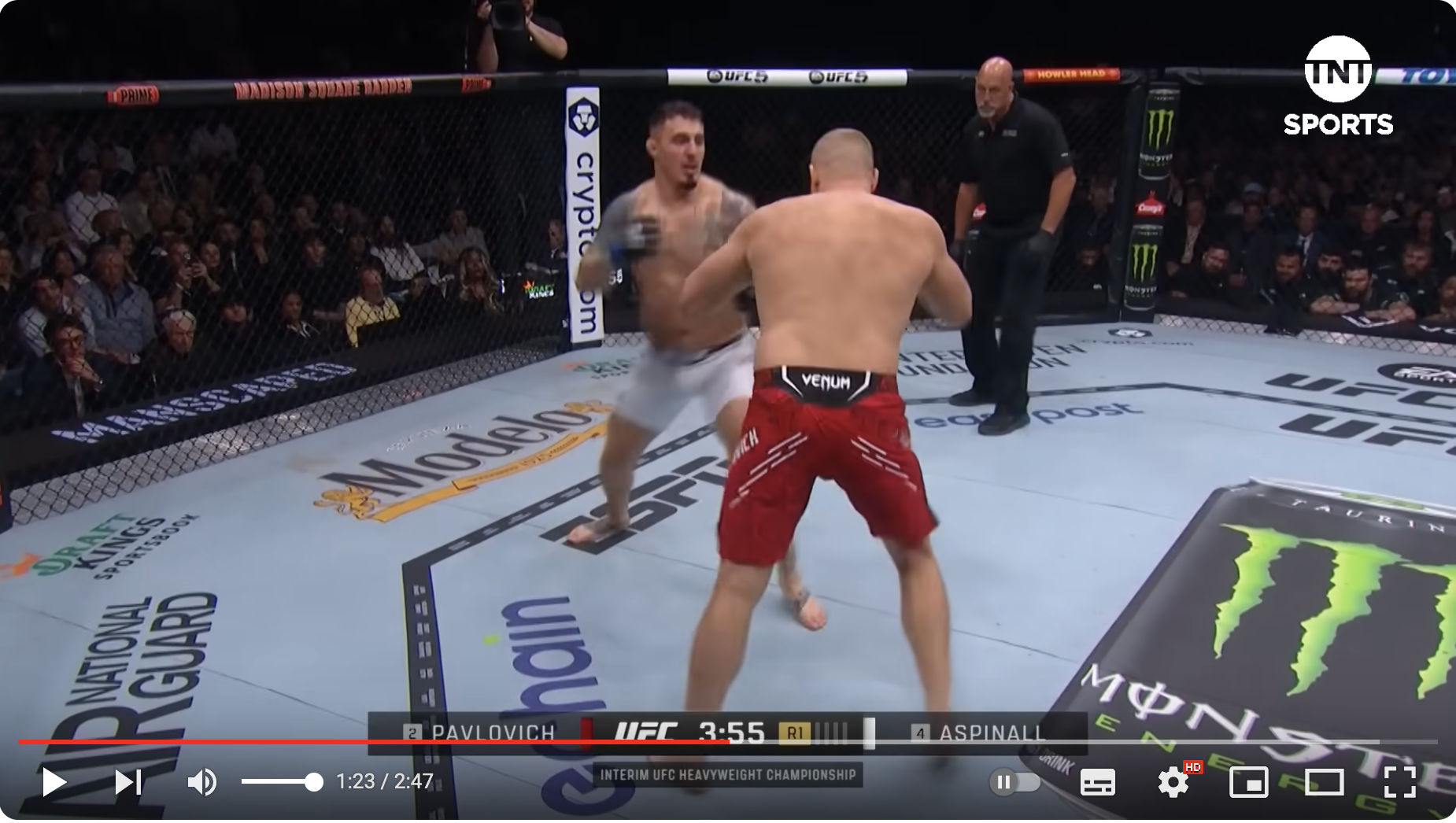
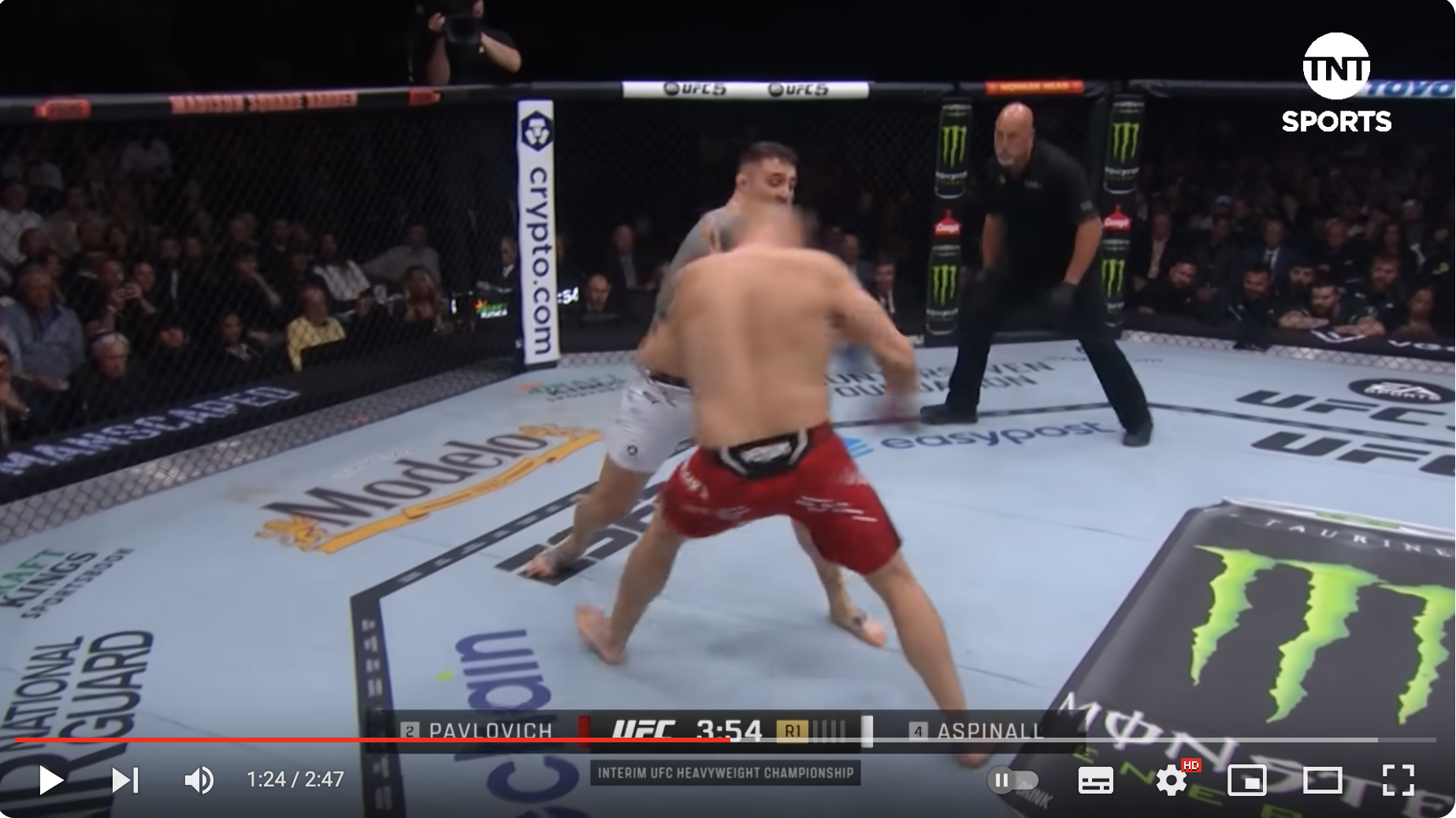
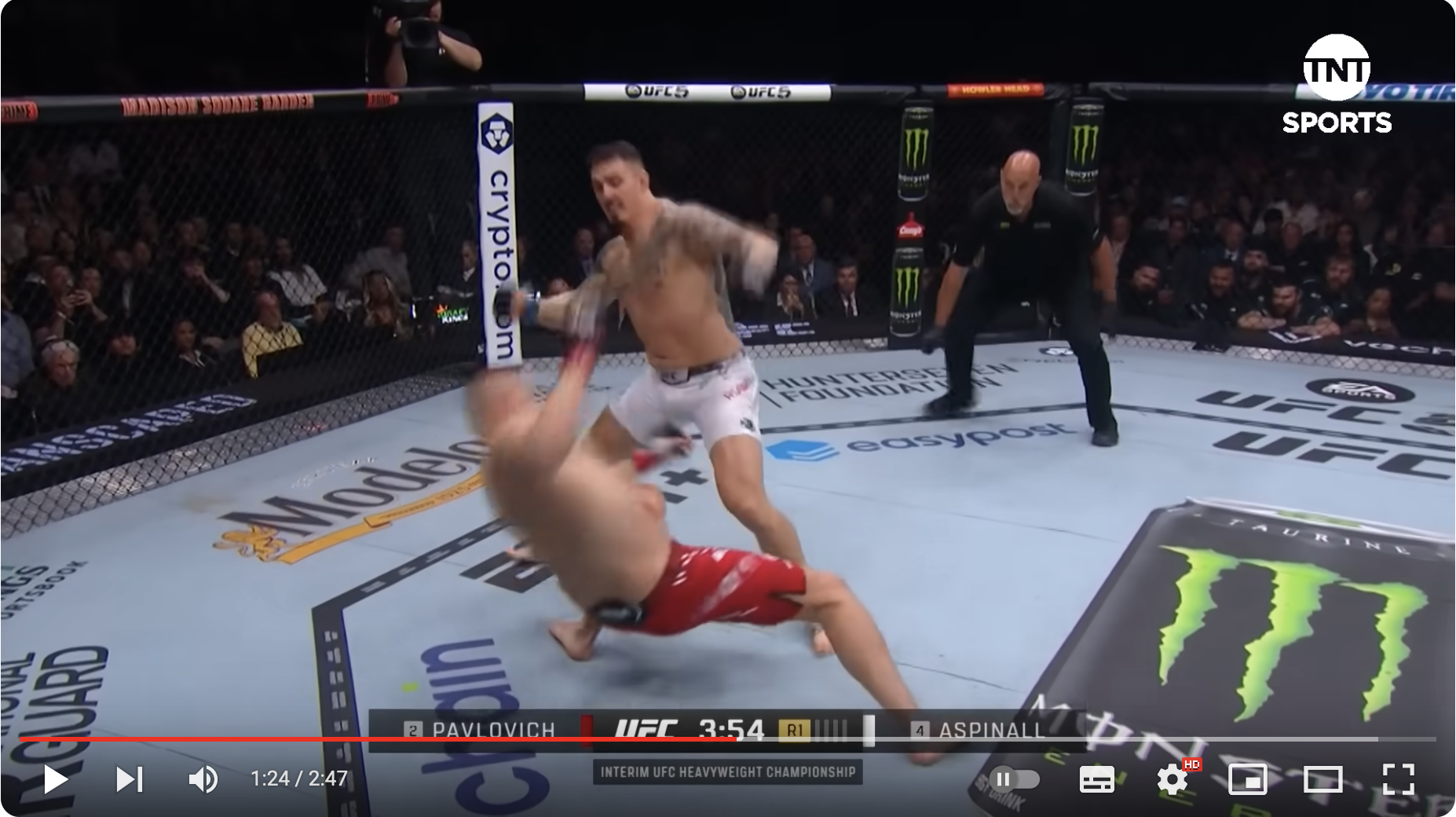
I left the reader with a question at the end… I asked them to take a look at another fight on the same UFC 295 card where British heavyweight Tom Aspinall took the interim heavyweight belt by defeating Sergei Pavlovich. The question was what animal style could we say that Tom Aspinall was a good example of. Take a look at the fight before reading further if, you haven’t already.
So, nobody decided to answer in my comments section but I got a few replies in private groups on Facebook, etc. One person got it half right, but they mixed two animals together in their answer, and only one was right. Interestingly most people seemed to opt for Tom being a rather large Monkey (Hu Xing). I get why, Tom is clearly bouncing in and out on his toes, despite being a massive human, but really that’s where the similarity with monkey ends. Monkey would try to attack from further out than Tom is standing, or from further in – it’s a very ‘in your face’ animal, but also a joker and a trickster. Taking pot shots, then running away. Remember the classic Monkey vs Tiger fight video? That’s Monkey. I can think of at least one modern MMA fighter who is a classic monkey – I’ll post about him in the future.
This charming man
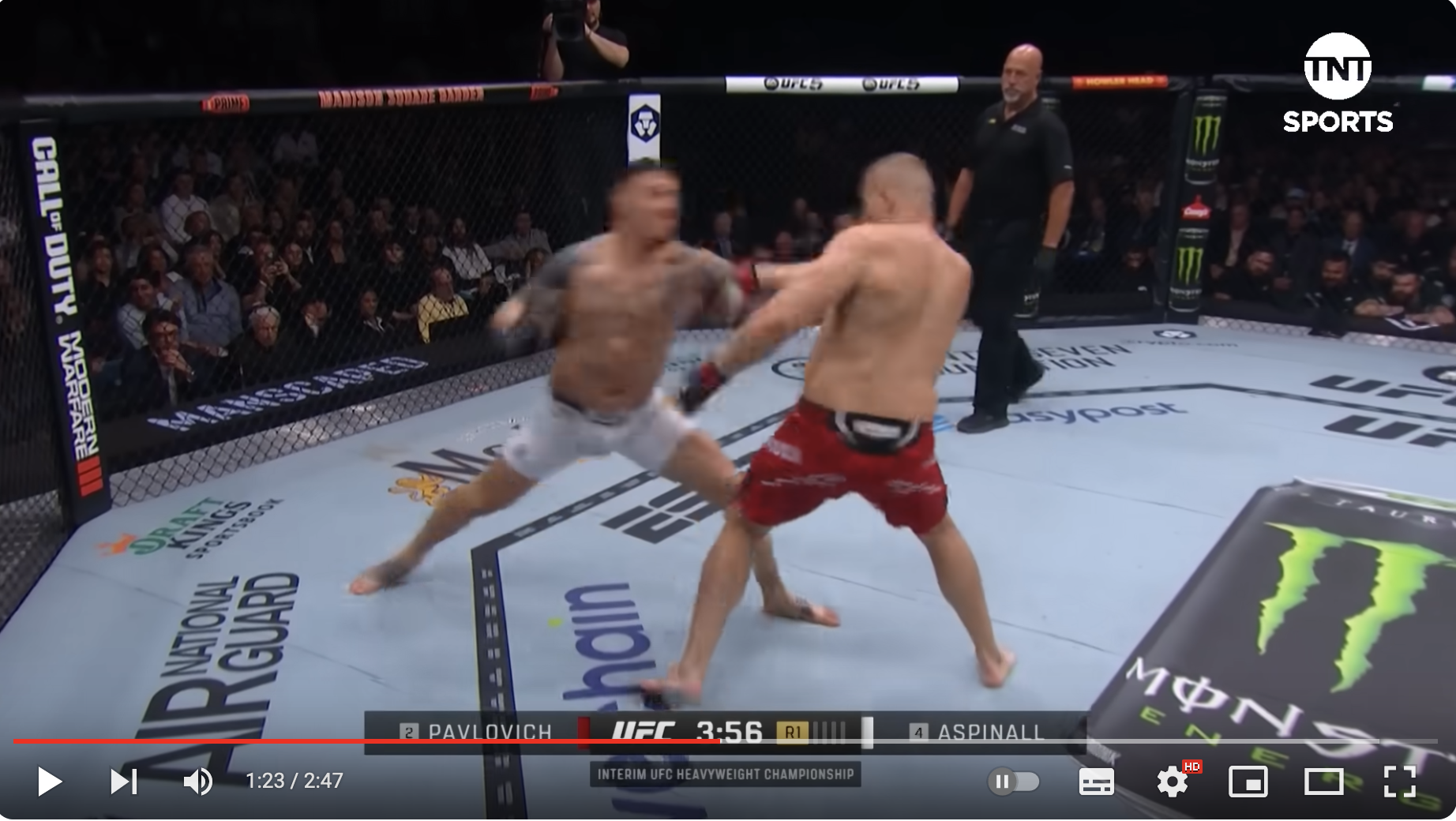
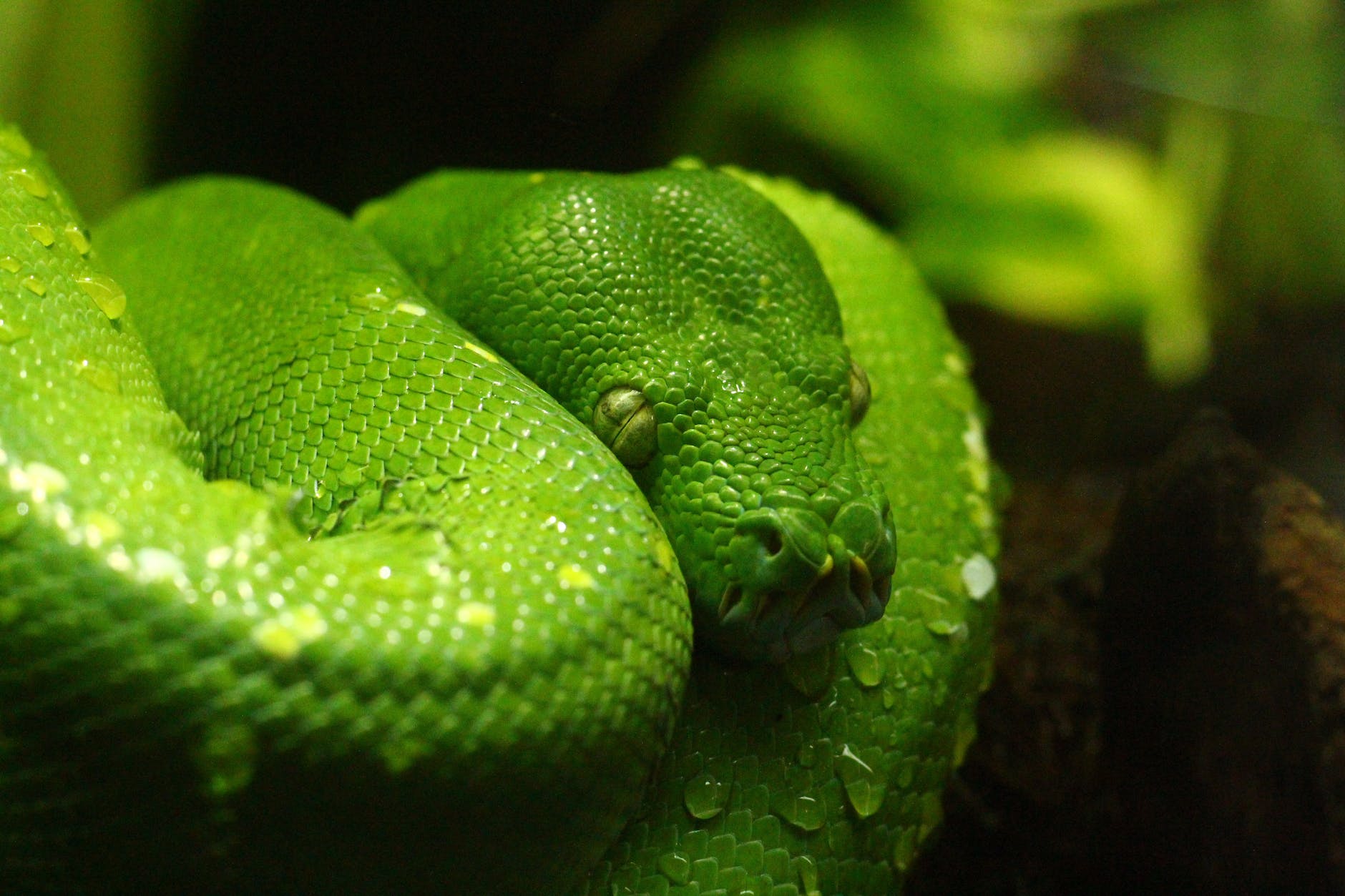
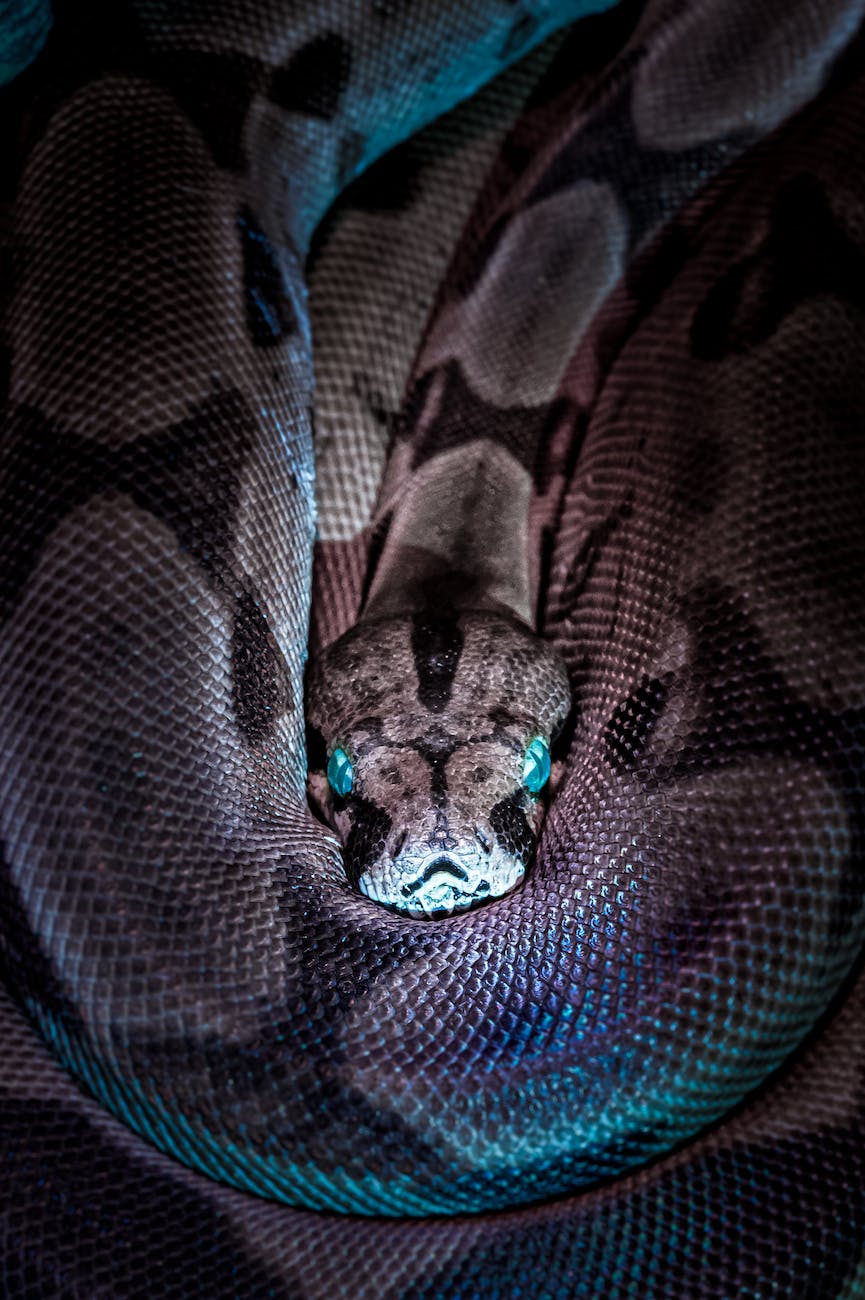
So, let’s look at what Tom actually is. He’s 100% Snake because Snake has Yin and Yang aspects. The key feature of snake is a coiling body, which can be used for either very quick strikes (Yang snake) or wrapping and coiling actions (Yin snake) for defence and grappling/locking. You can see this defensive coil aspect (Yin snake) particularly well when Tom is defending. There’s a little section in the round where he slips punches from Sergei while he coils and winds his body as he circles off – this is classic snake behaviour – just imagine if you were stupid enough to try to grab an angry snake by the neck – it would bend and coil around your hand, particularly if it was a python.
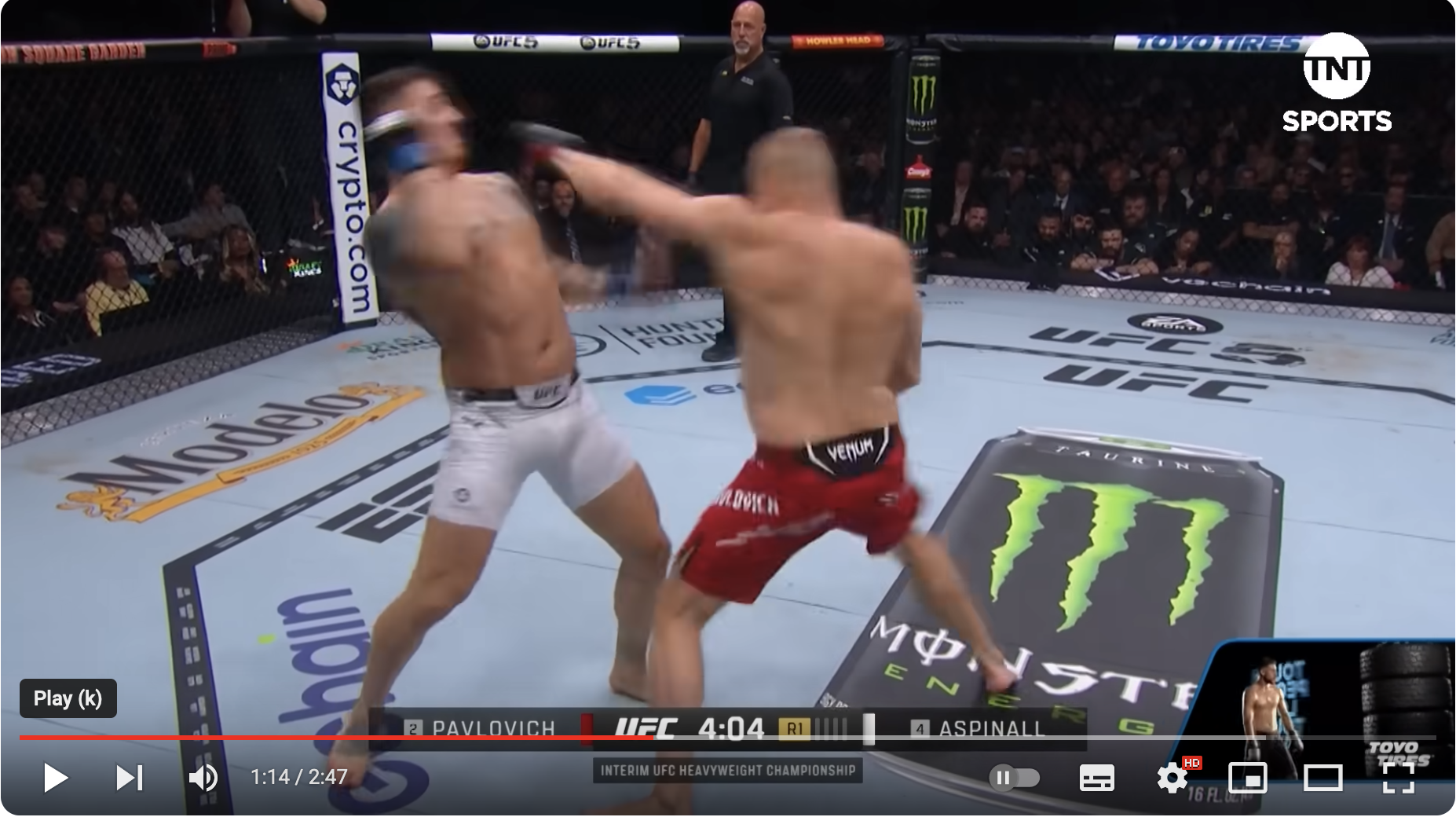
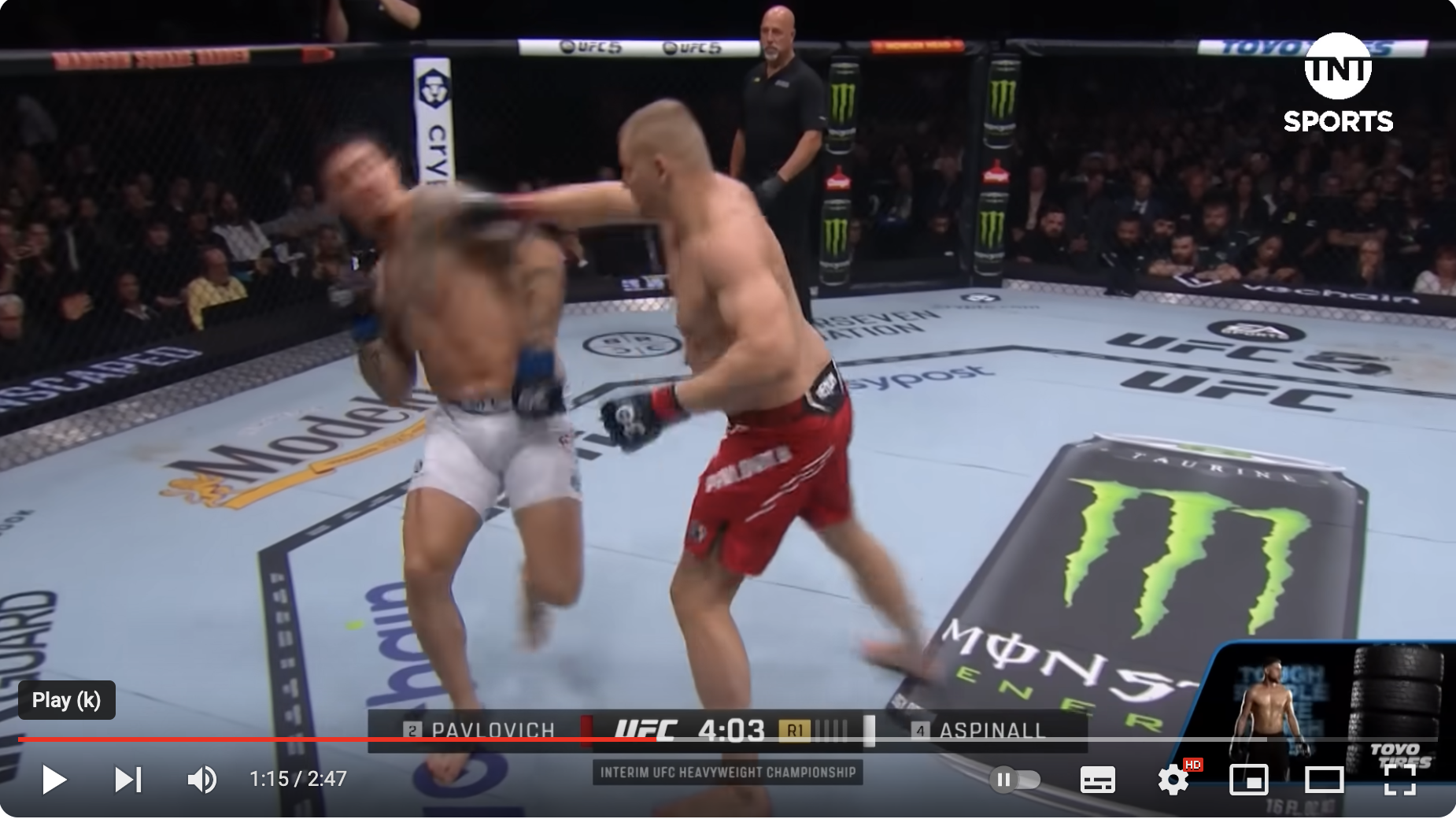
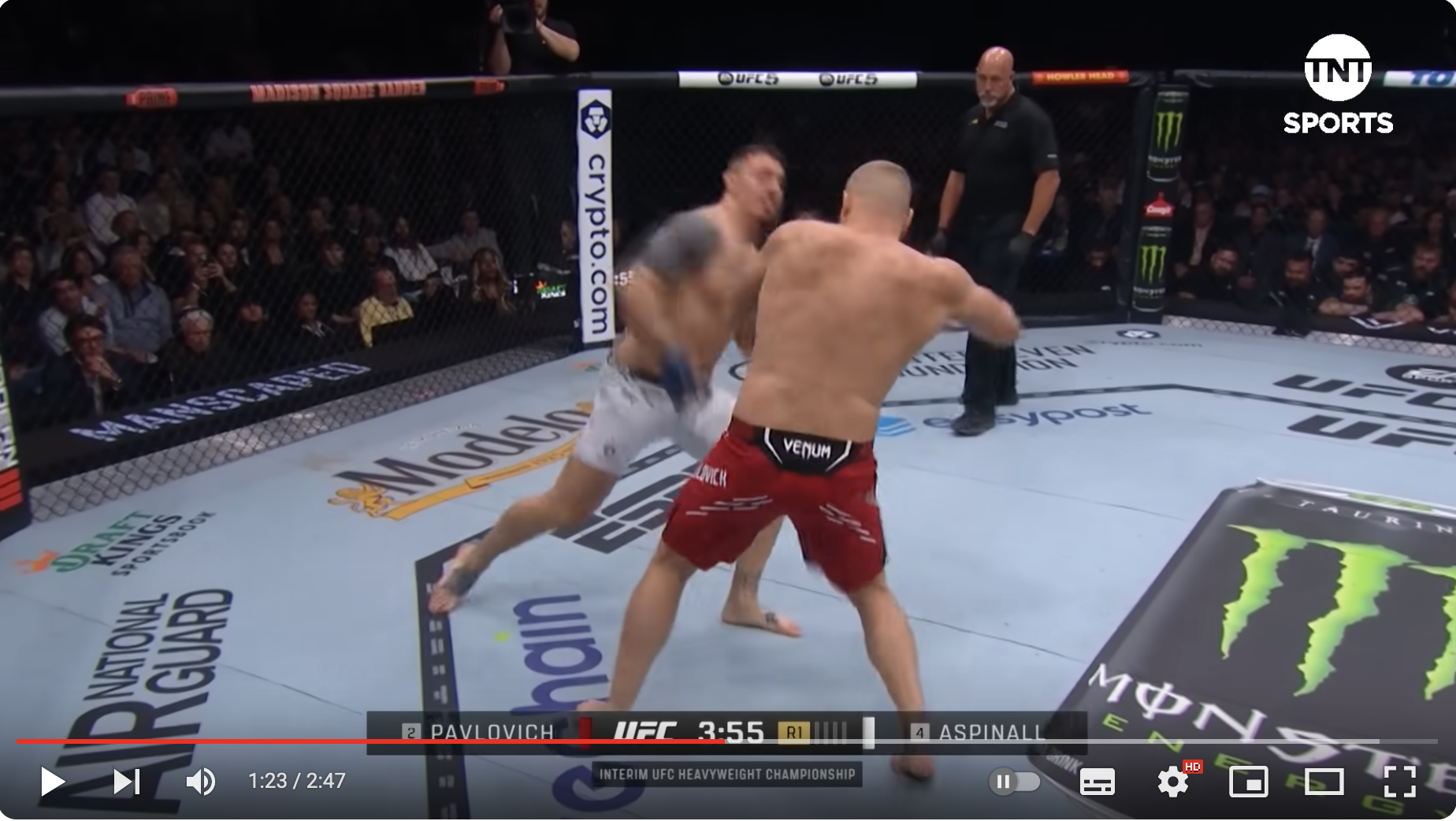
Snake’s are very aggressive, successful predators dating back to the time of the dinosaurs, and they’re always sensing forward, flicking out their tongue, and of course, they have the famous (and sometimes) venomous bite. When a snake bites the action is incredibly fast – you’ll notice that when Tom flicks out his jab the speed catches Sergei completely by surprise. For a big man he punches very quickly. The finish is so fast it’s hard to see, but Tom punches Sergei twice before Sergei can even react, steps back, looks at him, then punches him again sending him to the canvas:
Throughout the fight, Tom is flicking out single jabs and single low kicks too, very quickly.
Snake in Xing Yi is also associated with locking and grappling actions – we didn’t see any from Tom in this fight, but that doesn’t change the character that Tom is showing. (He’s actually a very accomplished grappler as well).
But what about Sergei? Well, we didn’t see much from Sergei in this fight, but from what we saw I’d vote Bear for him. His stepping is short as are his rounded punches. He’s incredibly powerful, and he landed the first strike of the match on Tom, which was so powerful he almost finished it there and then. Luckily for Tom he managed to absorb it. In our style we always include Bear and Eagle together, so I think Sergei’s got the potential for some Eagle strikes too, but the fight simply didn’t last long enough for him to show them.
* I suppose this post needs to end with some sort of “this is just my opinion” type of disclaimer. But I find people tend to get offended about everything they possibly can regarding Xing Yi these days, so I’m not going to loose too much sleep over it. And obviously Tom has probably never heard of Xing Yi – I’m just using it as a tool to analyse his fighting style. And if you want to enter an MMA match then MMA training is obviously the best way to train for it, not Xing Yi.
There are different lineages of Xing Yi, it’s been transplanted to different countries, and it’s very old, so it’s quite possible that none of my understanding of Xing Yi snake resonates with your particular lineage. It’s a sad fact that most Xing Yi animals have become just a set of techniques or moves, that have long since lost any connection to actual biological animals – successive waves of crushing political ideology, (both nationalism and communism) imposed on a marital art at the barrel of a gun will kind of do that. I will say however, that my understanding of Xing Yi snake is not really based on a particular style of Xing Yi, or a way of doing the move, but on tying to get back to what real snakes do. And I won’t say I wrote the book on Xing Yi Snake, but I did write one chapter of it.



 The Tai Chi Notebook