Episode 40 of the Tai Chi Notebook Podcast is out on Spotify, Apple Podcasts and elsewhere.
I’m joined by my friend Benjamin Palmer. Ben has been running a Xing Yi Quan training group in deepest darkest Somerset for a good few years now, but Ben has also been training Mishima Kempo, an eclectic Japanese martial art and is thinking of starting a class in that soon.
We share the same Xing Yi teacher, Damon Smith who has been a previous guest on my show.
I visited Ben’s Xing Yi class a couple of weeks ago to teach his group some grappling and afterwards we sat down for a chat, and a nice cup of tea, so here we are in Ben’s kitchen!
Update – December 2025: I received a message from the person who posted the 1974 Whitehouse video linked below, who has written a Wikipedia article with more info: “I just published an article on Wikipedia regarding this chapter of wushu history: https://en.wikipedia.org/wiki/1974_China_national_wushu_team“
I’ve actually only just noticed a comment on my Contacts page from January by Robert Lepper:
“I suggest you do an article about the 1974 historic visit to the United States by the elite Chinese National Wushu Team. There was a famous visit to the White House Rose Garden with President Nixon, Dr. Kissinger and other dignitaries. In October 2024 the team celebrated their 50th year celebration of the U.S. performances in Beijing and Qingdao City. After the U.S. demonstrations in 1974 they demonstrated in Great Britain (1975) and many other countries. These martial artists were the best of the best. It was the opening of China and Chinese martial arts to the world. Jet Li at age 11 was on this famous team.
There are many pictures available and a news video (poor quality) of the demonstration in the White House Rose Garden.”
Well, this actually seems like a good idea, especially since it was Jet Li who was demonstrating. I had a quick look online, and yes, there is a video of the event, showing a young Jet Li demonstrating a 2-man wushu form in front of President Nixon:
From what I can see, this looks like a version of the ‘Shaolin 2-man form’ that I learned years ago. Certainly some of the still postures – like the one in the video thumbnail cover – are postures I recognise.
Nixon first visited Beijing in 1972, in an effort to start establishing relations with the People’s Republic of China, after years of diplomacy that favoured the Republic of China, based in Taiwan. The visit was a huge symbolic gesture. This 1974 visit looks like a return visit, with the PRC trying to push the image of Chinese Wushu to the West.
It’s interesting to think of how Wushu is being used here as a demonstration of China’s soft power, and there’s no sign of any Taijiquan. This was not long after release of Enter the Dragon, when Bruce Lee had introduced kung fu to the international stage for the first time. Li would later become famous as a kung fu movie star in his own right, starring in films such as Shaolin Temple, the single most influential feature film in Shaolin history, and the film that many people suspected to have caused the re-population of the Shaolin temple with monks and the creation of a major tourist centre in China. I’d recommend Matthew Polly’s book American Shaolin.
It’s such an interesting historical footnote to see both a young Jet Li and President Nixon interacting together, back in 1974.
The age-old debate on sport vs self defence training opens up again, and this time, I’m in it!
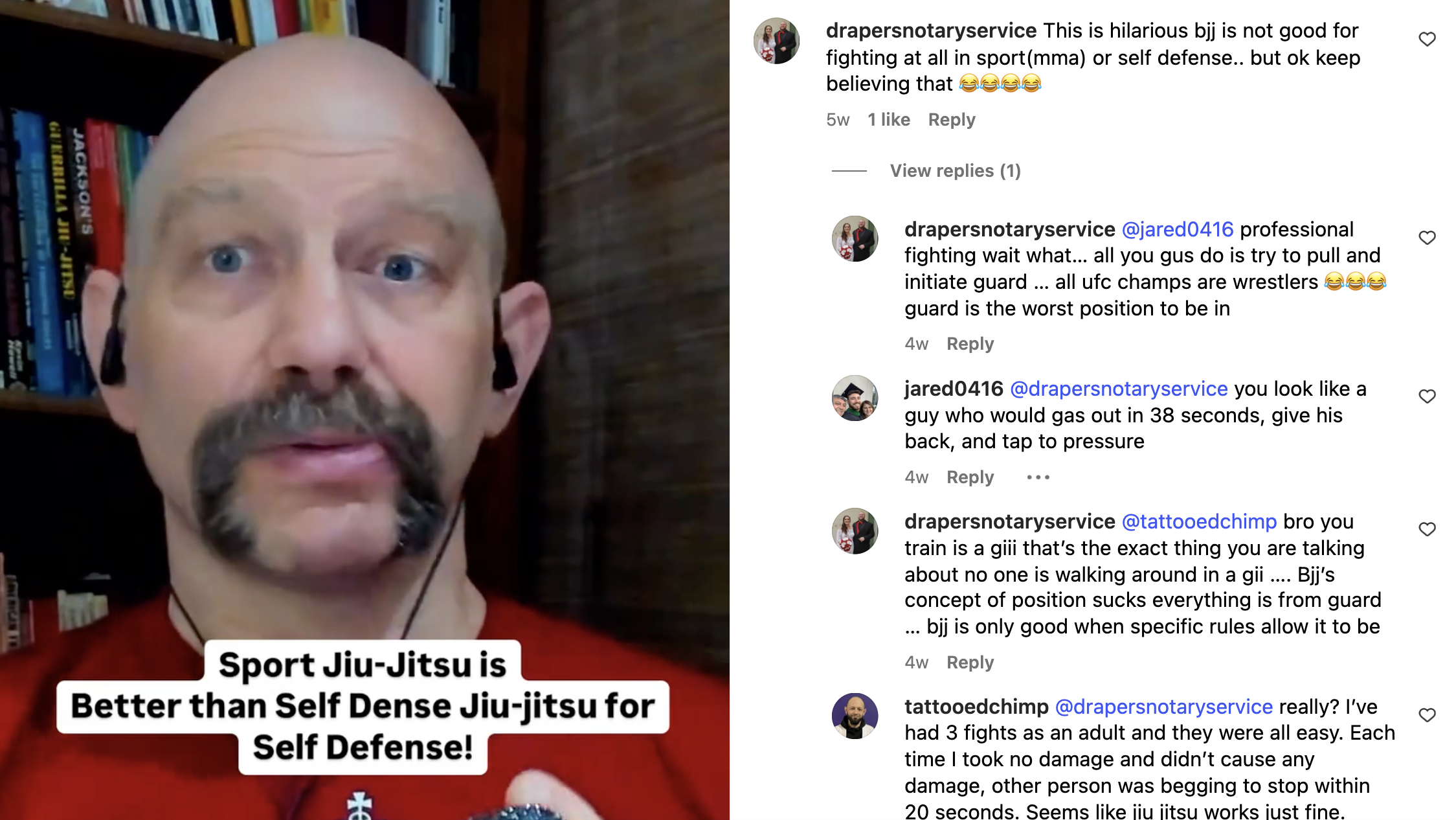
“I’ve said it before and I’ll say it again. If you had somebody who has only ever trained sport jiu-jitsu and they’ve done the most sporty of the sport jiu-jitsu – they’re only ever training berimbolos, crab rides and rolling back takes – that’s their whole game, but they’re training against resistance, and they compete, especially if they compete, they are 100 times better at self defence than a guy who just practices self defence techniques in isolation.” – Stephan Kesting
That’s a quote from the first part of this clip that has been making its way around the Internets from Stephan Kesting, one of the shining lights in the Brazilian Jiu-Jitsu community.
He goes on to say more, but the above quote is the essence of what he’s saying.
I completely agree with him, but not only that, I’m actually in the clip – I’m the guy with the glasses at the bottom of the screen.
This clip was part of the longer podcast we recorded I recorded along with my writing partner Seymour Yang (Meerkatsu) with Stephan about our new BJJ book, which is currently being shipped out to people that brought the pre-order.
Incidentally, the book is not on sale anymore, that pre-order was a limited run, hard back, collectors edition. We’ll probably release a softback version in the future on a similar limited print run idea, but we haven’t decided for sure yet.
But back to the clip.
Obviously, because this is the Internet and people can’t read or listen to something without immediately copying and pasting their own opinions about what they think he said, or wrote. So, this clip caused a bit of a ruckus online, attracting comments such as:
“This is hilarious BJJ is not good for fighting at all in sport (MMA) or self defense.. but ok keep believing that “
“I don’t know not all fights end up on the ground right away. And no one’s is gonna wait for you to sit down and start fighting. My complaint with some of the sports jiujitsu has to be Takedowns, it’s like they forgot to do takedowns.”
Now on their own there is some merit to the points being made, however they don’t refer to what was actually being said by Stephan. Let me reframe his statement in the way that Bruce Lee used back in the 1970s with his article called “Liberate Yourself from Classical Karate”:
Stephan is saying that the spontaneity and natural reactions that ‘live’ training will develop is worth 100 times what you’ll learn by practicing ONLY dead forms.
That’s the point, not the applicability of BJJ to self defence or whether all fights end up on the ground. And obviously it’s not an either/or choice, and there’s a lot of grey area in regards to marital arts triaining, but that’s the crux of the matter
Bruce framed the argument around the idea of live, spontaneous training vs repeating dead forms. There are a lot of great quotes in the article by Bruce Lee, but here’s a couple I particularly like:
“It is conceivable that a long time ago a certain martial artist discovered some partial truth. During his lifetime, the man resisted the temptation to organize this partial truth, although this is a common tendency in a man’s search for security and certainty in life. After his death, his students took “his” hypotheses, “his” postulates, “his” method and turned them into law. “
“Prolonged repetitious drilling will certainly yield mechanical precision and security of that kind comes from any routine. However, it is exactly this kind of “selective” security or “crutch” which limits or blocks the total growth of a martial artist. In fact, quite a few practitioners develop such a liking for and dependence on their “crutch” that they can no longer walk without it. Thus, any special technique, however cleverly designed, is actually a hindrance.”
To me the argument that Stephan is making and the argument that Bruce is making are different aspects of the same thing. It’s the ‘learning to swim by never getting in the pool’ analogy all over again. You simply can’t learn to swim without getting wet, no matter how great your theory of swimming may be.
We would all laugh in the face of a theoretical swimmer who only ever practices on dry land and yet we tend to revere the opinions of the theoretical martial artist far too strongly, especially if they have a cool uniform and a black belt with lots of stripes on it.
Personally, I find that the less I practice sparring in a week the stronger the need for coming up with solutions for theoretical situations becomes in my mind. The more actual resistive sparring I engage in, the less my mind craves these sorts of questions. Instead, I’ve actually got something useful to be thinking about, like how I would do a technique from that last round better, or how I would escape a particular situation that actually happened, next time.
Just imagine if you haven’t done any actual sparring for years. There are plenty of ‘martial artists’ like this. Their heads must be full of theoretical knowledge, most of which probably wouldn’t survive an encounter with reality. And all of which can be silenced with just a few seconds of actual sparring practice.
I wanted to share the process and journey of how Seymour Yang and I made our new Brazilian Jiu-Jitsu book.
First of all it’s worth noting we are both black belt instructors with many years of teaching experience. The book is aimed at beginners to developing white and blue belts and covers everything we felt was useful and relevant in today’s Jiu-jitsu club environment.
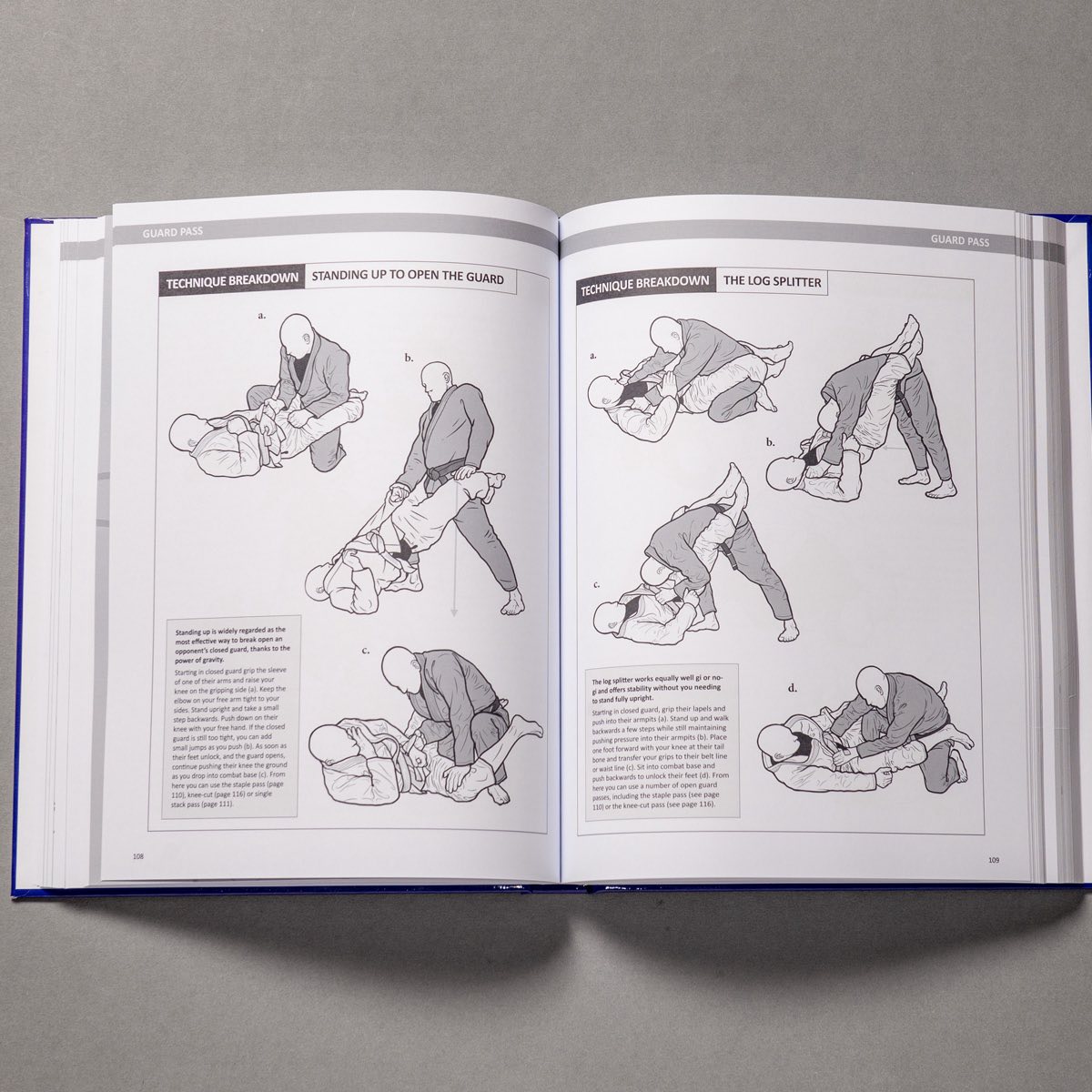
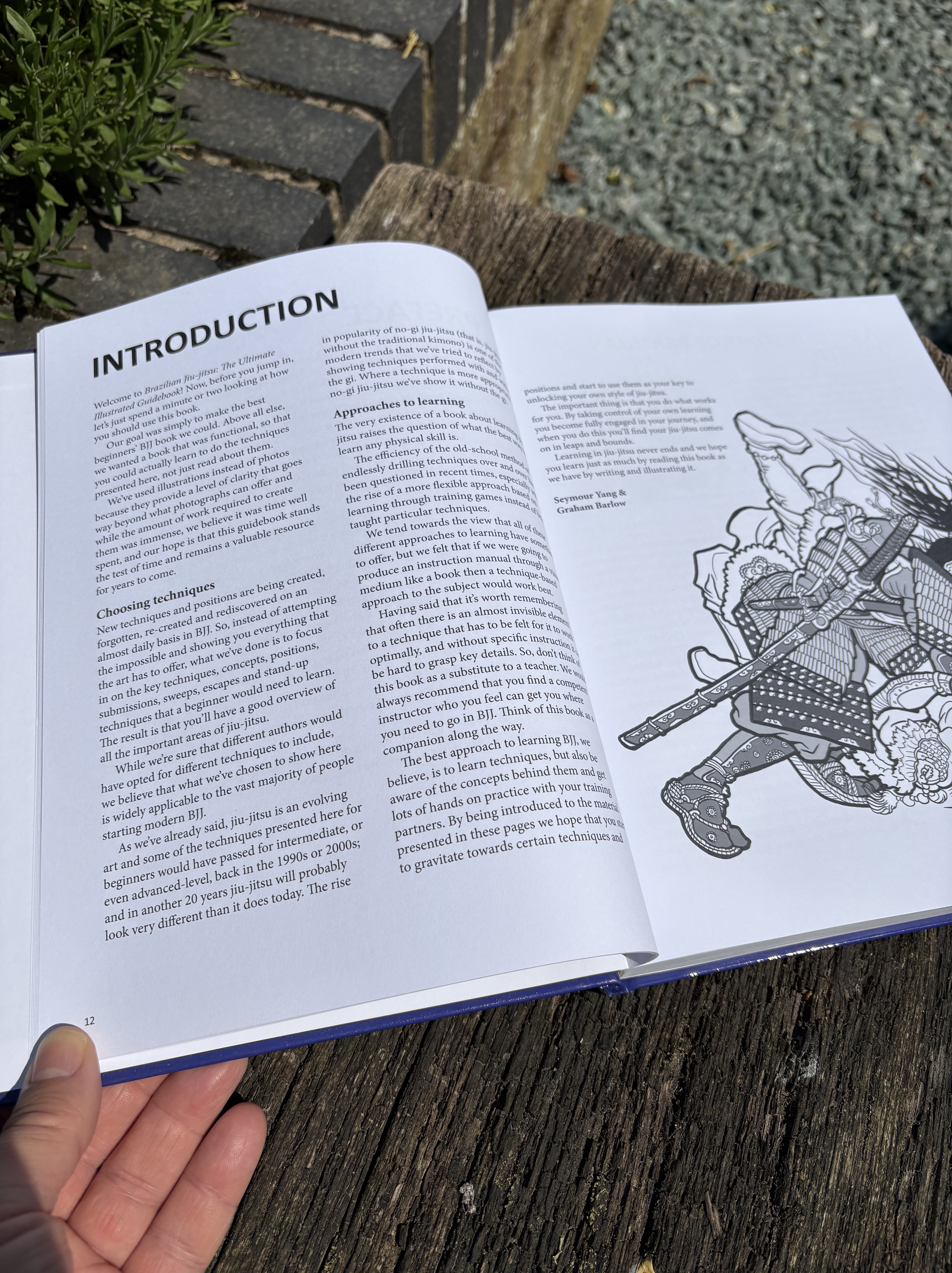
After much time planning and researching we then set about creating the contents. Every illustration is based on a photograph or video still that we took of our students or training partners. These stills Seymour used as references to hand draw the line art images. I then wrote the text.
That was just the beginning. The hardest stage was making sure the book was as accurate and tight as possible as a work of reference. For this we spent a long time proofing, editing and redesigning it. We then tested sample after sample from independent book printing companies to find the best one (we did not want to go the Amazon print on demand route)
I’m proud to say the book is finally available for our followers to buy (as a pre-order) and so far it’s proving very popular.
We decided to make it a pre-order as we just didn’t know quite how many to print in advance. A two week window was decided and after the pre-order window closes (June 11) we can then tell the print house how many to make.
If you want to know even more about how we made it then check out this informal 2 hour (2 hour!) video where we chat about making the book (it will be released in a more thoroughly edited audio-only version as an episode of my Tai Chi Notebook podcast shortly):
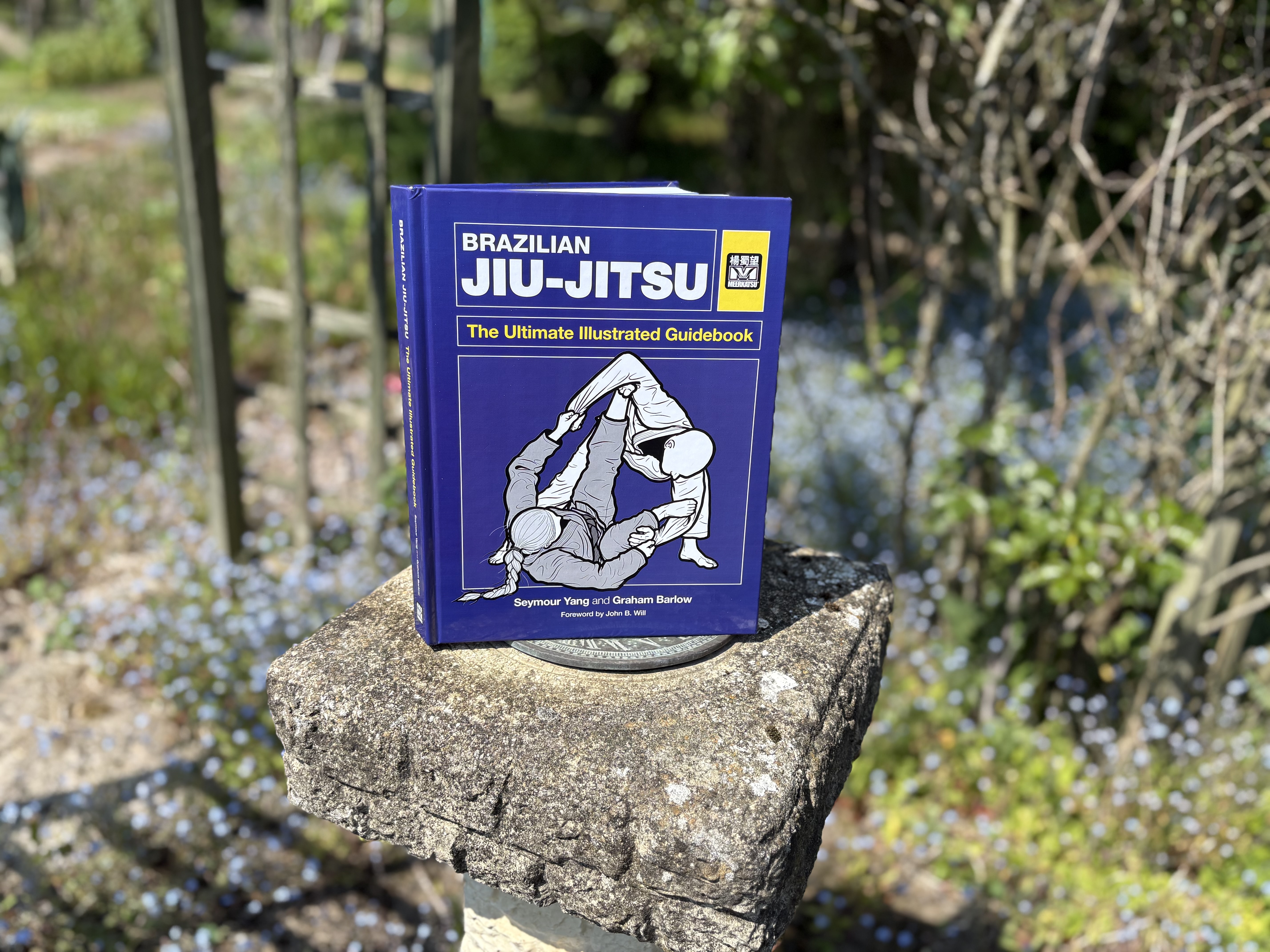
My co-author, Seymour Yang, and I have written a brand new BJJ book: Brazilian Jiu-Jitsu, The Ultimate Illustrated Guidebook, which will go on sale very soon.
If you want to see a free preview chapter, sign up to the Meerkatsu newsletter by visiting the website (Meerkatsu.com) and filling in the details in the pop up box.
The next newsletter will be released tomorrow (Wednesday 21st May).
A: Not confirmed yet but we will try to make it as affordable as possible for a premium independently published hardback book.
Q: How long will the pre-order last?
A: The pre-order window will last two weeks, then we send to printers to make the book (about two weeks), then we ship it out to you.
Q: What if I miss the pre-order?
A: We will print a few more books as spares and have them in stock but once they sell out, that’s it, they’re gone.
Q: Do you ship international?
A: Yes we do, see the drop-down list of destination countries in checkout.
Q: Shipping is gonna kill me, right?
A: See the shipping fee at checkout, it should cost no more than when ordering a kimono (it is calculated by weight).
Q: Will the book be available on Amazon?
A: Not in hardback form. This format will be exclusive to my store and when it sells out it sells out. But we may launch a softback version at some point later on. And this may or may not go on Amazon. We will see.
Q: Will you do an e-book version?
A: Maybe, we’ve not decided yet. We want this to be a tangible physical beautiful object you hold in your hands and cherish for years.
As some of you will be aware I’ve been working on a book about Brazilian Jiu-Jitsu for the last year, and well, that book – Brazilian Jiu-jitsu: The Ultimate Illustrated Guidebook – is finally finished, and will be available for pre-order very soon.
It’s a collaborative project with renowned illustrator and author Seymour Yang who goes by the brand name Meerkatsu, and is famous for his BJJ-themed illustrations, which are used in all sorts of BJJ clothing products like rash guards and gis.
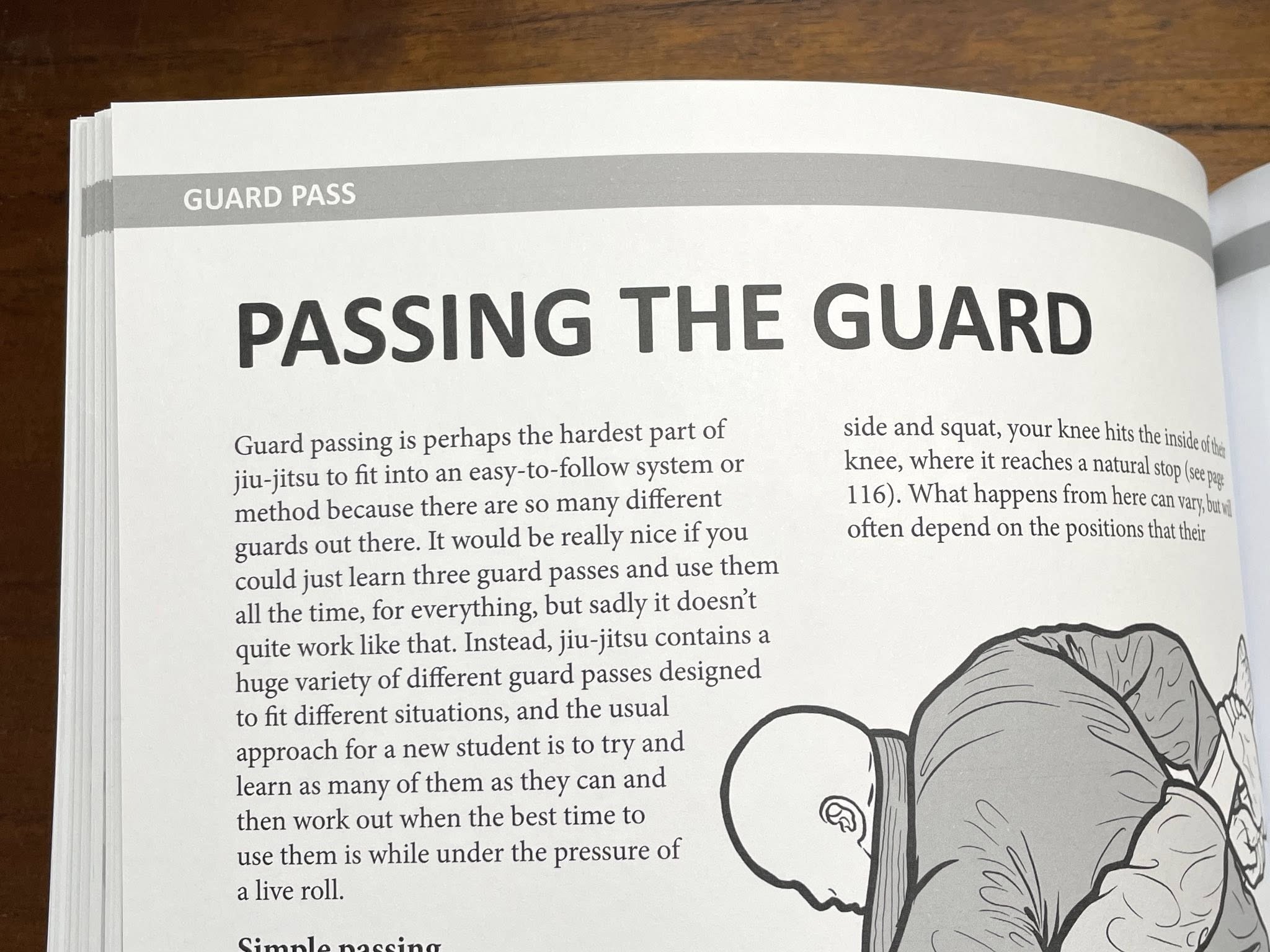
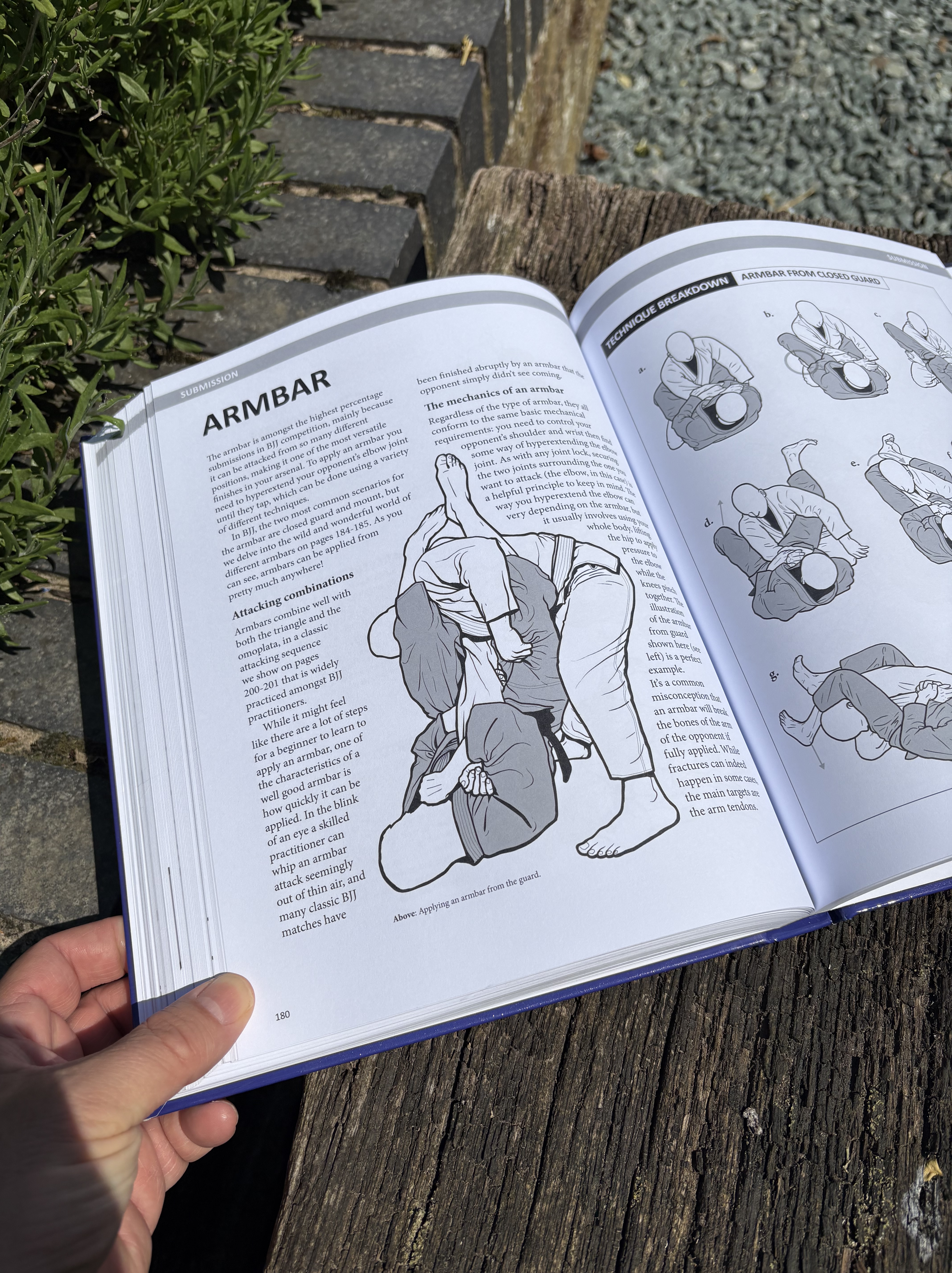
The book is a hefty hardback one-stop resource for everything a beginner, and even a more experienced person, needs to know about Brazilian jiu-jitsu. It contains over 260 pages containing over 970 hand-drawn illustrations that show each technique in detail. It covers all our favorite standup techniques, positions, different guards, guard passing, sweeps, submissions and escapes.
Get your free chapter!
Head over to meerkatsu.com, enter your email address into the popup box to sign up for the Meerkatsu newsletter and you’ll receive details on how to get your FREE chapter very soon.
This video has been doing the rounds online, showing some tai chi (taijiquan) fighting applications.
I don’t think there’s much to say about it, but it does perhaps prove useful for answering that question you get a lot: “can tai chi be used for fighting?”.
Let’s just try to say a few things about it though:
Firstly, he’s clearly just taking a tai chi posture (‘Play Guitar’) that looks very like that an ‘on guard’ position and using it in the same way a boxer does to parry and block punches. The hand he has by his chin he’s using in just the same way a boxer does their back hand to parry a jab. Is there anything wrong with that? Maybe not. You could use the posture like that, but is that its purpose?
Is that what that posture is designed to be used for? At this point, who knows. Usually you see ‘play guitar’ used as an arm locking posture, or combined with a foot sweep into a shuai jiao-style throw.
On the positive side, he’s actually getting the guy to throw the attacks properly, which is nice to see. Maybe they could be a smidgen closer together, so the punch would actually land, but compared to most applications you see from non-committal attacks, it’s not bad.
No, it’s not sparring, but not everything has to be. I don’t think it would look quite as much like ‘tai chi’ if it was sparring.
Finally, is there much ‘tai chi’ going on here? I’d be looking for smoothly flowing into sticking, yielding, and neutralising. He follows up a couple of times, but I don’t see much in the way of controlling the opponent here. The opponent is more often than not just blocked, and not controlled.
The bar for tai chi applications is pretty low. There are too many videos of people bouncing away at the slightest touch to muddy the water, so I think we have to say that this is at least a step in the right direction.
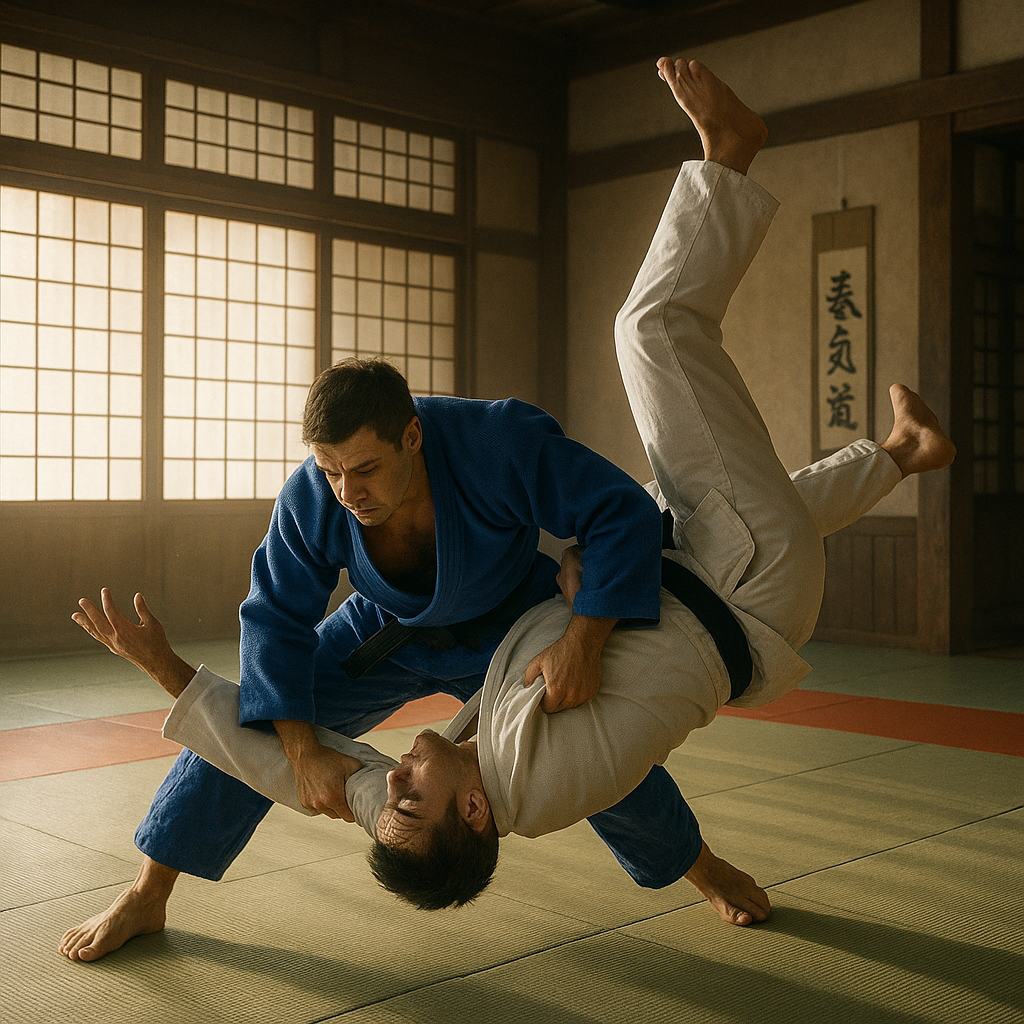
Judo and (Brazilian) Jiu-Jitsu might have exactly the same origins, but they’ve gone down really different paths in their evolution. While Judo has focused more on the sporting elements and becoming an Olympic grappling sport, BJJ has always wanted to keep things closer to its Value Tudo origins, which evolved into modern MMA.
Even today, many BJJ classes have a strong self-defence element, however BJJ is a broad church and some associations and classes are much more orientated towards sport grappling, particularly the no-gi variation.
One of the frequent criticisms of modern Olympic-style judo was that it had sacrificed too much realism in pursuit of beautiful big throws in competition. One way it did this was to make any grab of the pants or legs illegal. This seemingly simple rule change had dramatic effects on the sport. Since the legs were no longer a target the stance of judo players became more upright in their stance, leading to more possibilities for big dramatic throws.
Remember, under Judo rules a match can be won with an Ippon, a throw that lands the opponent on his or her back. In BJJ no such rule applies – a spectacular throw simply earns you two points and the match continues.
All Japan tournament rules
I hadn’t noticed before, but there has been a recent rule change in judo, in a particular Japanese tournament called the All Japan Championship, that means you are allowed to grab the legs again, opening up a whole range of possibilities for long-forgotten judo techniques to make a reemergence.
There are some restrictions though. To grab the pants you have to have a grip on the upper body with one hand, and you cannot grab the legs with two hands. This rules out popular BJJ and wrestling techniques like the single leg or double leg.
Will the new rules get adopted by wider judo federations and ultimately the Olympics? It’s unclear at this stage, and too early to say, but it will mean that going forward, judo could end up looking very different to the way it does now.
Traditional martial arts, which are perhaps better described as “martial arts that are not sports”, tend to have a lot of forms, or kata. I’m thinking of karate, tai chi, wing chun, choy li fut, etc.
But what exactly is the role of kata, or forms? And has it changed over time?
In this new episode of the Heretics podcast I discuss the role of kata with Damon Smith who has extensive experience in various martial arts over decades.
It certainly became very trendy once MMA became a big deal to describe forms as useless, however, I think they do have uses, even today. As usual Damon has some pretty interesting insights into how forms have changed over time, and he can look back to the way they used to be trained in the 1980s compared to today.
Mike Sigman’s post on qi has made me want to think more about jin and qi again. I realise I haven’t been posting about it very much recently – partly because I’ve been distracted by writing a book about BJJ – but now the book is finished it’s time I came back to the subject. I read another post Mike made recently on his 6H group about pushing against a wall, which I think is a brilliant idea, because it’s so simple.
In a way this post is just me writing it out in my own words as an exercise, so I can understand it, and contextualise it a little more in terms of my tai chi practice.
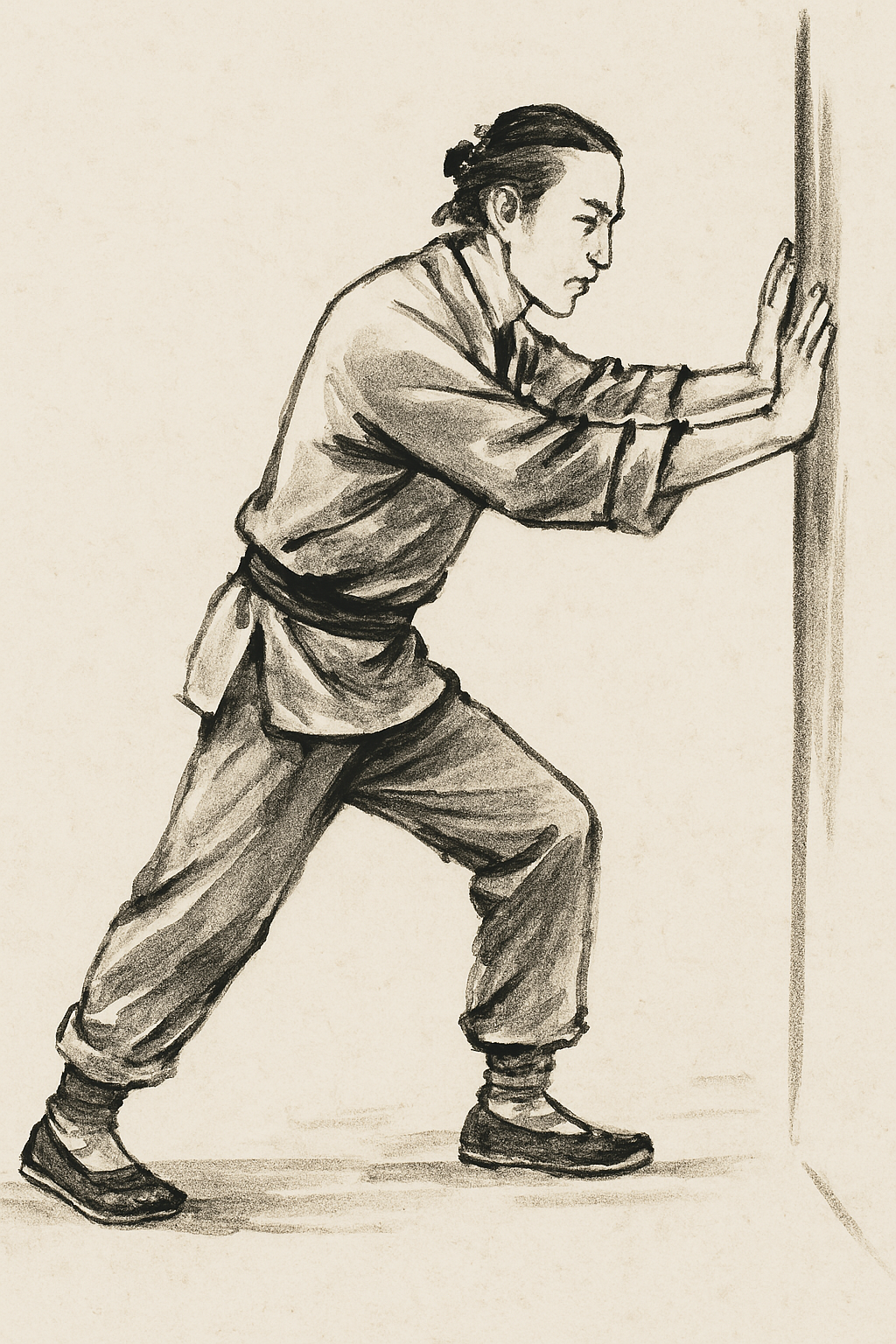
Pushing is a big deal in tai chi because it features so prominent in the form – one of the four ‘energies’ of tai chi is called push in English, which (as I discussed with Ethan Murchie in my last podcast) is confusing since the translation of “an” into English is more accurately to “press down”, which isn’t what the push posture in tai chi looks like, or how you’d push a wall.
An AI-generated tai chi ‘push’against a wall
Pushing is also part of tai chi’s two person exercise, tui shou – “push hands”. So most tai chi people are pretty familiar with the concept of pushing.
Now imagine you are pushing against a wall and somebody asked you to push harder. Most people would simply push harder with their arms and lean harder into the wall. What you’ll feel when you do this (try it) is that it pushes your upper body backwards and away from the wall quite a bit because it’s impossible to push hard with your arms without introducing excess tension into the system.
This is the “you’re using your shoulder too much!” criticism that a lot of tai chi teachers sling at their students, without really explaining how not to push using the shoulder.
So, let’s look at exactly how you could push harder without using the shoulder.
The only another way to increase the power of your push is to increase the downwards power through your legs. Now, it’s pretty hard to push downwards with your legs, since we have nothing above us to push off from if we want to push downwards. Instead, all we have in a downwards direction is gravity, so how do we use that gravity power? The answer is to relax and sink down into your legs harder.
Put your hands on a wall and try it.
As you sink and relax more through the legs you should feel the power in your arms increasing.
What you’ll notice is that you have to internally align your body correctly for this power to reach your hands. The good news is that you don’t need to think very hard to do this, you can just feel how you need to arrange yourself and your subconscious will do the rest. But you need to properly relax. If you tense up parts of your body – your shoulder being the main culprit – the power won’t slow smoothly and uninterruptedly through the body to reach its destination.
At this point you should start to realize why the word relax (or “sung” in Chinese) is said so often in tai chi practice.
That path from floor to hands is what you’d call a ground path, or a jin path. And the force you are channeling into your hands is known as jin in Chinese. The usual English translation of jin that you see used is “refined strength”.
Again, don’t get hung up with where the path goes through the body, just where you want the force to go.
You should also notice that as the jin force in your arms increases, you don’t get knocked or pushed backwards as easily as you did when you were using brute strength, because there is less tension in your upper body.
Obviously you are not going to push a wall over! But you can now feel the forces in your body that we should be dealing with when doing the tai chi form, and hopefully when you do “push” in the form, your push will now be a little bit different, more refined, a little less clumsy and a lot more tai chi-like.
 The Tai Chi Notebook