There’s a new episode of the Heretics podcast out. In this chat, Damon and I discuss Shuai Jiao, the popular modern Chinese wrestling style and try and separate fact from fiction. We discuss what martial arts it is related to and also if there is a connection to Japanese Kempo.
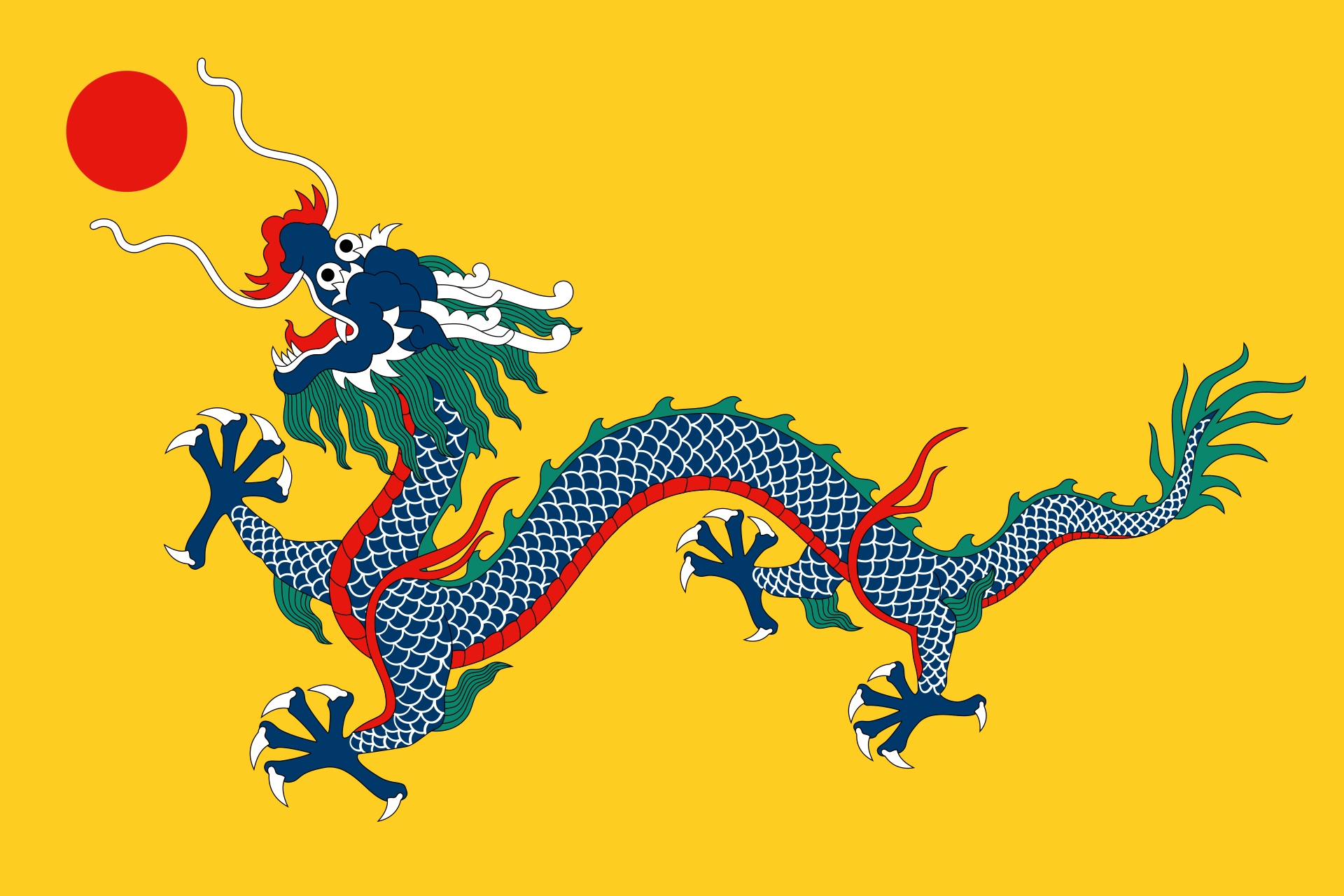
The best thing about this episode is that Damon talks a lot about Chinese cosmology, and how it may related to an earlier form of Chinese wrestling – we look at the cosmological concept of Qinglong, or the Azure Dragon.
The Azure Dragon on the national flag of China during the Qing dynasty, 1889-1912:
Saeed Esmaeli is my favourite wrestler, so I thought I’d share a couple of clips of him. I love the fact that he’s currently working out of a church with his classes, as you can see in his Instagram clips:
I like the way he’s emphasising using the whole body in his movements, not isolated leg and arms, much as we are encouraged to do in internal martial arts. “Wrestle with your hips, wrestle with your body”.
Wrestling arises spontaneously in every culture all over the world. Saeed’s branch has its roots in Iran. The story of how he comes to use a church is explained in this article from the Bristol 24/7. “THE UNLIKELY BOND BETWEEN AN IRANIAN WRESTLER AND A BRISTOL VICAR”
“Rather than striking, Pahlevani wrestling teaches students the art of grace under pressure, a great metaphor for dealing with the pressure that life can throw at us and one that reverend James Wilson can get on board with.
St Gregory the Great on Filton Road in Horfield officially opened its heavy oak doors to Wrestle for Humanity, a unique community Olympic wresting club and mental heath intervention service run by coach Saeed Esmaeli, whose mission is to make wrestling accessible and to help people feel good and perform well both on and off the mat.
Having experienced war, revolution and poverty, Iranian-born Saeed has overcome racism, bullying and grief and understands adversity. He brings a message of hope in his ‘infused psychology’ one-on-ones and in every community wrestling class.”
Byron Jacobs is a teacher of Xing Yi and Bagua based in Beijing, China. He’s a student of the famous Shifu Di Guoyong and is heavily involved in the martial arts scene in Beijing. As well as training traditional martial arts he’s also a BJJ practitioner and competitor.
In this wide ranging discussion we talk about training Xing Yi, Bagua and Tai Chi and whether Wu Shu will ever get into the Olympics. We also find out what it was like to train martial arts in Beijing during the Corona virus pandemic, and what the Chinese BJJ and MMA scene is like.
After battling hard through various technical challenges I’ve finally managed to create a Tai Chi Notebook podcast with humans on! (Previous episodes of my podcast have been a robot voice reading my blogs). I’m pleased to have my good friend Daniel Mroz on board for my first real episode where we have a conversation about what Chinese martial arts might be.
You can find it on all the usual places you find podcasts – search for The Tai Chi Notebook on Apple podcasts, Spotify, etc.. or here’s a link:
What is the relationship between Chinese martial arts and Chinese theatre, religion, mime, serious leisure activities and military tactics? How do all these factors intermingle and produce the arts we have today? In this wide ranging discussion between Graham Barlow of the Tai Chi Notebook Podcast and Daniel Mroz, Professor of Theatre at the University of Ottawa we tackle all these subjects and more. As well as being a professor of theatre, Daniel is also a Choy Li Fut and Taijiquan practitioner and has spoken at the Martial Arts Studies conference and contributes articles to various journals including the Martial Arts Studies journal.
Podcast Notes
1) That Daniel Mroz quote in full:
“By ‘Chinese martial arts’, I refer to folkways that began to assume their present forms from the mid 19th to the early 20th centuries, at the end of the Imperial, and the beginning of the Republican periods of Chinese history. These arts train credible fighting abilities through exacting physical conditioning; through partnered, combative drills and games; and through the practice of prearranged movement patterns called tàolù 套路 (Mroz, 2017 & 2020). For millennia, up end of the Imperial period in 1912, China explicitly understood itself as a religious state (Lagerwey 2010). Communities across China not only used their martial arts to defend themselves, they performed them as theatrical acts of religious self-consecration, communal blessing, and entertainment in an annual calendar of sacred festivals (Ward, 1978; Sutton, 2003; Boretz, 2010; Amos, 2021). Modernization, and secularization at the end of the Imperial period removed the original context of these practices. The Chinese martial arts were transformed over the course of the 20th century by both their worldwide spread, and by their ideological appropriation by the Chinese Republic of 1912, and the Communist state that succeeded it in 1949 (Morris, 2004). Their religious heritage forgotten in many social, and cultural contexts within greater China, and internationally, the arts we practice today combine a legacy of pragmatic combat skill, religious enaction, participatory recreation, competitive athleticism, and performed entertainment.”
I’ve been listening to, and really enjoying, Dan “The Outlaw” Hardy’s recent interview on the Raspberry Ape podcast. With a background in traditional martial arts, Dan was a pro MMA fighter and official UFC commentator.
Warning! It’s long. Over 3 hours, in fact, it’s almost 4 hours long.
The issue of how long a podcast should be is always a contentious one – you hear a lot of people say it should be as long as a commute to work, so 20 minutes to half an hour, but I have no objections to something like this one, which weighs in at over the 3 hour mark. I’m an adult – I can handle the idea of not listening to something all in one go.
Dan has a lot to say about the current state of the UFC, MMA, traditional martial arts, combat sports, capitalism, the old days, growing up and more. It’s quite a run through of various related topics. His thoughts on self defence, violence and the place of MMA in society I thought were particularly interesting.
A glorious analysis of Carl Douglas’ smash no.1 hit around the world, Everybody was Kung Fu Fighting, by Prof. Paul Bowman, proving once again that things do not need to be beyond a certain level of complexity to be an important cultural document.
You can get this on audio too, but you really need to watch the video as a lot of this is relying on visual performance of the song.
This episode explores the connection between the martial arts of the great Song generals’ tradition and Chinese theatre, which emerged during the height of the Yuan Dynasty.
Xing Yi Part 13, The Water Chestnut Mirror
I would also recommend this short, funny and smart crash course on Chinese Theatre as background ‘reading’:
A lot of the “x number of shoes, y number of hairdos” regulatory stuff was added later by the Confucians from the Ming onwards. In the Yuan it was much more Vale Tudo in spirit 🙂
To see some Yuan Dynasty plays we talk about in action I’d recommend this page, which also gives some more background on Yuan Zaju plays.
A mural from a temple in the Shanxi province, dated 1324. It shows zaju actors and musicians. Image source: The Archives of Finland–China Society.
I quite often see this written in Xing Yi discussions:
“The animals are just variations of the five elements”.
I should probably just let it go, but I can’t. This idea that Xing Yi’s 12 animals are just variations of the 5 element fists has become so ubiquitous now that it’s almost impossible to counteract. And, of course, it’s true in a very basic sense, but it’s far from the whole story of Xing Yi, and it creates a misleading impression of what the art really is. It’s also buying into the whole reductionist movement in Chinese martial arts that happened in the 20th century, performed by both the Republic of 1912 and the Communist state of 1949, when these rich, smokey, traditions turned into somewhat culturally bland, ideologically driven, if athletically more challenging, versions of themselves.
If you look at a sample movement from the Xing Yi animals, like say Tiger, (firstly there’s the problem that this animal has been reduced to but a single movement in most lineages of Xing Yi, but let’s ignore that for now), you’ll see that it consists of a kind of aggressive double-palm push, or strike, to the chest, repeated over and over. The way the push is done is clearly related to Pi Quan (Splitting) from the 5 element fists, which also uses a palm to strike, so I can see why this generative view of the relation between elements and animals is so popular.
Take the wood element – Beng (often called crushing fist). It’s a straight strike, like a spear thrust, usually to the body using a strong opening and closing action. Again, it pops up all over the animals: For example, you could look at the double fist strike seen in Tai Xing – another of the 12 animals, and say that it’s a variation of Beng using both fists with a particular fist shape. (You can extend the knuckle of the middle finger in Tai).
Viewed like this it does start to look like the elements came first, but what I believe really happened in the historical development of Xing Yi was that somebody (one of the Dai family or Li Luoneng, who learned from them, are the most obvious candidates) created the 5 elements out of the pre-existing animal movements as a way to teach beginners.
(Historically we can say animals came first with some certainty, since an older lineage known as Xin Yi Liu He has the animals, but not the 5 elements).
Most of the animals in Xing Yi and Xin Yi have a kind of downward cutting Pi action, just expressed in different ways. By identifying it and using it as one of the 5 elements, and practicing it in isolation away from the complexity of the animals you have a way ‘in’ to Xing Yi, so it’s quite useful. You have something simple that you can practice over and over again.
So, it’s not like the elements aren’t a useful addition – they are. And you might be left wondering if it really matters which way you view the relationship between Xing Yi’s animals and elements?
Our podcast on the history of Xing Yi has been gently making the case that Xing Yi grew out of the ideas contained in the Li movement in the Song Dynasty, which was a turning back to nature and the natural way of things. Xing Yi as I generally see it being practiced today isn’t a nature-focused martial art anymore. That time has gone, and the focus on nature was stripped out a long time ago, from the start of the 20th century onward. It’s an understatement to say that in nationalist and communist ideologies, taking inspiration from nature and the natural world is not a popular idea. The concept of an animal-based martial art didn’t really fit in a China where people could live or die based on their belief in abstract political ideas. These things were understandably more ‘real’ to the average person than the natural world around them. So, the martial arts were changed accordingly.
That leads on to the obvious question – if you aren’t practicing a nature-based martial art anymore then what’s the point of fussing about the place of animals within it?
I think that’s for the individual practitioner to answer for themselves, but I’ll just leave you with this thought – nature-based martial arts are, or should be, reality-based martial arts. They should be grounded in the way the real world actually functions, and not in the world of concepts about the way we think the real world should be. The modern trend in China for (self proclaimed) Chinese martial arts masters to take on challengers trained in fight sports and get a good pasting can be seen as an example of what happens when ideology hits the nature of reality.
I seem to have entered a little phase of practicing Tai Chi in the morning then immediately doing some Xing Yi straight afterwards. I’ve never really been into doing Tai Chi especially slowly, as some people seem to love to do, but the contrast with Xing Yi straight after has really accented the speed differences, and it’s made me think about the strategy of each art.
Reflecting on the reflections at today’s practice spot.
Tai Chi forms are performed much more slowly than Xing Yi links. We all know that Tai Chi should be done slow-ish, but how fast should Xing Yi be? Because it’s an “internal art” (check out my podcast for some thoughts on what that means) people often think that Xing Yi should be done relatively slowly too. My teacher recalled to me a story of one of his teachers who would always shout at them “Faster! Faster!”, whenever they did Xing Yi. The rule was, the faster, the better. They could never be quite fast enough to satisfy him.
Xing Yi works as an intercepting art – ideally you want to be attacking inside the opponent’s attack. It’s a very different approach to standing your ground and trading blows with an opponent. Once you’re ‘inside’ their attack you want to keep on pressing forward, which is why Xing Yi ‘forms’ are generally done in a straight line. The hardest thing is getting that inside position, but once you’ve got it you don’t want to give it up until you’ve got in several decisive blows, all the while moving forward with full body connection. Nobody said it was an easy strategy to achieve, but that is the strategy.
Doing Xing Yi quickly helps you develop that fast footwork you need to rush forward when required, without falling into disaray. It says in the Xing Yi classics somewhere that when standing you want to stand like a mountain – solid, unmoving, but when it’s time to move you want to move like the sound of thunder or a landslide.
Tai Chi – at least the Yang style and its sub-styles – in contrast seems more interested in doing as little work as possible. Relaxing, using natural body motions and letting your body weight do the work are the order of the day.
When you do Tai Chi you shouldn’t really be getting out of breath*, when you do Xing Yi you should. As such the two arts compliment each other nicely.
There’s a great article on Jiujitsu Style about the late, great, Anthony Bourdain and his love for BJJ, which he took up later in life. Over four years, Bourdain posted on the BJJ Reddit forum, r/bjj, as NooYawkCity 80 times before his death. He wasn’t doing it to promote a book or new TV show. He was just doing it because he loved BJJ, and his writing was real, honest, unflitered and above all, relatable.
Here’s an example:
“58 years old and getting so gassed during warm ups, that when we start to roll, I end up sticking my own head into an obvious guillotine –just to take a break. An utterly humiliating class yesterday, yet showed up for a private today with 250 lbs of muscle and bone so I could get pounded like a chicken fried steak . Why am I doing this? I don’t know. I’m like a dope fiend at this point. If I can’t train I start going into withdrawal. Wander around, twitching, restless and pissed off. At least with dope, you feel GOOD afterwards. After training, I feel like a rented and unloved mule . All the other (much, much younger) white belts all seem to be coming back from long breaks because of injury. Strangely enough, so far so good for me. I may feel like a fragile box of stale breadsticks but I’ve managed to avoid injury (if not discomfort). I have never enjoyed pain. I don’t care if it’s Gisele Bunchen coming at me in thigh boots wielding a riding crop, I’m not interested. Yet I insist on getting squashed on the mats every day and feel bereft if I can’t. This is not normal. When I talk about BJJ , Old friends look at me like I have an arm growing out of my forehead. But I Won’t stop. Can’t stop.” – NooYawkCity, July 9th, 2014






 The Tai Chi Notebook