How do I raise the spirit of vitality?

“Could you tell me if there is a specific exercise to raise the spirit of vitality?
Or could this be just any exercise at all rather than a specific one?
I have been learning tai chi and it talks about Spirit/Shen and its importance,
but I haven’t a clue exactly what it means. I know to feel full of spirit means you feel on top of the world and ready for life- this is what I would like to feel.”

Well, that’s a tricky one to answer. You have to ask what is meant by “spirit”. In the Mongol language, for example, there are a whole plethora of words that in English would translate in “spirit” and they all mean something slightly different. The Chinese word “shen”, I think, could be translated into several different English words depending on context. In English we have to add more words to a sentence containing “spirit” to add context. For example, “spirit of vitality” – this would be the sense of feeling full of energy and ready to face the world that you talk about. But there are other words that we translate as “sprit” that have all sorts of meanings, from the mundane to the profound – and all slightly related. For example to “raise the spirit” can mean something as mundane as keeping the posture upright with the head up, or as profound as the creative realm of the tree of life.

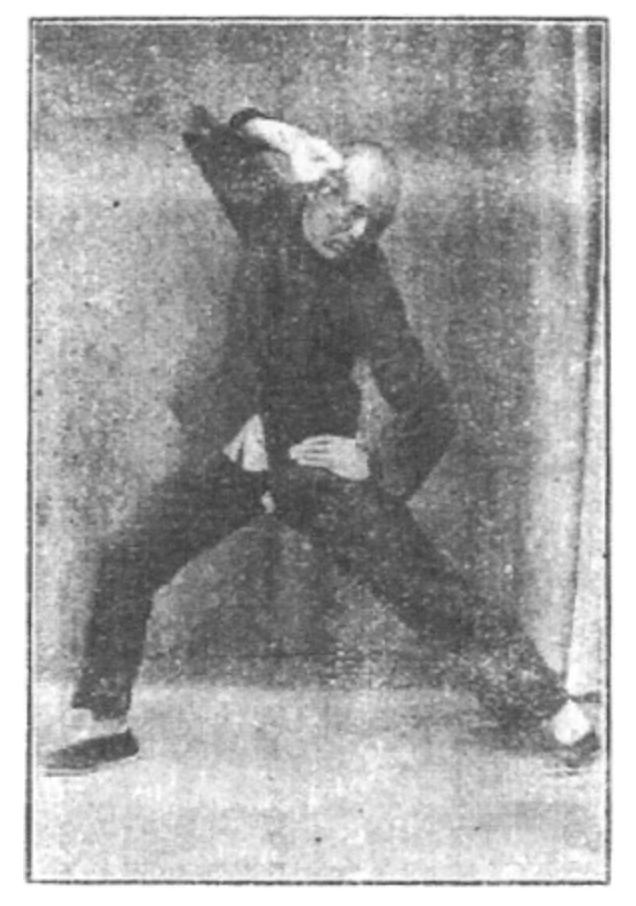
This idea of being upright (physically, mentally and spiritually) is a big thing in Tai Chi – we are told to “let a light and intangible energy raise to the head top” in Yang Cheng-Fu’s 10 Important Points.

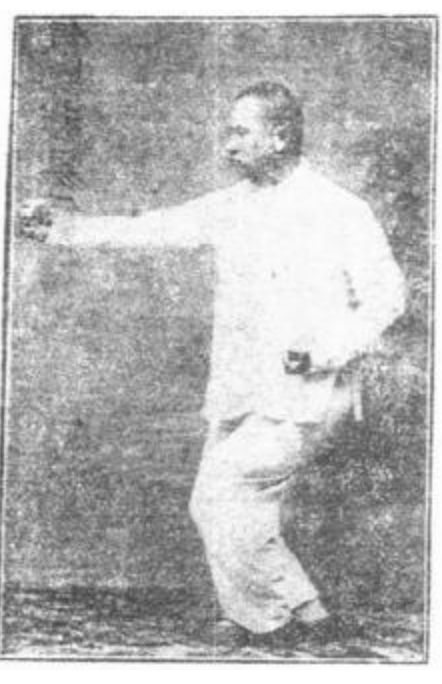
Yang Cheng-Fu

So, to get to the other part of your question – how to do it. There is no specific exercise for raising the spirit of vitality. Rather, it is a part of the postural requirements of Tai Chi, so it should apply in all exercise orientated towards Tai Chi practice. You want to feel as if your head if being pulled up by a thread from the crown point (between the tops of the ears). The result should be that the back of your neck gently lengthens and the chin tucks in. As always, you don’t want to achieve this posture with force, so don’t push your head into it. You should find that if you stand, focus on your breathing, generate that lightweight observation of self that is required in Tai Chi, your head and neck posture should naturally want to assume this posture.

Everything in Tai Chi works together. If you are breathing well, then it will encourage your posture to be upright and strong, which in turn will encourage you to ‘raise the head top’. If you can remove stress and tension from the body then the weight will sink down simultaneously, so you should feel strongly rooted into the ground and drawn up from the crown at the same time. These two pulls in opposite directions provide balance. You are separating yin and yang in the body – again, another part of the Tai Chi process.

I hope that helps.

Xing Yi Stepping Basics

One of the hardest things I think that there is to convey in Xing Yi, to the perspective new student, is how the 5 fists work with the stepping. All the time I see people doing the arm positions of the five fists in a highly stylistic and precise way, but the body isn’t right. If the body isn’t right then the fault can usually be found in the legs and waist, and most likely it’s the stepping. In Xing Yi your stepping is the delivery system for the power of the body.

The words of the Xing Yi Classic of Unification apply here:

“When the upper and lower move, the centre will attack.
When the centre moves, the upper and lower support,
Internal and external, front and rear are combined,
This is called “Threading into one”,
This cannot be achieved through force or mimicry.”

i.e. everything moves together, as one.

In this video I look at some of the common faults I see in Xing Yi stepping, which could be described as problems of partiality. First, the foot arriving before the hand, then the hand arriving before the foot, and finally the foot and hand landing (i.e. finishing their journey) at the same moment with no penetration.

The real Xing Yi stepping is deeper and more penetrating. You’re hitting the person (or bag) while your front foot is still in the air, as you move through them, displacing their mass. That’s the trick.

(N.B. this style of striking in Xing Yi is more popular in the Hebei style – other styles of Xing Yi have different specialties).

Are weapons forms more traditional than hand forms?

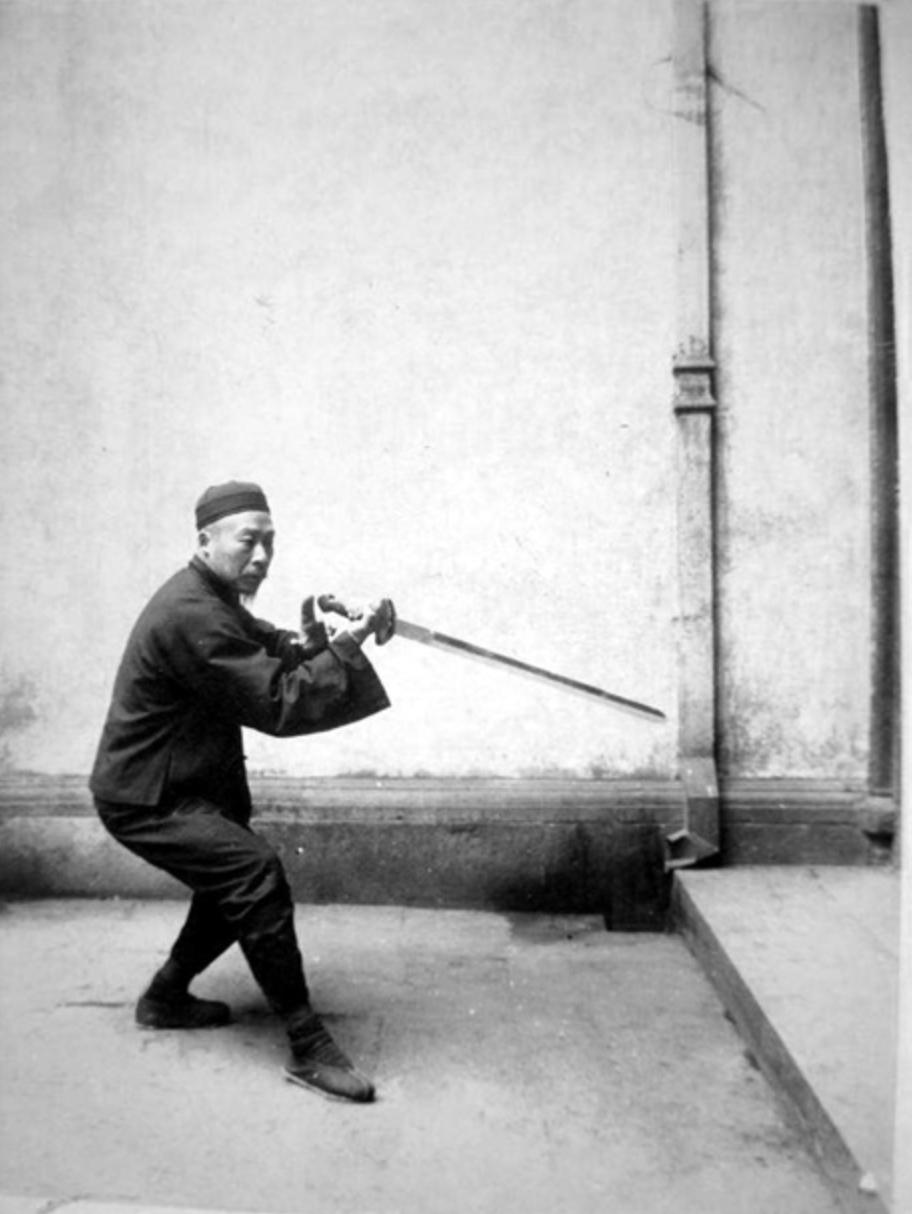
(Chen Wei Ming – Tai Chi Sword 1928)

I listened to a rather interesting comment in a podcast recently from a Tai Chi practitioner who preferred to do weapons forms rather than hand forms because “Tai Chi is really a battlefield art” and the postures in the hand form are clearly derived from holding weapons, and it was therefore more authentic to practice the weapons forms. The implication is also that the hand forms were retrofitted onto the art, while the weapons forms are the true origin.

There’s some truth in this idea depending on which art you art talking about, of course. Xing Yi for example – there’s no doubt that the weapons forms came first. Doing a Beng Chuan (a straight punch to the belly or chest area) barehand, as presented in the classical 5 Elements form, leaves a lot of questions unanswered – why is your head not protected as you punch forward, for example? Why is your other hand pulled back at your hip where it’s not doing much of anything? What stops them punching you in the face?

(Liu Dianchen, Beng Chuan, 1921)

As a barehand method, it’s clearly sub-optimal. Put a spear in your hand, and even better, wear armour, and  it starts to make a lot more sense though. The hand withdrawing to your hip is pulling the spear back after a thrust, for example.

But if we’re talking about the long, elaborate weapons forms found in Tai Chi, done usually in silk pyjamas, then you’ve got to ask yourself – what good is all that dancing about if your goal is martial effectiveness on the battlefield? Do you think Chinese soldiers, village militia or bodyguards with spears or Guan Dao did this kind of practice? I don’t think they did. Or maybe they did for demonstrations at the many and frequent festivals in old imperial China in the Qing Dynasty, but what use is all that on a battlefield?

While using a spear, for example, might be connecting your art back to an earlier time and usage, I’m not sure that your 180-move spear form, with jumps, twirls and spins is any more “authentic” than a modern day hand form. 

It’s very easy to fool yourself in Chinese martial arts. Stay sharp!

Getting lost in words like Qi and Yi

Photo by Happy Pixels on Pexels.com

I was observing the usual argument/discussion between two people about ancient Chinese words like Yi and Qi that frequently happen in Tai Chi circles, and it was going down a familiar route..

“Don’t lecture me! I read classic Chinese and Yi means ‘idea’ and Qi means ‘movement’.”

“Really? Wang Yongquan wrote ‘To mobilize Qi, you create an empty space, by Soong and a light Yi to empty the area. The differentiation of yin and yang is what makes Qi flow.”

“Seems quiet different then…”

Confused! Photo by Oladimeji Ajegbile on Pexels.com

And on and on and on…

Recently I had a conversation with a very experienced Chinese martial artist (it will be released as a podcast soon, don’t worry) about how these things are trained in Asia vs how we do it in the West. 

He made the point that in the West we have to understand something intellectually before we will do it. i.e. we have to know we’re not wasting our time, that we will get something out of this. It has to ‘make sense’. And we usually ask loads of questions before even trying it. In contrast, in Asia, there is a lot less questioning and a lot more doing. You just do it. If you’re doing it wrong you hope your teacher will notice and put you on the right track. But generally you just keep doing it secure in the knowledge that eventually you will get it. It’s all in the feel. If you have the feel right, then you are doing it. End of story.

Nowhere is this distinction between the Eastern and Western approach more clearly represented that on discussion forums about Tai Chi that are full of Westerners. We love to argue about what these ancient concept and words like Qi, Yi and Xin really mean. As if one day we will arrive at the ultimate answer. It seems we can’t get enough of it. 

But here’s the secret: it doesn’t matter how you define these words, what concept or theory you use for their implementation, or how well you read Classical Chinese from the Ming Dynasty. What matters is – can you do it? Can you show it to me?

If I said, “Show me your Yi. Let me feel your Jin” Could you do it?

If you can then it doesn’t matter wether you define Yi as “idea”, “mind” or “intent”. I’m sure we’re all familiar with the famous phrase coined by Polish-American scientist and philosopher Alfred Korzybski, who gave a paper in 1931 about physics and mathematics in which he wrote that “the map is not the territory” and that “the word is not the thing”, encapsulating his view that an abstraction derived from something, or a reaction to it, is not the thing itself.

So, all these online arguments about Qi and Yi, are effectively pointless. They are map, not territory. However, I do think that a little intellectual understanding can be useful. Especially if it stops you asking questions long enough to just practice. Also, there’s always this temptation to think that if I can just understand something perfectly, or write it down in the perfect, most simple way, then eventually everyone will go “Yes! That’s it!”

Anyway, as I was practicing this morning a thought popped into my head which I thought felt right, so I thought I’d write down and share it:

“Yi is the direction you’re sending your mind in, and the Jin follows.”

To me, Yi is always about a direction. And it is directed. It’s the opposite of a vague, warm, fuzzy haze. It has a steadfastness and a focus. There. Did that help? Or did it just make you more confused. Answers in the comments section please. If you have your own pithy phrase to summarise a concept as subtle as Yi that works for you, then feel free to add it below.

I’ve written before about Yi in Tai Chi Chuan. So, you can have a read of that too.

Can traditional masters beat MMA?

Friend of the Notebook, Byron Jacobs, who runs the Mu Shin Martial Culture Youtube channel and the Hua Jin Online Learning Program for Xing Yi and Baguazhang, just posted this monologue about Xu Xiaodong and the challenge matches that happened between him and various (self proclaimed) Chinese martial arts masters.

Now we’re a few months/years away from the high point of the Xu Xiaodong controversy it’s good to get a reasonable perspective on the matter from somebody who actually knows him and moves in the same martial arts circles in China.

It’s quite a long talk, but you can think of it like a podcast and listen to it while you’re doing your conditioning exercises. Wait, you are still doing those, right? 🙂

The restorative effects of Tai Chi practice

Sun Lu Tang

I’ve just finished recording my next podcast with the mighty Seymour Yang whose martial arts clothing range goes under the name Meerkatsu. It will be out soon. At one point he asked me how Tai Chi practice fits into my life after I started BJJ and I replied that when you wake up the morning after a hard training session you inevitably feel a bit stiff. I run through my Tai Chi form a few times and pretty soon I feel good again and able to train BJJ later. That’s a great benefit in my view.

Sun Lu Tang put it like this:

“Those of you who are weak, suffering from fatigue, injury or illness, or who have weakened your Qi from practicing other martial arts to the point that you no longer have the strength to train, all of you can practice Tai Ji Quan. With practice, qi will quickly return to a balanced state and become strong, while the spirit returns to a state of wholeness.”

– Sun Lu-Tang, A Study of Taijiquan, 1924

To me that sounds like the same thing, except there’s no need to mention Qi these days. As Notebook reader Richard commented on a recent post:

“When a Chinese traditional teacher answered, How is this done? with the answer, “qi.” He was essentially saying biomechanics, or physics, or motor control, or sports psychology, or some other subject he couldn’t fully explain. Or more specifically, by qi, he was saying, “I can’t explain the details of why, but it falls in the category of qi.”

The Power of Chi, the movie, and a response

A new YouTube video landed a day or so ago that has caused something of a sensation. It’s a trailer for a movie called The Power of Chi and has some well known UFC fighters and professional athletes in it, all experiencing the power of a Tai Chi master’s “chi”. And there’s a voice over by Morgan Freeman. I kid you not! Yes, the Morgan Freeman!

From the trailer, this mysterious chi is presented as a force that can be produced by the master and defies all explanation. To be honest, this tai chi master has been producing very similar YouTube videos for years now, but he’s usually demonstrating on no-name seminar attendees, this time however it’s a big budget production with well known fighters like Fabricio Werdum and Lyoto Machida being demonstrated on.

You can see the trailer here:

Now I haven’t seen the full film, and frankly, I’m not going to pay to download it, but colour me unimpressed with that. It all seems a bit silly to me.

Friend of the Notebook, Rob Poyton (who I recorded a podcast with recently) has produced his own video response to the trailer and I think it’s hard to argue with his conclusions, but feel free to make your own mind up:

I like Rob’s point at the end, that if you’re going to demonstrate things like this, then what are the functional uses of it? That’s what you should be demonstrating.

Tai Chi Feet, Kung Fu Toes

I came up with the title of this blog post by bastardising the old Chinese martial arts saying, “Southern Hands, Northern Legs”, but I don’t really have Kung Fu Toes (the mind boggles!) but what I really want to talk about today is your feet.

In Tai Chi we talk a lot about the waist and the joints, the spine and the kua, but we rarely give the feet a mention. Every part of your body is important, but your feet are especially so. You can think of your feet as the gateway to movement. If they are injured in some way, or have foot pain, you are immediately impaired in pretty much everything you do.

Lots of Tai Chi styles pay special attention to which parts of the sole are in contact with the floor. One style of Tai Chi I did instead that the foot had to be in contact with the ground in nine, (yes, nine!) places at all times for you to be ‘on balance’. It was perhaps an excessive number of point to realistically pay attention to. Other styles of Tai Chi talk about a more manageable 3 points of contact with the ground through the foot, and other styles don’t really place that much importance on what points of the foot are in contact with the floor, just that some of it is.

In general in Tai Chi I think it’s pretty safe to say that you don’t want to be rolling the weight of your body onto the edges of your feet. Why? Because it misaligns the ankle and therefore puts you at risk from injury not to mention ruins your body structure and posture, which is so important to Tai Chi. 

Remember that style I said that talked about 9 points? Let’s go back to that because it was a pretty thorough guide to keeping your foot aligned. Here are the 9 points:

The 9 points are the 5 toes, the outside edge, the two ‘pads’ and the heel.

However, before you start to shift you weight around on your feet to get all nine points touching, let’s just remember the position of the foot is maintained by the muscles of the hips. That’s a key point. If you are having trouble keeping these 9 points (or 3 in a simplified model) on the ground when you stand, or do Tai Chi, the problem could be that your lateral hip, hamstring, gluteal, and adductor (or inner thigh) muscle strength is weak. You may need to take these areas through fuller ranges of motion than a Tai Chi form allows to enable them to losen up. Tight hips are definitely going to be limiting to your foot function. You might want to look into some form of stretchy Qi Gong or Yoga to open up your hips if you want to get your feet to be flatter.

It’s also worth considering what you’re wearing on your feet when doing Tai Chi. Have you ever done Tai Chi barefoot? Do you wear chunky trainers, or (heaven forbid!) shoes with a heel, to do Tai Chi in? 

It’s quite possible that the muscles in your feet have atrophied from years of under use. In our shoe-wearing, chair-bound society we aren’t given the chance to give or feet the workout they require from daily use. 

Wearing minimal shoes while doing Tai Chi is probably the best option. But remember, we wear shoes these days to protect us from our overly-rigid environment. Training on stone flagstones or hard flooring will come as a shock to your feet, especially if they have been used to being continually protected from these environments, so you may need to take things slowly if you’re doing barefoot Tai Chi for the first time. Don’t push your atrophied foot muscles too far too soon!

Here’s an exercise you can do to help you feel where your weight is on your feet:

Exercise 1:

Stand as you would at the beginning of the Tai Chi form. Toes pointing forward, knees off lock and weight distributed evenly between your feet. 

Now ‘think forward’ and feel what happens to the weight in your feet. Think to the right, feel again, think to the left, and behind and repeat. You may notice a subtle shift in your body weight towards the direction you are thinking. This shows you how important your mental focus is when doing a Tai Chi form.

Exercise 2:

Now let your weight move around in an anti-clockwise circle. Forward first then around to the left. After a few circles you can change direction. You should notice that as your weight shifts the distribution of it over the 9 points (and therefore down to the floor through your feet) changes. As you move more to the left the right hand edge of your foot loses some contact with the ground. 

Now try and centre yourself over your feet so that all 9 points are equally weight baring. That’s your point of balance.

Now do your Tai Chi form and just pay attention to these 9 points of the feet. When do they feel light and when do they feel heavy? Is the weight equally distributed? This might give you something to think about as you do the form.

If you need some additional listening/reading about your feet I’d recommend this podcast/article by Katy Bowman on wearing minimal shoes to go hiking in and how to strengthen you foot muscles.

Whole body movement

Chen Ziming demonstrating whole body coordination.

What makes Tai Chi, Tai Chi? One of the things you often hear said is that whole body movement, or whole-body coordination, is what makes Tai Chi different to other kung fu styles. How this is interpreted in Tai Chi Chuan, however, seems to vary slightly, moderately or even hugely depending on the style of Tai Chi you’re watching or doing.

I was scrolling through the excellent 1932 book by Chen Ziming (I’ve discussed this book before) on Chen style small frame called “The inherited Chen family boxing art”. I did a search of the text for “whole-body coordination” and it appeared 34 times! That gives a good sort of indication on how important he thought it was to his Tai Chi Chuan. In fact, the phrase “The entire movement must have whole-body coordination.”, appears in almost every single description of a move in his form.

Earlier in the book he lists the key points of Tai Chi boxing and says:

[8] WHOLE-BODY COORDINATION

四肢百骸協同動作此之謂周身相隨故太極拳一動無有不動一靜無有不靜
Your four limbs and hundreds of bones are to be moving cooperatively. This is called “whole-body coordination”. Hence in Taiji Boxing: “When one part moves, every part moves, and when one part is still, every part is still.”

Chen Ziming

He’s quoting “When one part moves…” from the Tai Chi Classics there. But what does he mean?

In some styles of Tai Chi the footwork is lively and continually moving. Wu (Hou) style springs to mind as a good example. In others, there are moments where the practitioner seems to almost stop in a semi-static posture for a moment or two – Chen style springs to mind. It’s therefore no surprise then that people’s definition of what “whole body movement” actually is can vary considerable. 

It clearly doesn’t mean that the feet have to be moving all the time. My belief is that it’s more to do with engaging the whole body in a movement – think of the difference of lifting a heavy weight with just your arms, or getting your whole posterior muscle chain involved with the movement, all the way down to the feet. A Judo hip throw is a good martial example. When picking up a heavy object (like a spear) it’s more obvious when you are engaging the whole body and when you’re not. With a solo bare-hand form it requires an extra level of awareness to discern if you are engaging your whole body, or not, in a movement. You can essentially cheat because with no weight to carry, there are no consequences to using local movement. This is one of the advantages of practicing archaic weapons forms, even in the modern age – they give you direct feedback on your whole-body coordination.  

On a more subtle (esoteric?) level, whole-body movement can refer to dantien controlled movement, as often exhibited in silk reeling exercises. This is where you’re controlling the extremities (the limbs) by subtle movements from your dantien. This is a step beyond simply activating the posterior muscle chain in a movement, it’s a different way of moving altogether, and well worth investigating. Find out how to do it here.

Whether you subscribe to the belief that a dantien exists, and can be used to control the limbs, or not, you’ll notice that Chen Ziming only listed whole body coordination as one of the key points of Tai Chi boxing. There are others – 10 others in fact. All of which are worth noting too:

Key Points for Taiji Boxing
 性質
 [1] The Nature of the Art
 方法
 [2] Methods
 程序
 [3] Sequence of Training
 姿勢
 [4] Postures
 動作
 [5] Movement
 呼吸
 [6] Breathing
 精神
 [7] Spirit
 變著轉勢
 [8] Whole-Body Coordination
 周身相隨
 [9] Switching Techniques & Transitional Movements
 身作心維
 [10] The Body Performs & the Mind Ponders
 無貪無妄
 [11] Do Not Be Greedy or Rash
十三勢術名及其演練法