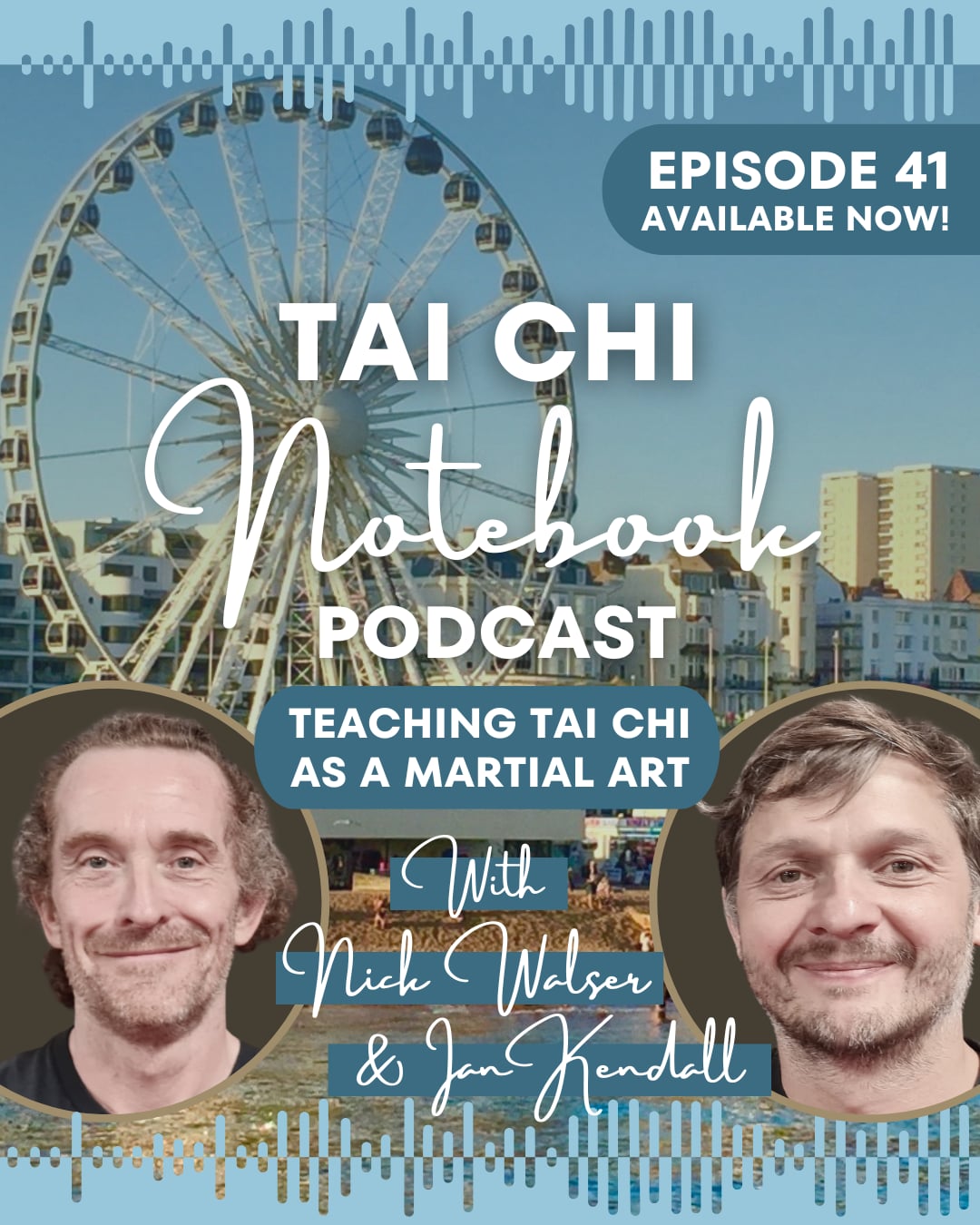
In this episode I talk to two Wudang Tai Chi teachers from Brighton, UK: Nick Walser and Ian Kendall. Both students of the late Dan Docherty, they have continued to practice the tai chi that Dan taught them and developed a new training system called 5 Snake.
5 Snake is a unique and powerful method for finding flow, resilience, and calm through partnered close- quarter practice, and they’re here to tell you all about it.
When Josh Robenblatt got to the age of 32 and realised he wanted to fight in an MMA match, he had to confront a lot of physical problems as well as inner demons before he set foot inside the cage. While the physicality of fighting is explored, this book is mostly about Josh’s internal struggles as a lifelong pacifist coming to terms with the casual approach to violence that MMA engenders. For many people Josh’s exact internal struggles wouldn’t exist (especially his frequent reference to his Jewish ancestry), but in a general sense they do exist in some form in all of us, and that’s what makes this book fascinating for anybody who trains in a martial art. It’s also a rare insight into the realities of training for an MMA fight – how much training is actually required, dealing with injuries, how it affects your relationships with friends and family and what the brutal realities of weight cutting are all about.
Josh writes well, particularly when it comes to articulating his inner thoughts on the subject of dealing with actual violence, either as a participant or an observer, and the transformative, almost transcendent, power that coming to terms with it often provides. I found he had managed to put into words something I’d felt before in my own life, but never stopped long enough to really think about and verbalise. As such ‘Why We Fight’ kept my attention constantly until the end, and you do become drawn into his underdog story and intrigued to find out what happens when he finally gets into that MMA match. I won’t spoil it here.
I felt very honoured to be asked to teach the technique section at the 2nd South West and Wales 40+ BJJ Open Mat this weekend at Bristol Dojo. It’s a group set up by a couple of older BJJ players who just want to organise some get-togethers for people to train BJJ in an open mat-type format. So, you can chat, pick each other’s brains, learn some technique or just roll. It’s up to you. There were 4 black belts on the mat and a whole raft of purple and browns, so there was no shortage of experience in the room.
I didn’t start BJJ until later in life and have always felt it’s a great sport/martial arts for older people despite its reputation as being all about younger, stronger, athletic guys who want to smash it in competitions or get into MMA. To me BJJ was just a natural progression from the arts I already practiced, like Tai Chi, into something that was similar, relied on technique not brute strength, and didn’t have the lack of martially-inclined training partners that Tai Chi suffers from.
Tending towards the ‘soft’ style of marital art, BJJ is also something you can do as you get older. Sure, you can’t keep up with the young guys, and your body racks up the damage, but with enough technique under your belt you can stay martially active and still enjoy really competitive rolls as you age.
I taught some back takes from the guard pull. All donations went to the Dementia UK charity. Thanks to Rob, @b_team_bjj for organising everything, it was a great day.
And thanks to Eira Culverwell @beyond_the_mats_ for the amazing Kinetic Massage I received – I felt like a new man again in just 10 minutes! Great for grapplers.
The jin should be rooted in the feet, generated from the legs, controlled by the waist, and expressed through the fingers.
This does present something of a dilemma – how can we both be rooted in the feet but also controlled by the waist, let alone also generated by the legs?
In the Treatise on Tai Chi Chuan, the classic says “Sink the chi to the dantien.”
This sinking is related to the pulling in action of the muscle tendon channels that are usually associated with the contraction (closing) phase of opening and closing – usually while breathing in. The breath sinks to the dantien area, and combined with correct mental focus, this should make the dantien area feel full as you breathe in.
This pressurised feeling in the dantien is also the pressurised feeling at soul of the foot. You could think of it as squeezing the pressure from the dantien down to the foot, but you really don’t need to do that, as it should be instantaneous, since they are the same thing.
With the exhale, the pressure pushes up, through the legs, up the back and out to the extremities including the head. It’s a continual cycle of store and release.
You could call this the internal side of Tai Chi, but really, it’s just the way Tai Chi works, rather than a particular side of it.
You can see the little wobble of the knee he does before he does a fajin in the form. This knee wobble has been the source of seemingly endless debate. Some lineages of Chen style do it, some don’t. Some do it but it’s very minimal, some do it and it’s quite exaggerated. It doesn’t even seem to be a village vs Beijing style thing either.
So, why do it? It’s a way to involve the knee in the generation of power. The best analogy I can think of is that it’s like retracting your fist before you punch, but instead of having to move your fist back (which has certain obvious martial disadvantages), you store power by moving the knee back instead. This obviously requires a conditioned body, where the hand to foot is all connected, so that when one part moves, all parts move. If you just took your average Joe off the street and they did a knee wobble, I don’t think it would do anything for their punching power. In fact, it would probably decrease it. But for somebody who has built that connection over time throughout the body, it has advantages.
Lots of people are convinced that the knee wobble is the route to ruin for your body, that it’s bio-mechanically inefficient and potentially injurious over time with hard training. I can see where they are coming from since you are using the knee as part of a whip-like kinetic chain for which the hinge joint is not well evolved.
But personally I’m not so convinced that, done properly as part of an overall training system, it is bad for the knee, necessarily. I think if you were holding your weight for a long time on a misaligned knee joint then that would be a bigger problem. But the quick flick of a fajin isn’t like that. There are also plenty of things athletes do all the time that I’d say are potentially much more dangerous. It also depends on the person. The knee is a particular weak point in the evolution of the human beings into an upright posture, and being severely overweight is very dangerous to your knee joints. And if I was severely overweight there is no way I’d be flicking my knee joints about like this, so it very much depends on the overall health of the person doing it.
Disclaimer! I’m not an orthopedic surgeon, or a physiotherapist, so I’d suggest getting your medical advice from somebody who is actually medically qualified.
The world is full, or so it seems, of marital artists trying to fix Aikido by making it more practical/better/not as weird. I’m proud to say that my Xing Yi teacher, Damon Smith, (who studied Aikido himself for years) is joining the fray with a new podcast called (wait for it) Fixing Aikido! It’s a podcast where Damon gets together with another friend of ours, Tammo Trantow who is a highly ranked Aikidoka from Austria, and they set about the enormous task of, well, fixing Aikido and creating an Aikido 2.0.
Will it work? Is it a fruitless task? Even if you don’t practice Aikido, or you don’t think it needs “fixing”, it’s quite an entertaining podcast so give it a listen!
Oh, and while you’re here, you can also listen to the now infamous and highly controversial episode of our Heretics podcast that possibly inspired the whole venture. Aikido Heresies
I was reading through my latest purchase, Chen Style Illustrated, again recently and I got to something that piqued my interest – it’s the section where they are describing the 8 energies and we get to Press (Ji)
“When in contact the aim of this gradual rolling move is is to unsettle the balance of he opponent.”
It’s not a bad description at all, but I don’t resonate with the word “gradual” there. The most common application you tend to see for Press is of a kind of “bump” that puts the person off balance, but my experience of Ji has been that there’s nothing particularly gradual about it. That bump can be applied in a hard sharp way. Jin done in a forward direction (which is Press) can often be quite jolting and it hurts inside.
The 8 energies are:
掤 peng, 捋 lu, 挤 ji, 按 an, 採 cai, 挒 lie, 肘 zhou, 靠 kao
Google translates 挤 as “press” or “crowd in”. (I’m not sure that another translation you often see of “squeeze” is helpful. I’ve read people writing about squeezing the hands together – that’s not it at all. ) From that you get the sense of a situation where you are already in contact with the person and, perceiving a point of weakness in their defence you press them further on the point. It reminds me a lot of the strategy of Horse in Xing Yi, which is to attack a point of defence that is already defended but has a weakness you can exploit.
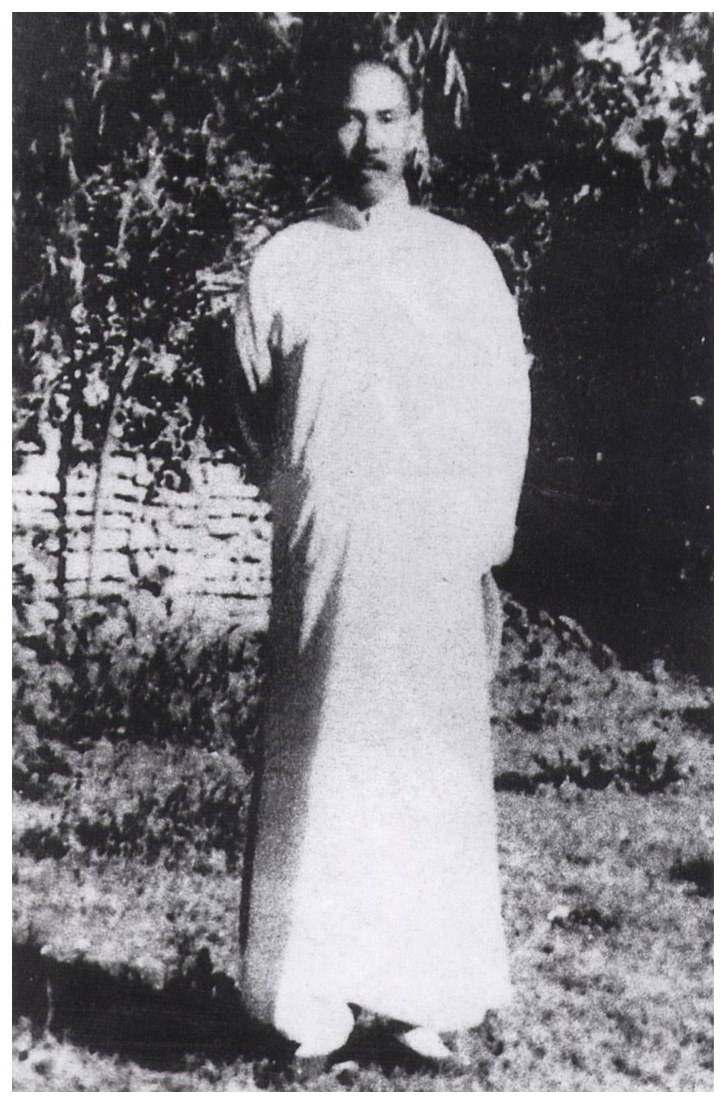
Cheng Man Ching doing Press
In the Tai Chi form Ji is usually done with the back of the hand in the typical Grasp Bird’s Tail sequence (presumably because it the easiest way to capitalise on a good position you’ve already achieved), but there’s nothing about the energy you’re using that means it has to be done with the back of the hand. It can be done with a fist or palm too.
And this is where the Tai Chi waters get a bit murky. There is the martial technique Press, which is to do with pressing further forward into an opponent you are already contacted with, and then there is the abstract concept of “jin in a forward direction”. Anytime you express jin (strength derived from the ground through a relaxed body) in a forward direction you could be said to be doing 挤, but when you put it into a Tai Chi context it takes on this quality of crowding in and pressing that attack.
I think this is one of the best historical videos of Tai Ch you’ll find. I’ve seen this film before, but the quality wasn’t great. This version of the Tai Chi documentary however seems to have been edited to make it smoother and sharper:
In the video you’ll find the most famous masters teaching Tai Chi in Beijing in the 1950s. It’s a good cross section of the different styles being taught. The masters are (and I think I’ve got the order correct): Li Yaochen, Li Bingqi, Chen Zhaokui (the youngest son of the famous Chen style patriarch, Chen Fake), Yang Yunting, who learned from Quan Yu, who was a direct student of Yang Lu Chan. Sun Jianyun (daughter of the famous Sun Lu Tang). Wang Yongquan, who performs the Yang long form and was a student of Yang Jianhou and Yang Shouhou. And finally Li Jing Wu, who was a student of Wu style and Chen style, but here is performing the Beijing 24 step form.
Somebody posted a quote by (founder of Yi Quan) Wang Xiang Zhai from his 1940s interview containing his thoughts on Tai Chi. It is pretty clear, unambiguous and to the point. Have a read:
Wang Xiang Zhai on Taijiquan (from an early 1940’s interview):As masters of the original Taijiquan, I should recommend the Yang brothers Shouhou and Chengfu. They are my friends, and I know that their Taiji has some knowledge of mechanics. But out of one hundred students, not even one gains its essence…and even then, it is still one-sided, because the skills of intuitive perception died out a long time ago. Originally, Taiji consisted of three fists, Wang Zongyue changed it into thirteen postures, and it was later embellished into as much as one hundred and fifty postures. This is the cause of the distortion.Sticking to mechanical movements, seeking beautiful postures and mistaking it for the glory of martial arts…that is terrible. Such a person cannot comprehend boxing for life. If a man of insight sees such a performance, he will feel sick for ten days.As a means of health preservation, Taijiquan restrains the spirit, and brings discomfort to its practitioner. For combat, it harms the practitioner’s limbs and trunk, and causes a useful body to become a mechanical and stiff thing…it’s nothing more than a waste of time.As for the training method—a punch with the fist here, a slap with the palm there, a kick to the left, and another one to the right—it is pitiful and laughable.As for dealing with an enemy in a fight: please do not even consider it. So ruined is this boxing that it has become useless. There are many more things, but I feel embarrassed to say them.
He doesn’t think much of Tai Chi, but there are some things to consider.
Wang was building a brand – Yi Quan – in a commercial setting. Setting out how you are different to/better than your competition is the first stage of building a brand.
2. This “three old fists” idea of history I don’t put much stock in. I think it’s a reference to the three old fists of Xin Yi (info on Jarek’s website), which he is therefore assuming as the origin of Tai Chi Chuan, but there’s not much of a link there that I can see. Or if there is, it’s very tenuous.
3. I think he’s criticising the Tai Chi training method, more than the art. He seems to hold the Yang brothers in high regard, but it’s their students and training methods he thinks are flawed. Wang was never a fan of forms training.
4. I think we need to consider what was happening in China in 1940. China has never (and still doesn’t) had a free press. If this was published it would conform to the political direction of the day.
From Wikipedia:
“In 1940, the Japanese set up the collaborationistWang Jingwei regime, with its capital in Nanking, which proclaimed itself the legitimate “Republic of China” in opposition to Chiang Kai-shek’s government, although its claims were significantly hampered due to its being a puppet state controlling limited amounts of territory.
The United Front between the Kuomintang and the CCP had salutary effects for the beleaguered CCP, despite Japan’s steady territorial gains in northern China, the coastal regions and the rich Yangtze River Valley in central China. After 1940, conflicts between the Kuomintang and Communists became more frequent in the areas not under Japanese control. The Communists expanded their influence wherever opportunities presented themselves through mass organizations, administrative reforms and the land- and tax-reform measures favoring the peasants and, the spread of their organizational network, while the Kuomintang attempted to neutralize the spread of Communist influence. Meanwhile, northern China was infiltrated politically by Japanese politicians in Manchukuo using facilities such as the Wei Huang Gong.”
So while all this conflict with Japan is going on I think the general trend is towards westernising and modernising China, leaving behind the older traditions that had held China back. This interview – looking towards newer scientific methods of martial arts – is in keeping with that trend. Japan was also very into adopting western military methods and building an empire, like the British had.
5. Both Yang Shao-Hou and Yang Cheng-Fu died in 1936, yet Wang is talking about them as if they are still alive in the 1940s, so something doesn’t add up. This interview is either doctored, or was done a long time before it was published in the 1940s.
6. You can get a better idea of his larger themes by reading the whole interview.
Picture Grog, the caveman. He’s sitting around the fire with his tribe, wearing animal skins and singing the songs of his ancestors, while his kids run around the back of the cave and paint bison on the walls. Compared to the sabre tooth tigers with their man-splitting canines and the huge giant sloths with their throat-cutting claws that roam freely the valley below, Grog hiding in this cave, doesn’t look like much. But in a mere 10,000 years Grog is going to become the dominant species on this planet. In fact, he probably already is.
Homo sapiens special power is that we’re a tool-making and tool-using creature. Our opposable thumbs gave us fine motor control to skillfully manipulate objects, and our brains have the super power of being able to picture what an object is going to look like before it exists in reality. These two factors, combined with our other abilities, like language and social bonds, put us on track to dominate the earth thousands of years ago. From humble beginnings, like making spears and flint knives, our tool use has grown exponentially into the today’s miracles of engineering like cars, planes, and penis-shaped space rockets. And don’t forget, in the past we’ve managed to build huge, complex structures with what would be considered only basic tools by today’s standards.
When it comes to combat, it’s no different. Our ancestors didn’t charge into battle barehanded as well as bare-chested. Well, maybe some of them did, but they’re not around anymore. We devised a whole range of deadly tools to effectively chop, sever and dismember our opponents, while wearing skillfully-made armor designed to protect our vital organs as best it could. In today’s more peaceful society our preference is for safe, unarmed martial arts, which we use to de-stress ourselves with after work. But these toothless tigers belie the long and bloody history of deadly weapons use amongst humans. And in terms of effectiveness between armed and unarmed, it’s not even a contest: even a professional boxer has very little chance against an unskilled man wielding a sharp knife.
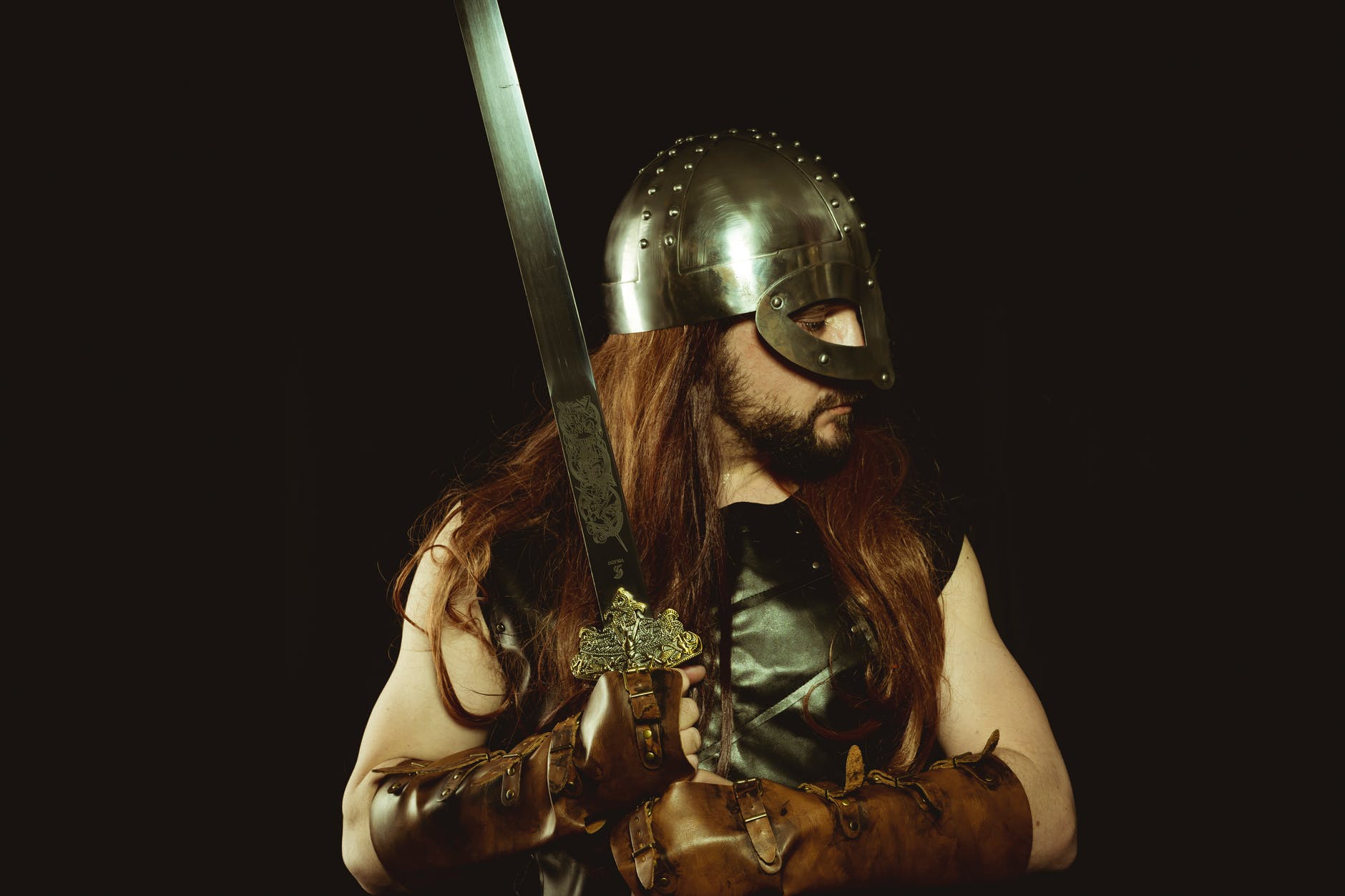
Modern interpretation of a Viking warrior: Photo by Fernando Cortu00e9s on Pexels.com
I remember having an interesting conversation with my martial arts mentor and teacher, Damon Smith, about what kept him interested in a martial arts over such a long period of time. He said that, for him, a marital art needed to contain weapons or he loses interest. While they might not be practical in the modern age, adding weapons to a martial art increases its difficulty level as well as its effectiveness hugely, providing a new physical and cognitive challenge in the process. And by ‘adding weapons’ I mean actually learning to fight with them, not just performing a solo form.
Of course, there is a long history of weapons usage in martial arts. In fact, many modern martial arts started off as weapons systems before transitioning into purely bare-hand arts in modern times. Weapons are found in almost all ‘traditional’ Chinese martial arts and consist of things like spears, nunchucks, swords, throwing darts and wooden staffs. European martial arts use quarterstaff, sword and buckler, amongst other things. The gladiators in the Colosseum in ancient Rome use swords, shields, tridents and nets.
But there’s one marital art that most people would consider a purely bare-hand grappling art, which I think should be more accurately categorised as a weapons system, and that’s Brazilian Jiujitsu, (or BJJ for short).
While most systems of Japanese Jujitsu train with traditional weapons you rarely see them shown in BJJ beyond basic defences to a few random knife or gun attacks, and we certainly don’t train to use things like swords or spears in defence or offense. However there is one weapon that we use all the time – the gi.
Jiujitsu was an import to Brazil from Japan, and adopted and taught by the famous Gracie family in Brazil in the early 20th century. It was originally practiced in the kimono, or “gi” as we call it today , and that is still how the majority of clubs train around the world, although the “no gi” or ‘spats and shorts’ version has been proving more popular in recent years.
The gi is a thick, and durable uniform that can stand up to tugging and wrenching without falling apart. It’s tied at the middle with a belt, which changes colour as you progress through the grades. For adults it goes from white to blue to purple to brown and finally black. There are belts after black, but most normal people don’t reach these.
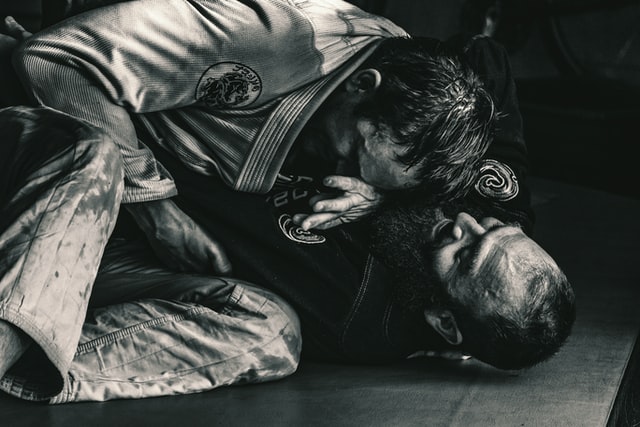
The gi doesn’t look like it, but it is actually a weapon. Chokes can be performed in BJJ with almost any part of your body. The famous triangle choke, for instance, uses the legs to shut off the bloody supply to the head, causing unconsciousness, unless the person taps first. However, when you’re wearing the gi the number of chokes available increases massively. Chokes using the collar can be performed from almost any angle. You can also wrap the lapels of your gi, or their gi around the neck to create a choke.
Soft weapons, like the rope dart in Chinese martial arts, have long been respected in martial circles for their efficiency and the gi is no different. In the hands of a skilled exponent of the art, the gi becomes simply another weapon with which to attack. While some people might consider that ‘cheating’ and no use for ‘the street’, there are plenty of others who point out that most people wear clothes when they go outside their house (and usually in their houses too), so these skills are transferable to real life situations.
There are plenty of videos online showing how gi chokes can be done even on somebody wearing a t-shirt:
I’ve stuck with Jiuitsu for 11 years now myself. and I think a large part of the attraction is the gi and the huge number of possibilities it offers. And while I favour a basic collar and sleeve grip when playing guard myself, there are whole systems of BJJ guard playing dedicated to intricate lapel grips, popularised by famous practitioners like Keenan Cornelius, the most famous of which is his Worm Guard:
The gi offers the same level of cognitive challenge that using a weapon does in other martial arts. And while Brazilian JiuJitsu takes the use of the gi to new levels, I think the same could be said about other grappling arts that make use of clothing, like judo and Mongolgian wrestling. Modern judo has become all about the grip fighting, for instance, and a good grip on the opponent’s clothing can give you a real advantage in arts like Mongolian wrestling.
There are downsides to fighting with the gi of course. Firstly, the damage to your fingers is real, especially as you get older. Too much gripping of the gi really takes it out of your fingers, especially once your grip gets twisted and your opponent is trying hard to break it.
The gi game tends to be a little bit slower-paced as well, since just having one grip somewhere on somebody can stop an attack completely. But while some people find that frustrating, to me it’s just another problem to solve, and more brain-tingling fun to keep training the mind as hard as the body.





 The Tai Chi Notebook