Now, you can agree or disagree with Rantwo’s opinion on whether the Pak Mei guy can fight or not. Personally I think Rantwo brings up some good points, but I’ve heard other people argue that he’s kind of missing the point – sparring never looks good.
Anyway, I don’t want to get into that. My comment on the video would be that Rantwo is making the classic mistake that a lot of people make when looking at videos of traditional master getting beaten up by average/bad kickboxers and then deciding that martial art XYZ must be no good: It’s always a reflection on the person involved, not the whole style.
I don’t think you can view a couple of videos of Pak Mei guys then decide the whole style is “not for fighting”. I can guarantee you there are Pak Mei guys out there who have no problem throwing down. To just dismiss a whole style like that seems to be incredibly naive.
When it comes to sparring, I don’t think there are styles, there are just individuals. At least that’s the way I look at it.
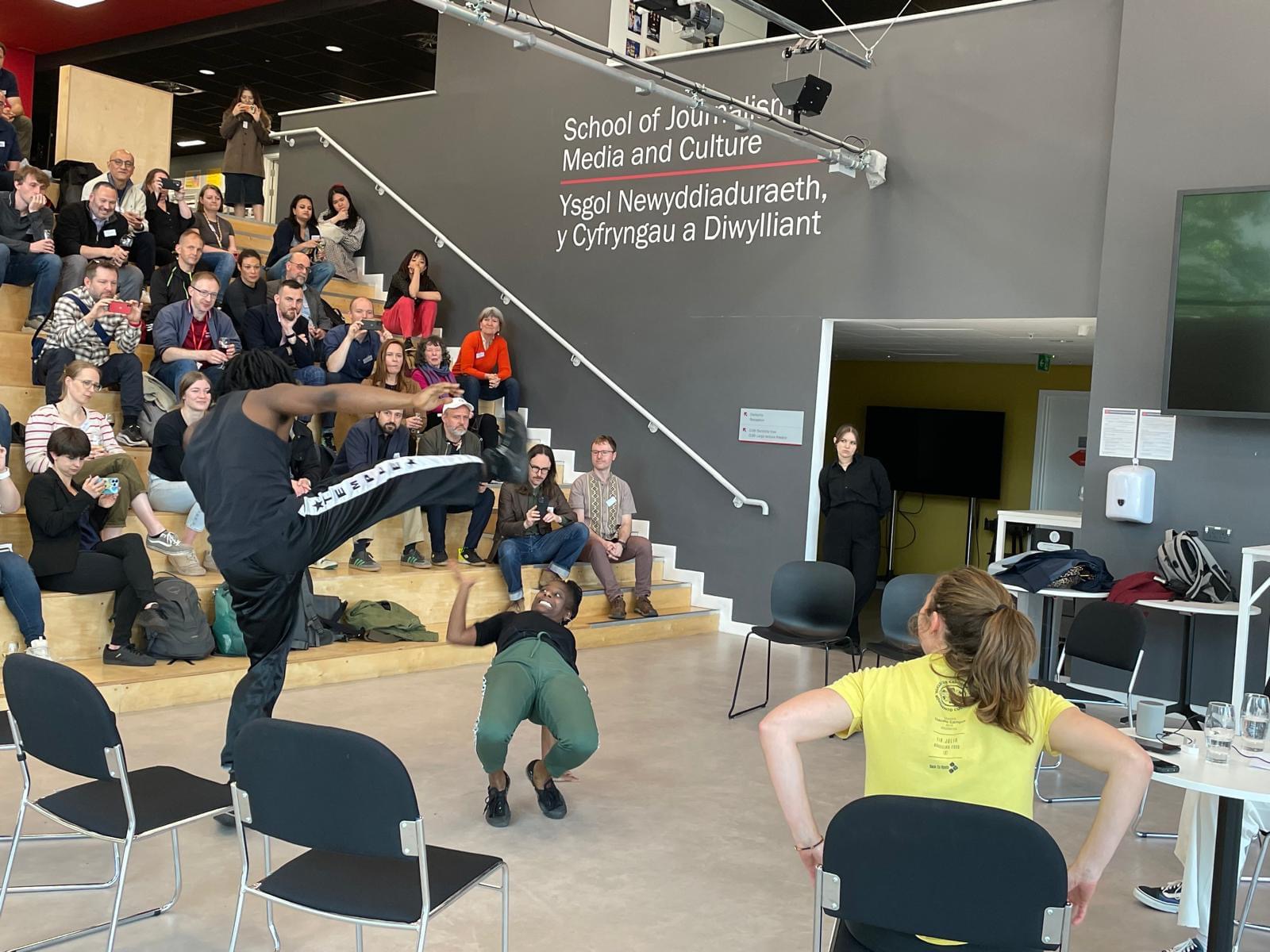
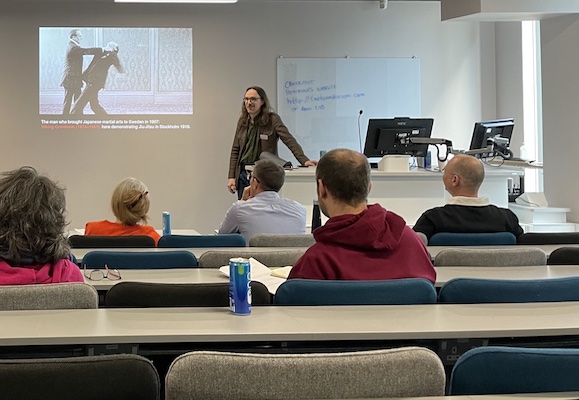
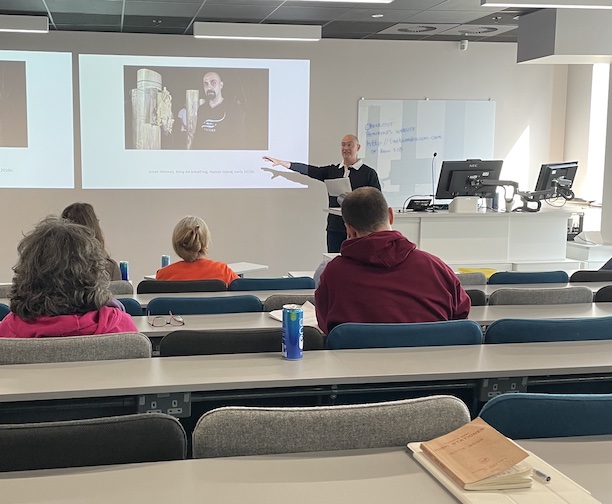
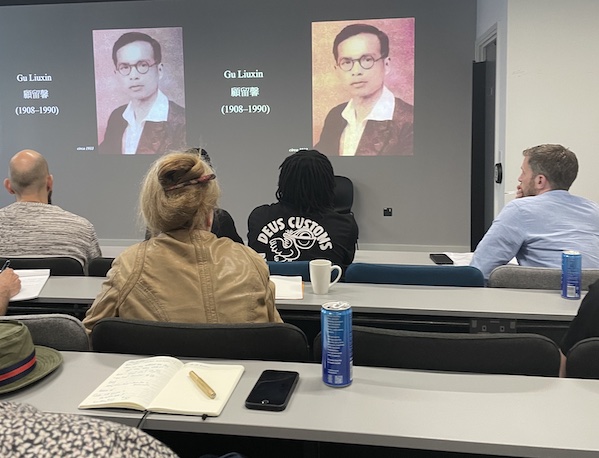
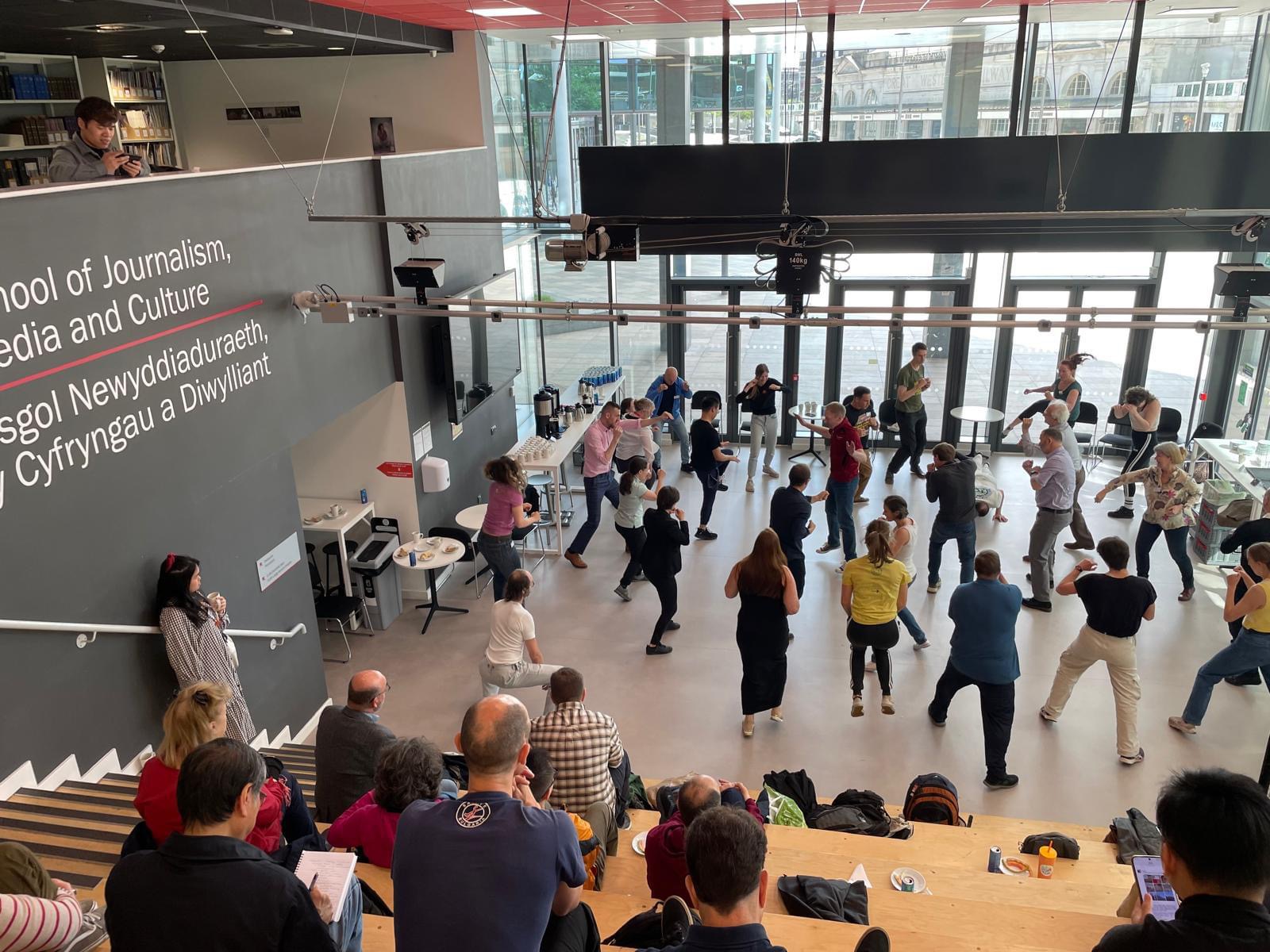
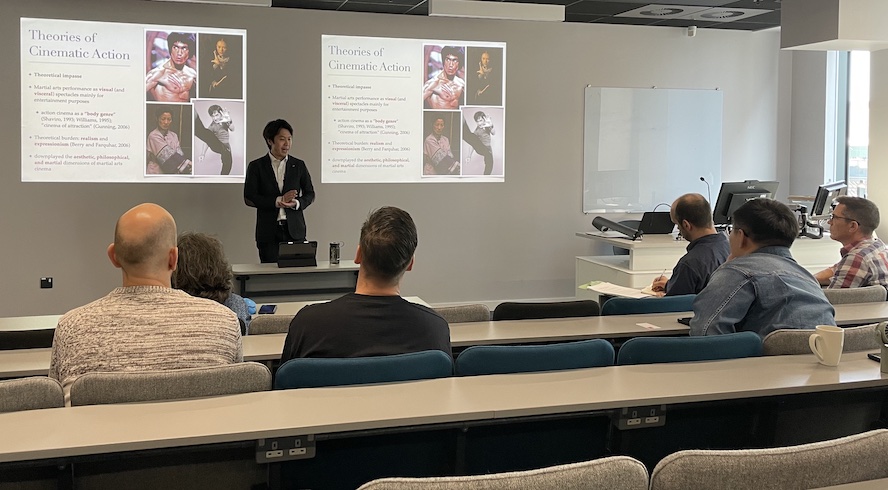
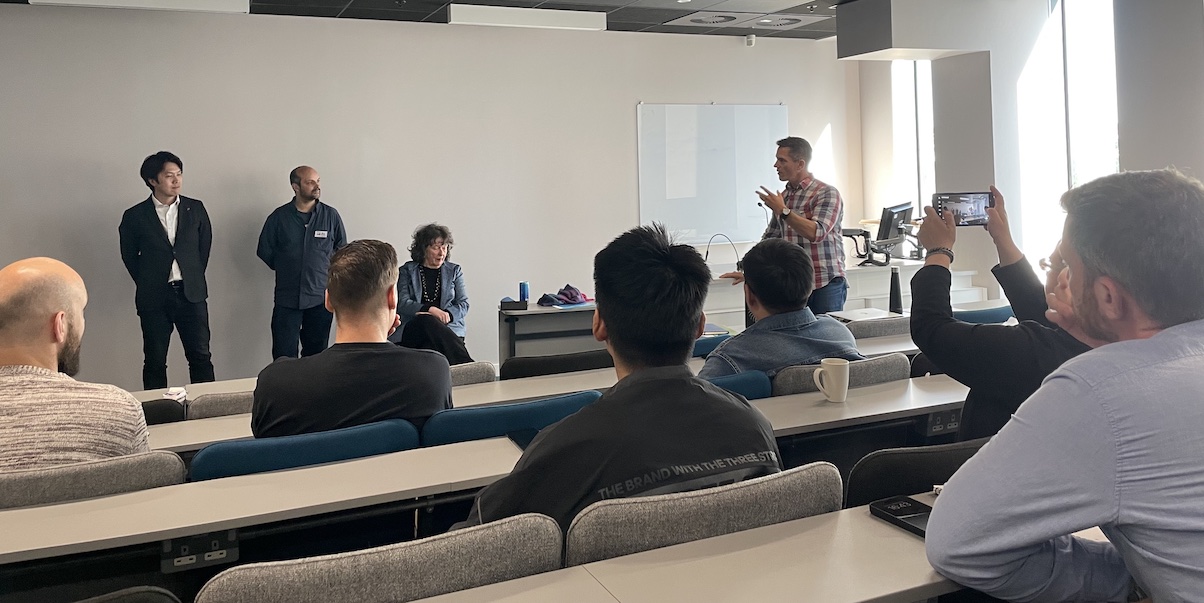
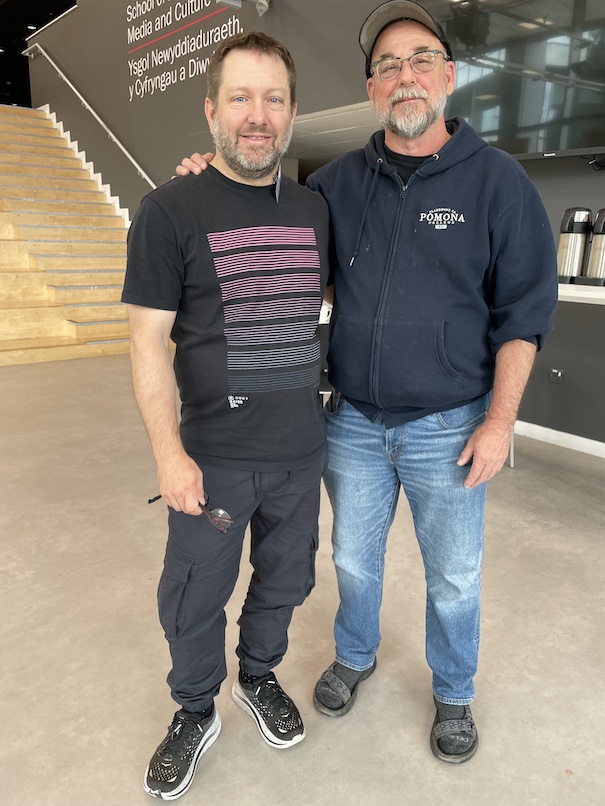
It’s really hard to do the 2024 Martial Arts Studies Conference justice in a write up. It’s an intense 3 days of thought-provoking lectures on all aspects of martial arts research that can open up huge vistas of unexplored subjects, ripe with possibilities for further study, or make you reevaluate what you think you already know about subjects you maybe thought were common knowledge. It’s attended by academics and researchers from all over the world and a few ‘civilians’, like myself, who are more populist writers or practitioners.
Maybe I could just recap a few of the things I learned after three days in Cardiff of having my preconceptions about martial subject gently poked, enlightened and challenged.
Firstly, I’m now much more informed on the subject of trauma-informed martial arts practice thanks to the excellent work of Georgia Verry who runs the Conscious Combat Club project and podcast who, as well as delivering a paper, ran a workshop on trauma-informed kickboxing. There’s also Dr Alex Channon and his work with the Love Fighting Hate Violence project on the same subject. I now have a new appreciation of the brilliance of 80s martial arts hero Cynthia Rothrock thanks to a paper delivered by Prof Meaghan Morris of the University of Sydney, and I have new ways to think about questions that used to fox me, like “why do you still do martial arts?”, thanks to a thought-provoking paper delivered by Wayne Wong. Daniel Mroz delivered new perspectives on martial arts history and Adam Frank gave me new ideas on how to think about qi. Scott MacMillan gave me some ideas about why Brazilian Jiujitsu answers life’s existential questions. And Tran Khải Hoài gave me insights into how Communist revolutionary Ho Chi Min may have influenced Taijiquan practice in ways we haven’t thought about. Yes, really!
But that’s just scratching the surface. The full schedule is here. I didn’t get to listen to all the talks as they were usually happening in parallel, so you had to choose which one to go to. However, I’m hoping they were all recorded and all appear on the martial arts studies YouTube channel soon so I can pick up the ones I missed.
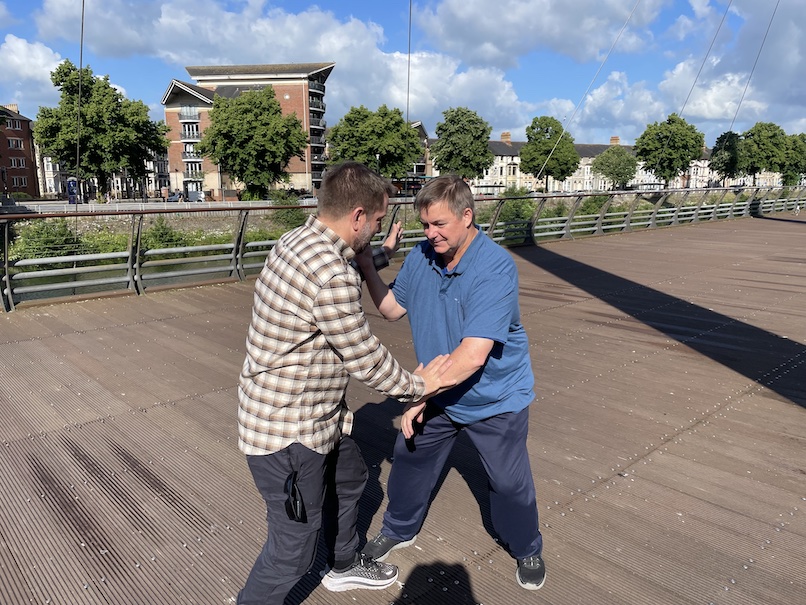
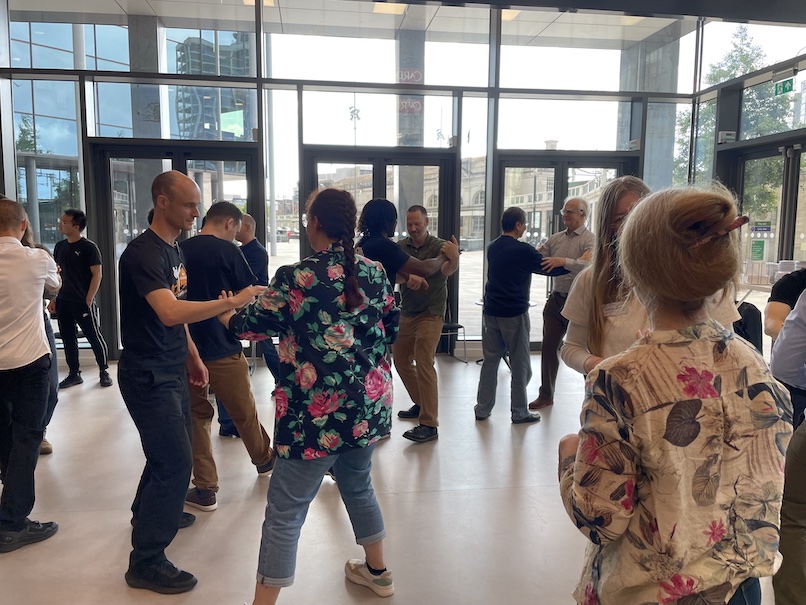
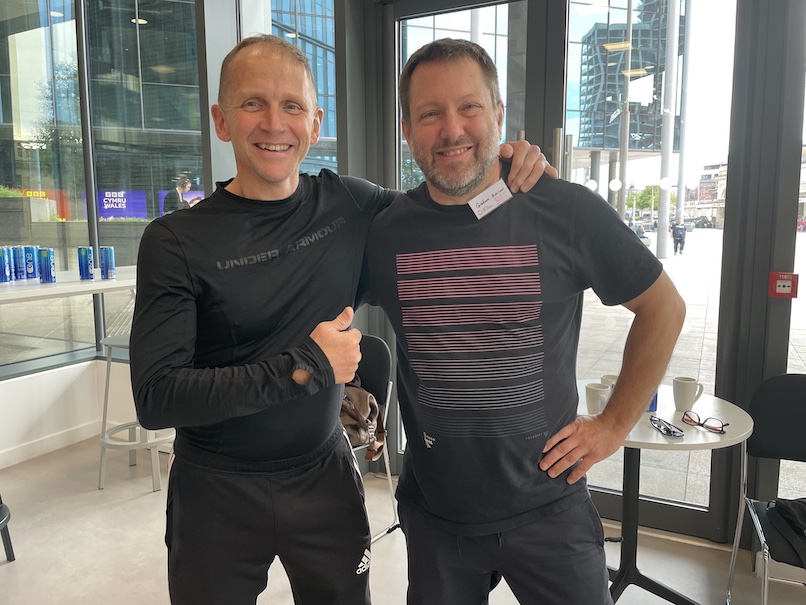
But really it’s the meeting of such a great bunch of people and the social elements that really make the event special. From an impromptu push hands session opposite the Millennium Stadium with Ian Sinclair from Canada to little demonstrations of martial technique here and there in pubs and restaurants in the evening (thanks Randy Brown!), it’s an invaluable opportunity to meet with really experienced practitioners of martial arts from all over the world. I got to talk at length with practitioners about Okinawan Karate, French Boxing Savate, Vietnamese martial arts, Capoeira, Mantis Boxing, Taijiquan, Ninjitsu, Aikido, Brazilian Jiujitsu, MMA and probably many more that I’ve forgotten, and regardless of the martial art, the positive conference vibe remained strong.
And let’s not forget the brilliant Capoeira demonstration that sought to teach us the difference between the Regional and Angola styles.
I didn’t want the conference to end, it was great to meet old friends and make new ones, and as one participant said “end of the MAS Conference Blues are a real thing”.
I’ve made lots of contacts so hopefully there will be more new faces appearing on my podcast in the weeks and months to come. Thanks to Paul Bowman for doing a great job organising it. Here’s to the next one.
I always find the labels ‘traditional’ and ‘modern’ misleading because something that’s current and popular, like Brazilian Jiujitsu, is actually quite old in comparison to some of the martial arts we would call traditional, like Aikido or Taekwondo. But even recently created martial arts are built on older traditions, so where do we start dating a martial art from? From the day it was named, or from the arts the proceeded it? If it’s the later then all martial arts are the same age and have existed (potentially) forever.
Another way of differentiating between traditional and modern is using the self defence vs sporting dichotomy, however so many martial arts exist in a grey area between the two – take Muay Thai for example, that I don’t think that’s a good way to do it either.
“For me, one of the best, i.e. concise and precisely written and kind of encompassing scholarly starts on traditional martial arts was and is the following by Moenig & Kim (orig. 2018; republished as a book chapter 2021):
“[T]he expression ‘traditional martial arts’, which has become very fashionable, is one of the most misrepresented and misused terms in the general discourse. ‘Traditional’ projects an image of a long history and of continuity throughout history, without change. In reality, most modern Asian martial arts are only a few hundred years old or are an evolutionary product of the twentieth century. On the other hand, some western combat sports, such as boxing and wrestling, actually have traditions as long as, or longer than, most modern, popular Asian martial arts, and nobody would ever classify them as ‘traditional martial arts’. The term ‘traditional’ seems wholly reserved as a reference to Asian martial arts. However, to the contrary, many present-day East Asian martial arts developed only recently, and are not ‘traditional’ by most definitions. Most traditional martial art proponents do not consider sports as having any philosophical aspects, as being mostly irrelevant, and as ‘merely’ a physical activity without any spiritual merits. Surveying the available literature on martial arts reveals that leaders and practitioners of traditional martial arts have often monopolized the discussion about philosophy, educational values, and realism in martial arts training; labelling the sports aspect inferior regarding educational benefits in addition to being unrealistic for real combat“ (Moenig & Kim in: Hong & Li, 2022: 43). Original reference Book reprint/republishing
You might also like to listen to the lecture, Inventing Traditional Martial Arts a lecture by Prof. Peter Lorge from one of the Martial Arts Studies conferences.
One of the things that martial arts training should give you, over the years, is better self control. At least in theory. You see some higher ranked people and it’s clear that it doesn’t always work out that way, but that’s the plan, at least in theory.
I’m a bit fan of Japanese martial arts expert Ellis Amdur who wrote the excellent book Hidden in Plain Sight about Aikido. That’s not the only book he’s written of course, and I really should try to read some of his others, but he’s done a lot of work in the fields of mental health and dealing with conflict resolution in a professional capacity. He made a recent short video, on the use of the word “triggered”, his point is that how we define or label something becomes your reality. If you define yourself as triggered by something, then you are saying that you have no control over the situation. You are, in effect, helpless. But if you redefine how something makes you feel, using a different word then you can define yourself as having agency, and that is the kind of training that martial arts can give you. I kind of agree, but not entirely*.
As Viktor E. Frankl said, “Between stimulus and response there is a space. In that space is our power to choose our response. In our response lies our growth and our freedom.” I think martial arts training should be a way to get used to stressful situations so you can more easily inhabit that space.
Of course, you need to be engaging in practices that take you out of your comfort zone to get these benefits. Most of the time being outside your comfort zone is not where you want to be but with repeated exposure to the discomfort of being pinned, attacked, thrown, etc, you can start to take these things less heavily, and you can learn to play within the spaces that appear once you stop panicking.
*I’d counter argue the point that Ellis is making – just because you say you are triggered by something that doesn’t necessarily imply action. Ellis equates the word trigger to imply a gun, and once a gun has been shot it can’t be un-fired. Well, maybe, but “triggered” could also just mean the state of readiness you are in to fire a gun – you still have that moment to take your finger off the trigger.
There’s a risk of being lost in semantics here, so let’s not lose sight of the whole thing – the point is, finding that moment of freedom and growth between stimulus and response and learning to live in it. Now that is one of the real benefits of martial arts.
My friend Sifu Donald Kerr of Spinning Dragon Tao has been producing some great videos recently featuring my teacher, Sifu Rand, demonstrating Tai Chi applications from our version of the Yang form. If you’re interested, I’ve written an article about the full lineage of that form before, but a quick summary is that it’s the Yang form from before Yang Cheng-Fu’s modifications, but with some input from Sun Lu Tang, so it’s a bit of a hybrid.
Needle at Bottom of the Sea, Shoulder through the arm and White Snake Spits Out Tongue.
I thought I’d do some posts as new videos become available comparing the videos to the historical books on the style that contain photographs.
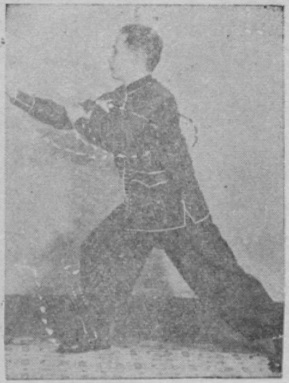
There are a couple of historical books available that catalogue the long form in quite some detail. The first is the 1938 book by Gu Ru Zhang, then there’s the 1952 book by his student Long Zi Xiang, both of which have been kindly translated by Paul Brennan.
I’m using the 1952 book by Long Zi Xiang here, as the photos are of a higher quality. The English versions of the move names will always be slightly different, depending on the translator. Brennan translates these moves I’m looking at today, in order, as Needle under the sea (海底針), Shoulder through the arm (肩通臂) and White Snake shoots out its tongue (白蛇吐信).
In our school we use the names Needle at Sea Bottom, Fan through back and we don’t have a name for what Long is calling White Snake… it’s just part of Fan through back.
The application Long describes for Needle at Sea Bottom is, “If the opponent punches to my chest, I grab his wrist and press down, making his power drop downward.” It’s a pretty short explanation, but it does seem to match the modern day demonstration quite well:
For Shoulder through the arm, Long says, “If an opponent strikes from in front of me, I use my right hand to prop up his fist so that he cannot lower it, at the same time using my left hand to obstruct his waist and send him outward, causing him to topple over.”
Again, that’s a pretty good explanation of what happens in that video.
Long has one more application for the part of the form we don’t name - White Snake… – which is a simple block and strike to a different opponent, “If an opponent punches to my waist, I then press down with my right hand while my body moves back so that his punch lands on nothing, and then I use my right [left] fist to strike to his face.“
We seem more interested in the next move, which is “Torso-Flung Punch” (撇身捶) according to Brennan’s translation. We call this move “Chop opponent with fist“, and it’s the natural conclusion to the previous moves, so I’ll add it on here:
The explanation for the application is: “If an opponent attacks me with a [left] punch and [right] kick at the same time, I then withdraw my right leg, causing his kick to land on nothing, my right hand pressing down his fist. Then my left palm pushes down on his arm, and my right hand turns over from inside with a strike to his face.” Which ties in very well with the video showing the application by Sifu Rand:
We often label other martial arts groups as a cult, and laugh at their silly behaviour and rituals, but at the same time we are a bit blind to the cult-like aspects to the things we do, because that’s ‘normal’ to us.
I went to a different BJJ school one time and they kept making jokes about my home school being a cult because we have to wear an official gi when training, which is more expensive to buy than a normal gi. There were a few other things mentioned, but that was their main issue. A white belt from another branch of my school had visited previously and he had committed the cardinal sin of facing the corner while tying his belt – that was apparently also a sign of a cult and they recounted the story with much hilarity – “I thought he was having a piss in the corner!”.
However, in that school I observed students doing several things that were equally cult-like, but were apparently completely normal to them:
If you stepped on the mat without bowing, that was 10 burpees.
Classes started and ended by lining up and bowing to the teacher.
I (a grown man) had to ask permission from the teacher to have a sip from my water bottle, or if I wanted to leave the mat for any reason. And then ask permission to come back on.
If a black belt asked somebody to roll, they weren’t allowed to say no, even if they had already agreed to roll with another person.
Now we do some of those things in my school too – we line up and bow at the start, for example, and bow onto and off the mat, but some of those things we don’t do. However, they’re all just different versions of showing respect to each other before and during training. We are learning techniques that have the ability to kill and maim, and people could easily get hurt in the training if we weren’t respectful of our partners safety. Building an atmosphere of respect around the training will hopefully instill that in the actual training.
There is something of an uneasy tension in modern martial arts between capitalism and customs. In modern times the people in a martial arts class are usually paying to be there – they are, as modern capitalism likes to call it “paying customers”. The phrase “the customer is always right” has not entirely entered the martial arts vocabulary yet. It still retains these throwbacks to its “traditional” student and master martial arts heritage, for the reasons outlined above.
But let’s not muse on capitalism too much. The point of this post is to draw attention to the blind spots we all have. To return to that BJJ school – the higher belts were technical, but also fighty without being overly aggressive or dangerous, and the instruction was good and clear, the rolls were good too. But I could have done without the undercurrent of tribalism that that had been instilled in the students and was reinforced by the higher belts.
I think it’s worth repeating that all martial arts are cults, and if you think yours isn’t… then isn’t that exactly what a cult member would say? My attitude is to accept the various rules and customs of each particular cult or organisation as the price for them existing. Without any rules anarchy and disorder would break out and there would be no club at all. The Xing Yi classics famously say – “There is only structure, and there is only Chi”. With no structure, the Chi just leaks all over the place, and with too much structure I guess it can’t flow anywhere. A happy medium is what you’re after.
We (human beings) have the same attitude to our own bodies as well – we don’t see our own blind spots. The way we walk feels natural to us, but that might involve pointing the toes outwards at 45 degrees, compromising our lower back, instead of forward, for no good reason except habit. We might have been doing that for 30,40,50 years, and will probably keep doing it until the day we die without question, until somebody comes along and points out our blind spot, at which point it has become our ‘normal’ and it feels weird to walk in any other way.
A little period of self refection on the subconscious and conscious beliefs we hold true, without thinking about them, is always a good thing.
Karate is something I’ve never done before, so it was a surprise to find myself doing some in the form of learning the Anan kata at a recent Foxfist event. The Anan kata is a nice little Karate form. In fact, there’s enough in there for it to be the only form you ever needed to learn for a small, self-contained, but effective, martial system. There are deflections, strikes, stand-up grappling and kicks.
The similarities between Okinawan systems and Southern Chinese martial arts systems are quite obvious in this kata, I think. But see what you think. Here is Anan being performed by somebody who, unlike me, knows what they’re doing with it.
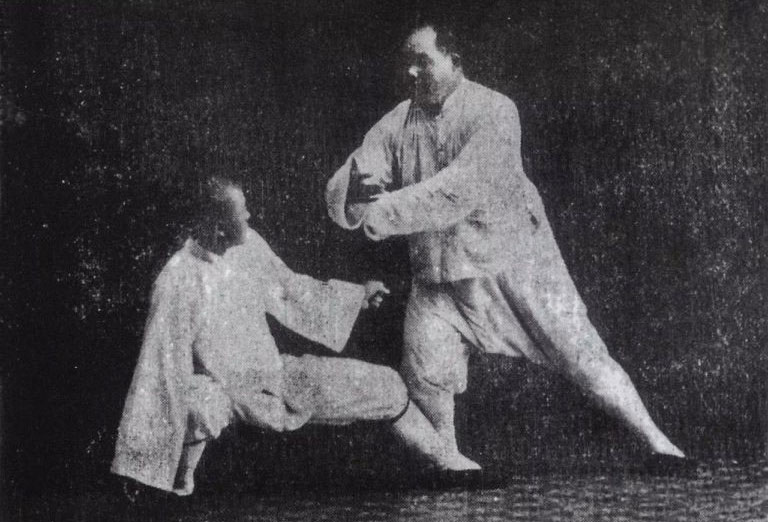
Yang Cheng-Fu showing Tai Chi applications from his book.
In the comments section Richard asked a good question in response to my last post. I wrote a brief reply in the comments, but I thought I’d flesh it out a bit as a blog post, because it’s an interesting topic.
The question is, ‘what’s the point of Tai Chi applications?’ Actually, to be fair, he was talking specifically about the one application video in my last post, not about Tai Chi in general. But personally I think you can extrapolate the question to include the wider Tai Chi universe, and that would be where I’d look for my answer.
There are plenty of videos of respected masters of various styles of Tai Chi running though the applications of their form movements and producing a series of very questionable applications that would require a perfect storm of events to happen for them to work. I don’t want to post them here because I think it would distract from the point I’m making, but look up ‘Name of famous master’ and ‘applications’ on YouTube and you’ll find them.
I really like the phrase “a perfect storm” to describe Tai Chi applications because as far as I can see, most (if not all) Tai Chi applications one would require a ‘perfect storm’ of attacker, positioning and timing for the application work. Therefore the one application video I posted previously is not particularly different to any other Tai Chi application video, at least to me.
That might not be a popular opinion, but I think it’s true.
Contrast this with a martial art like Choy Li Fut. I’ll choose CLF because it’s a kind of a typical Chinese Kung Fu style. It’s has some key techniques like Sao Choy – sweeping fist and Charp Choy – leopard fist and Pao Choy, a kind of big uppercut, Gwa Choy, a backlist, for example.
Here’s 10 of the ‘basic’ techniques that you find in CLF:
I wonder – does the man in the mirror ever punch him back?
If you watch a Choy Li Fut form then you’ll see these 10 techniques crop up again and again, but each form enables you to practice them in different combinations:
A great title for a video “Killer Choy Li Fut form!” It’s actually a great performance, especially with the drumming in the background.
Or check out the famous first form of Wing Chun – Siu Lim Tao, it’s a series of techniques performed very, very accurately so you can refine and practice them:
Now when you do those techniques in a form, you are performing a technique that would work exactly as shown. The only thing you need for success is to actually contact with an opponent and do the move correctly at the right time.
Tai Chi as a marital art just doesn’t work in the same way. We don’t have a toolbag of techniques designed to be pull out and used ‘as is’. Ward off is not a fundamental technique of Tai Chi – instead Peng, the ‘energy’ you use in performing ward-off, is the important thing. And I think this leads to a lot of confusion about what Tai Chi forms are.
So, if we don’t have techniques that exist in the same way as other marital arts, how are you supposed to fight with Tai Chi?
Tai Chi is a set of principles and a strategy that together make it a martial art. In a nutshell the strategy part can be summed up with the 5 keywords of push hands – listen, stick, yield, neutralise and attack. The principles cover how the body is used, resulting natural power derived from relaxation, ground force and a series of openings and closings expressed in the 8 energies. When the principles of Tai Chi are properly internalised you become something like a sphere, which can redirect force applied to you with ease and respond as appropriate. All these things are elucidated in the Tai Chi Classics.
Now that short description probably leaves a lot out, of what Tai Chi is, but at least it’s a starting point.
If that’s your goal, then putting emphasis on individual techniques doesn’t make much sense. Everything you do now exists in relation to an opponent, rather than existing on its own terms. The Tai Chi form then becomes a series of examples of how you might respond to specific attacks. In essence, it is a series of perfect storms, one after the other, put in a sequence that is long enough that you start to internalise the principles of movement and energy use. And obviously the strategy part requires a partner, hence why push hands exists.
I think that’s also the reason why Tai Chi forms are so long and slow, btw, so you internalise things.
As a final note, I’d say the jury is still out as to whether the Tai Chi way is the best approach to teaching people to fight. It’s interesting to note that a lot of martial arts innovators tend towards this same nebulous ‘technique-free’ style of training the further they get into their research into martial arts. Bruce Lee for example, was moving towards freedom and the technique of no technique in his later years – see his 1971 manifesto ‘Liberate yourself from Classical Karate’ for example. Then there’s Wang Xiang Zhai who created Yi Quan by removing fixed forms and routines from Xing Yi Quan and mixing it with whatever else he had studied. See his criticisms of other Kung Fu styles in his 1940 interview, for example.
In contrast a lot of the martial arts that have actually proven effective in modern combat events have turned out to be very, very technique based. Brazilian Jiujitsu, for example, is taught through very specific techniques. So is MMA. Karate, for all of Bruce Lee’s criticisms often does very well in competition against other more esoteric styles because it contains some no nonsense techniques.
Another factor to think of is that while Tai Chi may have those lofty goals of producing a formless fighter in its classical writing, it often isn’t taught like that in reality. One of the martial arts that Wang Xiang Zhai is criticising as having lost its way and become a parody of itself in that 1940 essay linked to above, is, in fact, Tai Chi Chuan!
So, as ever with marital arts, I think the answer is: it’s complicated.
Everybody was kung fu fighting! Photo by cottonbro on Pexels.com
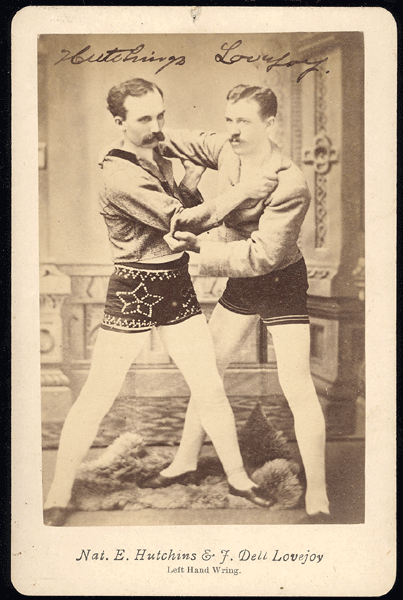
It’s time to say something slightly controversial, and I apologise in advance for the click-baity feel of the headline, but there’s no way to sum up a nuanced argument like this in less than 10 words. The thing is that there’s a real fascination these days with delving into Karate kata or Kung Fu forms and discovering the ‘real’ applications, hidden in plain sight, which are, always, wrestling moves, which were hidden away in the murky depths of time for vague and unspecified reasons.
This marital arts version of a conspiracy theory is a really popular idea at the moment, because, frankly, the wresting interpretations work a lot better than most of the applications of striking you see in these arts. However, that doesn’t mean its true!
Here’s a current example:
No, no, Kung Fu is NOT 90% wrestling. It’s just not!
Now look, I’m not saying that there are no throwing or takedown applications to Karate and Kung Fu moves – of course there are! But just because you can re-engineer some wrestling applications out of what are obviously supposed to be strikes, does not mean that those are the ‘original’ or ‘real’ applications. They are certainly an interpretation, but to claim some sort of historical precedent is going too far for me.
I would call my view somewhat heretical to modern orthodoxy based on the amount of comments I see under videos of people revealing the ‘real’ application of Kung Fu or Karate moves. It’s almost 100% positive, along the lines of “finally this move makes sense!”. I refer you to my previous point – just because these moves work better than the wacky traditional blocking and striking application usually taught does not mean these are the original applications. It’s a logical fallacy. A better question would be to ask, “why did they simplify or dumb these forms down so much that they’re unusable?” But I guess that’s a different topic…
Another reason why this wrestling-first approach is so popular is that learning real grappling or wrestling is just too much like hard work for some people. You’re going to need a working pair of knees and a body that’s probably 20-30 years younger than the one you’ve got, especially if you’re starting grappling from scratch. For the ageing martial artist the idea that they can just keep doing the katas or forms that they already know and now they are somehow also doing grappling is very tempting. As somebody on the wrong side of 50 I can see the attraction of this idea myself! But like all shortcuts, it cuts out the years of experience and hard work you’re going to need to put in if you want something you can use.
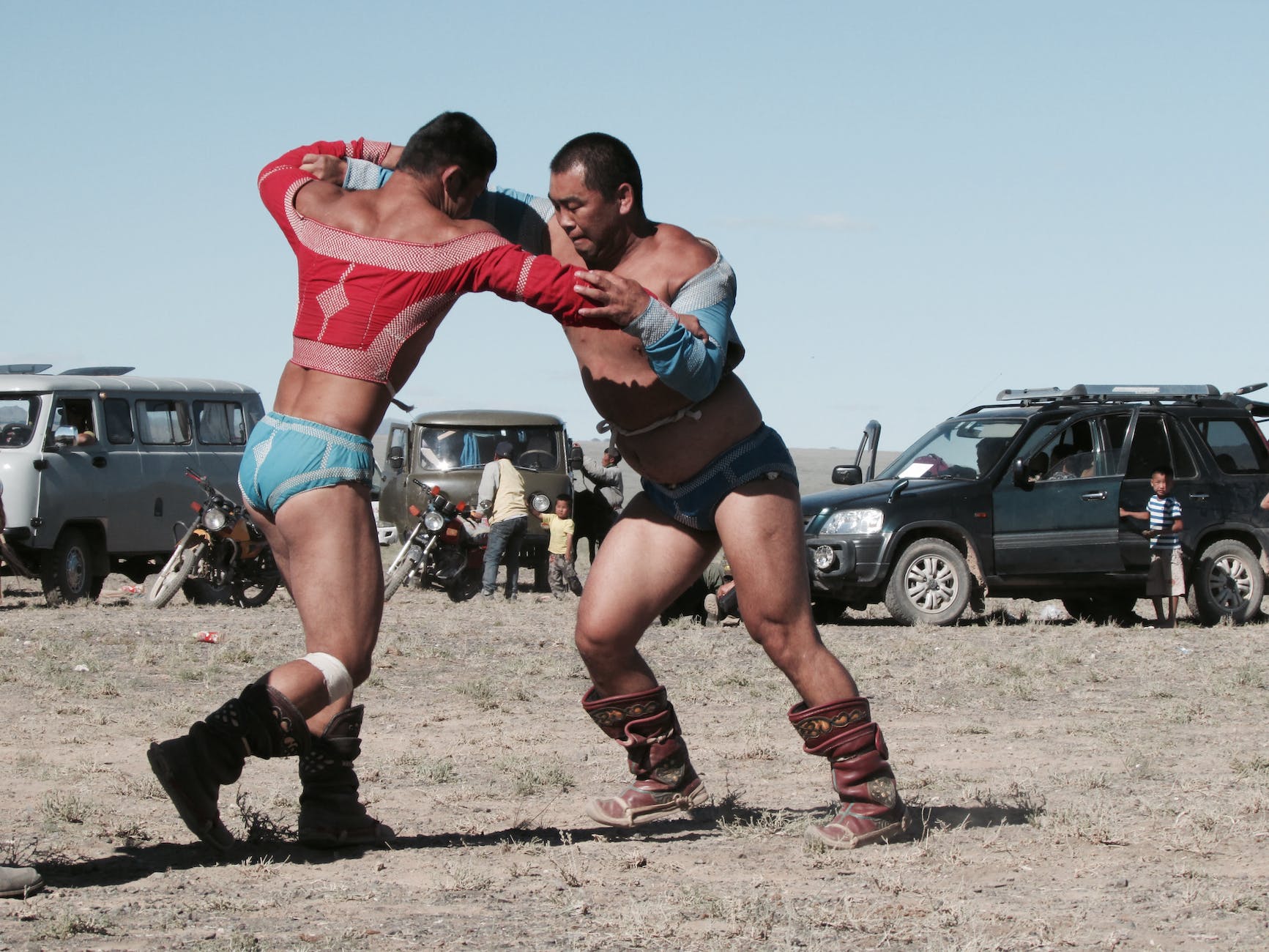
Wresting is, of course, older than martial arts, like Karate or Wing Chun, by thousands of years. This is not disputed. It seems that wherever men or women gathered, in any country, and conflicts needed to be resolved, wrestling naturally appeared as a way for this to happen, or as a way to keep people entertained, build a community connection, or in good physical shape for battle. It was a multi-purposed activity. For example, there has been Mongolian Wrestling for pretty much as long as there have been Mongolians. And it’s a tradition that has survived.
Modern Mongolian wrestlers. Photo by Agostino Toselli on Pexels.com
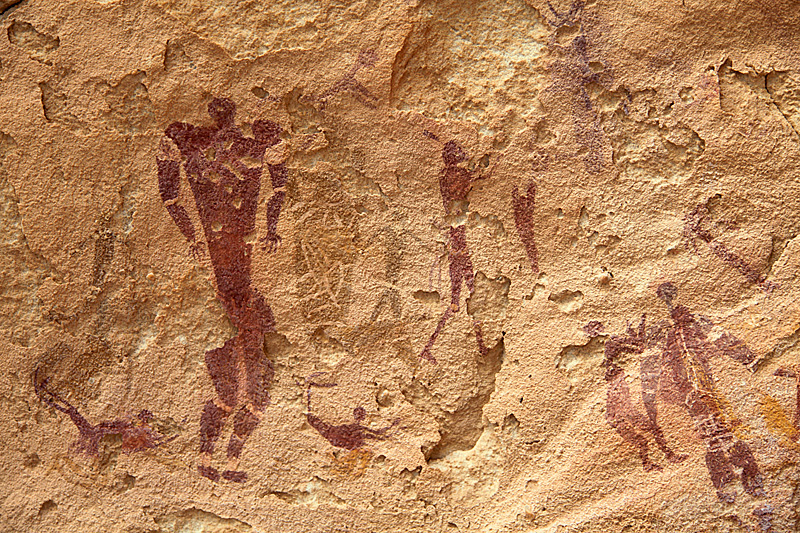
Cave paintings have been found in the Lascaux caves in France that have been suggested to depict sprinting and wrestling in the Upper Paleolithic time period, which is around 15,300 years ago.
Cave man wrestling?
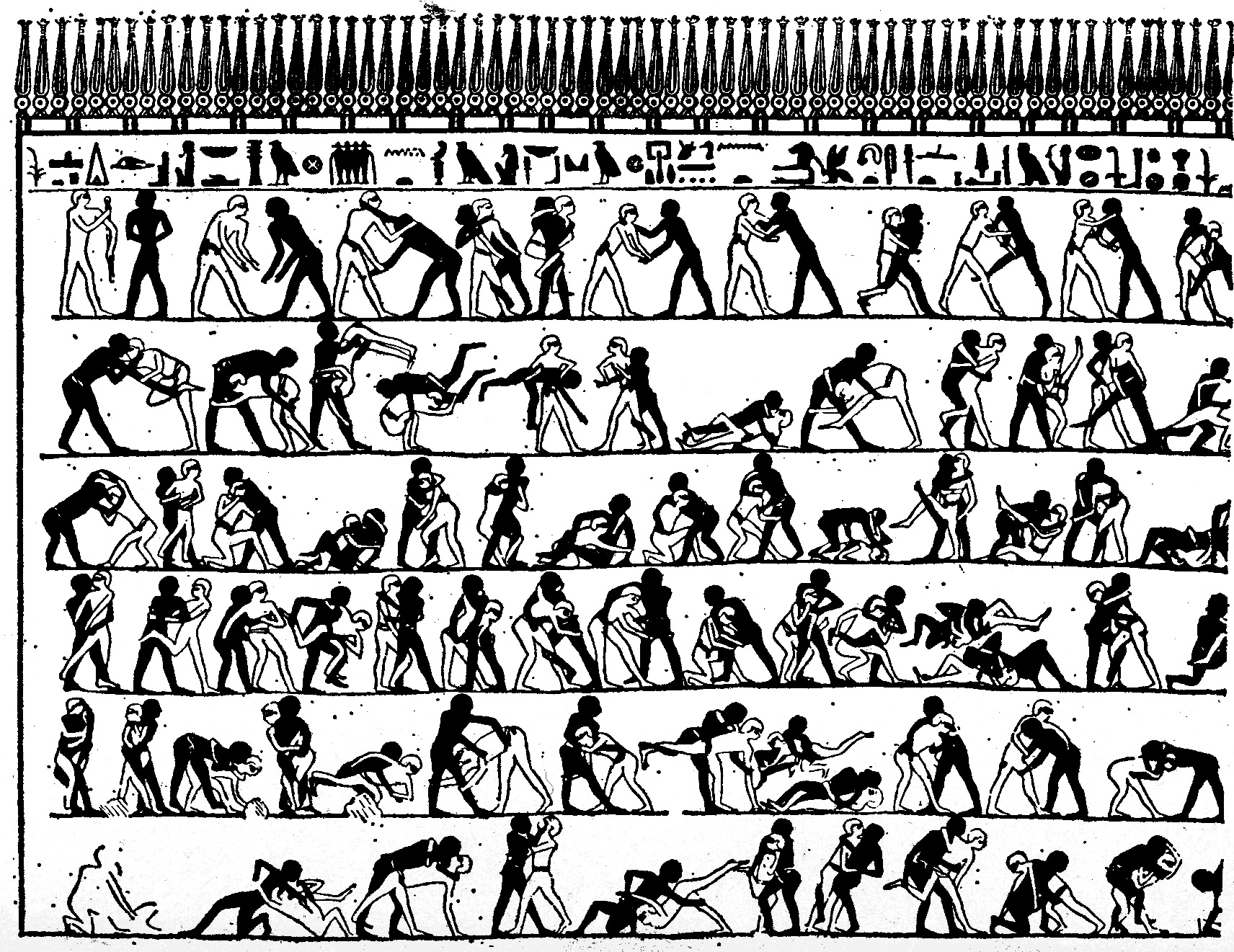
This Egyptian burial chamber mural from Khnumhotep and Niankhkhnum’s tomb dates to aroudn 2400 BC.
Wrestle like an Ancient Egyptian.
Almost every traditional culture has, or had, some form of indigenous wrestling. Many cultures that have evolved into living in villages, then towns, then cities have managed to maintain their wrestling traditions, even to the modern day. But most we have lost. For example, Collar and Elbow Wrestling was hugely popular in Ireland in the 19th century and spread to America where it again proved hugely popular with thousands of people coming to watch matches (even President Abraham Lincoln was a practitioner!)
Collar and elbow from the 1880s.
But huge changes in where people lived and worked lead to its demise until it vanished completely even in its native country. It seems that whenever a country experiences its industrial revolution, requiring massive shifts in population distribution, the folk traditions tend to die off, and wrestling is a folk tradition.
But that does not mean it is the original of Karate and Kung Fu.
I appreciate that you might not agree with me, so let me give you an example.
This video is comparing a karate technique to a Shuai jiao wrestling throw:
Yes, the movements have a physical similarity, but you are never – never! – going to learn how to do that throw by doing that kata. I mean, you could make that work so long as you only wrestle fellow karate practitioners and never ever get in a match with somebody who actually does wrestling. Then you’ll be fine. 🙂 Was this the original application of this kata? Who knows? But to assume ‘yes, it must be wrestling’ is such an illogical leap that to me it’s going too far. If you want to learn wresting, then just train wrestling. It’s that simple.
Here’s the Karate Nerd with a similar take on Karate Kata. Now, I quite like the Karate Nerd, so this is not an attack on him, but rather just an example of the current trend in marital arts regarding wresting applications and where it’s going.
Anyway, I feel like I’ve made my point and I’m just repeating myself now, so I’ll leave it there. But let me just recap one last time. Yes, there are some wrestling application in Karate and Kung Fu, yes you can re-engineer pretty much any movement to make it into a wrestling move, and no that does not mean that “it’s all wrestling“.
Jesse Kenkamp (AKA The Karate Nerd) has done another great video on tracing the roots of Karate. Here he is with White Crane practitioner Martin Watts in Yongchun, birthplace of White Crane, which is usually considered an ancestor style to Karate.
What I liked about this video is Martin’s no-nonsense teaching of what are generally thought of as internals in Chinese martial arts and shrouded in mystery (usually by westerners using Orientalism to sell books 😉 )
My point in posting this is that Martin covers “sinking the qi to the dantien” at 4.00 – what it is and, most importantly how what it is not is just as important.
I appreciate Martin’s simple, down to earth explanation.





 The Tai Chi Notebook