I wanted to share the process and journey of how Seymour Yang and I made our new Brazilian Jiu-Jitsu book.
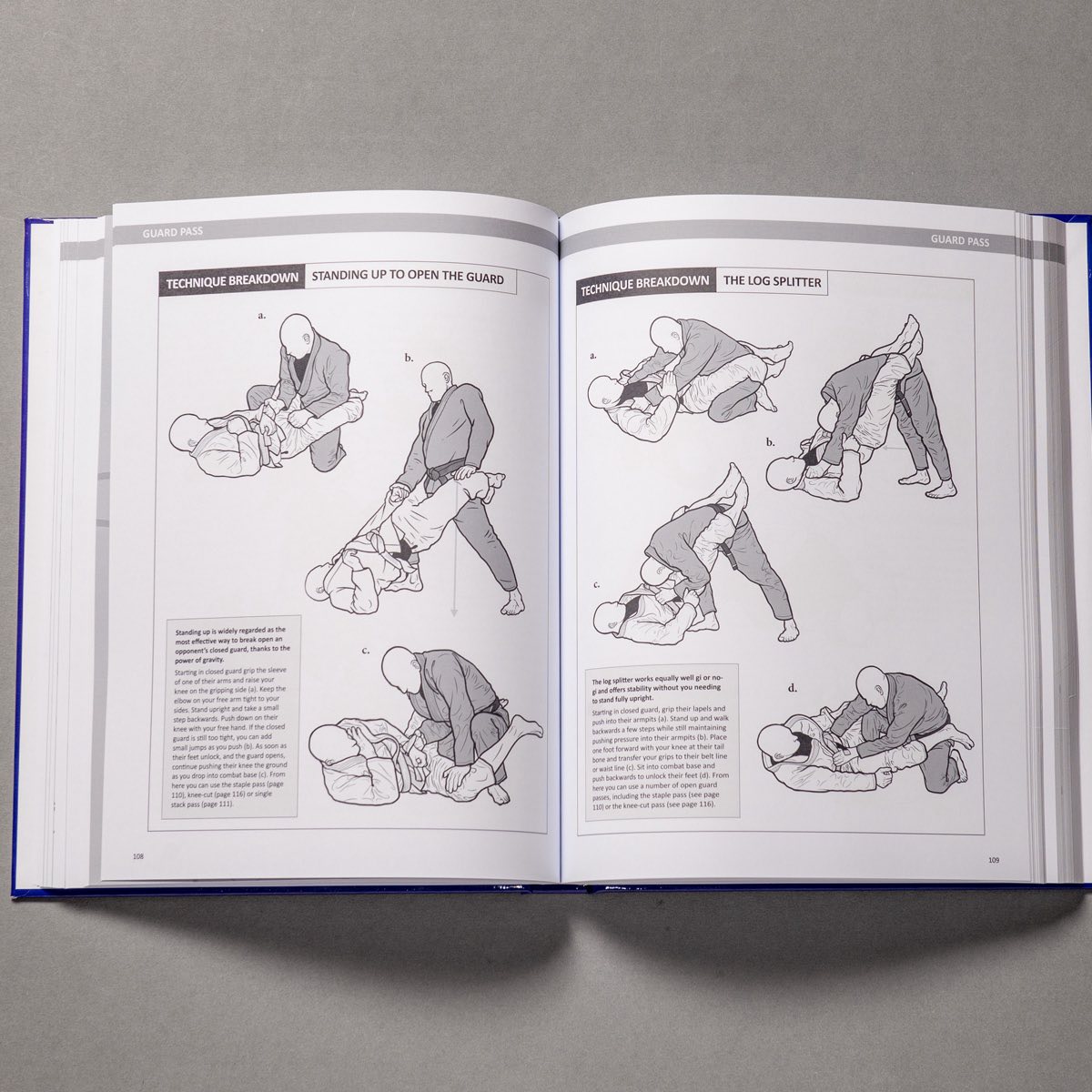
First of all it’s worth noting we are both black belt instructors with many years of teaching experience. The book is aimed at beginners to developing white and blue belts and covers everything we felt was useful and relevant in today’s Jiu-jitsu club environment.
After much time planning and researching we then set about creating the contents. Every illustration is based on a photograph or video still that we took of our students or training partners. These stills Seymour used as references to hand draw the line art images. I then wrote the text.
That was just the beginning. The hardest stage was making sure the book was as accurate and tight as possible as a work of reference. For this we spent a long time proofing, editing and redesigning it. We then tested sample after sample from independent book printing companies to find the best one (we did not want to go the Amazon print on demand route)
I’m proud to say the book is finally available for our followers to buy (as a pre-order) and so far it’s proving very popular.
We decided to make it a pre-order as we just didn’t know quite how many to print in advance. A two week window was decided and after the pre-order window closes (June 11) we can then tell the print house how many to make.
If you want to know even more about how we made it then check out this informal 2 hour (2 hour!) video where we chat about making the book (it will be released in a more thoroughly edited audio-only version as an episode of my Tai Chi Notebook podcast shortly):
Judo and (Brazilian) Jiu-Jitsu might have exactly the same origins, but they’ve gone down really different paths in their evolution. While Judo has focused more on the sporting elements and becoming an Olympic grappling sport, BJJ has always wanted to keep things closer to its Value Tudo origins, which evolved into modern MMA.
Even today, many BJJ classes have a strong self-defence element, however BJJ is a broad church and some associations and classes are much more orientated towards sport grappling, particularly the no-gi variation.
One of the frequent criticisms of modern Olympic-style judo was that it had sacrificed too much realism in pursuit of beautiful big throws in competition. One way it did this was to make any grab of the pants or legs illegal. This seemingly simple rule change had dramatic effects on the sport. Since the legs were no longer a target the stance of judo players became more upright in their stance, leading to more possibilities for big dramatic throws.
Remember, under Judo rules a match can be won with an Ippon, a throw that lands the opponent on his or her back. In BJJ no such rule applies – a spectacular throw simply earns you two points and the match continues.
All Japan tournament rules
I hadn’t noticed before, but there has been a recent rule change in judo, in a particular Japanese tournament called the All Japan Championship, that means you are allowed to grab the legs again, opening up a whole range of possibilities for long-forgotten judo techniques to make a reemergence.
There are some restrictions though. To grab the pants you have to have a grip on the upper body with one hand, and you cannot grab the legs with two hands. This rules out popular BJJ and wrestling techniques like the single leg or double leg.
Will the new rules get adopted by wider judo federations and ultimately the Olympics? It’s unclear at this stage, and too early to say, but it will mean that going forward, judo could end up looking very different to the way it does now.
Greg Souders on the Grappler’s Perspective podcast.
In the last episode of my podcast episode with Alan Wycherley about fantasy vs reality in tai chi we mentioned a subject that might have been unfamiliar to some of you – the ecological approach. This is a training method that is finding a lot of familiarity with BJJ right now, but I believe it has always been a part of tai chi training too, since tai chi contains push hands as a training method, which has the potential to be a free and playful exploration of movement.
Rather than try and explain the ecological approach myself, I thought it would be better to hear directly from the guy who made it famous in BJJ, Greg Souders. As you’ll discover, he’s not afraid to say controversial things about the learning method adopted by most BJJ academies!
So, here he is on a no punches pulled episode of the Grappler’s Perspective podcast. Have a listen and see what you think:
The UK is having a bit of a women’s safety moment right now, and since I’m in the UK and it’s a topic that crosses over into subjects I discuss on my blog, I think I should address it. As well as being about self-defence it’s also about how women and female perspectives are often ignored by a male-focused society. It all relates back to comments made by actress Saoirse Ronan on the Graham Norton Show, a clip of which has gone viral.
You can view the clip here:
She’s sitting on the sofa with fellow actors Denzel Washington, Eddie Redmayne and Paul Mescal. They’re having a lighthearted discussion about training martial arts/self defence for movie roles. While the men laugh and joke about something as ludicrous as thinking about a phone as a weapon of self defence, (can you imagine, lol!?) Ronan points out (she has to try twice to be heard) that this is something women have to think about all the time. The resulting awkward silence speaks louder than anything else.
That this one moment seems to have captured something very familiar to a lot of women – it’s captured men’s ignorance of women’s lived experience in terms of feeling unsafe when moving about in the world and having to think about using things like keys or mobile phones as weapons. Things that men generally don’t have to worry about.
I don’t want to jump on any kind of bandwagon and write an article about how to use a mobile phone as a weapon, because a) you can’t learn self defence from articles! And b) that seems like very opportunistic behaviour.
But what I would say to any women reading this, Brazilian Jiu-Jitsu (BJJ) is a great martial art that will benefit you more in the long run way more than a one-off 2-hour seminar on “self defence for women”. If you really want to feel more confident and less unsafe (of course, there is no guaranteed panacea for this, unfortunately) then I’d recommend starting regular BJJ classes at a BJJ Academy you feel comfortable with, and with an instructor you feel comfortable with (please shop around!), rather than going to a one-off seminar that aims to provide you with a quick fix.
And to the men who might need to become more of women’s lived experience (yes, you at the back!) You might like to read this article from the Guardian, detailing six women’s reactions to the clip, that’s worth a read.
And in the words of the sergeant from Hill Street Blues, “let’s be careful out there”.
I’m pleased to announce I’m partnering with XMartial for BJJ and general gym-wear clothing. I’ve gone with XMartial because they have a genuinely fun range of designs, and also their website is full of people I actually recognise from the world of BJJ, like John Danaher, Jordan Preisinger from Jordan Teaches Jiujitsu, and B-Mac. Plus, its Reddit customer reviews for quality and shipping to the UK are good and the customer service is highly rated.
Shipping in the US is free, but there is a small $9.50 for shipping to the UK. There are lots of different designs, and XMartial sell gis and hoodies too. So, if you’re looking for new, high quality, BJJ wear and you want to support The Tai Chi Notebook then head over there and have a look at what they’ve got. Thanks!
I came across an interesting video by Ed Hines of i-Bagua.com recently that discussed some general principles of throws and takedowns. There is some good information here, especially about dead angles, and base. Have a watch:
Of course, in my ear I can hear my BJJ friend saying it’s all nonsense, “why not just do wrestling?”, or “he’s doing zero hand fighting!”. My friend tends to think that everything you can know, or ever want to know, about throwing and standup grappling is already inside wrestling.
He probably has a point, and a lot of the clever ‘internal’ things that Tai Chi teachers demonstrate are really just found in wrestling basics, or are obvious if you do wrestling. But here’s the thing – not everybody wants to do wrestling or even can do wrestling! It’s time-intensive hard, physical work, from which you will probably get injured, and, frankly, it’s for young people, not anybody over the age of 30. Not to mention that you’ll also need to invest in a good quality BJJ mat for grappling training.
If you’re going to approach takedowns without having the time or energy required to learn wrestling, then you’re going to need a softer approach. Oh, hello internal arts.
How to defend everything
I wonder if you’ve ever seen the video “how to defend everything” by Chris Paines on YouTube? (It won’t embed, so I’ve had to link it). It’s about BJJ, not internal arts, and focused ground work, not standing, but those principles he’s expounding, I feel, are universal to all grappling, and they’ve really changed my approach to takedowns. It’s also very simple. Simple is good – simple is practical.
At 50 minutes it’s quite a long video, and some of the important points don’t happen until near the end, so I’ll give you a quick summary: In a nutshell, there are 5 parts of the human body that you need to access in at least one place to achieve a throw or takedown.
Part 1. Back of the head, Parts 2-3. Armpits and Parts 4-5. Back of the knees.
(back of knee area extends down to ankle, armpit area extends down to hip).
When I do takedowns I just keep looking to insert a part of my body (arm/hand/foot/head/whatever) into one of those places. I just keep spamming it as an attack. If you keep doing that then eventually you manage to ‘own’ one of those places and a takedown will sort of present itself, especially if you get more than one.
You can analyse any throw on YouTube and you’ll find that the person who did the throw got some part of their body into at least one of those places to make it happen. Now, that might mean that the model being used is too general (i.e. it covers a lot of the body!), however, I think it’s still a useful model if you want to work on defence (which people rarely do!)
If you’re doing some grappling and you get taken down, then replay what happened in your mind – you will have let your opponent into one of the 5 spaces for too long. Long enough for them to get a takedown on you. The answer to preventing the takedown then becomes about reclaiming control over those 5 points of your body, rather than trying to do some sort of pre-scripted counter to the throw.
N.B. You can look at standing on the foot as a possible exception to these rules, however… that doesn’t tend to work in a pure grappling environment, unless you also get one of the other 5 as well. Standing on a foot and striking somebody however is a different beast – it’s much more effective. It’s the same with standing wrist locks… they can work, but 9 times out of 10 they won’t – i.e. they are very low percentage, and almost certainly don’t work against experienced people. Your time is better spent trying to get one of the 5 control points. (Apologies to Aikido 🙂 )
N.B. 2 – But what about the gi or wrestling jacket? Well, think of it this way, a collar grip is simply a very effective lever to the under armpit area, so when you grip the collar, you are effectively cheating because it’s giving you easy access to their armpit area. It’s why, when we go for chokes we grip deep on the collar, under the ear, but when we go for throws we tend to grip much lower down, so that the lever to the armpit is stronger.
In the first episode we explore the development of the concept of heresy by two early christian teachers, Valentinus and Irenaeus. We then begin a multi-part series on the origins of Jiu Jitsu and Kempo, addressing some of the myths surrounding the samurai class in the process, as well as talking about some of the other, less famous, inhabitants of feudal Japan.