How to get a better tai chi push by pushing a wall

The power of relaxation

Mike Sigman’s post on qi has made me want to think more about jin and qi again. I realise I haven’t been posting about it very much recently – partly because I’ve been distracted by writing a book about BJJ – but now the book is finished it’s time I came back to the subject. I read another post Mike made recently on his 6H group about pushing against a wall, which I think is a brilliant idea, because it’s so simple.

In a way this post is just me writing it out in my own words as an exercise, so I can understand it, and contextualise it a little more in terms of my tai chi practice.

Pushing is a big deal in tai chi because it features so prominent in the form – one of the four ‘energies’ of tai chi is called push in English, which (as I discussed with Ethan Murchie in my last podcast) is confusing since the translation of “an” into English is more accurately to “press down”, which isn’t what the push posture in tai chi looks like, or how you’d push a wall.
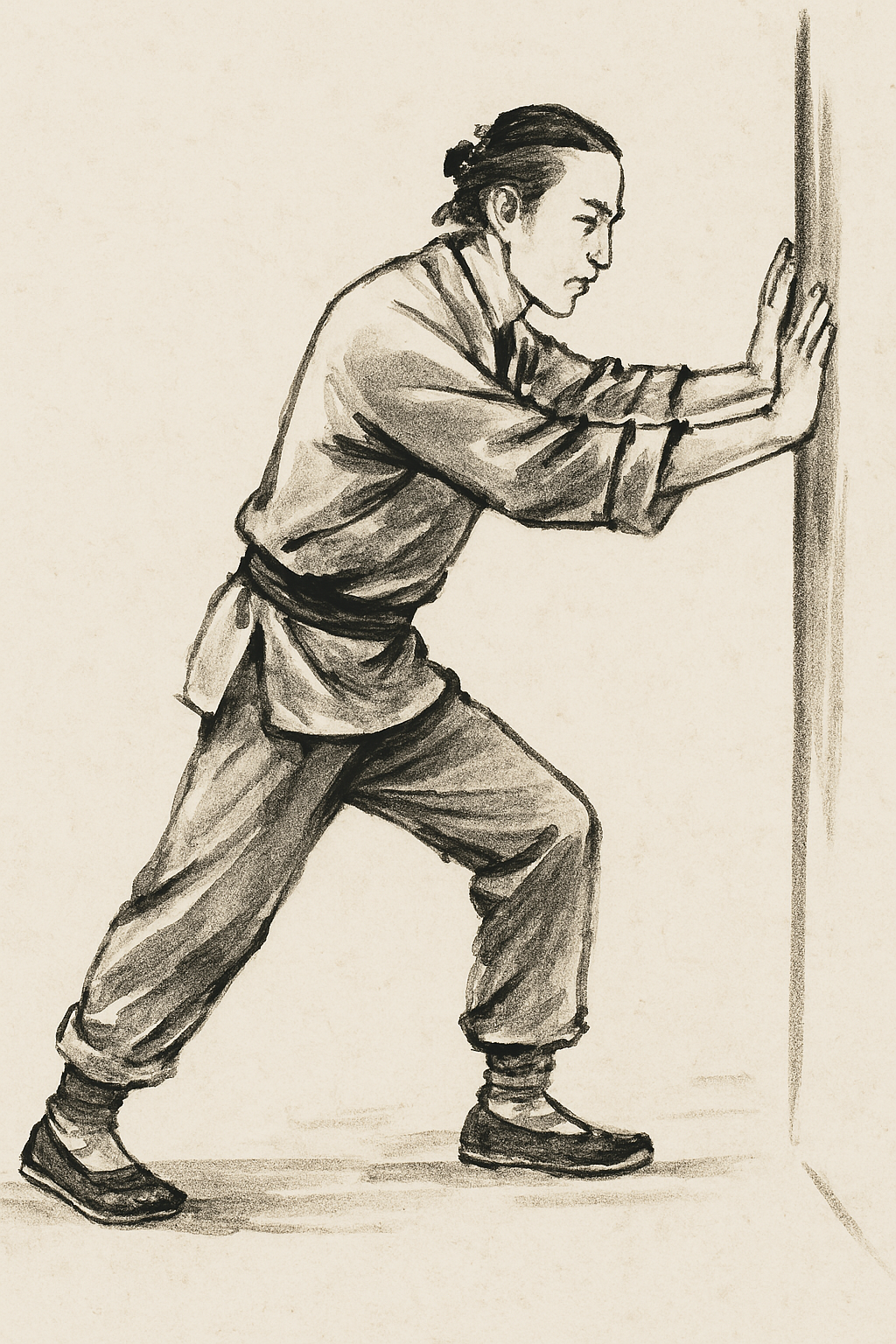
An AI-generated tai chi ‘push’ against a wall


Pushing is also part of tai chi’s two person exercise, tui shou – “push hands”. So most tai chi people are pretty familiar with the concept of pushing.

Now imagine you are pushing against a wall and somebody asked you to push harder. Most people would simply push harder with their arms and lean harder into the wall. What you’ll feel when you do this (try it) is that it pushes your upper body backwards and away from the wall quite a bit because it’s impossible to push hard with your arms without introducing excess tension into the system.

This is the “you’re using your shoulder too much!” criticism that a lot of tai chi teachers sling at their students, without really explaining how not to push using the shoulder.

So, let’s look at exactly how you could push harder without using the shoulder.

The only another way to increase the power of your push is to increase the downwards power through your legs. Now, it’s pretty hard to push downwards with your legs, since we have nothing above us to push off from if we want to push downwards. Instead, all we have in a downwards direction is gravity, so how do we use that gravity power? The answer is to relax and sink down into your legs harder.

Put your hands on a wall and try it.

As you sink and relax more through the legs you should feel the power in your arms increasing.

What you’ll notice is that you have to internally align your body correctly for this power to reach your hands. The good news is that you don’t need to think very hard to do this, you can just feel how you need to arrange yourself and your subconscious will do the rest. But you need to properly relax. If you tense up parts of your body – your shoulder being the main culprit – the power won’t slow smoothly and uninterruptedly through the body to reach its destination.

At this point you should start to realize why the word relax (or “sung” in Chinese) is said so often in tai chi practice.

That path from floor to hands is what you’d call a ground path, or a jin path. And the force you are channeling into your hands is known as jin in Chinese. The usual English translation of jin that you see used is “refined strength”.

Again, don’t get hung up with where the path goes through the body, just where you want the force to go.

You should also notice that as the jin force in your arms increases, you don’t get knocked or pushed backwards as easily as you did when you were using brute strength, because there is less tension in your upper body.

Obviously you are not going to push a wall over! But you can now feel the forces in your body that we should be dealing with when doing the tai chi form, and hopefully when you do “push” in the form, your push will now be a little bit different, more refined, a little less clumsy and a lot more tai chi-like.

Whole Body Power, or “threading into one” in Xing Yi

The Xing Yi classics don’t tend to get as much play as the Tai Chi Classics, perhaps because they’re not as easy to read and ramble a bit, but they’re older, and as every good Confucian scholar knows, older is better!

The origins of the writing known as the Xing Yi classics is uncertain, but they’re often attributed to the Song military hero Marshall Yue Fei who is also the apocryphal founder of Xing Yi. Many people dismiss him as the originator of Xing Yi, thinking of it as merely a folk tale, but as our History of Xing Yi podcast series is trying to show, while there is no literal teacher/student line that traces back from modern day Xing Yi practitioners to Marshall Yue Fei, there is a history of ideas that can be traced back.

Qing Dynasty portrait of Yue Fei.

But however the Xing Yi Classics came down to us, they have been hugely influential, so can’t be discounted. Pretty much all the manuals written about Xing Yi from the high point of the martial arts manuals creation period (the Republican era) quote from them extensively. So, if you want to find the source of the ideas that have seeped down into modern Xing Yi – things like elbows protecting the chest, all parts moving together, or all parts remaining still together, the six harmonies connecting and coordinating the different parts of the body together – they’re all here. And I think that the XingYi classics have been hugely influential on other internal martial arts, like Tai Chi. The Tai Chi Classics use similar phrases and ideas all the time. The Xing Yi classics are where we get our ideas of what makes internal martial arts different to external martial arts from because they contain the important idea of “Internal and external are combined, the front and the rear mutually required. ” And this was written long before people had heard of Tai Chi (Taijiquan).

I don’t read Chinese so I’ll point you to one English translation that’s available online. I don’t have any strong opinion on this being better than other translations, it’s just available. There’s one done by Yang Jwing Ming that’s also good.

Over and over the classic, which contains 10 ‘songs’, talks about how to coordinate the body so that a kind of whole body power is being delivered. Because of the amount of writing about it in the classics (including Tai Chi Classics), we have to assume that this ‘whole body power’ is not just a trivial, or easy to do. And if it was then I’d see a lot more people doing it, and I don’t. It’s hard to get a foot in the door of whole body power, and it’s even harder to do it very well. 

Being relaxed and not overly tense is important for whole body power, and I think Tai Chi is very good at teaching that, but the footwork tends to be lacking. Xing Yi is good for teaching you how to move with this whole body power. A lot of the Xing Yi classics are devote to talking about stepping.

But over and over, the overarching theme is of unifying the body, of “threading into one”. This is the whole body power that internal martial artists seek.

“About what one means; from top to the bottom of the feet, internally there are viscera, bowels, tendons, and bones. Externally, there are muscles, skin, the five sensing organs, and hundreds of bones of the skeleton, mutually combined and become one. When struck will not open, when hit will not decompose. The top wishes to move, the bottom automatically follows. The bottom wishes to move the top will automatically lead. The center section moves, the top and the bottom will coordinate. Internal and external are combined, the front and the rear mutually required. This is what is called threading into one.” – Thesis of Integrity from Mike Patterson’s website.

If you’d rather have somebody demonstrate the concepts contained in the Xing Yi Classics than read through them, then I’d recommend this new video by Byron Jacobs – he talks and demonstrates the content very well here: