I had a chat with Alan Wycherley from the In Defence of the Traditional Martial Arts YouTube channel for my podcast and the episode is now live. We talk about how Tai Chi can be used as a realistic self-defence system and Alan’s encounters with traditional martial artists from different kung fu systems.
Emei Mountain is the latest hot Kung Fu trend coming out of China, and a group of Kung Fu girls is leading the charge, according to a new article in China’s GlobalTimes.
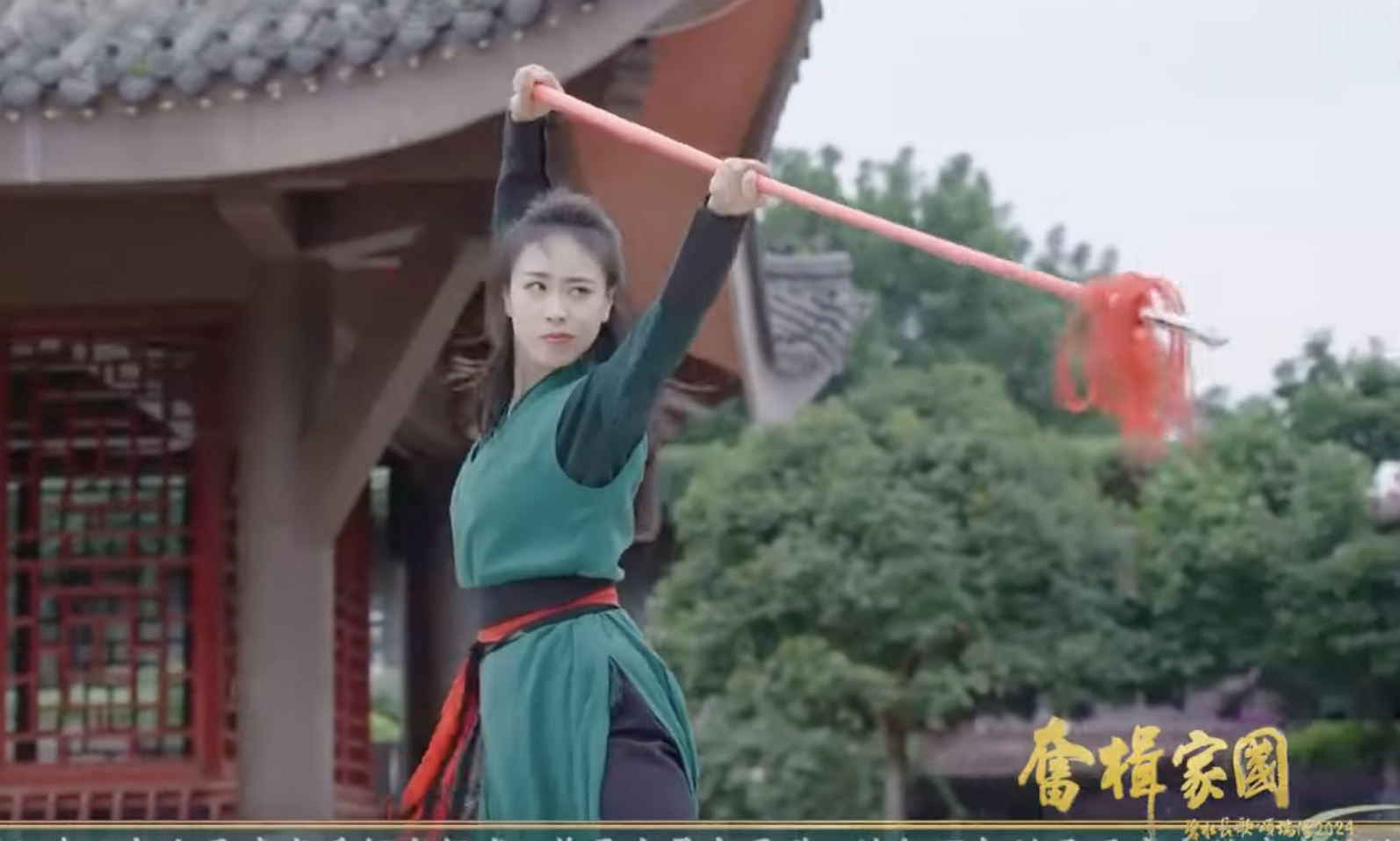
In April 2024 a video appeared showing nine female Kung Fu performers doing Kung Fu moves against the backdrop of Emei Mountain.
Chen Yufei, 23, one of the group members is quoted in the article: “Unlike the dramatized versions of Emei kung fu in TV shows, which focus on legends, our practice is rooted in the practical skills and traditions of Emei martial arts.”
The video shows performance with a variety of Kung Fu weapons including double whips, swords and of course, the famous Emei needles *, but the phrase “traditions of Emei martial arts” raises a few red flags for me.
A standout line from the article reads “In 2008, Emei martial arts, with a history spanning over three millennia, were designated a National Intangible Cultural Heritage.”
Ok, hang on, what?
Mount Emei has long been a sacred mountain for Buddhism, sure. But a 3,000 year old tradition of Kung Fu?
If you look up Kung Fu training camps on Mount Emei you’ll find a complete history of the martial arts and styles there: “Emei School has 1,093 bare-hand fighting skills, 518 skills with weapons, 41 pair practice routines and 276 practice methods.”
Call me a cynic, but I don’t believe any of this. It appears to me that the Kung Fu traditions of Emei Mountain really belong to the work of modern wuxi fiction of author Jin Yong who wrote a lot about a fictional Emei Sect. In his book, The Heaven Sword and Dragon Saber, the Emei School is founded during the early Yuan dynasty by Guo Xiang around the same time as when the Wudang School is established.
Of course, this being a complete fiction hasn’t stopped the Kung Fu tourist industry from setting up shop on Mount Emei. As this 2012 article describes, there was not much Kung Fu on the mountain back then, but it was starting to be set up, complete with a history. But if you look up Mount Emei today you’ll find Kung Fu competitions are held there, and very much like the operation at Mount Wudang, you can go there to study Kung Fu, for the right price.
The all-female Kung Fu troop heralding from Mount Emei seem to be as much a creation of the Kung Fu tourist industry as anything else, at least to me.
So where does their martial arts come from? Looking through various pages on the Internet I found a Reddit post that sounds true to me: ” “Emei” is just a generic term for martial arts from Sichuan, extremely few styles have any actual direct relation to anyone who loved or practiced on Emei shan. Also almost everything called “Emei” today are modern offshoots of northern Chinese martial arts brought to Sichuan with nationalist troops as they were forced westward by the Japanese in WWII.”
None of which, of course, is to take away from the performance of the Emei all-female Kung Fu group, who are pretty damn good at WuShu.
Note 1: Mount Emei even has its own weapon, the Emei Ci which are sharp steel rods known as needles or piercers, that can be worn on a ring on your finger and spun around.
A visit to Mount Emei by Will of Monkey Steals Peach:
At the recent 2024 Martial Arts Studies conference in Wales I had the good fortune to meet Randy Brown of Mantis Boxing and Brazilian JiuJitsu in Massachusetts, USA. We had a blast at the conference discussing martial history, theory and even demonstrating a few techniques on each other into the small hours in a pub in Cardiff city center! Not only is Randy highly skilled in mantis boxing, but he’s also a black belt in Brazilian Jiujitsu, so we had a lot in common.
When I was exchanging techniques with Randy he noticed that the Choy Li Fut I was showing was identical to moves from a form he knew called gong li quan, which translates as “power-building boxing”. It was a form he had learned that was used as foundational training for various Ching dynasty martial arts, like long fist, eagle claw boxing and praying mantis boxing.
Gōng Lì Quán, or Power Building Boxing, is a unique boxing set from northern China, and is included as a training routine amongst a variety of boxing styles in the north to include: long fist, eagle claw boxing, and praying mantis boxing. This form likely intermixed with the latter two styles when it was included as part of the Jīngwǔ Athletic Association’s fundamental wu shu curriculum. At Jīngwǔ, gōng lì quán was one of the mandatory six empty hand and four weapons sets taught to kung fu practitioners. These ten sets were required as a prerequisite to the study of: xingyiquan, bagua, taijiquan, eagle claw, or mantis boxing; considered by Jīngwǔ founders to be more ‘advanced’ styles.
Our meeting seems to have sparked a desire in Randy to delve further into gong li quan and resurrect this old form he’d forgotten about and try to bring the movement to life with grappling applications. He’s been kind enough to share video of his research.
3 Rings Trap the Moon
This was the original move we discussed in Cardiff, 3 Rings Trap the Moon, which in Choy Li Fut would be a gwa choy (back fist) followed by a sau choy (sweeping fist) followed by a biu choy (an outward forearm strike). Randy shows the original move from gong li quan, then his grappling applications. It’s pretty cool!
Twining Silk Legs
Randy has been updating his blog post with new applications as he goes, so keep checking back. One of his latest is the move Twining Silk Legs:
Twining Silk Legs is two upper cuts followed by two kicks. Again, Randy shows the move and then his grappling interpretation of the applications. What’s really interesting to me is that, once again, there’s a parallel in Choy Li Fut with this move. If you look at the move starting at 1.22 in the following Choy Li Fut video you’ll see what is essentially the same move as Twining Silk Legs – two upwards strikes followed by a kick. (Ok, just the one kick here, not two, but still…)
You could look at this as further proof that gong li quan and Choy Li Fut share a common ancestor back in the mists of time, but since I’d be willing to bet that other Chinese martial arts practitioners would also recognise these moves from their own systems, I’d venture to say that is is further evidence for Randy’s theory that the explosion of different martial styles during the end of the Ching dynasty (which is where we get Choy Li Fut, mantis, Wing Chun and the other well-known styles) was more about branding the martial arts, for commercial reasons, and that they actually shared a common pool of knowledge.
“A question needs to be asked, did ‘Chinese boxing’ of the era, have a similar common pool of knowledge? Qī Jì guāng’s manual would hint at such. Within ‘Chinese Boxing’, attributes, feats, or skills defining one fighter over another became definitive styles of their own right due to events of the time”.
(The Qi Ji Guang he’s referring to is the Ming dynasty general who fought off Japanese pirates and because a hero to the people. He wrote a famous manual which documented the martial arts of the time. The techniques in the manual seem to crop up in all sorts of Ching dynasty martial arts.)
You can learn more about the the tumultuous events of the Ching dynasty and the explosion of martial arts styles that happened during it in Randy’s video of his presentation from the 2019 Martial Arts Studies Conference:
2025 Martial Arts Studies Conference
Today I heard the exciting news that next year’s 2025 Martial Arts Studies Conference will also be held in Cardiff, Wales. This will be the 10th anniversary of the original 2015 conference, which was held on the 10th-12th June in Cardiff, and will be held on exactly the same dates. It’s almost too perfect. See you there?
The Martial Arts Studies Network has also released a new (and free as always) issue 15 – check it out, it’s full of top-quality articles on martial arts. Oh, and don’t forget, I also recorded a podcast with Randy while we were at the conference – here it is:
What’s in a name? When it comes to tai chi chuan (taijiquan), then the answer is… quite a lot.
Firstly, there’s the issue of how you write it. Occasionally, you will see an attempt to guess at the spelling of the name that makes the mind boggle, such as an email asking if somebody can come to your “thai chee” class, but usually it’s some variation of “tai chi” or “taiji”.
Tai chi was first romaised into English using the Wade–Giles system as “tʻai chi chʻüan”. But English speakers soon abbreviated it to “tʻai chi” and dropped the mark of aspiration. Nowadays, in the UK at least, we tend to use “tai chi” and forget about the “chuan”. Perhaps a better translation would be “tai chi boxing”, but this goes against the image of the art, which is usually practiced as a health exercise, so that’s never going to catch on. There really isn’t much “boxing” going on in most tai chi classes.
Then there’s he newer pinyin romanisation system, which has replaced Wade–Giles as the most popular system for romanizing Chinese. In pinyin, tai chi is written taijiquan. It’s popular to use taiji or taijiquan in English now to also remove any colonialist connotations of the term from a bygone era.
I get that, but I think the written phrase tai chi has slipped so far into the general populations consciousness that a lot of people have no idea what you’re talking about if you write taijiquan. I use tai chi myself.
Step back into the Qing dynasty
Then there’s the issue of when the art was given the name tai chi boxing. Tai chi emerged into public life in the royal court during the Qing dynasty, yet it wasn’t freely called tai chi until after the dynasty ended. If you try and find a written occurrence of the name published before 1912 you’ll draw a blank. There are certainly written documents that claim to be from years earlier that contain the name “tai chi boxing” yet not a single one of them was made public or published before 1912. What happened in 1912? The Qing dynasty collapsed and the new Republican era began.
My best guess as for the reason that this is the case is that Hong Taiji (1592 – 1643), the founding emperor of the Qing dynasty had adopted the name “Taiji”. It’s unclear if this was his personal name or a title, but there was certainly a taboo around using that name because it belonged to an emperor. It therefore became impossible for a marital art to be called “tai chi boxing” without breaking that taboo and suffering the (presumably harsh) consequences. However, once the Qing dynasty fell, the name was back on the market. (Credit to my friend Daniel Mroz for bringing this to my attention).
The taiji symbol
Then there’s the meaning of the name. The name taiji has obvious connections to the philosophical concept of the taiji symbol – the circle with the two fishes representing yin and yang and their constant interchangeable position. One state increase till it exhausts itself leading to the other in an infinite loop.
In Yang style tai chi lineages, the art has long been associated with Taoist ideas, which the taiji symbol is representative of. Chen style seems less Taoist in origin, however, the concept of taiji is a universal symbol, and used throughout all of Chinese thought.
The name taiji can be translated as “supreme ultimate”, which has lead many to conclude that tai chi boxing must have got the name because it was the boxing system par excellence of the Chinese martial arts scene. It is literally, the best! If only!
I wish that was true, but I think it’s just a common misunderstanding, which is perhaps played on as a marketing device in modern times. I mean, who wouldn’t want to be learning the supreme ultimate boxing system, right?
The concept of being a supreme ultimate is more to do with supremely different positions being harmonised. Extreme yang and extreme yin. Polar opposites that work together and find harmony. That’s the real meaning.
In Tai Chi your body moves through position after position – we call these ‘postures’ usually – in the transition between them the body will open and close in a repetitious cycle. Once yang (open) is exhausted the body will move to yin (close) once you’ve reached the extreme position of yin, you move back to yang again, and so on.
The opening and closing is a whole body action. So, you are literally enacting the taiji diagram with your body.
That’s the general idea. Of course, you can break down your body into sections and look at how each one of those opens and closes, there is seemingly no end to the level of detail you can drill down to, but on a basic level your body is always moving from yin to yang and back again, which is the reason for the name of the art – tai chi chuan.
This post is going to start somewhere you don’t expect – over 1,000 years ago in Song Dynasty China during which we find the legendary founder of Xing Yi, Yue Fei, a general in the Song Dynasty army, mulling over the advancing (heavily armoured) Jin cavalry, and wondering how his foot soldiers are going to fair against the crushing advance of an army that had destroyed the Liao Dynasty troops, scattering them to the Western regions.
The Jin/Song wars would last a century, starting in 1125, when the Jin attacked the Song after a series of negotiations between the previous allies failed. During this period North and Southern China was effectively separated between Jin and Song, with the Song retreating into the south of China. The Jin advance into southern China in 1130 was stymied by Song generals like Yue Fei and Han Shzhong. Eventually the Song allied with the Mongols in 1233 to defeat the Jin, but the Mongols then went on to defeat their previous allies, the Song, and thus the Yuan Dynasty was born.
But why this history lesson? Well, one weapon that was popular during the Song/Jin wars was the ‘sword breaker’ called a bian, which translates as ‘whip’. But it was a very solid short stick made of iron, not a flexible whip. It was often used on horseback because it was effective against heavily armoured warriors, and the Jin cavalry was very heavily armoured.
The Tai Chi move “Single Whip” (Dan Bian), has the same character for whip as the one used for the ‘sword breaker’. It’s also similar to the characters for ‘shoulder pole’, which I’d previously speculated was a possible origin for the name. But people who are better at Chinese than me have cast doubt on this theory. It seems much more likely that it’s the ‘sword breaker’ weapon that is being referred to, not a shoulder pole.
“Recently I’ve been made aware of some theories about the meaning behind “Single Whip” 單鞭 (dān biān)
Basically the claim is that the posture resembles a farmer carrying something on a pole or yoke and that the name refers to this yoke.
This yoke or shoulder pole is called 扁擔 (biǎndan)
So right away, simply linguistically, this claim is a little bit problematic.
English Character Pinyin Romanization. Single Whip 單 鞭 dān biān Shoulder Pole 扁 擔 biǎndan
We’re dealing with four completely different characters with completely different meanings. The dan in biandan is POLE not single.
To a native Chinese speaker this is like comparing apples to tennis balls. It’s just a ridiculous claim.”
The post goes on to look at the historical record, which is fairly interesting, and makes the case for the bian being the ‘sword breaker’.
Fair enough, the shoulder pole idea was just a theory of mine based on the similar name, and the way it looks. As with all good theories, it can be disproved with evidence. But as I also said in that original post of mine:
“The ‘whip’ could also be used as a weapon in Chinese Marital Arts. Again, it was usually referring to a short stick, not a flexible whip. In the excellent “Chinese Martial Arts Training Manuals” by Brian Kennedy and Elizabeth Guo you’ll find a description of a book called “Tiger Tail Whip” by Jiang Rong Qiao published in 1930. It features a “long routine for the metal tiger tail ‘whip’, which is rigid and actually amounts to a type of cane.””
“Chinese Martial Arts Training Manuals”, by Brian Kennedy and Elizabeth Guo
The ‘sword breaker’ or ‘bar mace’ was certainly more substantial than a cane. As the name implies, it could break swords, but it was also good for attacking heavily armoured soldiers as it could impact the person under the armour. Check out what it could do in this excellent video:
What’s in a name?
But it’s still hard to work out why the Single Whip posture would be named after the ‘sword breaker’ in the first place. I mean, the posture doesn’t resemble the weapon at all… But then I saw something very interesting recently:
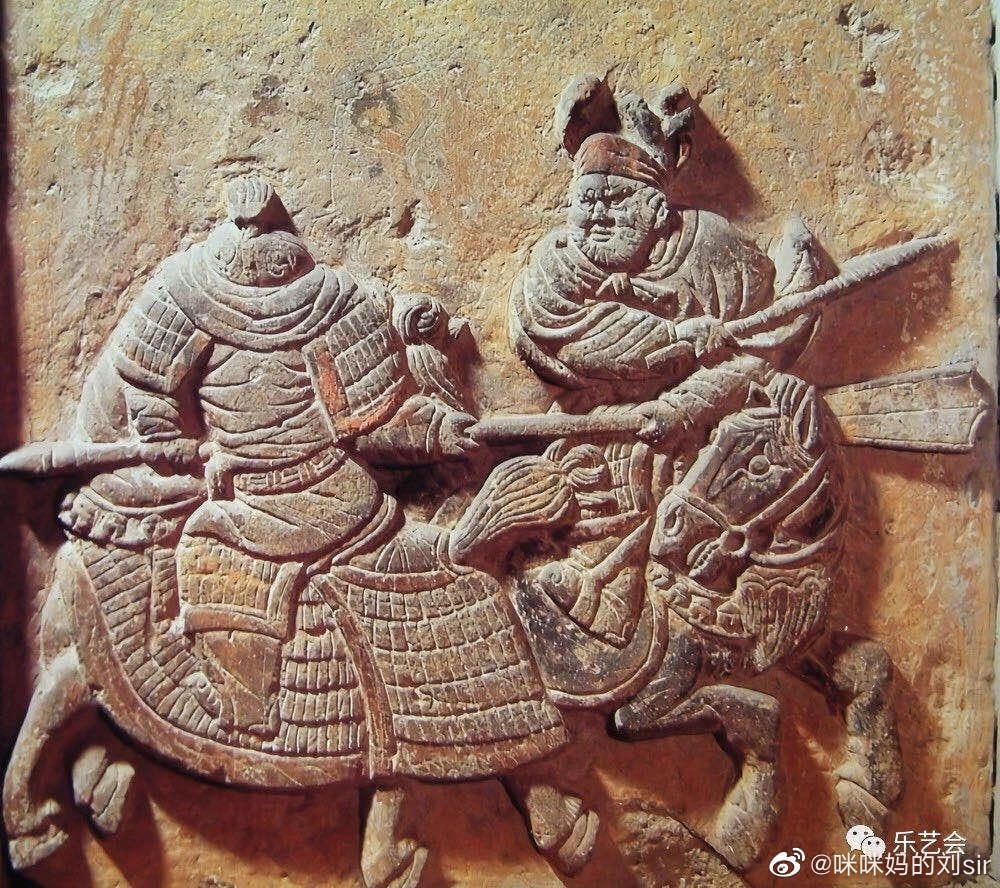
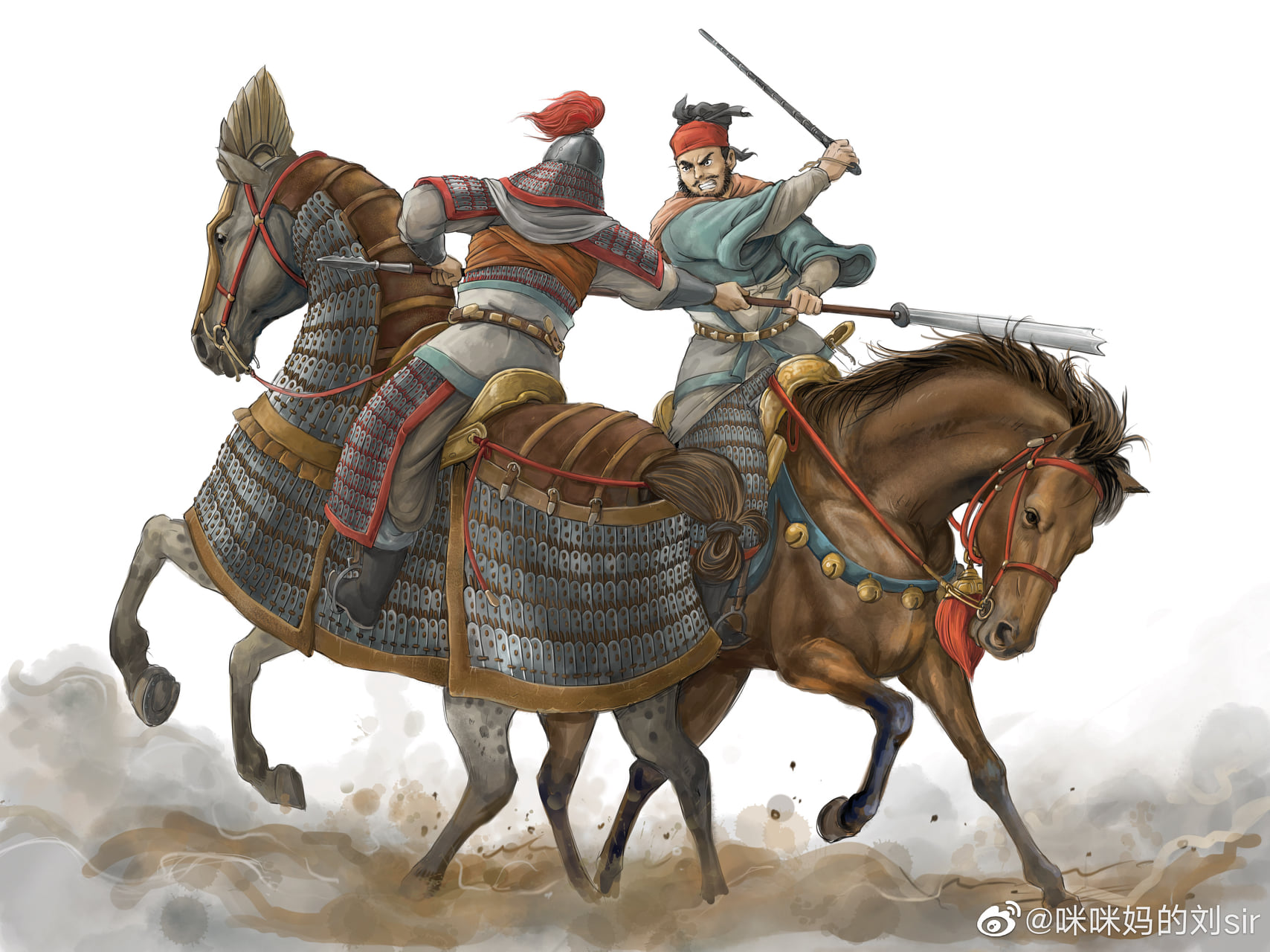
“This brick carving is from a tomb of Jurchen Jin (1125–1234), describing a battle between Song and Jin cavalries. The one who faced to us with a sword breaker 锏 might be Jin cavalry, who snatched the pole weapon (三尖两刃刀, lit. ‘Three points double edged blade’ fig. 3) away from Song cavalry and swung his sword breaker 锏 to attack his head from right to left. Song cavalry’s head and helmet were totally whacked. Well, pole weapon user should always keep distance with enemy and, such blunt weapons like mace, sword breaker etc. are really excellent weapon against heavy armor. Picture 2 was drawn by 咪咪妈的刘sir.”
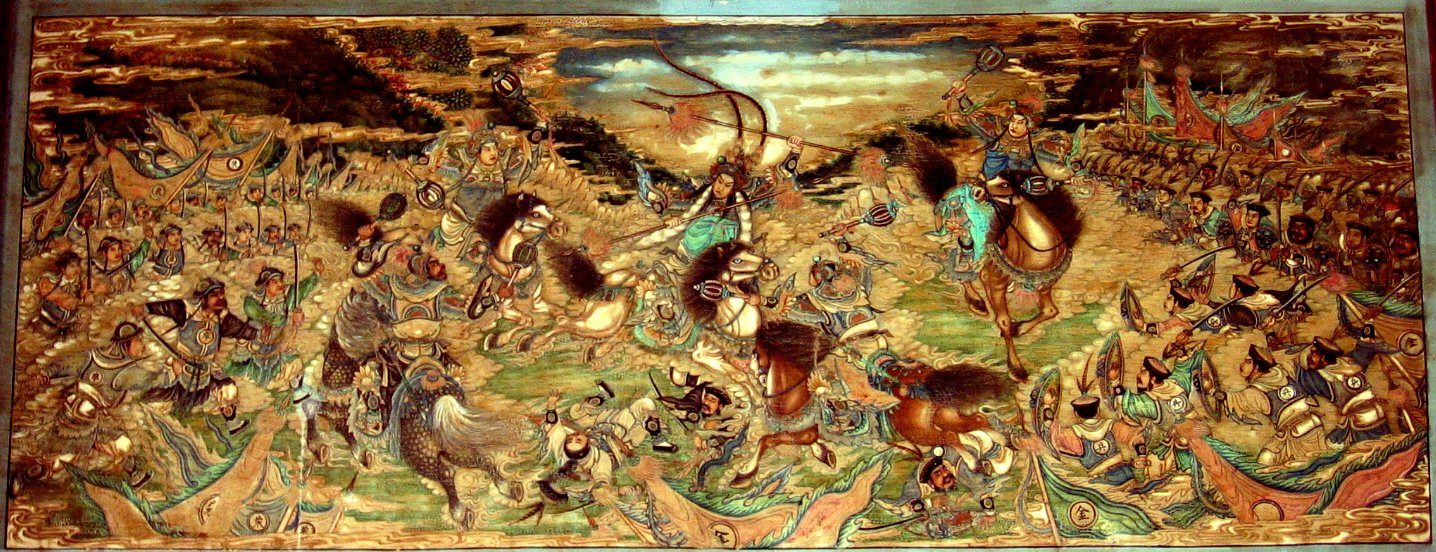
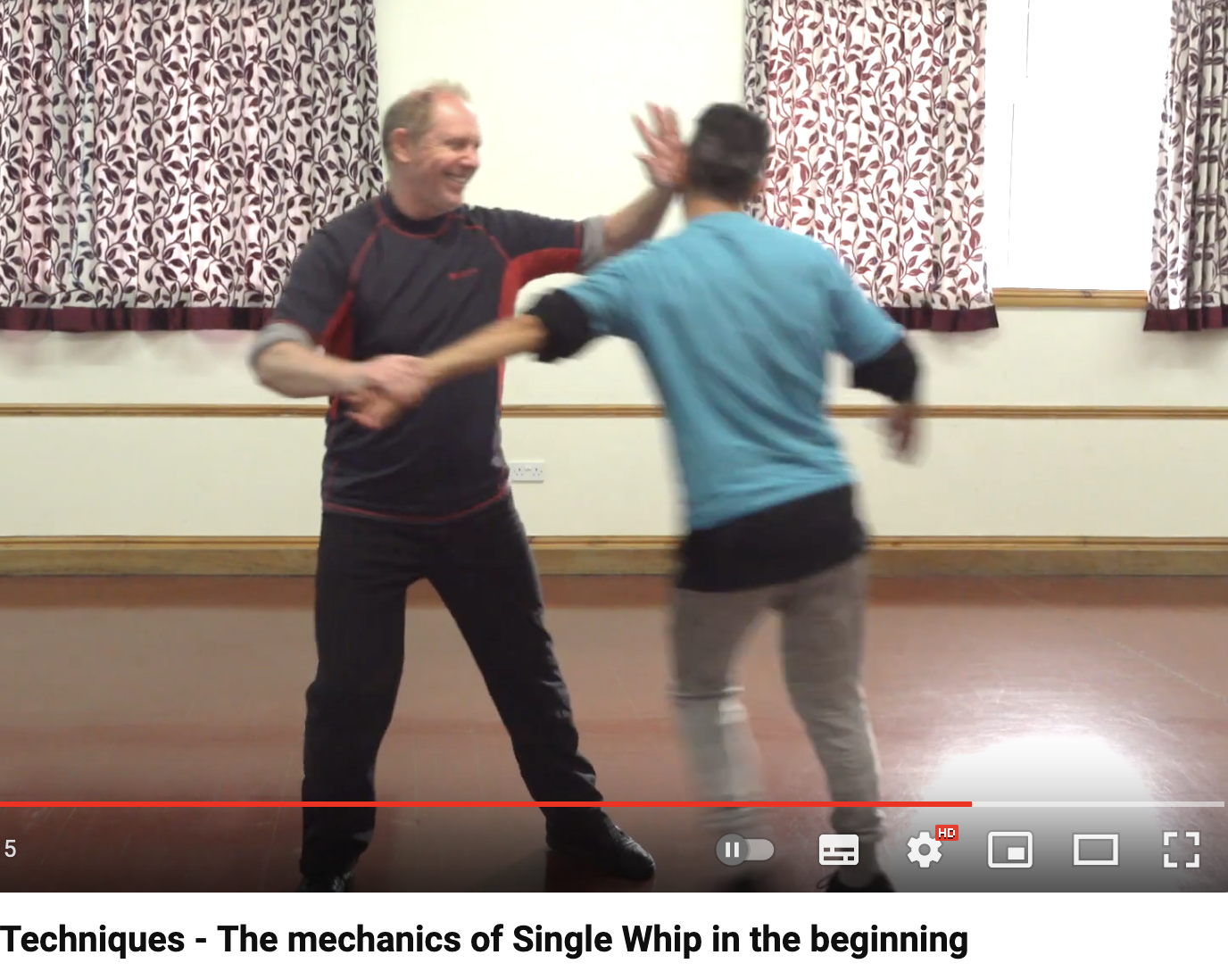
Now, what I notice about this carving, and the painting, is that it isn’t a million miles away from the application of single whip that we practice in our Tai Chi. Check it out:
Maybe that’s where the name “Single Whip” comes from? The application of the move is certainly similar to the way you’d use a ‘sword breaker’ way back in the Jin/Song wars to grab the opponent’s long pole weapon and bash them on the head with your ‘whip’.
But why “single”? Well, it turns out that the ‘sword breaker’ was often a two handed weapon. You had one in each hand, as this carving of the Jin cavalry shows:
You can also see double maces being used by cavalry in the painting that opens this article.
It’s as good an explanation for “single whip” as I’ve read anywhere else. And at least this reasoning makes some sense. At the end of the day, it’s just another theory, ready for some eager beaver to disprove.
I always find the labels ‘traditional’ and ‘modern’ misleading because something that’s current and popular, like Brazilian Jiujitsu, is actually quite old in comparison to some of the martial arts we would call traditional, like Aikido or Taekwondo. But even recently created martial arts are built on older traditions, so where do we start dating a martial art from? From the day it was named, or from the arts the proceeded it? If it’s the later then all martial arts are the same age and have existed (potentially) forever.
Another way of differentiating between traditional and modern is using the self defence vs sporting dichotomy, however so many martial arts exist in a grey area between the two – take Muay Thai for example, that I don’t think that’s a good way to do it either.
“For me, one of the best, i.e. concise and precisely written and kind of encompassing scholarly starts on traditional martial arts was and is the following by Moenig & Kim (orig. 2018; republished as a book chapter 2021):
“[T]he expression ‘traditional martial arts’, which has become very fashionable, is one of the most misrepresented and misused terms in the general discourse. ‘Traditional’ projects an image of a long history and of continuity throughout history, without change. In reality, most modern Asian martial arts are only a few hundred years old or are an evolutionary product of the twentieth century. On the other hand, some western combat sports, such as boxing and wrestling, actually have traditions as long as, or longer than, most modern, popular Asian martial arts, and nobody would ever classify them as ‘traditional martial arts’. The term ‘traditional’ seems wholly reserved as a reference to Asian martial arts. However, to the contrary, many present-day East Asian martial arts developed only recently, and are not ‘traditional’ by most definitions. Most traditional martial art proponents do not consider sports as having any philosophical aspects, as being mostly irrelevant, and as ‘merely’ a physical activity without any spiritual merits. Surveying the available literature on martial arts reveals that leaders and practitioners of traditional martial arts have often monopolized the discussion about philosophy, educational values, and realism in martial arts training; labelling the sports aspect inferior regarding educational benefits in addition to being unrealistic for real combat“ (Moenig & Kim in: Hong & Li, 2022: 43). Original reference Book reprint/republishing
You might also like to listen to the lecture, Inventing Traditional Martial Arts a lecture by Prof. Peter Lorge from one of the Martial Arts Studies conferences.
I had an interesting comment on my last post that made me think about the whole idea of making up your own forms (or Tao Lu) – in Tai Chi, Xing Yi, or whatever.
I’ve tried to do this over the course of several years and I’ve come to a few conclusions about it, which I’ll elaborate on here. Firstly, it’s hard. Making up new forms is not as easy as you think. But secondly, it depends what martial art you are making up a form in.
Author, performing Xini Yi Chicken (Ji) posture
If your martial art has forms that are constructed like lego bricks that can be slotted together in any order and still seem to work then it’s pretty simple to concoct a new form. Xing Yi is a good example of a martial art that has this quality. I was always told never to call Xing Yi tao lu by the English name “forms” because the correct term was lian huan which means “linking sequence” for this very reason.
The idea, (in our Xing Yi at any rate), is that all the links you learn are just examples, and you need to be constantly moving towards being able to spontaneously vary them as required, and then ultimately spontaneously create them. This idea has become heretical in the modern Xing Yi world to a large extent because modern Xing Yi has lost a lot of this spontaneous feel it used to (I admit that’s a subjective point) have, and things have become set in stone – forms that were once supposed to be fluid and flexible have become fixed and rigid. Forms of famous masters from the past now tend to be fixed forever. When words like “orthodox” start appearing to describe something you know it’s already dead, or on the way to dying.
But of course, anybody can make up a form, but is it any good? That’s a different matter. And it usually depends on the person doing it, not the moves themselves. With Xing Yi animals you can also ask the question – can I see the character of the animal being used coming out through the moves?
With Tai Chi I find it a lot harder to make up a form. Tai Chi’s approach to a form is quite different to Xing Yi, or other Kung Fu styles. The Tai Chi form tends to be a highly crafted piece of work that has been honed to perfection over many years. It is fixed because you need to be able to forget about the moves and concentrate more on what’s inside. It helps to do that if you don’t have to worry about what’s coming next because you’ve done it so many times that you can let go of that part of your brain and let it be aware of other things.
Tai Chi forms tend to start and finish in the same place for this reason. Usually, anyway. While long forms don’t tend to be balanced on left and right, a lot of the more modern, shorter forms make more of an effort to balance left and right movements.
If you understand Tai Chi and how to ‘pull’ or direct the limbs from the dantien movement then, sure you can make up your own Tai Chi forms, however, there is almost zero history of doing this in Tai Chi circles and it’s not really encouraged. I think this is because Tai Chi has push hands, which can be used as a kind of free-form expression of Tai Chi, completely away from the form and in contact with a partner to give you something to respond to, which is the whole strategy of Tai Chi Chuan, at least according to the Tai Chi Classics it is. To ‘give up yourself and follow the other’ you have to be spontaneous. There’s no other choice!
So, to conclude. I think that’s it’s in its application where the spirit of improvisation and spontaneity can be found in Tai Chi, not in the forms. I don’t think Tai Chi is particularly concerned with creating endless variations of forms and patterns like Xing Yi is, at all. Xing Yi, having a weapons starting point, doesn’t use this hands-on feeling and sensitivity to get started with spontaneity. Instead, it likes to create patterns, then vary them endlessly. Of course, you work with a partner when required, but it’s a different approach. Which is all quite natural, as these are two different martial arts, created by entirely different groups of people in a different locations and time periods.
You might like our Heretics history of Tai Chi and Xing Yi for more on that.
I’ve been meaning to read the story of Matthew Polly’s time spent training at the famous Shaolin monastery for years, but I finally got around to it recently thanks to my Audible.co.uk subscription*. And what a great read it is! I’m sure we can all identify with the teenage Polly, unsure of himself and his place in the world, who falls under the spell of Kung Fu and decides to dedicate his life to the pursuit of it as some kind of escapism from the pressures and fakeness of the modern world. To Polly, Kung Fu represented something sublime, pure and otherworldly that actually meant something. But unlike most of us, he did more than just dream about it, he actually went to Shaolin and lived there for almost a year, at a time when there was no Internet, no easy way to get there and China had only recently opened up to foreigners, so most Chinese people had never even seen a Laowai in the flesh before.
Polly’s story could best be summed up as a sequence of misadventures punctuated by moments of sublime martial arts inspiration. He manages to get into all sorts of scrapes involving accidentally offending senior party officials, being entered into a tournament against a San Da champion and hilarious misadventures with the opposite sex. Part Bill Bryson-style travelogue, and part kung fu geek-out, this is a rewarding, even emotional, look into what the Shaolin monks were really like in the 1990s, just as their international fame as stage performers was starting to spread and take over from the mystical image everybody had of them from the Kung Fu TV show. (Interestingly, at one point Polly watches the Kung Fu TV show with the monks who laughed their heads off at the idea of burning a dragon and tiger into your arms by lifting a hot anvil and dropping it into the snow – “why would you do that???”)
What you really get from this book is a sense of what the Shaolin monks are really like back then, and how much more human, relatable and down to earth they are compared to the lofty ideas we all have of them. It answers all the big questions like, how good are they at actually fighting, how seriously they take the “monk” side of their lives and how they train iron first, arm, head and even iron crotch.
The little snatches of Chinese you pick up by reading the book are also a hidden bonus and bring the characters to life marvellously. By the end of the book you feel like they are your friends and you know them just as well as Polly did. Anybody who likes this blog would love this book. Recommended.
N.B. The cover with a monk holding a Burger King bag is representative of the idea of American values seeping into China, but a little misleading as there were no Burger Kings in China then, and certainly nothing like that in the rural backwater of the Shaolin village.
*Like a number of other books, American Shaolin is included in the cost of an Audible subscription, so if you are a subscriber you get it free.
It’s no secret that Tai Chi is a series of circles. The body opening and closing using circulation motions, like a yin/yang symbol in action. But when you look at a Tai Chi form, you’ve got to wonder, what came first, the techniques or the philosophy? Was Tai Chi created in a moment of philosophical purity and clarity, or was the philosophy simply bolted on to existing military or self-defence techniques (or popular movements from theatrical or religious rituals) that were already as old as the hills?
What I’m wondering is, was there at some point a founder of the art who decided, as a starting point, that he was going to purposely create a martial art based entirely on a philosophy based on the Tai Chi symbol, which would be both the overarching principle and the raw material, out of which martial applications would be fashioned?
Or did the idea of doing things in circles come later, and get added to existing martial techniques, and in so doing, alter them forever?
Well, let’s look at what we know as fact.
Fact 1: Tai Chi does indeed contain nothing but circular movements. I’m sure somebody somewhere can point out a movement in a form that looks linear, but it’s quite possible that the movement is actually being created in a circular way, or it has degraded over time into something else. All we can do here is talk in broad brush strokes. If you look at a Karate form, or a Tae Kwan Do form you see lots of examples of linear movements, that are usually lacking from Tai Chi forms. From this we can conclude that some sort of philosophical idea must have been involved in its creation.
Fact 2: The techniques in Tai Chi forms look a lot like other techniques in other Chinese martial arts forms, so are not in any way unique. If you look at a lot of forms from the Shaolin Temple, or village styles from all over China, you see postures and movements that are very similar to the techniques found in Tai Chi. In a way, there is nothing new under the sun.
When solving a murder, detectives look for two things first – opportunity and motive.
When Tai Chi first appeared in Beijing in the late 19th century it was promoted along with the idea that it had a founder, an immortal Taoist called Chan Sang Feng who had created the art based on his observation (or a dream) of a fight between a crane (or possibly stork) and a snake. And while certain groups (see my last interview with George Thompson) on Wudang mountain still take this story very seriously, and possibly literally, modern scholarship has tended towards the idea that it was a fighting art from the rural countryside (Chen village being the most popular choice for origin) that found its way to Beijing via a young Yang LuChan, who taught it to those at the highest level of influence inside the Forbidden City.
Of course, the shadowy figure of Yang LuChan is never adequately explained, and since he was an uneducated nobody – a rural rube – nobody really made a record of his existence. The story everybody, including all the heads of the various Tai Chi families, follows, (because it’s the story the Chinese government approves of), is that he learned the art in Chen village. But I always wonder about that time in the 1860s when Yang and the very well educated and important Wu brothers were in Beijing, as being a time when Tai Chi could have been invented. The Wu brothers would have known the philosophy on which to hang it, and Yang would have had the martial skills to make it work and turn it into something that could bring the fractured court of the late Ching Dynasty together, bonding over something that was essentially Chinese in the face of constant threat from foreign powers. Yang and the Wu brothers together had both opportunity and motive, and regardless of whether you accept that interpretation of history or not, Tai Chi has been used as a political football ever since, especially by the current government to whom Tai Chi (the world’s most practiced marital art!) represents the ultimate form of soft power, spreading Chinese culture and influence the world over.
So, as a kind of counterpoint to my previous post questioning whether all Chinese martial arts come from military methods, I’d like to focus on one that definitely does – Xing Yi. Although, this really just emphasises my previous point because Xing Yi looks very different to most other Chinese martial arts and the reason it looks different is because it comes from weapons-based military methods and is therefore more concerened with military engagements than civilian. As our podcast series is showing, there is a verifiable historical connection between Xing Yi and soldiers – for example, the oldest historically verifiable practitioner linked to Xing Yi – Ji Long Feng, was a real life soldier in the Ming Dynasty army.
But the real reason you can tell Xing Yi descends from military methods is that you can simply look at it. The arms and legs are generally close together and close to the body, the posture is narrow and the direction of techniques is straight in front of you. Everything is done within the profile of the body. There are two main reasons for this 1) you were wearing armor and had to accommodate for the weight of it, and 2) you were using weapons, which were probably quite heavy, since they had to penetrate armor.
The Xing Yi we have today is what military arts would look like if you did them without wearing armor and using hand techniques instead of weapons. Of course, many people still do Xing Yi with a spear, but it’s rare to see anybody wearing armor doing it these days, which I think leads people to get the wrong idea about it.
Take a look at this video of my friend Byron Jacobs from Beijing doing Xing Yi Zuan Quan (Drilling fist). Look how tight everything is to the body and how the hands are kept within the profile of the body:
Here’s an example:
All this leads me to this excellent new video by Karate Nerd, Jessie Enkamp called “I trained like a Samurai for a day”. Here he gets Dr. Kacem Zoughari, a Japanese martial arts expert to take him around the Samurai Museum Berlin. It’s pretty interesting then half way through, it gets super interesting because he gets to wear old Samurai armor and have a go with a few authentic weapons. Now this is really valuable because he tries to do Karate movements in the armor and very quickly realises that it’s completely inefficient and exposes all the vital parts of the body to strikes from the opponent. The expert, Dr. Kacem Zoughari, gets him to change his movements so that everything happens within the profile of the body and makes him use the footwork, momentum and body to power the arm movements. The strikes become hidden, and tight to the body rather than telegraphed and open… and bingo! It starts to look just like Xing Yi! He suggests a cross step at one point and it looks a lot like Xing Yi Dragon step. The strikes he has to do start to look like parts of the 5 Elements – Pi, Beng, Tzuan.
Take a look:
Now you may be thinking Japanese armor isn’t the same as Chinese armor and therefore none of this is relevant, but you would be wrong. That armor at the top of this post is not Samurai armor, (although I bet if you took the average person off the street and asked them what it was they would think it was Samurai armor). It’s based on Chinese armor from the Song Dynasty. This would have been officer armor, not what your average soldier was wearing, but the same principles would apply – you want your movements to protect your vulnerable areas – the neck and joints in particular.
Xing Yi is based on these principles – minimal movement, a tight profile, using the body, momentum and the step to power the arms, strikes based on timing rather than speed, etc. And that’s why it looks so different to something like Karate or Norther Shaolin or Long Fist, etc.