What is the role of forms, or kata, in martial arts?


Traditional martial arts, which are perhaps better described as “martial arts that are not sports”, tend to have a lot of forms, or kata. I’m thinking of karate, tai chi, wing chun, choy li fut, etc.

But what exactly is the role of kata, or forms? And has it changed over time?

In this new episode of the Heretics podcast I discuss the role of kata with Damon Smith who has extensive experience in various martial arts over decades.

It certainly became very trendy once MMA became a big deal to describe forms as useless, however, I think they do have uses, even today. As usual Damon has some pretty interesting insights into how forms have changed over time, and he can look back to the way they used to be trained in the 1980s compared to today.

Give it a listen!

Podcast.

Making up your own forms – it’s not as easy as you think

I had an interesting comment on my last post that made me think about the whole idea of making up your own forms (or Tao Lu) – in Tai Chi, Xing Yi, or whatever.

I’ve tried to do this over the course of several years and I’ve come to a few conclusions about it, which I’ll elaborate on here. Firstly, it’s hard. Making up new forms is not as easy as you think. But secondly, it depends what martial art you are making up a form in.

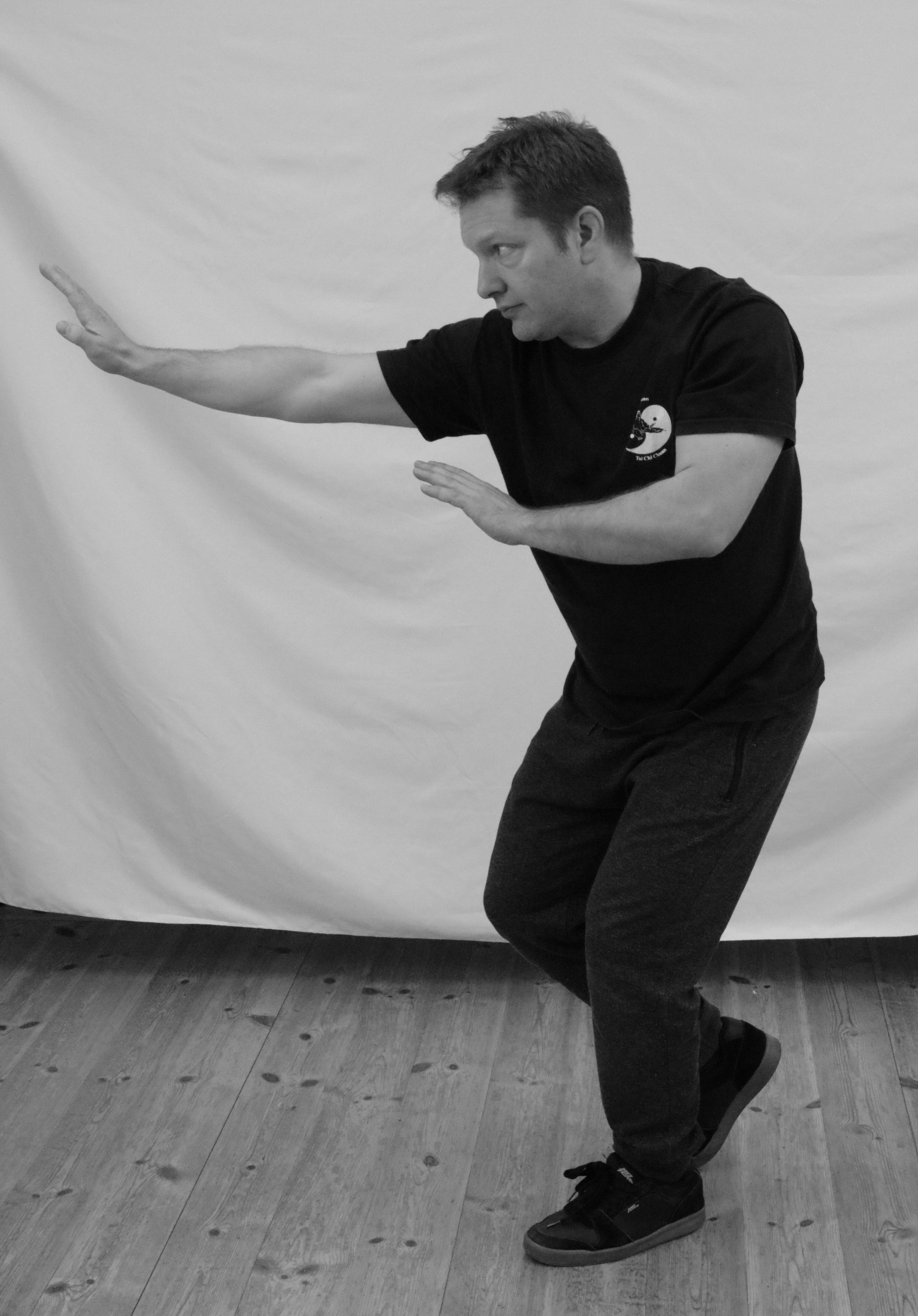
Author, performing Xini Yi Chicken (Ji) posture

If your martial art has forms that are constructed like lego bricks that can be slotted together in any order and still seem to work then it’s pretty simple to concoct a new form. Xing Yi is a good example of a martial art that has this quality. I was always told never to call Xing Yi tao lu by the English name “forms” because the correct term was lian huan which means “linking sequence” for this very reason.

The idea, (in our Xing Yi at any rate), is that all the links you learn are just examples, and you need to be constantly moving towards being able to spontaneously vary them as required, and then ultimately spontaneously create them. This idea has become heretical in the modern Xing Yi world to a large extent because modern Xing Yi has lost a lot of this spontaneous feel it used to (I admit that’s a subjective point) have, and things have become set in stone – forms that were once supposed to be fluid and flexible have become fixed and rigid. Forms of famous masters from the past now tend to be fixed forever. When words like “orthodox” start appearing to describe something you know it’s already dead, or on the way to dying.

But of course, anybody can make up a form, but is it any good? That’s a different matter. And it usually depends on the person doing it, not the moves themselves. With Xing Yi animals you can also ask the question – can I see the character of the animal being used coming out through the moves?

With Tai Chi I find it a lot harder to make up a form. Tai Chi’s approach to a form is quite different to Xing Yi, or other Kung Fu styles. The Tai Chi form tends to be a highly crafted piece of work that has been honed to perfection over many years. It is fixed because you need to be able to forget about the moves and concentrate more on what’s inside. It helps to do that if you don’t have to worry about what’s coming next because you’ve done it so many times that you can let go of that part of your brain and let it be aware of other things.

Tai Chi forms tend to start and finish in the same place for this reason. Usually, anyway. While long forms don’t tend to be balanced on left and right, a lot of the more modern, shorter forms make more of an effort to balance left and right movements.

If you understand Tai Chi and how to ‘pull’ or direct the limbs from the dantien movement then, sure you can make up your own Tai Chi forms, however, there is almost zero history of doing this in Tai Chi circles and it’s not really encouraged. I think this is because Tai Chi has push hands, which can be used as a kind of free-form expression of Tai Chi, completely away from the form and in contact with a partner to give you something to respond to, which is the whole strategy of Tai Chi Chuan, at least according to the Tai Chi Classics it is. To ‘give up yourself and follow the other’ you have to be spontaneous. There’s no other choice!

So, to conclude. I think that’s it’s in its application where the spirit of improvisation and spontaneity can be found in Tai Chi, not in the forms. I don’t think Tai Chi is particularly concerned with creating endless variations of forms and patterns like Xing Yi is, at all. Xing Yi, having a weapons starting point, doesn’t use this hands-on feeling and sensitivity to get started with spontaneity. Instead, it likes to create patterns, then vary them endlessly. Of course, you work with a partner when required, but it’s a different approach. Which is all quite natural, as these are two different martial arts, created by entirely different groups of people in a different locations and time periods.

You might like our Heretics history of Tai Chi and Xing Yi for more on that.


Making your own form

“If correct timing and position are not achieved,
the body will become disordered
and will not move as an integrated whole;
the correction for this defect
must be sought in the legs and waist.

When you’ve been practicing Tai Chi for a while – a few years maybe – you’ll get to the stage where you start to think about making your own form. Something that puts all the bits you really like together, and is either shorter than what you usually do, or longer, or uses less space, or fits into your garden better, or… something.

It’s potentially driven out of a need to make your own mark on the world; perhaps a sense of ego. You want something that is yours! Or maybe it’s just that you are a creative person and you have a need to continually create. Or perhaps it’s just to bring a sense of aliveness and play back into your Tai Chi…

What will then happen is you’ll start making a form, and then you fiddle with it, and fiddle with it and fiddle with it… and years pass and you’re still fiddling with it.

Ultimately, you’ll realise that this process never ends, and that your form will never be “finished”. Just when you think you’ll got it finished, you’ll notice a part of it isn’t quite right.

Whenever I mentioned to my teacher, over the years, that I’d made my own little form he was usually completely nonplussed. I mean, he asked to see it, but I could tell it wasn’t setting his world on fire 🙂

As I was pondering on my millionth version of my form this morning, another thought occurred to me. An obsession with creating your own form is probably an indication that you are getting a little too concerned with the external aspects of Tai Chi.

Switch your focus in Tai Chi back to the ‘internal’ elements – your perception of your body in space. Slow down, put your mind on what you are doing, notice your breathing, feel the (for want of a better word) energy inside the movements, notice where your weight is on your feet, push up from the ground, etc…

Now you’ll find that it doesn’t really matter to you what form you are doing – it’s all the same. If you are focused on the inside, your concern for what order movements come in and how many times you repeat something isn’t what matters anymore.

Suddenly, the idea of creating your own sequence of moves seems a bit, well, meaningless. Instead, you create your own form every time you practice, with every movement you do.

The great mystery of Kung Fu forms

One of the frequent criticisms I hear of the idea that there is a connection between Chinese martial arts and Chinese theatre and religion is that no respectable Chinese martial arts teacher has ever implied their work comes from dance or spiritual ritual, so the idea is laughable. I have experienced a pretty negative reaction from some of my Chinese martial arts friends to these ideas. The thought that the rough and tough martial art they genuinely suffered to learn and dedicated their lives to had religious or (worse) theatrical origins is anathema to their world view, akin to an insult.

But the question really is, how can they not be theatrical? Just look at Chinese martial arts – of course they’re theatrical!

Here are some questions to ask yourself: Why do we do long complex, showy forms at all? Why is Chinese martial arts still so strongly associated with Lion Dance? Why do its modern day performers so often put on demonstrations for the local community, on stages? Why do performances sometimes have chaotic drumming soundtracks?

I’m sure any competent Chinese martial arts practitioner can produce answers to all these questions based entirely in the physical realm of pugilism – it’s all physical training at the end of the day –  but when you put all these questions together an obvious picture begins to form.

Nobody looks at Capoeira and says, “this has nothing to do with dance”. So, why do most Chinese martial arts practitioners look at their long theatrical forms and say, “this has nothing to do with theatre or religious practice”?

There’s an inherent mystery to Tao Lu, or “forms” found in Chinese martial arts. This great video by The Scholar-General hopes to provide some answers:

January forms challenge!

New Year, new form

chenfake

Due to a nasty training injury, I’ve had to lay off the “rough stuff” for a while, which means I’ve got more time to spend on forms practice than usual. The latest little project I’ve been amusing myself with is learning the start of a different Taiji form than the one I know.

I’ve picked Chen style, since this is the oldest style, and pretty different to my Yang style form.

It’s often hard to see the connection between Yang and Chen style since they look so different, but as I’ve discovered, if you start to learn the beginning of one after already knowing the other it’s very easy to see how they have the same root. This has already provided lots of insights into my regular form by looking at how Chen style treats familiar movements.

To be clear, I’m just learning the first few moves of the form. Probably I’ll get up to the Crane Spreads Wings move (or whatever they call it in Chen). After that, I think the law of diminishing returns starts to kick in and the time spent working on a new form and remembering it starts to outweigh the benefits you get from practising it.  I already know a long form, so I don’t think there’s much to be gained by undergoing the arduous process of learning another one.

This little project has made me think about a few side issues, which I’d like to go over below:

  1. Learning from video

There’s this unwritten rule in martial arts that learning anything from a video is bad, or so the conventional wisdom goes. Learning from a real person is preferable, but not always practical. If you’ve got enough experience in an area then I think you can learn a lot from video. Also, let’s not forget, that there are videos on YouTube of recognised experts, like Chen Xiao Wang, doing the form, who are doing it a lot better than any local teacher you’ll find.

For instance, here’s the renowned Taijiquan expert Chen Zheng Li doing the Chen Lao Jia Yi Lu form in a nice relaxed pace that’s easy to follow:

Of course, there will be fine details I’ll miss by copying him, but I’m doing this more as an exercise in personal exploration, rather than in trying to get the Chen form perfect. In fact, I’ve already modified one move I felt would work slightly better in a way I’m more familiar with. (I’m a heretic, I know)

2. Distinguishing ‘energy’ from ‘moves’

Taiji uses the four primary directions of Jin – Peng (upwards), Ji (away from the body), Lu (towards the body) and An (downwards) in various combinations. It’s often hard for people to separate this ‘energy’ direction from the physical movements themselves. So, a “ward off” posture is one thing, but the energy that you usually use with it – Peng – is another. Confusingly, Peng is often translated as “ward off”, so the two become conflated. By doing a new form with different moves, you get to see how the same ‘energy’ is used in a different arm shape.

For instance, in Yang style the ‘ward off’ movements tend to have the palm pointing inwards towards the body, while in Chen style, they are pointed outwards, away from the body.


3. Spotting similarities

So, while a Chen form may look very different to a Yang form, once you start thinking in terms of which of the 4 energies you’re using, you start to see the similarities, even if the postures look different.

For example, both forms start with a Peng to the right, a step forward, another Peng forward, a splitting action, then another Peng to the right, then into the Peng, Lu, Ji, Lu, An sequence known in Yang style as “Grasp Birds Tail” in Yang and “Lazily tying coat” then “Six sealing four closing” in Chen style. (Apparently, the Yang naming came from a mistranslation of the original Chen name, but this matters not to me).

(Note: In some performances, of Chen style – like the one above by Chen Zengli, he misses out the “Lu then Ji” move of the sequence. In others, like this one by CXW below, it’s in there. I don’t know why. Personally, I like to put it in, because it connects me to the Yang style I know.)

Doing Peng in a different arm configuration than you’re used to is, frankly, good for your practice, because it helps you break out of the mould a bit, into a freer execution that is not dictated to by the conventions of your particular style.

The New Year Challenge! Do it yourself

I’d like to challenge you to do the same thing in January. If you’re a Chen stylist, then learn the start of the Yang form up to White Crane Spreads Wings. If you’re a Yang stylist, then give the Chen form a go. Alternatively, investigate the opening sequence of Sun, Wu or Wu(Hao) style. Give it a go!

Here’s a video of Yang and Chen forms done side by side that I’ve posted before because it helps show the similarities: