Why Tai Chi never had its Patrick Swayze moment

So, it turns out that they’re remaking the classic 1989 film Road House because, well, I guess some Hollywood executive has decided that it will make money. I can’t think of another reason why you’d want to remake one of the best-loved and enduring “fighty” films from the ’80s. The new version starts Jake Gyllenhaal as Dalton, and MMA superstar Conor McGregor as his nemesis, Knox. It’s combining more modern things like MMA into the mix, but it looks like it’s essentially the same plot. Trailer:

The original Road House is probably not classified as a martial arts film, because it mixed so many different film styles together, and didn’t really feature any famous “martial artists” in the cast, but Road House always felt like a classic martial arts film to me, just with more Western style fighting in the fight scenes.

It started Patrick Swayze as the bouncer of the aforementioned Road House, who has to deal with an onslaught of progressively worse ‘bad guys’ who are trying to bust up his bar, until he faces the final bad guy in a fight that remains forever legendary for its brutal throat ripping out scene, at least it’s legendary in my mind. It also had some great Blues music played ‘live‘ in the Road House, by the Jeff Healey Band.

Swayze was most famous for his role as a sexy dancing Butlins-entertainer in another classic ’80s film, Dirty Dancing. Casting him as a tough guy who could convincingly take out bad guys armed with knives and the like with his bare hands was a risky casting move, but he pulls it off with style and grace, perhaps proving once again that dancing is the best base for martial artists to emerge from (Bruce Lee was a Cha Cha dancer).

But what I liked most about Road House was the Tai Chi. When Dalton wanted to kick back and get away from the pressures of life he rocked up to the local lake shore and did some Tai Chi, (without his shirt on, obviously*.)
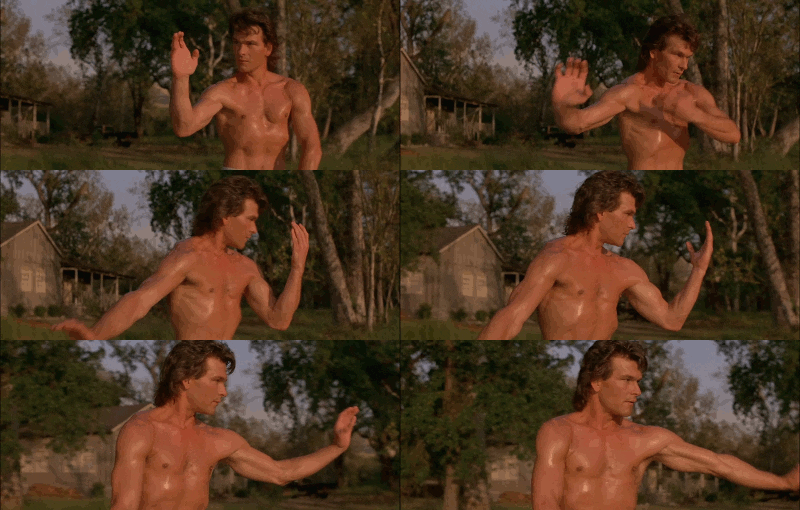
Ok, it wasn’t great, but at least it looked like Tai Chi. The implication was that Dalton was so good at fighting, and secretly enjoyed it so much, that he had to work hard to keep calming himself down otherwise his killing power would bubble up and overwhelm him, taking his humanity with it – kind of like the Hulk. He talks all the way through the film about not liking fighting, and how he does everything to avoid it. Eventually the bad guys push him too far and he unleashes the beast, resulting in the classic throat ripping scene.

I’ve always wondered why Tai Chi never had its Patrick Swayze moment. Wing Chun has been riding on the coat tails of Bruce Lee for half a century now, yet nobody really associates Tai Chi with Patrick Swayze, or this film. Perhaps if he’d gone on to make more Tai Chi or martial arts related films then things would have been different. Instead we got Ghost with Demi Moore and sexy pottery because his most associated activity!

Perhaps I’m being too hasty – when I started a Tai Chi class recently 4 women turned up asking if what they were going to learn was “like Patrick Swayze in Road House”? To be honest, I got the impression that they were more into shirtless Patrick than Tai Chi 🙂

But anyway, let me leave you with this compilation of the best lines from Road House.

Just remember: “I want you to be a nice…until it’s time to not be nice.”

“*” there was clearly a homoerotic subtext to the original Road House. While Swayze pratices shirtless Tai Chi he is gazed at by multiple men. Check out this exhaustive breakdown of Road House for more on that. Perhaps that’s another reason why Road House didn’t end up being a Tai Chi-promoting juggernaut?
Victorian & Edwardian Martial & Exercise Films

If you enjoy historical martial arts footage as much as I do then you’ll find the Victorian & Edwardian Martial & Exercise Films YouTube channel an absolute goldmine of footage.

This channel displays films and film segments that were created at the beginning of film making in the 19th Century through to the first half of the 20th century in relation to martial art and exercise.

Here are few examples of the content you’ll find here that caught my eye:

1897 Boxe Francaise (Savate) & Baton Demonstration – Lyon France

Filmed: Spring – June 6th 1897
Location: Lyon-France
These films show members of the 99th Infantry Regiment demonstrating Savate & Baton. These demonstrations are not sparring sessions. They are an exchange of techniques for the camera, in the form of a flow drill. In the Savate demonstration you can see that the practitioner on the left is aware of the camera position, and motions the other practitioner back into the frame of the camera. Sparring in this era was conducted on a “touch point system” along the same lines as fencing and points were scored for making contact, and the aim was not to seek a knock out.

https://www.youtube.com/watch?v=MLcG_QZPWek

1896 Burmese Martial Art in London

“These two films were filmed in July 1896 by Lumiere camera operator Alexandre Promio. The Location was Sydenham Crystal Place Park London. The first film depicts a form of Burmese martial art which includes open hand strikes, kicking and grappling. It is unclear what style is depicted as Burma (Myanmar) has a large variety of styles. (Martial Styles of Myanmar) https://www.youtube.com/watch?v=96IBH… Both practitioners seem to be sparring in a light friendly manner for the camera. The second film presents a solo performance of the ball exercises known in Burma (Mynamar) as Chinlone. Chinlone dates back over 1,500 years, and is heavily influenced by traditional Burmese martial art and dance. It was originally conceived as a form of entertainment for Burmese royalty. It is also played as a team sport and over the centuries, players have developed more than 200 different ways of kicking the ball. Form is all important in Chinlone, there is a correct way to position the hands, arms, torso, and head during the moves. A move is considered to have been done well only if the form is good.”

Victorian & Edwardian Martial & Exercise Films

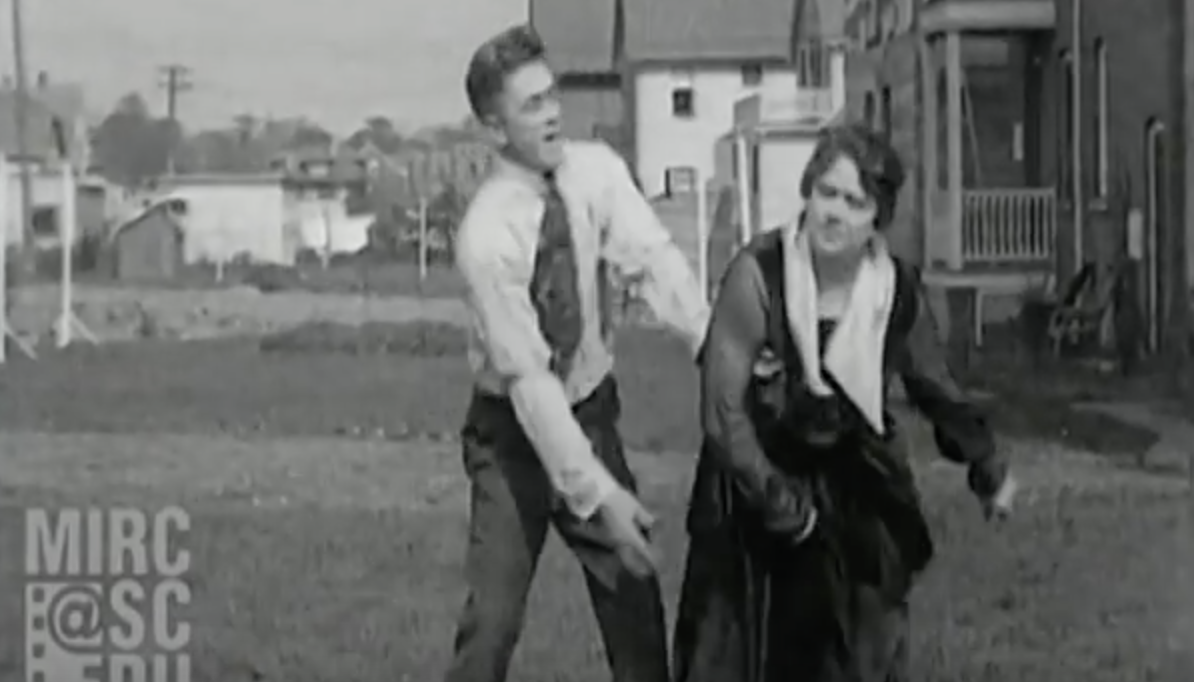
1919 Self -Defence (Jiu-Jitsu) – Johnny Kilbane

Film Date: 24-10-1919
Location: Cleveland (Ohio) U.S.A.
Description: Champion Boxer Johnny Kilbane teaching his wife self-defence (Jiu-Jitsu).

https://www.youtube.com/watch?v=flpOOrdI14I

Shang-Chi is here! And Brad Allen dead at 48

We stand on the cusp of a major new martial arts movie release – Shang-Chi and the Legend of the 5 Rings. On it’s own this should be something I write about, but it’s also the last film that Jackie Chan’s prodigy, Brad Allen worked on before his untimely death at 48.

Australian choreographer, performer and stunt coordinator, Brad Allen, was the first non-Asian member of Jackie Chan’s stunt team. He was incredibly skilled – here’s a short sample of his wushu and athletic ability:

It’s not clear how Brad Allen died, but 48 is very young. RIP.

I haven’t seen Shang-Chi yet, but by all accounts it’s a Kung Fu film done right, that avoids all the usual stereotypes, and a good chunk of the film’s dialogue is spoken in Mandarin Chinese, which is then translated into English subtitles for audiences.

“As an Asian (Taiwanese) Australian, it is so obvious that the film was written through the lens of those who have a lot of love for Asian culture and have lived through the Asian experience,” wrote kabutocat on Reddit, starting a fascinating discussion about the English-language translations of Mandarin dialogue in the movie. “The Chinese lines are written so well that a lot of the times the English subtitles actually failed to convey the nuances behind each line.”

Den of Geek article.

Shang-Chi’s origins lie in Marvels answer to the Kung Fu boom of the 1970s, with various Kung Fu-powered superheroes emerging, with perhaps Iron Fist being the post famous. The Shang-Chi comic was a product of its time and you can see orientalist tropes in its styling:

Shang-Chi was the first of the Kung Fu superheroes, and was designed to be the most gifted martial artist anyone had ever seen. He was trained in espionage, infiltration, assassination and more. But when he went on his first mission for his father, he broke his conditioning and dedicated himself to destroying his father’s criminal empire.

Here’s a breakdown of the film (warning SPOILERS).

Shang-Chi was the last film Brad Allen worked on, so let’s end with his excellent live performance with Jackie Chan on Saturday Night Live:

You can find out more about Brad Allen here.

Cobra Kai and the TRUTH about the Karate Kid

I really need (do I really?) to write something about this new Cobra Kai film coming out on YouTube Red (whatever that is – I think it’s just another way of saying, er, “YouTube you have to pay for”).

Here’s the trailer:


I’m picking up unusual levels of intelligence and self-awareness here. There has been a long-running fan theory that everybody got Karate Kid wrong – that Ralph Macchio’s character, Danny, the Karate Kid himself, wasn’t the hero of the film at all – he was the villain!

Check out the fan theory here:

It’s a good example of how you can view the same events from a different perspective and come up with a different version of “the truth”.

From watching the trailer, Cobra Kai seems well aware of this fan theory and is playing on it nicely. It seems that Daniel has grown up to be a bit of an asshole, his ego has become uncontrollable from his victory, while Johnny has kept it real, but fallen on hard times, his ego deflated by the ass-kicking he received in that infamous competition.

It looks like the two are heading for an inevitable rematch, but whose side do you feel like you belong on? There are 10 episodes planned, and I really hope there’s a schmaltzy ending where a digitally reconstructed hologram of Pat Morita comes back as some sort of Jedi force-ghost and whispers “Trust your feelings! Do the Crane kick!” in Danny’s ear.