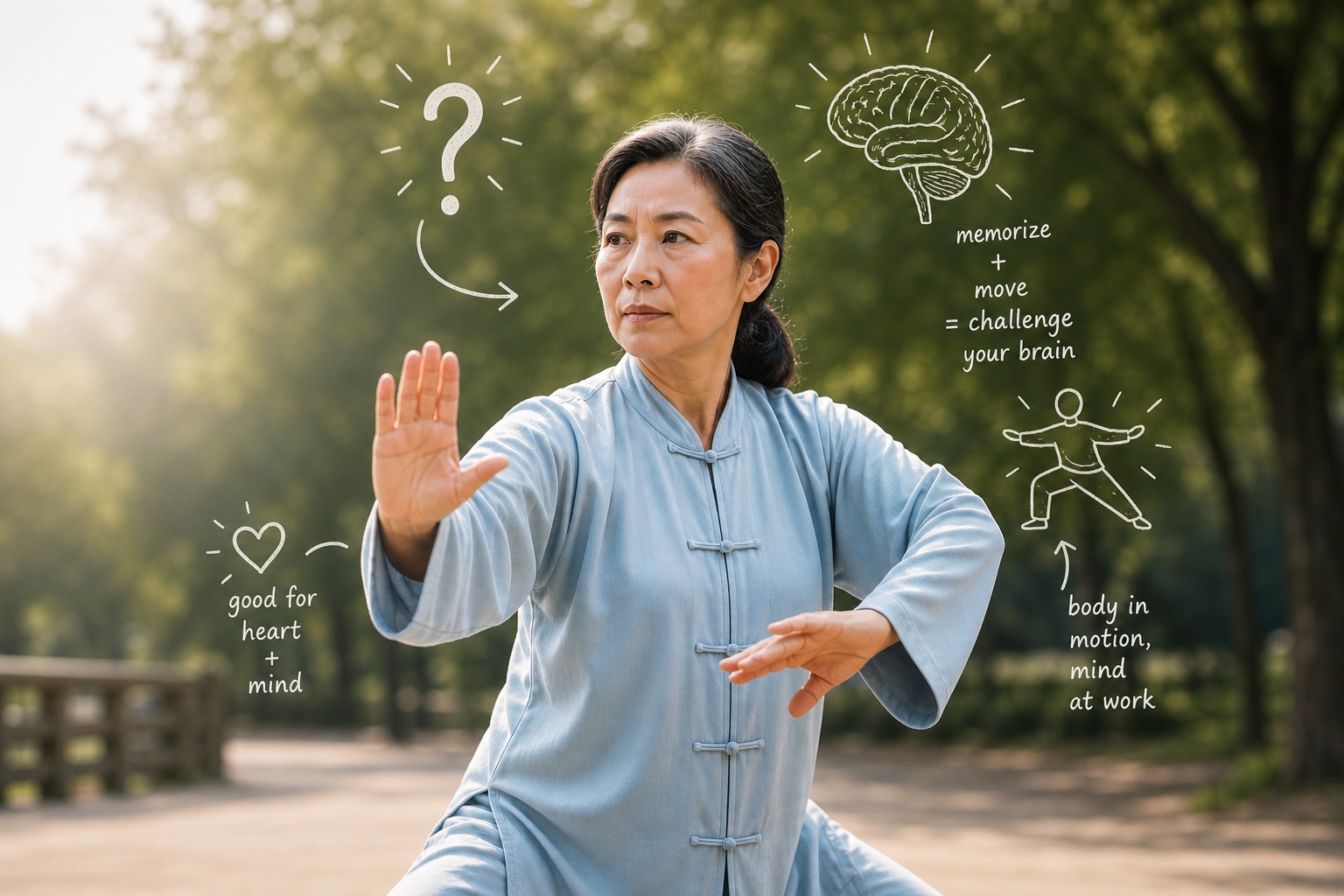
Why struggling to remember tai chi moves might be exactly what your brain needs
I’ve been running tai chi classes for years now, and the number one thing beginners say to me is always some variation of: “I didn’t think it would be this hard to remember the moves!” It’s usually coupled with a look of astonishment.
I mean, tai chi looks pretty simple, right? Older people do it, for goodness’ sake, so it must be pretty simple. Why is it so hard to remember the moves?
I’m only talking about learning the choreography of the form here, not even trying to delve into the principles that make the choreography ‘internal’ movement, like moving from the dantien.
The instructions for learning choreography are pretty simple. They’re things like: “Shift your weight to your left foot, pivot to your right and raise your toes, then transfer your weight to your right leg, raise the right arm, and lower the left arm.”
You even have somebody to follow along with to make it easier.
But after a few follow-alongs, when I turn around and say, “Now you do it,” there’s an immediate crisis and it all falls apart. That look of astonishment appears, and the question comes again:
“Why is it so hard?”
I don’t know. Maybe it’s because we don’t routinely do things that require us to use our brains to memorize movements while performing them. Perhaps learning to drive comes close.
I’d say learning a tai chi form is more of a mental workout than a physical one. It’s mentally very tiring. You can feel the effort people have to make to learn the sequence. It’s hard work, but you don’t need to be particularly mobile or fit to perform the movements.
In terms of tai chi as a health exercise, I wonder if the mental workout is perhaps the most beneficial part of the process. Studies into dementia have shown that changes in the brain start happening years before symptoms emerge, and changing your daily habits so that you actively use your brain is one of the things you can do to slow down, or even reverse, the process — if you catch it early.
But it is a physical workout — done right, Tai chi will make your thighs ache. In a good way.
I was listening to a podcast (from 54:20 onwards) the other day that emphasized how important strong legs are to your overall physical health, especially for preventing dementia. With tai chi, every day is leg day, so we’ve got that covered.
“Your legs protect your memory” was a phrase used in the podcast. It was said by a doctor, but I never know how much weight to give podcast advice. That said, the number one reason older people end up in the emergency room is falls. What prevents falls? Leg strength. Studies also suggest leg strength may help the brain more directly.
It’s certainly true that as we age, our legs get thinner, leading to the Chinese phrase “you die from the feet up.” And tai chi does help with leg strength.
Physical exercise is important for dementia prevention, and so is a brain workout. With tai chi, you get both — a mental workout combined with physical exercise.
And that might also be why it’s so hard, but that might also be the real benefit.
That frustration — forgetting what comes next, getting lost halfway through, having to piece it back together — is the process.
You’re asking your brain to do something unfamiliar, to coordinate thought and movement in real time, to hold focus for longer than it’s used to.
So when someone asks me why it’s so hard, the honest answer is:
Because if it were easy, it probably wouldn’t be doing you nearly as much good.
 The Tai Chi Notebook