UFC 295 – Alex Pereira vs Jiri Prochazka: Chicken vs Swallow fight analysis

One of the things I like to do when watching UFC fights is to try and analyse what the fighters are doing in terms of Xing Yi’s 12 animals. Now, I’ve got at least one friend who hates when I do this because he believes it makes people think that by practicing a few Xing Yi moves twice a week in your back yard you can somehow be on the level of professional MMA fighters. Yeah, I get that. Comparing martial arts can easily lead to delusion… however, my No. 1 one rule for The Tai Chi Notebook is this: this is my blog and I can write what I want! So, I’m going to do it anyway. But also, I genuinely think that if you’re a Xing Yi practitioner yourself, then trying to analyse MMA fighters in terms of the 12 animals is a really valuable hobby to get into. It will increase your understanding of not only the animals, but also of fighting itself.

Viewed through the modern Xing Yi lens (by modern, I mean, post Boxer Rebellion, from the early 20th century onward) it’s popular to understand the 12 Animals of Xing Yi as merely variations on the 5 Elements. This approach is indicative of the reductive, simplistic, winds of change that blew through Chinese martial arts over that century. It’s not a wrong view technically (the 5 elements are the basics, so of course they are inside the 12 animals), but it’s also a huge misunderstanding. The 12 Animals are more than just variations of the 5 Element fists, they are older and contain the essence of the art. They’re a continuation of a tradition that started back in the Song Dynasty. If you really want to understand that point of view then I’d point you towards the History of Xing Yi series we’ve been doing on the Heretics Podcast for a few years now – and is currently up to part 15, about to start the Ming Dynasty section.

But coming back to the present day, last week saw Alex Pereira vs Jiri Prochazka for the UFC Light Heavyweight belt at UFC 295. It was a great fight resulting in a knockout for Pereira, but honestly it could have gone either way. There was some debate about the finish being an early call from the ref, but Jiri himself said he was out cold, so it was fair. Highlights here:

Looking through my Xing Yi lens at what the fighters were doing, UFC 295 was a good one because it was very clear what animal strategy each of them was using. (Obviously, neither gentleman has probably ever heard of Xing Yi, however, like I said earlier, I’m simply using the 12 animals to analyse fighting styles.)

Swallow (yan xing)

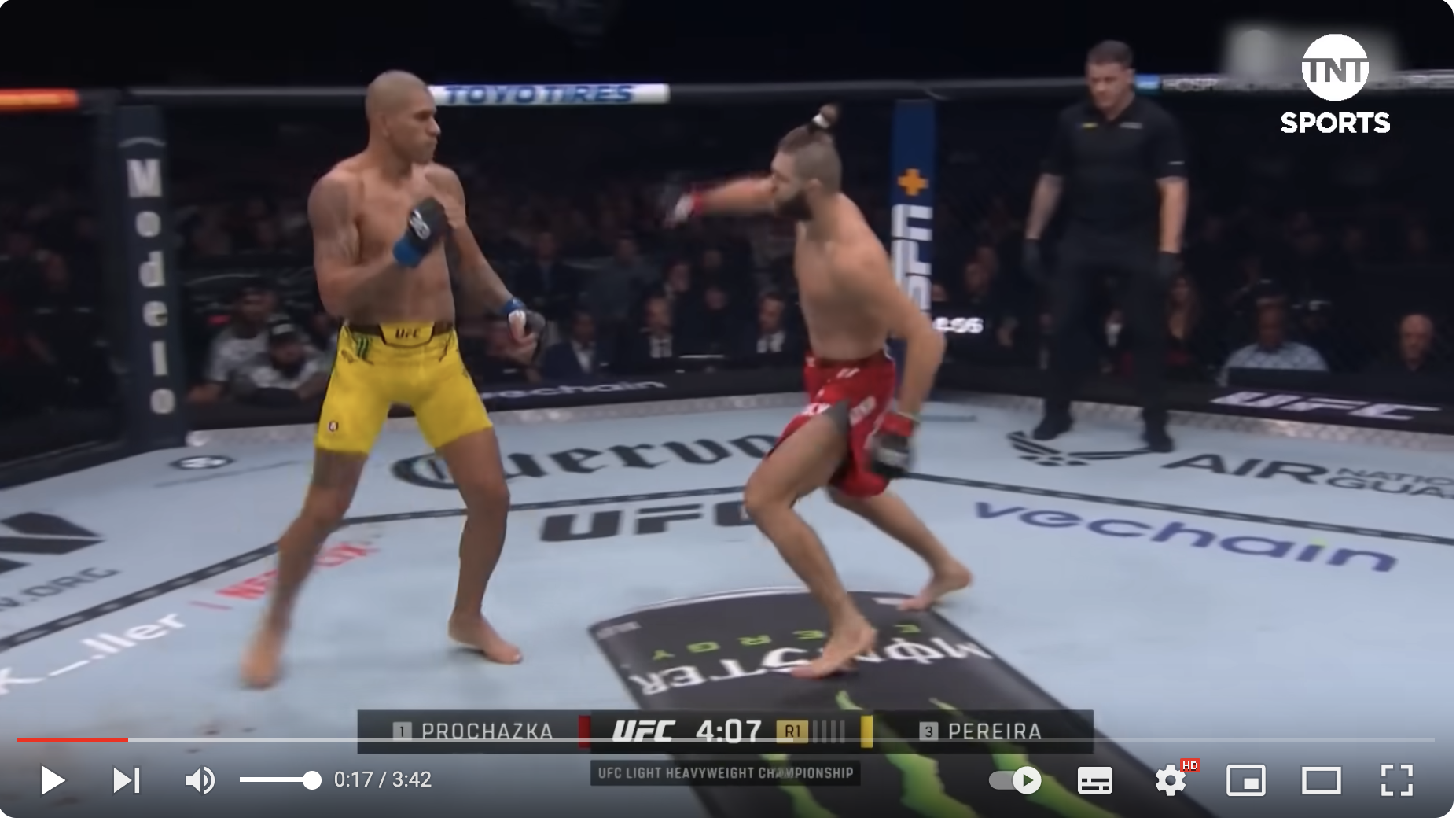
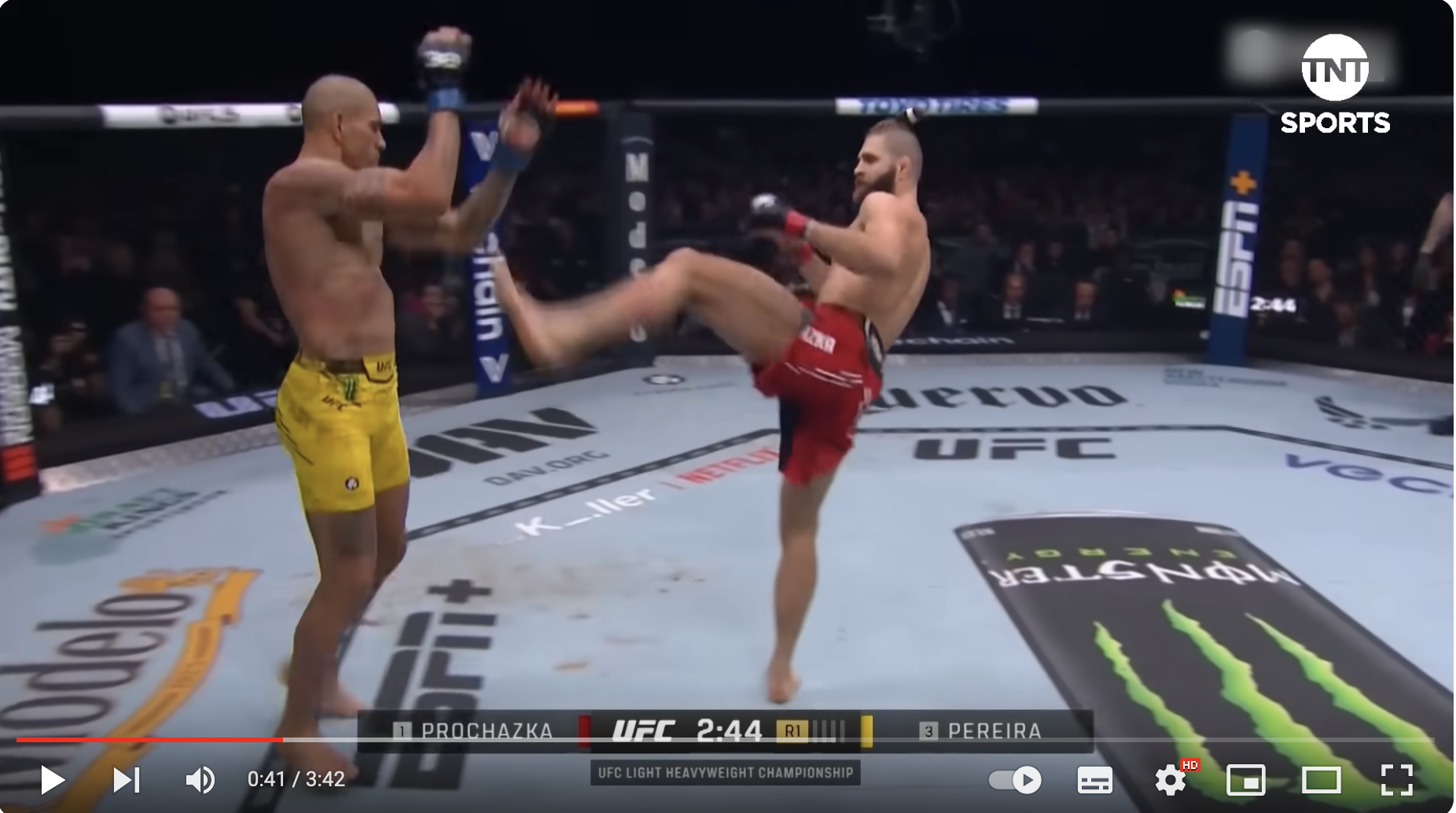
So, on one hand we have Jiri Prochazka (red shorts) whose attacks frequently go from high to low:

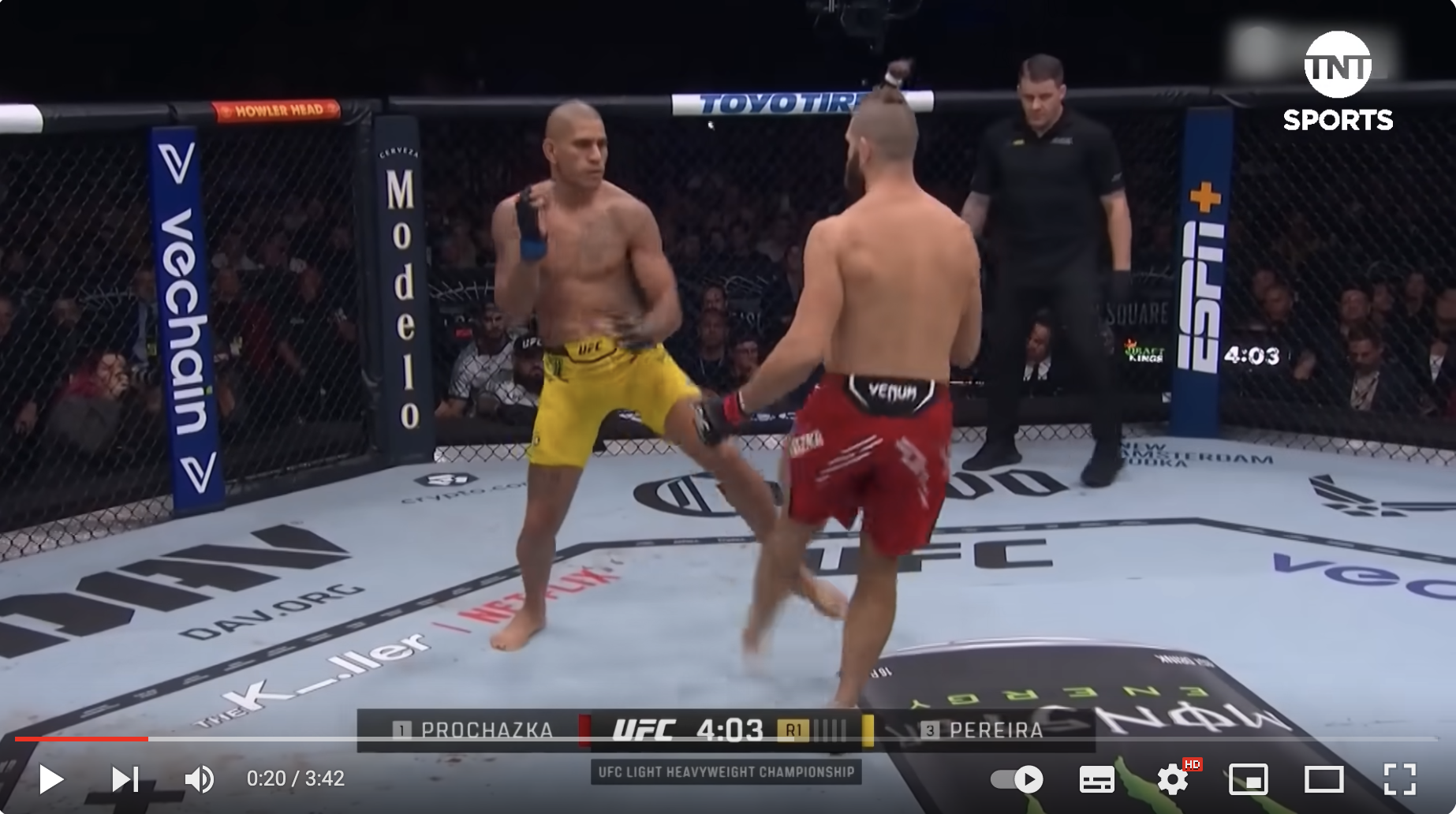
He kicks high to the head, then kicks low to the ankle:
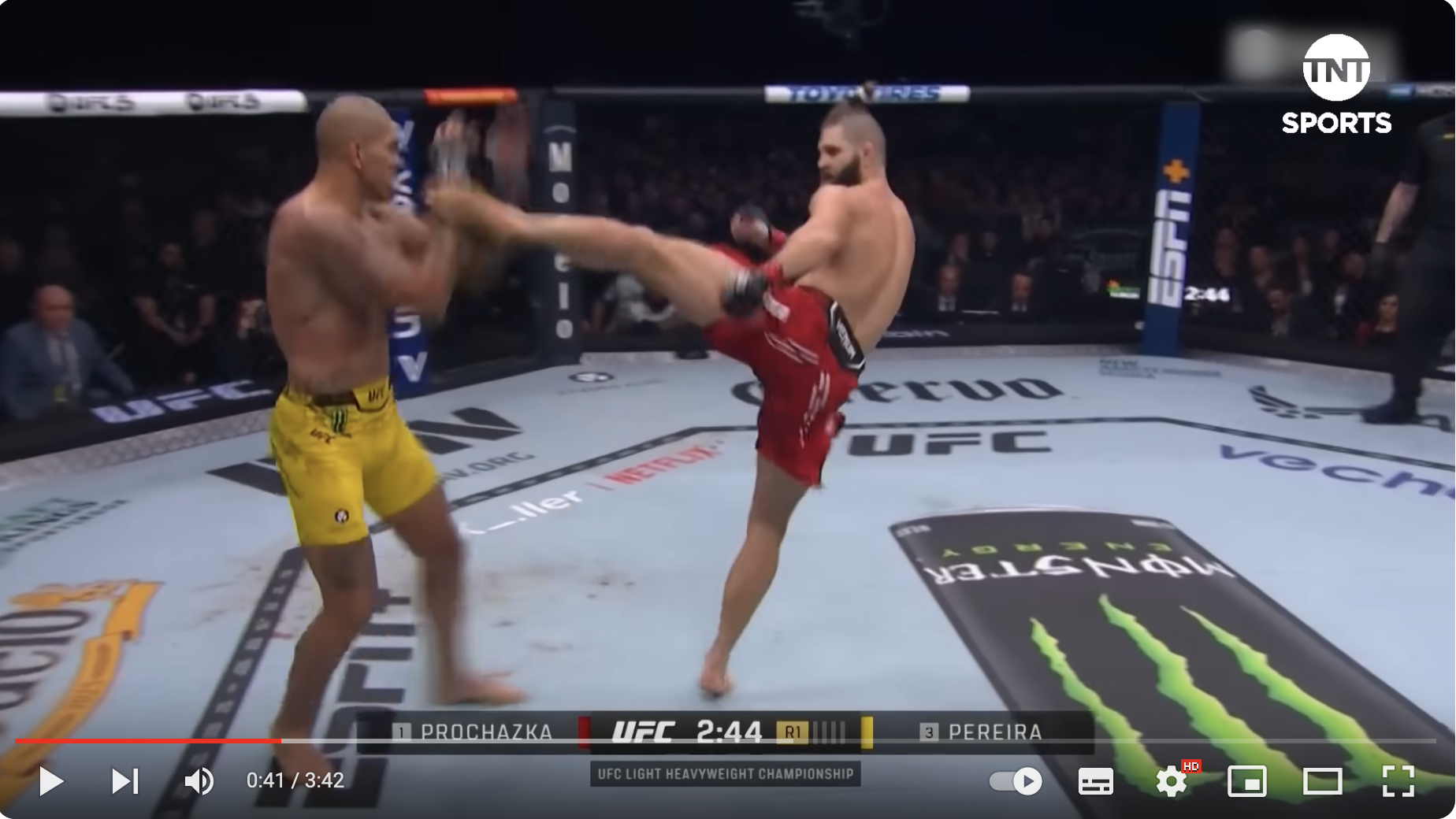

(Obviously a lot, but not all, MMA fighters kick to both heights, but it’s the alternating way he does it, as a strategy, that I’m interested in. It’s not the techniques that make something an animal style, it’s the intent and strategy behind them, but also certain styles lend themselves naturally to certain techniques – which is a subtle point)

He dummys a wrestling shot low but then comes up with an upper cut.
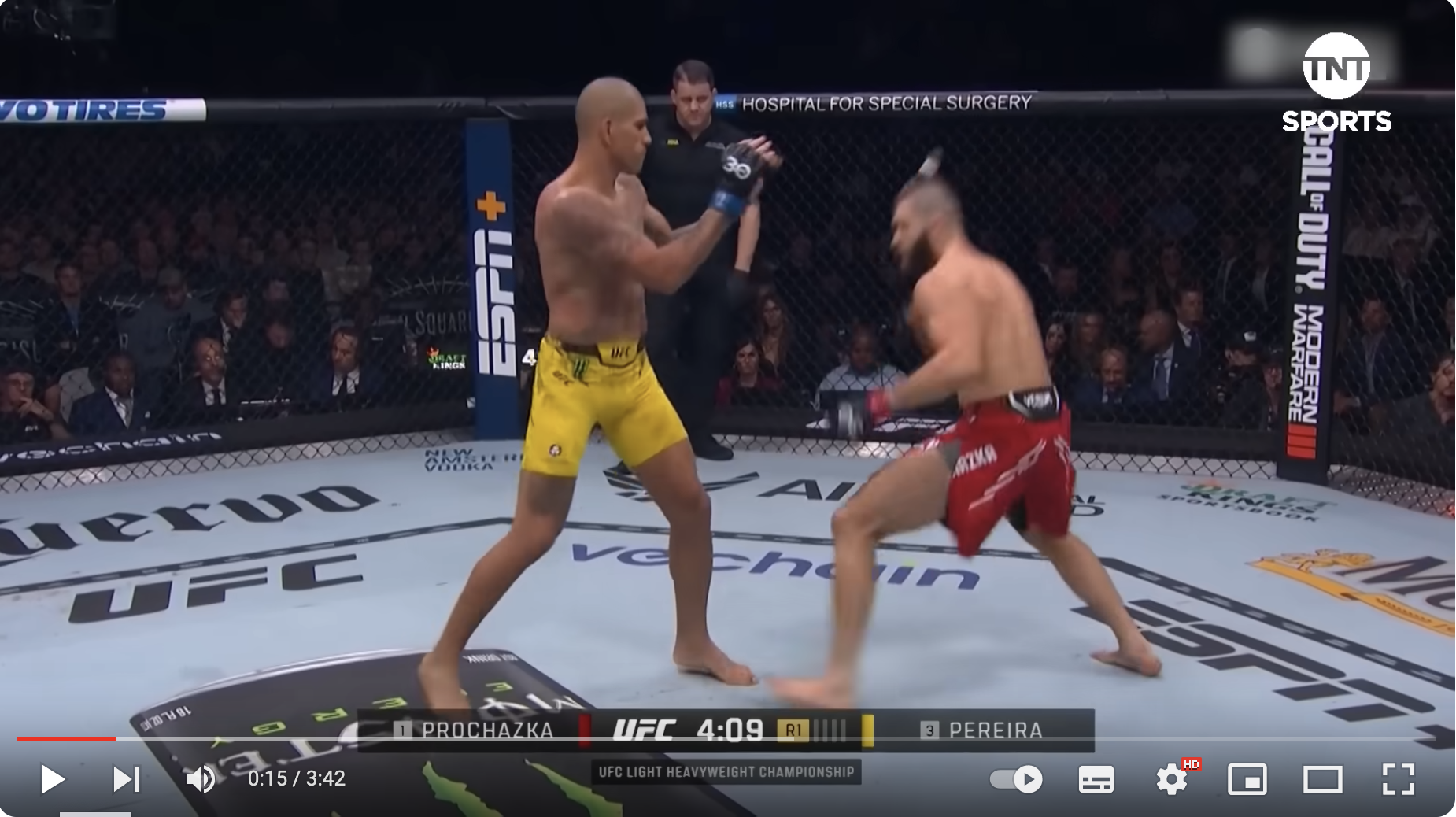
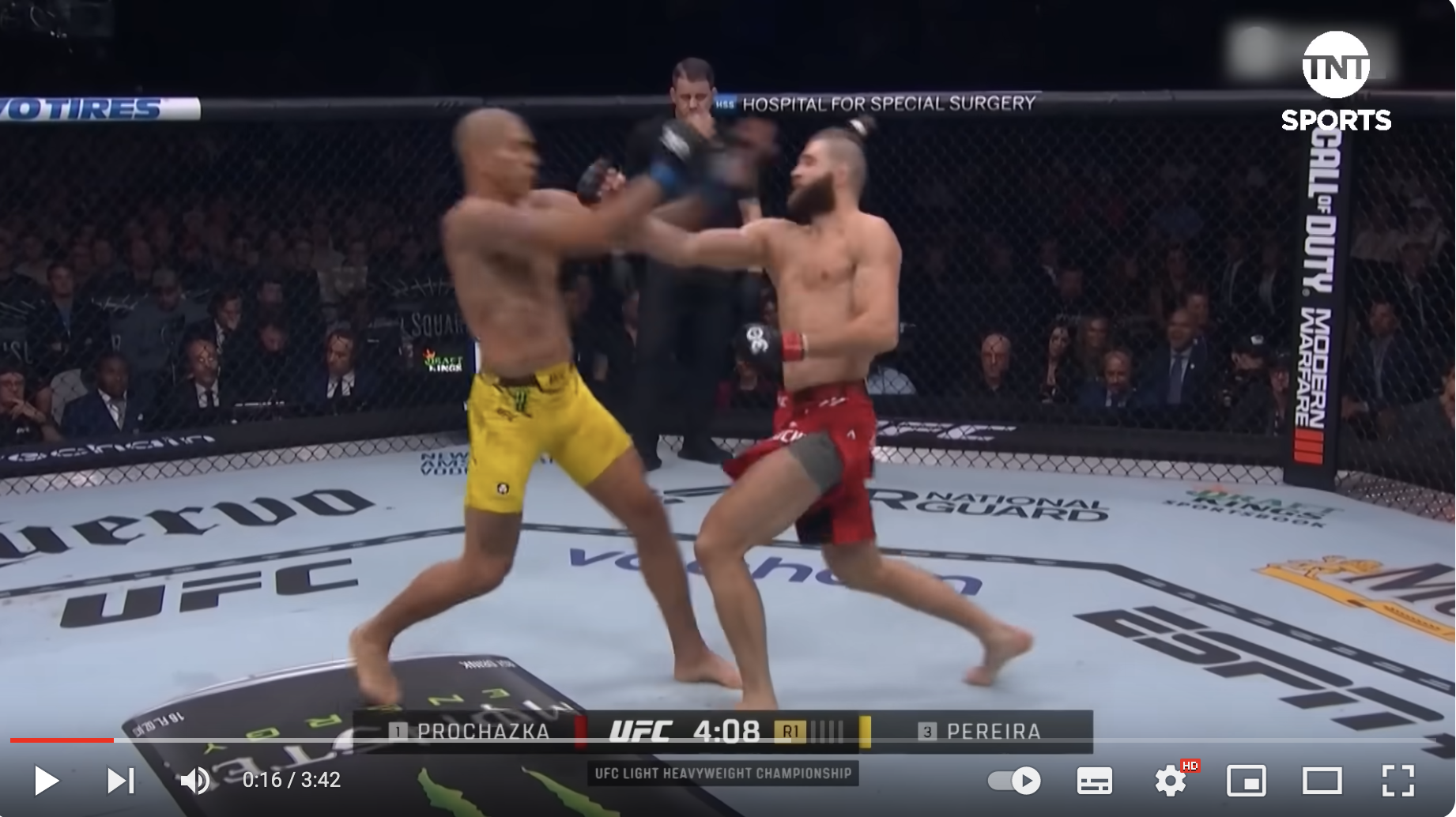
His preferred range is long, and when he punches he throws arcing punches that start low, go high and finish low:
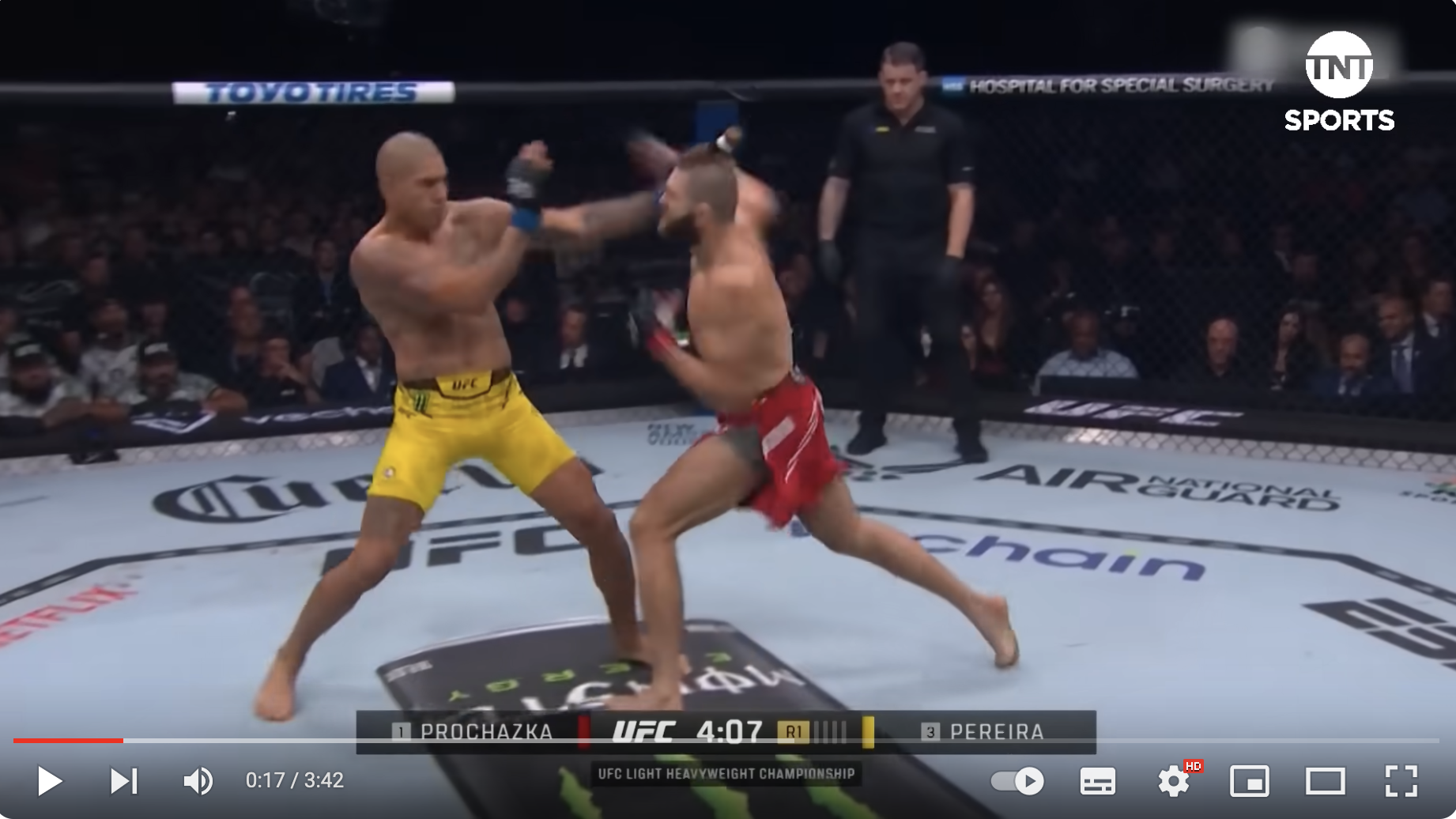
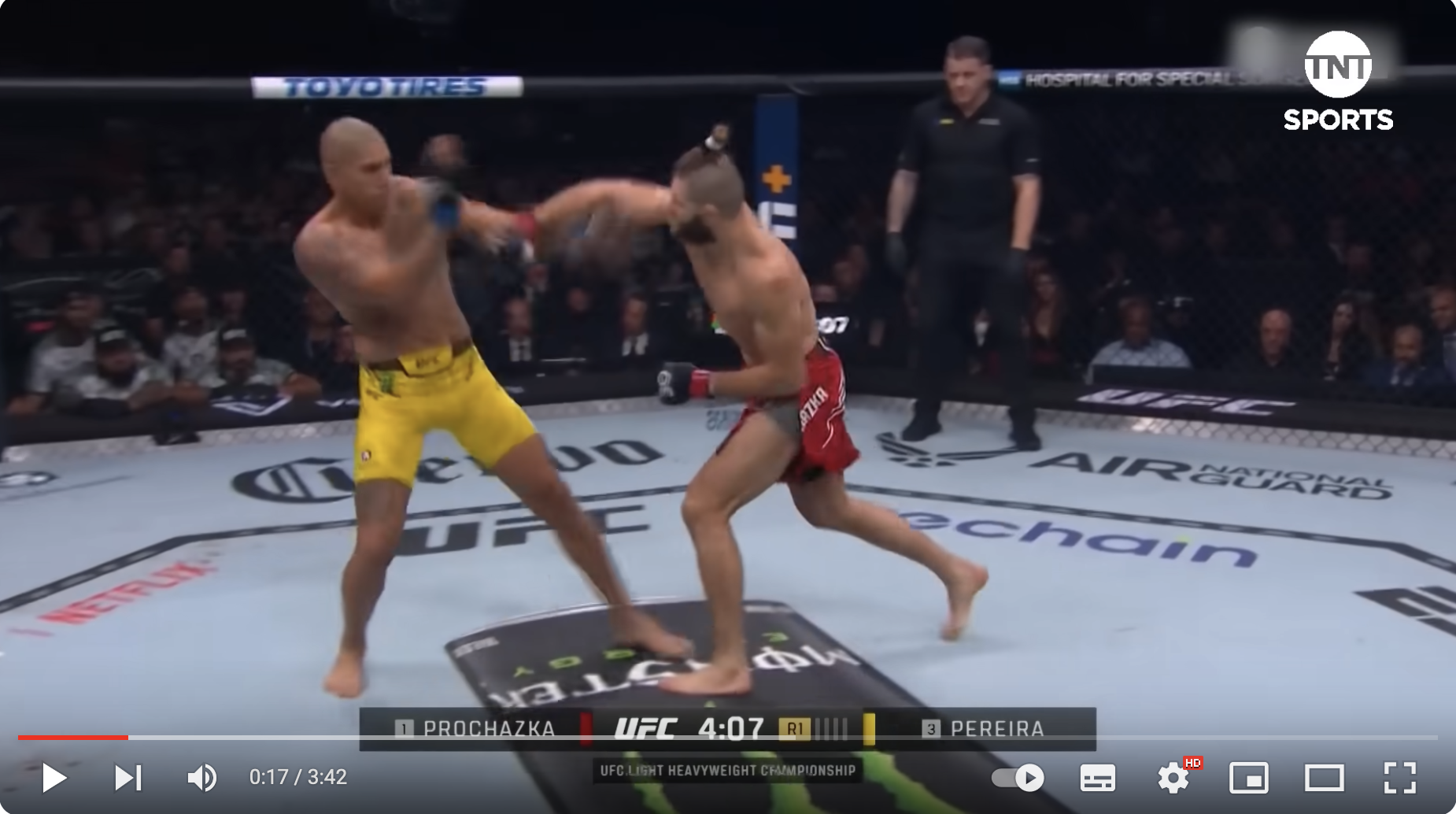
To me this is clearly a Swallow strategy. Swallow is a bird you wouldn’t normally associate with fighting, but it aggressively hunts insects on the wing, and defends its nesting location by dive bombing potential intruders, including humans! Its characteristics are swooping low then going high, particularly over water and “swallow skims the water” is a name often given to a popular swallow movement in forms in Xing Yi, Bagua and Qigong. But the swallow is also famous for its absolutely beautiful aerial acrobatics that are always elegant and graceful.

A swallow defending its nest – I like this clip because you can see the speed that the swallow attacks with, and how unafraid it is of something as big as a human.
The classic “swallow skims water” in action, by the true masters of the art – the swallows themselves.

A typical “swallow skims water” movement found in Chinese martial arts. This one from Cheng style Bagua.

Chicken (ji xing)

But let’s get back to UFC 295. In contrast his opponent, Alex Pereira is famous for his minimal movement and crushing low calf kicks. There’s a great clip of him playing about with UFC commentator Daniel Cormier taking his low kick:

A native of Brazil, Pereira is also famous for his indigenous face paint he wears to the weigh in events:

(For people that like to argue that Shamanistic things have no part in MMA, I always like to point them to double UFC champion, Alex Pereira!)

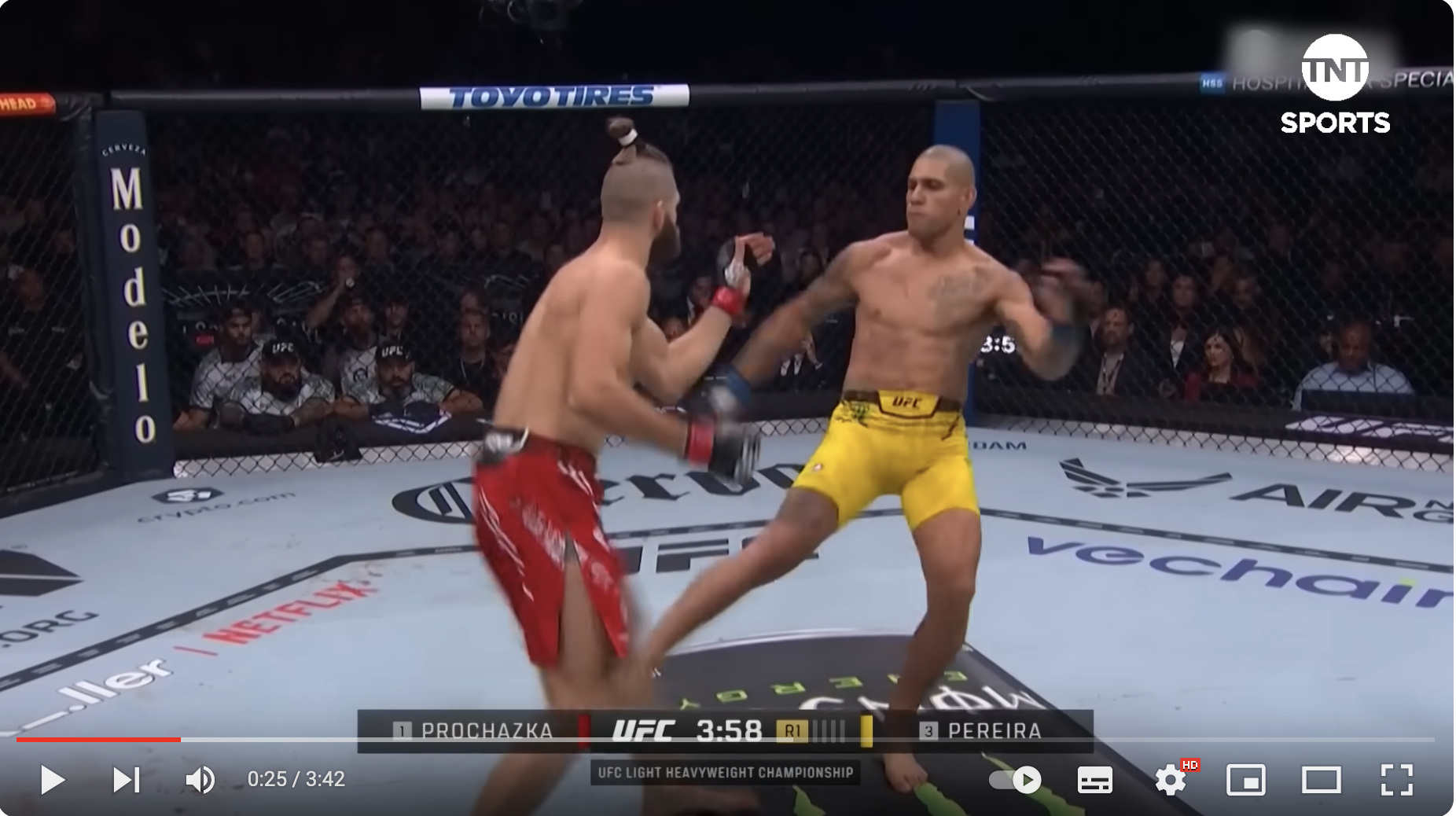
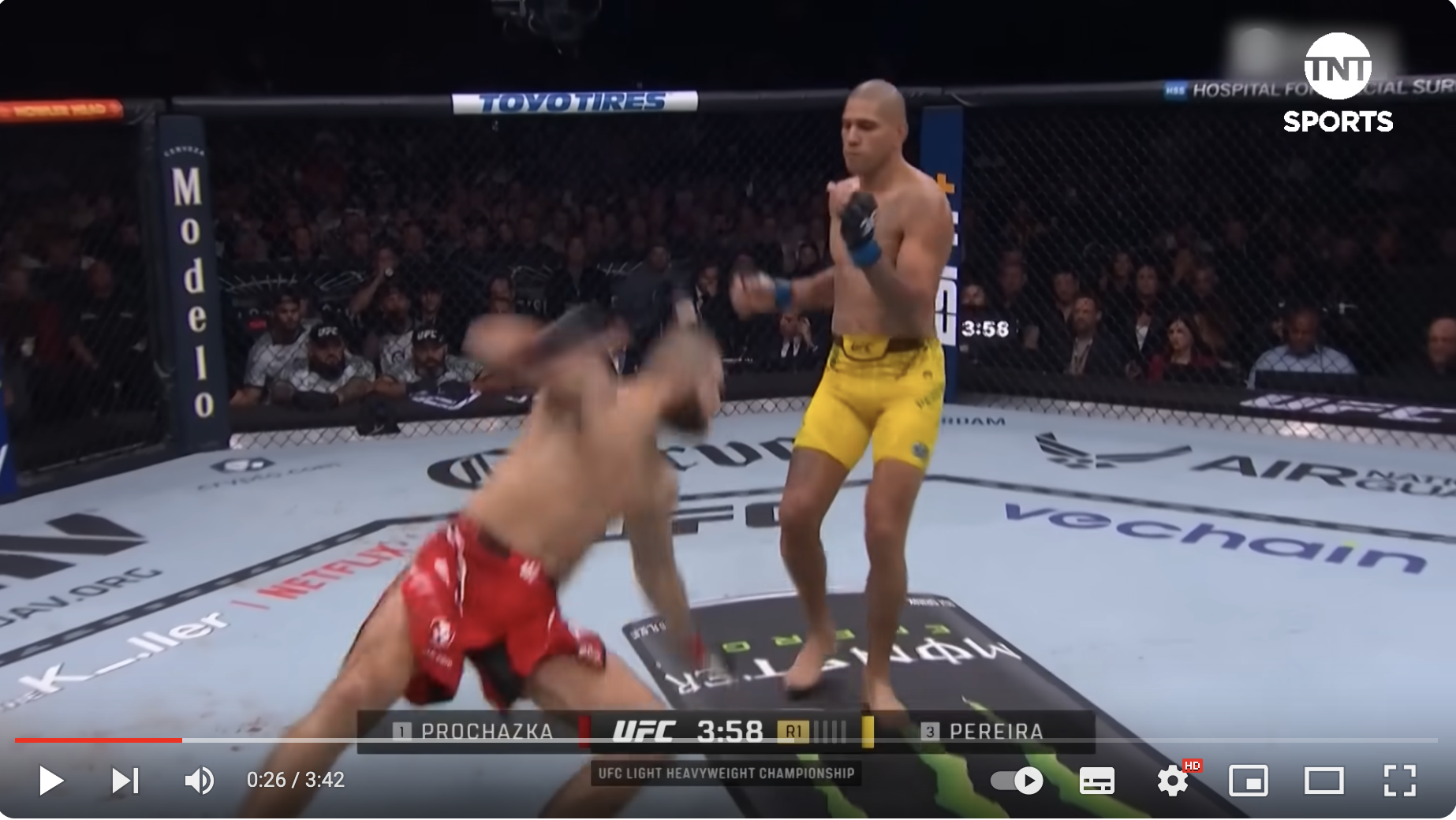
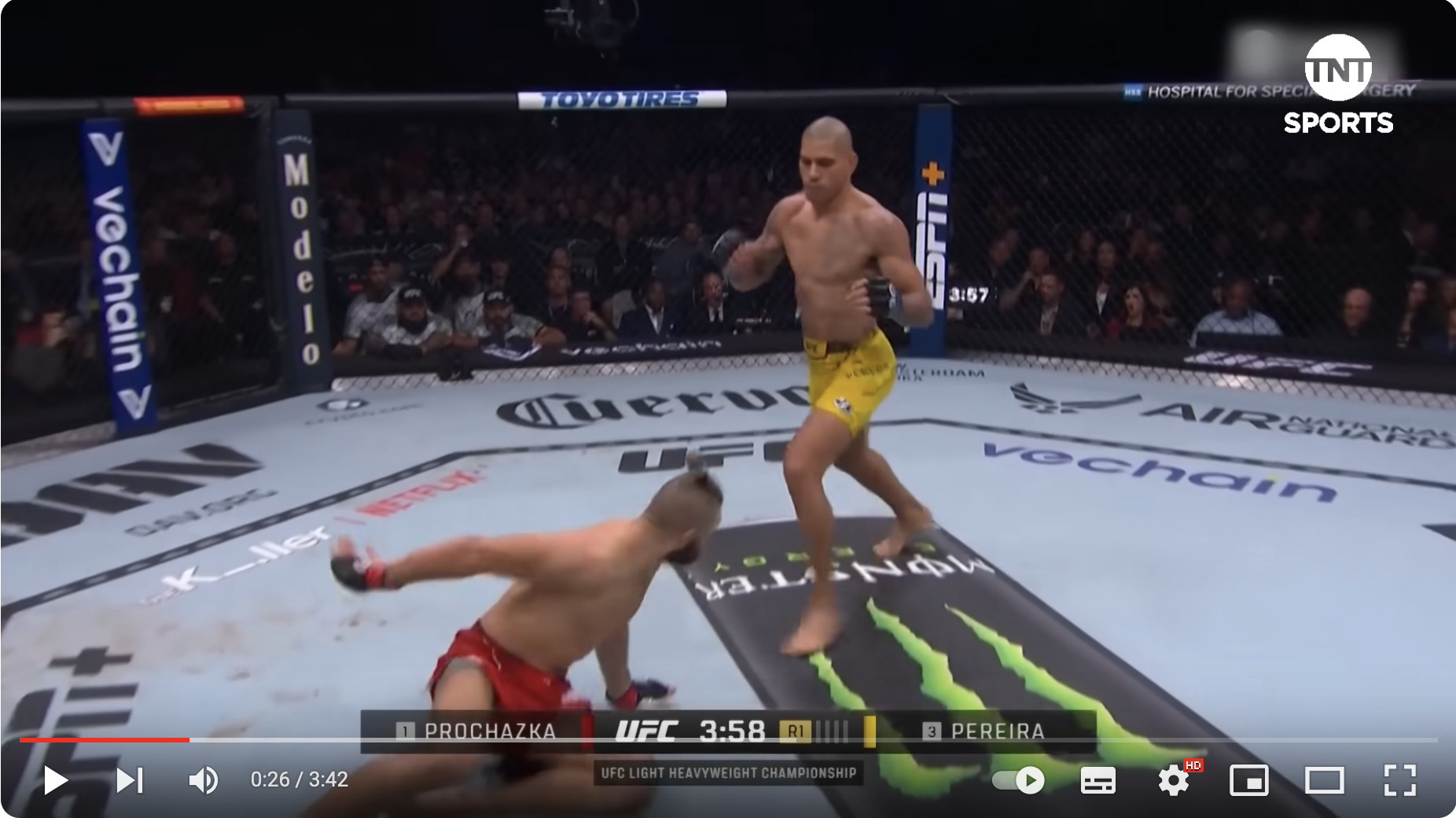
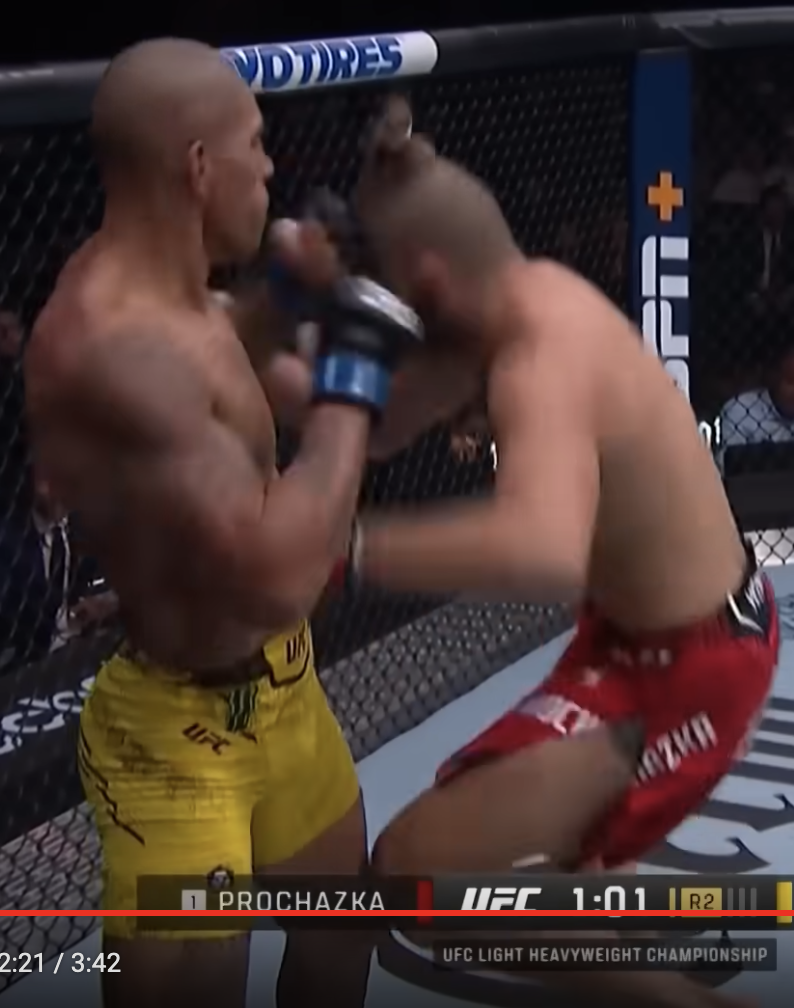
You can see his famous calf kick in action in UFC 295, completely taking Jiri off his feet:
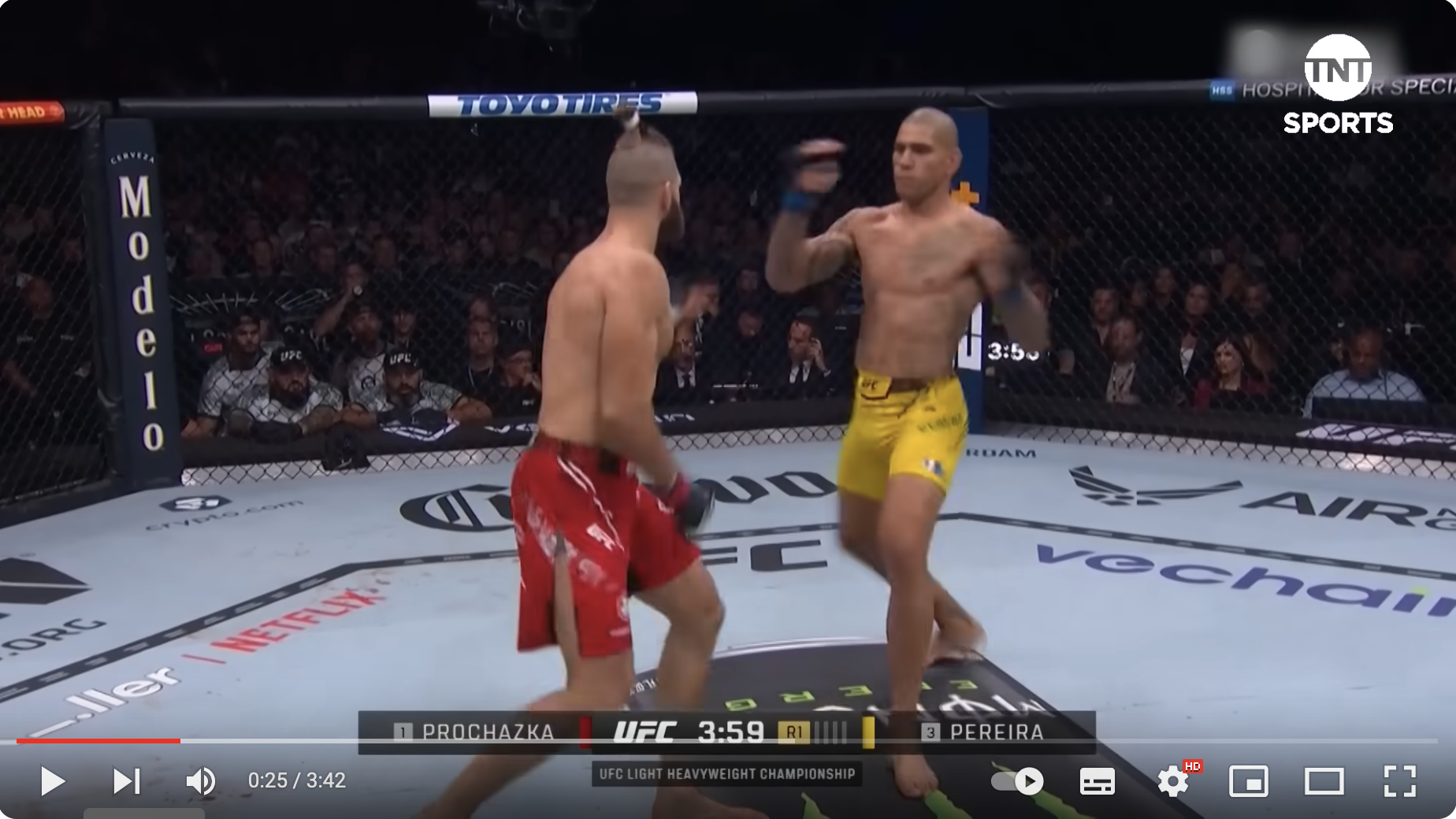
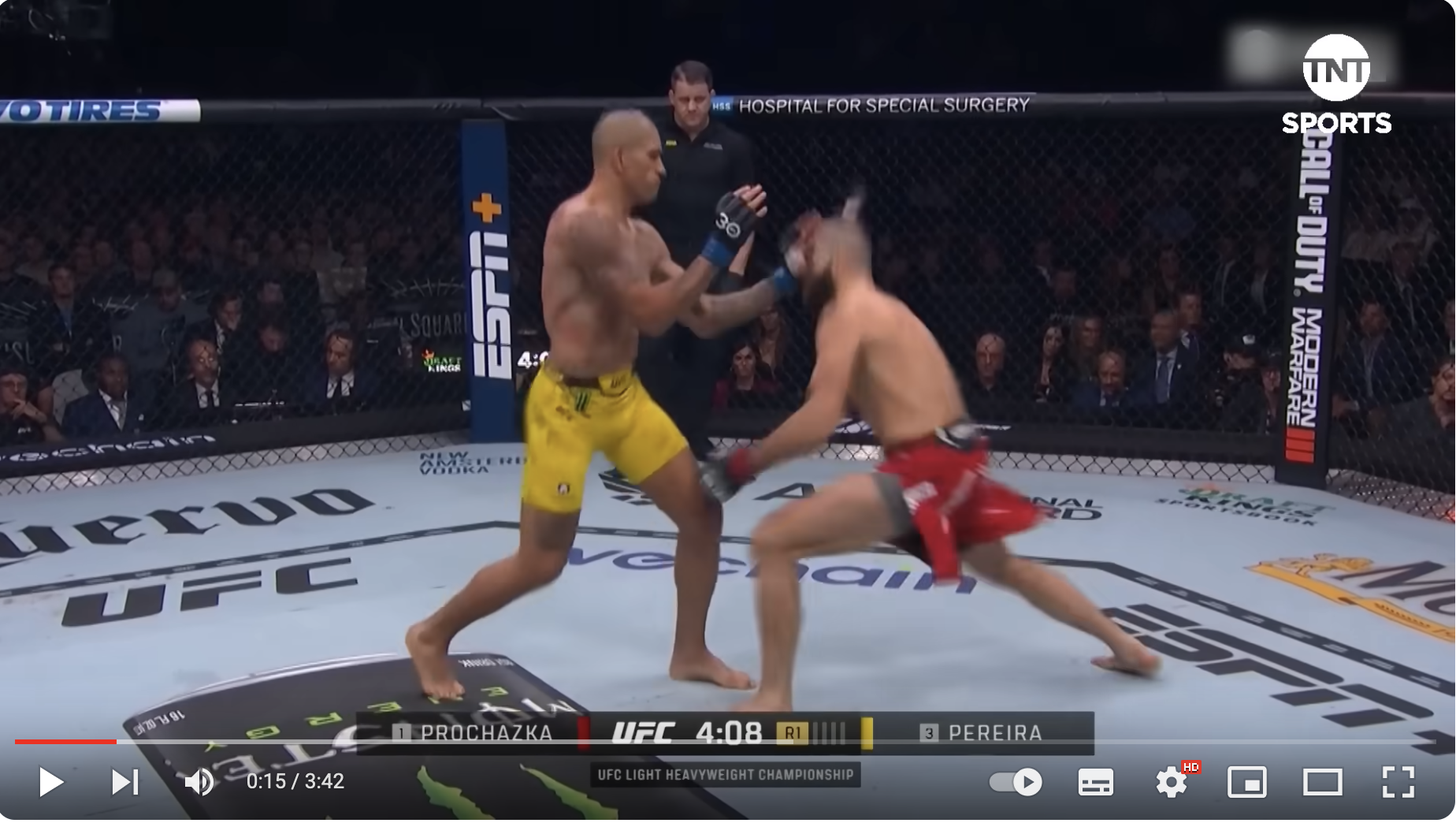
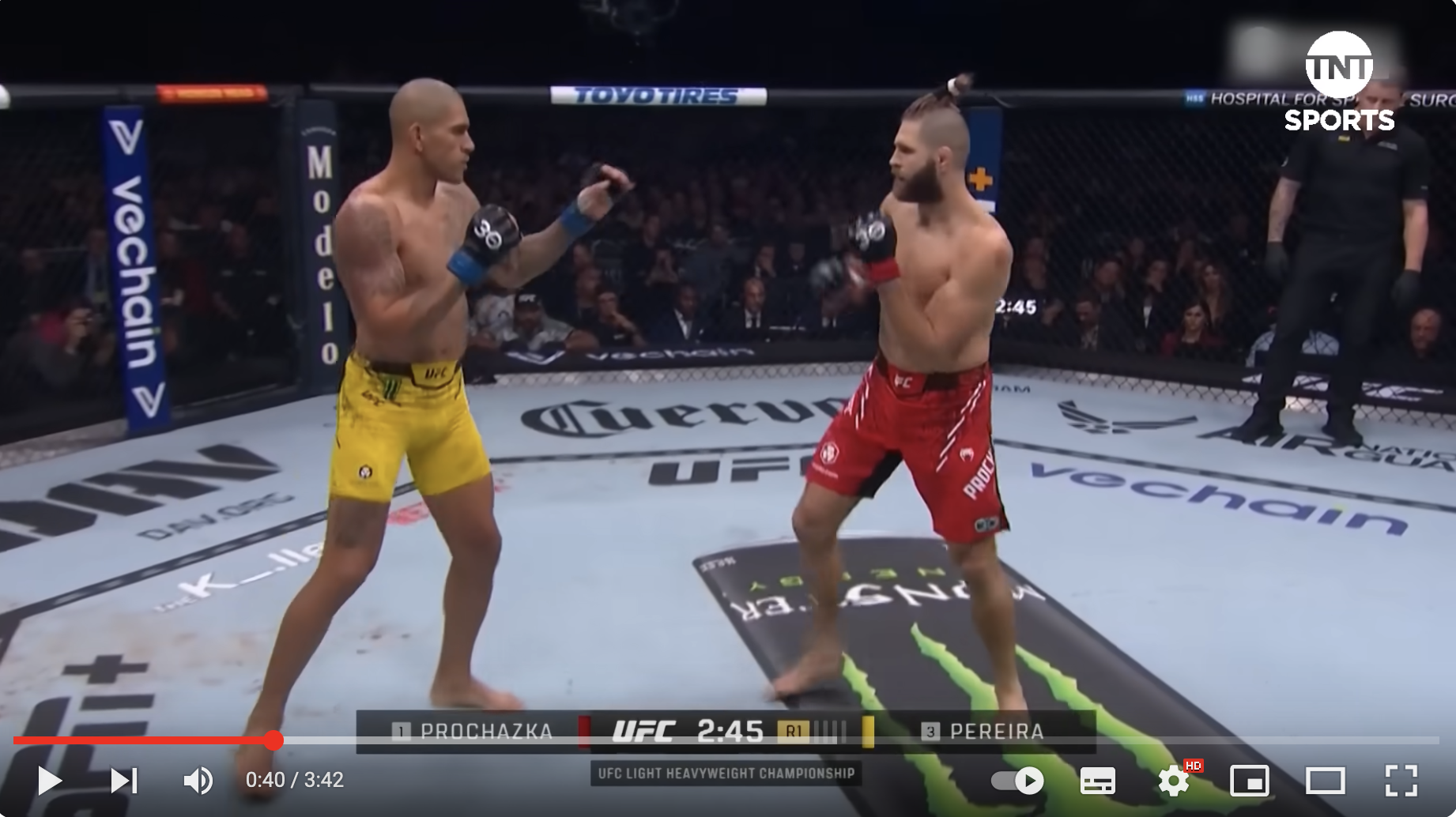
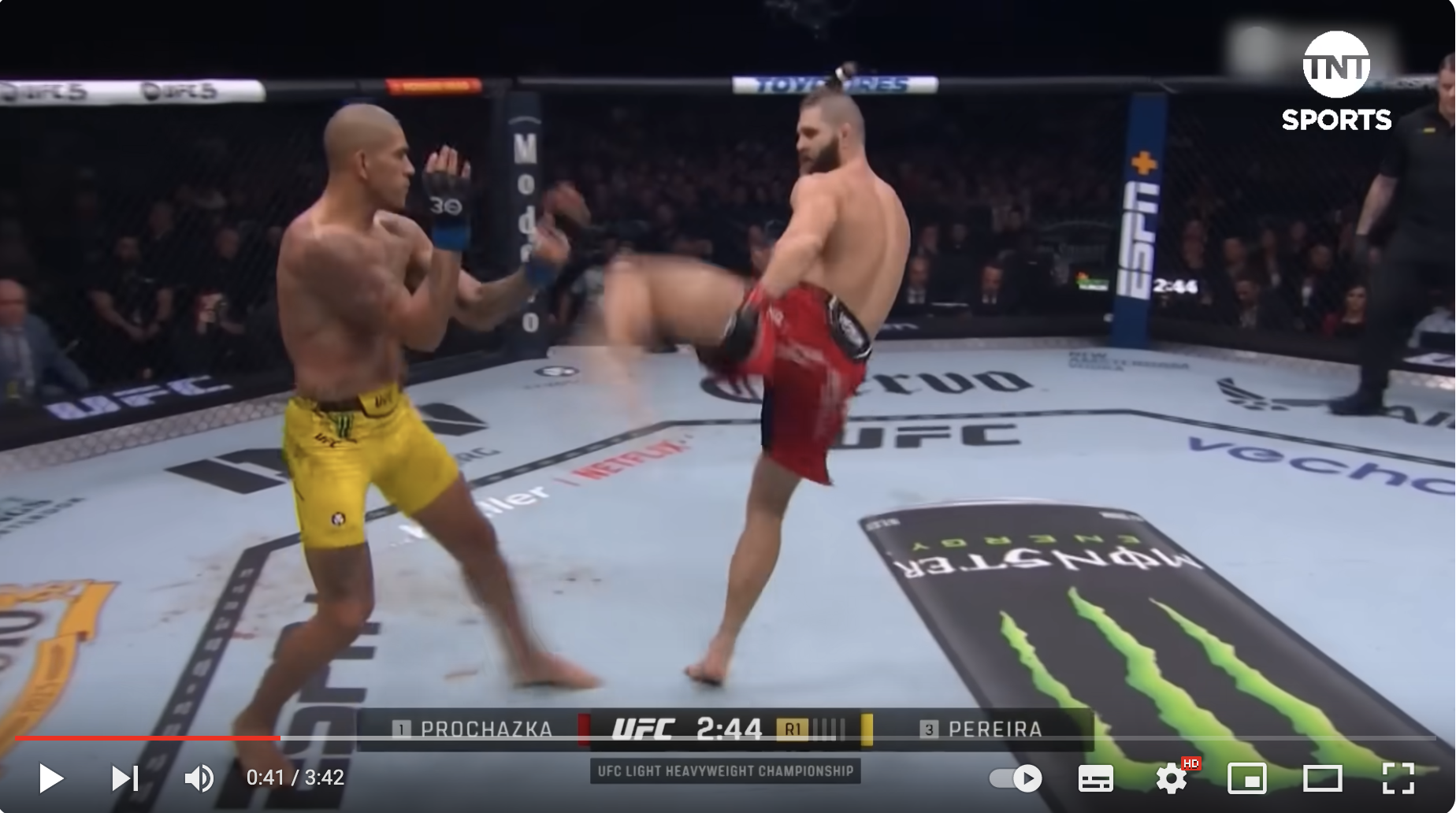
What’s remarkable about the Pereira calf kick is how little wind-up there is, which makes it hard to see coming – he just snaps it out. He does three identical kicks in a row in that part of the fight – the pictures above show the first – but all three hit home. His punches are delivered in the same way – the hand just snaps out with almost no telegraphing movement at all. You can see in the screen captures above of the kick that his body stays facing the opponent at all times. They don’t look like powerful shots, but you can see the deadly effect they have on his opponents. That very tight coil in his body around the spine that he’s using to pop his kicks and punches out is absolutely indicative of Chicken xing. “Chicken shakes its feathers” is a characteristic move of the animal found in Xing Yi links (forms) and somewhat resembles the Fa Jing expression that you see demonstrated in Tai Chi styles:

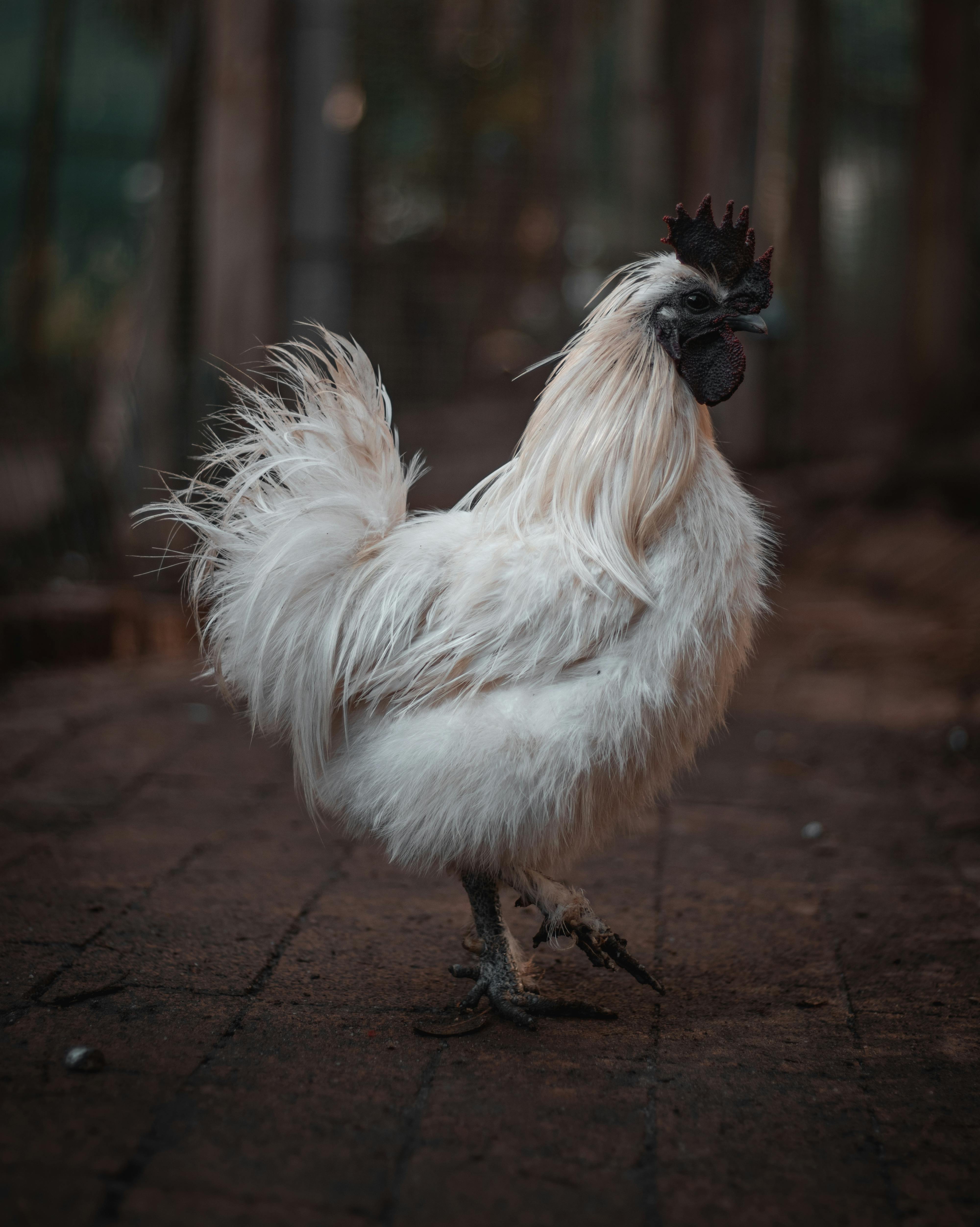
A chicken shaking its feathers.

Chicken step

When Pereira defends he is using footwork to evade rather than ducking his body – in fact, he stays very upright and his hands are kept high and defensive, just like they are in Xing Yi Chicken, which relies on footwork for evasion.
The blows which set up the finish from Pereira were so fast and minimal they were hard to see in real time, but it was a counter 1-2, again delivered with that very upright body with the hips underneath the shoulders that is so characteristic of Chicken:
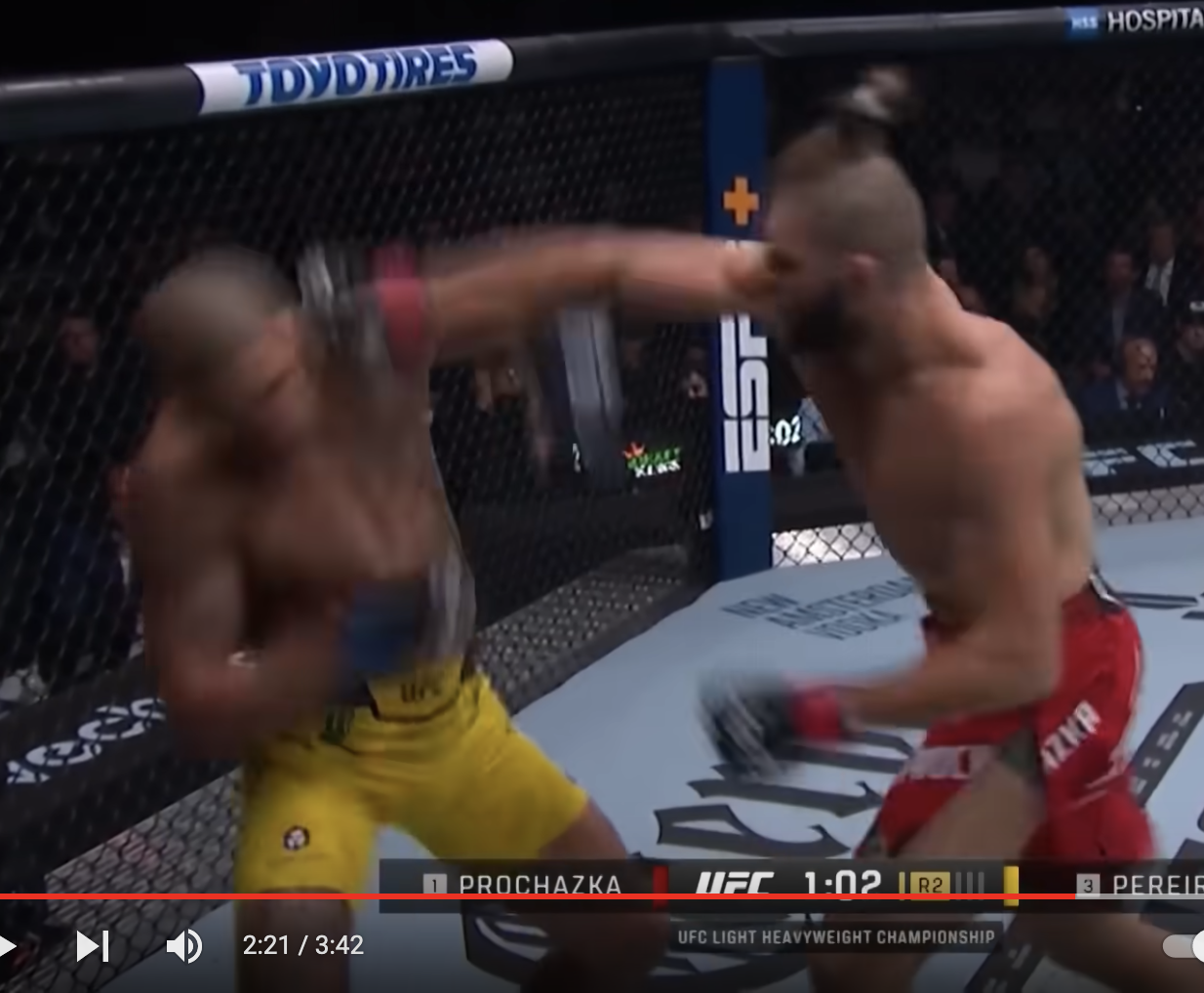
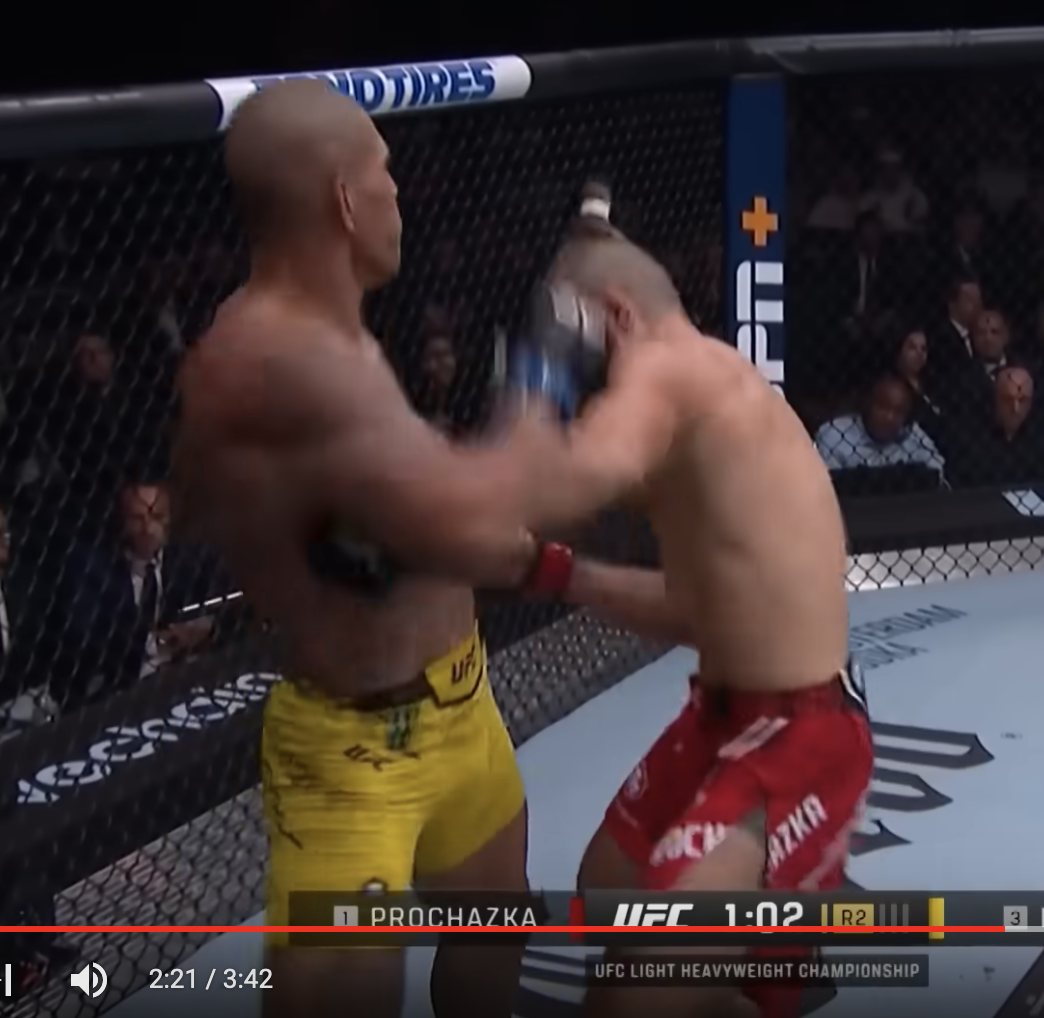
The very tight techniques of Chicken in Xing Yi are very metal in nature – sharp and cutting.

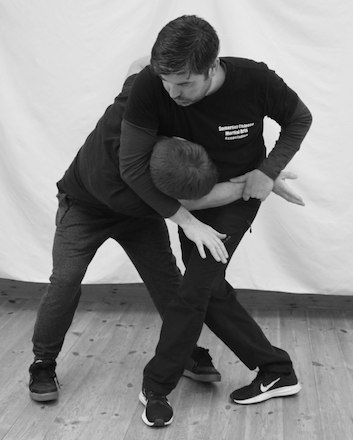
A perfect example of this Chicken style applied to MMA is the standing guillotine. When somebody shoots in for a takedown, wrapping the neck and using your hips to stand tall, with a narrow base is a very chicken-like technique. In fact, Pereira almost finishes the match with Jiri earlier with one:
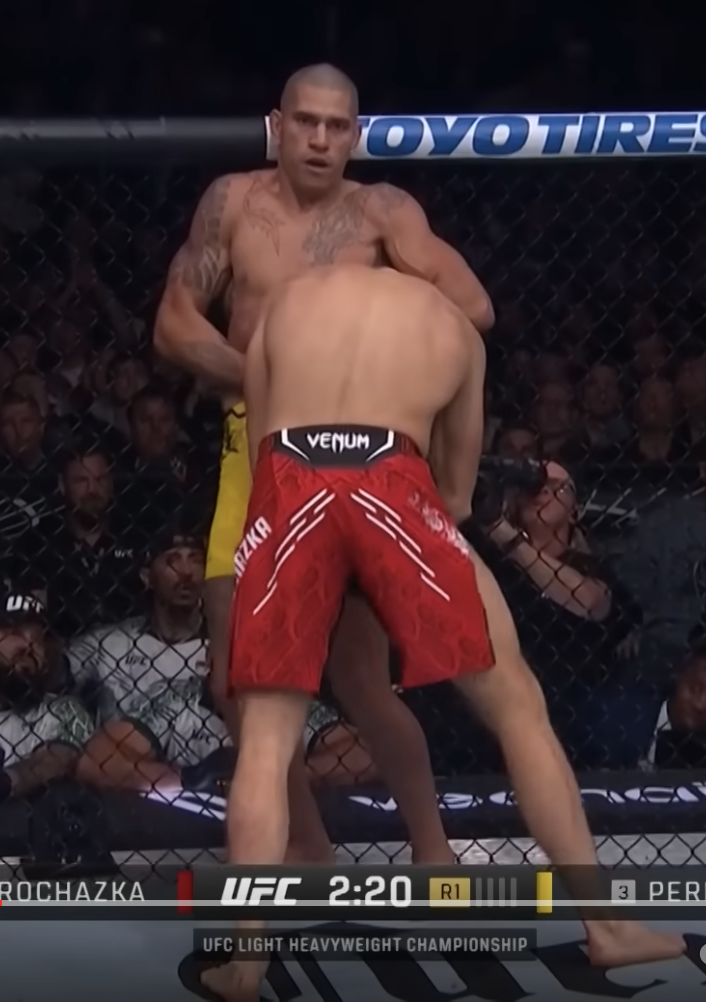
Standing guillotine attempt from Pereira.

Here’s a video of me doing some Xing Yi Chicken:

As I mention in the video, Chicken is an important animal in Xing Yi because it provides one of the requirements of the San Ti Shi structure – chicken leg.

Another thing Chicken (done by humans) is famous for are the knee strikes, which in real chickens are enhanced by the spurs it has on the back of its legs, and elbow strikes. You see this with fighting chickens especially. My teacher always said that the martial art that most resembles Xing Yi Chicken is Muay Thai, which is famous for knees and elbows.

The finish in UFC 295 was delivered by downward elbows from Alex Pereira and he has finished UFC fights with his famous flying knee before, delivered here in a way that looks very similar to the knee strikes in the Xing Yi link I do above:

Hopefully I’ve made my case.

To repeat: I’m not saying something simplistic like, “UFC fighters are doing Xing Yi”, but that as a tool for analysing fighting styles, I find Xing Yi really useful and the 12 Animals remain really fascinating.

A bit of homework for you…

Finally, I want to leave you with a bit of homework – also on that card that night at UFC 295 was British heavyweight Tom Aspinall. He managed to secure the interim heavy weight championship belt that evening. To me he’s a clear example of another one of Xing Yi’s 12 animals. The question is which one? You have 10 to choose from! Post your answers, compete with your reasoning, in the comments section below and I’ll give a prize for the correct answer (correct according to me, anyway, and I am the final word in this 😉 ).

Have a watch here:

Swallow Photo by Rajesh S Balouria: https://www.pexels.com/photo/close-up-of-swallow-17484064/

Chicken Photo by Luke Barky: https://www.pexels.com/photo/white-chicken-on-a-concrete-pavement-2886001/

Where should your elbows be in Xing Yi?

Today’s blog is about a weird quirk of the Xing Yi world. There’s a surprisingly large amount of online debate in Xing Yi circles about where the elbow should be when performing Xing Yi. I mean, a surprisingly large amount of debate. Especially for a matter that might, forgive me for saying this, be seen as trivial by people actively engaged in combat sports that actually spar with resistance.

Obviously, if you have some sort of two person free practice in your Xing Yi system that you actually engage in regularly, I’m not talking to you. I think the real reason why all these debates happen is simple – too much forms and not enough fighting.  

But, ok, there are other reasons. For example, details do matter in internal arts. Quite often we’re being asked to look in detail at our movements and micro movements to get the most perfectly coordinated and natural human movement possible. But without keeping one foot on the ground, (and grounded in the reality that sparring provides), the theoretical arguments start taking over and the art disappears up its own bum. A martial art that is predominantly forms-first is always going to be theoretical at best. To take the well worn analogy – you don’t learn to swim by practicing on dry land.

Long, explanatory videos have been made, back and forth, about why a certain person is doing it right or wrong because his elbows stick out or tuck in.

The problem stems from the fact that there’s a line in the Xing Yi classics that translates as: 

“The hands do not leave the heart and the elbows do not leave the ribs”.

But it’s how literally you take these words seems to be the crux of the matter. Now, I’ve seen videos of respected Xing Yi masters quoting this passage while demonstrating and their elbows are clearly leaving the ribs, if not in the horizontal axis, at least in the vertical axis. 

The reasoning behind keeping the elbows tight is sound – in boxing, kickboxing and MMA it’s generally considered best practice to keep your shoulders high and elbows tucked in close to the body to help protect the ribs. But boxers don’t tend to get hung up on this – as their individual style develops they don’t feel like they have to conform to the same ‘rules’ that the novice has to. They are free to develop their own personal style through experimentation and testing in the ring. I’m sure Prince Naseem was taught the same basics as Mike Tyson, but look how differently their boxing styles turned out in the end.

So, (and I know, dear reader, that you are just dying the hear this), what’s my take on where the elbow should be in Xing Yi?

Well, I’m glad you asked. Rather than getting hung up on words in an old writing (that may or may not be old at all) I prefer to get hung up on history. I mean, you have to get hung up on something, right?

Xing Yi is generally considered to be descended from military spear fighting. If you hold a heavy spear it becomes readily apparent that your best chance of wielding it with power is to keep it in front of the body, not out to the sides. It’s the same when you hold any heavy object – you are stronger when your arms are in front of you holding it than when they are at your side holding it. This is the truth I feel these words are aiming towards, and generally the postures and techniques of Xing Yi all comply with this idea of keeping the elbows in and the arms in front of the body, not to the sides. There are exceptions though. For example, Xing Yi Bear has a much rounder posture, with gaps under the elbows, more like the Yi Quan standing postures.

Professor Yu Yong Nian, demonstrated Yi Quan standing posture from https://zhanzhuangchikung.files.wordpress.com/

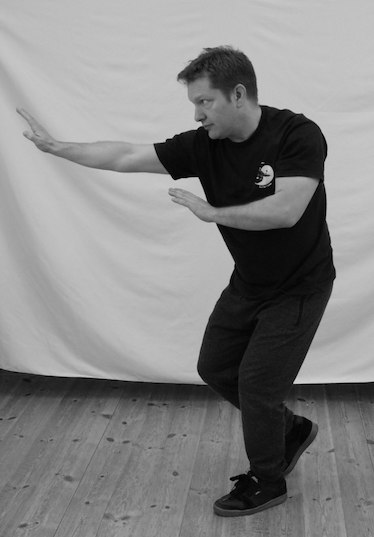
Some postures in our Xing Yi dragon and chicken links are for hitting with the elbows and we hold them out to the side when doing so, but in these cases you are normally (but not always) standing side-on to the opponent, so the elbow tip is pointing at the opponent, so in that sense it is not ‘out to the side’. 

A good example is this famous Liang Yi Zhuang posture from Baji, which is similar to the chicken posture I was talking about. (Baji is another Northern Chinese martial arts, that is a bit similar to Xing Yi).

Picture from https://bajiquan.fandom.com/wiki/Liang_Yi_Zhuang_两仪桩

I mean, we could decide that viewed from the opponent’s position the elbow is in line with the body, therefore it is not leaving the ribs, but the hands are not in front of the heart. No way. Are we therefore going to decide that this posture, taken out of context on its own, is wrong because it doesn’t correspond literally to some ancient writing that may, or may not, have been referring to a specific context?

Here’s another theory: I think what the whole thing is quite possibly about how soldiers work in formation on a battlefield. If Xing Yi does have military roots then a line of soldiers on a battlefield would all be orientated towards the enemy, standing side by side in a line. That’s another good reason to stick the elbows to the ribs. Any bladed weapons going towards your sides would definitely not be welcomed by your brothers in arms. 

Ultimately, I don’t expect this post to have really made a difference to the debate. I feel like this one is just going to run and run forever. So long as there are mainly theoretical practitioners of the art there will be always be many theoretical debates about how what somebody is doing is right or wrong in relation to some ancient writing.

I just think people’s efforts would be better put to trying moves out on other people and getting feedback that way. As one of my teachers used to say often:

“There is no such thing as correct technique, there is only appropriate technique.”

Make Xing Yi wild again

animal animal photography avian beak

Photo by Pixabay on Pexels.com

Rewilding is an environmental process that brings nature back to life and restores living systems. Apex predators and keystone species are reintroduced and we let nature reclaim parts of the landscape, without human intervention.

The coronavirus pandemic has lead to a kind of enforced rewinding of the urban world. As the human race retreats indoors for the next few months it’s a chance for nature to reclaim parts of cities. As tourists left corona-stricken Venice, swans, fish and even dolphins returned to the canals. In England, the constant background hum of traffic is dimmed as people stay at home. As I stand in my back garden and look up at the last of the blossom on my cherry tree I can see more birds flitting about in its branches than normal. I can hear more bird song than usual.

One of my favourite martial arts, Xing Yi, was once a wild and untamed martial art, but over time it has become a rather domesticated and pale version of its former self. Human ideas have come to dominate in Xing Yi, where once nature was its real inspiration. But now Xing Yi can no longer be practiced freely with other people maybe we should take this time to do the same thing with it and other martial arts — rewild them and return them to the source.

animal close up country countryside

Photo by Pixabay on Pexels.com

Our hook into the natural world

After trees and fields, our next point of entry into the natural world is usually from seeing wild animals. Even in cities, animals are all around us, but we rarely pay much attention to them. Foxes roam our streets at night, magpies land on our rooftops and birds of prey can even hunt in our gardens. In the past animals provided inspiration for many martial arts. Xing Yi, with its various animal ‘shapes’, in particular, was one of them. Unlike humans, wild animals aren’t separated from nature by civilisation. Even our pets can unexpectdly reveal their wild side on occasion.

Unusually, I was first introduced to Xing Yi Animals as part of my Tai Chi training. My teacher’s teacher had learned Xing Yi, along with various other martial arts in Hong Kong, before moving to the UK in the 1970s, but rather than teach the whole art to his UK students he used the 12 Animals as coat hangers for techniques which suited their individual body types and attributes. The main arts he taught my teacher were Tai Chi Chuan, Northern Shaolin and Buk Sing Choy Lee Fut, but to help his students become more effective in sparring he saw a lot of value in using the Xing Yi animal strategies. So, for example, one student who was good at straight punches would be given Horse to work with in sparring, and another, who was more stocky and good at rounded punches and kicks would be given Bear.  Learning in this way was very individual. You were given some sample movements, and it was then up to you to build from there by adding in other techniques that you found worked well in combination.

My own teacher also used the Xing Yi animals in the same way and from this little dip into the art my curiosity for Xing Yi was piqued and I became hungry to learn more. My search for Xing Yi-proper lead me to eventually meet an actual teacher of the full art, who was kind enough to take me on as a student. And while his techniques had more variety and specialisation, and the body methods looked more distinctively “Xing Yi”, (they required a good grounding in the 5 Element fists first, and were quite different to Tai Chi Chuan) I was pleased to see that his overall approach to the animals was roughly the same. After first learning a set sequence, he would then introducing variations to help you get the flavour of the animal through free experimentation. He encouraged you to actually observe the animal in question. Rather than being prescribed an animal to work with, his students tended to naturally gravitate towards one animal or two; the ones that suited their personalities and abilities.

Xing Yi Snake

The author practicing Xing Yi Snake with Glen Board, author of Xing Yi – A study of Tai and Tuo Xing . Photo by Emma Heeney (c) 2020 Somerset Valley Publishing

A proficient Xing Yi practitioner however, he taught me, should always be able to switch between animals freely, as required by the situation. Tiger, for instance, is good at entering from a distance while striking heavily on the opponent. Bear, for example, is good at close infighting and Snake is good at close quarter grappling. Moving between all three in an encounter may take only a few seconds.

Ultimately, the goal for a Xing Yi student is to get good at all 12, rather than just one or two, then leave them behind entirely and just practice “Xing Yi” itself. Of course, this training progression assumes you have hours of free time to practice, since this was the traditional way. The reality of adapting Xing Yi to our busy, modern lives is somewhat at odds with this expectation, so I found that focussing on an animal or two that suited me personally was perhaps a better use of my limited time. Bear-Eagle, Chicken and Monkey were my favourites.

Rewilding Xing Yi

In modern times, Xing Yi animals have taken something of a back seat to the 5 element fists, or set linking forms. Rather than expansive fighting strategies derived from nature they have become somewhat domesticated, reduced and institutionalised. Really, each animal should be practiced like a mini martial art in itself, yet it is often shrunk down to a single move repeated over and over.

Rewinding Xing Yi would involve putting the focus back on the 12 animals and expanding them. And that’s starts with research.

We live in a time when it’s possible to view Xing Yi from all over the world on your laptop at home. Between all the different lineages of Xing Yi there is enough animal content preserved to fully flesh out the characters of each animal. If we start to look at as many variations of them as we can possibly find between both Xin Yi and Xing Yi, we can build up a bigger picture of what a Xing Yi animal represents.

Even better, find another Xing Yi practitioner and share your animal methods.

Xing Yi Chicken

The author practicing Xing Yi Chicken. Photo by Emma Heeney (c) 2020 Somerset Valley Publishing

And let’s not forget that we can still do with a lot of the Xing Yi animals what the founders of the Li tradition of the Song Dynasty tried to do, which is to get back to nature through direct observation. Amongst the 12 animals, there are several which it’s possible to observe directly yourself in the countryside and woodlands of the United Kingdom. For instance, chickens can be found in farmyards. Horses can be found in fields, and swallows still perform their aerial acrobatics in our skys. While there are a goshawks living in Wales and Scotland, Sparrow hawks are common throughout Brtain, and you can at least find birds of prey on display at many centres throughout the UK.

The other way we can rewild our practice is to change where we practice. My teacher always taught outside, in nature, because that was the way he learned in China. It didn’t matter what the weather was like, if he said he was going to be there, he was there. In fact, if you turned up to practice in a snow or rainstorm he’d be happier and teach you something especially good! Experiencing the weather directly is one way to get closer to nature. You can only learn to take the environment into account in your practice if you have to deal with it on a regular basis. Practicing at night under the night sky where you can see the stars is another great way of turning your head back to nature. Stop practicing indoors. Training in village halls is fine, but that perfectly flat wooden floor is making life too easy for you. Get outside and feel the wind on your face, it will do you good.

brown and white eagle

Photo by Magda Ehlers on Pexels.com

I’m not suggesting that we abandon the fundamental principles of Xing Yi and adopt a delusional approach to practice, where our only judge of what’s correct is our own opinion. Animals living wild in nature don’t have the luxury of opinions. Their methods of hunting for prey or defending against predators either work, or they starve or get eaten.

The principles of Xing Yi are not derived from old sayings or old books. They’re derived directly from nature.

We’ve been ignoring nature for a long time now. As the coronavirus sweeps the world an old, uninvited guest has returned to the table. To quote the excellent poem, Sometimes a Wild God, by Tom Hirons,

Sometimes a wild god comes to the table.
He is awkward and does not know the ways
Of porcelain, of fork and mustard and silver.
His voice makes vinegar from wine.

When the wild god arrives at the door,
You will probably fear him.
He reminds you of something dark
That you might have dreamt,
Or the secret you do not wish to be shared.

We can fear this guest, or we can embrace him.

Let’s let nature be our teacher once more.

Let’s make Xing Yi wild again.

woman walking on a log in the forest

Photo by Brady Knoll on Pexels.com