As well as a Tai Chi practitioner and teacher, Richard is a full time movement coach working with athletes, so he brings an appreciation of athletic movement to his views on Tai Chi.
In our discussion Richard delves deeply into the internal workings of the Chen Style Practical Method and we talk a lot some interesting movement principles based around rotation. We also talk about how the Practical Method is different to the Chen Village style of Tai Chi.
You can see the little wobble of the knee he does before he does a fajin in the form. This knee wobble has been the source of seemingly endless debate. Some lineages of Chen style do it, some don’t. Some do it but it’s very minimal, some do it and it’s quite exaggerated. It doesn’t even seem to be a village vs Beijing style thing either.
So, why do it? It’s a way to involve the knee in the generation of power. The best analogy I can think of is that it’s like retracting your fist before you punch, but instead of having to move your fist back (which has certain obvious martial disadvantages), you store power by moving the knee back instead. This obviously requires a conditioned body, where the hand to foot is all connected, so that when one part moves, all parts move. If you just took your average Joe off the street and they did a knee wobble, I don’t think it would do anything for their punching power. In fact, it would probably decrease it. But for somebody who has built that connection over time throughout the body, it has advantages.
Lots of people are convinced that the knee wobble is the route to ruin for your body, that it’s bio-mechanically inefficient and potentially injurious over time with hard training. I can see where they are coming from since you are using the knee as part of a whip-like kinetic chain for which the hinge joint is not well evolved.
But personally I’m not so convinced that, done properly as part of an overall training system, it is bad for the knee, necessarily. I think if you were holding your weight for a long time on a misaligned knee joint then that would be a bigger problem. But the quick flick of a fajin isn’t like that. There are also plenty of things athletes do all the time that I’d say are potentially much more dangerous. It also depends on the person. The knee is a particular weak point in the evolution of the human beings into an upright posture, and being severely overweight is very dangerous to your knee joints. And if I was severely overweight there is no way I’d be flicking my knee joints about like this, so it very much depends on the overall health of the person doing it.
Disclaimer! I’m not an orthopedic surgeon, or a physiotherapist, so I’d suggest getting your medical advice from somebody who is actually medically qualified.
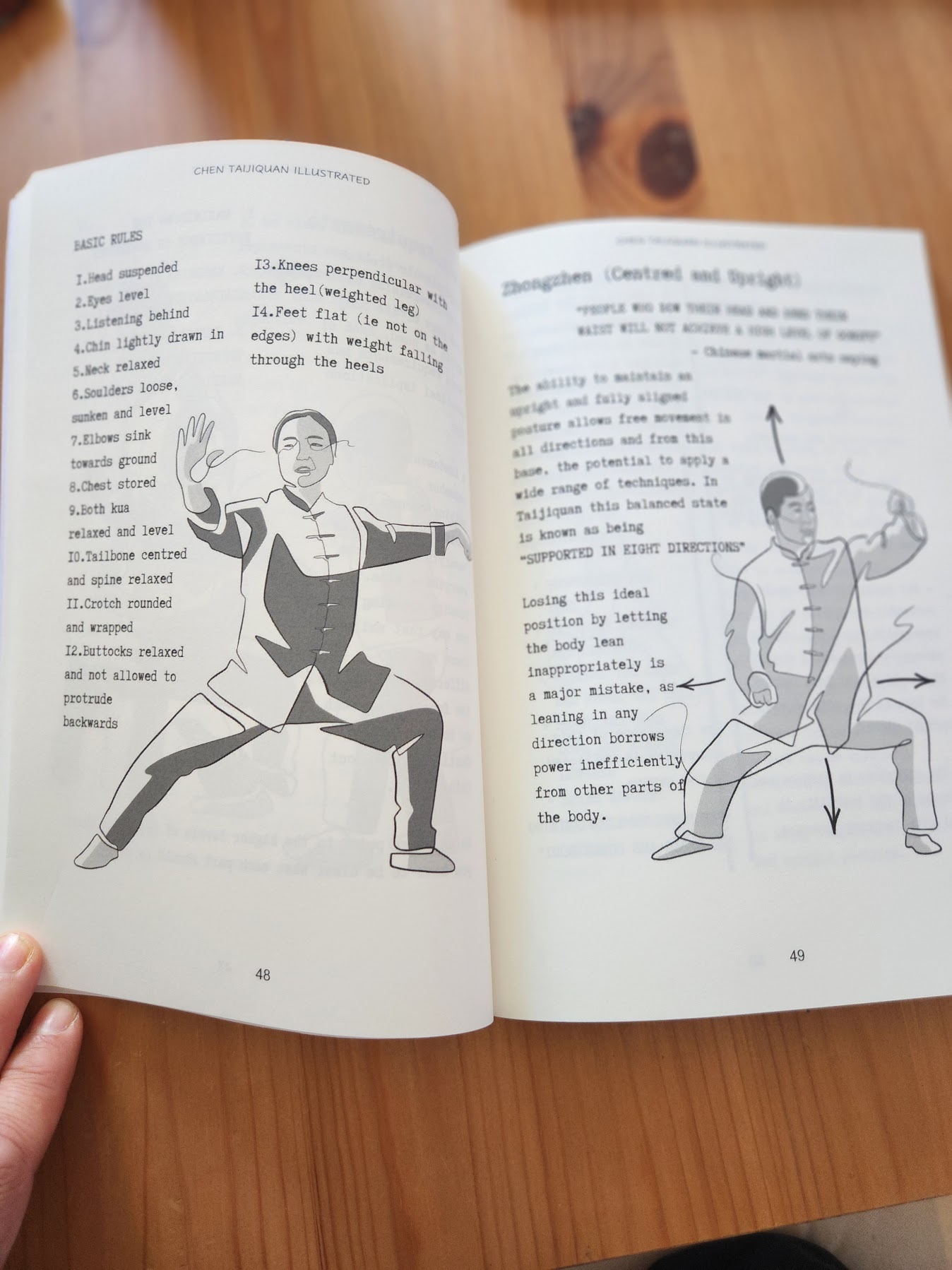
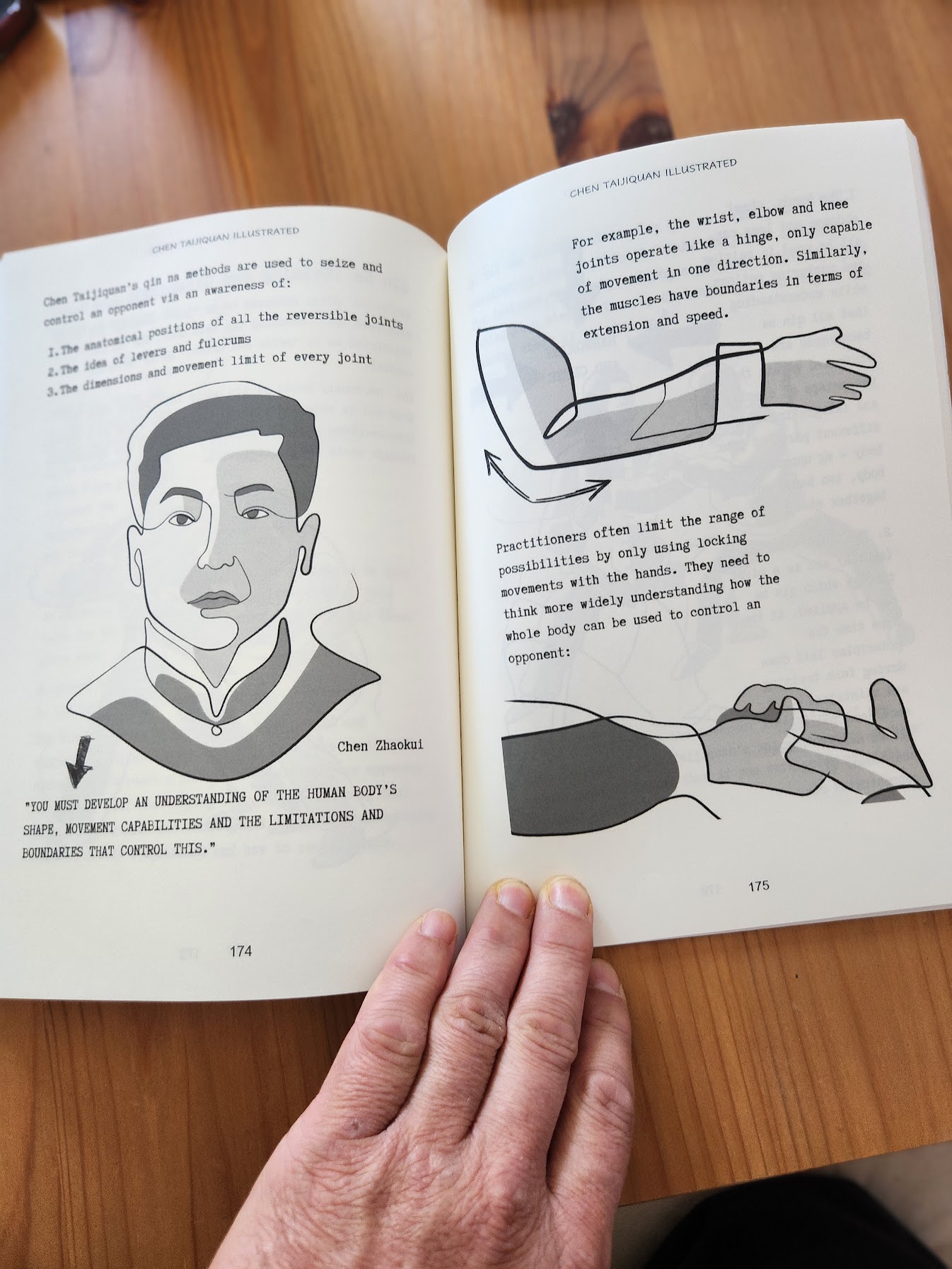
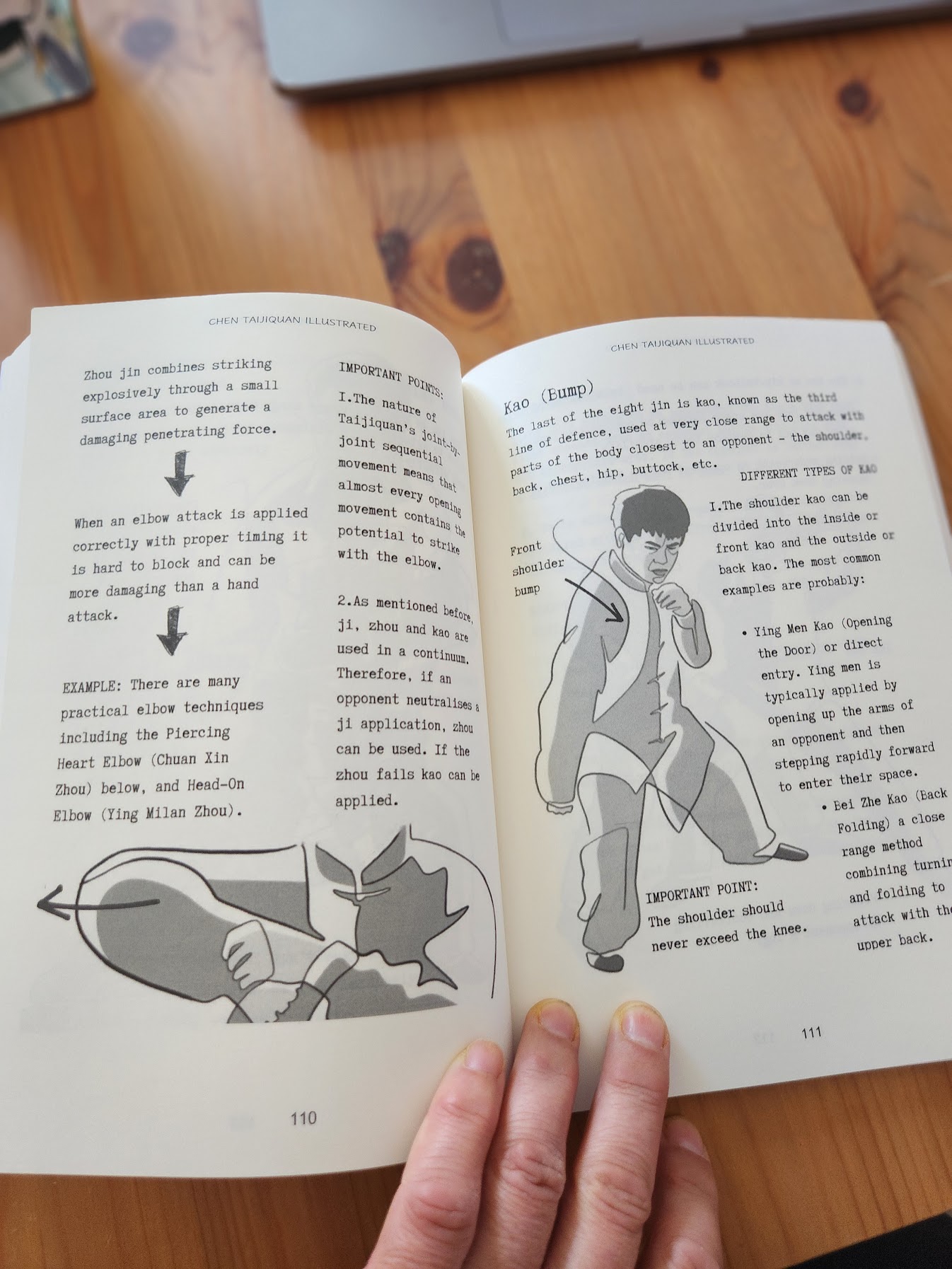
Chen Taijiquan Illustrated is an exploration of pretty much everything that makes up Chen Taijiquan, from principles, and body methods to practical usage and philosophy. But the most notable thing about this Taijiquan book, and the place where we should probably start, are the illustrations, because they are what really separates this book from others of its ilk.
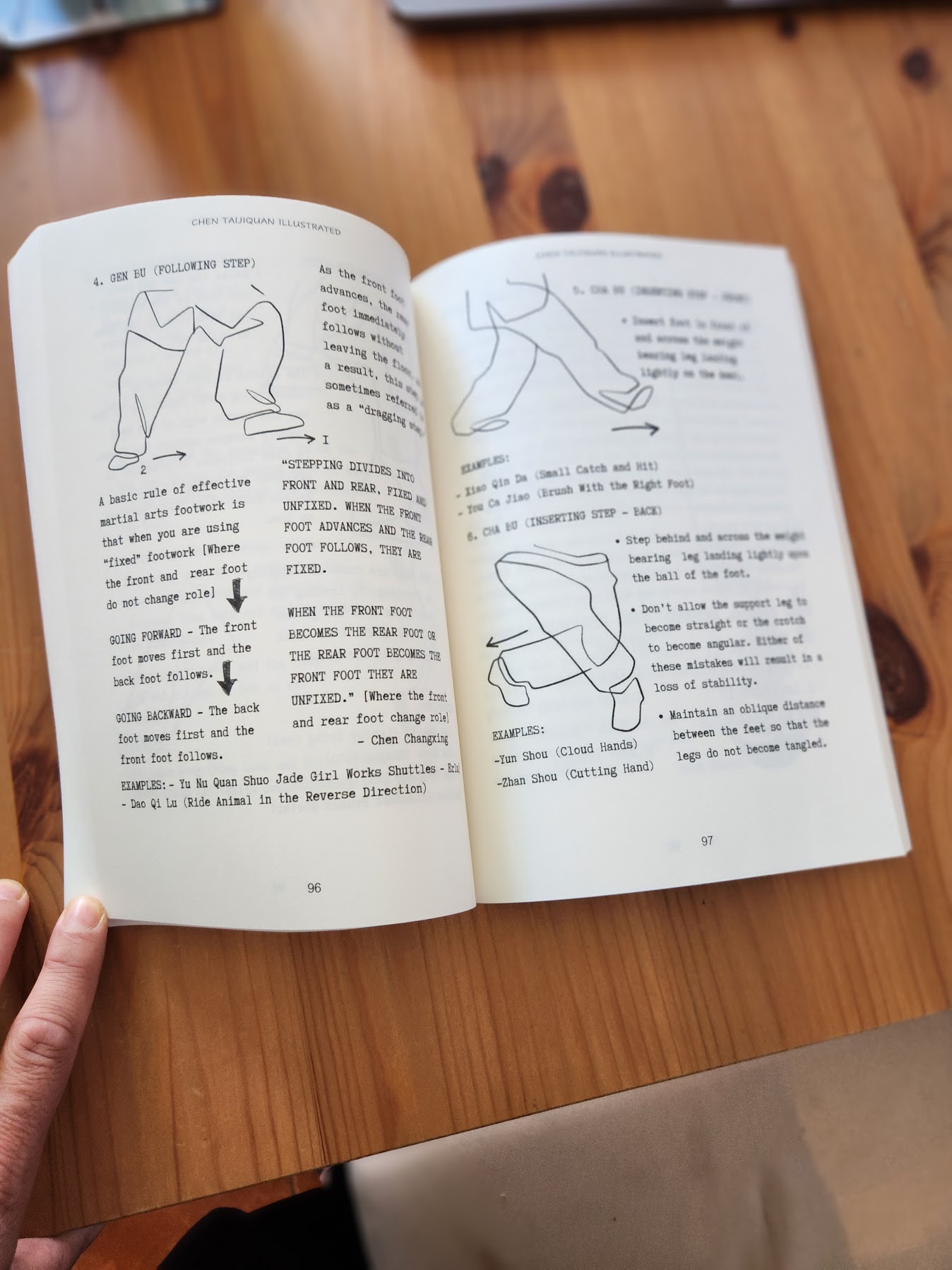
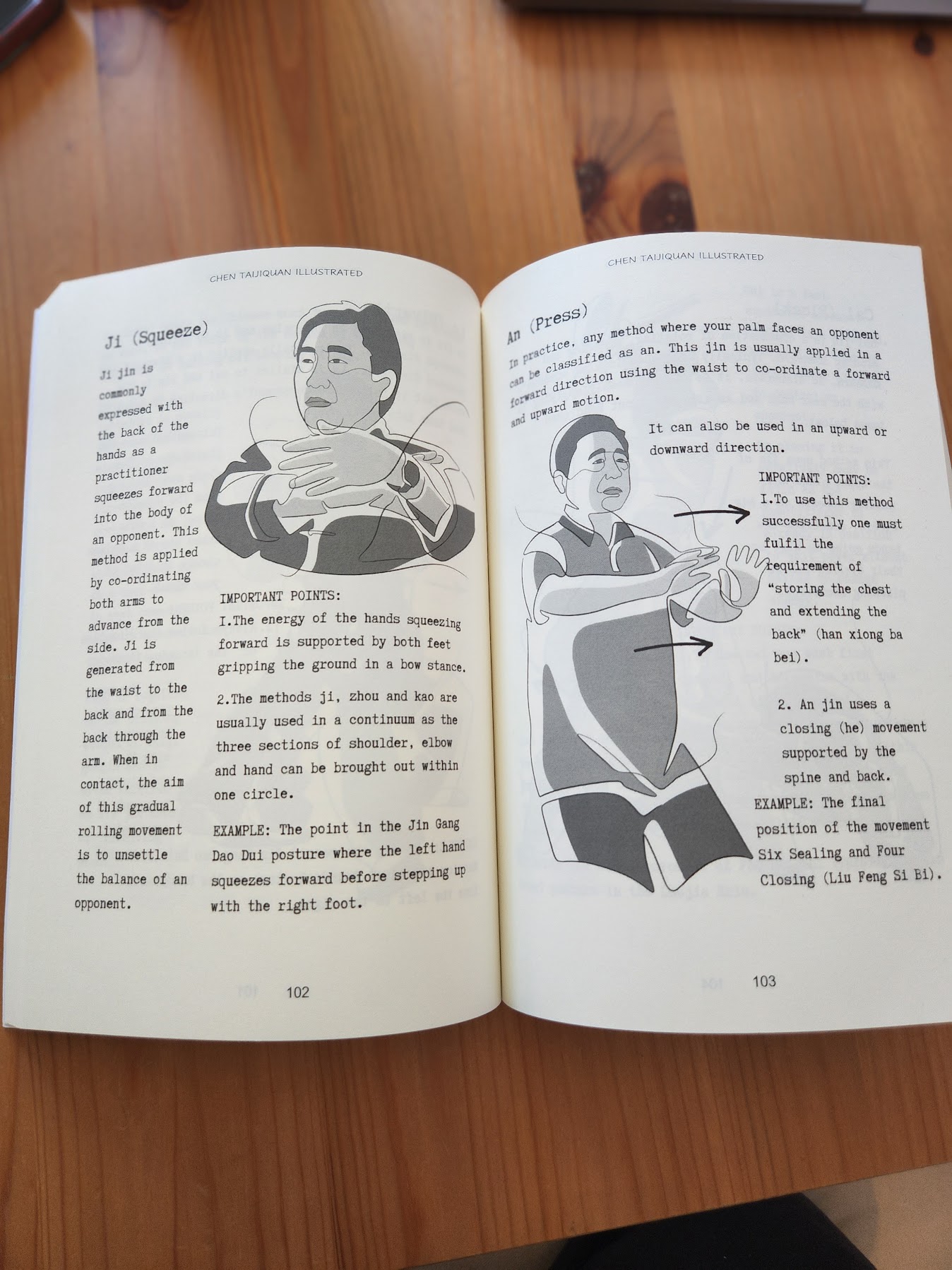
Almost every page here (and there are over 200) has some sort of detailed drawing on it that adds context to the text surrounding it. In fact, the whole book takes the form of a visual notebook, as if you are discovering a secret copy of the best-looking training notes you’ve ever seen. Surrounding the drawings are quotes from the most iconic practitioners in the Chen lineage, past and present, as well as explanations of principles, concepts and requirements of Taijiquan. Take a look and you’ll get the idea:
As you can see, the drawings are mainly done in a stylised cartoon way, which is actually very effective, and it’s pretty clear that these are photographs that have been traced over digitally, to produce the illustration, rather than drawn from scratch. The overall effect is really nice, and refreshingly modern and accessible.
Because a Taiji master’s posture takes years to develop and is a reflection of their skill, you can learn quite a lot from just looking at it. So, having a drawing based on a real photo gives you the best of both worlds – you get to see the genuine skill of the practitioner on show mixed with the accessibility and visual appeal of an illustration.
In fact, in a lot of cases you can guess the famous master that the drawing is based on. For example, the book cover shows, I believe, a digital tracing of a photo of Chen Xiaoxing, brother of Chen Xiaowang.
It should be pointed out that not all the illustrations in the book are done to the same high standard, but there are only a few where the quality dips significantly.
Chen Taijiquan Illustrated is split into three sections – Section 1, Body Rules (Shape and energy), Section 2, Practical use/Application and Section 3, Philosophical Roots. Section 3 on philosophy is tiny compared to the massive section two, which consists of a catalogue of pretty much all the practical methods found in Taijiquan – peng, lu, ji, an, listening, sticking, neutralising, push hands, hand methods, leg methods, stepping, chin na, etc. Pretty much everything to do with the Chen style is here!
The initial section on body requirements is very good, and something you can keep coming back to and the book goes into much more detail than you’d expect to find in a basic beginner’s book, which makes me happy. The explanations of the concepts and techniques in the second section can sometimes err towards being more of a catalogue of techniques than an in-depth ‘how to’ of each one, but there is always going to be a limit on how much can be achieved in print, and the illustration of various masters doing the method being discussed speaks volumes in itself, and adds a lot of depth. It’s also nice to see the martial methods of Taijiquan being discussed in detail, something that is also rare to find in a Taijiquan book.
Let’s talk for a moment about what the book doesn‘t include. For a start, there is no attempt to teach a form in this book, which is probably a good thing, as Chen style in particular would be hard to teach in a printed book due to its intricate nature and complex, spiraling movements. Also, there is no history section – personally I’m glad about that, as it’s a massive subject and would require too much space to do it justice, and frankly, it’s been done to death elsewhere, and matters not a jot to your actual practice of the art. If you want to discover the key to “internal movement” then you’ll find good pointers here, but if you really want to delve deeply into subjects like peng, groundpath and internal body mechanics then I’d say you should check out Ken Gullette’s book on the subject. Finally, there’s no mention of weapons here, which are obviously a huge part of the Chen art. The emphasis here is on body methods and bare hand methods only.
Taijiquan is a practical, doing art, not the sort of practice that benefits from too much intellectualism, and the visual nature of the book is great at reminding you of that fact, grounding the concepts and principles in practical reality.
Overall, I think this has to be one of my favourite books on Taijiquan ever produced. This is really one of the most comprehensive collection of training notes you’ll ever come across. And because everything is fitted around pictures, there are no long, boring, passages of text, meaning you can dip in and out at any point. In fact, just picking it up, flicking to a random page and starting to read for a few minutes can easily give you inspiration for your practice that day.
Highly recommended, and while obviously best suited to Chen style practitioners (there’s a lot of discussion of silk reeling), I think a Taijiquan practitioner of any style would get a lot out of it. I certainly did.
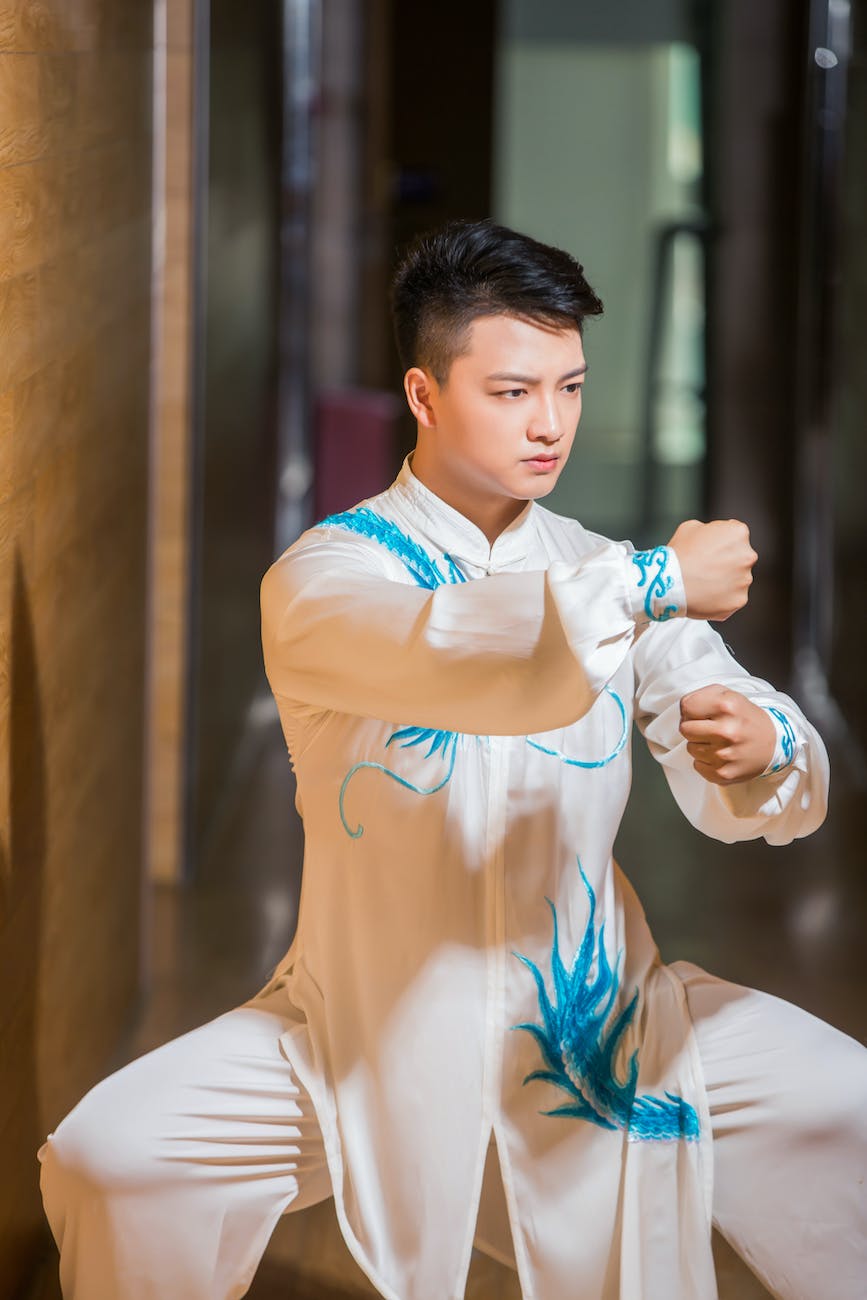
“The, at first sight, seemingly humorous Chenjiagou saying to “always keep an egg under your armpit” reflects the importance of not allowing the upper arms to become stuck to the side of the body.
This idea of always keeping a space under the armpit is something I’ve heard said in other styles of Tai Chi as well, and it fits in very well with the idea of “Peng all over the body” that you’re aiming for in Taijiquan, that kind of “inflated like a balloon, but also soft, springy and heavy” feeling.
Taijiquan, with armpit gaps. Photo by Stephen on Pexels.com
But how does that relate to the question I was looking at recently about the issue of where the elbows should be in Xing Yi? “The elbows never leave the ribs” is a line from the Xing Yi classics* (more of that later) that has caused a lot of arguments between practitioners on its interpretation and meaning.
And when you compare it to the previous saying about the armpit from Chen Village, it’s basically the complete opposite advice! And yet, both Taijiquan and Xingyiquan are said to be internal arts, and part of the same family. So, is the advice about the elbow a crucial element, as fundamental as, say, aligning the Bai Hui point (the crown) with the spine? Or is this more of a piece of strategic advice to do with the fighting style of Xingyiquan, and not anything to do with its fundamental body method?
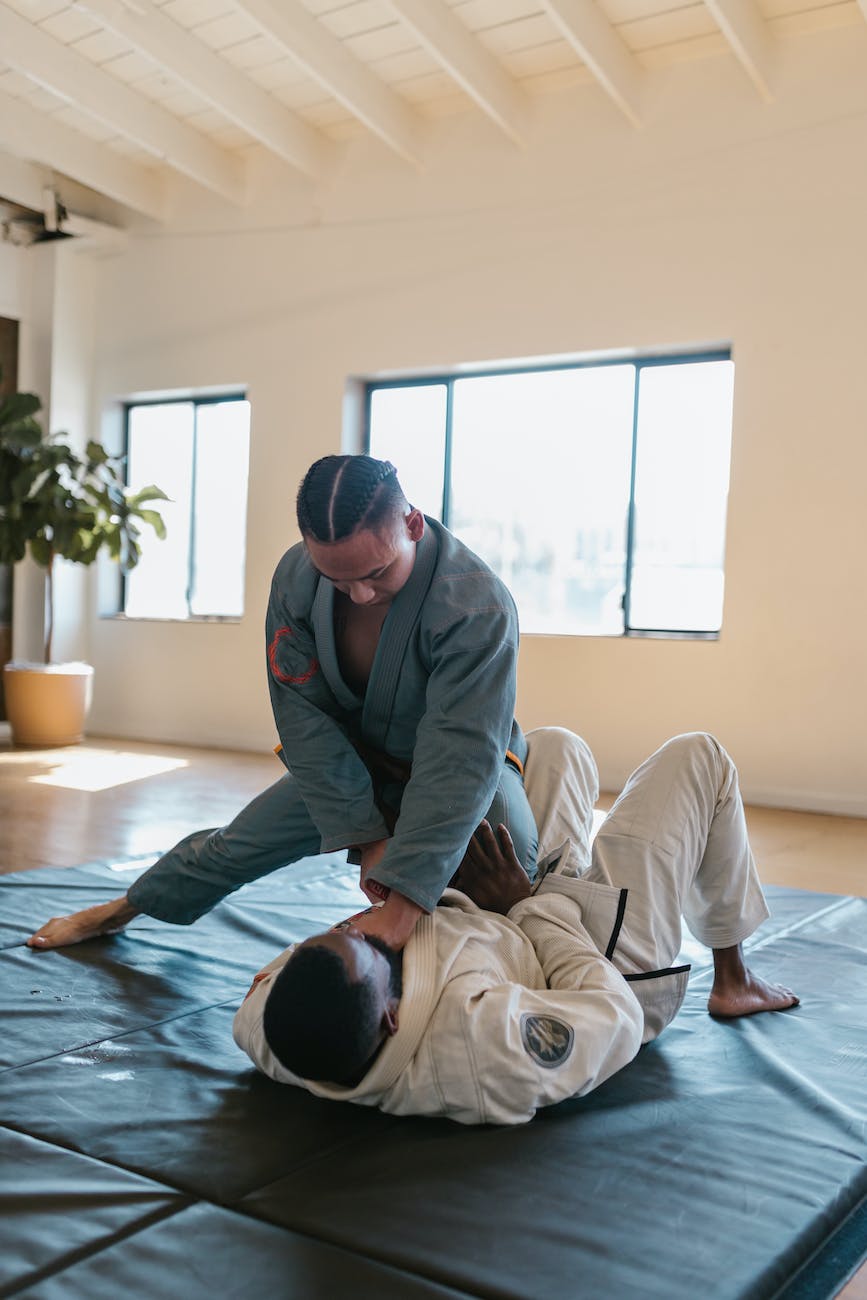
Let me throw in a curve ball here and switch arts to BJJ. “Glue your elbows to your ribs” is something I say to my students in BJJ all the time when they are on the bottom defending a position like side control, knee on belly or mount.
Knee on Belly in BJJ. Photo by RDNE Stock project on Pexels.com
If you let your opponent separate your elbows from your ribs in that position then only bad things can happen, so it’s great advice. Normally after I submit somebody new in BJJ I stop to explain to them how I did it, so we can turn it into a learning moment. 9 times out of 10 my explanation starts with “it started when you let me into the space under your armpit”. However, it would be ludicrous to make it into a hard and fast rule, to suggest that you should never let the ribs leave the armpit at any moment in BJJ. There are plenty of other times in BJJ where you need to pull with your arm, and you can’t do that fully without separating your elbow from your ribs.
In the preface to his manual Sun says (Translation by Brennan), “While once at Bai Xiyuan’s home in Beijing, I got to see one of the Yue Fei manuals, not an original copy of course, but a handwritten copy made by someone in a later generation. It was not very detailed and unfortunately contained no explanations of its terminology, only the barest of text from beginning to end. I was suddenly inspired by this, immediately wishing to provide more complete information, even though I was fully aware that my level of learning and skill was superficial, and without being tempted to make anything up [in order to fill information gaps]. I secretly made my own copy and then deeply studied it, going through it posture by posture until bit by bit I had built up the material to make this book. There is no decorative language in it at all, for in my studies I have not dared to hold on to even the slightest exaggerations. Wherever flaws are found within my work, I hope my comrades will correct me, for which I would be very appreciative.
– sincerely written by Sun Fuquan [Lutang] of Wan County, Baoding, 1915, 1st month, 15th day”
In his manual Sun has a chapter called “The Essentials of Practice” in which we find the advice about elbows and ribs. (Translation by Brennan)
“ESSENTIALS OF PRACTICE The essentials of practice in Xingyi Boxing: 1. Sink your waist. 2. Shrink your shoulders. 3. Hollow your chest. 4. Press. 5. Lift. 6. Horizontal and vertical should be clearly understood. 7. Lifting, drilling, dropping, and overturning should be clearly distinguished. … Your head presses up during drilling, then shrinks back during overturning. Your hands lift during drilling, then drop during overturning. Your foot lifts during drilling, then drops during overturning. Your waist lifts during drilling, then drops during overturning. [from the Xingyi Boxing Classics:] “In lifting there is a horizontal aspect, but it is invisible [because it appears to be only upward]. In dropping there is a vertical aspect, but it is invisible [because it appears to be only forward].” Lifting is going out and dropping is striking, but when lifting is also striking, dropping is still striking. Strike with lifting and dropping, like the overturning waves of water, which are lifting and dropping. Regardless of lifting and dropping, drilling and overturning, going and coming, it should always be that your elbow does not leave your ribs and your hand does not veer off from your centerline. These are considered to be the essentials in Xingyi Boxing. Knowing these, the right path in the art will be obtained.“
But you can see that even in this passage, Sun is quoting the older “Xing Yi Boxing Classics”. So, you have to start to wonder, how old is the advice that the elbows do not leave the ribs, really? I know some styles maintain that their “quan pu”, ancient collection of classic handwritten writings their family possesses has this advice in. At least with Sun’s work we have a published date we can be sure of.
But this also brings up the question of how much we dedicate ourselves to following the literal words of “the classics” to the letter. How much freedom are we allowed in our martial art? Were the classics intended to be a kind of set in stone, unwavering, set of rules to be followed on pain of death? The ancient writings of the founders always tend to take on this weight that gets heavier over time. If they’d been written a year ago, would we treat them with the same reverence? There are hard line Christians who treat every word of the Bible as the word of God, never to be questioned, and there are more modern progressive Christians who interpret the words in the Bible into a modern context, or see them as simply stories designed to teach an idea, and not to be taken literally.
Yang Cheng-Fu showing Tai Chi applications from his book.
In the comments section Richard asked a good question in response to my last post. I wrote a brief reply in the comments, but I thought I’d flesh it out a bit as a blog post, because it’s an interesting topic.
The question is, ‘what’s the point of Tai Chi applications?’ Actually, to be fair, he was talking specifically about the one application video in my last post, not about Tai Chi in general. But personally I think you can extrapolate the question to include the wider Tai Chi universe, and that would be where I’d look for my answer.
There are plenty of videos of respected masters of various styles of Tai Chi running though the applications of their form movements and producing a series of very questionable applications that would require a perfect storm of events to happen for them to work. I don’t want to post them here because I think it would distract from the point I’m making, but look up ‘Name of famous master’ and ‘applications’ on YouTube and you’ll find them.
I really like the phrase “a perfect storm” to describe Tai Chi applications because as far as I can see, most (if not all) Tai Chi applications one would require a ‘perfect storm’ of attacker, positioning and timing for the application work. Therefore the one application video I posted previously is not particularly different to any other Tai Chi application video, at least to me.
That might not be a popular opinion, but I think it’s true.
Contrast this with a martial art like Choy Li Fut. I’ll choose CLF because it’s a kind of a typical Chinese Kung Fu style. It’s has some key techniques like Sao Choy – sweeping fist and Charp Choy – leopard fist and Pao Choy, a kind of big uppercut, Gwa Choy, a backlist, for example.
Here’s 10 of the ‘basic’ techniques that you find in CLF:
I wonder – does the man in the mirror ever punch him back?
If you watch a Choy Li Fut form then you’ll see these 10 techniques crop up again and again, but each form enables you to practice them in different combinations:
A great title for a video “Killer Choy Li Fut form!” It’s actually a great performance, especially with the drumming in the background.
Or check out the famous first form of Wing Chun – Siu Lim Tao, it’s a series of techniques performed very, very accurately so you can refine and practice them:
Now when you do those techniques in a form, you are performing a technique that would work exactly as shown. The only thing you need for success is to actually contact with an opponent and do the move correctly at the right time.
Tai Chi as a marital art just doesn’t work in the same way. We don’t have a toolbag of techniques designed to be pull out and used ‘as is’. Ward off is not a fundamental technique of Tai Chi – instead Peng, the ‘energy’ you use in performing ward-off, is the important thing. And I think this leads to a lot of confusion about what Tai Chi forms are.
So, if we don’t have techniques that exist in the same way as other marital arts, how are you supposed to fight with Tai Chi?
Tai Chi is a set of principles and a strategy that together make it a martial art. In a nutshell the strategy part can be summed up with the 5 keywords of push hands – listen, stick, yield, neutralise and attack. The principles cover how the body is used, resulting natural power derived from relaxation, ground force and a series of openings and closings expressed in the 8 energies. When the principles of Tai Chi are properly internalised you become something like a sphere, which can redirect force applied to you with ease and respond as appropriate. All these things are elucidated in the Tai Chi Classics.
Now that short description probably leaves a lot out, of what Tai Chi is, but at least it’s a starting point.
If that’s your goal, then putting emphasis on individual techniques doesn’t make much sense. Everything you do now exists in relation to an opponent, rather than existing on its own terms. The Tai Chi form then becomes a series of examples of how you might respond to specific attacks. In essence, it is a series of perfect storms, one after the other, put in a sequence that is long enough that you start to internalise the principles of movement and energy use. And obviously the strategy part requires a partner, hence why push hands exists.
I think that’s also the reason why Tai Chi forms are so long and slow, btw, so you internalise things.
As a final note, I’d say the jury is still out as to whether the Tai Chi way is the best approach to teaching people to fight. It’s interesting to note that a lot of martial arts innovators tend towards this same nebulous ‘technique-free’ style of training the further they get into their research into martial arts. Bruce Lee for example, was moving towards freedom and the technique of no technique in his later years – see his 1971 manifesto ‘Liberate yourself from Classical Karate’ for example. Then there’s Wang Xiang Zhai who created Yi Quan by removing fixed forms and routines from Xing Yi Quan and mixing it with whatever else he had studied. See his criticisms of other Kung Fu styles in his 1940 interview, for example.
In contrast a lot of the martial arts that have actually proven effective in modern combat events have turned out to be very, very technique based. Brazilian Jiujitsu, for example, is taught through very specific techniques. So is MMA. Karate, for all of Bruce Lee’s criticisms often does very well in competition against other more esoteric styles because it contains some no nonsense techniques.
Another factor to think of is that while Tai Chi may have those lofty goals of producing a formless fighter in its classical writing, it often isn’t taught like that in reality. One of the martial arts that Wang Xiang Zhai is criticising as having lost its way and become a parody of itself in that 1940 essay linked to above, is, in fact, Tai Chi Chuan!
So, as ever with marital arts, I think the answer is: it’s complicated.
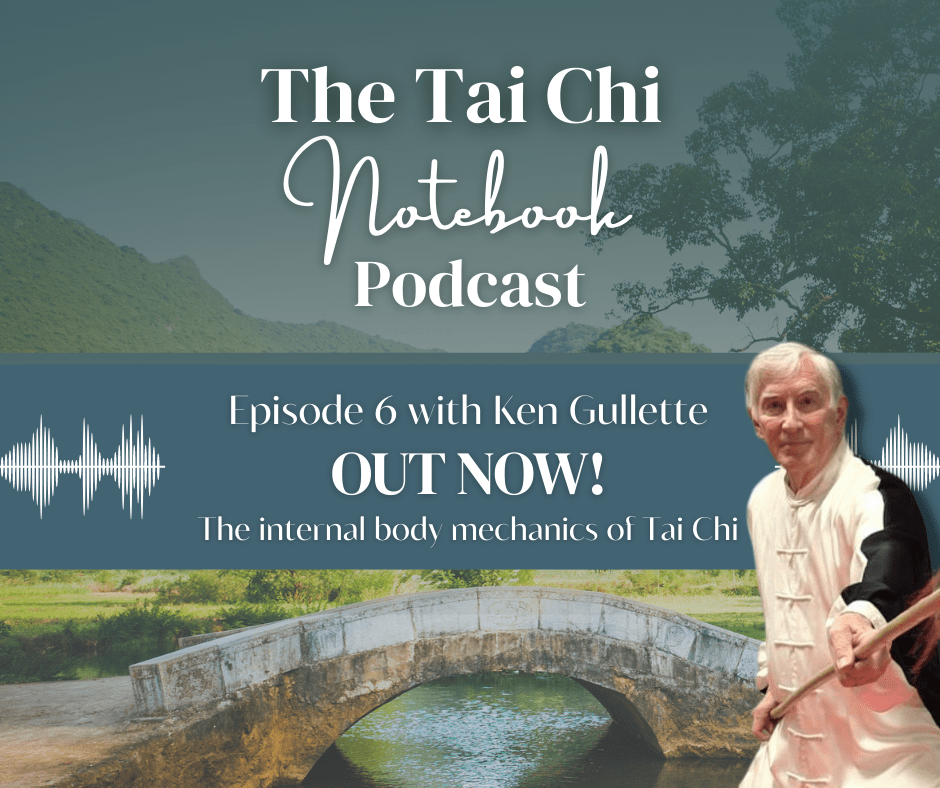
In this episode Tai Chi Notebook podcast my guest is Ken Gullette, a native of Illinois, USA, where he trains in all three of the main internal arts – Tai Chi, Bagua and Xing Yi. Ken also runs a website called internalfightingarts.com where he trains students from around the world in the three internal arts using a combination of recorded and live classes.
Ken is quite famous for his focus on body mechanics, internal power and getting to the root of these arts in a non-mystical and no-nonsense way. In fact, he’s written an excellent book that’s available on Amazon – it’s called ‘Internal body mechanics for Tai Chi, Bagua and Xing Yi’, and I’d recommend you get a copy.
In this episode we discuss the internal body mechanics of Tai Chi, training with disciples in the Chen family linage and there’s also a few stories of the times Ken has had to use his arts in real situations.
This podcast interview of Mark Chen by Ken Gullette is a real gem. If you haven’t listened to it before I’d really recommend it. It starts with a basic run-through of who taught who and in what order, and who all these people are, but then gets really interesting about halfway through when it talks of some of the more heretical things, like what happened during the utter insanity and madness of the Cultural Revolution in the 1960s. A period which is ignored by almost all Chinese martial artists. It’s just something that is not talked about these days – almost a non-subject, and those non-subjects always fascinate me.
There is also a section on the famous “Peng Lu Ji An” list used to describe the “powers” of Taijiquan, and the characters used. There are also some good thoughts about Taijiquan training and what Taijiquan is really all about. Overall this is an excellent podcast and shouldn’t be missed by anybody.
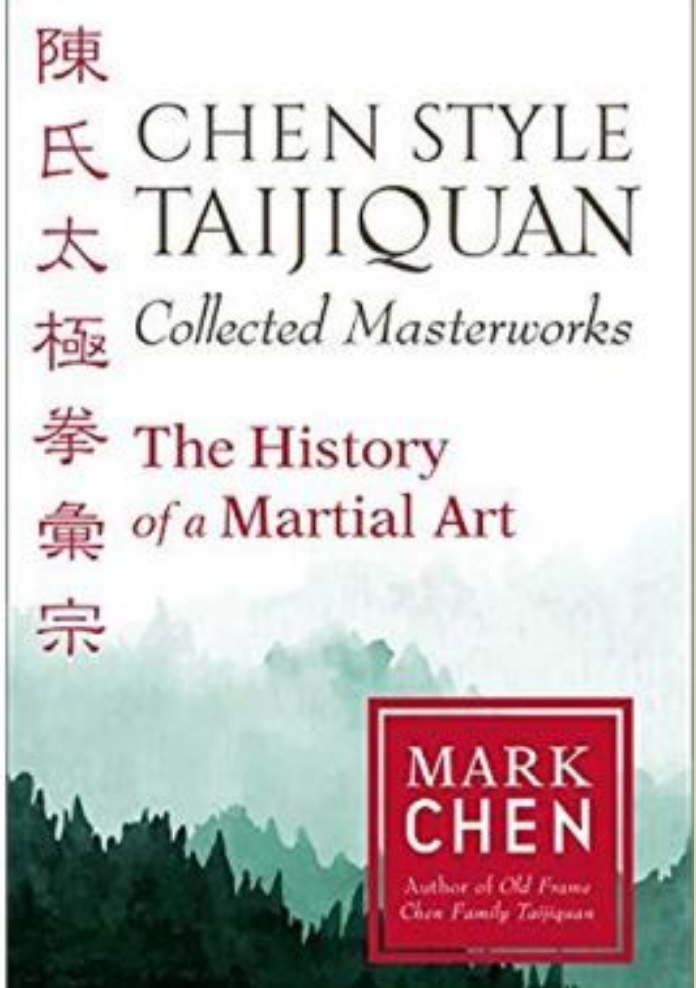
Mark’s book is a translation of most of the book by Chen Zhaopi’s book, published in 1935 and is available on Amazon in print and digital formats.
He’s the ‘Marmite‘ of the Tai Chi world (well, one of the Marmites anyway, you could argue the Tai Chi world is made up of Marmite personalities all the way down 🙂 ), but this free article is a nice neat summation of Scott Phillips’s theory of Taijiquan as dramatic storytelling.
It’s easy to dismiss Scott as “he’s just a dancer”, but to me those Chen style movements he’s talking about look so stylistic and deliberate that they’re clearly not just martial movements. If you’re arguing that Tai Chi is just a martial art and nothing else then I think you’ve got a lot of explaining to do. It’s pretty easy to see what fighting looks like these days, since sport fighting is on TV every weekend.
I think the idea that ‘Ok, this might be true, but does this matter?’ has much more validity. If Scott is right and he’s tracked down the origins of Tai Chi, then it clearly been forgotten over time, and Tai Chi these days has become something else.
In fact, it had become something else over a hundred years ago. China has gone through several major political and cultural shifts over that time that changed their society completely (often resulting in the deaths of millions of people and associated trauma). The Boxer Rebellion, the 1912 Chinese Revolution, the Communist rise to power, the Cultural revolution and the current rise of nationalism under the guise of Communism, etc…
Anyway, the article is in-depth and it’s worth a read if you have an interest in the possible origins of Tai Chi:
Paul Brennan has added a new selection of translations to the martial arts manuals contained on his website. This one is Chen Ziming’s “The inherited Chen family Taiji boxing art”.
Sample quote:
My colleague Chen Ziming is a native of the Chen Family Village in Henan and an expert of the Taiji boxing art. After many years of painstaking effort, he has written The Inherited Chen Family Taiji Boxing Art. A month ago, he begged me to proofread it and also to produce a preface. I read it carefully over the course of two weeks and could not help but slap the table in amazement. The Taiji boxing art is truly a means of connecting to the Way, which cannot be said about most other boxing arts. But unless you achieve a high level, you will not be capable of discussing its essentials.
This art as it is taught in modern times can be divided into about three styles: [1 – Chen] Chen Style Taiji is in a direct line of descent from the Chen family in Henan. [2 – Hao] Hao Weizhen taught Sun Lutang what is called “Open & Close Taiji”, but Hao Style was obtained from Wu Yuxiang, who had learned Chen Style. [3 – Yang] The Taiji that Yang Luchan studied was likewise taught to him by a member of the Chen family, Chen Changxing, and then Luchan taught it to his own sons, Banhou and Jianhou, and to this day his version is in fashion everywhere. All three of these versions actually originated from Chen Style. They have each evolved and been improved, and so they each have their differences.
Well, this page is interesting. It’s from Bosco Baek (and some of Bosco’s students) who is based in Los Angeles, USA, and from the looks of things, and it looks like a video reference for the whole Chen style Taijiquan curriculum!
Chen Bing Taiji Academy (陳炳太極院) was established by Master Chen Bing who is a 20th generation representative of Chen Family Taijiquan. Its headquarter is located in Chenjiagou, Wenxian County, Henan Province, China. – the birth place of Taijiquan. Master Chen Bing is a direct descendant of Chen Wangting (陳王廷), the creator of Taijiquan.
That’s very generous of him to share these videos. It’s fascinating. Things I’ve noticed so far:
The advanced stepping and silk reeling he shows shares a lot of similarities with Bagua (the tea cups-style exercises of Bagua Zhang are obviously silk reeling exercises, so this should be no surprise, but it’s the first time I’ve seen a Chen guy walking a circle, like they do in Bagua).
The advanced push hands videos look a lot like ‘wrestling without being allowed to grab the legs’. Looks like good basic training in stand-up grappling:
There’s a Yoga sequence at the end! Obviously he finds that a useful addition to Tai Chi. More weight to the idea that the primary origins of the ideas of body movement in Tai Chi and Yoga originate from the same source (or at least are compatible).




 The Tai Chi Notebook